
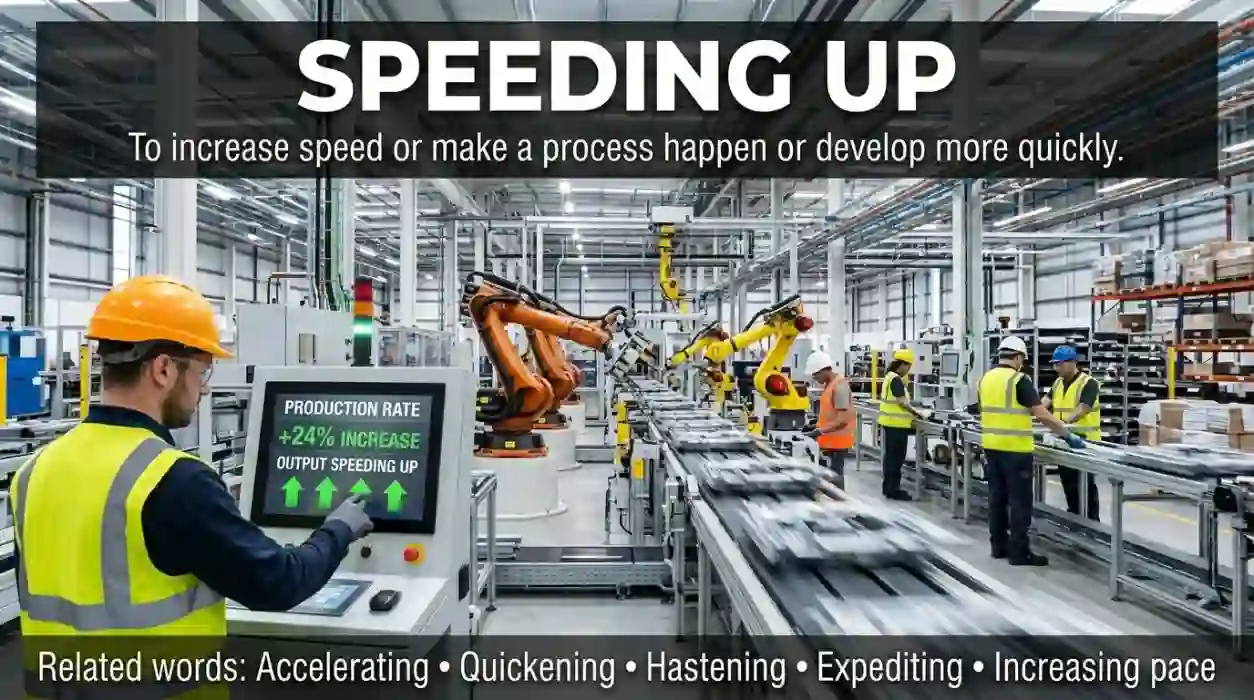
A synonym for speeding up is a word or phrase that means making something happen faster, increasing its speed, or reducing the time it takes. Common alternatives include accelerate, hasten, expedite, quicken, and fast-track. The best choice depends on the situation, from everyday conversation to professional writing.
Imagine you have a deadline tomorrow, but your project is only halfway done. You need to speed up your work. You might also say you need to work faster, accelerate progress, or pick up the pace.
The phrase speeding up appears in everyday English because people often discuss time, efficiency, movement, and progress. Learning alternatives helps you explain these ideas with greater accuracy.
For students, bloggers, and content writers, choosing the right synonym makes sentences more engaging. Daily English users can also communicate more clearly without repeating the same expression.
Whether you’re writing an email, preparing an essay, or chatting with a friend, a suitable synonym for speeding up can help you express urgency, efficiency, or rapid change naturally.
What Does “Speeding Up” Really Mean?
Speeding up means increasing the speed of an action, process, movement, or change. It can also mean helping something finish sooner or progress more quickly.
The phrase functions as a verb form. Speeding is the present participle of speed, while up acts as a particle that changes the meaning toward greater speed or pace.
Native English speakers use it in many situations:
- Movement: The driver is speeding up as the road clears.
- Work: We are speeding up the approval process.
- Technology: The update is speeding up the computer.
- Learning: Daily practice is speeding up her progress.
- Change: The pace of innovation is speeding up.
The expression is usually neutral. It describes increased speed without automatically suggesting that the change is good or bad. Context determines the attitude.
🧠 Connotative Meaning of “Speeding Up”
(Connotation is the feeling, attitude, or association a word carries beyond its basic dictionary meaning.)
- Positive tone: Speeding up can suggest efficiency, progress, and productivity. “The team is speeding up delivery.”
- Negative tone: It can suggest pressure, haste, or danger. “The driver is speeding up in heavy traffic.”
- Neutral tone: It can simply describe a change in pace. “The machine is speeding up gradually.”
The phrase itself does not guarantee a positive result. Faster work may save time, but moving too quickly can also lead to mistakes.
📖 Etymology:
The expression combines speed with the particle up.
The noun and verb speed developed from Old English spēd, which referred to success, prosperity, good fortune, or advancement. Over time, the word became closely associated with quick movement and rate of motion.
The particle up has Germanic roots and often indicates an increase, completion, or movement toward a higher level. In speed up, it signals an increase in pace or rate.
A Brief History Through English
- Old English (450–1100): Spēd was associated mainly with success, prosperity, and favorable progress. The modern expression speed up was not yet established in its current form.
- Middle English (1100–1500): The word speed continued to develop meanings connected with success and quickness. Its use became more closely linked to the rate of movement.
- Modern English (1500–present): Speed became firmly associated with rapid movement and rate. The phrasal verb speed up came to mean increasing pace or making a process faster.
Pronunciation, Syllables, and Affixation
- US IPA: /ˌspiː.dɪŋ ˈʌp/
- UK IPA: /ˌspiː.dɪŋ ˈʌp/
Syllables: speed-ing up — three syllables in total.
Affixation pattern
- Root: speed
- Prefix: None
- Suffix: -ing, added to speed to form speeding
- Particle: up, which contributes the meaning of increasing speed
The phrase is a phrasal verb construction rather than a single word formed by adding both a prefix and a suffix.
📚 Synonyms List
These alternatives overlap in meaning, but they are not interchangeable in every sentence. Some describe greater speed, while others emphasize urgency, efficiency, faster progress, or reduced delay. Check the meaning and register before choosing one.
1. Accelerate (verb) — US / UK: /əkˈsel.ə.reɪt/
Meaning: To increase speed or make a process develop faster.
Tone/Register: Neutral, formal, scientific, and professional.
Examples:
The car began to accelerate on the open road.
The new policy could accelerate economic growth.
2. Hasten (verb) — US / UK: /ˈheɪ.sən/
Meaning: To make an event or action happen sooner.
Tone/Register: Formal, literary, or professional.
Examples:
We should hasten the review before the deadline.
Her call hastened the final decision.
3. Expedite (verb) — US / UK: /ˈek.spə.daɪt/
Meaning: To make a process move faster, especially by reducing delays.
Tone/Register: Formal, administrative, and business.
Examples:
Please expedite the delivery if possible.
The office expedited our application.
4. Quicken (verb) — US / UK: /ˈkwɪk.ən/
Meaning: To make something faster or increase its pace.
Tone/Register: Neutral, literary, or descriptive.
Examples:
The runner quickened her pace near the finish.
His heartbeat quickened when the phone rang.
5. Accelerate the pace (verb phrase) — US / UK: /əkˈsel.ə.reɪt ðə peɪs/
Meaning: To increase the rate at which an activity progresses.
Tone/Register: Neutral to formal.
Examples:
We need to accelerate the pace of testing.
The class accelerated the pace before exams.
6. Pick up the pace (idiom) — US / UK: /pɪk ʌp ðə peɪs/
Meaning: To start moving or working faster.
Tone/Register: Conversational and informal.
Examples:
Let’s pick up the pace and finish before lunch.
The hikers picked up the pace as daylight faded.
7. Step up (phrasal verb) — US / UK: /step ʌp/
Meaning: To increase effort, activity, or intensity.
Tone/Register: Conversational and professional.
Examples:
We must step up our efforts this week.
The team stepped up production before the launch.
8. Fast-track (verb) — US / UK: /ˈfæst.træk/
Meaning: To move something through a process more quickly than usual.
Tone/Register: Business, administrative, and professional.
Examples:
The board agreed to fast-track the proposal.
They fast-tracked her training for the new role.
9. Hurry (verb) — US / UK: /ˈhɝː.i/ /ˈhʌr.i/
Meaning: To do something or move with greater speed, often because time is limited.
Tone/Register: Everyday and conversational.
Examples:
We need to hurry, or we’ll miss the bus.
He hurried to finish his homework.
10. Rush (verb) — US / UK: /rʌʃ/
Meaning: To do something very quickly, often with limited time or care.
Tone/Register: Informal; may imply pressure or poor preparation.
Examples:
Don’t rush the final paragraph.
She rushed to catch the last train.
11. Make faster (verb phrase) — US / UK: /meɪk ˈfæs.tɚ/ /meɪk ˈfɑː.stə/
Meaning: To cause an action, system, or process to operate at a higher speed.
Tone/Register: Neutral and plain English.
Examples:
This shortcut will make the setup faster.
We changed the route to make the journey faster.
12. Increase the speed (verb phrase) — US / UK: /ɪnˈkriːs ðə spiːd/
Meaning: To raise the rate at which something moves or operates.
Tone/Register: Neutral, technical, and descriptive.
Examples:
Increase the speed gradually on the straight section.
The engineer increased the speed of the conveyor belt.
13. Step on it (idiom) — US / UK: /step ɒn ɪt/ /step ɑːn ɪt/
Meaning: To move or act faster, often under time pressure.
Tone/Register: Informal and sometimes forceful.
Examples:
Step on it; the meeting starts in ten minutes.
We had to step on it to reach the station.
14. Get a move on (idiom) — US / UK: /ɡet ə muːv ɒn/ /ɡet ə muːv ɑːn/
Meaning: To start acting more quickly instead of wasting time.
Tone/Register: Informal and conversational.
Examples:
Get a move on,n or we’ll be late.
I told the kids to get a move on before school.
15. Hurry along (verb phrase) — US / UK: /ˈhɝː.i əˈlɔːŋ/ /ˈhʌr.i əˈlɒŋ/
Meaning: To encourage someone or something to proceed faster.
Tone/Register: Conversational.
Examples:
The guide hurried the group along.
A reminder helped hurry the paperwork along.
16. Spur on (phrasal verb) — US / UK: /spɝː ɑːn/ /spɜːr ɒn/
Meaning: To encourage someone to make faster or greater progress.
Tone/Register: Neutral, motivational, and literary.
Examples:
The coach’s words spurred the runners on.
Positive feedback spurred him on to finish early.
17. Propel (verb) — US / UK: /prəˈpel/
Meaning: To drive something forward or help it advance rapidly.
Tone/Register: Formal, academic, and descriptive.
Examples:
The discovery propelled the research forward.
Her curiosity propelled her toward a new solution.
18. Boost (verb) — US / UK: /buːst/
Meaning: To increase the level, strength, or effectiveness of something.
Tone/Register: Neutral, business, and informal.
Examples:
A clear schedule boosted our productivity.
The update boosted the app’s performance.
19. Step up the pace (verb phrase) — US / UK: /step ʌp ðə peɪs/
Meaning: To increase the speed or intensity of an activity.
Tone/Register: Conversational and professional.
Examples:
We stepped up the pace during the final week.
The instructor asked us to step up the pace.
20. Push forward (verb phrase) — US / UK: /pʊʃ ˈfɔːr.wɚd/ /pʊʃ ˈfɔː.wəd/
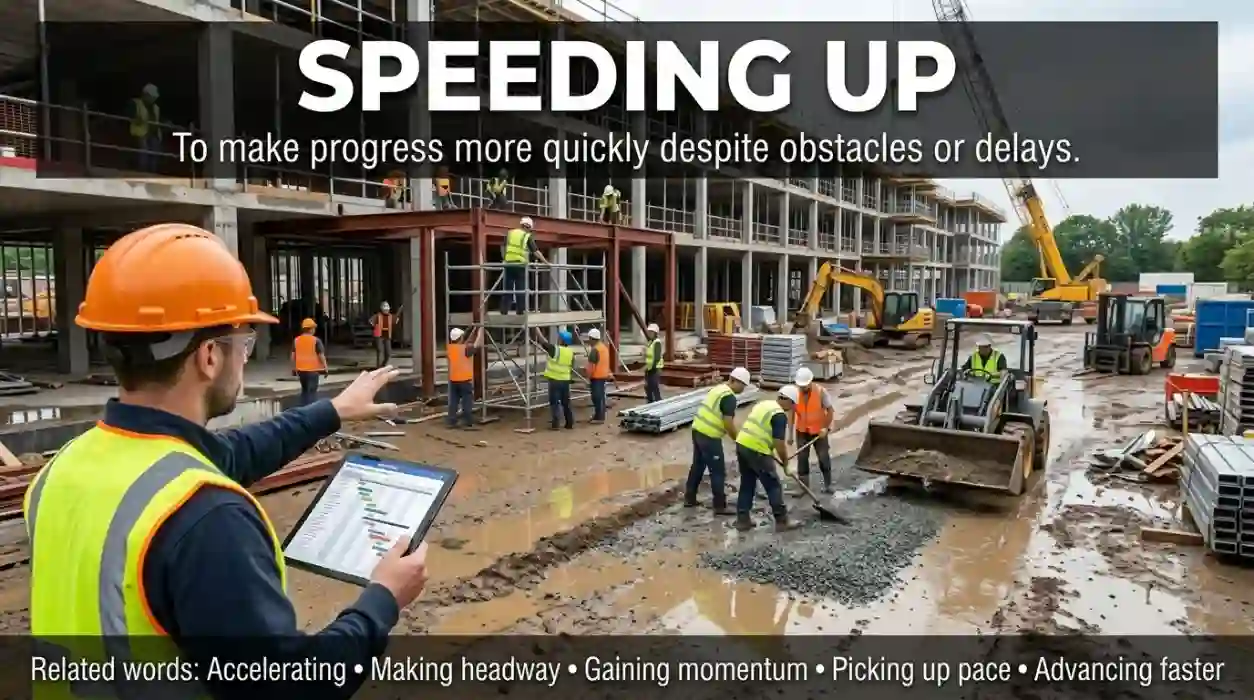
Meaning: To continue making progress despite obstacles or delays.
Tone/Register: Motivational, professional, and neutral.
Examples:
The team pushed forward despite the technical problem.
We need to push forward with the next stage.
21. Advance (verb) — US / UK: /ədˈvæns/
Meaning: To move something forward or help it progress.
Tone/Register: Formal, academic, and professional.
Examples:
The new evidence advanced the investigation.
Regular practice advanced his language skills.
22. Accelerate development (verb phrase) — US / UK: /əkˈsel.ə.reɪt dɪˈvel.əp.mənt/
Meaning: To help a product, skill, or process develop in less time.
Tone/Register: Professional, technical, and academic.
Examples:
Mentoring can accelerate employee development.
The extra lessons accelerated her reading development.
23. Shorten (verb) — US / UK: /ˈʃɔːr.tən/ /ˈʃɔː.tən/
Meaning: To reduce the length or duration of something.
Tone/Register: Neutral and formal.
Examples:
We shortened the meeting to save time.
The revised route shortened the journey by ten minutes.
24. Reduce delays (verb phrase) — US / UK: /rɪˈduːs dɪˈleɪz/
Meaning: To decrease the amount of waiting that slows a process.
Tone/Register: Professional and administrative.
Examples:
Better planning can reduce delays at check-in.
The team changed its workflow to reduce delays.
25. Streamline (verb) — US / UK: /ˈstriːm.laɪn/
Meaning: To make a process simpler and more efficient so it takes less time or effort.
Tone/Register: Professional, business, and technical.
Examples:
We streamlined the reporting process.
The new form streamlines student registration.
26. Optimize (verb) — US / UK: /ˈɑːp.tə.maɪz/ /ˈɒp.tɪ.maɪz/
Meaning: To improve a system or method so it works as effectively as possible.
Tone/Register: Technical, academic, and professional.
Examples:
The developers optimized the website’s loading time.
We optimized the schedule to avoid unnecessary waiting.
27. Improve efficiency (verb phrase) — US / UK: /ɪmˈpruːv ɪˈfɪʃ.ən.si/
Meaning: To reduce wasted time, effort, or resources while maintaining useful results.
Tone/Register: Professional and academic.
Examples:
Clear instructions improve efficiency in the lab.
The changes improved efficiency across the department.
28. Facilitate (verb) — US / UK: /fəˈsɪl.ə.teɪt/
Meaning: To make an action or process easier, allowing it to proceed more smoothly.
Tone/Register: Formal, academic, and professional.
Examples:
The shared document facilitated faster collaboration.
A clear agenda facilitated the discussion.
29. Promote (verb) — US / UK: /prəˈmoʊt/ /prəˈməʊt/
Meaning: To encourage or support progress, growth, or development.
Tone/Register: Neutral to formal.
Examples:
The policy promotes faster access to services.
Daily reading promotes language development.
30. Catalyze (verb) — US / UK: /ˈkæt̬.əl.aɪz/ /ˈkæt.əl.aɪz/
Meaning: To trigger or significantly speed up a change or process.
Tone/Register: Academic, scientific, and formal.
Examples:
The announcement catalyzed a wave of reform.
The new partnership catalyzed further research.
31. Jump-start (verb) — US / UK: /ˈdʒʌmp.stɑːrt/ /ˈdʒʌmp.stɑːt/
Meaning: To get something started quickly or restore its activity.
Tone/Register: Informal, business, and conversational.
Examples:
A short brainstorming session jump-started the project.
The teacher used a quick game to jump-start the lesson.
32. Kick-start (verb) — US / UK: /ˈkɪk.stɑːrt/ /ˈkɪk.stɑːt/
Meaning: To give an activity or process a strong, quick beginning.
Tone/Register: Informal and professional.
Examples:
The workshop kick-started our planning.
A morning walk kick-starts my day.
33. Rev up (phrasal verb) — US / UK: /rev ʌp/
Meaning: To make an engine run faster or increase energy and activity.
Tone/Register: Informal and energetic.
Examples:
The mechanic revved up the engine.
A lively song revved up the crowd.
34. Gear up (phrasal verb) — US / UK: /ɡɪr ʌp/ /ɡɪə ʌp/
Meaning: To prepare for increased activity or an approaching challenge.
Tone/Register: Informal and professional.
Examples:
The school is gearing up for exam season.
Our team geared up for the final presentation.
35. Intensify (verb) — US / UK: /ɪnˈten.sə.faɪ/
Meaning: To make an activity, effort, or process stronger or more concentrated.
Tone/Register: Formal, academic, and neutral.
Examples:
The researchers intensified their efforts before publication.
Rain intensified as we approached the coast.
36. Increase momentum (verb phrase) — US / UK: /ɪnˈkriːs moʊˈmen.təm/ /ɪnˈkriːs məˈmen.təm/
Meaning: To build growing force or progress that helps an activity move forward faster.
Tone/Register: Professional, motivational, and analytical.
Examples:
The campaign increased momentum after the debate.
Small wins helped the project gain momentum.
37. Gain ground (idiom) — US / UK: /ɡeɪn ɡraʊnd/
Meaning: To make progress or improve one’s position, often against competition or obstacles.
Tone/Register: Neutral, journalistic, and conversational.
Examples:
The small business is gaining ground in the market.
Our proposal gained ground after the second review.
38. Make headway (idiom) — US / UK: /meɪk ˈhed.weɪ/
Meaning: To make noticeable progress toward a goal.
Tone/Register: Neutral to formal.
Examples:
We made headway on the assignment this afternoon.
The team finally made headway with the investigation.
39. Move along (phrasal verb) — US / UK: /muːv əˈlɔːŋ/
Meaning: To continue to the next stage or encourage progress.
Tone/Register: Conversational and neutral.
Examples:
Let’s move along to the next question.
The facilitator moved the meeting along smoothly.
40. Push ahead (phrasal verb) — US / UK: /pʊʃ əˈhed/
Meaning: To continue or advance with determination, even when progress is difficult.
Tone/Register: Neutral, motivational, and professional.
Examples:
The team pushed ahead with the redesign.
She pushed ahead despite the unexpected setback.

41. Bring forward (phrasal verb) — US / UK: /brɪŋ ˈfɔːr.wɚd/ /brɪŋ ˈfɔː.wəd/
Meaning: To arrange for an event or deadline to happen earlier than planned.
Tone/Register: Professional and administrative.
Examples:
They brought forward the meeting to Monday.
The committee brought forward the review date.
42. Move up (phrasal verb) — US / UK: /muːv ʌp/
Meaning: To schedule something earlier or advance it to a higher position.
Tone/Register: Conversational and professional.
Examples:
Can we move up the appointment by an hour?
The school moved up the test date.
43. Bring about more quickly (verb phrase) — US / UK: /brɪŋ əˈbaʊt mɔːr ˈkwɪk.li/ /brɪŋ əˈbaʊt mɔː ˈkwɪk.li/
Meaning: To cause a result or change to occur sooner.
Tone/Register: Neutral to formal.
Examples:
Better communication may bring about change more quickly.
The agreement brought about a resolution sooner than expected.
44. Cut down the time (verb phrase) — US / UK: /kʌt daʊn ðə taɪm/
Meaning: To reduce the time needed to complete an activity.
Tone/Register: Conversational and practical.
Examples:
Batch cooking cuts down the time spent preparing dinner.
The template cut down the time needed for reports.
45. Compress (verb) — US / UK: /kəmˈpres/
Meaning: To fit activities or information into a shorter period or smaller space.
Tone/Register: Formal, technical, and professional.
Examples:
We compressed the training into two days.
The editor compressed the timeline without removing key scenes.
46. Condense (verb) — US / UK: /kənˈdens/
Meaning: To make something shorter while retaining its main content or purpose.
Tone/Register: Neutral, academic, and professional.
Examples:
I condensed the introduction into three sentences.
The instructor condensed the course into a short revision session.
47. Gain speed (verb phrase) — US / UK: /ɡeɪn spiːd/
Meaning: To become faster over time.
Tone/Register: Neutral and descriptive.
Examples:
The cyclist gained speed on the downhill stretch.
The download gained speed after the connection stabilized.
48. Build up speed (verb phrase) — US / UK: /bɪld ʌp spiːd/
Meaning: To increase speed gradually rather than all at once.
Tone/Register: Neutral and descriptive.
Examples:
The train built up speed after leaving the station.
Give the machine time to build up speed safely.
49. Quick-step (verb) — US / UK: /ˈkwɪk.step/
Meaning: To move with quick, short steps; this is a context-specific alternative rather than a general synonym for making a process faster.
Tone/Register: Descriptive, literary, or specialized.
Examples:
She quick-stepped across the wet pavement.
The dancers quick-stepped toward the center of the stage.
50. Make haste (idiom) — US / UK: /meɪk heɪst/
Meaning: To act or travel quickly, usually because there is limited time.
Tone/Register: Formal, literary, or old-fashioned.
Examples:
We must make haste before the gates close.
The travelers made haste toward the shelter.
Synonyms by Tone
The best synonym depends on what you want readers to feel. A word that sounds motivating in a team meeting may sound impatient in a personal conversation.
Positive Synonyms
Use these words when you want to emphasize progress, efficiency, or improvement.
- Accelerate: emphasizes faster progress or movement.
- Expedite: suggests removing delays from a process.
- Streamline: highlights efficiency and fewer unnecessary steps.
- Boost: emphasizes an increase in performance or activity.
- Propel: suggests powerful forward movement.
- Jump-start: focuses on creating a quick beginning.
- Kick-start: suggests giving an activity fresh energy.
- Catalyze: emphasizes triggering significant change.
Example: “We streamlined the workflow to accelerate delivery without sacrificing quality.”
Neutral Synonyms
Choose these when you simply want to describe a change in speed or timing.
- Quicken
- Increase the speed
- Gain speed
- Build up speed
- Shorten
- Move up
- Bring forward
- Make faster
Example: “The train gradually gained speed after leaving the platform.”
Negative or Urgent Synonyms
These words can suggest pressure, impatience, risk, or insufficient time.
- Rush
- Hurry
- Step on it
- Get a move on
- Make haste
- Intensify
These expressions are not always negative. Their effect depends on context. For instance, hurry may be practical when catching a bus, while rush can imply careless work.
Example: “Don’t rush the report just to meet the deadline; check the facts first.”
Playful or Informal Synonyms
These expressions sound natural in casual conversation.
- Pick up the pace
- Step on it
- Get a move on
- Rev up
- Gear up
- Kick-start
- Step up the pace
Example: “Let’s pick up the pace. The movie starts in fifteen minutes!”
“Speeding Up” vs. Close Alternatives
These expressions overlap, but each emphasizes a different idea.
| Expression | Main meaning | Best used when |
|---|---|---|
| Speeding up | Increasing speed or pace | You need a general, flexible phrase |
| Accelerating | Increasing speed or the rate of progress | You are describing movement, growth, or change |
| Expediting | Helping something happen sooner by reducing delays | You are discussing applications, deliveries, or approvals |
| Streamlining | Making a process simpler and more efficient | You are removing unnecessary steps |
| Hastening | Causing something to happen sooner | You want a formal or literary expression |
| Rushing | Acting very quickly, sometimes carelessly | Time pressure or urgency is important |
Compare these examples:
- “We’re speeding up production.” This is a general statement about increased pace.
- “We’re expediting the application.” This emphasizes reducing administrative delays.
- “We’re streamlining production.” This suggests simplifying the workflow so it takes less time or effort.
Remember: a process can become more efficient without every individual action becoming faster.
How “Speeding Up” Changes by Context
Daily Conversation
In everyday speech, natural expressions include hurry up, pick up the pace, and get a move on. They work well when discussing travel, chores, appointments, or plans.
“Can we hurry up? The bus is almost here.”
Writing and Blogging
For articles, blogs, and essays, accelerate, hasten, and quicken can add variety. Use accelerate when discussing trends, growth, learning, or technological change.
“Consistent practice can accelerate language learning.”
Professional or Academic Writing
In formal communication, expedite, streamline, optimize, and facilitate may sound more precise. Choose the word that describes the actual change rather than using a sophisticated word simply to sound formal.
“We streamlined the review process to reduce administrative delays.”
Creative and Informal Writing
For dialogue, storytelling, and social posts, rush, rev up, and pick up the pace can create energy. They can help readers imagine movement or feel a character’s urgency.
“The music revved up, and the crowd began to dance.”
Common Mistakes Learners Make
1. Treating Every Synonym as Interchangeable
Expedite usually applies to processes that can be completed sooner. Accelerate can refer to speed, growth, or change. Streamline means improving efficiency, not simply moving faster.
Incorrect: “I streamlined the car on the highway.”
More natural: “I accelerated the car on the highway.”
2. Confusing “Speed Up” With “Move Up”
Speed up means increase speed or pace. Move up often means schedule something earlier or advance it to a higher position.
- “Let’s speed up the review.” The review should proceed faster.
- “Let’s move up the review.” The review should happen earlier.
3. Using “Expedite” in Every Casual Conversation
Expedite is correct, but it can sound overly formal in relaxed speech.
Formal: “Could you expedite the process?”
Casual: “Could you help get this done sooner?”
4. Assuming Faster Always Means Better
Speed can improve productivity, but rushing may reduce accuracy or safety. In academic work, editing, medical decisions, and driving, careful progress may matter more than raw speed.
5. Overusing the Same Expression
Repeating speed up in every paragraph can make writing feel monotonous. However, replacing it with a different word every time can also sound unnatural. Use a synonym when it adds precision or variety.
Register Notes
- Formal: expedite, accelerate, facilitate, optimize.
- Neutral: speed up, quicken, increase the speed, shorten.
- Informal: hurry up, pick up the pace, get a move on.
- Written English: streamline, accelerate, expedite.
- Spoken English: hurry, rush, step on it.
For more vocabulary practice, consider an internal article about synonyms for improve. It can help you distinguish faster progress from better results.
Real-Life Mini Scenarios
Workplace
Your team is falling behind on a report. Instead of telling colleagues to “work faster,” you might say, “Let’s streamline the approval process.” This focuses on removing delays rather than putting pressure on everyone.
Social Situations
Your friends are waiting outside while you finish getting ready. “Pick up the pace!” sounds natural and friendly. “Expedite your preparations” would sound stiff and humorous in the same situation.
Media and Pop Culture
A news report might say that technological change is accelerating. A film review might describe how the action picks up pace in the final act. Each phrase conveys faster movement, but the style suits a different audience.
Writing and Storytelling
Imagine a character racing to catch the last train. “She hurried down the stairs” creates a sense of urgency. “The train gathered speed” describes the train’s movement instead. Choose a synonym that matches the subject and action.
Suggested External Source
For reliable definitions and examples, consult the Cambridge Dictionary entry for speed up, along with its entries for accelerate, expedite, and streamline. These references can help you check meaning, pronunciation, and grammatical usage.

Practice Exercise
1. A government office wants applications processed sooner. Which word fits best?
A. Expedite
B. Condense
C. Rev up
D. Gain ground
2. Your friend is walking too slowly, and you may miss the bus. What sounds natural?
A. Catalyze the pace
B. Get a move on
C. Optimize your walking
D. Facilitate yourself
3. A company removes unnecessary steps from a workflow. What is it doing?
A. Rushing
B. Hastening
C. Streamlining
D. Gaining speed
4. A car begins moving faster. Which verb is most precise?
A. Condense
B. Bring forward
C. Facilitate
D. Accelerate
5. Which word may imply doing something too quickly and carelessly?
A. Rush
B. Expedite
C. Streamline
D. Optimize
6. A meeting is rescheduled from Friday to Wednesday. What happened?
A. It was intensified
B. It was brought forward
C. It was accelerated physically
D. It was revved up
7. Which expression best describes building speed gradually?
A. Make haste
B. Cut down the time
C. Build up speed
D. Bring about
8. Which phrase is most appropriate for a formal request about an application?
A. Step on it
B. Get a move on
C. Rev up
D. Could you expedite it?
9. A researcher says a discovery triggered rapid change. Which word fits?
A. Catalyzed
B. Shortened
C. Hurried
D. Moved up
10. You want a casual phrase meaning to start working faster. Which is best?
A. Facilitate the matter
B. Pick up the pace
C. Optimize the circumstance
D. Condense the activity
Reflection Task
Write one sentence about your day using a synonym for speeding up. You could describe finishing homework, improving a process, or catching a bus. Then check whether your chosen word fits the situation and tone.
Answer key: 1-A, 2-B, 3-C, 4-D, 5-A, 6-B, 7-C, 8-D, 9-A, 10-B
Conclusion
Learning a synonym for speeding up gives you more ways to describe progress, urgency, and efficiency. The right word helps you communicate your meaning clearly without repeating the same phrase.
Students can use these alternatives in essays, while bloggers and content writers can make explanations more precise. In conversation, natural expressions like “pick up the pace” make everyday English sound more fluent.
Remember that accelerate, expedite, and streamline do not mean the same thing. Match your word to the action, audience, and tone for clearer communication.
Choose three new synonyms today and practise using them in an email, a short paragraph, and a daily conversation. Small steps build a stronger vocabulary over time.
Frequently Asked Questions
1. What is the best synonym for speeding up in professional writing?
Accelerate, expedite, and streamline are strong choices, but each has a different use. Accelerate emphasizes faster progress or change. Expedite means helping a process finish sooner, often by reducing delays. Streamline focuses on removing unnecessary steps. Choose the term that accurately describes the action in your sentence.
2. Is “speed up” the same as “hurry up”?
Not exactly. Speed up can describe a machine, vehicle, process, or person becoming faster. Hurry up usually tells a person to act more quickly, often because time is limited. For example, “The computer is speeding up” describes performance, while “Hurry up, we’re late” is a direct request.
3. What is a formal alternative to “speeding up a process”?
Expediting a process is a formal alternative when the goal is to reduce delays. Streamlining a process works when you simplify the steps involved. You can also say “accelerating the process” when emphasizing a higher rate of progress. The most accurate choice depends on whether you’re removing delays, simplifying work, or increasing pace.
4. What is the difference between “accelerate” and “expedite”?
Accelerate means to increase speed or the rate of progress. It can describe a car, a trend, or a project. Expedite means to make something happen sooner, usually by helping a process move through its stages more quickly. A vehicle accelerates, while an office might expedite a permit application.
5. What is a good synonym for speeding up learning?
Accelerate learning is a natural choice in formal and educational writing. You could also say “quicken progress” or “help someone learn faster.” If you’re describing an approach that makes learning more efficient, use “improve learning efficiency.” The best expression depends on whether you mean faster progress, better methods, or improved results.

Shahzeena Shazadi is the founder and lead writer at VocablyHub.com, where she creates accurate, reader-focused English language content designed to help people communicate with clarity and confidence. She specializes in synonyms, antonyms, word meanings, idioms, and practical vocabulary guides that simplify complex language concepts for everyday use. Every article is carefully researched, fact-checked, and written in clear, accessible language using reliable references and real-world examples. Her goal is to provide helpful, trustworthy content that supports learners at every stage of their English language journey.
Her editorial approach focuses on accuracy, transparency, and user value while following modern content quality standards. She regularly reviews and updates content to keep information relevant, useful, and easy to understand. Through VocablyHub.com, Shahzeena Shazadi is committed to publishing reliable language resources that help students, writers, educators, professionals, and English learners expand their vocabulary, improve their writing skills, and communicate with confidence in academic, professional, and everyday situations.