
A synonym for solemnity is seriousness, gravity, dignity, or formality, depending on the context. These words describe a serious mood, respectful behavior, or an occasion that deserves thoughtful attention. The closest alternative is often seriousness, while gravity and dignity emphasize different shades of meaning.
Imagine attending a memorial service. People speak quietly, listen carefully, and show respect. The atmosphere has solemnity. Choosing the right synonym helps you describe that moment with greater accuracy.
The word solemnity appears in ceremonies, speeches, literature, religious settings, and formal writing. It communicates that a moment carries emotional weight or deserves respect.
Students can use its alternatives in essays. Bloggers and content writers can avoid repetitive language. Everyday English speakers can also express serious feelings more naturally.
Learning a synonym for solemnity is especially useful when describing a wedding, an important announcement, a memorial, or a formal promise. Each alternative adds a slightly different shade of meaning.
What Does “Solemnity” Really Mean?
Solemnity is a noun that describes a serious, dignified, or respectful mood, manner, or occasion. It often suggests that people recognize the importance of a moment and behave accordingly.
For example, the solemnity of a graduation ceremony may reflect the students’ hard work and the importance of their achievement. At a funeral, solemnity expresses grief, respect, and remembrance.
Native English speakers generally understand solemnity as more formal than ordinary seriousness. It often appears when an event, statement, promise, or responsibility carries special significance.
Part of Speech and Simple Definition
- Part of speech: Noun
- Simple definition: The quality of being serious, dignified, or respectful.
- Related adjective: Solemn
- Related adverb: Solemnly
- Related abstract noun: Solemnness
Example: The speaker addressed the audience with solemnity.
This means the speaker used a serious, respectful manner suited to the occasion.
Connotative Meaning of Solemnity
(Connotation is the emotional association or feeling that a word suggests beyond its basic dictionary meaning.)
- Positive tone: Solemnity can suggest dignity, sincerity, reverence, and respect.
- Negative tone: In some contexts, it may suggest excessive seriousness, stiffness, or an unnecessarily heavy atmosphere.
- Neutral tone: It can simply describe the serious mood of a ceremony, announcement, or important occasion.
The context determines the feeling. Solemnity at a memorial may express respect, while solemnity during a lighthearted celebration might make the atmosphere feel unusually stiff.
Etymology of Solemnity
The word solemnity ultimately comes from Latin sollemnis, meaning customary, established, or associated with a particular occasion or religious observance. It entered English through Old French forms related to solemn.
Its history helps explain why the word can refer to both seriousness and ceremony.
Old English Period (450–1100)
Solemnity was not an established English word in its modern form during the Old English period. English already had ways to express seriousness and religious observance, but the word itself developed through later French and Latin influence.
Middle English Period (1100–1500)
After the Norman Conquest, French and Latin vocabulary strongly influenced English. Forms related to solemnity entered the language during this broader period of linguistic exchange. They were associated with formal observances, important occasions, and serious conduct.
Modern English Period (1500–Present)
Over time, solemnity developed its familiar abstract meaning: the quality of being solemn. Today, it describes serious moods, dignified behavior, ceremonial importance, and the gravity of commitments or events.

Pronunciation of Solemnity
- US IPA: /səˈlɛm.nə.t̬i/
- UK IPA: /səˈlɛm.nə.ti/
- Syllables: sol-em-ni-ty
- Word stress: The third syllable, em, receives the main stress: suh-LEM-nuh-tee.
Affixation Pattern
- Root/base: solemn
- Prefix: None
- Suffix: -ity, which forms an abstract noun describing a quality or state.
The spelling changes slightly when the suffix is added: solemn becomes solemnity. Notice that the n in solemn is generally silent, as it is in solemnity.
Synonyms List
Not every alternative to solemnity works in every sentence. Some emphasize seriousness, while others highlight dignity, ceremony, reverence, or emotional weight. The following 50 words and phrases are useful alternatives when the context supports their specific meaning.
1. Seriousness (Noun) — US / UK: /ˈsɪr.i.əs.nəs/
Meaning: The quality of treating a matter as important rather than trivial or amusing.
Tone/Register: Neutral; suitable for conversation, work, and academic writing.
Examples:
The seriousness of the announcement silenced the room.
Her expression showed the seriousness of the decision.
2. Gravity (Noun) — US / UK: /ˈɡræv.ə.t̬i/; UK /ˈɡræv.ə.ti/
Meaning: The importance or severity of a situation, especially one with significant consequences.
Tone/Register: Formal; common in journalism, speeches, and professional settings.
Examples:
The director explained the gravity of the safety issue.
Everyone understood the gravity of his warning.
3. Dignity (Noun) — US / UK: /ˈdɪɡ.nə.t̬i/; UK /ˈdɪɡ.nə.ti/
Meaning: A quality of calm self-respect and honorable behavior that often accompanies solemn occasions.
Tone/Register: Positive; formal and respectful.
Examples:
She accepted the award with dignity.
The family handled the difficult day with remarkable dignity.
4. Gravitas (Noun) — US / UK: /ˈɡræv.ə.tæs/
Meaning: A quality of seriousness and authority that makes someone or something seem important and deserving of respect.
Tone/Register: Formal; often used in leadership, public speaking, and criticism.
Examples:
His measured voice gave the speech gravitas.
The young presenter brought unexpected gravitas to the discussion.
5. Formality (Noun) — US / UK: /fɔːrˈmæl.ə.t̬i/; UK /fɔːˈmæl.ə.ti/
Meaning: The observance of established rules, customs, or ceremonial behavior.
Tone/Register: Neutral to formal; common in business and official events.
Examples:
The ceremony began with the usual formality.
The meeting required more formality than our casual team calls.
6. Reverence (Noun) — US / UK: /ˈrev.ər.əns/
Meaning: Deep respect for a person, belief, tradition, or something regarded as sacred.
Tone/Register: Respectful; often religious, cultural, or literary.
Examples:
The visitors entered the historic shrine with reverence.
She spoke about her teacher with genuine reverence.
7. Solemnness (Noun) — US / UK: /ˈsɑː.ləm.nəs/; UK /ˈsɒl.əm.nəs/
Meaning: The state or quality of being solemn, serious, or dignified.
Tone/Register: Formal or descriptive; less common than solemnity.
Examples:
The solemnness of the farewell stayed with him.
A sudden laugh briefly interrupted the solemnness of the room.
8. Earnestness (Noun) — US / UK: /ˈɝː.nɪst.nəs/; UK /ˈɜː.nɪst.nəs/
Meaning: A sincere, serious attitude that shows someone genuinely means what they say.
Tone/Register: Positive; suitable for conversation, essays, and character descriptions.
Examples:
Her earnestness convinced the committee to listen.
He asked for help with such earnestness that nobody dismissed him.
9. Serious-mindedness (Noun) — US / UK: /ˌsɪr.i.əsˈmaɪn.dɪd.nəs/; UK /ˌsɪə.ri.əsˈmaɪn.dɪd.nəs/
Meaning: The habit of approaching ideas, duties, or decisions thoughtfully rather than casually.
Tone/Register: Neutral to positive; useful in education and workplace writing.
Examples:
Her serious-mindedness helped the group stay focused.
The role requires patience and serious-mindedness.
10. Respectfulness (Noun) — US / UK: /rɪˈspekt.fəl.nəs/
Meaning: The quality of showing consideration and respect toward other people or an important occasion.
Tone/Register: Positive; appropriate in social, educational, and professional settings.
Examples:
The students showed respectfulness during the memorial.
His respectful manner helped calm the disagreement.
11. Decorum (Noun) — US / UK: /dɪˈkɔːr.əm/; UK /dɪˈkɔː.rəm/
Meaning: Behavior that is proper, controlled, and appropriate to a particular setting.
Tone/Register: Formal; often used for ceremonies, meetings, and public conduct.
Examples:
The chair asked everyone to maintain decorum.
Even during the heated debate, she preserved her decorum.
12. Reverentialness (Noun) — US / UK: /ˌrev.əˈren.ʃəl.nəs/
Meaning: The quality of expressing deep respect or near-reverence.
Tone/Register: Formal and descriptive; less common than reverence.
Examples:
The documentary captured the community’s reverentialness toward the site.
His tone carried a reverentialness that suited the occasion.
13. Austerity (Noun) — US / UK: /ɔːˈster.ə.t̬i/; UK /ɒˈster.ə.ti/
Meaning: A quality of plainness, restraint, or lack of ornament that can contribute to a solemn atmosphere.
Tone/Register: Formal; common in architecture, design, politics, and criticism.
Examples:
The chapel’s austerity made the space feel contemplative.
The memorial’s simple design reflected an atmosphere of austerity.
14. Sobriety (Noun) — US / UK: /səˈbraɪ.ə.t̬i/; UK /səˈbraɪ.ə.ti/
Meaning: A serious, restrained manner without frivolity or excessive emotion.
Tone/Register: Formal; also has a separate meaning related to not being intoxicated.
Examples:
The judge delivered the ruling with sobriety.
The report approached the tragedy with appropriate sobriety.
15. Composure (Noun) — US / UK: /kəmˈpoʊ.ʒɚ/; UK /kəmˈpəʊ.ʒə/
Meaning: The ability to remain calm and controlled, especially during a serious or emotional moment.
Tone/Register: Neutral to positive; useful in daily and professional English.
Examples:
She maintained her composure while reading the tribute.
He regained his composure before addressing the audience.
16. Restraint (Noun) — US / UK: /rɪˈstreɪnt/
Meaning: The practice of controlling words, actions, or emotions instead of expressing them excessively.
Tone/Register: Neutral to formal; useful in writing, public speaking, and conflict resolution.
Examples:
The filmmaker portrayed the loss with admirable restraint.
His restraint made the apology feel sincere.
17. Decency (Noun) — US / UK: /ˈdiː.sən.si/
Meaning: Behavior that shows basic respect, fairness, and consideration for others.
Tone/Register: Positive; common in everyday speech and ethical discussions.
Examples:
They treated the grieving family with decency.
A little decency can make a difficult conversation easier.
18. Respect (Noun) — US / UK: /rɪˈspekt/
Meaning: Regard for the worth, feelings, beliefs, or importance of someone or something.
Tone/Register: Neutral to positive; widely used in everyday English.
Examples:
The audience stood in respect for the victims.
He lowered his voice out of respect for the occasion.
19. Honor (Noun) — US / UK: /ˈɑː.nɚ/; UK /ˈɒn.ə/
Meaning: High respect or recognition for a person, duty, or achievement; it may accompany solemn ceremonies.
Tone/Register: Formal to neutral; common in commemorations and public speeches.
Examples:
The town held a ceremony to honor its fallen firefighters.
She considered it an honor to deliver the memorial address.
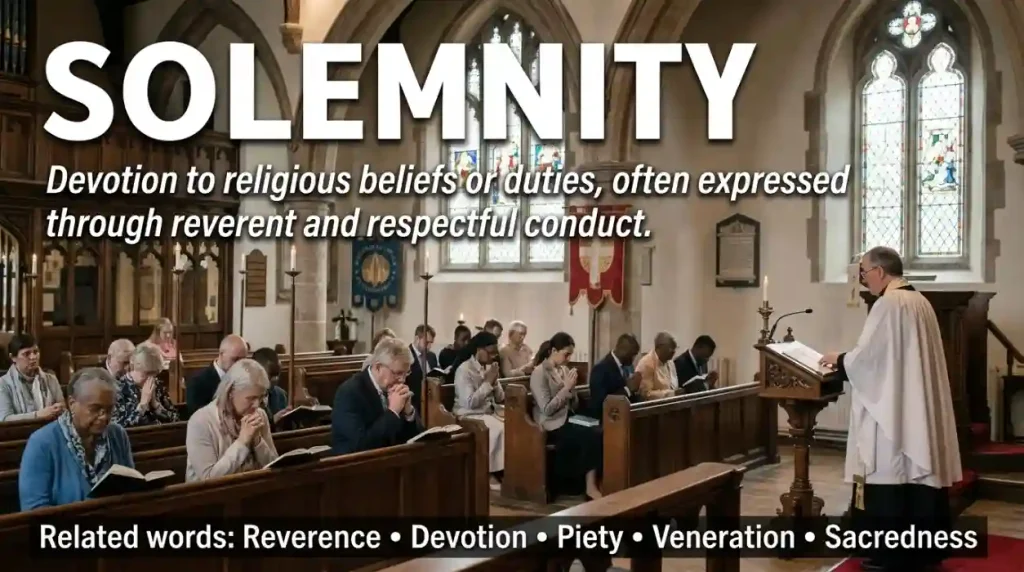
20. Piety (Noun) — US / UK: /ˈpaɪ.ə.t̬i/; UK /ˈpaɪ.ə.ti/
Meaning: Devotion to religious beliefs or duties, often expressed through reverent conduct.
Tone/Register: Religious or literary; context-dependent.
Examples:
The novel explores her piety and devotion to her faith.
His quiet piety shaped many of his daily choices.
21. Devoutness (Noun) — US / UK: /dɪˈvaʊt.nəs/
Meaning: The quality of being deeply committed to religious belief or worship.
Tone/Register: Respectful; religious and descriptive.
Examples:
Her devoutness was clear in the care she gave her community.
The biography describes his lifelong devoutness.
22. Sanctity (Noun) — US / UK: /ˈsæŋk.tə.t̬i/; UK /ˈsæŋk.tə.ti/
Meaning: The state of being sacred, holy, or worthy of special protection and respect.
Tone/Register: Formal and often religious or ethical.
Examples:
The ceremony emphasized the sanctity of the marriage vows.
They gathered quietly to honor the sanctity of the site.
23. Reveredness (Noun) — US / UK: /rɪˈvɪrd.nəs/
Meaning: The condition of being deeply admired or respected, especially over time.
Tone/Register: Formal and uncommon; the respect in which someone is held is often more natural.
Examples:
The elder’s reveredness came from decades of public service.
Her reveredness among former students was evident at the reunion.
24. Ceremony (Noun) — US / UK: /ˈser.ə.moʊ.ni/; UK /ˈser.ə.mə.ni/
Meaning: A formal event or set of actions performed to mark an important occasion.
Tone/Register: Neutral to formal; used for weddings, graduations, and commemorations.
Examples:
The graduation ceremony opened with a moment of silence.
The award ceremony had a warm but dignified atmosphere.
25. Ritual solemnity (Noun phrase) — US / UK: /ˈrɪtʃ.u.əl səˈlem.nə.ti/
Meaning: The serious, respectful mood created by a repeated formal or ceremonial practice.
Tone/Register: Formal; common in cultural studies and descriptive writing.
Examples:
The ritual solemnity of the procession impressed the visitors.
Each movement followed the ritual solemnity of the ancient tradition.
26. Heaviness (Noun) — US / UK: /ˈhev.i.nəs/
Meaning: An emotional weight or seriousness that makes a situation feel difficult or intense.
Tone/Register: Neutral; common in conversation and creative writing.
Examples:
A sense of heaviness settled over the room after the news.
The novel captures the heaviness of saying goodbye.
27. Weightiness (Noun) — US / UK: /ˈweɪ.ti.nəs/
Meaning: The quality of seeming important, serious, or intellectually substantial.
Tone/Register: Formal or academic; sometimes suggests an overly serious style.
Examples:
The weightiness of the topic called for careful discussion.
She balanced the essay’s weightiness with clear examples.
28. Solemn atmosphere (Noun phrase) — US / UK: /ˈsɑː.ləm ˈæt.mə.sfɪr/; UK /ˈsɒl.əm ˈæt.mə.sfɪə/
Meaning: An environment characterized by seriousness, quiet respect, or emotional significance.
Tone/Register: Neutral to formal; useful for describing places and events.
Examples:
A solemn atmosphere filled the hall before the announcement.
The candles and quiet music created a solemn atmosphere.
29. Seriousness of purpose (Noun phrase) — US / UK: /ˈsɪr.i.əs.nəs əv ˈpɝː.pəs/; UK /ˈsɪə.ri.əs.nəs əv ˈpɜː.pəs/
Meaning: A clear commitment to an important goal or responsibility.
Tone/Register: Professional, academic, or formal.
Examples:
Her seriousness of purpose impressed the selection panel.
The volunteers worked with seriousness of purpose throughout the emergency.
30. Solemn regard (Noun phrase) — US / UK: /ˈsɑː.ləm rɪˈɡɑːrd/; UK /ˈsɒl.əm rɪˈɡɑːd/
Meaning: A serious and respectful attitude toward someone, something, or an important duty.
Tone/Register: Formal and literary.
Examples:
The community held the anniversary in solemn regard.
He spoke of his former mentor with solemn regard.
31. Contemplation (Noun) — US / UK: /ˌkɑːn.temˈpleɪ.ʃən/; UK /ˌkɒn.temˈpleɪ.ʃən/
Meaning: Deep, sustained thought that can accompany a serious or reflective mood.
Tone/Register: Neutral to formal; common in reflective and academic writing.
Examples:
The quiet garden offered space for contemplation.
After the announcement, she sat in contemplation before responding.
32. Reflection (Noun) — US / UK: /rɪˈflek.ʃən/
Meaning: Careful thought about an experience, decision, or important subject.
Tone/Register: Neutral; widely used in conversation, education, and personal writing.
Examples:
The anniversary prompted reflection on the past decade.
His final remarks invited reflection rather than applause.
33. Thoughtfulness (Noun) — US / UK: /ˈθɔːt.fəl.nəs/
Meaning: The quality of considering something carefully or showing consideration for other people.
Tone/Register: Positive; suitable for daily, professional, and personal communication.
Examples:
Her thoughtfulness made the farewell more meaningful.
He answered with thoughtfulness instead of rushing to judgment.
34. Introspection (Noun) — US / UK: /ˌɪn.trəˈspek.ʃən/
Meaning: The examination of one’s own thoughts and feelings, often in a serious or reflective state.
Tone/Register: Academic, psychological, or literary.
Examples:
The experience led him to a period of introspection.
Her journal became a space for honest introspection.
35. Mindfulness (Noun) — US / UK: /ˈmaɪnd.fəl.nəs/
Meaning: Attentive awareness of the present moment, which can support a calm and respectful approach.
Tone/Register: Neutral to positive; common in well-being and everyday language.
Examples:
The group observed a minute of mindfulness before beginning.
Mindfulness helped her listen carefully during the difficult conversation.
36. Quietude (Noun) — US / UK: /ˈkwaɪ.ə.tuːd/
Meaning: A state of quietness or calm that can create space for solemn reflection.
Tone/Register: Literary and formal; uncommon in casual conversation.
Examples:
The old library offered a welcome sense of quietude.
He sought quietude after the emotionally demanding ceremony.
37. Stillness (Noun) — US / UK: /ˈstɪl.nəs/
Meaning: A condition of physical quiet or lack of movement that may accompany a solemn moment.
Tone/Register: Neutral; effective in storytelling and descriptive writing.
Examples:
Stillness spread through the crowd as the names were read.
The stillness of the room made every word feel important.
38. Silence (Noun) — US / UK: /ˈsaɪ.ləns/
Meaning: The absence of sound, sometimes used to express respect, grief, or serious reflection.
Tone/Register: Neutral; common in everyday and formal English.
Examples:
The audience observed silence in memory of the victims.
A brief silence followed her heartfelt statement.
39. Hush (Noun) — US / UK: /hʌʃ/
Meaning: A quiet or subdued atmosphere, especially when people become attentive or respectful.
Tone/Register: Neutral to literary; natural in storytelling and conversation.
Examples:
A hush fell over the room when the results arrived.
The crowd grew hushed as the choir began to sing.
40. Pomp (Noun) — US / UK: /pɑːmp/
Meaning: Impressive ceremony or display, which may accompany solemn occasions but can also suggest excessive grandeur.
Tone/Register: Formal; often appears in phrases such as pomp and ceremony.
Examples:
The inauguration combined tradition with a touch of pomp.
She preferred a simple farewell without unnecessary pomp.
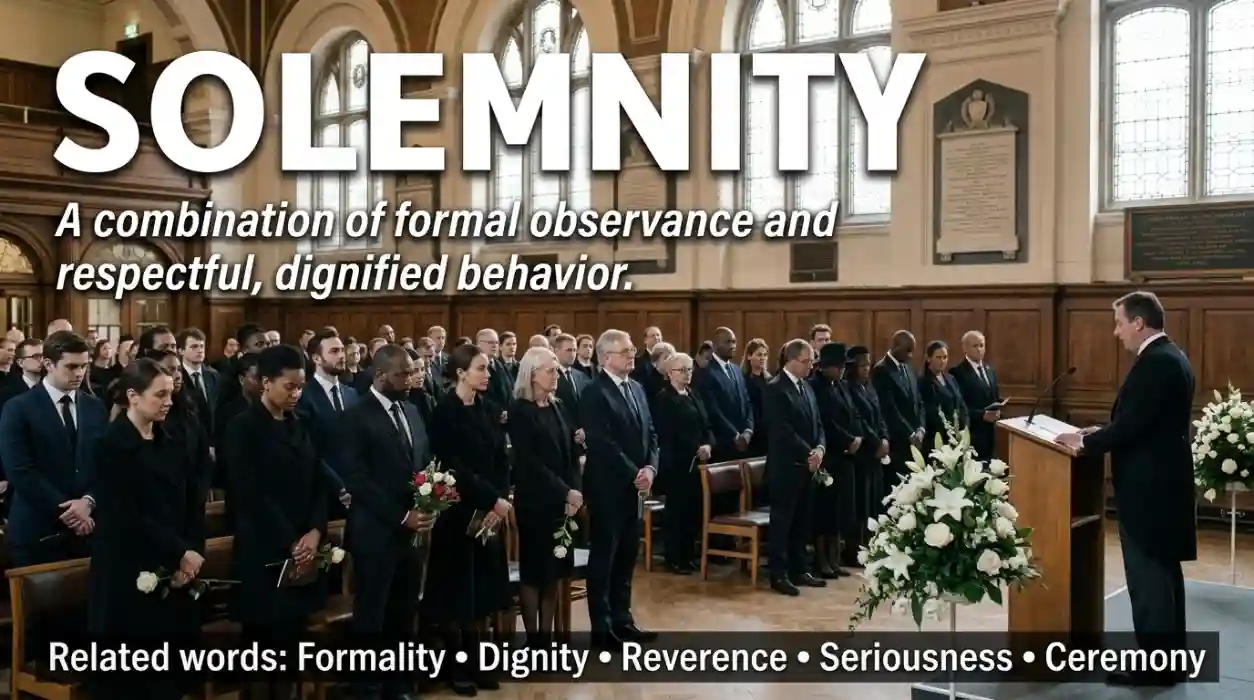
41. Ceremony and dignity (Noun phrase) — US / UK: /ˈser.ə.moʊ.ni ænd ˈdɪɡ.nə.t̬i/; UK /ˈser.ə.mə.ni ænd ˈdɪɡ.nə.ti/
Meaning: A combination of formal observance and respectful, dignified behavior.
Tone/Register: Formal; useful for describing official events.
Examples:
The service was conducted with ceremony and dignity.
They wanted the public tribute to reflect ceremony and dignity.
42. Formal seriousness (Noun phrase) — US / UK: /ˈfɔːr.məl ˈsɪr.i.əs.nəs/; UK /ˈfɔː.məl ˈsɪə.ri.əs.nəs/
Meaning: A serious manner shaped by the conventions of an official or ceremonial setting.
Tone/Register: Formal; suitable for professional and academic descriptions.
Examples:
The principal spoke with formal seriousness at the assembly.
The letter’s formal seriousness matched the gravity of the issue.
43. Solemn dignity (Noun phrase) — US / UK: /ˈsɑː.ləm ˈdɪɡ.nə.t̬i/; UK /ˈsɒl.əm ˈdɪɡ.nə.ti/
Meaning: A combination of seriousness and calm self-respect, particularly in a meaningful or difficult moment.
Tone/Register: Formal and respectful.
Examples:
She accepted the difficult news with solemn dignity.
The procession moved forward with solemn dignity.
44. Serious decorum (Noun phrase) — US / UK: /ˈsɪr.i.əs dɪˈkɔːr.əm/; UK /ˈsɪə.ri.əs dɪˈkɔː.rəm/
Meaning: Proper and controlled conduct suited to an important or serious occasion.
Tone/Register: Formal; used for meetings, ceremonies, and public events.
Examples:
The panel maintained serious decorum throughout the hearing.
The occasion called for serious decorum rather than jokes.
45. Reverent solemnity (Noun phrase) — US / UK: /ˈrev.ər.ənt səˈlem.nə.t̬i/; UK /ˈrev.ər.ənt səˈlem.nə.ti/
Meaning: A serious atmosphere marked by deep respect, often for sacred things or people being remembered.
Tone/Register: Formal, religious, or literary.
Examples:
The congregation listened in reverent solemnity.
The film portrayed the memorial with reverent solemnity.
46. Impressive seriousness (Noun phrase) — US / UK: /ɪmˈpres.ɪv ˈsɪr.i.əs.nəs/; UK /ɪmˈpres.ɪv ˈsɪə.ri.əs.nəs/
Meaning: A serious manner that creates a strong impression of importance or authority.
Tone/Register: Descriptive; useful in reviews and character descriptions.
Examples:
The young speaker displayed impressive seriousness during the debate.
Her impressive seriousness helped the audience trust her judgment.
47. Soberness (Noun) — US / UK: /ˈsoʊ.bɚ.nəs/; UK /ˈsəʊ.bə.nəs/
Meaning: A restrained, serious quality that avoids excessive excitement or ornament.
Tone/Register: Formal or literary; less common than sobriety.
Examples:
The report’s soberness suited the subject.
He described the loss with a soberness that felt sincere.
48. Earnest gravity (Noun phrase) — US / UK: /ˈɝː.nɪst ˈɡræv.ə.t̬i/; UK /ˈɜː.nɪst ˈɡræv.ə.ti/
Meaning: A combination of sincerity and a strong awareness of a situation’s importance.
Tone/Register: Formal and literary.
Examples:
She spoke with earnest gravity about the future of the school.
The letter’s earnest gravity made its appeal difficult to ignore.
49. solemn observance (Noun phrase) — US / UK: /ˈsɑː.ləm əbˈzɝː.vəns/; UK /ˈsɒl.əm əbˈzɜː.vəns/
Meaning: A serious and respectful act of marking an important event, tradition, or anniversary.
Tone/Register: Formal; common in commemorative and cultural contexts.
Examples:
The city marked the anniversary with solemn observance.
The day began with a solemn observance at the monument.
50. Sacred seriousness (Noun phrase) — US / UK: /ˈseɪ.krɪd ˈsɪr.i.əs.nəs/; UK /ˈseɪ.krɪd ˈsɪə.ri.əs.nəs/
Meaning: A serious attitude toward something regarded as holy, deeply meaningful, or deserving special respect.
Tone/Register: Formal, religious, or literary; use when the context genuinely has sacred significance.
Examples:
The vows were spoken with sacred seriousness.
The ceremony treated the tradition with sacred seriousness.
Synonyms by Tone
The best synonym depends on the feeling you want to communicate. Some words emphasize respect, while others highlight seriousness, reflection, or ceremony.
Positive Synonyms
Use these words when solemnity reflects admirable qualities or meaningful respect:
- Dignity: Calm self-respect and honorable conduct.
- Reverence: Deep respect for something valued or sacred.
- Earnestness: Genuine sincerity and commitment.
- Respectfulness: Consideration for people and important occasions.
- Composure: Calm control during an emotional moment.
- Thoughtfulness: Careful consideration of ideas and feelings.
- Honor: Respect or recognition for someone or something important.
Neutral Synonyms
These words describe serious moods or formal behavior without necessarily praising or criticizing them:
- Seriousness: An attitude that treats something as important.
- Gravity: The weight or importance of a matter.
- Formality: Behavior that follows established conventions.
- Solemnness: The quality of being solemn.
- Sobriety: A restrained, serious manner.
- Decorum: Appropriate conduct in a particular setting.
- Reflection: Thoughtful consideration of an experience or subject.
- Silence: An absence of sound that may communicate respect.
Negative or Potentially Critical Alternatives
These words are not direct replacements in every situation. They can describe aspects of solemnity that feel excessive, restrictive, or uncomfortable.
- Austerity: A severe or unadorned quality.
- Heaviness: An emotionally weighty atmosphere.
- Weightiness: A sense of importance that can sometimes feel overly serious.
- Pomp: Elaborate ceremony that may seem excessive.
- Soberness: A restrained manner that can feel plain or severe.
For example, the dignity of the ceremony praises its respectful atmosphere. The pomp of the ceremony may criticize how elaborate it was.
Playful or Informal Alternatives
Solemnity itself is a fairly formal word, so casual substitutes usually describe a specific part of the mood rather than matching the meaning exactly.
- Seriousness: The simplest everyday choice.
- Silence: Useful when people stop talking.
- Stillness: Effective when the room or crowd becomes motionless.
- Hush: A natural choice for a sudden, quiet atmosphere.
- Heaviness: Useful when an emotional situation feels difficult.
Why tone matters: A synonym does more than replace a word. It tells readers how to interpret the scene. Choose reverence to emphasize respect, gravity to stress importance, and hush to make a moment feel quiet and immediate.
“Solemnity” vs. Close Alternatives
Several words overlap with solemnity, but their meanings are not identical. This comparison can help you choose the most natural expression.
| Word | Main emphasis | Best used when |
|---|---|---|
| Solemnity | Seriousness combined with dignity or ceremonial importance | Describing memorials, formal promises, and meaningful occasions |
| Seriousness | Treating something as important | Discussing decisions, risks, duties, or concerns |
| Gravity | The significance or possible consequences of something | Emphasizing the importance of a warning or situation |
| Dignity | Respect, self-control, and honorable behavior | Describing how a person behaves during a difficult event |
| Reverence | Deep respect or devotion | Describing sacred places, traditions, or admired people |
| Formality | Following established conventions | Discussing official events, business meetings, or ceremonies |
Consider these examples:
- Solemnity: The solemnity of the memorial moved everyone.
- Seriousness: The seriousness of the problem required immediate action.
- Gravity: The minister explained the gravity of the crisis.
- Dignity: The family faced the loss with dignity.
- Reverence: Visitors treated the sacred object with reverence.
- Formality: The reception followed strict rules of formality.
The first sentence emphasizes the atmosphere of an important occasion. The second highlights the importance of a problem. The fourth focuses on the family’s behavior.
How Solemnity Changes by Context
Daily Conversation
In everyday speech, seriousness is usually more natural than solemnity. The longer word can sound formal if the situation is ordinary.
Instead of saying, “I admired the solemnity of our conversation,” you might say, “I appreciated how seriously you took the conversation.”
Use solemnity when the moment feels unusually important, such as a meaningful family announcement or a formal promise.
Writing and Blogging
Writers often use solemnity to establish mood. It can make a description feel respectful, ceremonial, or emotionally powerful.
For example, “The solemnity of the farewell lingered long after the guests left” creates a reflective atmosphere. A word like sadness would focus more directly on emotion, while dignity would emphasize the way people behaved.
For blogs, essays, and articles, vary your vocabulary according to meaning rather than replacing the same word repeatedly.
Professional or Academic English
In formal writing, gravity, decorum, seriousness, and formality may be more precise than solemnity.
A workplace report might refer to “the gravity of the findings.” An academic paper might discuss “the solemnity of a public ritual.” The first emphasizes significance; the second describes a ceremonial quality.
Always consider what your evidence actually supports.
Creative and Informal Writing
In stories, stillness, hush, quietude, and heaviness can help readers experience a scene.
For example, “A hush spread across the courtroom” creates an immediate image. “The solemnity of the courtroom was noticeable” is more abstract.
Choose concrete details when you want readers to feel a mood rather than simply be told that it exists.
Common Mistakes Learners Make
Mistake 1: Treating Every Alternative as an Exact Synonym
Solemnity, sadness, silence, and formality can appear in similar settings, but they mean different things. A solemn occasion may be joyful, and a silent room may have no serious atmosphere at all.
Choose the word that describes the specific quality you want to communicate.
Mistake 2: Confusing Seriousness With Sadness
Solemnity often appears during funerals or memorials, but it does not mean sadness itself. A graduation ceremony can have solemnity because it marks a significant transition, even when everyone feels happy.
Use grief or sadness when emotional pain is the main point. Use solemnity when the serious, dignified atmosphere matters.
Mistake 3: Using “Gravity” to Mean Physical Silence
In this context, gravity means importance or seriousness. It does not mean that a room is quiet.
Say, “The gravity of the decision was clear,” rather than “The gravity of the room was quiet.” For quietness, choose silence, stillness, or hush.
Mistake 4: Overusing Formal Words
Words such as gravitas, quietude, and reverence can make writing sound thoughtful. Too many formal terms in a short passage can make it feel stiff.
Mix precise vocabulary with familiar words. Clear language usually serves readers better than an impressive but unnatural expression.
Mistake 5: Using “Pomp” as an Unconditionally Positive Word
Pomp refers to elaborate ceremony or display. Depending on context, it may suggest grandeur or criticize unnecessary showiness.
If you mean respectful behavior, dignity is often better. If you mean a formal public display, pomp may be appropriate.
Register Notes: Formal vs. Informal
- Formal and literary: solemnity, gravitas, reverence, decorum, quietude.
- Neutral and widely understood: seriousness, dignity, respect, composure, reflection.
- More descriptive than interchangeable: stillness, silence, hush, heaviness, contemplation.
In speech, people often say seriousness or respect. In essays, speeches, and literary descriptions, solemnity can be more effective when the context supports it.
For further vocabulary practice, compare the uses of seriousness, dignity, and reverence in a learner’s dictionary.
Real-Life Examples Using
Workplace Scenario
A manager announces that a long-serving colleague is retiring after a difficult year. The team listens quietly and responds with respect.
Natural sentence: The meeting had a sense of solemnity as everyone thanked her for years of service.
Here, solemnity conveys the importance of the occasion without suggesting that everyone is unhappy.
Social Scenario
A family gathers to remember a relative. Some people share stories, while others remain quietly reflective.
Natural sentence: The family observed the anniversary with solemnity and affection.
The word communicates respect and emotional significance. It does not require complete silence or an absence of warmth.
Media and Pop Culture Scenario
A documentary shows a crowd gathering at a national memorial. The camera lingers on flowers, quiet faces, and a moment of silence.
Natural sentence: The director preserved the solemnity of the gathering by avoiding dramatic music.
Here, the word describes the serious mood created by both the event and the film’s presentation.
Writing and Storytelling Scenario
A novelist describes a character making a promise that will change several lives.
Natural sentence: The solemnity of the vow made everyone pause before responding.
The word signals that the promise carries real emotional or moral weight.

Practice Quiz
1. A news presenter explains the serious consequences of a major safety failure. Which word best emphasizes the importance of the situation?
A. Hush
B. Gravity
C. Pomp
D. Quietude
2. A family wants to show deep respect at a memorial service. Which word fits best?
A. Reverence
B. Playfulness
C. Informality
D. Excitement
3. A colleague stays calm while delivering difficult news. Which word best describes this quality?
A. Ceremony
B. Composure
C. Austerity
D. Piety
4. Guests follow official customs at a formal award presentation. Which word describes this behavior?
A. Heaviness
B. Reflection
C. Formality
D. Silence
5. A student carefully considers an important life decision. Which word best describes this process?
A. Reflection
B. Pomp
C. Decorum
D. Reverence
6. A crowd becomes completely quiet as the names of victims are read aloud. Which word describes the lack of sound?
A. Gravitas
B. Silence
C. Honor
D. Earnestness
7. A speaker sincerely wants the audience to understand the importance of a promise. Which word best describes the speaker’s attitude?
A. Earnestness
B. Austerity
C. Ceremony
D. Quietude
8. A ceremony is respectful and dignified, without unnecessary display. Which quality best describes appropriate behavior?
A. Pomp
B. Decorum
C. Heaviness
D. Weightiness
9. A writer wants to describe a quiet garden where a character thinks deeply. Which word best captures peaceful quiet?
A. Gravity
B. Quietude
C. Honor
D. Formality
Answer Key
1-B | 2-A | 3-B | 4-C | 5-A | 6-B | 7-A | 8-B | 9-B
Reflection Task
Write two original sentences about an important occasion. Use solemnity in one sentence and a suitable alternative, such as dignity, gravity, or reverence, in the other. Explain how the word choice changes the meaning.
Suggested External Sources
- Merriam-Webster Dictionary — definitions, word history, and related forms.
- Cambridge Dictionary — learner-friendly meanings and pronunciation.
- Oxford Learner’s Dictionaries — usage examples and pronunciation guidance.
Conclusion
Solemnity describes more than seriousness. It can express respect, dignity, ceremony, and the emotional importance of a moment. The right alternative makes that meaning clearer.
Learning these synonyms can strengthen essays, blogs, speeches, and everyday conversations. Precise vocabulary helps readers understand not only what happened but also how the moment felt.
You do not need to memorize all 50 alternatives at once. Start with seriousness, gravity, dignity, and reverence, then notice how writers use them in context.
Choose one new word today and use it in an email, an essay, or a conversation. Small, regular practice will help you build a more natural and expressive English vocabulary.
Frequently Asked Questions About Solemnity
1. What is the closest synonym for solemnity in formal writing?
Seriousness is often the closest general synonym for solemnity, but the best choice depends on the sentence. Use gravity when emphasizing the importance of an issue, dignity when describing respectful behavior, and reverence when expressing deep respect. In descriptions of ceremonies, solemnity itself may be the most precise word.
2. Can solemnity describe a happy occasion?
Yes. Solemnity does not always mean sadness. A wedding, graduation, or award ceremony can have solemnity because the event carries deep meaning or marks an important commitment. People may feel happy while behaving with seriousness and respect. The word describes the mood or significance of the occasion rather than a single emotion.
3. What is the difference between solemnity and solemnness?
Both words refer to the quality of being solemn. Solemnity is the more established and generally preferred noun, particularly in formal writing and descriptions of ceremonies. Solemnness is understandable but less common. For most essays, reports, and polished descriptions, solemnity is usually the more natural choice.
4. What is the adjective and adverb form of solemnity?
The adjective is solemn, and the adverb is solemnly. For example, “The ceremony was solemn” describes the event, while “She spoke solemnly” describes how she spoke. The noun solemnity names the quality itself. Learning these related forms helps you use the word naturally in different sentence structures.
5. Is solemnity a positive or negative word?
Solemnity is generally neutral, although its effect depends on context. It can suggest respect, dignity, and sincerity during an important event. In another situation, excessive solemnity may make people seem stiff or overly serious. Look at the surrounding words and the writer’s purpose before deciding whether the word carries praise, criticism, or simple description.

Shahzeena Shazadi is the founder and lead writer at VocablyHub.com, where she creates accurate, reader-focused English language content designed to help people communicate with clarity and confidence. She specializes in synonyms, antonyms, word meanings, idioms, and practical vocabulary guides that simplify complex language concepts for everyday use. Every article is carefully researched, fact-checked, and written in clear, accessible language using reliable references and real-world examples. Her goal is to provide helpful, trustworthy content that supports learners at every stage of their English language journey.
Her editorial approach focuses on accuracy, transparency, and user value while following modern content quality standards. She regularly reviews and updates content to keep information relevant, useful, and easy to understand. Through VocablyHub.com, Shahzeena Shazadi is committed to publishing reliable language resources that help students, writers, educators, professionals, and English learners expand their vocabulary, improve their writing skills, and communicate with confidence in academic, professional, and everyday situations.