
Synonyms for rotting include decaying, decomposing, deteriorating, putrefying, festering, spoiling, breaking down, wasting away, and going bad. The best alternative depends on what is rotting, how it is changing, and whether you mean physical decay or figurative decline.
You open the refrigerator and notice an old peach covered in soft, dark patches. Suddenly, “rotting” feels too general, and a more precise word can describe what you see.
The phrase synonyms for rotting is useful because English has many ways to describe decay. Each choice can show speed, cause, smell, damage, or severity.
Students can use these alternatives to make essays clearer. Bloggers and content writers can avoid repetitive wording, while daily speakers gain more natural vocabulary.
Learning these words also helps you understand science, gardening, food, buildings, nature, and storytelling. The right synonym can make a description much sharper.
What Does “Rotting” Really Mean?
Rotting means gradually breaking down or decaying, usually because of natural biological processes that damage organic material.
It is the -ing form of the verb “rot.”
For example:
“The apples are rotting in the basket.”
This means the apples are undergoing decay and becoming spoiled or decomposed.
The word can describe:
- food
- fruit
- vegetables
- leaves
- wood
- plants
- animal matter
- organic waste
- teeth
- buildings affected by decay
- situations or institutions in figurative language
Oxford defines rot as decaying, or causing something to decay, naturally and gradually. Cambridge similarly defines it as causing or undergoing decay.
Native speakers usually understand rotting as a gradual process rather than a single moment of damage.
For example, a broken chair is not necessarily rotting. A wooden chair that has become damp and is slowly breaking down may be described as rotting.
Part of Speech
Rotting can function as:
- a present participle: “The fruit is rotting.”
- a gerund: “Rotting can attract insects.”
- an adjective: “We found rotting wood.”
The base verb is rot.
Connotative Meaning
Connotation (the emotional feeling or association connected with a word beyond its basic dictionary meaning) matters when choosing a synonym.
Positive Tone
Most words related to rotting are not strongly positive.
However, words such as decomposing, biodegrading, or breaking down can sound neutral or even environmentally positive when discussing natural cycles.
Negative Tone
Rotting, putrefying, festering, decaying, and deteriorating often create unpleasant or negative associations.
They may suggest bad smells, damage, weakness, disease, neglect, or destruction.
Neutral Tone
Decomposing, breaking down, decaying, and biodegrading can sound more scientific and objective.
The tone depends heavily on context.
“Rotting food” sounds unpleasant.
“Decomposing leaves” sounds much more scientific and natural in an environmental discussion.
Etymology
The word rotting comes from the verb rot, which has very old Germanic roots.
The English verb traces back to Old English rotian, meaning to decay, putrefy, or undergo decomposition. It is connected with Proto-Germanic forms related to the idea of rotting.
Old English: 450–1100
Old English had rotian, referring to the decay or decomposition of animal and vegetable matter.
The word belonged to the native Germanic vocabulary of early English.
Middle English: 1100–1500
The verb developed into forms such as roten and became established in Middle English.
The noun rot also developed as a word for decay, putrefaction, and the condition of being rotten.
Modern English: 1500–Present
The modern forms rot, rotted, rotten, and rotting became firmly established.
The word also developed figurative meanings. By the medieval period, rot could describe moral corruption or deterioration, not just physical decay.
Today, rotting can describe physical decomposition as well as figurative decline.
Pronunciation
US: /ˈrɑː.tɪŋ/
UK: /ˈrɒt.ɪŋ/
Syllables
rot-ting
Two syllables.
Affixation Pattern of “Rotting”
Root: rot
Prefix: none
Suffix: -ing
The -ing ending forms the present participle or gerund.
The spelling doubles the final consonant before -ing:
rot → rotting
Synonyms List
A quick accuracy note is important.
The full list below includes direct synonyms, close alternatives, and context-specific expressions. Each one is labeled by its particular shade of meaning.
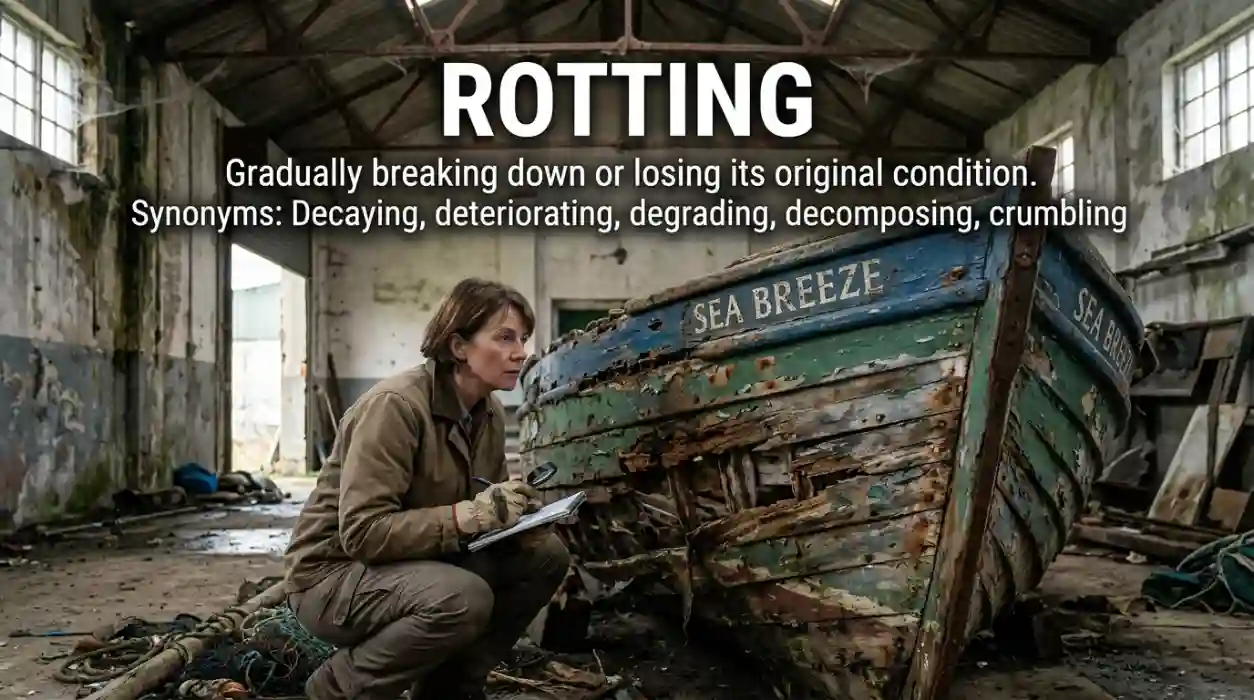
1. Decaying (Verb/Adjective) — US /dɪˈkeɪ.ɪŋ/ — UK /dɪˈkeɪ.ɪŋ/
Meaning: Gradually breaking down or losing its original condition.
Tone/Register: Neutral; very common.
Example: The fallen leaves are decaying on the forest floor.
Example: The old wooden fence is slowly decaying.
2. Decomposing (Verb/Adjective) — US /ˌdiː.kəmˈpoʊ.zɪŋ/ — UK /ˌdiː.kəmˈpəʊ.zɪŋ/
Meaning: Breaking down into simpler substances through natural biological processes.
Tone/Register: Scientific, academic, neutral.
Example: The dead leaves are decomposing naturally.
Example: Scientists studied the rate of decomposing plant material.
3. Putrefying (Verb/Adjective) — US /ˈpjuː.trə.faɪ.ɪŋ/ — UK /ˈpjuː.trɪ.faɪ.ɪŋ/
Meaning: Undergoing decomposition that produces an unpleasant smell, especially in animal matter.
Tone/Register: Formal, scientific, graphic.
Example: The researchers examined putrefying organic matter.
Example: A strong odor came from the putrefying remains.
4. Festering (Verb/Adjective) — US /ˈfes.tɚ.ɪŋ/ — UK /ˈfes.tər.ɪŋ/
Meaning: Becoming increasingly unhealthy, infected, or rotten.
Tone/Register: Strong, negative.
Example: The wound was festering without treatment.
Example: Water collected around the festering material.
5. Spoiling (Verb/Adjective) — US /ˈspɔɪ.lɪŋ/ — UK /ˈspɔɪ.lɪŋ/
Meaning: Becoming unfit to eat or use because of deterioration.
Tone/Register: Everyday, neutral.
Example: The milk is spoiling in the refrigerator.
Example: We threw away the spoiling fruit.
6. Deteriorating (Verb/Adjective) — US /dɪˈtɪr.i.ə.reɪ.tɪŋ/ — UK /dɪˈtɪə.ri.ə.reɪ.tɪŋ/
Meaning: Gradually becoming worse in condition or quality.
Tone/Register: Formal, professional, neutral.
Example: The roof is deteriorating after years of neglect.
Example: The building’s condition kept deteriorating.
7. Breaking Down (Verb Phrase) — US /ˈbreɪ.kɪŋ daʊn/ — UK /ˈbreɪ.kɪŋ daʊn/
Meaning: Gradually separating or losing its structure.
Tone/Register: Everyday and scientific.
Example: The organic waste is breaking down naturally.
Example: Moisture caused the material to start breaking down.
8. Degrading (Verb) — US /dɪˈɡreɪ.dɪŋ/ — UK /dɪˈɡreɪ.dɪŋ/
Meaning: Gradually losing quality, strength, or structure.
Tone/Register: Formal, technical.
Example: Sunlight is degrading the plastic.
Example: The fabric is degrading after years outdoors.
9. Disintegrating (Verb/Adjective) — US /ˌdɪsˈɪn.tə.ɡreɪ.tɪŋ/ — UK /ˌdɪsˈɪn.tɪ.ɡreɪ.tɪŋ/
Meaning: Breaking into smaller pieces or losing physical structure.
Tone/Register: Formal, descriptive.
Example: The old book was disintegrating in his hands.
Example: The damp cardboard began disintegrating.
10. Crumbling (Verb/Adjective) — US /ˈkrʌm.blɪŋ/ — UK /ˈkrʌm.blɪŋ/
Meaning: Breaking into small pieces, especially because of age or damage.
Tone/Register: Common, descriptive.
Example: The old bricks are crumbling.
Example: The neglected wall is slowly crumbling.
11. Wasting Away (Verb Phrase) — US /ˈweɪ.stɪŋ əˈweɪ/ — UK /ˈweɪ.stɪŋ əˈweɪ/
Meaning: Gradually becoming weaker, smaller, or less useful.
Tone/Register: Informal to literary.
Example: The abandoned house was wasting away.
Example: The old structure seemed to be wasting away.
12. Going Bad (Verb Phrase) — US /ˈɡoʊ.ɪŋ bæd/ — UK /ˈɡəʊ.ɪŋ bæd/
Meaning: Becoming spoiled or unsuitable for consumption.
Tone/Register: Informal, everyday.
Example: I think these berries are going bad.
Example: The cheese is going bad in the fridge.
13. Spoiled (Adjective) — US /spɔɪld/ — UK /spɔɪld/
Meaning: No longer fresh or safe to eat because of deterioration.
Tone/Register: Everyday.
Example: The meat smelled spoiled.
Example: We found spoiled vegetables in the drawer.
14. Rotten (Adjective) — US /ˈrɑː.tən/ — UK /ˈrɒt.ən/
Meaning: Fully or significantly affected by decay.
Tone/Register: Everyday, descriptive.
Example: The apple was completely rotten.
Example: We replaced the rotten boards.
15. Rancid (Adjective) — US /ˈræn.sɪd/ — UK /ˈræn/.sɪd/
Meaning: Having an unpleasant smell or taste because fats or oils have deteriorated.
Tone/Register: Food-related, precise.
Example: The old butter tasted rancid.
Example: Rancid oil can ruin a meal.
16. Moldering (Adjective/Verb) — US /ˈmoʊl.dɚ.ɪŋ/ — UK /ˈməʊl.dər.ɪŋ/
Meaning: Slowly decaying, especially in a damp or neglected place.
Tone/Register: Literary, descriptive.
Example: Books were moldering in the damp basement.
Example: The cabin contained moldering wooden furniture.
17. Mouldering (Adjective/Verb) — UK /ˈməʊl.dər.ɪŋ/ — US /ˈmoʊl.dɚ.ɪŋ/
Meaning: A British spelling and form describing slow decay.
Tone/Register: British, literary.
Example: Mouldering leaves covered the path.
Example: The old papers were mouldering in a box.
18. Foul (Adjective) — US /faʊl/ — UK /faʊl/
Meaning: Having an extremely unpleasant smell or condition.
Tone/Register: Informal to literary.
Example: A foul smell came from the bin.
Example: The stagnant water had become foul.
19. Putrid (Adjective) — US /ˈpjuː.trɪd/ — UK /ˈpjuː.trɪd/
Meaning: Extremely rotten and unpleasant, especially in smell.
Tone/Register: Formal, vivid.
Example: A putrid odor filled the room.
Example: The meat had become putrid.
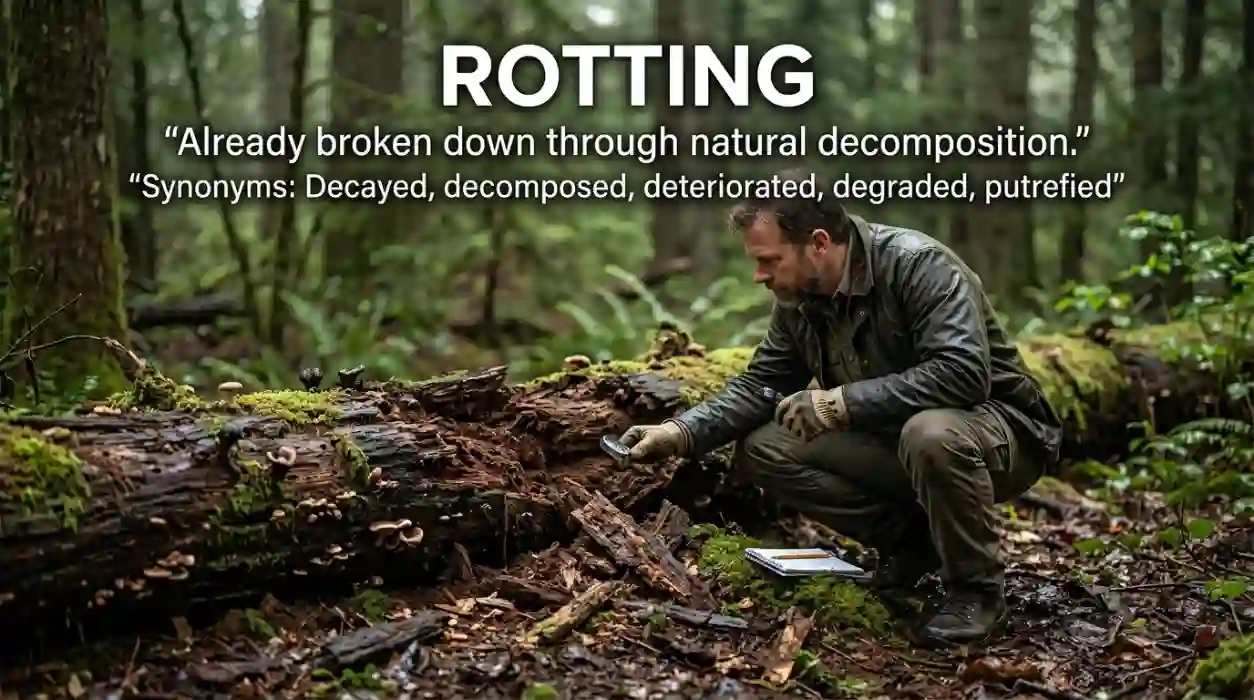
20. Decomposed (Adjective) — US /ˌdiː.kəmˈpoʊzd/ — UK /ˌdiː.kəmˈpəʊzd/
Meaning: Already broken down through natural decomposition.
Tone/Register: Scientific, neutral.
Example: The decomposed leaves enriched the soil.
Example: Researchers examined decomposed plant material.
21. Decomposing (Adjective) — US /ˌdiː.kəmˈpoʊ.zɪŋ/ — UK /ˌdiː.kəmˈpəʊ.zɪŋ/
Meaning: Currently undergoing decomposition.
Tone/Register: Scientific, neutral.
Example: Decomposing leaves covered the ground.
Example: The compost contained decomposing vegetables.
22. Decayed (Adjective) — US /dɪˈkeɪd/ — UK /dɪˈkeɪd/
Meaning: Damaged or broken down because of decay.
Tone/Register: Neutral.
Example: The decayed wood was unsafe.
Example: We removed the decayed branches.
23. Eroding (Verb/Adjective) — US /ɪˈroʊ.dɪŋ/ — UK /ɪˈrəʊ.dɪŋ/
Meaning: Gradually being worn away or weakened.
Tone/Register: Formal, technical.
Example: Water was eroding the old structure.
Example: The riverbank is slowly eroding.
Note: Erosion is not the same biological process as rotting.
24. Disintegrating (Verb) — US /ˌdɪsˈɪn.tə.ɡreɪ.tɪŋ/ — UK /ˌdɪsˈɪn.tɪ.ɡreɪ.tɪŋ/
Meaning: Breaking apart into smaller pieces.
Tone/Register: Formal.
Example: The damp paper was disintegrating.
Example: The old fabric is disintegrating quickly.
25. Decomposing Organically (Verb Phrase) — US /ˌdiː.kəmˈpoʊ.zɪŋ ɔːrˈɡæn.ɪk.li/ — UK /ˌdiː.kəmˈpəʊ.zɪŋ ɔːˈɡæn.ɪk.li/
Meaning: Breaking down naturally through biological processes.
Tone/Register: Scientific, environmental.
Example: The leaves are decomposing organically.
Example: Organic waste decomposes naturally under suitable conditions.
26. Biodegrading (Verb) — US /ˌbaɪ.oʊ.dɪˈɡreɪ.dɪŋ/ — UK /ˌbaɪ.əʊ.dɪˈɡreɪ.dɪŋ/
Meaning: Breaking down through biological activity.
Tone/Register: Scientific, environmental.
Example: The material is biodegrading in the soil.
Example: Some packaging materials biodegrade more readily than others.
27. Fermenting (Verb) — US /fɚˈmen.tɪŋ/ — UK /fəˈmen.tɪŋ/
Meaning: Undergoing a chemical process caused by microorganisms.
Tone/Register: Scientific, culinary.
Example: The fruit was fermenting in the container.
Example: The mixture began fermenting overnight.
Note: Fermentation is not synonymous with rotting, although both involve microorganisms.
28. Infesting (Verb) — US /ɪnˈfes.tɪŋ/ — UK /ɪnˈfes.tɪŋ/
Meaning: Becoming occupied by large numbers of unwanted organisms.
Tone/Register: Neutral to negative.
Example: Flies were infesting the rotting food.
Example: Insects began infesting the decaying material.
Note: Infesting describes the organisms present, not the decay itself.
29. Decomposing Naturally (Verb Phrase) — US /ˌdiː.kəmˈpoʊ.zɪŋ ˈnætʃ.ər.ə.li/ — UK /ˌdiː.kəmˈpəʊ.zɪŋ ˈnætʃ.ər.ə.li/
Meaning: Breaking down through normal environmental processes.
Tone/Register: Neutral, environmental.
Example: Fallen branches are decomposing naturally.
Example: The leaves were left to decompose naturally.
30. Breaking Apart (Verb Phrase) — US /ˈbreɪ.kɪŋ əˈpɑːrt/ — UK /ˈbreɪ.kɪŋ əˈpɑːt/
Meaning: Separating into smaller pieces or losing structural unity.
Tone/Register: Everyday.
Example: The old wood was breaking apart.
Example: The damp material began breaking apart.
31. Weakening (Verb) — US /ˈwiː.kən.ɪŋ/ — UK /ˈwiː.kən.ɪŋ/
Meaning: Becoming less strong or stable.
Tone/Register: Neutral.
Example: Moisture was weakening the wooden frame.
Example: The supports were weakening over time.
32. Degenerating (Verb) — US /dɪˈdʒen.ə.reɪ.tɪŋ/ — UK /dɪˈdʒen.ə.reɪ.tɪŋ/
Meaning: Gradually becoming worse in quality, condition, or function.
Tone/Register: Formal.
Example: The neglected system was degenerating.
Example: The material began degenerating after prolonged exposure.
33. Declining (Verb/Adjective) — US /dɪˈklaɪ.nɪŋ/ — UK /dɪˈklaɪ.nɪŋ/
Meaning: Gradually becoming weaker, poorer, or less successful.
Tone/Register: Formal and neutral.
Example: The neglected garden was declining.
Example: The old structure showed signs of decline.
Note: This works best for figurative or broad deterioration.
34. Fading (Verb) — US /ˈfeɪ.dɪŋ/ — UK /ˈfeɪ.dɪŋ/
Meaning: Gradually losing strength, color, or intensity.
Tone/Register: Neutral, literary.
Example: The old flowers were fading.
Example: The paint was fading in the damp weather.
Note: Fading does not normally mean rotting.
35. Discoloring (Verb) — US /dɪˈkʌl.ɚ.ɪŋ/ — UK /dɪˈkʌl.ər.ɪŋ/
Meaning: Developing a different or less attractive color because of age, damage, or deterioration.
Tone/Register: Neutral.
Example: The fruit was discoloring before it softened.
Example: Moisture was discoloring the wooden surface.
36. Softening (Verb) — US /ˈsɔːfənɪŋ/ — UK /ˈsɒfənɪŋ/
Meaning: Becoming less firm or solid, sometimes as an early sign of decay.
Tone/Register: Everyday.
Example: The peaches are softening quickly.
Example: The damaged fruit started softening overnight.
37. Spoiling Gradually (Verb Phrase) — US /ˈspɔɪ.lɪŋ ˈɡrædʒ.u.ə.li/ — UK /ˈspɔɪ.lɪŋ ˈɡrædʒ.u.ə.li/
Meaning: Slowly becoming unsuitable for eating or use.
Tone/Register: Everyday.
Example: The vegetables are spoiling gradually.
Example: We noticed the fruit spoiling gradually.
38. Turning Rotten (Verb Phrase) — US /ˈtɝː.nɪŋ ˈrɑː.tən/ — UK /ˈtɜː.nɪŋ ˈrɒt.ən/
Meaning: Becoming rotten over time.
Tone/Register: Informal.
Example: The bananas are turning rotten.
Example: The fruit started turning rotten after a few days.
39. Going Rotten (Verb Phrase) — US /ˈɡoʊ.ɪŋ ˈrɑː.tən/ — UK /ˈɡəʊ.ɪŋ ˈrɒt.ən/
Meaning: Becoming rotten or heavily decayed.
Tone/Register: Informal.
Example: The apples are going rotten.
Example: We should use the vegetables before they go rotten.
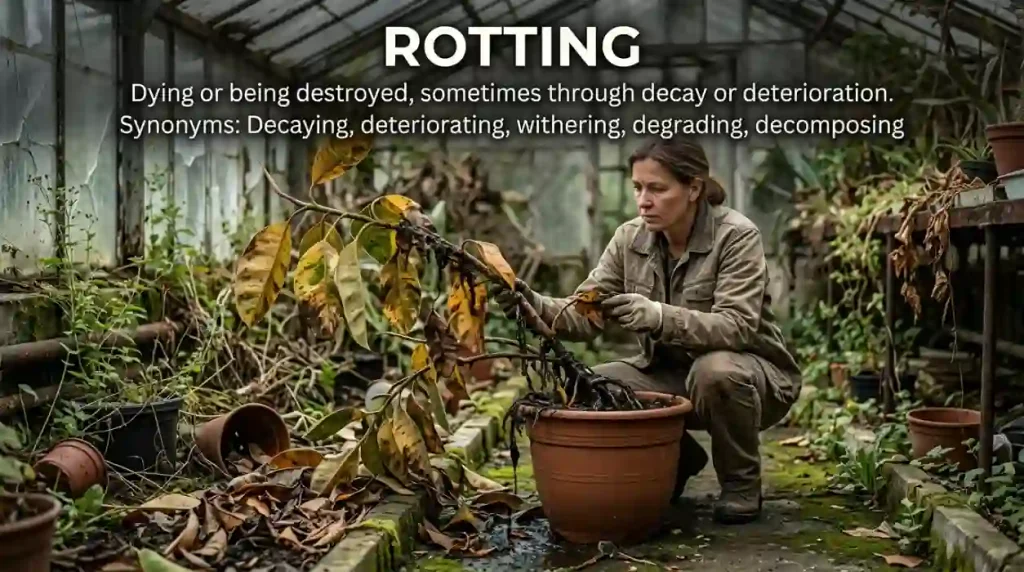
40. Perishing (Verb) — US /ˈper.ɪʃ.ɪŋ/ — UK /ˈper.ɪʃ.ɪŋ/
Meaning: Dying or being destroyed, sometimes through decay or deterioration.
Tone/Register: Literary, formal.
Example: The old plants were perishing without water.
Example: The neglected garden looked as though it were perishing.
Note: This is not a direct synonym for physical rotting.
41. Succumbing to Decay (Verb Phrase) — US /səˈkʌmɪŋ tə dɪˈkeɪ/ — UK /səˈkʌmɪŋ tə dɪˈkeɪ/
Meaning: Gradually becoming affected and damaged by decay.
Tone/Register: Formal, literary.
Example: The beams were succumbing to decay.
Example: The abandoned building was succumbing to decay.
42. Decomposing Slowly (Verb Phrase) — US /ˌdiː.kəmˈpoʊ.zɪŋ ˈsloʊ.li/ — UK /ˌdiː.kəmˈpəʊ.zɪŋ ˈsləʊ.li/
Meaning: Breaking down gradually over an extended period.
Tone/Register: Scientific, descriptive.
Example: The fallen tree was decomposing slowly.
Example: The plant matter was decomposing slowly in the shade.
43. Breaking Down Biologically (Verb Phrase) — US /ˈbreɪ.kɪŋ daʊn ˌbaɪ.əˈlɑː.dʒɪ.kəl.i/ — UK /ˈbreɪ.kɪŋ daʊn ˌbaɪ.əˈlɒdʒ.ɪ.kəl.i/
Meaning: Being broken down through biological activity.
Tone/Register: Scientific.
Example: The waste is breaking down biologically.
Example: Microorganisms help organic matter break down biologically.
44. Rotting Away (Verb Phrase) — US /ˈrɑː.tɪŋ əˈweɪ/ — UK /ˈrɒt.ɪŋ əˈweɪ/
Meaning: Gradually becoming completely rotten or useless.
Tone/Register: Informal, vivid.
Example: The abandoned boat is rotting away.
Example: The fence has been rotting away for years.
45. Maturing Into Decay (Verb Phrase) — US /məˈtʃʊrɪŋ ˈɪn.tu dɪˈkeɪ/ — UK /məˈtjʊərɪŋ ˈɪn.tu dɪˈkeɪ/
Meaning: Progressing from an earlier stage toward advanced decay.
Tone/Register: Literary, uncommon.
Example: The fallen fruit was moving toward advanced decay.
Example: The organic matter changed as decay progressed.
Note: This is descriptive rather than a standard synonym.
46. Withering (Verb/Adjective) — US /ˈwɪð.ər.ɪŋ/ — UK /ˈwɪð.ər.ɪŋ/
Meaning: Drying out and losing freshness or vitality.
Tone/Register: Literary, botanical.
Example: The flowers were withering in the heat.
Example: Withering leaves covered the garden bed.
Note: Withering differs from rotting because it emphasizes drying and loss of vitality.
47. Dying Back (Verb Phrase) — US /ˈdaɪ.ɪŋ bæk/ — UK /ˈdaɪ.ɪŋ bæk/
Meaning: Gradually dying from the outer parts inward or from older growth.
Tone/Register: Gardening, botanical.
Example: The plant is dying back after the cold weather.
Example: Several branches were dying back.
48. Succumbing (Verb) — US /səˈkʌm.ɪŋ/ — UK /səˈkʌm.ɪŋ/
Meaning: Gradually giving way to a harmful condition or force.
Tone/Register: Formal.
Example: The timber was succumbing to moisture damage.
Example: The old structure eventually succumbed to decay.
49. Becoming Putrid (Verb Phrase) — US /bɪˈkʌm.ɪŋ ˈpjuː.trɪd/ — UK /bɪˈkʌm.ɪŋ ˈpjuː.trɪd/
Meaning: Becoming extremely rotten and unpleasant, especially in smell.
Tone/Register: Formal, vivid.
Example: The discarded meat was becoming putrid.
Example: The organic waste became putrid in the heat.
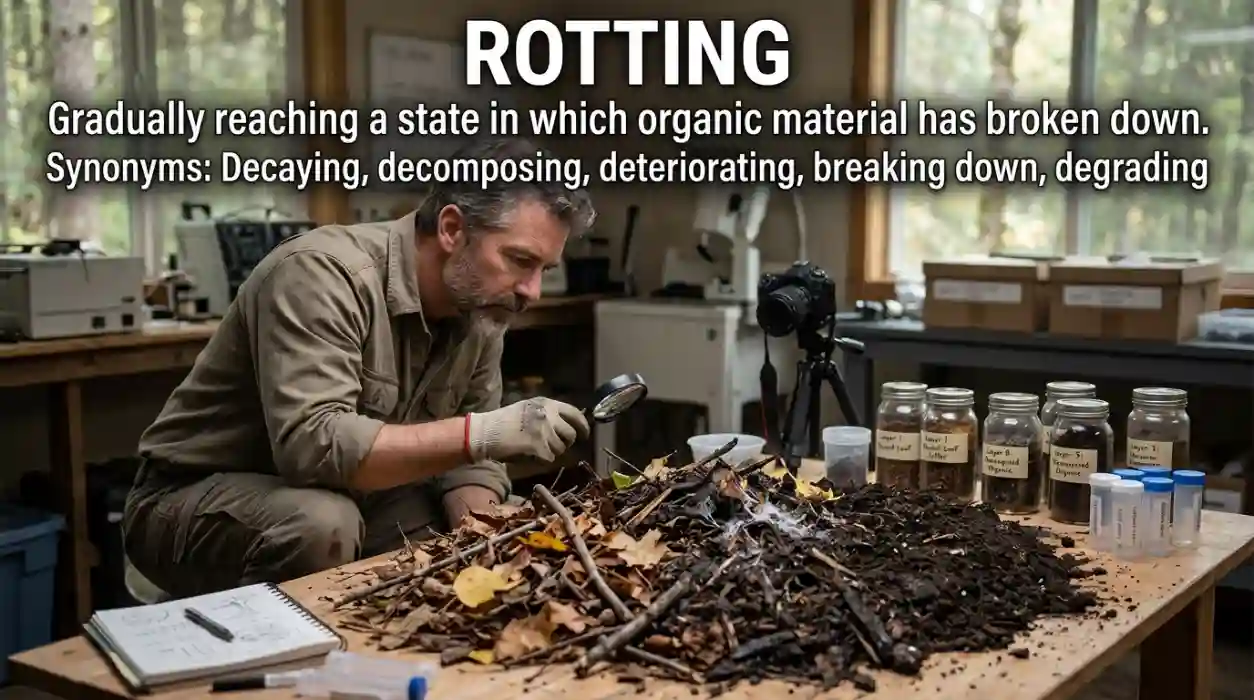
50. Becoming Decomposed (Verb Phrase) — US /bɪˈkʌm.ɪŋ ˌdiː.kəmˈpoʊzd/ — UK /bɪˈkʌm.ɪŋ ˌdiː.kəmˈpəʊzd/
Meaning: Gradually reaching a state in which organic material has broken down.
Tone/Register: Scientific, neutral.
Example: The leaves were becoming decomposed.
Example: The material was becoming decomposed as microorganisms acted on it.
Synonyms by Tone
Positive or Neutral-Feeling Choices
These are useful when you want to describe a natural process without making it sound disgusting:
- decomposing
- biodegrading
- breaking down
- decomposing naturally
- breaking down biologically
- decaying
These are especially useful in environmental, gardening, and scientific writing.
Neutral Choices
Use these for straightforward descriptions:
- decaying
- decomposing
- deteriorating
- degrading
- weakening
- disintegrating
- breaking apart
- spoiling
Negative or Vivid Choices
These create stronger unpleasant imagery:
- putrefying
- putrid
- festering
- foul
- rotten
- rotting away
- moldering
- rancid
Informal Choices
These sound natural in everyday conversation:
- going bad
- going rotten
- turning rotten
- breaking down
- rotting away
- wasting away
Tone matters because “rotting food” creates a stronger sensory reaction than “decomposing organic matter.”
“Rotting” vs Close Alternatives
Rotting vs Decaying
These are often interchangeable.
Rotting is more everyday and vivid.
Decaying sounds slightly more neutral and works well in scientific, environmental, and descriptive writing.
“The fruit is rotting.”
“The organic material is decaying.”
Both are natural.
Rotting vs Decomposing
Decomposing emphasizes the biological process of breaking organic material down.
Rotting is broader and more conversational.
In science, decomposing is often the better choice.
In casual conversation, rotting is often more natural.
Rotting vs Spoiling
Spoiling is especially common for food.
“The milk is spoiling.”
Rotting suggests more advanced physical decay.
“The fruit is rotting.”
The two overlap, but they are not always interchangeable.
How “Rotting” Changes by Context
Daily Conversation
In everyday English, rotting, going bad, going rotten, and spoiling are common.
“The bananas are going bad.”
This sounds very natural.
“The wood is rotting.”
This is also ordinary everyday English.
Writing and Blogging
Writers often choose decaying, deteriorating, or decomposing to make descriptions more precise.
A gardening article might say:
“The leaves are decomposing and returning nutrients to the soil.”
A home-maintenance article might say:
“The untreated wood is deteriorating.”
Professional and Academic English
Scientific writing usually favors precise terms.
Decomposing, biodegrading, degrading, and deteriorating can communicate the mechanism or condition more clearly.
For example:
“The researchers measured the rate at which organic material decomposed.”
This sounds more technical than:
“The material rotted.”
Creative and Informal Writing
Creative writing often benefits from stronger sensory vocabulary.
Words such as moldering, putrid, festering, and rotting away can create atmosphere.
“The abandoned cabin stood among moldering leaves.”
The word choice immediately creates a darker image.
Common Mistakes & Native Usage
Mistake 1: Using “rotting” for every type of damage
Not everything that becomes damaged is rotting.
A plastic chair can crack.
A metal pipe can corrode.
A wall can crumble.
A wooden beam can rot.
Choosing the right verb makes the description more accurate.
Mistake 2: Confusing “rotting” and “spoiling”
Food can spoil without becoming visibly rotten.
Milk usually spoils.
Fruit may rot.
Both words are useful, but the context determines the natural choice.
Mistake 3: Using “putrefying” in casual conversation
“Putrefying” is grammatically correct, but it sounds formal and vivid.
Most people would simply say:
“The meat is rotting.”
“Putrefying” is more suitable for technical, scientific, or deliberately graphic writing.
Mistake 4: Treating “decomposing” and “rotting” as identical everywhere
They overlap, but decomposition is a broader scientific concept.
A natural biological process can be described as decomposition without the unpleasant associations that “rotting” often creates.
Mistake 5: Using “eroding” as a direct synonym
Erosion normally involves material being worn away by forces such as water, wind, or ice.
Rotting is associated with biological or chemical decomposition.
The processes are different.
Register Notes
Rotting is common and conversational.
Decaying works across everyday and formal writing.
Decomposing is especially useful in scientific and environmental contexts.
Putrefying and moldering are more specialized or literary.
If you are building a vocabulary article, an internal link to a related guide on synonyms for decay would fit naturally here.
Real-Life Mini Scenarios
Workplace
An old wooden storage shed has been ignored for years.
A manager might say:
“The wooden frame is rotting.”
A maintenance report might use:
“The timber is deteriorating due to prolonged moisture exposure.”
The second version sounds more professional.
Social Situation
Someone notices fruit sitting on a kitchen counter.
They might casually say:
“Those bananas are going bad.”
That sounds much more natural than saying:
“Those bananas are undergoing biological decomposition.”
The context determines the right register.
Media and Pop Culture
A documentary about forests may describe decomposing trees and decaying plant matter.
A horror story may use rotting, putrid, or moldering to create a darker mood.
Writing and Storytelling
A writer describing an abandoned building could choose:
“The floorboards were rotting away.”
That phrase creates a stronger visual image than simply saying:
“The floor was damaged.”
How to Choose the Right Synonym
- Ask what kind of change you are describing.
- Use rotting for general physical decay.
- Use decaying for a broad, neutral description.
- Use decomposing for biological breakdown.
- Use spoiling for food that is no longer fresh.
- Use deteriorating for a gradual decline in condition.
- Use putrefying for advanced, foul-smelling decomposition.
- Use festering for infected or increasingly unhealthy conditions.
- Use moldering for slow decay, especially in damp or neglected settings.
- Use biodegrading when biological processes are breaking material down.
- Use crumbling when something is physically breaking into pieces.
- This approach gives you accuracy instead of simply replacing one word with another.
Practice Exercise
1. Old leaves are naturally breaking down in a compost pile.
A. Decomposing
B. Shining
C. Freezing
D. Polishing
2. Milk has become unsafe and unpleasant to drink.
A. Spoiling
B. Eroding
C. Crumbling
D. Withering
3. A wooden beam is gradually being destroyed by moisture and decay.
A. Rotting
B. Fading
C. Fermenting
D. Bleaching
4. You are writing a scientific report about organic matter.
A. Decomposing
B. Going bad
C. Getting gross
D. Turning nasty
5. Meat has developed an extremely unpleasant smell because of advanced decay.
A. Putrefying
B. Fading
C. Withering
D. Eroding
6. An old building is becoming worse because nobody maintains it.
A. Deteriorating
B. Fermenting
C. Ripening
D. Blossoming
7. You want an informal phrase for fruit becoming spoiled.
A. Going bad
B. Biodegrading
C. Succumbing to decay
D. Disintegrating
8. A damp book is slowly falling apart.
A. Disintegrating
B. Ripening
C. Fermenting
D. Growing
9. A plant’s leaves are drying and losing vitality.
A. Withering
B. Rotting
C. Fermenting
D. Rancid
10. A writer wants a literary word for slow decay in a neglected house.
A. Moldering
B. Spoiling
C. Going bad
D. Freshening
Answer Key: 1-A | 2-A | 3-A | 4-A | 5-A | 6-A | 7-A | 8-A | 9-A | 10-A
Reflection Task
Write one sentence about something that is rotting, decaying, or decomposing.
Then rewrite it with a more precise synonym. Try decomposing, deteriorating, spoiling, moldering, or festering.
External Reference Sources
For authoritative definitions, pronunciation, and usage, useful external references include Cambridge Dictionary, Oxford Learner’s Dictionaries, Collins Dictionary, and Etymonline.
Conclusion
The best synonym for rotting depends on the material, process, and tone. “Decaying” is broad, while “decomposing” sounds more scientific and precise.
For food, “spoiling” often feels natural. For vivid creative writing, “moldering” or “putrid” can create a stronger image.
Learning these distinctions improves essays, blogs, stories, and everyday conversations. It also helps you describe natural processes with greater confidence and accuracy.
Choose one new synonym today and use it in an email, essay, or conversation. A few small vocabulary choices can make your English much more expressive.
Frequently Asked Questions
1. What is the closest synonym for rotting?
The closest general synonyms for rotting are decaying and decomposing. Both describe gradual breakdown, but “decomposing” sounds more scientific and specifically emphasizes biological breakdown. “Decaying” is broader and works naturally for food, plants, wood, buildings, and even abstract situations. The best choice depends on the subject and the tone of your sentence.
2. What is a scientific synonym for rotting?
Decomposing is one of the best scientific alternatives to “rotting.” Scientists often discuss organic matter as it decomposes through biological activity. Biodegrading can also work when microorganisms break a material down. These terms sound more neutral and technical than “rotting,” which often carries stronger everyday or unpleasant associations.
3. What is the difference between rotting and decomposing?
Rotting and decomposing overlap, but they are not identical in tone. Rotting is an everyday term for material gradually becoming rotten or decayed. Decomposing is broader and more scientific. It describes the breakdown of organic material into simpler substances. For an academic or environmental article, “decomposing” is often the more precise choice.
4. What is a synonym for rotting food?
Common choices include spoiling, going bad, going rotten, decaying, and rotting itself. “Spoiling” is especially natural for food that is no longer fresh or suitable to eat. “Rotting” often suggests more advanced visible decay, particularly with fruit and vegetables. “Going bad” is the most casual everyday expression.
5. What word describes wood that is slowly rotting?
Decaying, rotting, and deteriorating can all describe damaged wood. “Rotting wood” is the most direct everyday expression. “Decaying wood” sounds slightly more descriptive, while “deteriorating timber” fits technical or professional writing. If fungal or moisture-related damage is involved, the exact type of wood decay may be described more specifically.

Shahzeena Shazadi is the founder and lead writer at VocablyHub.com, where she creates accurate, reader-focused English language content designed to help people communicate with clarity and confidence. She specializes in synonyms, antonyms, word meanings, idioms, and practical vocabulary guides that simplify complex language concepts for everyday use. Every article is carefully researched, fact-checked, and written in clear, accessible language using reliable references and real-world examples. Her goal is to provide helpful, trustworthy content that supports learners at every stage of their English language journey.
Her editorial approach focuses on accuracy, transparency, and user value while following modern content quality standards. She regularly reviews and updates content to keep information relevant, useful, and easy to understand. Through VocablyHub.com, Shahzeena Shazadi is committed to publishing reliable language resources that help students, writers, educators, professionals, and English learners expand their vocabulary, improve their writing skills, and communicate with confidence in academic, professional, and everyday situations.