
Synonyms for naturalist can make your English more precise when you describe someone who studies, observes, or deeply appreciates the natural world.
Imagine a person spending the morning identifying birds and the afternoon studying native plants. You could call this person a naturalist.
However, different situations call for different words. A scientist may be a biologist, while a person who protects habitats may be a conservationist.
Learning synonyms for naturalist helps students, bloggers, writers, and daily English users choose words that match their exact meaning and tone.
What Does “Naturalist” Really Mean?
A naturalist is a person who studies, observes, or has a strong interest in nature and the natural world.
Simple definition: A naturalist is someone who carefully observes and learns about plants, animals, environments, or other natural phenomena.
The word is a noun. It can describe a professional scientist, field researcher, or knowledgeable amateur who spends time studying nature.
For example, a person who regularly observes birds and records their behavior can be called a naturalist. Similarly, someone who studies plants in their natural environment may use the same term.
The meaning changes slightly according to context. In scientific settings, naturalist can refer to someone involved in natural history or field observation. In everyday English, it can describe a person with a deep interest in nature.
Connotative Meaning
Connotation (the feeling or association a word carries beyond its basic dictionary meaning) can change the effect of a sentence.
Positive tone: Naturalist often suggests curiosity, knowledge, patience, outdoor experience, and appreciation for nature.
Negative tone: The word itself usually carries no negative meaning. However, some alternatives may imply limited expertise or a particular viewpoint.
Neutral tone: In academic or descriptive writing, naturalist can simply identify someone who studies or observes the natural world.
Therefore, context matters. Biologist sounds scientific, while nature enthusiast sounds more personal and informal.
Etymology of “Naturalist”
The word naturalist comes from natural, which ultimately traces back to Latin natura, meaning “nature” or “the natural order.”
The ending -ist comes through French and Latin usage. It commonly forms nouns describing people connected with a particular subject, activity, or belief.
Old English: 450–1100
The modern word naturalist did not exist in Old English. However, Old English contained words for nature, animals, plants, earth, and other parts of the physical world.
Middle English: 1100–1500
After the Norman Conquest, English adopted many French and Latin terms. Vocabulary connected with nature and scholarly study became increasingly common.
Modern English: 1500–Present
As scientific observation developed, naturalist became associated with people who carefully studied plants, animals, fossils, landscapes, and other natural phenomena.
Today, the word can describe professional researchers as well as highly knowledgeable nature enthusiasts.
Pronunciation of Naturalist
US: /ˈnætʃərəlɪst/
UK: /ˈnætʃərəlɪst/
Syllables
nat-u-ral-ist
Affixation Pattern
Root: nature
Prefix: None
Suffix: -ist
The suffix -ist often identifies a person connected with a field, practice, or area of study.
Synonyms List:
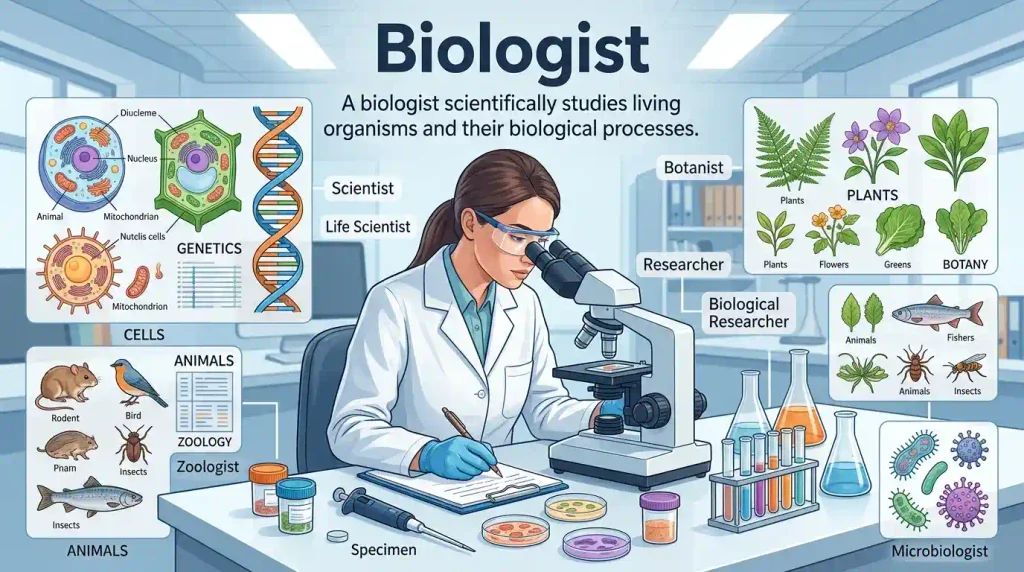
Biologist (Noun) — US: /baɪˈɑːlədʒɪst/ | UK: /baɪˈɒlədʒɪst/
Meaning: A biologist scientifically studies living organisms and their biological processes.
Tone/Register: Academic, scientific
Example: The biologist examined the local species.
Her research focuses on animal development.
Ecologist (Noun) — US: /iˈkɑːlədʒɪst/ | UK: /iˈkɒlədʒɪst/
Meaning: An ecologist studies relationships between organisms and their environments.
Tone/Register: Academic, scientific
Example: The ecologist studied the wetland ecosystem.
His team measured changes in the habitat.
Botanist (Noun) — US: /ˈbɑːtənɪst/ | UK: /ˈbɒtənɪst/
Meaning: A botanist specializes in the scientific study of plants.
Tone/Register: Academic, scientific
Example: The botanist identified a rare flower.
She studies native plants in the region.
Zoologist (Noun) — US: /zoʊˈɑːlədʒɪst/ | UK: /zuːˈɒlədʒɪst/
Meaning: A zoologist studies animals, their biology, and their behavior.
Tone/Register: Academic, scientific
Example: The zoologist observed the mammals quietly.
His research examines animal behavior.
Wildlife Biologist (Noun) — US: /ˈwaɪldlaɪf baɪˈɑːlədʒɪst/ | UK: /ˈwaɪldlaɪf baɪˈɒlədʒɪst/
Meaning: A wildlife biologist studies wild animals and their natural habitats.
Tone/Register: Professional, scientific
Example: The wildlife biologist tracked a deer population.
Her study examines wildlife movement.
Wildlife Researcher (Noun) — US: /ˈwaɪldlaɪf rɪˈsɝːtʃər/ | UK: /ˈwaɪldlaɪf rɪˈsɜːtʃə/
Meaning: A wildlife researcher investigates wild species through observation and research.
Tone/Register: Professional, academic
Example: The wildlife researcher recorded animal activity.
His project focuses on forest species.
Field Biologist (Noun) — US: /fiːld baɪˈɑːlədʒɪst/ | UK: /fiːld baɪˈɒlədʒɪst/
Meaning: A field biologist studies organisms directly in their natural environments.
Tone/Register: Scientific, professional
Example: The field biologist worked in the forest.
She collected data during field visits.
Field Researcher (Noun) — US: /fiːld rɪˈsɝːtʃər/ | UK: /fiːld rɪˈsɜːtʃə/
Meaning: A field researcher gathers information directly from real-world environments.
Tone/Register: Academic, professional
Example: The field researcher observed birds at dawn.
His notes supported the research project.
Nature Researcher (Noun) — US: /ˈneɪtʃər rɪˈsɝːtʃər/ | UK: /ˈneɪtʃə rɪˈsɜːtʃə/
Meaning: A nature researcher studies aspects of the natural world.
Tone/Register: Neutral, academic
Example: The nature researcher documented seasonal changes.
Her work covers plants and wildlife.
Wildlife Observer (Noun) — US: /ˈwaɪldlaɪf əbˈzɝːvər/ | UK: /ˈwaɪldlaɪf əbˈzɜːvə/
Meaning: A wildlife observer watches animals and records their behavior.
Tone/Register: Neutral, informal
Example: The wildlife observer spotted a rare bird.
He recorded the sighting in his journal.
Nature Observer (Noun) — US: /ˈneɪtʃər əbˈzɝːvər/ | UK: /ˈneɪtʃə əbˈzɜːvə/
Meaning: A nature observer carefully watches natural environments and their features.
Tone/Register: Neutral
Example: The nature observer noticed early spring changes.
She photographed the plants nearby.
Wildlife Enthusiast (Noun) — US: /ˈwaɪldlaɪf ɪnˈθuːziæst/ | UK: /ˈwaɪldlaɪf ɪnˈθjuːziæst/
Meaning: A wildlife enthusiast has a strong personal interest in wild animals.
Tone/Register: Informal, positive
Example: He is a passionate wildlife enthusiast.
She enjoys watching animals in national parks.
Nature Enthusiast (Noun) — US: /ˈneɪtʃər ɪnˈθuːziæst/ | UK: /ˈneɪtʃə ɪnˈθjuːziæst/
Meaning: A nature enthusiast enjoys learning about and spending time in nature.
Tone/Register: Informal, positive
Example: My sister is a nature enthusiast.
She spends weekends hiking outdoors.
Environmental Scientist (Noun) — US: /ɪnˌvaɪrənˈmentəl ˈsaɪəntɪst/ | UK: /ɪnˌvaɪərənˈmentəl ˈsaɪəntɪst/
Meaning: An environmental scientist studies environmental systems and their changes.
Tone/Register: Professional, scientific
Example: The environmental scientist tested the river water.
His report examined pollution levels.
Conservationist (Noun) — US: /ˌkɑːnsərˈveɪʃənɪst/ | UK: /ˌkɒnsəˈveɪʃənɪst/
Meaning: A conservationist works to protect wildlife, habitats, and natural resources.
Tone/Register: Professional, environmental
Example: The conservationist protects endangered habitats.
Her team monitors threatened species.
Environmentalist (Noun) — US: /ɪnˌvaɪrənˈmentəlɪst/ | UK: /ɪnˌvaɪərənˈmentəlɪst/
Meaning: An environmentalist supports the protection and improvement of the environment.
Tone/Register: Neutral, environmental
Example: The environmentalist spoke about clean water.
His campaign encourages responsible environmental practices.
Ornithologist (Noun) — US: /ˌɔːrnəˈθɑːlədʒɪst/ | UK: /ˌɔːnɪˈθɒlədʒɪst/
Meaning: An ornithologist specializes in the scientific study of birds.
Tone/Register: Academic, scientific
Example: The ornithologist identified the bird by its call.
She studies seasonal migration.
Entomologist (Noun) — US: /ˌentəˈmɑːlədʒɪst/ | UK: /ˌentəˈmɒlədʒɪst/
Meaning: An entomologist studies insects scientifically.
Tone/Register: Academic, scientific
Example: The entomologist collected insect samples.
His research examines pollinating species.
Herpetologist (Noun) — US: /hərpəˈtɑːlədʒɪst/ | UK: /hɜːpəˈtɒlədʒɪst/
Meaning: A herpetologist studies reptiles and amphibians.
Tone/Register: Academic, scientific
Example: The herpetologist examined a frog population.
Her research covers reptiles and amphibians.
Marine Biologist (Noun) — US: /məˈriːn baɪˈɑːlədʒɪst/ | UK: /məˈriːn baɪˈɒlədʒɪst/
Meaning: A marine biologist studies organisms and ecosystems in marine environments.
Tone/Register: Scientific, professional
Example: The marine biologist studied coral reefs.
His team monitors coastal ecosystems.
Field Scientist (Noun) — US: /fiːld ˈsaɪəntɪst/ | UK: /fiːld ˈsaɪəntɪst/
Meaning: A field scientist conducts scientific research outside laboratory settings.
Tone/Register: Professional, scientific
Example: The field scientist recorded wildlife data.
She worked outdoors throughout the summer.
Wildlife Specialist (Noun) — US: /ˈwaɪldlaɪf ˈspeʃəlɪst/ | UK: /ˈwaɪldlaɪf ˈspeʃəlɪst/
Meaning: A wildlife specialist has focused knowledge of wild animals or their habitats.
Tone/Register: Professional
Example: The wildlife specialist identified animal tracks.
Her advice helped the research team.
Biodiversity Researcher (Noun) — US: /ˌbaɪoʊdaɪˈvɜːrsəti rɪˈsɝːtʃər/ | UK: /ˌbaɪəʊdaɪˈvɜːsəti rɪˈsɜːtʃə/
Meaning: A biodiversity researcher studies the variety of living organisms in an area.
Tone/Register: Academic, scientific
Example: The biodiversity researcher surveyed the forest.
Her findings revealed several uncommon species.
Ecosystem Researcher (Noun) — US: /ˈiːkoʊsɪstəm rɪˈsɝːtʃər/ | UK: /ˈiːkəʊsɪstəm rɪˈsɜːtʃə/
Meaning: An ecosystem researcher studies interactions among organisms and their environments.
Tone/Register: Academic
Example: The ecosystem researcher monitored the lake.
His study examines water quality.
Field Naturalist (Noun) — US: /fiːld ˈnætʃərəlɪst/ | UK: /fiːld ˈnætʃərəlɪst/
Meaning: A field naturalist studies nature through direct outdoor observation.
Tone/Register: Scientific, traditional
Example: The field naturalist identified animal tracks.
She recorded observations during every field trip.
Wildlife Expert (Noun) — US: /ˈwaɪldlaɪf ˈekspɜːrt/ | UK: /ˈwaɪldlaɪf ˈekspɜːt/
Meaning: A wildlife expert has advanced knowledge of wild animals or their behavior.
Tone/Register: Professional, media
Example: The wildlife expert explained the animal’s behavior.
His comments appeared in the documentary.
Nature Expert (Noun) — US: /ˈneɪtʃər ˈekspɜːrt/ | UK: /ˈneɪtʃə ˈekspɜːt/
Meaning: A nature expert has substantial knowledge of natural environments and organisms.
Tone/Register: Neutral, professional
Example: The nature expert identified native species.
She explained the ecological changes clearly.
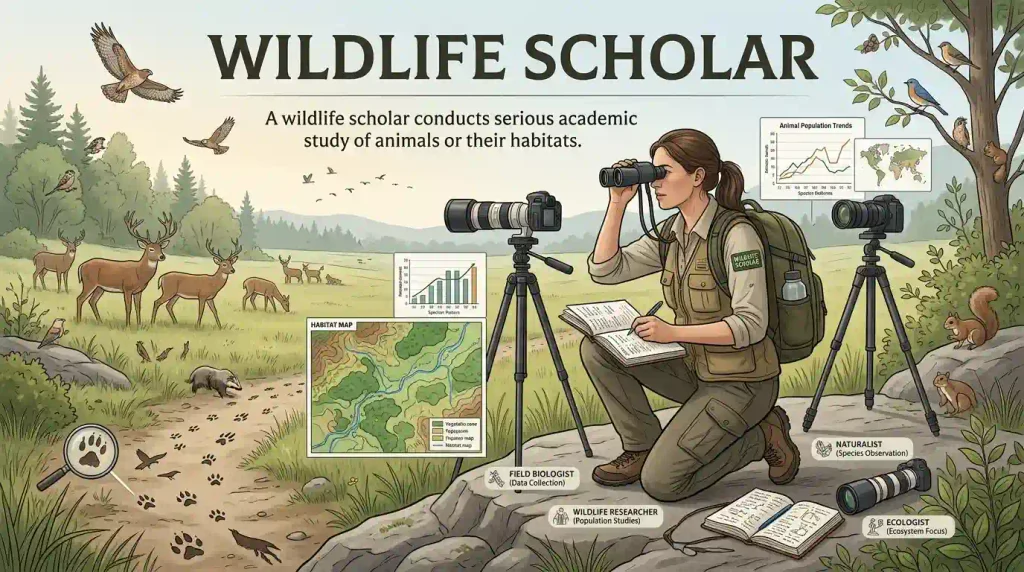
Wildlife Scholar (Noun) — US: /ˈwaɪldlaɪf ˈskɑːlər/ | UK: /ˈwaɪldlaɪf ˈskɒlə/
Meaning: A wildlife scholar conducts serious academic study of animals or their habitats.
Tone/Register: Academic
Example: The wildlife scholar published a detailed study.
His research examines predator behavior.
Natural History Researcher (Noun) — US: /ˈnætʃərəl ˈhɪstəri rɪˈsɝːtʃər/ | UK: /ˈnætʃərəl ˈhɪstəri rɪˈsɜːtʃə/
Meaning: A natural history researcher studies organisms and the natural world through observation and research.
Tone/Register: Academic, scientific
Example: The researcher studies natural history collections.
Her work focuses on regional species.
Natural History Scholar (Noun) — US: /ˈnætʃərəl ˈhɪstəri ˈskɑːlər/ | UK: /ˈnætʃərəl ˈhɪstəri ˈskɒlə/
Meaning: A natural history scholar studies the diversity and development of the natural world.
Tone/Register: Academic
Example: The scholar examined historical specimens.
His research explores species diversity.
Natural Science Scholar (Noun) — US: /ˈnætʃərəl saɪəns ˈskɑːlər/ | UK: /ˈnætʃərəl saɪəns ˈskɒlə/
Meaning: A natural science scholar studies scientific subjects concerning the physical or living world.
Tone/Register: Academic
Example: The natural science scholar presented her findings.
Her research connects biology and environmental science.
Natural History Expert (Noun) — US: /ˈnætʃərəl ˈhɪstəri ˈekspɜːrt/ | UK: /ˈnætʃərəl ˈhɪstəri ˈekspɜːt/
Meaning: A natural history expert has extensive knowledge of organisms, specimens, and natural environments.
Tone/Register: Professional, academic
Example: The expert identified the specimen.
His explanation helped museum visitors.
Nature Scholar (Noun) — US: /ˈneɪtʃər ˈskɑːlər/ | UK: /ˈneɪtʃə ˈskɒlə/
Meaning: A nature scholar studies the natural world through research or academic work.
Tone/Register: Academic
Example: The nature scholar studies regional ecosystems.
Her latest paper explores plant diversity.
Wildlife Academic (Noun) — US: /ˈwaɪldlaɪf ˌækəˈdemɪk/ | UK: /ˈwaɪldlaɪf ˌækəˈdemɪk/
Meaning: A wildlife academic researches wildlife within an academic or university setting.
Tone/Register: Academic
Example: The wildlife academic published a new study.
His students joined the field project.
Natural World Researcher (Noun) — US: /ˈnætʃərəl wɝːld rɪˈsɝːtʃər/ | UK: /ˈnætʃərəl wɜːld rɪˈsɜːtʃə/
Meaning: A natural world researcher studies organisms, environments, and natural processes.
Tone/Register: Neutral, academic
Example: The researcher documents local habitats.
Her observations support environmental research.
Nature Lover (Noun) — US: /ˈneɪtʃər ˈlʌvər/ | UK: /ˈneɪtʃə ˈlʌvə/
Meaning: A nature lover greatly enjoys natural environments and outdoor experiences.
Tone/Register: Informal, positive
Example: She is a lifelong nature lover.
He enjoys quiet walks through the forest.
Nature Student (Noun) — US: /ˈneɪtʃər ˈstuːdənt/ | UK: /ˈneɪtʃə ˈstjuːdənt/
Meaning: A nature student is someone who actively learns about the natural world.
Tone/Register: Neutral, educational
Example: The nature student keeps detailed field notes.
She learns to identify local species.
Environmental Researcher (Noun) — US: /ɪnˌvaɪrənˈmentəl rɪˈsɝːtʃər/ | UK: /ɪnˌvaɪərənˈmentəl rɪˈsɜːtʃə/
Meaning: An environmental researcher investigates environmental conditions, systems, and changes.
Tone/Register: Academic, professional
Example: The environmental researcher studied soil quality.
His findings support the environmental report.
Biodiversity Specialist (Noun) — US: /ˌbaɪoʊdaɪˈvɜːrsəti ˈspeʃəlɪst/ | UK: /ˌbaɪəʊdaɪˈvɜːsəti ˈspeʃəlɪst/
Meaning: A biodiversity specialist focuses on the variety and distribution of living organisms.
Tone/Register: Professional, scientific
Example: The biodiversity specialist surveyed the reserve.
She identified several vulnerable species.
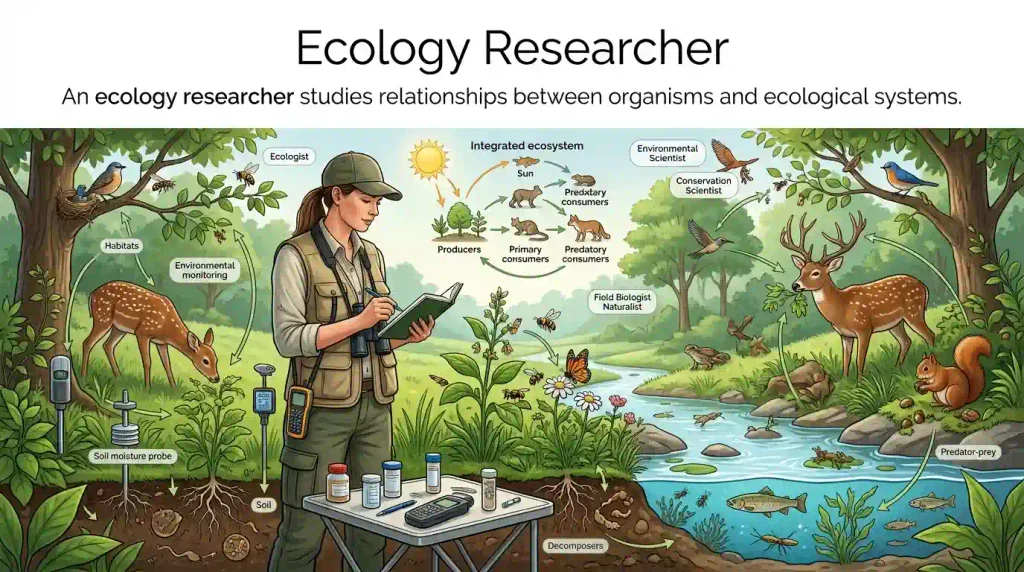
Ecology Researcher (Noun) — US: /iˈkɑːlədʒi rɪˈsɝːtʃər/ | UK: /iˈkɒlədʒi rɪˈsɜːtʃə/
Meaning: An ecology researcher studies relationships between organisms and ecological systems.
Tone/Register: Academic, scientific
Example: The ecology researcher studied forest interactions.
His project examines habitat changes.
Natural Science Researcher (Noun) — US: /ˈnætʃərəl saɪəns rɪˈsɝːtʃər/ | UK: /ˈnætʃərəl saɪəns rɪˈsɜːtʃə/
Meaning: A natural science researcher investigates scientific questions about the physical or biological world.
Tone/Register: Academic
Example: The researcher studies natural science in the field.
Her project examines local environmental patterns.
Wildlife Scientist (Noun) — US: /ˈwaɪldlaɪf ˈsaɪəntɪst/ | UK: /ˈwaɪldlaɪf ˈsaɪəntɪst/
Meaning: A wildlife scientist uses scientific methods to study wild animals and their environments.
Tone/Register: Professional, scientific
Example: The wildlife scientist analyzed tracking data.
His study focuses on animal populations.
Nature Scientist (Noun) — US: /ˈneɪtʃər ˈsaɪəntɪst/ | UK: /ˈneɪtʃə ˈsaɪəntɪst/
Meaning: A nature scientist studies scientific aspects of the natural world.
Tone/Register: Neutral, scientific
Example: The nature scientist examined the habitat.
Her observations revealed environmental changes.
Natural History Specialist (Noun) — US: /ˈnætʃərəl ˈhɪstəri ˈspeʃəlɪst/ | UK: /ˈnætʃərəl ˈhɪstəri ˈspeʃəlɪst/
Meaning: A natural history specialist has focused knowledge of organisms, specimens, and natural history.
Tone/Register: Academic, professional
Example: The specialist examined the museum collection.
His knowledge helped identify the specimen.
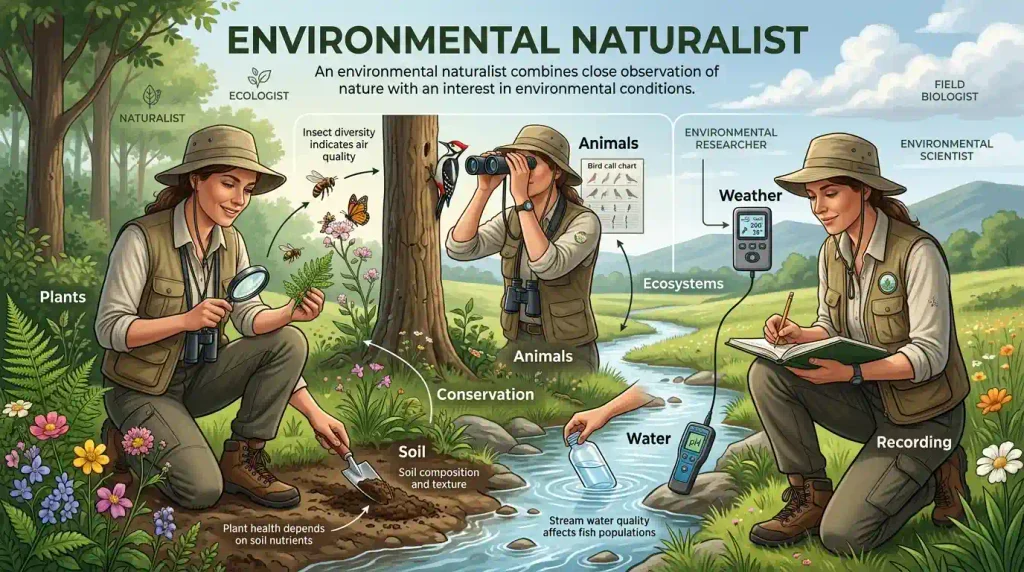
Environmental Naturalist (Noun) — US: /ɪnˌvaɪrənˈmentəl ˈnætʃərəlɪst/ | UK: /ɪnˌvaɪərənˈmentəl ˈnætʃərəlɪst/
Meaning: An environmental naturalist combines close observation of nature with an interest in environmental conditions.
Tone/Register: Descriptive, environmental
Example: The environmental naturalist studies changing habitats.
She documents how local species respond to environmental shifts.
Synonyms for Naturalist by Tone
Positive
For an appreciative tone, use nature enthusiast, wildlife enthusiast, nature lover, nature expert, or nature scholar.
These choices emphasize curiosity, knowledge, and admiration for the natural world.
Neutral
Neutral options include naturalist, wildlife observer, nature observer, nature researcher, field researcher, field scientist, and wildlife researcher.
They describe someone’s relationship with nature without adding strong emotion.
Academic and Scientific
Academic contexts favor precise terms such as biologist, ecologist, botanist, zoologist, ornithologist, entomologist, herpetologist, marine biologist, and biodiversity researcher.
Specific terminology makes technical writing more accurate.
Environmental
For environmental protection, conservationist and environmentalist are often stronger choices.
Still, these words are not perfect replacements. They emphasize environmental action rather than nature observation.
Informal
In casual conversation, nature lover, nature enthusiast, and wildlife enthusiast sound friendly and accessible.
These expressions suit blogs, personal profiles, and everyday discussions.
Naturalist vs Close Alternatives
Naturalist vs Biologist
A naturalist has a broad interest in observing and understanding nature. A biologist specifically studies living organisms through biological science.
Use naturalist for broad field observation. Use biologist when the person’s work involves formal biological research.
Naturalist vs Ecologist
An ecologist focuses on relationships between organisms and their environments. A naturalist can study many aspects of nature without specializing in ecology.
Therefore, an ecologist is more precise in environmental science.
Naturalist vs Conservationist
A naturalist primarily observes or studies nature. A conservationist focuses on protecting wildlife, habitats, or natural resources.
One person can perform both roles, but the main emphasis differs.
How Naturalist Changes by Context
Daily Conversation
In everyday speech, naturalist can describe someone who enjoys observing plants, animals, birds, and outdoor environments.
For a more casual sound, nature lover or nature enthusiast may feel more natural.
Writing and Blogging
Bloggers often choose approachable expressions such as wildlife enthusiast or nature observer.
These alternatives help general readers understand the subject without needing scientific knowledge.
Professional or Academic Writing
Professional writing benefits from precise terminology. A plant specialist is a botanist, while an animal specialist may be a zoologist.
Likewise, an ecosystem researcher is generally an ecologist.
Creative Writing
Creative writers can use field naturalist, nature lover, or wildlife observer to create a vivid image.
These terms can make a character’s connection with forests, birds, plants, or wildlife feel more personal.
Common Mistakes and Native Usage
Mistake: Treating Every Environmentalist as a Naturalist
An environmentalist usually supports environmental protection or advocacy.
A naturalist may simply observe and study nature without promoting environmental causes.
Mistake: Using Biologist for Every Nature Expert
A biologist specializes in living organisms and biological processes.
A naturalist has a broader meaning and does not necessarily have formal scientific training.
Mistake: Confusing Naturalist With Naturist
These words look similar but have very different meanings.
Naturalist relates to nature study and observation. Naturist commonly refers to someone who practices or supports social nudity.
Mistake: Using Highly Specific Terms Incorrectly
Do not call someone an ornithologist unless their work focuses on birds.
Similarly, a botanist studies plants, while an entomologist studies insects.
Native Usage Tip
Native speakers usually select a broad term in casual situations and a precise term in professional settings.
For example, “She is a nature enthusiast” sounds relaxed, while “She is an ecologist” gives specific professional information.
Register Notes
Casual: nature lover, nature enthusiast, wildlife enthusiast
Neutral: naturalist, nature observer, wildlife observer
Professional: wildlife specialist, environmental researcher, field scientist
Academic: biologist, ecologist, botanist, zoologist
Environmental: conservationist, environmentalist
Specialized: ornithologist, entomologist, herpetologist, marine biologist
Choosing the right register makes your writing sound more natural and purposeful.
Real-Life Mini Scenarios
Workplace
A research organization may hire an ecologist to examine how development affects a local ecosystem.
Social Situations
Someone who enjoys birdwatching and hiking might describe themselves as a nature enthusiast.
Media and Pop Culture
A documentary may feature a wildlife expert who explains unusual animal behavior.
Writing and Storytelling
A writer might describe a character as a field naturalist to show their passion for outdoor observation.
How to Choose the Best Synonym
When the subject studies living organisms, biologist is a strong scientific choice.
For ecosystems, ecologist provides greater precision.
When the focus is plants, choose botanist. For animals, zoologist is more specific.
If the person studies birds, ornithologist is the clearest option. For insects, choose entomologist.
When the main goal involves protecting nature, conservationist is often better.
For a relaxed description of someone who loves nature, nature enthusiast or nature lover works well.
Ultimately, naturalist remains a useful broad term for someone who observes, studies, or understands the natural world.
Interactive Practice Quiz
1. Which term best describes someone who studies plants?
A. Zoologist
B. Botanist
C. Ecologist
D. Conservationist
2. Who studies relationships between organisms and their environment?
A. Ecologist
B. Ornithologist
C. Journalist
D. Historian
3. Which option sounds most casual?
A. Nature enthusiast
B. Entomologist
C. Environmental scientist
D. Biodiversity researcher
4. Someone who professionally studies birds. Which word fits best?
A. Botanist
B. Ornithologist
C. Conservationist
D. Ecologist
5. Which word focuses most on protecting habitats?
A. Conservationist
B. Wildlife observer
C. Nature scholar
D. Naturalist
6. Someone studies insects. Which term is most precise?
A. Zoologist
B. Entomologist
C. Ecologist
D. Botanist
7. Which term suits someone who watches wildlife without necessarily being a professional scientist?
A. Wildlife observer
B. Marine biologist
C. Environmental scientist
D. Ecologist
8. Which alternative fits a friendly nature blog?
A. Nature enthusiast
B. Herpetologist
C. Biodiversity researcher
D. Field scientist
9. Someone studies reptiles and amphibians. What is the correct term?
A. Herpetologist
B. Botanist
C. Ornithologist
D. Entomologist
10. Who studies ocean organisms?
A. Marine biologist
B. Botanist
C. Nature scholar
D. Wildlife observer
11. Which word emphasizes environmental protection?
A. Environmentalist
B. Zoologist
C. Nature observer
D. Field researcher
12. Which term sounds most academic?
A. Wildlife enthusiast
B. Nature lover
C. Biodiversity researcher
D. Nature observer
13. Someone studies wild animals in their natural habitats. Which term can fit?
A. Wildlife biologist
B. Botanist
C. Environmentalist
D. Nature lover
14. Which word works as a broad term for someone who studies nature?
A. Naturalist
B. Ornithologist
C. Entomologist
D. Herpetologist
Reflection Task
Write one sentence using naturalist, ecologist, botanist, conservationist, or nature enthusiast.
Then explain why your selected word fits the situation.
Answer Key: 1-B, 2-A, 3-A, 4-B, 5-A, 6-B, 7-A, 8-A, 9-A, 10-A, 11-A, 12-C, 13-A, 14-A
FAQs
1. What is the closest synonym for naturalist?
The closest alternative depends on the person’s role. Nature enthusiast works for someone who enjoys and observes nature, while biologist suits someone who scientifically studies living organisms. Ecologist is more specific when the focus involves interactions between organisms and their environment. Therefore, naturalist remains the broadest choice for general nature observation and study.
2. What is a professional synonym for naturalist?
Professional alternatives include biologist, ecologist, wildlife biologist, environmental scientist, field scientist, and wildlife researcher. The best option depends on specialization. A plant specialist is generally a botanist, while a professional bird researcher is an ornithologist. These precise terms work especially well in academic papers, reports, research profiles, and professional descriptions.
3. What is a simple synonym for naturalist?
For simple everyday English, nature enthusiast, nature lover, nature observer, and wildlife enthusiast are useful choices. They are easy for general readers to understand. However, they do not necessarily suggest professional scientific training. When formal research matters, terms such as biologist or ecologist usually provide more precise information.
4. Is naturalist the same as ecologist?
No. A naturalist has a broad interest in observing and understanding nature. An ecologist specifically studies interactions between organisms and their physical environments. Ecology is therefore a specialized scientific field. A person can be both a naturalist and an ecologist, but the two words highlight different aspects of their knowledge and work.
5. Is a naturalist the same as a conservationist?
Not exactly. A naturalist primarily studies, observes, or appreciates the natural world. A conservationist focuses on protecting wildlife, habitats, ecosystems, or natural resources. Their activities can overlap, but their main purposes differ. Someone who studies endangered animals and works to protect their habitat could accurately fit both descriptions.
6. What is the difference between naturalist and naturist?
The two words have completely different meanings. Naturalist refers to someone who studies, observes, or has a strong interest in nature. Naturist commonly refers to someone who practices or supports social nudity. Because the spelling is similar, learners should check the context carefully before using either word.
7. Which synonym for naturalist is best for academic writing?
The most suitable synonym depends on the subject. Use botanist for plants, zoologist for animals, ornithologist for birds, entomologist for insects, and ecologist for ecosystems. For broad natural-world research, naturalist or natural history researcher may work. Specific terminology usually makes academic writing clearer and more credible.
8. Can an amateur nature lover be called a naturalist?
Yes. A naturalist does not always need to be a professional scientist. Someone who regularly studies birds, identifies plants, records wildlife behavior, or closely observes natural environments can use the term. In everyday English, however, nature enthusiast or nature lover may sound more approachable when formal scientific expertise is not important.
Conclusion
Learning synonyms for naturalist gives you more precise ways to describe people connected with nature. The right word can show their field, expertise, interests, or environmental role.
For instance, botanist identifies a plant specialist, while zoologist identifies an animal specialist. Meanwhile, nature enthusiast creates a warmer and more casual impression.
A stronger vocabulary can improve essays, blogs, professional writing, storytelling, and everyday conversations. Precise word choices also make your message easier for readers to understand.
Keep practicing these alternatives in emails, essays, articles, and daily conversations. Try one new term at a time, and notice how the tone changes with each choice.

Shahzeena Shazadi is the founder and lead writer at VocablyHub.com, where she creates accurate, reader-focused English language content designed to help people communicate with clarity and confidence. She specializes in synonyms, antonyms, word meanings, idioms, and practical vocabulary guides that simplify complex language concepts for everyday use. Every article is carefully researched, fact-checked, and written in clear, accessible language using reliable references and real-world examples. Her goal is to provide helpful, trustworthy content that supports learners at every stage of their English language journey.
Her editorial approach focuses on accuracy, transparency, and user value while following modern content quality standards. She regularly reviews and updates content to keep information relevant, useful, and easy to understand. Through VocablyHub.com, Shahzeena Shazadi is committed to publishing reliable language resources that help students, writers, educators, professionals, and English learners expand their vocabulary, improve their writing skills, and communicate with confidence in academic, professional, and everyday situations.