
A synonym for spend time is an expression such as pass time, devote time, take time, hang out, stay, or occupy yourself. The best choice depends on context. Some alternatives suggest enjoyment, while others emphasize effort, commitment, or how time is used.
A synonym for spend time becomes useful when you want to describe an ordinary moment more clearly. Imagine meeting a friend after work. You could say, “We spent time together,” or make it more natural: “We hung out after work.”
The phrase is common because everyone talks about time. Students describe study routines, bloggers write about daily habits, and colleagues discuss how they use their working hours.
Learning alternatives can make your English more expressive. A student might devote time to revision, while a content writer might invest time in research. Both expressions describe using time, but each adds a different shade of meaning.
If you want to sound more natural in conversation or more precise in writing, choosing the right synonym for spend time can help. The examples below show which expressions work best in different situations.
What Does “Spend Time” Really Mean?
Spend time means to use a period of time doing something, being somewhere, or staying with someone. It is a verb phrase, usually formed with the verb spend and the noun time.
Native English speakers use it for almost every part of daily life. They might spend time with family, spend time studying, spend time at work, or spend time relaxing at home.
The phrase itself is neutral. It does not automatically suggest that the time was enjoyable, productive, or wasted. The surrounding words provide that information.
For example:
- “I spent time with my grandparents.” This often suggests companionship.
- “I spent three hours fixing the computer.” This describes an activity and its duration.
- “I spent too much time scrolling.” This suggests the speaker regrets how the time was used.
Connotative Meaning
(Connotation is the feeling, attitude, or association that a word or phrase carries beyond its basic definition.)
- Positive tone: “I devoted time to helping my community.” This suggests care and commitment.
- Negative tone: “I wasted time arguing online.” This expresses regret or disapproval.
- Neutral tone: “I spent two hours at the library.” This simply reports what happened.
Etymology of “Spend Time”
The phrase combines spend, a verb with Germanic roots, and time, a word that entered English through Old French from Latin tempus, meaning “time.”
The verb spend developed from older forms associated with using or paying out resources. Over time, English speakers extended it from money and other resources to hours, days, and years.
A Brief History
- Old English (450–1100): Early English had related Germanic vocabulary for time and older forms of verbs associated with expenditure. The modern phrase was not yet established in its present form.
- Middle English (1100–1500): Forms of spend became established through contact with related Germanic and French-influenced vocabulary. Using the verb for time developed alongside its resource-related meaning.
- Modern English (1500–present): “Spend time” became an everyday expression for describing activities, relationships, work, leisure, and the passage of life.

Pronunciation, Syllables, and Affixation
Pronunciation of “spend time”
- US IPA: /spɛnd taɪm/
- UK IPA: /spɛnd taɪm/
Syllables: spend-time
Affixation pattern
- Root: spend + time
- Prefix: None
- Suffix: None in the base phrase
Spend is an irregular verb: its common forms are spend, spends, spending, and spent. The phrase can take different grammatical forms, as in “spending time with friends” or “spent time studying.”
Synonyms List
These alternatives share the general idea of using time, but they are not interchangeable in every sentence. Some describe social activities, others emphasize effort, and a few suggest that time is being used unproductively.
1. Pass time (verb phrase) — US /pæs taɪm/ | UK /pɑːs taɪm/
Meaning: To do something while waiting or during an otherwise unoccupied period.
Tone/Register: Neutral, conversational.
Examples:
I read a magazine to pass the time at the airport.
She played a word game to pass the time on the train.
2. While away time (verb phrase) — US /waɪl əˈweɪ taɪm/ | UK /waɪl əˈweɪ taɪm/
Meaning: To let time pass by doing something, often in a relaxed or unhurried way.
Tone/Register: Conversational, slightly literary.
Examples:
We whiled away the afternoon chatting in the garden.
He whiled away an hour watching the boats.
3. Devote time to (verb phrase) — US /dɪˈvoʊt taɪm tuː/ | UK /dɪˈvəʊt taɪm tuː/
Meaning: To give time and attention to an activity or responsibility.
Tone/Register: Formal, academic, professional.
Examples:
She devotes time to mentoring new employees.
I need to devote more time to my studies.
4. Dedicate time to (verb phrase) — US /ˈdɛdɪˌkeɪt taɪm tuː/ | UK /ˈdɛdɪkeɪt taɪm tuː/
Meaning: To deliberately reserve time for something important.
Tone/Register: Positive, purposeful.
Examples:
He dedicates time to learning a new language every evening.
They dedicated their weekends to restoring the old house.
5. Invest time in (verb phrase) — US /ɪnˈvɛst taɪm ɪn/ | UK /ɪnˈvɛst taɪm ɪn/
Meaning: To use time with the expectation of gaining a benefit or making progress.
Tone/Register: Professional, motivational.
Examples:
Invest time in building strong writing habits.
She invested months in preparing for the exam.
6. Allocate time to (verb phrase) — US /ˈæləˌkeɪt taɪm tuː/ | UK /ˈæləkeɪt taɪm tuː/
Meaning: To assign a particular amount of time to a task.
Tone/Register: Formal, business, academic.
Examples:
We allocate thirty minutes to each interview.
Try to allocate more time to reading practice.
7. Set aside time for (verb phrase) — US /sɛt əˈsaɪd taɪm fɔːr/ | UK /sɛt əˈsaɪd taɪm fɔː/
Meaning: To reserve time for an activity in advance.
Tone/Register: Neutral, practical.
Examples:
I set aside time for exercise before breakfast.
She sets aside Sunday afternoons for her family.
8. Make time for (verb phrase) — US /meɪk taɪm fɔːr/ | UK /meɪk taɪm fɔː/
Meaning: To find room in a busy schedule for a person or activity.
Tone/Register: Warm, everyday.
Examples:
Even during exams, he makes time for his friends.
Let’s make time for a proper catch-up this week.
9. Use time (verb phrase) — US /juːz taɪm/ | UK /juːz taɪm/
Meaning: To employ a period of time for a particular purpose.
Tone/Register: Neutral.
Examples:
Use your free time to review the difficult chapters.
We used the extra hour to finish the presentation.
10. Fill time (verb phrase) — US /fɪl taɪm/ | UK /fɪl taɪm/
Meaning: To occupy an available period, especially when there is little else to do.
Tone/Register: Neutral, conversational.
Examples:
I filled time before my appointment by browsing a bookshop.
The host asked a few questions to fill time before the show.
11. Kill time (verb phrase) — US /kɪl taɪm/ | UK /kɪl taɪm/
Meaning: To do something mainly to make waiting feel shorter.
Tone/Register: Informal.
Examples:
We killed time at the café until the doors opened.
He watched short videos to kill time during the delay.
12. Spend quality time (verb phrase) — US /spɛnd ˈkwɑːləti taɪm/ | UK /spɛnd ˈkwɒləti taɪm/
Meaning: To give someone meaningful, attentive time rather than simply being nearby.
Tone/Register: Positive, personal.
Examples:
I want to spend quality time with my children tonight.
They spent quality time together without checking their phones.
13. Hang out (phrasal verb) — US /hæŋ aʊt/ | UK /hæŋ aʊt/
Meaning: To relax or socialize with other people without a formal plan.
Tone/Register: Informal, friendly.
Examples:
We hang out at the park after class.
Do you want to hang out this weekend?
14. Socialize (verb) — US /ˈsoʊʃəˌlaɪz/ | UK /ˈsəʊʃəlaɪz/
Meaning: To spend time interacting with other people.
Tone/Register: Neutral, social, professional.
Examples:
New students can socialize during the welcome event.
She socializes with colleagues after work sometimes.
15. Be with (verb phrase) — US /biː wɪð/ | UK /biː wɪð/
Meaning: To spend time in another person’s company.
Tone/Register: Neutral, personal.
Examples:
I just want to be with my family this evening.
He was with his closest friends during the holiday.
16. Keep someone company (verb phrase) — US /kiːp ˈsʌmwʌn ˈkʌmpəni/ | UK /kiːp ˈsʌmwʌn ˈkʌmpəni/
Meaning: To stay with someone so they do not feel alone.
Tone/Register: Caring, conversational.
Examples:
I stayed to keep my grandmother company.
Can you keep me company while I wait for the bus?
17. Stay with (verb phrase) — US /steɪ wɪð/ | UK /steɪ wɪð/
Meaning: To remain in someone’s company or at a particular place for a period.
Tone/Register: Neutral.
Examples:
We stayed with our cousins for the whole weekend.
She stayed with her friend until the rain stopped.
18. Relax (verb) — US /rɪˈlæks/ | UK /rɪˈlæks/
Meaning: To spend time resting and becoming less tense.
Tone/Register: Casual, positive.
Examples:
I relax with a novel after a busy day.
He relaxed at home instead of going out.
19. Unwind (verb) — US /ʌnˈwaɪnd/ | UK /ʌnˈwaɪnd/
Meaning: To spend time releasing stress after work or another demanding activity.
Tone/Register: Informal, wellness-oriented.
Examples:
She unwinds by listening to jazz in the evening.
I need an hour to unwind after the meeting.
20. Linger (verb) — US /ˈlɪŋɡər/ | UK /ˈlɪŋɡə/
Meaning: To remain somewhere longer than expected, often because you do not want to leave.
Tone/Register: Descriptive, literary.
Examples:
We lingered over coffee after lunch.
A few guests lingered in the garden after the party.
21. Work on (phrasal verb) — US /wɜːrk ɑːn/ | UK /wɜːk ɒn/
Meaning: To use time making progress on a task, project, or skill.
Tone/Register: Neutral, professional.
Examples:
I’m working on my research paper this afternoon.
She worked on the design throughout the weekend.

22. Study (verb) — US /ˈstʌdi/ | UK /ˈstʌdi/
Meaning: To spend time learning about a subject or preparing for an assessment.
Tone/Register: Academic, neutral.
Examples:
He studies biology for two hours every night.
I studied with my classmates before the final exam.
23. Practice (verb) — US /ˈpræktɪs/ | UK /ˈpræktɪs/
Meaning: To spend time repeating an activity to improve a skill.
Tone/Register: Educational, purposeful.
Examples:
She practices the piano before dinner.
I practice speaking English with a friend each day.
24. Train (verb) — US /treɪn/ | UK /treɪn/
Meaning: To spend time developing physical ability or preparing for a specific performance.
Tone/Register: Athletic, professional.
Examples:
The runners train at the stadium every morning.
He’s training for his first marathon.
25. Learn (verb) — US /lɜːrn/ | UK /lɜːn/
Meaning: To use time gaining knowledge or developing a new ability.
Tone/Register: Neutral, educational.
Examples:
She learns Spanish through daily conversations.
I spent the summer learning how to cook.
26. Pursue (verb) — US /pərˈsuː/ | UK /pəˈsjuː/
Meaning: To spend time working toward a goal, interest, or ambition.
Tone/Register: Formal, aspirational.
Examples:
He pursues his interest in photography on weekends.
She pursued a degree while working full-time.
27. Engage in (verb phrase) — US /ɪnˈɡeɪdʒ ɪn/ | UK /ɪnˈɡeɪdʒ ɪn/
Meaning: To take part in an activity and give it some attention.
Tone/Register: Formal, academic.
Examples:
The students engage in group discussions every Friday.
He engages in regular physical activity to stay fit.
28. Participate in (verb phrase) — US /pɑːrˈtɪsəˌpeɪt ɪn/ | UK /pɑːˈtɪsɪpeɪt ɪn/
Meaning: To take part in an event or activity over a period of time.
Tone/Register: Neutral, formal.
Examples:
I participated in a community cleanup last weekend.
Several employees participated in the training session.
29. Attend (verb) — US /əˈtɛnd/ | UK /əˈtɛnd/
Meaning: To be present at an organized event, class, or meeting.
Tone/Register: Neutral, professional.
Examples:
She attends evening classes twice a week.
I attended a three-day writing workshop.
Note: Attend means being present, not necessarily spending all your time actively participating.
30. Devote oneself to (verb phrase) — US /dɪˈvoʊt wʌnˈsɛlf tuː/ | UK /dɪˈvəʊt wʌnˈself tuː/
Meaning: To give substantial time and energy to a pursuit or responsibility.
Tone/Register: Formal, committed.
Examples:
After retiring, he devoted himself to community service.
She devoted herself to writing her first novel.
31. Immerse oneself in (verb phrase) — US /ɪˈmɜːrs wʌnˈsɛlf ɪn/ | UK /ɪˈmɜːs wʌnˈself ɪn/
Meaning: To become deeply involved in an activity or experience for an extended period.
Tone/Register: Descriptive, academic, creative.
Examples:
He immersed himself in French films to improve his listening.
She immersed herself in the world of historical fiction.
32. Dabble in (verb phrase) — US /ˈdæbəl ɪn/ | UK /ˈdæbəl ɪn/
Meaning: To spend a little time trying an activity without making it a major commitment.
Tone/Register: Informal, light.
Examples:
I dabble in watercolor painting when I have free time.
She has dabbled in coding but hasn’t chosen a specialty.
33. Explore (verb) — US /ɪkˈsplɔːr/ | UK /ɪkˈsplɔː/
Meaning: To spend time discovering a place, subject, idea, or possibility.
Tone/Register: Neutral, curious.
Examples:
We explored the old town for most of the afternoon.
He spent months exploring different career paths.
34. Browse (verb) — US /braʊz/ | UK /braʊz/
Meaning: To look through items or information casually, without a fixed goal.
Tone/Register: Informal, everyday.
Examples:
I browsed the shelves while waiting for my friend.
She browses travel blogs on quiet evenings.
35. Read (verb) — US /riːd/ | UK /riːd/
Meaning: To use time looking at and understanding written material.
Tone/Register: Neutral, educational or recreational.
Examples:
He reads the news over breakfast.
I read a mystery novel during the flight.
36. Watch (verb) — US /wɑːtʃ/ | UK /wɒtʃ/
Meaning: To spend time viewing a program, event, or activity.
Tone/Register: Neutral, conversational.
Examples:
We watched a documentary after dinner.
She watches birds from her kitchen window every morning.
37. Listen to (verb phrase) — US /ˈlɪsən tuː/ | UK /ˈlɪsən tuː/
Meaning: To use time hearing and paying attention to music, speech, or other sounds.
Tone/Register: Neutral, everyday.
Examples:
I listen to podcasts on my commute.
They listened to their grandfather’s stories all evening.
38. Travel (verb) — US /ˈtrævəl/ | UK /ˈtrævəl/
Meaning: To spend time going from one place to another, often for work or enjoyment.
Tone/Register: Neutral.
Examples:
We traveled around the coast for ten days.
She travels by train whenever possible.
39. Wander (verb) — US /ˈwɑːndər/ | UK /ˈwɒndə/
Meaning: To move around without a fixed route or strict schedule.
Tone/Register: Relaxed, descriptive.
Examples:
We wandered through the market until sunset.
He wandered around the museum at his own pace.
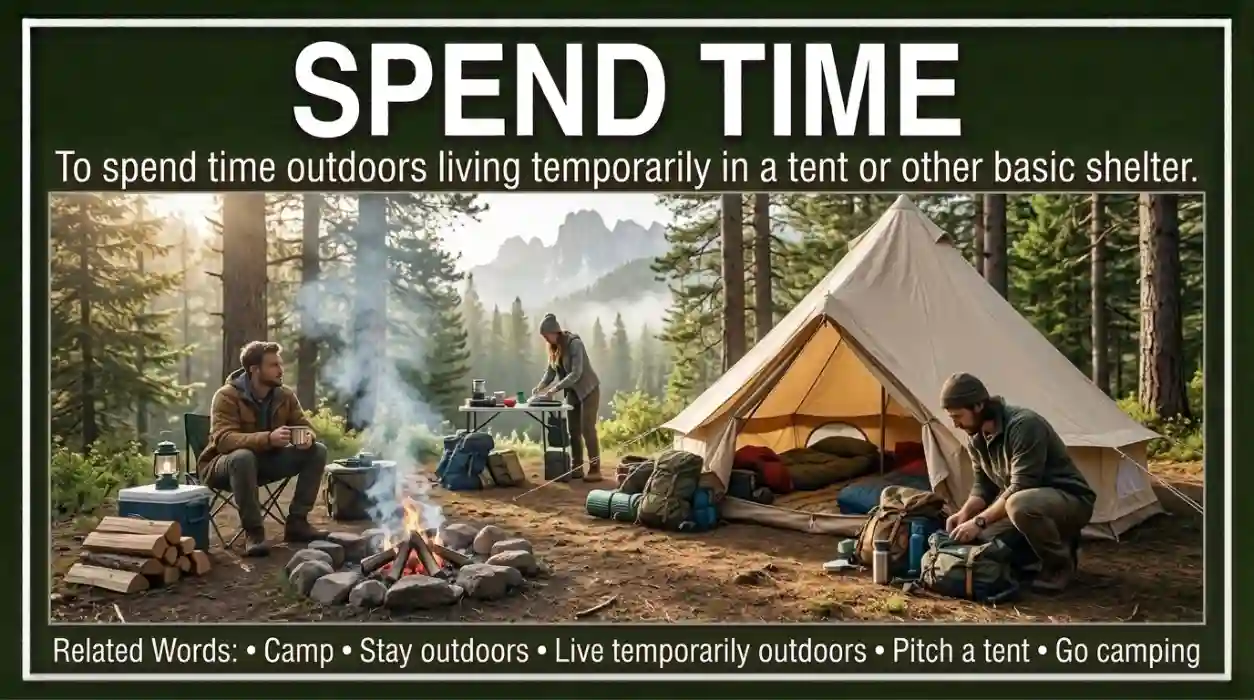
40. Camp (verb) — US /kæmp/ | UK /kæmp/
Meaning: To spend time outdoors living temporarily in a tent or other basic shelter.
Tone/Register: Informal, outdoor recreation.
Examples:
Our family camped beside the lake for three nights.
They camped in the hills during their school break.
41. Volunteer (verb) — US /ˌvɑːlənˈtɪr/ | UK /ˌvɒlənˈtɪə/
Meaning: To give time freely to help people, an organization, or a cause.
Tone/Register: Positive, community-focused.
Examples:
She volunteers at the local library every Saturday.
I volunteered to help organize the neighborhood festival.
42. Care for (verb phrase) — US /kɛr fɔːr/ | UK /keə fɔː/
Meaning: To spend time looking after someone or something that needs attention.
Tone/Register: Caring, practical.
Examples:
He cares for his younger brother after school.
She spent the afternoon caring for an injured bird.
43. Look after (phrasal verb) — US /lʊk ˈæftər/ | UK /lʊk ˈɑːftə/
Meaning: To spend time taking responsibility for a person, animal, or place.
Tone/Register: Everyday, caring.
Examples:
Can you look after the children for an hour?
They looked after their neighbor’s cat during the holiday.
44. Entertain oneself (verb phrase) — US /ˌɛntərˈteɪn wʌnˈsɛlf/ | UK /ˌentəˈteɪn wʌnˈself/
Meaning: To find an activity that keeps you interested when you are alone or waiting.
Tone/Register: Neutral, slightly formal.
Examples:
The children entertained themselves with a puzzle.
I entertained myself by sketching in my notebook.
45. Amuse oneself (verb phrase) — US /əˈmjuːz wʌnˈsɛlf/ | UK /əˈmjuːz wʌnˈself/
Meaning: To spend time doing something enjoyable or funny for your own pleasure.
Tone/Register: Neutral, sometimes playful.
Examples:
He amused himself by inventing silly names for the plants.
She amused herself with a crossword while waiting.
46. Play (verb) — US /pleɪ/ | UK /pleɪ/
Meaning: To spend time taking part in a game or recreational activity.
Tone/Register: Informal, everyday.
Examples:
The children played outside until dinner.
We played cards during the power outage.
47. Rehearse (verb) — US /rɪˈhɜːrs/ | UK /rɪˈhɜːs/
Meaning: To spend time practicing a performance, speech, or presentation before delivering it.
Tone/Register: Professional, creative.
Examples:
The band rehearsed for two hours before the concert.
I rehearsed my presentation in front of a mirror.
48. Reflect (verb) — US /rɪˈflɛkt/ | UK /rɪˈflɛkt/
Meaning: To spend time thinking carefully about experiences, decisions, or ideas.
Tone/Register: Thoughtful, formal.
Examples:
She reflected on the lessons she learned that year.
I took a quiet walk to reflect on my next move.
49. Meditate (verb) — US /ˈmɛdəˌteɪt/ | UK /ˈmedɪteɪt/
Meaning: To spend time practicing focused attention or calm awareness.
Tone/Register: Calm, wellness-oriented.
Examples:
He meditates for ten minutes before starting work.
She spent the morning meditating beside the window.
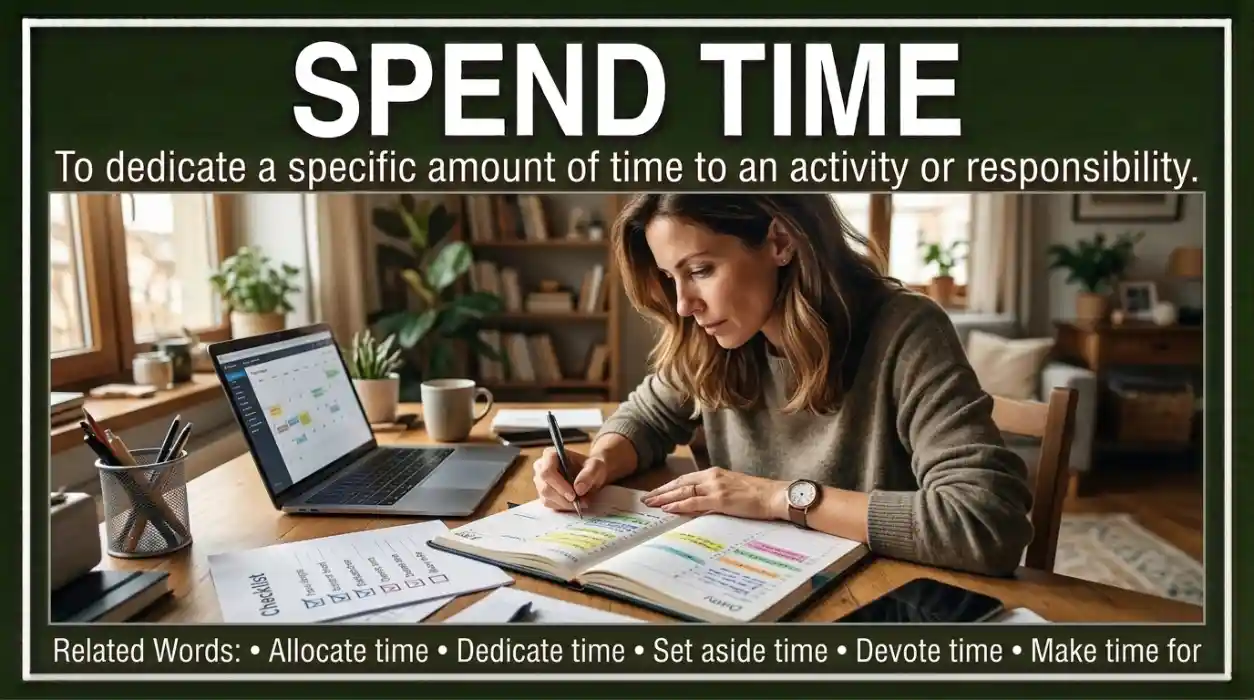
50. Devote an hour (or another period) to (verb phrase) — US /dɪˈvoʊt ən ˈaʊər tuː/ | UK /dɪˈvəʊt ən ˈaʊə tuː/
Meaning: To give a specific length of time to one activity or responsibility.
Tone/Register: Neutral to formal, purposeful.
Examples:
I devote an hour each day to improving my vocabulary.
They devoted the entire afternoon to planning the event.
Synonyms by Tone
The best synonym depends on what you want your reader or listener to understand. A phrase about relaxing may sound odd in a formal report, while a business expression may feel stiff in a friendly conversation.
Positive synonyms
Use these when time brings enjoyment, connection, learning, or personal growth:
- Spend quality time — emphasizes meaningful relationships.
- Make time for — shows that someone matters enough to fit into a busy schedule.
- Invest time in — suggests a worthwhile future benefit.
- Dedicate time to — conveys commitment.
- Unwind — highlights rest and stress relief.
- Immerse oneself in — suggests deep involvement.
- Volunteer — emphasizes freely giving time to help others.
Neutral synonyms
These work for ordinary descriptions without strong emotional judgment:
- Use time
- Pass time
- Stay with
- Browse
- Read
- Watch
- Listen to
- Participate in
- Attend
- Explore
Negative or critical expressions
These are useful when the speaker wants to express regret, inefficiency, or a lack of purpose:
- Kill time — usually means filling a wait, not necessarily wasting time.
- While away time — can sound relaxed, but may imply that time passed without a clear purpose.
- Dabble in — can suggest limited or casual commitment, depending on context.
Important: Waste time is another common expression, but it is not a neutral replacement. It explicitly suggests that the time was used badly or unproductively.
Playful and informal synonyms
Use these with friends or in relaxed conversation:
- Hang out
- Kill time
- Play
- Amuse oneself
- Entertain oneself
- Dabble in
Tone matters because synonyms do more than repeat an idea. They tell your reader whether an activity is serious, enjoyable, casual, or purposeful.
“Spend Time” vs. Close Alternatives
| Expression | Main difference | Best situation |
|---|---|---|
| Spend time | General and flexible; does not explain whether the time was useful or enjoyable | Everyday speech and writing |
| Devote time to | Highlights commitment and attention | Study, work, causes, and important responsibilities |
| Hang out | Emphasizes relaxed social contact | Friends, family, and casual plans |
| Invest time in | Suggests that effort may produce a future benefit | Learning, career development, and relationships |
| Kill time | Emphasizes filling an otherwise empty period | Waiting for transport, appointments, or events |
Compare these examples:
- “I spent time learning Spanish.” This is a general description.
- “I devoted time to learning Spanish.” This emphasizes commitment.
- “I invested time in learning Spanish.” This suggests that the effort may pay off later.
The activity is similar in each sentence, but the speaker’s emphasis changes.
How “Spend Time” Changes by Context
Daily conversation
For friends and family, simple expressions usually sound the most natural. Say “We hung out after class” when you mean casual socializing. Use “I relaxed at home” when you mean resting.
“Spend time” remains a safe, natural choice when you do not need to emphasize a particular feeling or purpose.
Writing and blogging
Writers can use more specific verbs to avoid repetitive sentences. Instead of repeatedly saying that someone spends time on a hobby, try practices, explores, pursues, or immerses themselves in, depending on the activity.
Choose an expression that adds meaning rather than one that merely changes the wording.
Professional and academic English
In reports, essays, and workplace communication, phrases such as allocate time to, devote time to, and participate in can sound more precise.
For example, “The team allocated two hours to testing” is more specific than “The team spent time testing.” However, simple language is often better when the extra formality adds no useful meaning.
Creative and informal writing
In storytelling, a verb can help establish atmosphere. Characters might linger over breakfast, wander through a quiet street, or spend a rainy afternoon.
These expressions create a clearer picture of the scene. Choose them for their exact meaning, not just because they sound more sophisticated.
Common Mistakes Learners Make
Using an alternative that does not fit the activity
“Hang out” generally describes casual socializing. It does not naturally replace “spend time” in every sentence.
- Natural: “I hung out with my cousins.”
- Better for a work report: “I devoted time to the project.”
Treating every synonym as equally positive
“Invest time” often implies a worthwhile effort. “Kill time” usually means filling a period while waiting. “Waste time” directly criticizes how time was used.
These phrases may refer to similar periods, but their meanings and attitudes differ.
Forgetting the correct preposition
Many alternatives use specific prepositions:
- Devote time to a task.
- Invest time in a skill.
- Set aside time for an appointment.
- Engage in an activity.
- Immerse yourself in a subject.
Learning the entire phrase helps you avoid grammatical errors.
Overusing formal vocabulary
Replacing every instance of “spend time” with allocate, dedicate, or immerse can make writing sound unnatural. In everyday English, ordinary expressions are often the clearest choice.
Register notes
- Formal and professional: allocate time to, devote time to, participate in.
- Informal and conversational: hang out, kill time, chill out (very informal).
- Written and descriptive: linger, wander, while away time.
- Neutral and widely useful: spend time, use time, make time for.
For additional vocabulary practice, you can explore a related guide to synonyms for enjoy and compare how each word changes the tone of a sentence.
Real-Life Examples Using
At work:
A project manager might say, “We allocated an extra hour to testing the new feature.” This tells the team exactly how the schedule was organized.
With friends:
Someone might text, “Want to hang out after dinner?” The phrase sounds friendly and relaxed.
In entertainment:
A viewer might say, “I spent the evening watching documentaries.” A more descriptive version could be, “I immersed myself in a series about ancient history.”
In a personal story:
A writer could say, “They lingered on the porch long after sunset.” This creates a slower, more reflective mood than simply saying they spent time outside.
Practice Exercise
1. You are waiting for a delayed train and play a puzzle. What do you do?
Devote time
Kill time
Participate in
2. You reserve Sunday morning for your family. What do you do?
Set aside time for
Dabble in
Linger
3. You want to emphasize the future benefit of learning coding.
Invest time in
Kill time
Hang out
4. You meet friends and chat casually at a café.
Allocate time
Hang out
Rehearse
5. A formal report explains that two hours were assigned to interviews.
Amuse oneself
Allocate time to
Wander
6. You repeat a speech before giving it to an audience.
Rehearse
Socialize
While away time
7. You remain at a café because you enjoy the conversation and do not want to leave.
Linger
Train
Attend
8. You help at a community food bank without being paid.
Volunteer
Browse
Kill time
9. You give careful attention to a major research project.
Devote time to
Dabble in
Fill time
10. You casually try painting without making it a serious hobby.
Immerse yourself in
Dabble in
Pursue
Answer key: 1. Kill time · 2. Set aside time for · 3. Invest time in · 4. Hang out · 5. Allocate time to · 6. Rehearse · 7. Linger · 8. Volunteer · 9. Devote time to · 10. Dabble in
Reflection task
Write two short sentences about your day. In the first, use spend time. In the second, replace it with a more precise synonym. Notice how the change affects the meaning or tone.
External Source
For reliable definitions, pronunciation, and authentic usage examples, consult the Cambridge Dictionary: dictionary.cambridge.org.
Conclusion
Learning alternatives to spend time helps you express your ideas more clearly. A small vocabulary change can make your writing more vivid, precise, and natural.
For better blogging and essays, choose verbs that explain how time is used. For speaking, try familiar expressions that fit the situation and sound comfortable.
Practice these alternatives in emails, essays, and everyday conversations. Start with two or three new expressions, then use them until they become part of your natural English.
Keep exploring, reading, and experimenting with words. Write your own examples, notice how native speakers use these phrases, and build your vocabulary one meaningful sentence at a time.
Frequently Asked Questions
1. What is the most natural synonym for “spend time with someone”?
Be with, hang out with, and enjoy someone’s company are natural alternatives, but they have different shades of meaning. “Be with” is broad and neutral. “Hang out with” suggests casual socializing. “Enjoy someone’s company” highlights the pleasure of being together. Choose the phrase that reflects the relationship and situation.
2. How can I say “spend time” without repeating it in an essay?
Replace the phrase according to the activity. Use study for learning, practice for developing a skill, devote time to for commitment, or explore for discovering ideas. You can also restructure a sentence. Instead of “She spent time reading,” write “She read every evening.” Clear writing matters more than using a different synonym in every sentence.
3. What is a professional way to say “spend time on a task”?
Devote time to, allocate time to, and invest time in are useful professional alternatives. “Allocate time” emphasizes scheduling and resources. “Devote time” highlights attention and commitment. “Invest time” suggests that the effort may produce benefits. For example, “The team allocated two hours to testing” is suitable for a project update.
4. Is “pass time” the same as “spend time”?
Not exactly. “Pass time” usually means doing something to make a waiting period feel shorter or to occupy an otherwise empty period. “Spend time” is broader and can describe purposeful work, relationships, hobbies, or rest. You might pass time with a crossword while waiting, but spend time studying for an exam.
5. What is a synonym for spending time together as a family?
Spend quality time together is a common choice when you want to emphasize meaningful attention. You could also say “be together,” “enjoy time together,” or “share time as a family.” “Hang out together” works in casual conversation. If you want to emphasize family connection, choose a phrase that communicates closeness rather than simply being in the same place.

Shahzeena Shazadi is the founder and lead writer at VocablyHub.com, where she creates accurate, reader-focused English language content designed to help people communicate with clarity and confidence. She specializes in synonyms, antonyms, word meanings, idioms, and practical vocabulary guides that simplify complex language concepts for everyday use. Every article is carefully researched, fact-checked, and written in clear, accessible language using reliable references and real-world examples. Her goal is to provide helpful, trustworthy content that supports learners at every stage of their English language journey.
Her editorial approach focuses on accuracy, transparency, and user value while following modern content quality standards. She regularly reviews and updates content to keep information relevant, useful, and easy to understand. Through VocablyHub.com, Shahzeena Shazadi is committed to publishing reliable language resources that help students, writers, educators, professionals, and English learners expand their vocabulary, improve their writing skills, and communicate with confidence in academic, professional, and everyday situations.