
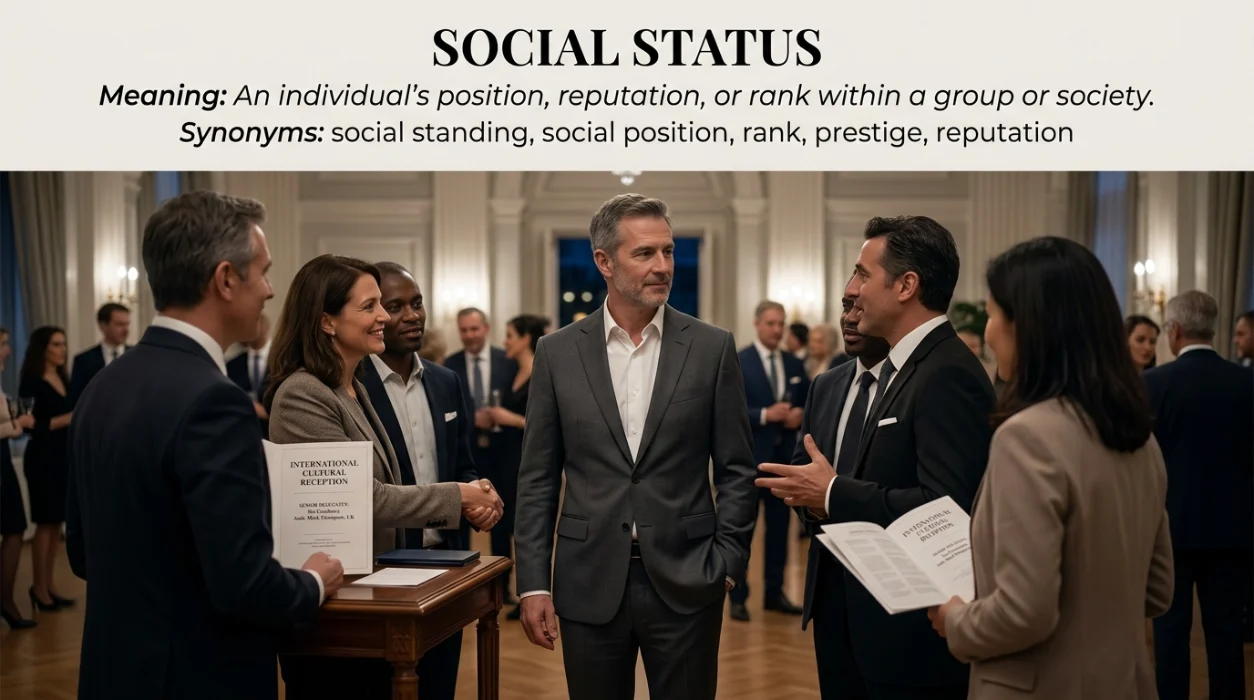
The term social status refers to the position or standing a person or group has within a society. It can be influenced by factors such as occupation, education, wealth, reputation, family background, or social recognition.
Understanding social status can help you describe how people or groups are viewed or positioned within a particular community or society. Learning its synonyms, meaning, and examples can also expand your English vocabulary and improve your communication skills.
The meaning of social status can vary depending on the context. It may describe social rank, prestige, standing, position, or the level of recognition someone has within a community.
By learning social status, its synonyms, meaning, and examples, you can strengthen your vocabulary and writing skills. This guide will help you understand the term clearly and use it naturally and confidently in different English contexts.
What Does “Social Status” Really Mean?
The phrase “social status” refers to a person’s standing, rank, or position within a community or social hierarchy. Native speakers use it to describe both earned prestige and inherited societal placement.
In English grammar, “social status” functions as a compound noun phrase, representing a concrete position or abstract influence within a community.
Definition: The relative rank, standing, or position that an individual holds within a society.
Connotative Meaning
Connotation refers to the emotional feeling or cultural association attached to a word beyond its strict dictionary definition.
- Positive tone: Prestige, honor, high standing, respect, and recognized authority.
- Negative tone: Elitism, class divides, caste barriers, and pretentious arrogance.
- Neutral tone: Sociological position, demographic rank, or objective administrative tier.
Etymology and History
The term combines “social” (from Latin socialis, meaning companionable) and “status” (from Latin status, meaning condition or standing).
- Old English (450–1100): Early Anglo-Saxons used terms like dóm (judgment/repute) or æðelu (noble birth) to describe community rank.
- Middle English (1100–1500): Anglo-Norman French introduced words like estate and degree to define strict feudal ranks.
- Modern English (1500–Present): The exact phrase emerged in sociological studies to measure socio-economic position objectively.
Pronunciation and Syllables
- US Pronunciation: /ˈsoʊ.ʃəl ˈstæt.əs/
- UK Pronunciation: /ˈsəʊ.ʃəl ˈsteɪ.təs/
- Syllables: so-cial sta-tus
Affixation Pattern:
- Root: soci- (companion) + stat- (stand)
- Prefix: None
- Suffix: -al (adjective-forming) + -us (noun-forming)
Synonyms List
Standing (Noun) — US: /ˈstæn.dɪŋ/ | UK: /ˈstæn.dɪŋ/
Meaning: An individual’s position, reputation, or rank within a group or society.
Tone/Register: General / Neutral
Examples:
- Her standing in the legal community grew after winning the historic civil rights case.
- The local business owner maintained a respected standing among town residents.
Rank (Noun) — US: /ræŋk/ | UK: /ræŋk/
Meaning: A specific official or social position within a hierarchical structure.
Tone/Register: Formal / Structural
Examples:
- Officers of high rank attended the international military summit yesterday.
- She rose through the corporate ranks to become chief operating officer.
Prestige (Noun) — US: /prɛˈstiːʒ/ | UK: /prɛˈstiːʒ/
Meaning: Widespread respect or admiration felt for someone based on their achievements.
Tone/Register: Elevated / Positive
Examples:
- Winning the international science award brought great prestige to her university.
- The institution lost its historical prestige after the financial audit revealed flaws.
Stature (Noun) — US: /ˈstætʃ.ɚ/ | UK: /ˈstætʃ.ər/
Meaning: High reputation or importance gained through ability or achievement.
Tone/Register: Formal / Respectful
Examples:
- The professor’s academic stature attracted top graduate students from around the world.
- Her growing stature as a diplomat helped settle the regional dispute quickly.
Position (Noun) — US: /pəˈzɪʃ.ən/ | UK: /pəˈzɪʃ.ən/
Meaning: A person’s location or place within a social hierarchy or organization.
Tone/Register: Neutral / Practical
Examples:
- His position in the firm guaranteed access to executive board meetings.
- They discussed her changing social position after the inheritance was finalized.
Caste (Noun) — US: /kæst/ | UK: /kɑːst/
Meaning: A rigid social class system based on hereditary status or wealth.
Tone/Register: Formal / Academic
Examples:
- Historical scholars analyzed the traditional caste system of the ancient kingdom.
- Modern legislation aims to reduce traditional caste discrimination across rural provinces.
Class (Noun) — US: /klæs/ | UK: /klɑːs/
Meaning: A division of society based on economic, educational, and social status.
Tone/Register: General / Sociological
Examples:
- She wrote an insightful essay exploring working-class history in industrial towns.
- Economic mobility allows citizens to transition between social class categories.
Estate (Noun) — US: /ɪˈsteɪt/ | UK: /ɪˈsteɪt/
Meaning: A historical major order or class in a feudal or traditional society.
Tone/Register: Historical / Formal
Examples:
- Feudal societies divided populations into distinct estate levels governed by law.
- The third estate demanded fair political representation during the revolution.
Station (Noun) — US: /ˈsteɪ.ʃən/ | UK: /ˈsteɪ.ʃən/
Meaning: One’s assigned or recognized social rank and duties in life.
Tone/Register: Literary / Traditional
Examples:
- Nineteenth-century novels often depicted characters striving to improve their station.
- She treated everyone with kindness regardless of their social station or wealth.
Distinction (Noun) — US: /dɪˈstɪŋk.ʃən/ | UK: /dɪˈstɪŋk.ʃən/
Meaning: Excellence that sets someone apart with high social honor or rank.
Tone/Register: Formal / Positive
Examples:
- The diplomat served the nation with great distinction for three decades.
- He received a medal of distinction during the annual civic ceremony.
Prominence (Noun) — US: /ˈprɑː.mə.nəns/ | UK: /ˈprɒm.ɪ.nəns/
Meaning: The state of being famous, important, or highly noticeable in society.
Tone/Register: Public / Elevated
Examples:
- Her rapid rise to prominence surprised many political analysts this season.
- The family used their public prominence to advocate for environmental reform.
Reputation (Noun) — US: /ˌrɛp.jəˈteɪ.ʃən/ | UK: /ˌrep.jəˈteɪ.ʃən/
Meaning: The opinion that people generally have about a person’s character or standing.
Tone/Register: Universal / Everyday
Examples:
- The doctor built an outstanding reputation for compassionate patient care.
- False rumors threatened to damage his professional reputation in the industry.
Renown (Noun) — US: /rɪˈnaʊn/ | UK: /rɪˈnaʊn/
Meaning: The state of being widely acclaimed, famous, and highly honored.
Tone/Register: Literary / Positive
Examples:
- The architect achieved international renown for designing sustainable skyscrapers.
- Authors of great renown contributed essays to the literary magazine.
Esteem (Noun) — US: /ɪˈstiːm/ | UK: /ɪˈstiːm/
Meaning: Respect and admiration held by society or peers for an individual.
Tone/Register: Respectful / Warm
Examples:
- She is held in high esteem by colleagues across the research field.
- The community showed deep esteem for the retiring town mayor.
Repute (Noun) — US: /rɪˈpjuːt/ | UK: /rɪˈpjuːt/
Meaning: The general opinion or status held by a person in public view.
Tone/Register: Formal / Traditional
Examples:
- He is a scholar of international repute in ancient history studies.
- The firm maintained its solid reputation by delivering quality services.
Footing (Noun) — US: /ˈfʊt.ɪŋ/ | UK: /ˈfʊt.ɪŋ/
Meaning: The basis on which relationships or standing exist between individuals.
Tone/Register: Practical / Relational
Examples:
- The new agreement placed both negotiating partners on an equal footing.
- She interacted with senior managers on a friendly and professional footing.
Tier (Noun) — US: /tɪr/ | UK: /tɪər/
Meaning: A specific level or grade within a ranked social or corporate hierarchy.
Tone/Register: Corporate / Categorical
Examples:
- Executive directors belong to the top tier of corporate management.
- The policy provides distinct benefits for each economic tier of society.
Degree (Noun) — US: /dɪˈɡriː/ | UK: /dɪˈɡriː/
Meaning: A step, level, or grade in a social scale or hierarchy.
Tone/Register: Historical / Formal
Examples:
- Court etiquette varied according to the noble degree of each guest.
- Citizens of every degree gathered to hear the official announcement.
Order (Noun) — US: /ˈɔːr.dɚ/ | UK: /ˈɔː.dər/
Meaning: A rank, social class, or group organized by status or profession.
Tone/Register: Institutional / Traditional
Examples:
- Medieval society was organized into strict religious and secular order groups.
- Leaders sought to maintain social order during times of economic change.
Level (Noun) — US: /ˈlɛv.əl/ | UK: /ˈlev.əl/
Meaning: A position in a scale of rank, responsibility, or social standing.
Tone/Register: General / Everyday
Examples:
- Entry-level employees receive guidance from managers at the supervisory level.
- Housing options vary across every income level in the city.

Pedigree (Noun) — US: /ˈpɛd.ə.ɡriː/ | UK: /ˈped.ɪ.ɡriː/
Meaning: Social lineage, ancestral background, or inherited family standing.
Tone/Register: Traditional / Elite
Examples:
- His aristocratic pedigree gave him access to exclusive social clubs.
- Biographers researched her historical pedigree to understand her family background.
Lineage (Noun) — US: /ˈlɪn.i.ɪdʒ/ | UK: /ˈlɪn.i.ɪdʒ/
Meaning: Direct descent from an ancestor that determines family heritage or rank.
Tone/Register: Historical / Formal
Examples:
- Royal lineage determined who inherited the throne under ancient laws.
- She traced her family lineage back to early settlement pioneers.
Bloodline (Noun) — US: /ˈblʌd.laɪn/ | UK: /ˈblʌd.laɪn/
Meaning: The sequence of ancestors determining inherited social or royal status.
Tone/Register: Expressive / Traditional
Examples:
- The noble bloodline was preserved through strategic family marriages.
- Historians documented the ancient bloodline of regional rulers.
Heritage (Noun) — US: /ˈhɛr.ə.tɪdʒ/ | UK: /ˈher.ɪ.tɪdʒ/
Meaning: Valued traditions, status, or culture passed down through generations.
Tone/Register: Culturally Rich / Positive
Examples:
- She took immense pride in her family’s rich cultural heritage.
- The historic town preserves its architectural heritage for future generations.
Ancestry (Noun) — US: /ˈæn.sɛs.tri/ | UK: /ˈæn.ses.tri/
Meaning: One’s ancestral background or origin contributing to social standing.
Tone/Register: Academic / Descriptive
Examples:
- Genealogists mapped his noble ancestry using parish records.
- Diverse ancestry enriched the cultural life of the growing port city.
Stigma (Noun) — US: /ˈstɪɡ.mə/ | UK: /ˈstɪɡ.mə/
Meaning: A mark of social disgrace associated with low status or circumstances.
Tone/Register: Negative / Critical
Examples:
- Community programs work to remove the social stigma around mental health care.
- Poverty often carries an unfair social stigma in wealthy societies.
Upper Echelon (Noun) — US: /ˈʌp.ɚ ˈɛʃ.ə.lɑːn/ | UK: /ˈʌp.ər ˈeʃ.ə.lɒn/
Meaning: The highest level or rank within an organization or society.
Tone/Register: Professional / Executive
Examples:
- Members of the upper echelon met to decide long-term corporate strategy.
- She reached the upper echelon of diplomatic service after decades of work.
Elite Status (Noun) — US: /iˈliːt ˈstæt.əs/ | UK: /iˈliːt ˈsteɪ.təs/
Meaning: An exclusive social position marked by privilege, power, or wealth.
Tone/Register: High-Status / Formal
Examples:
- Membership in the private club confers elite status among local leaders.
- Elite status often brings significant public visibility and influence.
Social Rank (Noun) — US: /ˈsoʊ.ʃəl ræŋk/ | UK: /ˈsəʊ.ʃəl ræŋk/
Meaning: Specific placement within a structured sociological hierarchy.
Tone/Register: Objective / Scientific
Examples:
- Sociologists measure how education influences social rank over time.
- Her social rank changed significantly after her business venture succeeded.
Socioeconomic Standing (Noun) — US: /ˌsoʊ.si.oʊ.ɛk.əˈnɑː.mɪk ˈstæn.dɪŋ/ | UK: /ˌsəʊ.si.əʊ.ek.əˈnɒm.ɪk ˈstæn.dɪŋ/
Meaning: Combined social and economic placement based on income, education, and job.
Tone/Register: Academic / Analytical
Examples:
- Public policy aims to support families of low socioeconomic standing.
- Researchers studied how socioeconomic standing affects educational success.
Merit Rank (Noun) — US: /ˈmɛr.ɪt ræŋk/ | UK: /ˈmer.ɪt ræŋk/
Meaning: Position achieved purely through talent, skill, and effort rather than birth.
Tone/Register: Professional / Positive
Examples:
- The firm promotes employees based strictly on their individual merit rank.
- Merit rank systems encourage equal opportunity in public service hiring.
Nobility (Noun) — US: /noʊˈbɪl.ə.ti/ | UK: /nəʊˈbɪl.ə.ti/
Meaning: High social rank derived from aristocratic birth or state titles.
Tone/Register: Historical / Formal
Examples:
- Members of the ancient nobility held extensive land titles across the kingdom.
- The local museum displays artifacts belonging to former regional nobility.
Aristocracy (Noun) — US: /ˌær.əˈstɑː.krə.si/ | UK: /ˌær.ɪˈstɒk.rə.si/
Meaning: A privileged governing class holding inherited titles and high status.
Tone/Register: Historical / Critical
Examples:
- Political power shifted away from the landed aristocracy during the modern era.
- The author wrote a critique of the old European aristocracy.
Gentry (Noun) — US: /ˈdʒɛn.tri/ | UK: /ˈdʒen.tri/
Meaning: People of high social standing below the titled nobility.
Tone/Register: Traditional / Regional
Examples:
- The landed gentry gathered annually for autumn hunting festivals.
- Nineteenth-century literature often depicted the daily life of country gentry.
High Society (Noun) — US: /haɪ səˈsaɪ.ə.ti/ | UK: /haɪ səˈsaɪ.ə.ti/
Meaning: The wealthy, fashionable, and influential elite class of a community.
Tone/Register: Media / Descriptive
Examples:
- Famous artists and patrons attended the annual high society gala dinner.
- Fashion magazines featured socialites from regional high society circles.
Establishment (Noun) — US: /ɪˈstæb.lɪʃ.mənt/ | UK: /ɪˈstæb.lɪʃ.mənt/
Meaning: The dominant group holding power, status, and authority in society.
Tone/Register: Political / Critical
Examples:
- Young voters challenged traditional establishment policies during elections.
- The legal establishment resisted sudden administrative reform proposals.
Ruling Class (Noun) — US: /ˈruː.lɪŋ klæs/ | UK: /ˈruː.lɪŋ klɑːs/
Meaning: The social class that holds political power and controls economic assets.
Tone/Register: Political / Analytical
Examples:
- Historians analyzed how the ruling class maintained influence across centuries.
- Economic shifts reduced the dominance of the traditional ruling class.
Underclass (Noun) — US: /ˈʌn.dɚ.klæs/ | UK: /ˈʌn.də.klɑːs/
Meaning: The segment of society suffering from chronic poverty and low social status.
Tone/Register: Sociological / Critical
Examples:
- Social workers developed programs to support marginalized underclass families.
- Economic investment aims to lift vulnerable groups out of underclass traps.
Peasantry (Noun) — US: /ˈpɛz.ən.tri/ | UK: /ˈpez.ən.tri/
Meaning: Historical small farmers or agricultural workers of low social rank.
Tone/Register: Historical / Descriptive
Examples:
- Feudal lords collected heavy agricultural taxes from the rural peasantry.
- The rural peasantry revolted, demanding land ownership rights.
Proletariat (Noun) — US: /ˌproʊ.ləˈtɛr.i.ət/ | UK: /ˌprəʊ.lɪˈteər.i.ət/
Meaning: The industrial working class whose status relies on selling manual labor.
Tone/Register: Socio-Political / Academic
Examples:
- Labor leaders organized meetings to protect the rights of the industrial proletariat.
- Early political theorists wrote extensively about the role of the proletariat.

Bourgeoisie (Noun) — US: /ˌbʊr.ʒwɑːˈziː/ | UK: /ˌbʊə.ʒwɑːˈziː/
Meaning: The middle-class social group defined by commercial and financial interests.
Tone/Register: Academic / Socio-Economic
Examples:
- Industrial growth expanded the economic influence of the rising bourgeoisie.
- The movement gained financial backing from the educated urban bourgeoisie.
Social Hierarchy (Noun) — US: /ˈsoʊ.ʃəl ˈhaɪ.rɑːr.ki/ | UK: /ˈsəʊ.ʃəl ˈhaɪə.rɑː.ki/
Meaning: The arrangement of society into ranked levels of power, status, and privilege.
Tone/Register: Scientific / Academic
Examples:
- Complex organizations often reflect the broader social hierarchy of a country.
- Sociologists study how education disrupts traditional social hierarchy barriers.
Social Strata (Noun) — US: /ˈsoʊ.ʃəl ˈstræt.ə/ | UK: /ˈsəʊ.ʃəl ˈstrɑː.tə/
Meaning: The distinct horizontal layers into which population groups are classified by rank.
Tone/Register: Academic / Formal
Examples:
- The policy addresses needs across diverse social strata within urban centers.
- Researchers collected survey data from every social stratum in the region.
Pecking Order (Noun) — US: /ˈpɛk.ɪŋ ˈɔːr.dɚ/ | UK: /ˈpek.ɪŋ ˈɔː.dər/
Meaning: An informal hierarchy of status or authority within a social group.
Tone/Register: Informal / Conversational
Examples:
- New employees soon learned the unwritten pecking order inside the office.
- Athletic teams establish a natural pecking order during preseason training.
Clout (Noun) — US: /klaʊt/ | UK: /klaʊt/
Meaning: Influence, power, or social status, especially in modern media or business.
Tone/Register: Informal / Modern
Examples:
- The digital creator used her online clout to launch a charitable campaign.
- Executives leveraged corporate clout to secure favorable business terms.
Prestige Level (Noun) — US: /prɛˈstiːʒ ˈlɛv.əl/ | UK: /prɛˈstiːʒ ˈlev.əl/
Meaning: A measurable degree of social respect or professional recognition.
Tone/Register: Corporate / Categorical
Examples:
- Managing international accounts elevates a consultant’s prestige level.
- The certification program provides a recognized prestige level in tech.
Cachet (Noun) — US: /kæˈʃeɪ/ | UK: /ˈkæʃ.eɪ/
Meaning: An indication of high social status, prestige, or exceptional quality.
Tone/Register: Elevated / Stylish
Examples:
- Owning property in the historic district carries distinct social cachet.
- The brand label adds exclusive cachet to simple clothing designs.
Importance (Noun) — US: /ɪmˈpɔːr.təns/ | UK: /ɪmˈpɔː.təns/
Meaning: The state of holding high social status, value, or influence.
Tone/Register: Universal / General
Examples:
- Community leaders recognized his growing social importance in local affairs.
- She understated her importance within the executive planning committee.
Influence (Noun) — US: /ˈɪn.flu.əns/ | UK: /ˈɪn.flu.əns/
Meaning: The capacity to affect the actions, status, or opinions of others.
Tone/Register: Practical / Professional
Examples:
- Political commentators noted her significant influence over economic policy.
- He used his media influence to support youth education programs.
Prominence Rank (Noun) — US: /ˈprɑː.mə.nəns ræŋk/ | UK: /ˈprɒm.ɪ.nəns ræŋk/
Meaning: A formal or informal metric evaluating an individual’s public visibility and standing.
Tone/Register: Analytical / Media
Examples:
- The survey measures the prominence rank of corporate leaders annually.
- Public figures closely track their prominence rank in digital media.
Upper Crust (Noun) — US: /ˈʌp.ɚ krʌst/ | UK: /ˈʌp.ər krʌst/
Meaning: An informal expression referring to the highest economic and social class.
Tone/Register: Informal / Idiomatic
Examples:
- Members of the local upper crust gathered for the museum fundraiser gala.
- He felt out of place while attending parties hosted by the city’s upper crust.
High Rank (Noun) — US: /haɪ ræŋk/ | UK: /haɪ ræŋk/
Meaning: An elevated position of authority, respect, or official standing.
Tone/Register: Clear / Direct
Examples:
- Military officers of high rank led the ceremonial national parade.
- Achieving high rank requires years of dedicated professional service.
Social Footing (Noun) — US: /ˈsoʊ.ʃəl ˈfʊt.ɪŋ/ | UK: /ˈsəʊ.ʃəl ˈfʊt.ɪŋ/
Meaning: An individual’s comparative status or equality in social interactions.
Tone/Register: Relational / Practical
Examples:
- Shared interests helped the team members interact on an equal social footing.
- Legal protections ensure citizens stand on equal social footing in court.
Social Scale (Noun) — US: /ˈsoʊ.ʃəl skeɪl/ | UK: /ˈsəʊ.ʃəl skeɪl/
Meaning: The broad continuum along which individuals are ranked by societal status.
Tone/Register: Descriptive / Sociological
Examples:
- Hard work enabled her family to move up the social scale across generations.
- Policies must protect individuals at every point along the social scale.
Dignity (Noun) — US: /ˈdɪɡ.nə.ti/ | UK: /ˈdɪɡ.nə.ti/
Meaning: The honor, respect, and high standing inherent to an individual’s position.
Tone/Register: Respectful / Elevated
Examples:
- She maintained her personal dignity despite facing unfair public criticism.
- The office carries a quiet dignity that inspires respect among staff.
Synonyms by Tone
Tone Breakdown
Consequently, selecting the correct synonym for social status depends on your context and emotional tone.
- Positive / Elevated: Prestige, Stature, Distinction, Renown, Esteem, Merit, Rank, Cachet, Dignity.
- Neutral / Analytical: Standing, Position, Class, Tier, Social Rank, Socioeconomic Standing, Social Strata.
- Negative / Critical: Caste, Stigma, Establishment, Underclass, Ruling Class.
- Informal / Conversational: Pecking Order, Clout, Upper Crust.
Tone matters immensely because calling a professional manager “upper crust” sounds overly informal, while describing standard demographic data as “caste” creates confusion.
“Social Status” vs Close Alternatives
| Feature | Social Status | Prestige | Standing |
| Primary Focus | General rank or position in a sociological hierarchy | High respect or admiration earned through achievement | Current reputational status within a specific community |
| Tone & Register | Objective / Academic / Universal | Elevated / Positive / Formal | Neutral / Practical / Professional |
| Best Usage | Demographic studies, sociological reports, general writing | Awards, professional excellence, academic honor | Legal reputation, corporate position, peer respect |
Therefore, use social status when discussing overall position in society, choose prestige to emphasize earned honor, and select standing for practical reputational placement.
How “Social Status” Changes by Context
Daily Conversation
In everyday speech, people prefer simple terms like “standing,” “reputation,” or “clout.” For example: “Her standing in the town is excellent.”
Writing or Blogging
Content writers often select expressive options like “prestige,” “influence,” or “cachet” to create colorful descriptions that keep readers engaged.
Professional or Academic Tone
In business reports and sociological texts, formal terms such as “socioeconomic standing,” “social rank,” or “social strata” are preferred.
Creative or Informal Use
Writers of fiction choose atmospheric words like “station,” “pecking order,” or “upper crust” to build deep, vivid narrative scenes.
Common Mistakes Learners Make
Language learners sometimes misuse historical or dramatic terms like “caste” or “nobility” when discussing standard workplace positions. Remember that “caste” implies rigid inherited barriers, whereas modern business calls for “rank” or “tier.”
Confusing positive prestige with negative societal dominance is another frequent error. Words like “ruling class” imply political control and should never replace neutral terms like “standing.”
Native Usage Tip: Always align your vocabulary selection with sentence context. Choose professional terms like “socioeconomic standing” for academic essays, and keep expressive choices like “cachet” for descriptive writing. For more insights on expanding your vocabulary, explore our guide onadvanced vocabulary building.
Real-Life Examples Using “Social Status”
- Workplace: Corporate managers evaluated how internal leadership training improves professional social status across divisions.
- Social Situations: Volunteers organized community events where residents connected regardless of economic standing.
- Media & Pop Culture: Documentaries frequently examine how digital media alters traditional views of public clout.
- Writing & Storytelling: The historical novel described a protagonist who challenged traditional class barriers to improve her family’s station.

Conclusion
Understanding social status can help you describe a person’s or group’s position, standing, or level of recognition within society. Learning its synonyms, meaning, and examples can improve your English vocabulary and make your communication more precise.
The term social status is commonly used in discussions about society, relationships, culture, education, and professional life. Knowing its related synonyms can help you express ideas about social position, rank, prestige, standing, and recognition in different ways.
By practicing social status in sentences and exploring related terms, you can strengthen your vocabulary and writing skills. A clear understanding of this term will help you use it naturally, accurately, and confidently in different English contexts.
Practice Quiz
1. Which synonym for social status fits best in an academic sociological study?
A) Upper crust
B) Socioeconomic standing
C) Pecking order
D) Clout
2. Choose the term that specifically describes earned respect resulting from excellence:
A) Stigma
B) Prestige
C) Underclass
D) Peasantry
3. If a writer describes an informal hierarchy within an office environment, they might use:
A) Pecking order
B) Nobility
C) Caste
D) Bloodline
4. Which word carries a distinctly negative, exclusionary connotation?
A) Stature
B) Distinction
C) Stigma
D) Esteem
5. What term refers to a historical social class below titled nobility?
A) Gentry
B) Clout
C) Footing
D) Tier
6. Which phrase fits a casual conversation about online influence?
A) Digital clout
B) Historical peasantry
C) Feudal estate
D) Social strata
7. What term describes direct family descent determining rank?
A) Lineage
B) Cachet
C) Standing
D) Level
8. Which word represents high social standing or quality appeal?
A) Cachet
B) Underclass
C) Stigma
D) Rank
9. What word best describes position achieved purely through skill?
A) Merit rank
B) Caste
C) Peasantry
D) Ruling class
10 .Which term refers to horizontal layers in population analysis?
A) Social strata
B) Upper crust
C) Clout
D) Pecking order
Reflection Task:
Write one original sentence using the synonym “prestige” to describe an academic achievement.
Answer Key: 1-B, 2-B, 3-A, 4-C, 5-A, 6-A, 7-A, 8-A, 9-A, 10-A
Frequently Asked Questions
1. What is the most formal synonym for social status in business?
The most formal synonyms for social status in business include “socioeconomic standing,” “professional standing,” and “corporate rank.” These terms describe position and authority clearly without sounding dramatic or informal.
2. How does “prestige” differ from standard social status?
While “social status” objectively describes an individual’s placement in a hierarchy, “prestige” specifically highlights widespread admiration, respect, and high regard earned through notable achievements or excellence.
3. Can “standing” replace social status in everyday writing?
Yes, “standing” is a highly versatile synonym that works well in everyday conversation, news articles, and business emails to describe a person’s reputational rank within a community.
4. What is a negative synonym related to social status?
Negative synonyms often describe low rank or societal dishonor, such as “stigma” or “underclass.” Terms like “ruling class” can also carry negative connotations of unfair political dominance.
5. Which synonym for social status is best for academic essays?
In academic writing, phrases like “socioeconomic standing,” “social rank,” and “social strata” are best because they offer precise, objective, and analytical definitions for research contexts.

Shahzeena Shazadi is the founder and lead writer at VocablyHub.com, where she creates accurate, reader-focused English language content designed to help people communicate with clarity and confidence. She specializes in synonyms, antonyms, word meanings, idioms, and practical vocabulary guides that simplify complex language concepts for everyday use. Every article is carefully researched, fact-checked, and written in clear, accessible language using reliable references and real-world examples. Her goal is to provide helpful, trustworthy content that supports learners at every stage of their English language journey.
Her editorial approach focuses on accuracy, transparency, and user value while following modern content quality standards. She regularly reviews and updates content to keep information relevant, useful, and easy to understand. Through VocablyHub.com, Shahzeena Shazadi is committed to publishing reliable language resources that help students, writers, educators, professionals, and English learners expand their vocabulary, improve their writing skills, and communicate with confidence in academic, professional, and everyday situations.