
Synonyms for talisman include amulet, charm, lucky charm, fetish, mascot, and protective object. These words describe objects believed to bring good luck, offer protection, or hold special symbolic power. The best choice depends on the object’s purpose and cultural context.
Imagine carrying a small pendant before an important interview. You know it cannot guarantee success, yet holding it makes you feel calmer. You might call it a talisman, a lucky charm, or a personal symbol of hope.
The word talisman appears in conversations about luck, folklore, fantasy, spirituality, and personal beliefs. Its meaning can be literal, symbolic, or fictional, depending on the situation.
Learning synonyms for talisman helps you describe these objects more precisely. Students can improve vocabulary, while bloggers and content writers can make their descriptions more varied and engaging.
Daily English users can also choose words that better express comfort, protection, or good fortune. A carefully selected synonym makes your meaning clearer without changing the central idea.
What Does “Talisman” Really Mean?
A talisman is an object believed to bring good luck, provide protection, or attract a particular benefit to its owner. It may be a necklace, stone, coin, written symbol, or another meaningful item.
Part of speech: Noun. The plural is talismans.
A talisman may have religious, cultural, magical, personal, or fictional significance. Some people wear one for protection. Others keep an object because it reminds them of courage, family, or an important goal.
Native English speakers understand talisman as a relatively specific word. It often suggests that an object has an unusual power or special significance, whether that power is believed to be real or exists only within a story.
Common contexts include mythology, historical writing, fantasy novels, cultural traditions, personal rituals, and discussions of good fortune.
Connotative Meaning of Talisman
(Connotation is the emotional or cultural association a word carries beyond its basic dictionary meaning.)
- Positive tone: A talisman can suggest hope, reassurance, protection, confidence, or good fortune.
- Negative tone: In a skeptical context, the word may suggest superstition or an unsupported belief in supernatural power.
- Neutral tone: In historical or academic writing, talisman can simply describe an object believed to have a protective or beneficial function.
The word itself is not inherently positive or negative. Its tone depends on the speaker’s attitude and the context.
Etymology of Talisman
The English word talisman entered the language through French talisman and ultimately came through Arabic ṭilasm or a related form, associated with a magical image or object. Its deeper history is linked to Greek telesma, meaning a consecrated object or religious rite.
Over time, the word became associated with objects believed to influence events, repel harm, or attract good fortune.
Talisman in Old English (450–1100)
Talisman was not an established Old English word. However, Anglo-Saxon writing included ideas about charms, protective objects, healing practices, and supernatural beliefs. These concepts provide historical context, but they should not be confused with the later English word’s documented history.
Talisman in Middle English (1100–1500)
The exact word talisman was not a standard feature of Middle English. European contact with Arabic learning and traditions involving astrology, medicine, and occult philosophy helped transmit related concepts. The word’s adoption into English came later.
Talisman in Modern English (1500–Present)
The term entered English in the early modern period and became more familiar through writing about magic, astrology, religion, and folklore. Today, it also appears in fantasy, films, games, and figurative descriptions of objects that inspire confidence.
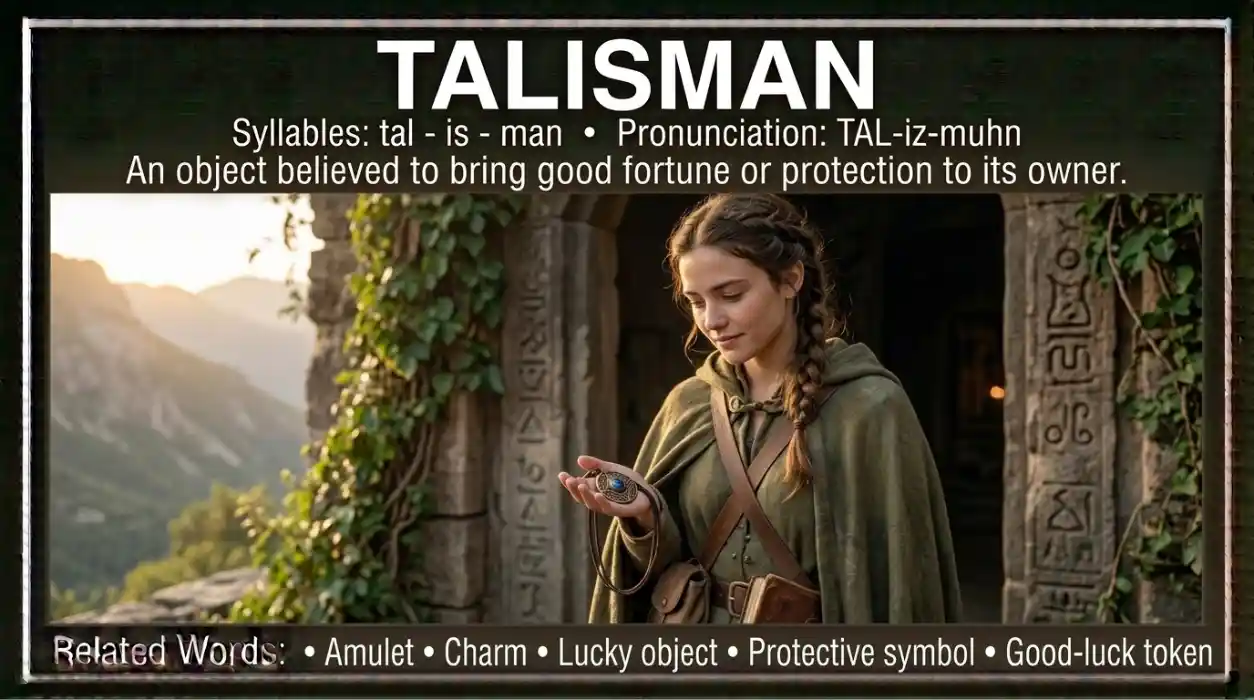
Pronunciation of Talisman
- US IPA: /ˈtælɪzmən/
- UK IPA: /ˈtælɪzmən/
Syllables: tal-is-man
Affixation pattern
- Root: talisman (the complete borrowed word in modern English)
- Prefix: None
- Suffix: No productive English suffix is normally identified in the modern word
The final syllable is unstressed. Practise saying the word naturally: TAL-iz-mən.
Synonyms List
Not every word below is an exact substitute in every sentence. Some name objects believed to offer protection or luck, while others emphasize symbolism, spiritual significance, or a person’s role as a source of confidence. Cultural meanings also vary.
1. Amulet (Noun) — US /ˈæmjələt/ | UK /ˈæmjʊlət/
Meaning: An amulet is an object worn or carried because it is believed to protect its owner from harm or misfortune.
Tone/Register: Neutral; historical, cultural, and spiritual writing.
Examples:
She wore an amulet that had belonged to her grandmother.
The museum displayed an ancient amulet beside other personal objects.
2. Charm (Noun) — US /tʃɑrm/ | UK /tʃɑːm/
Meaning: A charm is a small object believed to bring luck or protection, although the word can also refer to an attractive quality or a spoken spell.
Tone/Register: Neutral to informal.
Examples:
He kept a tiny charm in his jacket pocket.
Her silver charm reminded her of home.
3. Lucky Charm (Noun Phrase) — US /ˈlʌki tʃɑrm/ | UK /ˈlʌki tʃɑːm/
Meaning: A lucky charm is an object someone associates with good fortune.
Tone/Register: Informal and conversational.
Examples:
I take my lucky charm to every important exam.
She believes her old key brings her good luck.
4. Protective Amulet (Noun Phrase) — US /prəˈtɛktɪv ˈæmjələt/ | UK /prəˈtɛktɪv ˈæmjʊlət/
Meaning: A protective amulet is an object specifically believed to guard someone against danger or harmful influences.
Tone/Register: Neutral to formal.
Examples:
The character wore a protective amulet during the journey.
The article explores the history of protective amulets in different cultures.
5. Talismanic Object (Noun Phrase) — US /ˌtælɪzˈmænɪk ˈɑbdʒɛkt/ | UK /ˌtælɪzˈmænɪk ˈɒbdʒɪkt/
Meaning: A talismanic object is something treated as a source of symbolic or supposed supernatural power.
Tone/Register: Formal, literary, or academic.
Examples:
The old coin became a talismanic object for the explorer.
In the novel, the ring serves as a talismanic object of hope.
6. Fetish (Noun) — US /ˈfɛtɪʃ/ | UK /ˈfɛtɪʃ/
Meaning: In certain religious or anthropological contexts, a fetish is an object believed to contain spiritual power; in modern English, it has other meanings too.
Tone/Register: Academic or specialized; potentially sensitive.
Examples:
The researcher examined historical beliefs about objects thought to hold spiritual power.
The term should be used carefully because its meaning changes across contexts.
7. Mascot (Noun) — US /ˈmæskɑt/ | UK /ˈmæskɒt/
Meaning: A mascot is a person, animal, or object associated with a group and believed, sometimes playfully, to bring good luck or represent team spirit.
Tone/Register: Informal to neutral; sports and organizational contexts.
Examples:
The team carried its mascot onto the field before the final.
Their handmade owl became a cheerful symbol of good fortune.
8. Good-Luck Token (Noun Phrase) — US /ˌɡʊd ˈlʌk ˈtoʊkən/ | UK /ˌɡʊd ˈlʌk ˈtəʊkən/
Meaning: A good-luck token is a small item kept as a reminder or symbol of hoped-for success.
Tone/Register: Neutral and conversational.
Examples:
He gave his sister a coin as a good-luck token.
She slipped the token into her bag before the competition.
9. Protective Charm (Noun Phrase) — US /prəˈtɛktɪv tʃɑrm/ | UK /prəˈtɛktɪv tʃɑːm/
Meaning: A protective charm is an object or, in some contexts, a spell believed to guard against harm.
Tone/Register: Neutral; folklore and fantasy.
Examples:
The villagers hung a protective charm above the doorway.
The fantasy hero searched for a charm that could shield the village.
10. Amuletic Object (Noun Phrase) — US /ˌæmjəˈlɛtɪk ˈɑbdʒɛkt/ | UK /ˌæmjʊˈlɛtɪk ˈɒbdʒɪkt/
Meaning: An amuletic object is an item that functions like an amulet by serving a protective or symbolic purpose.
Tone/Register: Academic and specialist.
Examples:
The archaeologist classified the pendant as an amuletic object.
The paper discusses how amuletic objects were used in ancient communities.
11. Relic (Noun) — US /ˈrɛlɪk/ | UK /ˈrɛlɪk/
Meaning: A relic is an object preserved because of its historical, religious, or personal significance, and it may be treated as protective or sacred.
Tone/Register: Neutral to formal.
Examples:
The family kept the medal as a relic of their difficult journey.
Pilgrims travelled to see the religious relic displayed in the chapel.
12. Sacred Object (Noun Phrase) — US /ˈseɪkrɪd ˈɑbdʒɛkt/ | UK /ˈseɪkrɪd ˈɒbdʒɪkt/
Meaning: A sacred object is something regarded as holy or spiritually significant, though it is not necessarily a talisman.
Tone/Register: Formal, religious, or academic.
Examples:
Visitors were asked not to touch the sacred object.
The historian explained the object’s role in the community’s ceremonies.
13. Holy Token (Noun Phrase) — US /ˈhoʊli ˈtoʊkən/ | UK /ˈhəʊli ˈtəʊkən/
Meaning: A holy token is an item that represents religious devotion or spiritual protection.
Tone/Register: Religious or literary.
Examples:
He carried a holy token during the long pilgrimage.
The story describes a token passed down through generations of believers.
14. Protective Token (Noun Phrase) — US /prəˈtɛktɪv ˈtoʊkən/ | UK /prəˈtɛktɪv ˈtəʊkən/
Meaning: A protective token is an item kept to represent safety, reassurance, or hoped-for protection.
Tone/Register: Neutral to formal.
Examples:
She kept the protective token beside her bed.
The novel uses a small token to represent the hero’s promise of safety.
15. Good-Luck Charm (Noun Phrase) — US /ˌɡʊd ˈlʌk tʃɑrm/ | UK /ˌɡʊd ˈlʌk tʃɑːm/
Meaning: A good-luck charm is a familiar object associated with success or favourable outcomes.
Tone/Register: Informal and widely understood.
Examples:
His old wristband is his good-luck charm.
She wore the same scarf for every big presentation.
16. Magic Charm (Noun Phrase) — US /ˈmædʒɪk tʃɑrm/ | UK /ˈmædʒɪk tʃɑːm/
Meaning: A magic charm is an object or spell believed, especially in folklore or fiction, to produce a supernatural effect.
Tone/Register: Informal, fantasy, and folklore.
Examples:
The young wizard learned how to make a magic charm.
A magic charm in the tale opened the locked gate.
17. Spell Object (Noun Phrase) — US /ˈspɛl ˌɑbdʒɛkt/ | UK /ˈspɛl ˌɒbdʒɪkt/
Meaning: A spell object is an item used within a magical practice or fictional spell, rather than a standard everyday synonym for talisman.
Tone/Register: Informal or fictional.
Examples:
The game required the player to find a spell object.
The author created a crystal that helped the magician focus the spell.
18. Magical Emblem (Noun Phrase) — US /ˈmædʒɪkəl ˈɛmbləm/ | UK /ˈmædʒɪkəl ˈɛmbləm/
Meaning: A magical emblem is a sign or design believed in a story or tradition to carry supernatural significance.
Tone/Register: Literary or fantasy.
Examples:
The magical emblem glowed whenever danger approached.
The artist designed an emblem to mark the ancient order.
19. Sacred Emblem (Noun Phrase) — US /ˈseɪkrɪd ˈɛmbləm/ | UK /ˈseɪkrɪd ˈɛmbləm/
Meaning: A sacred emblem is a symbol of religious or spiritual importance, though it may not be believed to cause good fortune.
Tone/Register: Formal and religious.
Examples:
The sacred emblem appeared on the temple’s entrance.
The guide explained what the symbol meant to worshippers.
20. Protective Symbol (Noun Phrase) — US /prəˈtɛktɪv ˈsɪmbəl/ | UK /prəˈtɛktɪv ˈsɪmbəl/
Meaning: A protective symbol is a sign believed or intended to represent safety and ward off harm.
Tone/Register: Neutral to formal.
Examples:
She painted a protective symbol on the wooden door.
The documentary examined symbols associated with protection across several societies.
21. Good-Luck Symbol (Noun Phrase) — US /ˌɡʊd ˈlʌk ˈsɪmbəl/ | UK /ˌɡʊd ˈlʌk ˈsɪmbəl/
Meaning: A good-luck symbol is an image, sign, or object associated with hoped-for success.
Tone/Register: Neutral and conversational.
Examples:
A four-leaf clover is a familiar good-luck symbol.
He drew a small star as a good-luck symbol on his notebook.
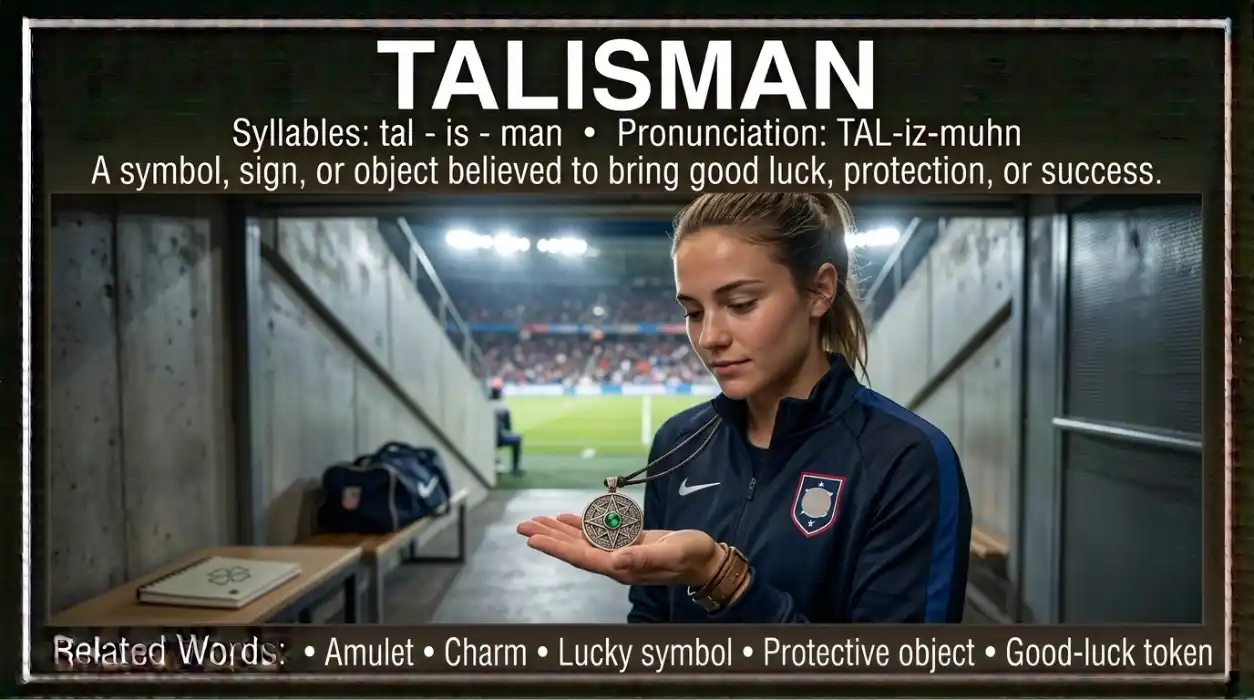
22. Totem (Noun) — US /ˈtoʊtəm/ | UK /ˈtəʊtəm/
Meaning: A totem is a symbol, often involving an animal or natural feature, connected with a family, community, or cultural identity; it is not automatically a talisman.
Tone/Register: Cultural, academic, or symbolic.
Examples:
The exhibit explained the animal’s role as a totem within that community.
In the fantasy story, the wolf totem represents the hero’s ancestral connection.
23. Idol (Noun) — US /ˈaɪdəl/ | UK /ˈaɪdəl/
Meaning: An idol is an image or object of worship, or someone greatly admired; it is not a direct synonym for a luck-bringing object.
Tone/Register: Religious, cultural, or everyday.
Examples:
The museum displayed an ancient idol from the region.
The singer had become an idol to many young fans.
24. Charmstone (Noun) — US /ˈtʃɑrmˌstoʊn/ | UK /ˈtʃɑːmˌstəʊn/
Meaning: A charmstone is a stone treated as a charm or valued for its supposed protective or magical qualities.
Tone/Register: Specialized, historical, or folkloric.
Examples:
The collector kept a smooth charmstone in a small wooden box.
The story’s heroine believed the charmstone would guide her home.
25. Power Object (Noun Phrase) — US /ˈpaʊər ˌɑbdʒɛkt/ | UK /ˈpaʊə ˌɒbdʒɪkt/
Meaning: A power object is an item believed to hold or represent special spiritual, symbolic, or fictional power.
Tone/Register: Neutral to academic; fantasy contexts.
Examples:
The museum label described the item as a power object in the ritual.
In the game, the power object unlocks the hidden passage.
26. Spirit Object (Noun Phrase) — US /ˈspɪrɪt ˌɑbdʒɛkt/ | UK /ˈspɪrɪt ˌɒbdʒɪkt/
Meaning: A spirit object is an item connected with spirits or spiritual beliefs in a particular tradition or fictional setting.
Tone/Register: Specialized, cultural, or fantasy.
Examples:
The researcher avoided assigning a single meaning to the spirit object.
In the novel, the spirit object lets the hero hear ancestral voices.
27. Ritual Object (Noun Phrase) — US /ˈrɪtʃuəl ˌɑbdʒɛkt/ | UK /ˈrɪtʃuəl ˌɒbdʒɪkt/
Meaning: A ritual object is used in a ceremony or repeated practice and may carry protective or symbolic meaning.
Tone/Register: Formal and academic.
Examples:
The bowl was used as a ritual object during seasonal ceremonies.
The curator documented the object’s role in the community’s traditions.
28. Sacred Relic (Noun Phrase) — US /ˈseɪkrɪd ˈrɛlɪk/ | UK /ˈseɪkrɪd ˈrɛlɪk/
Meaning: A sacred relic is a religiously significant object or remains that people preserve or venerate.
Tone/Register: Formal and religious.
Examples:
The sacred relic was kept in a carefully protected case.
The visitors listened as the guide explained its religious importance.
29. Heirloom (Noun) — US /ˈɛrˌluːm/ | UK /ˈeəˌluːm/
Meaning: An heirloom is a treasured item passed down through a family; it may serve as a talisman if the family associates it with luck or protection.
Tone/Register: Neutral and personal.
Examples:
Her grandmother’s ring was a treasured family heirloom.
He wore the heirloom watch before every major life decision.
30. Keepsake (Noun) — US /ˈkiːpˌseɪk/ | UK /ˈkiːpˌseɪk/
Meaning: A keepsake is an item retained to remember a person, place, or event, and it may become talisman-like through personal meaning.
Tone/Register: Warm and conversational.
Examples:
She carried a keepsake from her first trip abroad.
The ticket became a keepsake of the day they met.
31. Memento (Noun) — US /məˈmɛntoʊ/ | UK /məˈmɛntəʊ/
Meaning: A memento is something kept as a reminder of an experience or person, not necessarily for luck or protection.
Tone/Register: Neutral to formal.
Examples:
He kept the photograph as a memento of his childhood home.
The small badge was a memento of their first championship.
32. Token (Noun) — US /ˈtoʊkən/ | UK /ˈtəʊkən/
Meaning: A token is an item representing an idea, relationship, or promise; it resembles a talisman when it is also associated with good fortune or protection.
Tone/Register: Neutral.
Examples:
She gave him a token to remember their friendship.
He carried the token during the journey as a sign of hope.
33. Emblem (Noun) — US /ˈɛmbləm/ | UK /ˈɛmbləm/
Meaning: An emblem is a visual sign representing an idea, group, or quality, and it may have talismanic significance in a particular context.
Tone/Register: Formal and descriptive.
Examples:
The bird became an emblem of courage in the story.
The team chose an emblem to represent its shared values.
34. Symbol of Protection (Noun Phrase) — US /ˈsɪmbəl əv prəˈtɛkʃən/ | UK /ˈsɪmbəl əv prəˈtɛkʃən/
Meaning: A symbol of protection represents safety or the hope of being guarded against harm.
Tone/Register: Neutral to formal.
Examples:
The pendant served as a symbol of protection for the traveller.
The mural included a symbol of protection near the doorway.
35. Symbol of Good Fortune (Noun Phrase) — US /ˈsɪmbəl əv ˌɡʊd ˈfɔrtʃən/ | UK /ˈsɪmbəl əv ˌɡʊd ˈfɔːtʃən/
Meaning: A symbol of good fortune is an object or image associated with favourable events or success.
Tone/Register: Neutral and formal.
Examples:
The horseshoe is often treated as a symbol of good fortune.
The author used a golden bird as a symbol of good fortune in the novel.
36. Lucky Token (Noun Phrase) — US /ˈlʌki ˈtoʊkən/ | UK /ˈlʌki ˈtəʊkən/
Meaning: A lucky token is a small object that someone keeps because it represents or seems to attract luck.
Tone/Register: Informal.
Examples:
He placed his lucky token beside his computer before the interview.
The child chose a smooth pebble as a lucky token for the race.
37. Protective Relic (Noun Phrase) — US /prəˈtɛktɪv ˈrɛlɪk/ | UK /prəˈtɛktɪv ˈrɛlɪk/
Meaning: A protective relic is a historically or spiritually significant object believed by some people to offer protection.
Tone/Register: Formal, historical, or religious.
Examples:
The legend described the relic as a source of protection.
The historian distinguished the tradition from verified historical evidence.
38. Spiritual Keepsake (Noun Phrase) — US /ˈspɪrɪtʃuəl ˈkiːpˌseɪk/ | UK /ˈspɪrɪtʃuəl ˈkiːpˌseɪk/
Meaning: A spiritual keepsake is an item retained for its connection to a meaningful spiritual experience or belief.
Tone/Register: Personal and reflective.
Examples:
She kept the small pendant as a spiritual keepsake from her pilgrimage.
The handwritten prayer became a spiritual keepsake after the ceremony.
39. Personal Symbol (Noun Phrase) — US /ˈpɜrsənəl ˈsɪmbəl/ | UK /ˈpɜːsənəl ˈsɪmbəl/
Meaning: A personal symbol is an object or image that represents an individual’s values, memories, or hopes and may function like a talisman.
Tone/Register: Neutral and reflective.
Examples:
The mountain sketch became a personal symbol of resilience.
He chose a simple bracelet as a personal symbol of his new beginning.
40. Source of Comfort (Noun Phrase) — US /ˈsɔrs əv ˈkʌmfərt/ | UK /ˈsɔːs əv ˈkʌmfət/
Meaning: A source of comfort is something that provides reassurance, though it does not necessarily have a magical or protective meaning.
Tone/Register: Neutral and emotionally expressive.
Examples:
The old scarf was a source of comfort during her first week away.
For him, the familiar song became a source of comfort before every performance.
41. Confidence Object (Noun Phrase) — US /ˈkɑnfɪdəns ˌɑbdʒɛkt/ | UK /ˈkɒnfɪdəns ˌɒbdʒɪkt/
Meaning: A confidence object is an informal description of an item someone associates with feeling prepared or self-assured.
Tone/Register: Informal; not a fixed dictionary synonym.
Examples:
She called her notebook a confidence object before presentations.
The player touched his wristband to settle his nerves.
42. Good-Luck Keepsake (Noun Phrase) — US /ˌɡʊd ˈlʌk ˈkiːpˌseɪk/ | UK /ˌɡʊd ˈlʌk ˈkiːpˌseɪk/
Meaning: A good-luck keepsake is a treasured item that also represents hoped-for success or good fortune.
Tone/Register: Informal and personal.
Examples:
Her father gave her a good-luck keepsake before she left for university.
The little wooden bird became a good-luck keepsake after the trip.
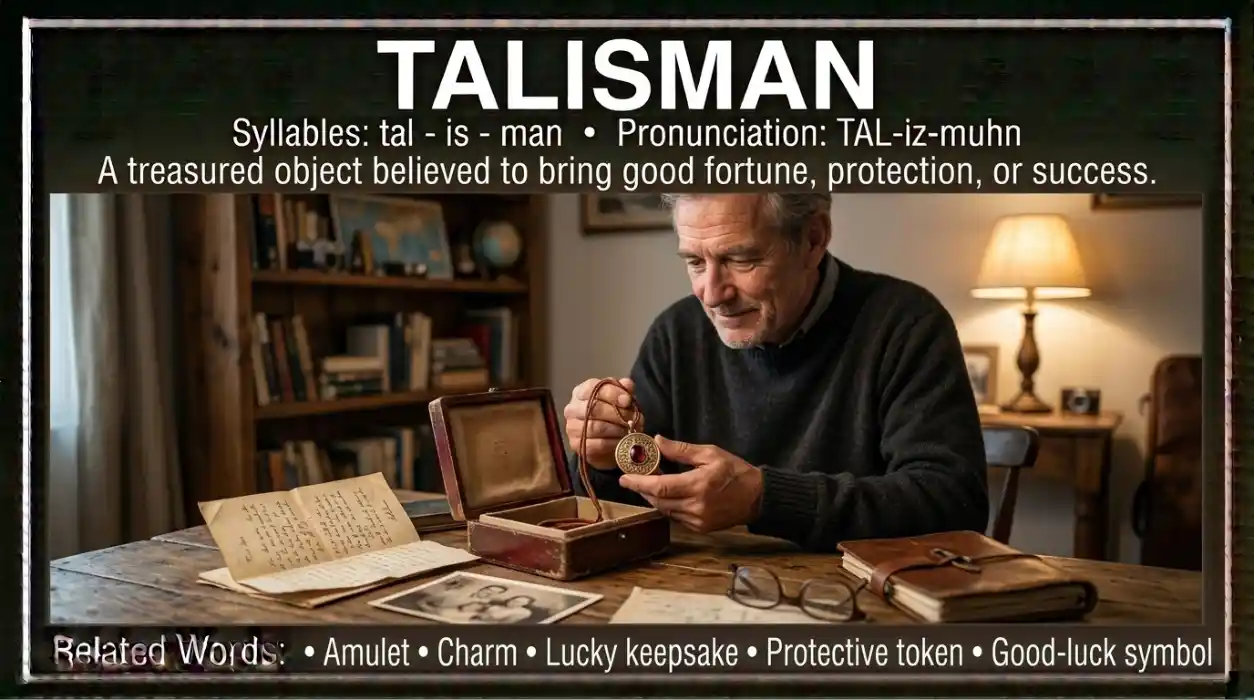
43. Guardian Symbol (Noun Phrase) — US /ˈɡɑrdiən ˈsɪmbəl/ | UK /ˈɡɑːdiən ˈsɪmbəl/
Meaning: A guardian symbol is an image or sign representing a protective presence in a story or belief system.
Tone/Register: Literary or descriptive.
Examples:
The lion was used as a guardian symbol above the city gate.
The illustrator created a guardian symbol for the hero’s shield.
44. Ward (Noun) — US /wɔrd/ | UK /wɔːd/
Meaning: In magical or literary usage, a ward is a charm, sign, or protective measure intended to keep danger away.
Tone/Register: Literary, historical, or fantasy.
Examples:
The villagers placed a ward at the entrance to the forest.
In the story, a protective ward kept unwanted spirits outside.
45. Talismanic Charm (Noun Phrase) — US /ˌtælɪzˈmænɪk tʃɑrm/ | UK /ˌtælɪzˈmænɪk tʃɑːm/
Meaning: A talismanic charm is an object or symbol treated as having the special significance associated with a talisman.
Tone/Register: Literary or descriptive.
Examples:
The blue bead served as a talismanic charm throughout the adventure.
The writer described the pendant as a talismanic charm against despair.
46. Magical Token (Noun Phrase) — US /ˈmædʒɪkəl ˈtoʊkən/ | UK /ˈmædʒɪkəl ˈtəʊkən/
Meaning: A magical token is an item with supernatural significance in folklore, games, or fiction.
Tone/Register: Informal and imaginative.
Examples:
The player exchanged a magical token to enter the hidden realm.
The prince gave the traveller a magical token to guide the way.
47. Lucky Pendant (Noun Phrase) — US /ˈlʌki ˈpɛndənt/ | UK /ˈlʌki ˈpɛndənt/
Meaning: A lucky pendant is a piece of jewellery worn because its owner associates it with good fortune.
Tone/Register: Everyday and informal.
Examples:
He wore a lucky pendant on the day of his driving test.
Her silver pendant reminded her to stay hopeful.
48. Protective Pendant (Noun Phrase) — US /prəˈtɛktɪv ˈpɛndənt/ | UK /prəˈtɛktɪv ˈpɛndənt/
Meaning: A protective pendant is jewellery believed or intended to represent safety, spiritual protection, or reassurance.
Tone/Register: Neutral to formal.
Examples:
The pendant was described as a protective pendant in the family’s oral history.
She wore it because it reminded her of her mother’s advice.
49. Charm Amulet (Noun Phrase) — US /ˈtʃɑrm ˈæmjələt/ | UK /ˈtʃɑːm ˈæmjʊlət/
Meaning: A charm amulet is an amulet valued as a charm for luck or protection; the phrase is descriptive rather than a distinct, universally established term.
Tone/Register: Descriptive and folkloric.
Examples:
The catalogue described the small object as a charm amulet.
In the story, the charm amulet was passed from mentor to student.
50. Symbolic Safeguard (Noun Phrase) — US /sɪmˈbɑlɪk ˈseɪfˌɡɑrd/ | UK /sɪmˈbɒlɪk ˈseɪfˌɡɑːd/
Meaning: A symbolic safeguard is an object or practice that represents protection, without necessarily providing literal safety.
Tone/Register: Formal and analytical.
Examples:
The family treated the old photograph as a symbolic safeguard during difficult times.
The report described the ceremony as a symbolic safeguard for the community’s shared identity.
Synonyms for Talisman by Tone
Not all alternatives have the same emotional effect. Choose a word that matches your purpose and audience.
Positive
- Lucky charm
- Good-luck token
- Protective amulet
- Symbol of good fortune
- Source of comfort
- Personal symbol
- Lucky pendant
- Good-luck keepsake
These choices emphasize hope, reassurance, success, or personal meaning.
Neutral
- Amulet
- Charm
- Token
- Relic
- Keepsake
- Memento
- Emblem
- Protective symbol
These terms work well when you want to describe an object without strongly judging the belief attached to it.
Negative or Skeptical
- Superstitious object: An object treated as if it controls events through luck or supernatural influence.
- False safeguard: Something mistakenly trusted to provide real protection.
- Placebo-like reassurance: An item that may comfort its owner without having a proven protective effect.
These are contextual descriptions, not exact synonyms. Use them only when the sentence genuinely expresses skepticism.
Playful or Informal
- Lucky charm
- Lucky token
- Lucky pendant
- Mascot
- Good-luck keepsake
These work in everyday conversation, sports stories, and friendly messages.
Why tone matters: Calling an item an amulet sounds more specific than calling it a keepsake. Describing it as a false safeguard expresses doubt. Match the term to your intended meaning instead of replacing talisman mechanically.
Talisman vs. Close Alternatives
Talisman vs. Amulet
A talisman is often associated with attracting good fortune or bringing a desired benefit. An amulet is more commonly associated with protection against harm.
The distinction is not absolute. Some objects are described by both words, especially in folklore and historical writing.
Use talisman when the emphasis is on luck, influence, or a special power. Use amulet when protection is the main idea.
Talisman vs. Lucky Charm
A lucky charm is a familiar, conversational expression for an object associated with good fortune. Talisman sounds more formal and may suggest a stronger magical, historical, or symbolic role.
Say, “This is my lucky charm,” in casual conversation. Choose talisman for a literary description or a discussion of folklore.
Talisman vs. Keepsake
A keepsake preserves a memory. A talisman is associated with luck, protection, or special power.
A ring from a grandparent may be a keepsake because it carries family memories. If its owner also believes it brings good luck, it may function as a personal talisman.
How Talisman Synonyms Change by Context
Daily Conversation
Use lucky charm, lucky token, or lucky pendant when talking about personal routines or objects that make you feel hopeful.
For example: “I always carry my lucky charm before an exam.” This sounds natural and friendly.
Writing and Blogging
In blog posts, talisman, amulet, and symbol of protection can help explain folklore, cultural traditions, or fictional objects. Define specialized terms when your audience may be unfamiliar with them.
Avoid repeating the same keyword in every sentence. Use a synonym only when it fits the precise meaning.
Professional or Academic Writing
Terms such as amulet, ritual object, sacred object, and protective symbol can work in historical or anthropological writing. Explain the relevant tradition rather than assuming all cultures understand these objects in the same way.
Distinguish documented cultural beliefs from claims that an object has objectively proven supernatural powers.
Creative and Informal Use
Fantasy stories may use magical tokens, wards, or talismanic charms. These expressions can suggest mystery, danger, or hidden power.
In a contemporary story, a character’s old bracelet might act as a talisman because it gives them courage. The narrative does not need to claim that the bracelet has actual magical effects.
Common Mistakes Learners Make
Treating Every Related Word as an Exact Synonym
An idol is usually an object of worship or a person who is greatly admired. A relic is valued for historical or religious reasons. Neither automatically means talisman.
Better approach: Check whether the object is associated with luck, protection, or a special power before choosing a replacement.
Confusing Protection With Good Fortune
An amulet is often linked to protection, while a lucky charm usually emphasizes good fortune. The words can overlap, but they do not always communicate the same idea.
Better approach: Decide whether the sentence focuses on avoiding harm or attracting a favourable outcome.
Using Specialized Terms Without Context
Words such as fetish, totem, and sacred relic have cultural, academic, or religious meanings. Using them as casual substitutes may be inaccurate or insensitive.
Better approach: Check the word’s established meaning and the context in which it is used.
Overusing “Talisman” in SEO Content
Repeating the focus keyword too often makes writing sound unnatural. Search-friendly writing should still serve readers first.
Better approach: Use the main keyword where it is relevant. Choose alternatives based on meaning, not simply to increase keyword variety.
Register Notes
- Formal: amulet, ritual object, protective symbol, talismanic object
- Informal: lucky charm, lucky token, lucky pendant
- Spoken English: lucky charm is usually the most accessible everyday option.
- Written English: talisman can be more effective in literary, historical, and analytical passages.
For further vocabulary practice, explore related English word-choice topics in your vocabulary-learning notes or other relevant articles.
Real-Life Examples Using
Workplace
A new employee keeps a small coin in a pocket before important presentations. They call it a lucky charm because it reminds them to stay calm. The coin is a source of confidence, not a substitute for preparation.
Social Situations
A friend gives someone a bracelet before a long trip. The recipient treats it as a personal talisman because it represents friendship and encouragement. The object’s emotional meaning matters more than its material value.
Media and Pop Culture
In a fantasy series, a hero discovers a pendant that protects a village from an imaginary curse. The writer may call it a talisman, an amulet, or a magical token, depending on how the object works in the plot.
Writing and Storytelling
A novelist wants to show that a character has grown more confident. Rather than repeating talisman, the writer describes a keepsake that becomes a personal symbol of resilience. This approach develops the character while keeping the vocabulary varied.
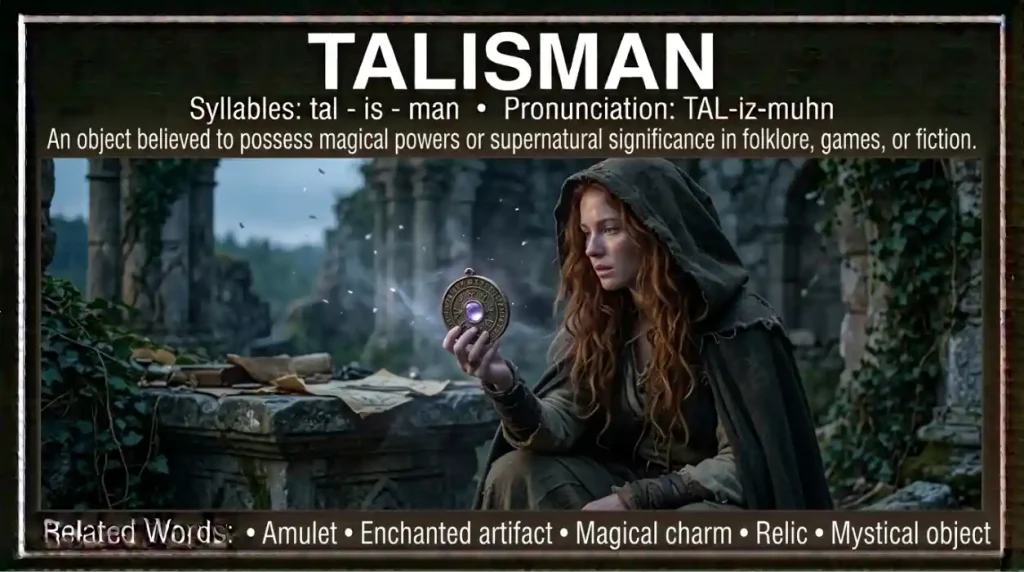
Practice Exercise
1. Maya wears a small object because she believes it helps keep danger away. Which word fits best?
A. Memento
B. Amulet
C. Mascot
D. Emblem
2. Ben carries the same pen to every exam because he associates it with success. What is the most natural everyday term?
A. Sacred relic
B. Ritual object
C. Lucky charm
D. Idol
3. A museum describes an item used during a religious ceremony. Which phrase is most suitable?
A. Ritual object
B. Lucky pendant
C. Confidence object
D. Mascot
4. A photograph reminds Sara of her first overseas trip. What is it primarily?
A. Ward
B. Amulet
C. Memento
D. Magical emblem
5. A sports team has a character that represents team spirit and is associated with good luck. What is it?
A. Relic
B. Mascot
C. Heirloom
D. Fetish
6. In a fantasy novel, a bracelet is believed to attract success for its wearer. Which term works well?
A. Talisman
B. Memento
C. Idol
D. Keepsake
7. A family passes a treasured watch from one generation to the next. What is the best word?
A. Ward
B. Heirloom
C. Spell object
D. Lucky token
8. A researcher wants a neutral phrase for a sign associated with protection. Which is best?
A. False safeguard
B. Personal obsession
C. Protective symbol
D. Lucky mascot
9. A character carries a small enchanted item that helps activate a spell. Which phrase best suits a fantasy setting?
A. Magical token
B. Family heirloom
C. Sacred relic
D. Source of comfort
Reflection Task
Write two short sentences about an object that matters to you or to a fictional character. In the first sentence, use talisman. In the second, replace it with a synonym that matches the object’s meaning.
Answer Key
1-B, 2-C, 3-A, 4-C, 5-B, 6-A, 7-B, 8-C, 9-A
Suggested External Sources
For reliable background research, consult these established references:
- Merriam-Webster Dictionary — definitions, pronunciation, and usage of talisman and related words.
- Oxford English Dictionary — historical development and etymology of talisman.
- Encyclopaedia Britannica — broader context on amulets, charms, and related cultural traditions.
Use dictionary definitions for word meanings and specialist historical sources for cultural context. Beliefs about supernatural protection should be described as beliefs, rather than presented as scientifically established effects.
Conclusion
Choosing among synonyms for talisman becomes easier when you understand what an object represents. Some words suggest luck, others emphasize protection, and some describe memory or spiritual significance.
A stronger vocabulary helps you write clearer essays, more engaging blog posts, and more natural conversations. It also lets you express subtle differences without repeating the same word.
Start with familiar choices such as lucky charm, amulet, and keepsake. Then practise more specialized terms when your topic calls for them.
Try using two or three of these words in an email, short story, or daily conversation this week. Notice how each choice changes the meaning, tone, and feeling of your sentence.
FAQs
1. What is the closest synonym for talisman in everyday English?
The closest everyday synonym is usually lucky charm. It describes an object that someone associates with good fortune. If the object is mainly believed to protect its owner from harm, an amulet may be more precise. Choose based on whether the sentence emphasizes luck, protection, or personal meaning.
2. Is an amulet the same as a talisman?
The words overlap, but they are not always identical. An amulet is commonly associated with protection from danger or harm. A talisman may be associated with attracting good fortune, achieving a desired result, or providing protection. Historical sources sometimes use the terms interchangeably, so context matters.
3. What is another word for talisman in a fantasy novel?
Amulet, magical token, ward, and enchanted charm can work in fantasy writing. The best option depends on what the object does in the story. Use ward for a protective measure, amulet for a protective object, and magical token for an item that has a special role in the plot.
4. What is a good synonym for talisman in academic writing?
Amulet, ritual object, or protective symbol may suit academic writing, depending on the evidence and context. Use amulet when discussing an object believed to provide protection. Choose ritual object when its ceremonial role matters more. Avoid treating every culturally significant item as a talisman without explaining its specific function.
5. Can a personal item be called a talisman without being magical?
Yes. In figurative use, a talisman can be an object that inspires confidence, comfort, or hope. A person might call a family ring a talisman because it helps them feel connected to loved ones. This use describes symbolic or emotional significance rather than proving that the item has supernatural power.

Shahzeena Shazadi is the founder and lead writer at VocablyHub.com, where she creates accurate, reader-focused English language content designed to help people communicate with clarity and confidence. She specializes in synonyms, antonyms, word meanings, idioms, and practical vocabulary guides that simplify complex language concepts for everyday use. Every article is carefully researched, fact-checked, and written in clear, accessible language using reliable references and real-world examples. Her goal is to provide helpful, trustworthy content that supports learners at every stage of their English language journey.
Her editorial approach focuses on accuracy, transparency, and user value while following modern content quality standards. She regularly reviews and updates content to keep information relevant, useful, and easy to understand. Through VocablyHub.com, Shahzeena Shazadi is committed to publishing reliable language resources that help students, writers, educators, professionals, and English learners expand their vocabulary, improve their writing skills, and communicate with confidence in academic, professional, and everyday situations.