
A synonym for sphere depends on the meaning you intend. For a round three-dimensional object, alternatives include globe, ball, and orb. For an area of activity or influence, use realm, domain, field, or area. Context determines the best choice.
Imagine describing Earth to a child. You might call it a globe or a sphere. Now imagine discussing someone’s influence in politics. In that sentence, realm or domain may sound more natural.
The phrase synonym for sphere is useful because sphere has both a geometric meaning and a figurative one. It can describe a solid round shape or a person’s area of knowledge, responsibility, or influence.
Students encounter the word in mathematics and science. Bloggers and content writers use it when discussing society, business, culture, and personal interests. Everyday English speakers use it to describe different parts of life.
Learning related words helps you avoid repetition and express your meaning more precisely. The key is to choose an alternative that matches the sentence, not simply one that sounds sophisticated.
What Does “Sphere” Really Mean?
Sphere is a noun with two common meanings.
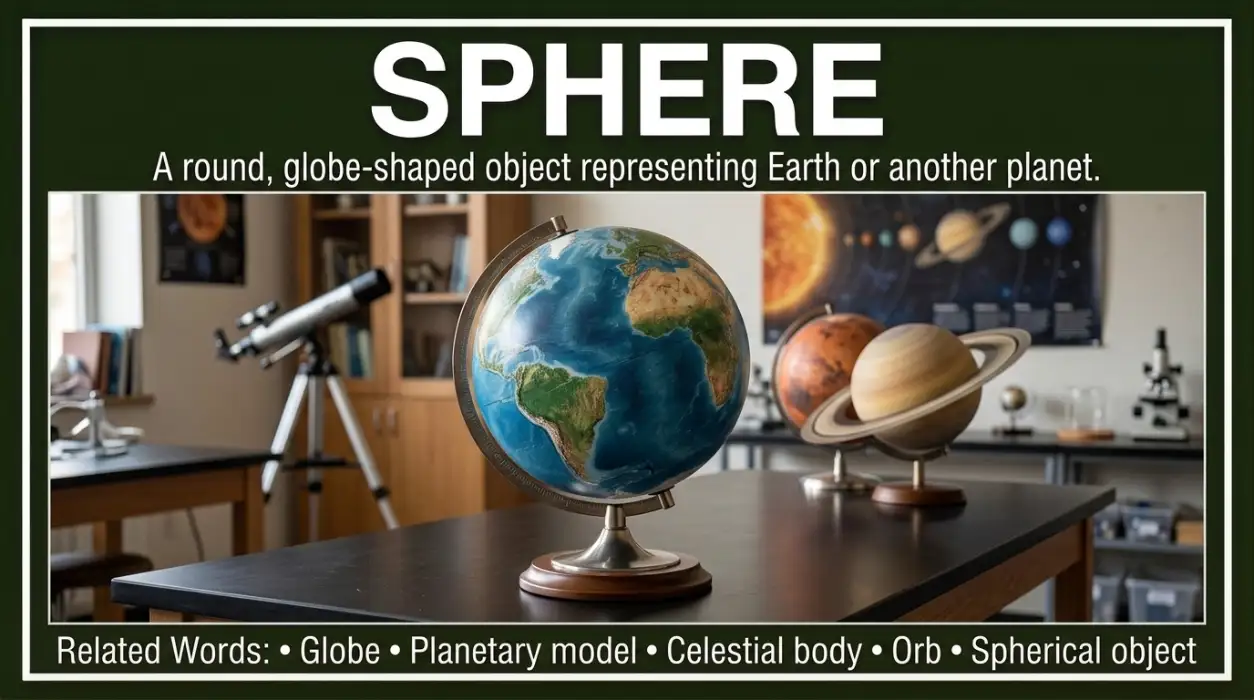
- Geometric meaning: A perfectly round three-dimensional shape whose surface points are all the same distance from its center. A ball is a familiar example of this shape, although a mathematical sphere refers specifically to its surface or the idealized solid, depending on context.
- Figurative meaning: An area of activity, knowledge, responsibility, influence, or interest.
Native English speakers understand the intended meaning from context. In “The model is shaped like a sphere,” the word refers to geometry. In “She works in the sphere of public health,” it refers to a field of activity.
The word is usually neutral. It can sound technical in mathematics and science, or formal and abstract when describing influence, society, or professional life.
Connotative Meaning
(Connotation is the feeling, attitude, or association a word carries beyond its basic dictionary meaning.)
- Positive tone: “He has a strong influence in the academic sphere.” This suggests respect or importance.
- Negative tone: “Corruption has spread through the political sphere.” The negative feeling comes from corruption, not from the sphere itself.
- Neutral tone: “The diagram shows a sphere.” This is a straightforward description.
Etymology of “Sphere”
The word sphere entered English through Old French espere and Latin sphaera, from Greek sphaira, meaning “ball” or “globe.” Its earliest sense concerned a round object. Later, it also described the imagined celestial shells associated with ancient models of the universe.
The figurative meaning developed from the idea of a bounded area or domain. Just as a sphere has a defined shape, a person’s sphere can represent the limits or reach of their activity and influence.
A Brief History
- Old English (450–1100): The modern word sphere was not a regular part of Old English vocabulary. Speakers used native Germanic words for round objects and related ideas.
- Middle English (1100–1500): The word entered English through French and Latin-influenced learning. It appeared in discussions of astronomy, geometry, and the structure of the heavens.
- Modern English (1500–present): Its scientific meaning became more precise, while figurative uses expanded to describe professional fields, social roles, interests, and influence.
Pronunciation, Syllables, and Affixation
Pronunciation of “sphere”
- US IPA: /sfɪr/
- UK IPA: /sfɪə/
Syllables: sphere — one syllable.
Affixation pattern
- Root: sphere, from Greek sphaira through Latin sphaera
- Prefix: None
- Suffix: None in the base word
The word also appears in related forms such as spherical (an adjective), spherically (an adverb), and sphericity (a noun referring to the quality of being spherical).
Synonyms List
The following alternatives cover both meanings of sphere: a round three-dimensional shape and an area of activity or influence. Some are close synonyms, while others work only in a specific context. Always check the meaning before replacing the original word.
1. Globe (noun) — US /ɡloʊb/ | UK /ɡləʊb/
Meaning: A round object representing Earth or another planet, or a globe-shaped object.
Tone/Register: Neutral, educational, scientific.
Examples:
The classroom globe showed where the continents were located.
A glass globe hung above the entrance.
2. Orb (noun) — US /ɔːrb/ | UK /ɔːb/
Meaning: A round object, especially one described in a poetic, mysterious, or decorative way.
Tone/Register: Literary, poetic.
Examples:
A bright orb rose above the distant hills.
The fantasy story described a glowing orb hidden in a cave.
3. Ball (noun) — US /bɔːl/ | UK /bɔːl/
Meaning: A round object, often used in sports or play, that approximates a sphere.
Tone/Register: Everyday, informal.
Examples:
The child rolled the ball across the floor.
The artist used a simple ball to demonstrate shading.
4. Spheroid (noun) — US /ˈsfɪrɔɪd/ | UK /ˈsfɪərɔɪd/
Meaning: A three-dimensional shape similar to a sphere but slightly flattened or stretched.
Tone/Register: Technical, mathematical.
Examples:
Earth is often modeled as an oblate spheroid.
The engineer calculated the volume of the spheroid.
5. Ellipsoid (noun) — US /ɪˈlɪpˌsɔɪd/ | UK /ɪˈlɪp.sɔɪd/
Meaning: A three-dimensional shape whose cross-sections are ellipses.
Tone/Register: Scientific, mathematical.
Examples:
The simulation represented the object as an ellipsoid.
An ellipsoid can be longer along one axis than another.
6. Globule (noun) — US /ˈɡlɑːbjuːl/ | UK /ˈɡlɒbjuːl/
Meaning: A small rounded drop or particle of liquid or another substance.
Tone/Register: Scientific, descriptive.
Examples:
Tiny globules of oil floated on the water.
The microscope revealed a globule inside the sample.
7. Orbicular form (noun phrase) — US /ɔːrˈbɪkjələr fɔːrm/ | UK /ɔːˈbɪkjʊlə fɔːm/
Meaning: A rounded or circular form, especially in descriptive or technical writing.
Tone/Register: Technical, formal.
Examples:
The mineral displayed an orbicular form.
The designer used orbicular forms in the sculpture.
8. Round body (noun phrase) — US /raʊnd ˈbɑːdi/ | UK /raʊnd ˈbɒdi/
Meaning: A physical object with an approximately round shape.
Tone/Register: Neutral, descriptive.
Examples:
The diagram showed a round body floating in space.
The toy had a smooth round body and short legs.
9. Solid (noun) — US /ˈsɑːlɪd/ | UK /ˈsɒlɪd/
Meaning: A three-dimensional object; in geometry, a sphere is one particular kind of solid.
Tone/Register: Mathematical, educational.
Examples:
The students compared a sphere with a cube.
Each solid had a different surface area.
Note: Solid is a broader category, not an exact synonym for sphere.
10. Celestial sphere (noun phrase) — US /səˈlɛstʃəl sfɪr/ | UK /sɪˈlɛstiəl sfɪə/
Meaning: An imagined sphere surrounding Earth on which celestial objects appear to lie.
Tone/Register: Astronomical, academic.
Examples:
The lesson introduced the concept of the celestial sphere.
Astronomers use celestial coordinates to map objects across the sky.
Note: This is a specialized concept rather than a general replacement for sphere.
11. Realm (noun) — US /rɛlm/ | UK /rɛlm/
Meaning: An area of activity, knowledge, experience, or influence.
Tone/Register: Formal, literary.
Examples:
Artificial intelligence is changing the realm of education.
The discussion moved into the realm of ethics.
12. Domain (noun) — US /doʊˈmeɪn/ | UK /dəʊˈmeɪn/
Meaning: A particular field of knowledge, responsibility, activity, or control.
Tone/Register: Academic, professional.
Examples:
Data security falls within the domain of information technology.
Her domain expertise helped the team solve the problem.
13. Field (noun) — US /fiːld/ | UK /fiːld/
Meaning: An area of study, work, or professional activity.
Tone/Register: Neutral, academic, professional.
Examples:
He hopes to build a career in the field of environmental science.
Research in this field is moving quickly.
14. Area (noun) — US /ˈɛriə/ | UK /ˈeəriə/
Meaning: A particular subject, activity, or part of life.
Tone/Register: Neutral, widely used.
Examples:
Communication is an area where she excels.
The company plans to expand into a new area of research.
15. Arena (noun) — US /əˈriːnə/ | UK /əˈriːnə/
Meaning: A setting where people compete, debate, or pursue public activities.
Tone/Register: Formal, journalistic.
Examples:
She has earned respect in the international business arena.
The issue sparked a debate in the political arena.
16. Scope (noun) — US /skoʊp/ | UK /skəʊp/
Meaning: The range or extent of an activity, subject, or responsibility.
Tone/Register: Professional, academic.
Examples:
The project falls within the scope of our department.
The research expanded the scope of the original investigation.
Note: Scope emphasizes range or limits, not the entire field itself.
17. Province (noun) — US /ˈprɑːvɪns/ | UK /ˈprɒvɪns/
Meaning: A particular area of knowledge, responsibility, or activity; it can also mean an administrative region.
Tone/Register: Formal, sometimes literary.
Examples:
The decision belongs to the province of the courts.
Detailed analysis is the province of the research team.
18. Territory (noun) — US /ˈtɛrəˌtɔːri/ | UK /ˈterɪtəri/
Meaning: An area under control or an unfamiliar area of activity or knowledge.
Tone/Register: Neutral, business, informal.
Examples:
The startup is entering new territory with its latest product.
Negotiation remains unfamiliar territory for him.
19. World (noun) — US /wɜːrld/ | UK /wɜːld/
Meaning: A particular environment, community, or field of activity.
Tone/Register: Conversational, journalistic.
Examples:
She has made a name for herself in the world of design.
The documentary offers a glimpse into the world of marine biology.
20. Circle (noun) — US /ˈsɜːrkəl/ | UK /ˈsɜːkəl/
Meaning: A group of people with shared interests, relationships, or influence.
Tone/Register: Neutral, social, sometimes formal.
Examples:
He is well known in literary circles.
The idea gained support among academic circles.
Note: Circle refers to a social group, not usually an entire field of activity.

21. Sector (noun) — US /ˈsɛktər/ | UK /ˈsektə/
Meaning: A distinct part of an economy, industry, or organized activity.
Tone/Register: Business, economic, formal.
Examples:
The renewable energy sector is expanding.
She works in the public sector.
22. Industry (noun) — US /ˈɪndəstri/ | UK /ˈɪndəstri/
Meaning: A branch of economic activity involving related businesses or production.
Tone/Register: Business, professional.
Examples:
He has worked in the film industry for years.
Technology has transformed the publishing industry.
23. Branch (noun) — US /bræntʃ/ | UK /brɑːntʃ/
Meaning: A subdivision of a larger subject, profession, or organization.
Tone/Register: Academic, professional.
Examples:
Astrophysics is a branch of astronomy.
She specializes in a branch of environmental law.
24. Discipline (noun) — US /ˈdɪsəplɪn/ | UK /ˈdɪsɪplɪn/
Meaning: A recognized area of study or professional knowledge.
Tone/Register: Academic, formal.
Examples:
Linguistics is a discipline that examines language.
The conference brought together researchers from several disciplines.
25. Specialty (noun) — US /ˈspɛʃəlti/ | UK /ˈspeʃəlti/
Meaning: A subject or activity in which someone has particular skill or knowledge.
Tone/Register: Neutral, professional.
Examples:
Wildlife photography is her specialty.
His medical specialty is pediatric cardiology.
26. Niche (noun) — US /nɪtʃ/ or /niːʃ/ | UK /niːʃ/
Meaning: A narrow, specialized area of interest, expertise, or activity.
Tone/Register: Business, informal, professional.
Examples:
The blogger found a niche writing about urban gardening.
This small company serves a niche in the outdoor market.
27. Department (noun) — US /dɪˈpɑːrtmənt/ | UK /dɪˈpɑːtmənt/
Meaning: A division of an organization responsible for a particular function.
Tone/Register: Professional, organizational.
Examples:
The issue was referred to the legal department.
She joined the university’s English department.
28. Sphere of influence (noun phrase) — US /sfɪr əv ˈɪnfluəns/ | UK /sfɪə əv ˈɪnfluəns/
Meaning: The area or group over which a person, organization, or country has influence.
Tone/Register: Political, historical, formal.
Examples:
The two countries competed to expand their spheres of influence.
Her professional network increased her sphere of influence.
29. Responsibility (noun) — US /rɪˌspɑːnsəˈbɪləti/ | UK /rɪˌspɒnsəˈbɪləti/
Meaning: A duty or area of work for which someone is accountable.
Tone/Register: Neutral, professional.
Examples:
Staff training is one of her main responsibilities.
The new role brings additional responsibilities.
Note: This fits when sphere means a person’s area of responsibility, not a physical shape.
30. Province of activity (noun phrase) — US /ˈprɑːvɪns əv ækˈtɪvəti/ | UK /ˈprɒvɪns əv ækˈtɪvɪti/
Meaning: A particular field or area in which someone operates, often with a formal or literary tone.
Tone/Register: Formal, literary.
Examples:
Scientific testing is the province of the laboratory team.
Public diplomacy has become an important province of government activity.
Note: This is a contextual phrase, not a direct synonym in every sentence.
31. Environment (noun) — US /ɪnˈvaɪrənmənt/ | UK /ɪnˈvaɪrənmənt/
Meaning: The social, professional, or physical setting in which activity takes place.
Tone/Register: Neutral, professional.
Examples:
She thrives in a creative working environment.
The school provides an environment for collaborative learning.
32. Setting (noun) — US /ˈsɛtɪŋ/ | UK /ˈsetɪŋ/
Meaning: The place or circumstances in which an event or activity occurs.
Tone/Register: Neutral, descriptive.
Examples:
The story unfolds in the world of competitive sports.
The workshop offers a setting for open discussion.
33. Context (noun) — US /ˈkɑːntɛkst/ | UK /ˈkɒntekst/
Meaning: The circumstances or background that give an activity, statement, or event its meaning.
Tone/Register: Academic, professional.
Examples:
The phrase has a different meaning in a legal context.
We need to understand the historical context before judging the decision.
34. Sphere of activity (noun phrase) — US /sfɪr əv ækˈtɪvəti/ | UK /sfɪə əv ækˈtɪvɪti/
Meaning: The particular type or range of work or action in which someone is involved.
Tone/Register: Formal, descriptive.
Examples:
Education is an important sphere of public activity.
The report examines her sphere of activity within the organization.
35. Sphere of interest (noun phrase) — US /sfɪr əv ˈɪntrəst/ | UK /sfɪə əv ˈɪntrəst/
Meaning: An area or subject that attracts someone’s attention or concern.
Tone/Register: Formal, academic.
Examples:
Architecture lies within his sphere of interest.
The project connects several spheres of interest, including health and technology.
36. Specialty area (noun phrase) — US /ˈspɛʃəlti ˈɛriə/ | UK /ˈspeʃəlti ˈeəriə/
Meaning: A focused area in which a person or team has specific expertise.
Tone/Register: Professional, academic.
Examples:
Climate policy is her specialty area.
The hospital has expanded its specialty areas in pediatric care.
37. Field of expertise (noun phrase) — US /fiːld əv ˌɛkspərˈtiːz/ | UK /fiːld əv ˌekspəˈtiːz/
Meaning: A subject or professional area in which someone has advanced knowledge or skill.
Tone/Register: Professional, academic.
Examples:
Machine learning is his field of expertise.
Please direct technical questions to someone in the relevant field of expertise.
38. Walk of life (noun phrase) — US /wɔːk əv laɪf/ | UK /wɔːk əv laɪf/
Meaning: A person’s social, professional, or economic background.
Tone/Register: Neutral, idiomatic.
Examples:
The conference attracted people from every walk of life.
Volunteers from different walks of life joined the project.
Note: This describes background or social position, not a field of expertise.
39. Social domain (noun phrase) — US /ˈsoʊʃəl doʊˌmeɪn/ | UK /ˈsəʊʃəl dəʊˌmeɪn/
Meaning: An area of social relationships, institutions, or public life.
Tone/Register: Academic, sociological.
Examples:
The study explores trust in the social domain.
Online communities have changed how people interact in this domain.
40. Public arena (noun phrase) — US /ˈpʌblɪk əˈriːnə/ | UK /ˈpʌblɪk əˈriːnə/
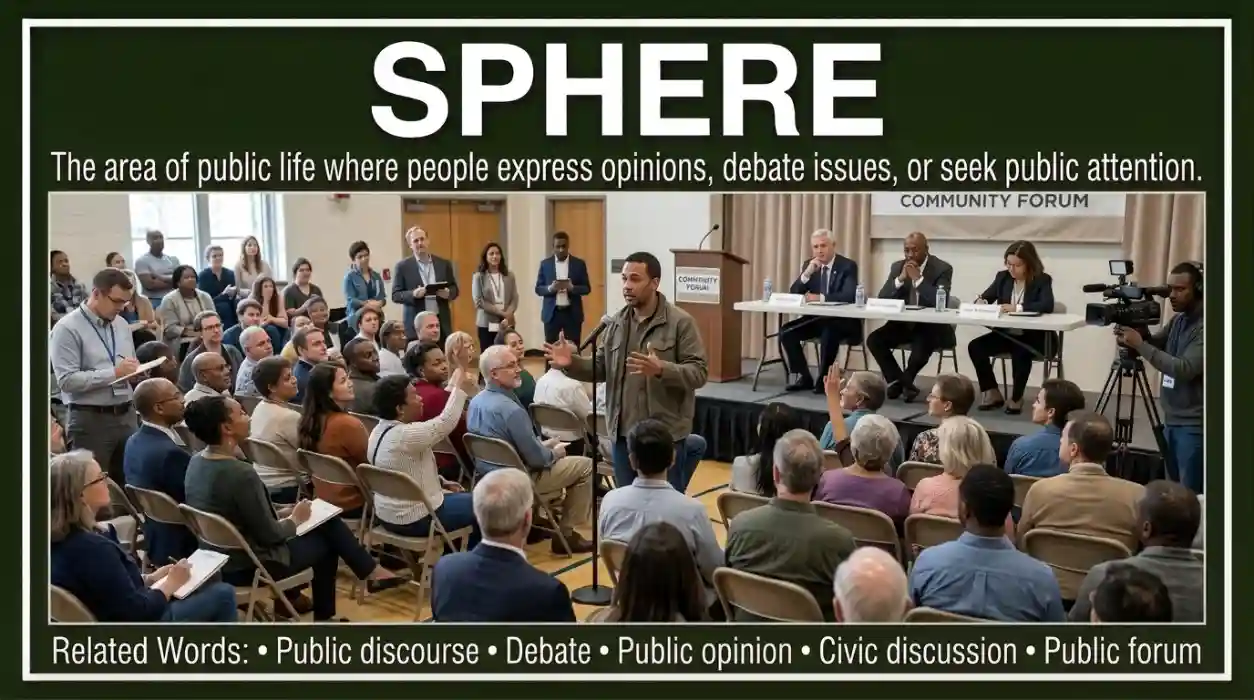
Meaning: The part of public life where people express opinions, debate issues, or seek attention.
Tone/Register: Political, journalistic.
Examples:
The proposal received considerable attention in the public arena.
She entered the public arena to advocate for better schools.
41. Sphere of control (noun phrase) — US /sfɪr əv kənˈtroʊl/ | UK /sfɪə əv kənˈtrəʊl/
Meaning: The area or set of matters over which someone has authority.
Tone/Register: Formal, organizational.
Examples:
Budget approval falls within the director’s sphere of control.
The manager clarified each team’s sphere of control.
42. Jurisdiction (noun) — US /ˌdʒʊrɪsˈdɪkʃən/ | UK /ˌdʒʊərɪsˈdɪkʃən/
Meaning: The official authority to make decisions or apply the law within a defined area.
Tone/Register: Legal, formal.
Examples:
The case falls under federal jurisdiction.
The agency cannot investigate matters outside its jurisdiction.
Note: Jurisdiction is appropriate when sphere means an area of authority, especially legal authority.
43. Orbit (noun) — US /ˈɔːrbɪt/ | UK /ˈɔːbɪt/
Meaning: A path around a celestial body, or figuratively, a person’s social or professional circle of influence.
Tone/Register: Scientific, figurative.
Examples:
The satellite entered a stable orbit around Earth.
The young artist soon entered the orbit of a famous producer.
44. Circle of influence (noun phrase) — US /ˈsɜːrkəl əv ˈɪnfluəns/ | UK /ˈsɜːkəl əv ˈɪnfluəns/
Meaning: The people or situations a person can affect through relationships or authority.
Tone/Register: Professional, personal development.
Examples:
She expanded her circle of influence through community work.
Leaders should understand the limits of their circle of influence.
45. Sphere of operation (noun phrase) — US /sfɪr əv ˌɑːpəˈreɪʃən/ | UK /sfɪə əv ˌɒpəˈreɪʃən/
Meaning: The area in which a person, group, or system carries out its activities.
Tone/Register: Formal, technical.
Examples:
The organization’s sphere of operation now includes rural communities.
The report defines the sphere of operation for each unit.
46. Sector of activity (noun phrase) — US /ˈsɛktər əv ækˈtɪvəti/ | UK /ˈsektə əv ækˈtɪvɪti/
Meaning: A distinct category of work or economic activity.
Tone/Register: Business, economic.
Examples:
Tourism is a major sector of activity in the region.
The program supports innovation across several sectors of activity.
47. Specialty field (noun phrase) — US /ˈspɛʃəlti fiːld/ | UK /ˈspeʃəlti fiːld/
Meaning: A particular area of professional or academic specialization.
Tone/Register: Professional, academic.
Examples:
Forensic linguistics is her specialty field.
The university offers advanced courses in several specialty fields.
48. Discipline area (noun phrase) — US /ˈdɪsəplɪn ˈɛriə/ | UK /ˈdɪsɪplɪn ˈeəriə/
Meaning: A subject category within education, research, or professional study.
Tone/Register: Academic, administrative.
Examples:
The grant encourages cooperation across discipline areas.
Students can choose projects from more than one discipline area.
49. Sphere of responsibility (noun phrase) — US /sfɪr əv rɪˌspɑːnsəˈbɪləti/ | UK /sfɪə əv rɪˌspɒnsəˈbɪləti/
Meaning: The duties and decisions assigned to a person or role.
Tone/Register: Professional, formal.
Examples:
Staff development is part of the supervisor’s sphere of responsibility.
The policy defines each officer’s sphere of responsibility.
50. Realm of influence (noun phrase) — US /rɛlm əv ˈɪnfluəns/ | UK /rɛlm əv ˈɪnfluəns/
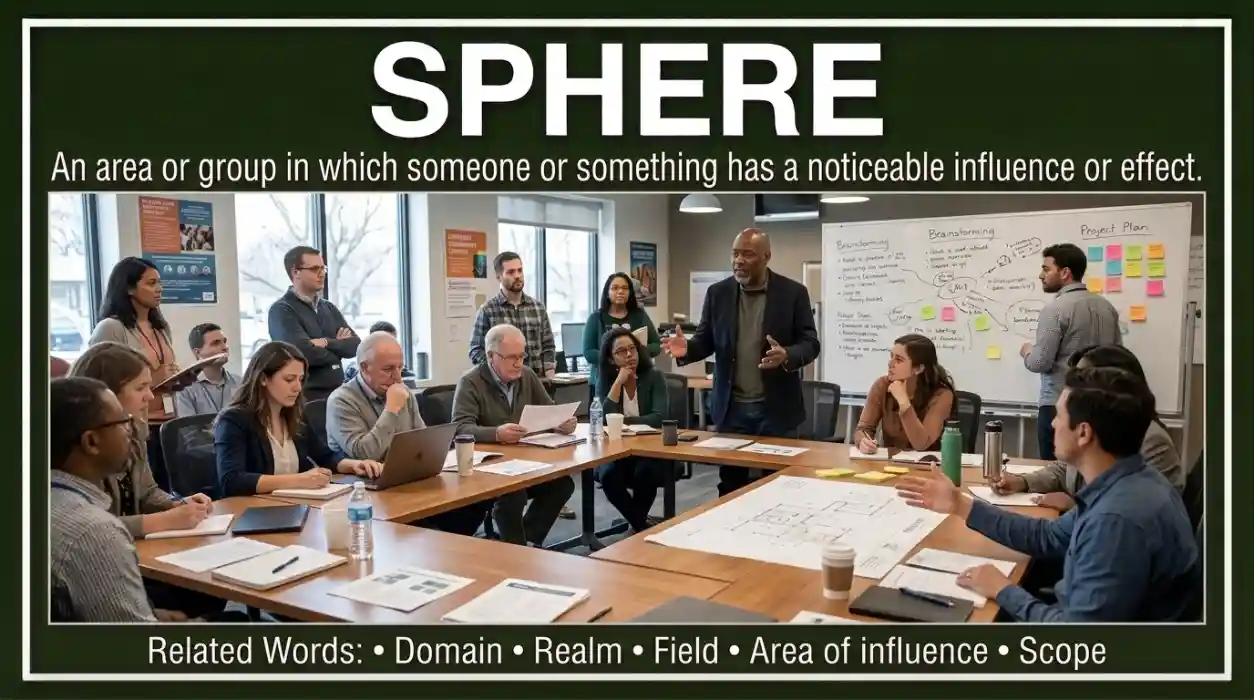
Meaning: An area or group in which someone or something has a noticeable effect.
Tone/Register: Formal, descriptive.
Examples:
The writer’s realm of influence extended beyond literature.
Social media has created a new realm of influence for independent artists.
Usage note: The strongest direct alternatives for a figurative sphere are usually realm, domain, field, and area. For a geometric sphere, globe, orb, and ball are more relevant. The longer phrases above fit specific meanings rather than replacing sphere in every sentence.
Synonyms by Tone
The tone of a synonym affects how formal, technical, or conversational your writing sounds. A word that fits a scientific explanation may feel unnatural in a casual conversation.
Positive or aspirational
These expressions can suggest opportunity, expertise, or influence:
- Realm — a broad area of possibility or achievement.
- Field of expertise — highlights knowledge and skill.
- Niche — suggests a distinctive specialty.
- Sphere of influence — emphasizes the ability to make an impact.
- Domain — can convey authority or mastery in a subject.
Neutral
These options work well in ordinary explanations:
- Area
- Field
- World
- Sector
- Branch
- Department
- Discipline
- Globe
- Ball
Negative or critical
Sphere itself is not normally negative. The alternatives also remain neutral unless the sentence supplies a negative attitude. For example, “a narrow domain of influence” may suggest limited reach, while “a restricted area of authority” emphasizes constraints.
Choose a word that conveys the criticism directly instead of relying on a supposedly negative synonym.
Playful or informal
For a physical object, ball is the most familiar everyday option. In figurative expressions, world can sound conversational, as in “the world of gaming.” Niche is also common in casual conversations about hobbies and interests.
“Sphere” vs. Close Alternatives
| Word | Meaning difference | Best use |
|---|---|---|
| Sphere | A round three-dimensional shape or a broad area of activity or influence | Geometry, formal writing, abstract ideas |
| Realm | An area of knowledge, experience, or possibility | Essays, storytelling, reflective writing |
| Domain | An area of knowledge, authority, or responsibility | Academic, technical, and professional writing |
| Field | A subject or professional line of work | Careers, education, research |
| Globe | A round object, especially a model of Earth | Geography, education, physical descriptions |
Consider these sentences:
- “She is influential in the political sphere.” This sounds broad and somewhat formal.
- “She is influential in the political realm.” This sounds more rhetorical or literary.
- “She specializes in the political field.” This emphasizes professional or academic expertise.
- “This decision falls within her domain.” This emphasizes authority or responsibility.
The words overlap, but they highlight different aspects of the subject.
How “Sphere” Changes by Context
Daily conversation
In everyday English, people often prefer area, field, or world when talking about interests and activities. For example, “That’s not my area of expertise” sounds more natural in many conversations than “That’s not my sphere.”
When describing a round object, ball is usually easier and more familiar than sphere, unless you are discussing geometry.
Writing and blogging
Writers often use sphere when discussing broad topics such as politics, culture, technology, or relationships. However, repeatedly using the word can make an article sound abstract.
Use field for professional subjects, realm for broad or conceptual discussions, and sector for parts of the economy. These choices give readers a clearer picture of what you mean.
Professional and academic English
In research papers, domain, discipline, and field are often more precise than sphere. A computer scientist might refer to a “problem domain,” while a researcher might describe linguistics as an academic discipline.
Use sphere of responsibility when discussing duties. Choose jurisdiction when you specifically mean official legal authority.
Creative and informal writing
In fiction, orb can create a sense of mystery or wonder. Realm can suggest a fantasy world, while world often feels more immediate and familiar.
For example, “A silver orb glowed in the cave” creates a different mood from “A silver ball sat in the cave.” The first sounds mysterious; the second sounds ordinary.
Common Mistakes Learners Make
Using “sphere” and “circle” as exact equivalents
A sphere is three-dimensional. A circle is a two-dimensional shape. Although circle can refer to a social group, it is not a general replacement for sphere.
- Geometric: “The model is a sphere.”
- Social: “She belongs to a circle of researchers.”
Replacing every figurative use with “realm”
Realm often sounds formal or literary. In an everyday sentence, “This isn’t my realm” may sound more dramatic than “This isn’t my area.”
Use the simpler option when it communicates the idea more naturally.
Confusing a field with a sector
A field often refers to a subject or profession. A sector usually refers to a distinct part of the economy or a larger organized system.
For example, medicine is a field, while the private healthcare sector describes a category of economic activity.
Using technical terms for ordinary objects
A spheroid and an ellipsoid describe specific mathematical shapes. They are not always interchangeable with a sphere. If an object is perfectly spherical, calling it an ellipsoid may be inaccurate.
Overusing formal vocabulary
Replacing every instance of sphere with domain, realm, or province can make prose feel heavy. Good vocabulary is not about choosing the longest word. It is about selecting the word that best fits the meaning.
Register notes
- Formal: realm, domain, province, jurisdiction.
- Academic: field, discipline, spheroid, ellipsoid.
- Business: sector, industry, scope, niche.
- Everyday: area, world, ball, globe.
- Literary: orb, realm, celestial sphere.
For related vocabulary practice, consider comparing sphere with scope and domain. These words often appear in academic and professional writing, but they do not always mean the same thing.
Real-Life Mini Scenarios
Workplace:
A manager explains that employee training falls within her sphere of responsibility. The phrase sounds formal and identifies an assigned duty.
Social situations:
Someone says, “That’s outside my circle of friends.” Here, circle describes a group of people, not a geometric object or an entire professional field.
Science and education:
A teacher holds up a ball to explain the geometry of a sphere. Students can then compare a sphere with a cube and an ellipsoid.
Media and pop culture:
A film review describes a character entering a mysterious realm. The word creates a sense of discovery that area would not convey as strongly.
Blogging and storytelling:
A writer discussing online culture might say, “The digital sphere has changed how communities communicate.” In a more conversational article, “the online world” could communicate the same broad idea.
Practice Quiz
1. A mathematics teacher describes a perfectly round three-dimensional shape.
Sphere
Sector
Circle
2. You are talking about someone’s professional area of knowledge
.Orb
Field
Ball
3. A writer wants a poetic word for a glowing round object in a fantasy story.
Department
Orb
Jurisdiction
4. A company divides its business into distinct parts of the economy.
Sectors
Circles
Ellipsoids
5. A lawyer discusses the official authority of a court.
Niche
Jurisdiction
Globe
6. You describe a person’s area of control or impact.
Sphere of influence
Round body
Celestial sphere
7. You mean a specialized topic that a blogger writes about.
Niche
Orbit
Solid
8. A researcher describes a recognized area of academic study.
Discipline
Ball
Setting
9. A model of Earth is placed on a classroom desk.
Realm
Globe
Province
10. A project manager clarifies which duties belong to each employee.
Sphere of responsibility
Orbicular form
Walk of life
Answer key: 1. Sphere · 2. Field · 3. Orb · 4. Sectors · 5. Jurisdiction · 6. Sphere of influence · 7. Niche · 8. Discipline · 9. Globe · 10. Sphere of responsibility
Reflection task
Write two sentences about your studies, job, or favorite hobby. Use sphere in one sentence, then replace it with a more precise alternative in the other. Explain how the meaning or tone changes.
External Source
For dictionary definitions, pronunciation, and additional examples, consult the Merriam-Webster Dictionary.
Conclusion:
Choosing the right synonym for sphere helps you communicate more accurately. Words such as globe, orb, domain, and field each have a distinct purpose, so context should guide your choice.
A strong vocabulary improves essays, blogs, professional writing, and everyday conversations. You do not need complicated words to sound fluent. You need words that express your meaning clearly.
Start by learning three alternatives that fit your daily interests. Practice them in emails, essays, and conversations, then notice how native English speakers use them.
Keep exploring the language and testing new expressions in your own sentences. With regular practice, you will become more confident and precise in the way you communicate.
Frequently Asked Questions
1. What is the best synonym for sphere of influence in politics?
Area of influence, realm of influence, and zone of influence can work, depending on the sentence. In political history, sphere of influence is a specific term for an area where a country has substantial power without necessarily exercising full sovereignty. Avoid replacing it with jurisdiction unless you mean formal legal authority.
2. What is the difference between a sphere, a spheroid, and an ellipsoid?
A sphere is perfectly round, with all surface points equally distant from its center. A spheroid resembles a sphere but is flattened or stretched along one axis. An ellipsoid is a more general three-dimensional shape with elliptical cross-sections. These terms describe different geometric forms, so they should not be used interchangeably in technical writing.
3. What is a synonym for sphere in mathematics?
Depending on the problem, globe or ball may work in everyday explanations, while spheroid and ellipsoid refer to related but distinct shapes. In formal mathematics, sphere has a precise definition. Check whether the problem refers to the spherical surface or the solid ball before choosing a replacement.
4. What word can replace sphere in the phrase “sphere of activity”?
Field, area, domain, and realm are possible alternatives. “Field of activity” works well when discussing work or professional interests. “Domain” emphasizes a particular area of knowledge or responsibility. “Realm” can sound more abstract or literary. The most natural choice depends on whether the sentence describes a job, subject, responsibility, or broad experience.
5. Is “domain” more formal than “sphere”?
Often, yes. Domain is common in technical, academic, and professional writing, especially when discussing expertise, control, or responsibility. Sphere can also sound formal, particularly in phrases such as “the political sphere.” Neither word is always more formal; the subject and surrounding sentence determine the register.

Shahzeena Shazadi is the founder and lead writer at VocablyHub.com, where she creates accurate, reader-focused English language content designed to help people communicate with clarity and confidence. She specializes in synonyms, antonyms, word meanings, idioms, and practical vocabulary guides that simplify complex language concepts for everyday use. Every article is carefully researched, fact-checked, and written in clear, accessible language using reliable references and real-world examples. Her goal is to provide helpful, trustworthy content that supports learners at every stage of their English language journey.
Her editorial approach focuses on accuracy, transparency, and user value while following modern content quality standards. She regularly reviews and updates content to keep information relevant, useful, and easy to understand. Through VocablyHub.com, Shahzeena Shazadi is committed to publishing reliable language resources that help students, writers, educators, professionals, and English learners expand their vocabulary, improve their writing skills, and communicate with confidence in academic, professional, and everyday situations.