
Moonlight has a soft, natural beauty that can make a scene feel peaceful, mysterious, or romantic. Whether you are writing a poem, story, essay, or everyday description, using the right alternative can make your language more vivid. Learning synonyms for moonlight can help you describe the gentle glow of the moon in different ways.
The word moonlight can refer to the light that comes from the moon and illuminates the earth at night. Depending on the context, you might describe it as a lunar glow, moon glow, silver light, or nocturnal radiance. Each expression can create a slightly different mood.
Exploring synonyms for moonlight is especially useful for writers who want to avoid repetition. Some alternatives sound poetic, while others are simple and suitable for everyday English. Choosing the right word depends on the tone, setting, and feeling you want to communicate.
In this guide, you will discover synonyms for moonlight with clear meanings and examples. These alternatives will help you expand your vocabulary and choose more expressive words when describing nighttime scenes, landscapes, emotions, and natural beauty.
What Does “Moonlight” Really Mean?
Moonlight means the natural light that reaches Earth after being reflected from the Moon.
In simple English, it is the soft light produced by the Moon at night.
The word is mainly a noun. For example:
The moonlight filled the room through the open window.
Moonlight usually has a neutral to positive emotional tone. It often suggests calmness, beauty, romance, mystery, or peace.
Native speakers commonly use moonlight when talking about nighttime scenery, outdoor settings, photography, romance, nature, poetry, and fiction.
The word can also appear in the verb moonlight, which means to work at a second job, usually outside one’s main occupation. However, that meaning is unrelated to lunar illumination.
Simple Definition
Moonlight (noun): The natural light reflected by the Moon that illuminates the Earth at night.
Connotative Meaning
Connotation (the feeling or idea a word suggests beyond its basic dictionary meaning) can change how a description feels.
Positive Tone
Moonlight can suggest beauty, romance, serenity, elegance, and wonder.
Example:
The garden looked beautiful under the gentle moonlight.
Negative Tone
Moonlight itself is not normally negative. However, writers can use it to create a lonely, eerie, cold, or mysterious atmosphere.
Example:
A dark figure appeared beneath the pale moonlight.
Neutral Tone
In factual writing, moonlight simply describes nighttime illumination without creating a strong emotion.
Example:
The hikers used the moonlight to see the path.
Etymology of Moonlight
The word moonlight is a compound formed from moon + light.
The first element, moon, comes from Old English mōna, meaning the Moon or the celestial body that moves around Earth. It is related to similar Germanic forms found in other early Germanic languages.
The second element, light, comes from Old English lēoht, meaning brightness or illumination.
Old English: 450–1100
Old English used related forms of mōna for the Moon and lēoht for light. The basic concepts of moon and illumination were already well established.
Middle English: 1100–1500
After the Norman Conquest, English vocabulary and spelling changed significantly. Forms related to moon and light continued developing, eventually producing the familiar compound.
Modern English: 1500–Present
The compound moonlight became firmly established in Modern English. Today, it is common in ordinary conversation as well as poetry, fiction, music, journalism, and descriptive writing.
Pronunciation of Moonlight
US: /ˈmuːn.laɪt/
UK: /ˈmuːn.laɪt/
Syllables
moon-light
Affixation Pattern of Moonlight
Root: moon + light
Prefix: none
Suffix: none
Moonlight is a compound word, not a prefixed or suffixed form.
Synonyms List:
Lunar Light (Noun Phrase) — US / UK: /ˈluː.nər laɪt/
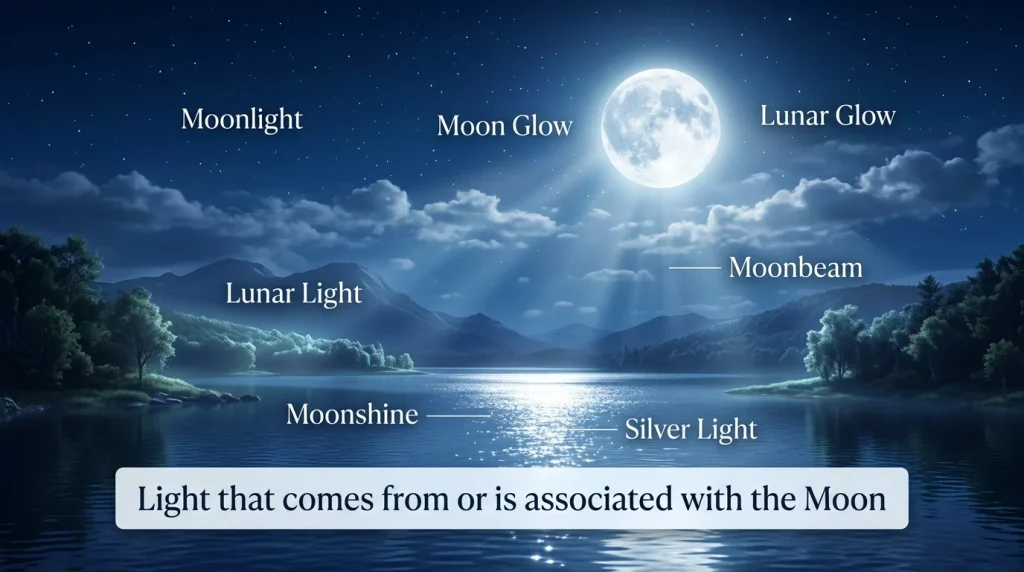
Meaning: Light that comes from or is associated with the Moon.
Tone/Register: Formal, literary, scientific
Example:
The mountains were visible in the soft lunar light.
The photographer waited for enough lunar light to illuminate the landscape.
Moon Glow (Noun Phrase) — US / UK: /ˈmuːn ɡloʊ/
Meaning: The gentle brightness or radiance produced by the Moon.
Tone/Register: Neutral, descriptive, poetic
Example:
A soft moon glow appeared over the lake.
The moon glow made the water look almost silver.
Moonshine (Noun) — US / UK: /ˈmuːn.ʃaɪn/
Meaning: Light from the Moon, especially in literary or older usage.
Tone/Register: Literary, traditional
Example:
The old stone walls looked pale in the moonshine.
They walked quietly through the forest by moonshine.
Native usage note: Moonshine can also mean illegally produced alcohol, so context matters.
Lunar Glow (Noun Phrase) — US / UK: /ˈluː.nər ɡloʊ/
Meaning: A soft, visible glow associated with light from the Moon.
Tone/Register: Literary, descriptive
Example:
The lunar glow touched the tops of the trees.
Her face appeared peaceful beneath the lunar glow.
Moon Glowlight (Noun Phrase) — US / UK: /ˈmuːn ɡloʊ.laɪt/
Meaning: A descriptive expression for the gentle illumination associated with the Moon.
Tone/Register: Poetic, creative
Example:
The path shimmered beneath the moon glowlight.
Writers may use this expression for atmosphere, although moonlight is much more natural in everyday English.
Silver Light (Noun Phrase) — US / UK: /ˈsɪl.vər laɪt/
Meaning: A poetic description of moonlight that emphasizes its pale, silvery appearance.
Tone/Register: Poetic, literary
Example:
Silver light covered the quiet fields.
The river reflected the silver light of the Moon.
Silver Glow (Noun Phrase) — US / UK: /ˈsɪl.vər ɡloʊ/
Meaning: A soft silvery brightness, often suggesting moonlight.
Tone/Register: Poetic, descriptive
Example:
A silver glow spread across the snowy hills.
The windows reflected a faint silver glow.
Lunar Radiance (Noun Phrase) — US / UK: /ˈluː.nər ˈreɪ.di.əns/
Meaning: The bright or glowing appearance of light associated with the Moon.
Tone/Register: Formal, literary
Example:
The valley shone beneath the lunar radiance.
The painting captures the quiet beauty of lunar radiance.
Moonbeam (Noun) — US / UK: /ˈmuːn.biːm/
Meaning: A visible ray or narrow beam of light coming from the Moon.
Tone/Register: Neutral, literary
Example:
A moonbeam entered through the bedroom window.
She stood quietly in a narrow moonbeam.
Important: Moonbeam is not the same as moonlight. It usually means a particular ray or beam.
Moon Ray (Noun Phrase) — US / UK: /ˈmuːn reɪ/
Meaning: A ray or beam of light from the Moon.
Tone/Register: Descriptive, literary
Example:
A moon ray slipped through the clouds.
The leaves glowed beneath a narrow moon ray.
Moon Rays (Noun Phrase) — US / UK: /ˈmuːn reɪz/
Meaning: Multiple rays of light appearing to come from the Moon.
Tone/Register: Literary, descriptive
Example:
Moon rays broke through the clouds.
The lake caught the moon rays beautifully.
Lunar Illumination (Noun Phrase) — US / UK: /ˈluː.nər ɪˌluː.məˈneɪ.ʃən/
Meaning: Illumination provided by light reflected from the Moon.
Tone/Register: Formal, academic, technical
Example:
Lunar illumination made the trail easier to see.
The study examined visibility under different levels of lunar illumination.
Moonlit Glow (Noun Phrase) — US / UK: /ˈmuːn.lɪt ɡloʊ/
Meaning: A gentle glow created by an area being illuminated by moonlight.
Tone/Register: Literary, descriptive
Example:
The cabin stood in a soft moonlit glow.
The trees looked beautiful in the moonlit glow.
Moonlit Radiance (Noun Phrase) — US / UK: /ˈmuːn.lɪt ˈreɪ.di.əns/
Meaning: The bright, beautiful appearance created by moonlight.
Tone/Register: Poetic, literary
Example:
The palace walls shimmered with moonlit radiance.
The scene was peaceful beneath the moonlit radiance.
Moonlit Brightness (Noun Phrase) — US / UK: /ˈmuːn.lɪt ˈbraɪt.nəs/
Meaning: The visible brightness created by the Moon at night.
Tone/Register: Neutral, descriptive
Example:
The road was clear in the moonlit brightness.
The hikers appreciated the moonlit brightness.
Nighttime Glow (Noun Phrase) — US / UK: /ˈnaɪt.taɪm ɡloʊ/
Meaning: A soft glow visible during the night, often referring to moonlight in context.
Tone/Register: Neutral, conversational
Example:
The garden looked different in the nighttime glow.
A gentle nighttime glow filled the courtyard.
Celestial Light (Noun Phrase) — US / UK: /səˈles.tʃəl laɪt/
Meaning: Light associated with a celestial body such as the Moon.
Tone/Register: Formal, poetic
Example:
The travelers rested beneath the celestial light.
The scene was painted in cool celestial light.
Native usage note: This can refer to light from other heavenly bodies, so it is broader than moonlight.
Celestial Glow (Noun Phrase) — US / UK: /səˈles.tʃəl ɡloʊ/
Meaning: A soft glow associated with something in the sky.
Tone/Register: Poetic, literary
Example:
The clouds reflected a faint celestial glow.
The writer described the lake beneath a celestial glow.
Nocturnal Glow (Noun Phrase) — US / UK: /nɑːkˈtɝː.nəl ɡloʊ/
Meaning: A glow visible at night.
Tone/Register: Formal, descriptive
Example:
The village appeared calm beneath the nocturnal glow.
The photographer captured the nocturnal glow over the valley.
Important: This is broader than moonlight and may describe other nighttime sources.
Night Radiance (Noun Phrase) — US / UK: /naɪt ˈreɪ.di.əns/
Meaning: Brightness or glow visible during the night.
Tone/Register: Poetic, literary
Example:
The lake reflected the night radiance.
The poet described the hills beneath the night radiance.
Pale Light (Noun Phrase) — US / UK: /peɪl laɪt/
Meaning: Weak or soft light, often used to describe moonlight.
Tone/Register: Neutral, descriptive
Example:
Pale light entered through the curtains.
The road disappeared beneath the pale light.
Soft Light (Noun Phrase) — US / UK: /sɔːft laɪt/
Meaning: Gentle, non-harsh illumination that can describe moonlight in context.
Tone/Register: Neutral, everyday
Example:
Soft light came through the bedroom window.
The garden looked peaceful in the soft light.
Gentle Glow (Noun Phrase) — US / UK: /ˈdʒen.təl ɡloʊ/
Meaning: A mild and pleasing brightness.
Tone/Register: Neutral, descriptive
Example:
A gentle glow covered the quiet street.
The lake reflected a gentle glow from above.
Nighttime Illumination (Noun Phrase) — US / UK: /ˈnaɪt.taɪm ɪˌluː.məˈneɪʃən/
Meaning: Light that provides visibility during nighttime.
Tone/Register: Formal, technical
Example:
The path received some nighttime illumination from the Moon.
The level of nighttime illumination changed as clouds moved across the sky.
Moonlit Shine (Noun Phrase) — US / UK: /ˈmuːn.lɪt ʃaɪn/
Meaning: The visible shining effect created by moonlight.
Tone/Register: Poetic, informal
Example:
The waves sparkled under the moonlit shine.
Her dress caught the moonlit shine from the window.
Moonlit Brightness (Noun Phrase) — US / UK: /ˈmuːn.lɪt ˈbraɪt.nəs/
Meaning: Brightness produced by an environment illuminated by the Moon.
Tone/Register: Descriptive
Example:
The path was easy to follow in the moonlit brightness.
The snow looked blue in the moonlit brightness.
Moonlit Glow (Noun Phrase) — US / UK: /ˈmuːn.lɪt ɡloʊ/
Meaning: A soft illumination or glow produced by moonlight.
Tone/Register: Poetic, descriptive
Example:
The flowers looked delicate in the moonlit glow.
A moonlit glow surrounded the old bridge.
Moonbeam Glow (Noun Phrase) — US: /ˈmuːn.biːm ɡloʊ/ | UK: /ˈmuːn.biːm ɡləʊ/
Meaning: A soft brightness created by a visible beam of light from the Moon.
Tone/Register: Poetic, descriptive
Example:
A moonbeam glow rested on the quiet garden.
The curtains shimmered in the moonbeam glow.
Moonlit Sheen (Noun Phrase) — US: /ˈmuːn.lɪt ʃiːn/ | UK: /ˈmuːn.lɪt ʃiːn/
Meaning: A smooth, faint shine appearing on a surface under moonlight.
Tone/Register: Literary, descriptive
Example:
The lake had a beautiful moonlit sheen.
A moonlit sheen covered the wet stones.
Lunar Sheen (Noun Phrase) — US: /ˈluː.nər ʃiːn/ | UK: /ˈluː.nə ʃiːn/
Meaning: A delicate shine produced by illumination from the Moon.
Tone/Register: Literary, formal
Example:
A lunar sheen appeared across the ocean.
The rooftops caught the faint lunar sheen.
Moonlit Gleam (Noun Phrase) — US: /ˈmuːn.lɪt ɡliːm/ | UK: /ˈmuːn.lɪt ɡliːm/
Meaning: A brief or noticeable shine caused by moonlight.
Tone/Register: Poetic, descriptive
Example:
A moonlit gleam appeared on the window.
The path showed a faint moonlit gleam.
Lunar Gleam (Noun Phrase) — US: /ˈluː.nər ɡliːm/ | UK: /ˈluː.nə ɡliːm/
Meaning: A soft or faint shine associated with the Moon.
Tone/Register: Literary, poetic
Example:
The hills appeared beneath a quiet lunar gleam.
A lunar gleam touched the distant rooftops.
Moonlit Luster (Noun Phrase) — US: /ˈmuːn.lɪt ˈlʌs.tər/ | UK: /ˈmuːn.lɪt ˈlʌs.tə/
Meaning: A gentle, reflective shine created by moonlight.
Tone/Register: Literary, descriptive
Example:
The sea had a soft moonlit luster.
The silver stones reflected the moonlit luster.
Lunar Shimmer (Noun Phrase) — US: /ˈluː.nər ˈʃɪm.ər/ | UK: /ˈluː.nə ˈʃɪm.ə/
Meaning: A delicate, flickering brightness associated with reflected lunar light.
Tone/Register: Poetic, descriptive
Example:
A lunar shimmer danced across the water.
The waves carried a gentle lunar shimmer.
Moonlit Shimmer (Noun Phrase) — US: /ˈmuːn.lɪt ˈʃɪm.ər/ | UK: /ˈmuːn.lɪt ˈʃɪm.ə/
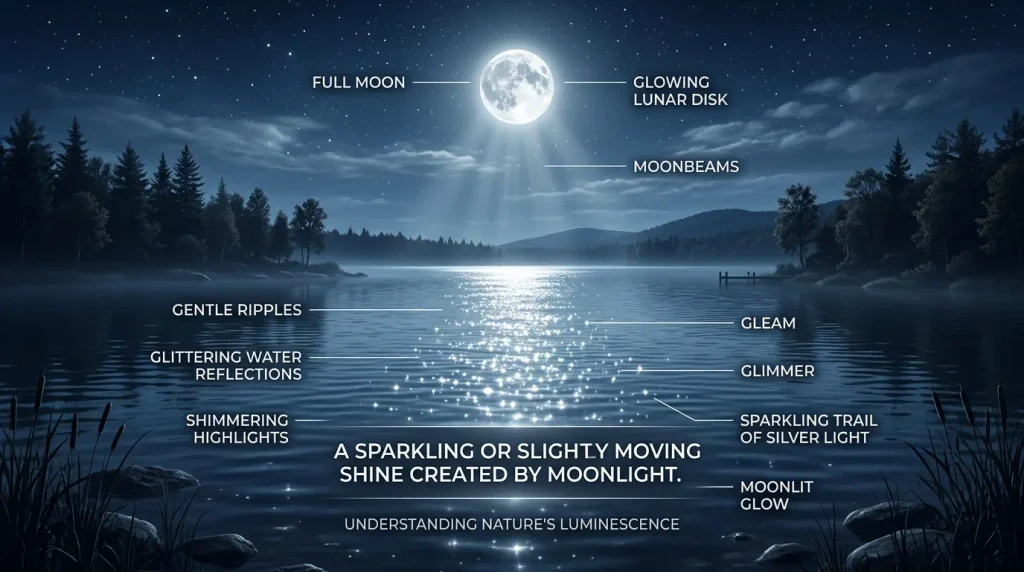
Meaning: A sparkling or slightly moving shine created by moonlight.
Tone/Register: Poetic, creative
Example:
The river displayed a moonlit shimmer.
Leaves moved beneath the moonlit shimmer.
Lunar Brightness (Noun Phrase) — US: /ˈluː.nər ˈbraɪt.nəs/ | UK: /ˈluː.nə ˈbraɪt.nəs/
Meaning: The amount of visible brightness provided by the Moon.
Tone/Register: Formal, neutral
Example:
The lunar brightness helped the travelers see the trail.
Clouds reduced the lunar brightness considerably.
Moonlit Illumination (Noun Phrase) — US: /ˈmuːn.lɪt ɪˌluː.məˈneɪ.ʃən/ | UK: /ˈmuːn.lɪt ɪˌluː.mɪˈneɪ.ʃən/
Meaning: Light or visibility created when an area is illuminated by the Moon.
Tone/Register: Formal, descriptive
Example:
The photographer worked with the soft moonlit illumination.
The trail was visible because of the moonlit illumination.
Note: Some expressions above are contextual alternatives rather than strict dictionary synonyms. This distinction matters because moonbeam, for example, refers to a ray of moonlight, while moonlight refers to lunar illumination generally.
Synonyms for Moonlight by Tone
Tone matters because different alternatives create different impressions.
Positive and Beautiful
For romantic, peaceful, or beautiful descriptions, use:
- Moon glow
- Lunar glow
- Silver light
- Silver glow
- Moonlit glow
- Lunar radiance
- Gentle glow
These choices work especially well in poetry, travel writing, storytelling, and personal descriptions.
Neutral
For ordinary descriptions, prefer:
- Moonlight
- Lunar light
- Pale light
- Soft light
- Moonlit brightness
- Nighttime illumination
These expressions are clear and easy to understand.
Formal
For academic or technical contexts, use:
- Lunar illumination
- Lunar light
- Celestial light
- Nighttime illumination
For example, a scientific discussion about visibility would normally favor lunar illumination over a poetic expression such as silver glow.
Poetic and Creative
For creative writing, consider:
- Silver light
- Silver glow
- Moonlit radiance
- Moonbeam
- Night radiance
- Celestial glow
- Lunar radiance
These expressions help create imagery and atmosphere.
Does Moonlight Have Negative Synonyms?
Not really. Most alternatives describe the same physical phenomenon rather than an attitude or emotion.
However, a writer can make moonlight feel dark, eerie, lonely, or threatening through surrounding words.
For example:
The pale moonlight revealed an empty road.
The word moonlight remains neutral, but the context creates an unsettling mood.
Moonlight vs Close Alternatives
Moonlight is the everyday choice. It sounds natural in conversation and general writing.
Lunar light is more formal and emphasizes the Moon as a celestial object.
Use moonlight:
The children played outside in the moonlight.
Use lunar light:
The researchers observed the landscape under lunar light.
Moonlight vs Moonbeam
Moonlight refers to lunar illumination generally.
Moonbeam refers to a specific ray or narrow beam of that light.
Use moonlight:
The garden was bright with moonlight.
Use moonbeam:
A moonbeam entered through the window.
Moonlight vs Moonshine
Moonlight is the safest everyday word.
Moonshine can mean moonlight, especially in literary or older usage. However, it also commonly refers to illegally produced alcoholic liquor.
Use moonlight:
The beach looked beautiful in the moonlight.
Use moonshine:
The old poem describes a forest glowing in moonshine.
How Moonlight Changes by Context
In Daily Conversation
In everyday English, moonlight is usually the best option.
Native speakers commonly say:
The moonlight is beautiful tonight.
We walked home under the moonlight.
Although alternatives can sound attractive, they are not always natural in casual speech. Lunar radiance may sound overly poetic in a simple conversation.
In Writing and Blogging
Bloggers can use descriptive alternatives to prevent unnecessary repetition.
For example, instead of writing:
The moonlight covered the lake. The moonlight made the water sparkle.
You could write:
The moonlight covered the lake. Its silver glow made the water sparkle.
This approach improves readability while keeping the description natural.
In Professional or Academic Writing
Formal writing benefits from precise vocabulary.
Lunar illumination is useful when discussing visibility, astronomy, environmental conditions, or scientific observations.
For example:
Visibility increased because of stronger lunar illumination.
Here, silver glow would sound less precise.
In Creative Writing
Creative writing gives you more freedom.
Words such as silver light, lunar radiance, and moonlit glow can help establish mood.
For example:
Silver light stretched across the silent lake.
The expression creates an image without repeatedly using moonlight.
Common Mistakes Learners Make
Treating Every Alternative as an Exact Synonym
Not every expression above has the same meaning.
Moonbeam means a ray of moonlight, while lunar illumination describes illumination more formally.
Therefore, always consider the specific meaning before replacing the original word.
Using Poetic Words in Casual Situations
Some expressions can sound unnatural in ordinary conversation.
For example:
The lunar radiance was lovely tonight.
This is grammatically possible, but most native speakers would simply say:
The moonlight was beautiful tonight.
Confusing Moonshine With Moonlight
Moonshine has another common meaning: illegally produced alcoholic liquor.
Therefore, avoid it when your sentence could become confusing.
Overusing Silver
Expressions such as silver light and silver glow are useful in creative writing. However, using silver in every sentence can make your writing feel repetitive.
Instead, vary your vocabulary according to the context.
Register Notes
Moonlight is neutral and works in almost any context.
Lunar light and lunar illumination sound more formal.
Silver light and lunar radiance are more literary.
Moonbeam is common enough to be understood easily, but it describes a specific ray rather than all moonlight.
Moonshine has a traditional literary meaning but also has a completely different modern meaning.
Therefore, the safest everyday choice is still moonlight.
Real-Life Mini Scenarios
Workplace
A travel writer describes a campsite:
The campsite looked peaceful under the moonlight.
For a more formal report, the writer might say:
Visibility remained adequate because of lunar illumination.
Social Situation
A friend might say:
Look at the moonlight on the water!
This sounds much more natural than using a highly literary phrase.
Media and Pop Culture
Movie reviews often describe scenes through visual language.
For example:
The director uses silver light to create a mysterious atmosphere.
Here, silver light works because the goal is artistic description.
Writing and Storytelling
A novelist may want to create suspense:
A pale light revealed the empty road ahead.
The phrase pale light leaves room for atmosphere without directly repeating moonlight.
Why Learning These Alternatives Improves Your English
Vocabulary becomes more useful when you understand choice, not just memorization.
Knowing that moonbeam means a ray helps you use it accurately. Similarly, understanding that lunar illumination is formal helps you avoid awkward wording in casual conversation.
Synonyms also help writers create stronger imagery.
Instead of repeating the same noun several times, you can select a related expression that matches the scene, mood, and audience.
Most importantly, learning alternatives should not become a search for the most complicated word. Good English is about choosing the right word.
Interactive Practice Quiz
1. Which word is the most natural choice in everyday English?
A. Lunar radiance
B. Moonlight
C. Celestial glow
D. Nocturnal glow
2. Which expression is most appropriate for a formal scientific context?
A. Silver glow
B. Moonbeam
C. Lunar illumination
D. Gentle glow
3. Which word means a narrow ray of moonlight?
A. Moonbeam
B. Moonlight
C. Moonshine
D. Lunar light
4. Which phrase sounds most poetic?
A. Nighttime illumination
B. Lunar illumination
C. Silver light
D. Soft light
5. A student wants to write, “The lake looked beautiful at night.” Which option adds a poetic image?
A. The lake shone beneath the silver light.
B. The lake had nighttime illumination.
C. The lake had lunar illumination.
D. The lake had light.
6. Which word can be confusing because it has another common meaning?
A. Moonlight
B. Moonshine
C. Moonbeam
D. Lunar light
7. Which alternative is broader than moonlight?
A. Moonbeam
B. Celestial light
C. Lunar illumination
D. Moon glow
8. Which phrase best describes gentle brightness?
A. Gentle glow
B. Moon ray
C. Moonbeam
D. Moonshine
9. Which expression would suit an academic report best?
A. Silver glow
B. Lunar illumination
C. Moonlit radiance
D. Moonlit shine
10. Which sentence uses “moonbeam” correctly?
A. The entire valley was moonbeam.
B. A moonbeam entered through the window.
C. The moonbeam was beautiful everywhere.
D. We walked in the moonbeam for hours.
Reflection Task
Write one sentence describing a nighttime scene. Use moonlight, moonbeam, silver light, or lunar glow.
Answer Key: 1-B | 2-C | 3-A | 4-C | 5-A | 6-B | 7-B | 8-A | 9-B | 10-B
FAQs
1. What are the best synonyms for moonlight in creative writing?
The best creative alternatives include silver light, silver glow, lunar radiance, moonlit glow, lunar glow, and celestial glow. These expressions add imagery and atmosphere. However, moonlight is still the most natural choice when you want a simple and direct description.
2. What is a formal synonym for moonlight?
Lunar illumination is one of the strongest formal alternatives. Lunar light is another useful option. These expressions work well in academic, scientific, or technical writing because they describe illumination from the Moon more precisely than highly poetic phrases such as silver glow.
3. Is moonbeam another word for moonlight?
Not exactly. A moonbeam is a specific ray or beam of light from the Moon, while moonlight refers to lunar light more generally. Therefore, you can say, “A moonbeam entered the room,” but you would normally say, “The room was filled with moonlight.”
4. What is a poetic word for moonlight?
Silver light is one of the most natural poetic alternatives because moonlight is often imagined as pale or silvery. Other choices include lunar radiance, silver glow, moonlit glow, and celestial glow. The best choice depends on whether you want a romantic, peaceful, mysterious, or dramatic mood.
5. Can I use moonshine instead of moonlight?
Yes, but use it carefully. Moonshine has a traditional meaning referring to moonlight, especially in literary contexts. However, modern English also uses moonshine for illegally produced alcohol. Because of this double meaning, moonlight is usually clearer for everyday communication.
Conclusion
Learning synonyms for moonlight gives you more than extra vocabulary. It helps you describe nighttime scenes with greater accuracy, variety, and feeling.
From everyday moonlight to poetic silver light and formal lunar illumination, each expression has a useful place.
Good vocabulary is not about choosing the biggest word. Instead, it is about selecting the word that fits your meaning, audience, and tone.
Now, practice these alternatives in an essay, blog paragraph, email, or daily conversation. The more you use them, the more naturally they become part of your English.

Shahzeena Shazadi is the founder and lead writer at VocablyHub.com, where she creates accurate, reader-focused English language content designed to help people communicate with clarity and confidence. She specializes in synonyms, antonyms, word meanings, idioms, and practical vocabulary guides that simplify complex language concepts for everyday use. Every article is carefully researched, fact-checked, and written in clear, accessible language using reliable references and real-world examples. Her goal is to provide helpful, trustworthy content that supports learners at every stage of their English language journey.
Her editorial approach focuses on accuracy, transparency, and user value while following modern content quality standards. She regularly reviews and updates content to keep information relevant, useful, and easy to understand. Through VocablyHub.com, Shahzeena Shazadi is committed to publishing reliable language resources that help students, writers, educators, professionals, and English learners expand their vocabulary, improve their writing skills, and communicate with confidence in academic, professional, and everyday situations.