
A synonym for speaking up is voicing an opinion, speaking out, expressing yourself, standing up for yourself, or raising your voice, depending on the context. These expressions describe sharing thoughts, addressing concerns, challenging unfairness, or making your position known with confidence.
Imagine a student who notices an unfair classroom rule but feels nervous about questioning it. When she finally explains her concerns, she is speaking up. She could also be described as voicing her opinion or speaking out.
Finding the right synonym for speaking up helps you express courage, disagreement, or honesty more precisely. Each alternative carries a slightly different meaning and emotional tone.
The phrase is common in everyday conversations, workplace discussions, education, social issues, and personal relationships. People use it when someone chooses to communicate instead of remaining silent.
Students, bloggers, content writers, and everyday English learners can use these expressions to strengthen essays, write engaging articles, and communicate their ideas more confidently.
What Does “Speaking Up” Really Mean?
Speaking up means expressing an opinion, concern, objection, or personal need instead of staying silent. It can involve asking a question, correcting misinformation, defending someone, or making your feelings known.
For example, an employee who questions an unsafe workplace practice is speaking up. A student who asks a teacher to explain an unclear instruction is also speaking up.
The phrase does not always imply anger or confrontation. Sometimes it describes a quiet but confident statement. In other situations, it suggests courage because the speaker risks criticism or disagreement.
Part of Speech and Simple Definition
Speaking up is a verb phrase formed from the verb speak and the particle up.
- Speak: To communicate through words.
- Up: In this phrasal verb, it contributes the idea of expressing something openly or assertively.
- Speaking up: Expressing what you think, feel, need, or believe rather than remaining silent.
Native speakers use the phrase in personal, academic, professional, and social contexts. Its meaning depends on the situation and the speaker’s intention.
Connotative Meaning of “Speaking Up”
(Connotation is the emotional feeling or association a word or expression carries beyond its literal meaning.)
Positive tone: Speaking up can suggest courage, confidence, honesty, leadership, and self-respect.
Example: “She spoke up when her colleague received unfair criticism.”
Negative tone: In some situations, speaking up may sound confrontational, disruptive, or disrespectful, especially when someone interrupts or speaks aggressively.
Example: “He kept speaking up during the presentation and interrupted every speaker.”
Neutral tone: The phrase can simply describe expressing an opinion or asking a question.
Example: “Please speak up if you need clarification.”
The phrase itself is not inherently positive or negative. The speaker’s intention, delivery, and circumstances shape how other people interpret it.
Etymology
The expression combines two Old English elements: speak and up.
Old English (450–1100)
The verb speak developed from Old English specan or sprecan, meaning to speak or utter words. The word up came from Old English up, describing an upward direction.
Middle English (1100–1500)
The verb appeared in Middle English in forms such as speken. English speakers increasingly developed combinations of verbs and particles to express meanings beyond their individual parts.
Modern English (1500–Present)
Over time, speak up developed several established uses. It can mean speaking more loudly so others can hear, expressing an opinion openly, or voicing an objection. Today, the phrase commonly appears in conversations about confidence, fairness, communication, and advocacy.
Pronunciation
- US IPA: /ˌspiː.kɪŋ ˈʌp/
- UK IPA: /ˌspiː.kɪŋ ˈʌp/
Syllables: speak-ing-up
Affixation pattern: speak + -ing + up
- Root: Speak
- Prefix: None
- Suffix: -ing
- Particle: Up
The suffix -ing forms the present participle of speak. The particle up changes the meaning of the verb phrase, giving it the sense of expressing something openly or assertively.
Synonyms List
The following alternatives cover different aspects of speaking up, including expressing an opinion, raising a concern, challenging injustice, defending yourself, and communicating assertively. Some are direct alternatives, while others suit specific contexts.
1. Voicing an Opinion (Verb Phrase) — US / UK: /ˈvɔɪ.sɪŋ ən əˈpɪn.jən/
Meaning: Expressing what you think about a subject or situation.
Tone/Register: Neutral to positive; everyday, academic, and professional.
Examples:
Maya voiced her opinion during the team meeting.
Everyone should feel comfortable voicing an opinion about the new policy.
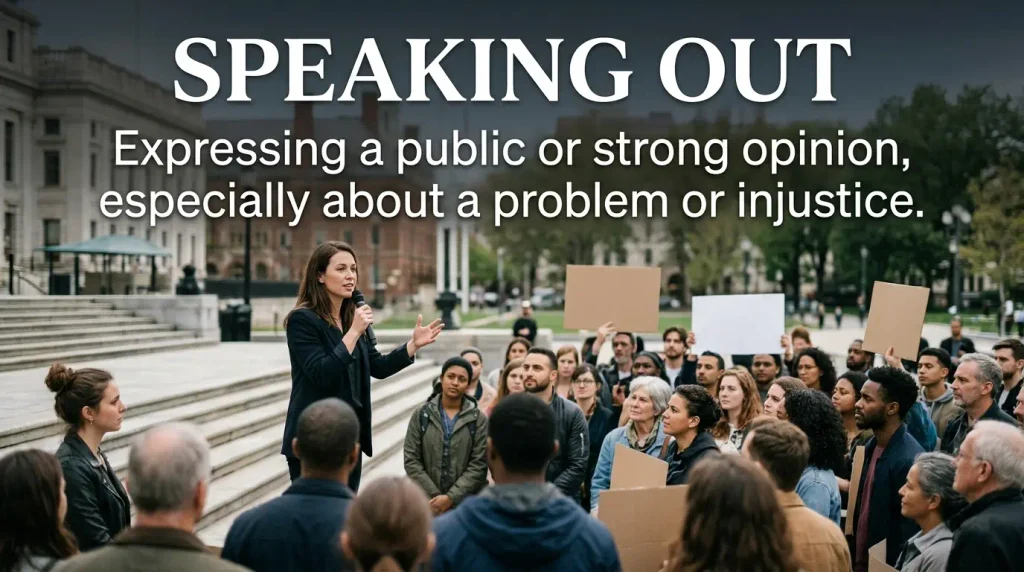
2. Speaking Out (Phrasal Verb) — US / UK: /ˈspiː.kɪŋ ˈaʊt/
Meaning: Expressing a public or strong opinion, especially about a problem or injustice.
Tone/Register: Assertive; social, political, and professional.
Examples:
Several residents spoke out against the proposed development.
He decided to speak out about the unfair treatment.
3. Expressing Yourself (Verb Phrase) — US / UK: /ɪkˈspres.ɪŋ jɚˈself/; /ɪkˈspres.ɪŋ jəˈself/
Meaning: Communicating your thoughts, feelings, or ideas openly.
Tone/Register: Neutral to positive; personal, educational, and creative.
Examples:
Art gives children a safe way to express themselves.
She is learning to express herself more clearly.
4. Raising Your Voice (Verb Phrase) — US / UK: /ˈreɪ.zɪŋ jɚ ˈvɔɪs/; /ˈreɪ.zɪŋ jə ˈvɔɪs/
Meaning: Speaking more loudly or making your views heard, sometimes with strong emotion.
Tone/Register: Neutral to negative; conversational and confrontational contexts.
Examples:
You don’t need to raise your voice to make your point.
The crowd raised its voice in protest.
5. Standing Up for Yourself (Verb Phrase) — US / UK: /ˈstæn.dɪŋ ʌp fər jɚˈself/; /ˈstæn.dɪŋ ʌp fə jəˈself/
Meaning: Defending your rights, needs, or boundaries when someone treats you unfairly.
Tone/Register: Positive and assertive; personal and workplace communication.
Examples:
Lena stood up for herself when her coworker took credit for her work.
Learning to stand up for yourself can strengthen your confidence.
6. Speaking Your Mind (Verb Phrase) — US / UK: /ˈspiː.kɪŋ jɚ ˈmaɪnd/; /ˈspiː.kɪŋ jə ˈmaɪnd/
Meaning: Saying honestly what you think or believe.
Tone/Register: Informal to neutral; personal and social.
Examples:
My brother always speaks his mind about new films.
You can speak your mind without insulting anyone.
7. Making Your Voice Heard (Verb Phrase) — US / UK: /ˈmeɪ.kɪŋ jɚ ˈvɔɪs hɝːd/; /ˈmeɪ.kɪŋ jə ˈvɔɪs hɜːd/
Meaning: Ensuring that other people notice and consider your views.
Tone/Register: Positive; advocacy, education, and public discussion.
Examples:
Local students organized a meeting to make their voices heard.
She wrote to the council to make her concerns heard.
8. Asserting Yourself (Verb Phrase) — US / UK: /əˈsɝː.tɪŋ jɚˈself/; /əˈsɜː.tɪŋ jəˈself/
Meaning: Communicating your needs or position confidently and directly.
Tone/Register: Assertive; professional, personal development, and psychology.
Examples:
He learned to assert himself during difficult conversations.
Asserting yourself does not mean ignoring other people’s feelings.
9. Speaking Frankly (Verb Phrase) — US / UK: /ˈspiː.kɪŋ ˈfræŋk.li/
Meaning: Communicating honestly and directly without hiding your real opinion.
Tone/Register: Neutral to formal; professional and personal.
Examples:
I’ll speak frankly about the challenges we face.
She spoke frankly about why the project failed.
10. Being Vocal (Verb Phrase) — US / UK: /ˈbiː.ɪŋ ˈvoʊ.kəl/; /ˈbiː.ɪŋ ˈvəʊ.kəl/
Meaning: Expressing opinions or concerns openly and often.
Tone/Register: Neutral; media, workplace, and social contexts.
Examples:
Parents have been vocal about the school schedule.
He is vocal about protecting local parks.
11. Voicing Concerns (Verb Phrase) — US / UK: /ˈvɔɪ.sɪŋ kənˈsɝːnz/; /ˈvɔɪ.sɪŋ kənˈsɜːnz/
Meaning: Expressing worries or objections about a particular issue.
Tone/Register: Professional and neutral; workplace and academic writing.
Examples:
Several employees voiced concerns about the new timetable.
She voiced concerns about the accuracy of the report.
12. Raising an Issue (Verb Phrase) — US / UK: /ˈreɪ.zɪŋ ən ˈɪʃ.uː/
Meaning: Bringing a problem or topic to other people’s attention.
Tone/Register: Neutral to formal; business and academic.
Examples:
I’d like to raise an issue before we finalize the plan.
The student raised an issue about the grading process.
13. Objecting (Verb) — US / UK: /əbˈdʒek.tɪŋ/
Meaning: Expressing disagreement or opposition to something.
Tone/Register: Neutral to formal; meetings, debates, and official discussions.
Examples:
Several members objected to the proposed changes.
She objected when the discussion became disrespectful.
14. Challenging (Verb) — US / UK: /ˈtʃæl.ɪn.dʒɪŋ/
Meaning: Questioning an idea, decision, or practice instead of accepting it without examination.
Tone/Register: Assertive; academic, professional, and social.
Examples:
The researcher challenged the assumptions behind the study.
He challenged the decision and requested a review.
15. Confronting (Verb) — US / UK: /kənˈfrʌn.tɪŋ/
Meaning: Addressing a difficult problem or person directly rather than avoiding the situation.
Tone/Register: Strong and sometimes negative; personal and professional.
Examples:
She confronted her teammate about the missing files.
We need to confront the problem before it grows.
16. Protesting (Verb) — US / UK: /prəˈtes.tɪŋ/
Meaning: Expressing strong opposition to an action, policy, or situation.
Tone/Register: Assertive; civic, political, and everyday contexts.
Examples:
Residents protested against the planned road closure.
The students protested when the library hours were reduced.
17. Advocating (Verb) — US / UK: /ˈæd.və.keɪ.tɪŋ/
Meaning: Publicly supporting an idea, cause, or group.
Tone/Register: Positive; professional, educational, and social causes.
Examples:
She is advocating for better access to public transport.
The organization advocates for equal learning opportunities.
18. Defending a Position (Verb Phrase) — US / UK: /dɪˈfen.dɪŋ ə pəˈzɪʃ.ən/
Meaning: Explaining why you support a particular opinion or decision.
Tone/Register: Formal and assertive; debates, essays, and professional meetings.
Examples:
The student defended her position with clear evidence.
He defended his proposal during the review meeting.
19. Calling Something Out (Verb Phrase) — US / UK: /ˈkɔː.lɪŋ ˈsʌm.θɪŋ ˈaʊt/
Meaning: Publicly identifying or criticizing behavior that seems wrong, unfair, or inappropriate.
Tone/Register: Informal to neutral; social media and everyday discussions.
Examples:
She called out the misleading claim in the comments.
It’s reasonable to call out bullying when you witness it.
20. Pushing Back (Phrasal Verb) — US / UK: /ˈpʊʃ.ɪŋ ˈbæk/
Meaning: Resisting a demand, suggestion, or decision you disagree with.
Tone/Register: Informal to professional; workplace and personal contexts.
Examples:
The team pushed back against an unrealistic deadline.
He pushed back when the rules changed without warning.
21. Intervening (Verb) — US / UK: /ˌɪn.tɚˈviː.nɪŋ/; /ˌɪn.təˈviː.nɪŋ/
Meaning: Stepping into a situation to influence what happens, often to prevent harm or resolve a problem.
Tone/Register: Neutral to positive; professional and social.
Examples:
A teacher intervened when the argument became heated.
She intervened to stop a stranger from being harassed.
22. Speaking on Behalf of (Verb Phrase) — US / UK: /ˈspiː.kɪŋ ɑːn bɪˈhæf əv/; /ˈspiː.kɪŋ ɒn bɪˈhɑːf əv/
Meaning: Expressing views or concerns for another person or group with appropriate permission or authority.
Tone/Register: Formal; meetings, organizations, and public communication.
Examples:
The representative spoke on behalf of the residents.
I’m speaking on behalf of our project team today.
23. Testifying (Verb) — US / UK: /ˈtes.tə.faɪ.ɪŋ/
Meaning: Giving a formal statement about facts or experiences, especially in a legal or official setting.
Tone/Register: Formal; legal and institutional.
Examples:
The witness testified about what she saw.
He agreed to testify at the hearing.
24. Declaring (Verb) — US / UK: /dɪˈkler.ɪŋ/
Meaning: Stating a position, intention, or belief clearly and openly.
Tone/Register: Formal to emphatic; public statements and announcements.
Examples:
The group declared its opposition to the proposal.
She declared that the results needed further review.
25. Proclaiming (Verb) — US / UK: /proʊˈkleɪ.mɪŋ/; /prəʊˈkleɪ.mɪŋ/
Meaning: Announcing an opinion or belief openly and emphatically.
Tone/Register: Formal, emphatic, and sometimes dramatic.
Examples:
The mayor proclaimed support for the new initiative.
He proclaimed his innocence during the interview.
26. Announcing (Verb) — US / UK: /əˈnaʊn.sɪŋ/
Meaning: Making information, a decision, or an intention known to others.
Tone/Register: Neutral; everyday, professional, and public communication.
Examples:
She announced her decision to leave the committee.
The principal announced a change to the school timetable.
27. Revealing (Verb) — US / UK: /rɪˈviː.lɪŋ/
Meaning: Making information or feelings known that were previously hidden or unknown.
Tone/Register: Neutral; personal, journalistic, and storytelling contexts.
Examples:
He revealed his concerns after the meeting ended.
The interview revealed why she had remained silent.
28. Confessing (Verb) — US / UK: /kənˈfes.ɪŋ/
Meaning: Admitting something personal, embarrassing, or wrong that you had previously kept private.
Tone/Register: Personal and sometimes emotional; everyday and formal.
Examples:
She confessed that she had misunderstood the instructions.
He finally confessed his doubts about the plan.
29. Admitting (Verb) — US / UK: /ədˈmɪt.ɪŋ/
Meaning: Acknowledging a fact, mistake, or feeling that may be difficult to accept.
Tone/Register: Neutral; conversational and professional.
Examples:
The manager admitted that the original estimate was inaccurate.
I admitted that I needed more time to prepare.
30. Interjecting (Verb) — US / UK: /ˌɪn.tɚˈdʒek.tɪŋ/; /ˌɪn.təˈdʒek.tɪŋ/
Meaning: Adding a comment or question during someone else’s speech or a discussion.
Tone/Register: Neutral; conversation, meetings, and debates.
Examples:
May I interject with a quick question?
He interjected to clarify one important detail.
31. Chiming In (Phrasal Verb) — US / UK: /ˈtʃaɪ.mɪŋ ˈɪn/
Meaning: Joining an ongoing conversation by adding your opinion or a relevant comment.
Tone/Register: Informal and friendly; group conversations.
Examples:
Everyone chimed in with suggestions for the party.
Feel free to chime in if you have another idea.
32. Weighing In (Phrasal Verb) — US / UK: /ˈweɪ.ɪŋ ˈɪn/
Meaning: Giving your opinion on an issue, especially one that other people are discussing.
Tone/Register: Informal to professional; media, debates, and meetings.
Examples:
Several experts weighed in on the proposed changes.
I’ll weigh in after I’ve read the full report.
33. Having Your Say (Verb Phrase) — US / UK: /ˈhæv.ɪŋ jɚ ˈseɪ/; /ˈhæv.ɪŋ jə ˈseɪ/
Meaning: Getting an opportunity to express your opinion or preferences.
Tone/Register: Neutral and conversational; public discussions and group decisions.
Examples:
Every student had their say before the vote.
Let the residents have their say about the new park.
34. Giving Your Two Cents (Idiom) — US / UK: /ˈɡɪv.ɪŋ jɚ ˌtuː ˈsents/; /ˈɡɪv.ɪŋ jə ˌtuː ˈsents/
Meaning: Offering your personal opinion, often informally and with a touch of humor.
Tone/Register: Informal and conversational; everyday English.
Examples:
I’ll give my two cents after everyone has finished.
She gave her two cents about the movie’s ending.
35. Putting Your Point Across (Verb Phrase) — US / UK: /ˈpʊt.ɪŋ jɚ ˈpɔɪnt əˈkrɔːs/; /ˈpʊt.ɪŋ jə ˈpɔɪnt əˈkrɒs/
Meaning: Explaining an idea clearly enough for other people to understand it.
Tone/Register: Neutral to professional; meetings, writing, and discussions.
Examples:
He used a simple example to put his point across.
A clear opening sentence helps you put your point across.
36. Articulating Your Thoughts (Verb Phrase) — US / UK: /ɑːrˈtɪk.jə.leɪ.tɪŋ jɚ ˈθɔːts/; /ɑːˈtɪk.jə.leɪ.tɪŋ jə ˈθɔːts/
Meaning: Expressing ideas clearly and coherently in words.
Tone/Register: Formal to neutral; academic, professional, and educational.
Examples:
The workshop helped students articulate their thoughts.
She took a moment to articulate her concerns precisely.
37. Making an Appeal (Verb Phrase) — US / UK: /ˈmeɪ.kɪŋ ən əˈpiːl/
Meaning: Asking people or an authority to consider a request or respond to a concern.
Tone/Register: Formal; official, legal, and public contexts.
Examples:
Residents made an appeal for safer pedestrian crossings.
The student made an appeal for another review of her grade.
38. Petitioning (Verb) — US / UK: /pəˈtɪʃ.ən.ɪŋ/
Meaning: Formally asking an authority to make a change or address a problem.
Tone/Register: Formal; civic, legal, and institutional.
Examples:
Residents are petitioning the council for better street lighting.
Students petitioned the administration to extend library hours.
39. Reporting (Verb) — US / UK: /rɪˈpɔːr.tɪŋ/; /rɪˈpɔː.tɪŋ/
Meaning: Informing the appropriate person or organization about an event, concern, or misconduct.
Tone/Register: Neutral to formal; workplace, school, and official settings.
Examples:
She reported the safety concern to her supervisor.
The student reported repeated bullying to a teacher.
40. Whistleblowing (Noun or Verb Form) — US / UK: /ˈwɪs.əlˌbloʊ.ɪŋ/; /ˈwɪs.əlˌbləʊ.ɪŋ/
Meaning: Reporting suspected wrongdoing within an organization to someone able to investigate it.
Tone/Register: Formal; legal, business, and public-interest contexts.
Examples:
The investigation began after an employee reported suspected fraud.
Whistleblowing can expose serious problems within an organization.
41. Taking a Stand (Verb Phrase) — US / UK: /ˈteɪ.kɪŋ ə ˈstænd/
Meaning: Publicly expressing firm support for or opposition to an issue.
Tone/Register: Assertive and often positive; civic and personal contexts.
Examples:
The community took a stand against discriminatory rules.
She took a stand for fair treatment at work.
42. Standing Firm (Verb Phrase) — US / UK: /ˈstæn.dɪŋ ˈfɝːm/; /ˈstæn.dɪŋ ˈfɜːm/
Meaning: Maintaining your position despite pressure to change it.
Tone/Register: Assertive; negotiation, leadership, and personal boundaries.
Examples:
He stood firm when the client demanded an unrealistic deadline.
She stood firm on the need for accurate reporting.
43. Defending Someone (Verb Phrase) — US / UK: /dɪˈfen.dɪŋ ˈsʌm.wʌn/
Meaning: Speaking or acting to protect another person from unfair criticism or treatment.
Tone/Register: Positive; personal, social, and professional.
Examples:
I defended my teammate when others blamed her unfairly.
He defended his younger brother during the disagreement.
44. Advocating for Yourself (Verb Phrase) — US / UK: /ˈæd.və.keɪ.tɪŋ fər jɚˈself/; /ˈæd.və.keɪ.tɪŋ fə jəˈself/
Meaning: Clearly communicating your needs, interests, or rights so others can consider them.
Tone/Register: Positive and assertive; education, health care, and professional settings.
Examples:
She advocated for herself during the performance review.
Students can advocate for themselves by asking for clear feedback.
45. Calling for Change (Verb Phrase) — US / UK: /ˈkɔː.lɪŋ fər ˈtʃeɪndʒ/; /ˈkɔː.lɪŋ fə ˈtʃeɪndʒ/
Meaning: Publicly asking people or institutions to improve an existing situation.
Tone/Register: Assertive; social issues, organizations, and public debate.
Examples:
Young residents are calling for change in local transport.
The report called for changes to the complaints process.
46. Questioning Authority (Verb Phrase) — US / UK: /ˈkwes.tʃən.ɪŋ əˈθɔːr.ə.ti/; /ˈkwes.tʃən.ɪŋ ɔːˈθɒr.ə.ti/
Meaning: Asking whether a decision, rule, or person in power is justified or correct.
Tone/Register: Neutral to assertive; academic, civic, and professional.
Examples:
The class discussed the importance of questioning authority respectfully.
He questioned the decision because the evidence was incomplete.
47. Challenging the Status Quo (Verb Phrase) — US / UK: /ˈtʃæl.ɪn.dʒɪŋ ðə ˌsteɪ.təs ˈkwoʊ/
Meaning: Questioning established habits, systems, or beliefs and encouraging a different approach.
Tone/Register: Assertive; business, social change, and academic discussion.
Examples:
The new director is challenging the status quo.
Her research challenges the status quo in education.
48. Speaking Candidly (Verb Phrase) — US / UK: /ˈspiː.kɪŋ ˈkæn.dɪd.li/
Meaning: Speaking openly and honestly about a subject, even when the truth may be uncomfortable.
Tone/Register: Neutral to formal; interviews, leadership, and personal conversations.
Examples:
The coach spoke candidly about the team’s weaknesses.
I’d like to speak candidly about our communication problems.
49. Being Assertive (Verb Phrase) — US / UK: /ˈbiː.ɪŋ əˈsɝː.tɪv/; /ˈbiː.ɪŋ əˈsɜː.tɪv/
Meaning: Communicating your opinions, needs, and boundaries clearly while respecting others.
Tone/Register: Positive; workplace, educational, and personal development.
Examples:
Being assertive helped him set reasonable boundaries.
She was assertive without becoming rude.
50. Breaking the Silence (Verb Phrase) — US / UK: /ˈbreɪ.kɪŋ ðə ˈsaɪ.ləns/
Meaning: Beginning to speak about something that people have avoided discussing.
Tone/Register: Emotional and emphatic; personal stories, journalism, and social issues.
Examples:
Several former students broke the silence about the harmful policy.
His honest account helped others discuss their experiences.
Important note: These 50 expressions are not interchangeable in every sentence. Some describe expressing an opinion, while others involve disagreement, advocacy, reporting, or defending someone. Choose the expression that matches the action you want to describe.
Synonyms by Tone
Choosing a synonym involves more than finding a similar definition. The right expression also communicates your attitude, confidence, and intention.
Positive Synonyms
These expressions emphasize confidence, courage, honesty, or support for others.
- Standing up for yourself
- Advocating
- Making your voice heard
- Asserting yourself
- Taking a stand
- Defending someone
- Speaking candidly
- Being assertive
- Breaking the silence
Example: “She took a stand against bullying and encouraged others to report it.”
Neutral Synonyms
These expressions describe communicating information or opinions without necessarily praising or criticizing the speaker.
- Voicing an opinion
- Expressing yourself
- Raising an issue
- Voicing concerns
- Announcing
- Admitting
- Interjecting
- Chiming in
- Weighing in
- Articulating your thoughts
Example: “He raised an issue about the meeting schedule.”
Negative or Confrontational Synonyms
These expressions may suggest conflict, public criticism, or opposition. Their tone depends on the situation.
- Confronting
- Objecting
- Calling something out
- Pushing back
- Protesting
- Challenging
- Questioning authority
Example: “She pushed back against the proposal because it ignored important safety concerns.”
These expressions are not automatically negative. Challenging a harmful decision may be necessary and constructive.
Playful and Informal Synonyms
Use these expressions in casual conversations, friendly debates, and informal online discussions.
- Giving your two cents
- Chiming in
- Speaking your mind
- Having your say
- Weighing in
- Calling something out
Example: “Everyone was sharing movie recommendations, so I decided to give my two cents.”
Why Tone Matters
Imagine that a colleague disagrees with a new workplace rule.
You could say the colleague raised a concern, pushed back, or challenged authority. Each description frames the same event differently.
The first sounds professional and measured. The second suggests resistance. The third emphasizes a challenge to someone in power.
Select words that reflect what happened instead of adding unintended praise or criticism.
“Speaking Up” vs. Close Alternatives
| Expression | Meaning difference | Tone | When to use it |
|---|---|---|---|
| Speaking up | Expressing an opinion, need, or concern instead of remaining silent | Neutral to positive | General situations involving communication |
| Speaking out | Expressing a strong view, often about a public problem or injustice | Assertive | Public debate, advocacy, and social issues |
| Speaking your mind | Saying what you honestly think | Informal and direct | Personal conversations and friendly discussions |
| Standing up for yourself | Protecting your rights, needs, or boundaries | Confident and positive | Unfair treatment or difficult relationships |
| Voicing concerns | Communicating worries or objections | Professional and measured | Meetings, reports, and workplace discussions |
Consider a student who disagrees with a grading decision.
- Speaking up: The student asks the teacher to review the grade.
- Speaking out: The student publicly challenges a broader unfair grading policy.
- Standing up for themselves: The student calmly explains why their own work deserves reconsideration.
All three descriptions can fit related situations, but they emphasize different intentions.
How “Speaking Up” Changes by Context
Daily Conversation
In everyday English, people often use speaking your mind, chiming in, and having your say.
These phrases sound natural when friends share opinions or family members discuss decisions.
For example, “You can speak your mind” invites an honest opinion. “Feel free to chime in” invites someone to join an ongoing conversation.
Writing and Blogging
Bloggers can use voicing concerns, speaking out, challenging assumptions, and making their voice heard to explain how people respond to issues.
A personal development article might say, “Learning to assert yourself can improve communication.” A social commentary article might say, “Residents spoke out against the proposed policy.”
Precise synonyms also help writers avoid repeating speak up throughout an article.
Professional and Academic English
In a workplace, choose language that describes the action without making unnecessary assumptions about someone’s attitude.
- Raise a concern: Suitable for a professional discussion.
- Question an assumption: Useful in academic debate.
- Challenge a proposal: Appropriate when evaluating a suggested course of action.
- Articulate a position: Useful when presenting a clear, reasoned argument.
- Report misconduct: Appropriate when informing an authorized person about suspected wrongdoing.
For example, “The researcher challenged the original interpretation” sounds more precise than “The researcher spoke up.”
Creative and Informal Writing
Writers can use break the silence, speak your mind, declare, and proclaim to create different effects.
“After years of silence, she finally spoke out” creates a sense of courage and emotional release.
“He proclaimed his love from the rooftop” sounds dramatic and expressive. “She chimed in with a joke” creates a lighter mood.
The best choice depends on the character, setting, and emotional effect you want.
Common Mistakes and Native Usage
Mistake 1: Treating Every Synonym as an Exact Replacement
Speaking up is a broad expression. Whistleblowing refers specifically to reporting suspected wrongdoing, while interjecting means adding a comment during an ongoing conversation.
Better approach: Identify the action first, then select a matching expression.
Mistake 2: Confusing Speaking Up With Raising Your Voice
Speaking up does not necessarily mean shouting. A person can speak up quietly, calmly, and respectfully.
Raising your voice may refer to increased volume or stronger emotion. Use it carefully when describing someone’s behavior.
Mistake 3: Using “Confront” for Every Disagreement
Confronting someone usually means addressing a difficult issue or person directly. It can sound stronger than raising a concern.
In a professional email, “I’d like to raise a concern about the schedule” often sounds more diplomatic than “I need to confront you about the schedule.”
Mistake 4: Confusing “Assertive” With “Aggressive”
Assertive communication expresses needs and opinions clearly while respecting other people. Aggressive communication may ignore their rights, feelings, or boundaries.
Assertive: “I disagree with that decision. Could we review the evidence?”
Aggressive: “Your decision is ridiculous, and you never listen.”
The first communicates disagreement without attacking the other person.
Mistake 5: Using Formal Expressions in Casual Conversations
Words such as testifying, petitioning, and articulating are useful in specific situations. They may sound unnatural when a simple phrase would do.
For example, “I want to share my opinion” sounds more conversational than “I wish to articulate my position” in a casual chat.
Register Notes: Formal vs. Informal
Formal: Raise a concern, articulate a position, submit an objection, report misconduct, make an appeal.
Informal: Speak your mind, chime in, give your two cents, have your say.
Assertive: Speak out, take a stand, push back, stand up for yourself.
Emotional: Break the silence, confess, reveal, speak candidly.
In spoken English, familiar phrases often feel warmer. In formal writing, precise expressions help readers understand the exact action.
For further vocabulary development, consider an internal article about synonyms for confidence and the difference between assertive and aggressive communication.
Real-Life Mini Scenarios
Workplace Scenario
A team member notices that a deadline will compromise the quality of the work. Instead of staying silent, she raises a concern and suggests a more realistic timeline.
Here, raising a concern sounds professional, while pushing back emphasizes resistance to an unreasonable demand.
Social Scenario
A friend makes an unfair joke about another person. You calmly explain why the comment is hurtful.
You are standing up for someone and calling out inappropriate behavior. Both expressions fit, but the second focuses more directly on identifying the problem.
Media and Pop Culture Scenario
A documentary features people describing an experience they previously kept private.
The phrase breaking the silence emphasizes the emotional significance of finally talking about the issue. Speaking out highlights their decision to express their views publicly.
Writing and Storytelling Scenario
A fictional character usually avoids conflict. During a crucial scene, the character finally explains what they believe.
The writer might say the character found their voice, spoke their mind, or asserted themselves. Each expression can suggest a slightly different kind of personal growth.
External Learning Sources
For authoritative definitions, pronunciation, and examples, consult these dictionaries:
- Cambridge Dictionary — learner-friendly definitions and UK and US pronunciation.
- Oxford Learner’s Dictionaries — usage examples, grammar patterns, and pronunciation guidance.
- Merriam-Webster — definitions, word history, and American English usage.
Practice Quiz:
1. An employee politely explains that a new deadline is unrealistic. What is the best expression?
A. Confessing
B. Pushing back
C. Proclaiming
D. Chiming in
2. A student tells the teacher that a grading decision may be unfair. The student is:
A. Raising a concern
B. Breaking the silence
C. Testifying
D. Giving their two cents
3. Friends are discussing a film, and you want to add your opinion casually. You can:
A. Petition
B. Intervene
C. Chime in
D. Testify
4. A person publicly reports suspected fraud at their company. This may be described as:
A. Whistleblowing
B. Interjecting
C. Announcing
D. Having their say
5. Someone calmly explains their needs and boundaries without insulting anyone. They are:
A. Proclaiming
B. Being assertive
C. Confronting
D. Protesting
6. A resident publicly criticizes a proposed policy because it may harm the community. The resident is:
A. Speaking out
B. Confessing
C. Admitting
D. Chiming in
7. During a meeting, you briefly add a relevant comment while another person is speaking. You are:
A. Petitioning
B. Interjecting
C. Advocating
D. Declaring
8. A person finally discusses a painful experience that everyone had avoided mentioning. They are:
A. Weighing in
B. Raising their voice
C. Breaking the silence
D. Announcing
9. A colleague shares an honest opinion about a new policy in a casual conversation. The colleague is:
A. Speaking their mind
B. Testifying
C. Petitioning
D. Reporting
10. A student provides evidence to explain why their argument is reasonable. They are:
A. Protesting
B. Defending a position
C. Confessing
D. Chiming in
Answer key: 1-B, 2-A, 3-C, 4-A, 5-B, 6-A, 7-B, 8-C, 9-A, 10-B
Reflection Task
Think of a real situation in which you wanted to express an opinion but felt hesitant.
Conclusion:
Learning a synonym for speaking up helps you communicate with clarity, confidence, and purpose. The right expression can make your writing more precise and your conversations more natural.
Different alternatives express different intentions. Speaking out suggests public expression, while asserting yourself emphasizes confidence, and raising a concern suits professional communication.
Students, bloggers, and content writers can use these distinctions to create stronger essays, clearer articles, and more engaging conversations. A wider vocabulary also helps everyday English users express their feelings more accurately.
Choose three new expressions today and practice them in an email, an essay, or a daily conversation. With regular practice, you can make your voice clearer while respecting the voices of others.
Frequently Asked Questions
1. What is a synonym for speaking up for someone shy?
Expressing yourself, voicing your opinion, and asserting yourself can describe a shy person who begins communicating more openly. The best phrase depends on the situation. Someone who shares an opinion is voicing their thoughts, while someone who communicates their needs confidently is asserting themselves. Speaking up does not require becoming loud or outgoing.
2. What is the best synonym for speaking up in a professional email?
Raise a concern, express a concern, and request clarification are useful options for professional emails. These expressions communicate a problem without sounding unnecessarily confrontational. For example, “I’d like to raise a concern about the proposed timeline” sounds measured and constructive. Choose a phrase that clearly identifies your purpose and suits your relationship with the recipient.
3. What does “speak up for those who cannot” mean?
The expression means using your voice, influence, or position to support people who may struggle to express their needs or defend their rights. It can involve challenging unfair treatment, reporting harmful behavior, or bringing overlooked concerns to public attention. Depending on the context, related expressions include advocating for others, defending someone, and being a voice for the voiceless.
4. Is “speak up” appropriate in academic essays?
Yes, but more precise alternatives may improve an academic essay. Use challenge an assumption, express a position, object, or articulate an argument when these phrases accurately describe the action. For example, “The researcher challenged the prevailing assumption” communicates a specific intellectual action. The phrase speak up remains useful when discussing participation or the confidence to contribute.
5. What is the difference between speaking up and speaking out against something?
Speaking up broadly describes expressing an opinion, need, or concern rather than remaining silent. Speaking out against something more specifically emphasizes public opposition or criticism. For example, asking a manager to clarify a rule is speaking up. Publicly criticizing an unfair policy is speaking out against it. The appropriate expression depends on the purpose and audience.

Shahzeena Shazadi is the founder and lead writer at VocablyHub.com, where she creates accurate, reader-focused English language content designed to help people communicate with clarity and confidence. She specializes in synonyms, antonyms, word meanings, idioms, and practical vocabulary guides that simplify complex language concepts for everyday use. Every article is carefully researched, fact-checked, and written in clear, accessible language using reliable references and real-world examples. Her goal is to provide helpful, trustworthy content that supports learners at every stage of their English language journey.
Her editorial approach focuses on accuracy, transparency, and user value while following modern content quality standards. She regularly reviews and updates content to keep information relevant, useful, and easy to understand. Through VocablyHub.com, Shahzeena Shazadi is committed to publishing reliable language resources that help students, writers, educators, professionals, and English learners expand their vocabulary, improve their writing skills, and communicate with confidence in academic, professional, and everyday situations.