
Finding the right words can make your writing clearer, more natural, and more precise. If you are looking for synonyms for miner, there are several alternatives you can use depending on the context and type of mining work you mean.
The word miner usually refers to a person who works in a mine and extracts valuable materials such as coal, gold, silver, or other minerals from the earth. However, different terms can highlight a worker’s role, profession, or specific type of mining activity.
In this guide, you’ll discover useful synonyms for miner along with their meanings and simple examples. These alternatives can help you avoid repetition and choose vocabulary that fits both everyday and professional writing.
Whether you are improving your English vocabulary, writing an article, or looking for more precise words, this list makes it easier to understand the differences between related terms and use them correctly.
What Does “Miner” Really Mean?
A miner is a person who works in a mine to extract coal, metallic ores, diamonds, or other useful minerals from the ground. Native speakers understand this term as someone who does hard, physical labor in dark, dangerous, and cramped subterranean environments. The word usually carries a tone of gritty endurance, physical strength, and blue-collar respect. It frequently appears in historical texts, news about energy policies, and discussions regarding industrial labor.
Part of Speech: Noun. Simple Definition: A worker whose job is to dig materials out of the earth.
Connotative Meaning
- Positive tone: Represents hard work, resilience, grit, and industrial backbone.
- Negative tone: Can suggest danger, exploitation, hazardous conditions, or environmental damage.
- Neutral tone: Describes a profession or job title in the resource sector.
- (Connotation refers to the emotional or cultural feeling associated with a word beyond its strict dictionary definition.)
Etymology
- Source Language: Derived from Middle English and Old French terms related to mining and military undermining.
- Old English (450–1100): The root idea relates to digging pits and trenches, though specialized underground mineral extraction evolved later.
- Middle English (1100–1500): The noun form “minour” entered the language from Anglo-French, referring to workers digging beneath castle walls or extracting earth resources.
- Modern English (1500–Present): Stabilized into the modern spelling and definition, covering industrial coal extraction, metal mining, and modern mechanized earth operations.
Pronunciation & Morphology
- US Pronunciation: /ˈmaɪ.nɚ/
- UK Pronunciation: /ˈmaɪ.nə/
- Syllables: mi-ner (2 syllables)
- Affixation Pattern:
- Root: mine (verb/noun)
- Prefix: None
- Suffix: -er (noun suffix indicating a person who acts)
Synonyms List:
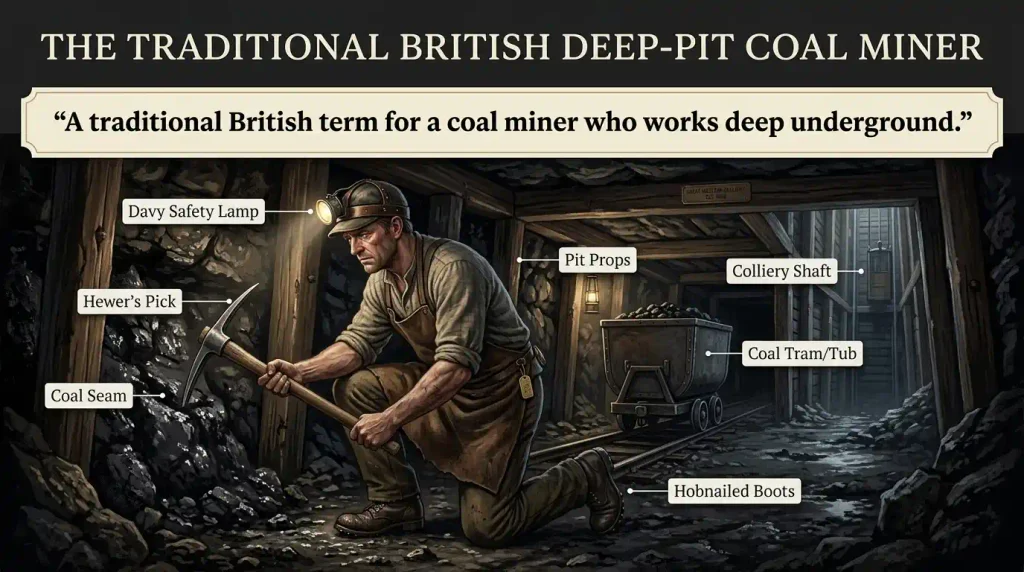
Pitman (Noun) — US /ˈpɪt.mən/ / UK /ˈpɪt.mən/
Meaning: A traditional British term for a coal miner who works deep underground.
Tone/Register: Informal, Regional, Traditional
Example:
The old pitman shared stories about his decades working in the northern coalfields.
Every morning, the retired pitman walked past the memorial gate.
Collier (Noun) — US /ˈkɑːl.i.ɚ/ / UK /ˈkɒl.i.ə/
Meaning: A person who works in a coal mine or a ship that transports coal.
Tone/Register: Historical, Formal, Literary
Example:
Historical novels often feature the daily struggles of a nineteenth-century collier.
The young collier pushed heavy carts through the narrow tunnel.
Extractor (Noun) — US /ɪkˈstræk/.tɚ/ / UK /ɪkˈstræk.tə/
Meaning: A modern technical term for a worker or machine that pulls valuable elements from the earth. Tone/Register: Technical, Industrial, Formal
Example:
The automated extractor reduced human risk in deep-rock environments.
Engineers monitored the digital controls of the heavy mineral extractor.
Excavator (Noun) — US /ˈek.skə.veɪ.tɚ/ / UK /ˈeks.kə.veɪ.tə/
Meaning: Someone who digs out earth and rock, or a heavy machine used for the same purpose. Tone/Register: Technical, General Professional
Example:
The skilled excavator operator carved a new path through the rocky hillside.
An archaeological excavator carefully brushed dirt from the ancient artifact.
Quarryman (Noun) — US /ˈkwɔːr.i.mən/ / UK /ˈkwɒr.i.mən/
Meaning: A worker who cuts stone, slate, or marble out of an open-air quarry.
Tone/Register: Traditional, Occupational
Example:
The sturdy quarryman hoisted the massive block of granite onto the flatbed.
Generations of stonecutting families produced local master quarrymen.
Prospector (Noun) — US /ˈprɑː.spek.tɚ/ / UK /ˈprɒs.pek.tə/
Meaning: An explorer searching an area for mineral deposits or precious metals.
Tone/Register: Historical, Adventurous, Literary
Example:
The dusty prospector panned for gold along the rushing mountain river.
An ambitious prospector staked his claim in the remote valley.
Digger (Noun) — US /ˈdɪɡ.ɚ/ / UK /ˈdɪɡ.ə/
Meaning: A casual term for someone who digs holes, trenches, or mineral deposits.
Tone/Register: Informal, Conversational
Example:
Every enthusiastic amateur digger hoped to find a hidden treasure chest.
The seasoned gold digger tested the soil composition with a small trowel.
Tunneler (Noun) — US /ˈtʌn.əl.ɚ/ / UK /ˈtʌn.əl.ə/
Meaning: A worker who specializes in boring underground tunnels for transit or resource extraction. Tone/Register: Technical, Construction
Example:
The expert tunneler reinforced the soft ceiling with steel beams.
Civil engineers directed the team of underground tunnelers beneath the city.
Sucker (Noun) — US /ˈsʌk.ɚ/ / UK /ˈsʌk.ə/
Meaning: In specific regional mining slang, a worker engaged in manual extraction tasks.
Tone/Register: Highly Informal, Slang
Example:
Old-timers used colorful local slang to describe each rookie worker.
(Note: Use with caution as this word has multiple alternative meanings in daily English.)
Panner (Noun) — US /ˈpæn/.ɚ/ / UK /ˈpæn.ə/
Meaning: A small-scale prospector who washes river gravel in a pan to find gold flakes.
Tone/Register: Informal, Traditional
Example:
Patiently crouching by the stream, the lone panner watched for metallic glint.
Tourists watched the demonstration given by an experienced river panner.
Ore-cutter (Noun) — US /ˈɔːrˌkʌt.ɚ/ / UK /ˈɔːˌkʌt.ə/
Meaning: A manual laborer specifically tasked with slicing through mineral-bearing rock veins.
Tone/Register: Occupational, Industrial
Example:
The tired ore-cutter wiped soot from his brow before taking a lunch break.
Heavy machinery eventually replaced the traditional hand-held ore-cutter.
Colliery worker (Noun) — US /ˈkɑːl.jɛi ˈwɝː.kɚ/ / UK /ˈkɒl.jəri ˈwɜː.kə/
Meaning: An employee working at a coal mine facility on the surface or underground.
Tone/Register: Formal, British English
Example:
The local community center celebrated the history of every colliery worker.
Generations of families proudly identified as dedicated colliery workers.
Mudlark (Noun) — US /ˈmʌd.lɑːrk/ / UK /ˈmʌd.lɑːk/
Meaning: Someone who scavenges in river mud for items of value, akin to historical low-level recovery. Tone/Register: Historical, British Slang
Example:
The resourceful mudlark searched the Thames riverbanks for lost trinkets.
Historical records describe the gritty daily routine of a London mudlark.
Trench-digger (Noun) — US /ˈtrentʃˌdɪɡ.ɚ/ / UK /ˈtrentʃˌdɪɡ.ə/
Meaning: A laborer who digs deep narrow ditches for utilities, drainage, or underground access.
Tone/Register: Practical, Construction
Example:
The hardworking trench-digger operated heavy pneumatic tools in the street.
Safety inspectors ensured the trench-digger wore proper protective gear.
Shaftman (Noun) — US /ˈʃæft.mən/ / UK /ˈʃɑːft.mən/
Meaning: A specialist responsible for maintaining vertical access shafts in deep mines.
Tone/Register: Technical, Occupational
Example:
The experienced shaftman inspected the elevator cables before morning shifts.
Deep underground operations rely heavily on skilled shaftmen.
Driller (Noun) — US /ˈdrɪl.ɚ/ / UK /ˈdrɪl.ə/
Meaning: A person who operates drilling equipment to bore holes into rock or earth.
Tone/Register: Professional, Industrial
Example:
The lead driller set up the rig early in the freezing morning.
The site geologist and driller carefully analyzed core samples.
Blaster (Noun) — US /ˈblæs.tɚ/ / UK /ˈblɑː.stə/
Meaning: A certified technician who handles explosives to break up rock formations underground. Tone/Register: Specialized, High-Risk
Example:
The licensed blaster cleared the blocked mineral vein safely.
Strict safety protocols governed every action taken by the site blaster.
Sinker (Noun) — US /ˈsɪŋ.kɚ/ / UK /ˈsɪŋ.kə/
Meaning: Historical slang for a workman who excavates vertical mine shafts downward.
Tone/Register: Historical, Occupational Slang
Example:
Victorian engineering feats relied on the sheer grit of every shaft sinker.
The dangerous job of a shaft sinker required exceptional nerve.
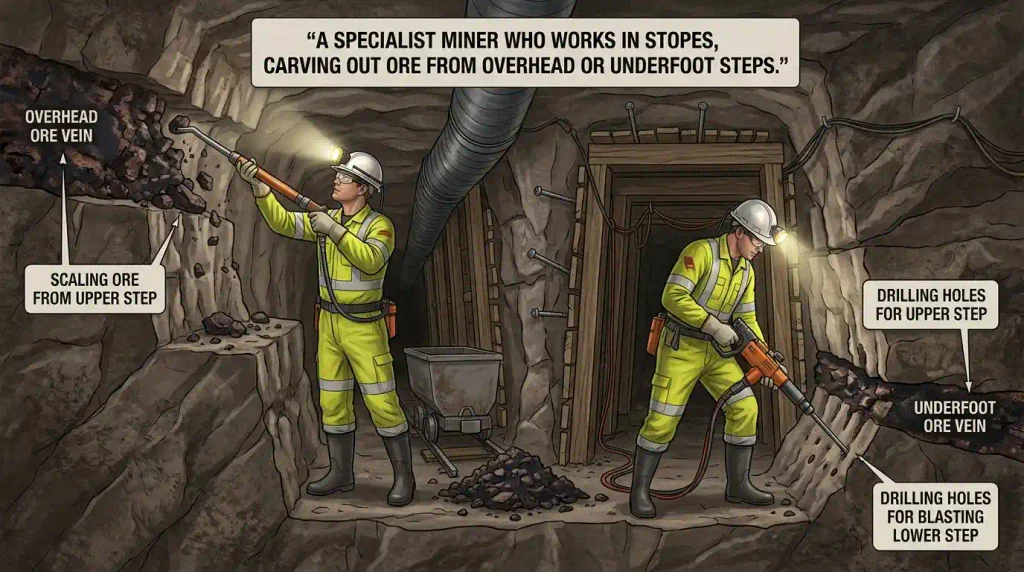
Stoper (Noun) — US /ˈstoʊ.pɚ/ / UK /ˈstəʊ.pə/
Meaning: A specialist miner who works in stopes, carving out ore from overhead or underfoot steps. Tone/Register: Technical, Mining Industry
Example:
The specialized stoper drilled upward into the rich copper deposit.
Modern automation has largely changed the traditional role of the stoper.
Laborer (Noun) — US /ˈleɪ.bɚ.ɚ/ / UK /ˈleɪ.bər.ə/
Meaning: A general term for a worker who performs heavy physical manual tasks.
Tone/Register: General, broad.
Example:
The general laborer helped move heavy timber supports into the tunnel.
Many immigrants started their new lives working as site laborers.
Hard-rocker (Noun) — US /ˈhɑːrdˌrɑːkɚ/ / UK /ˈhɑːdˌrɒk.ə/
Meaning: A specialist worker who extracts hard metallic ores from deep underground lodes.
Tone/Register: Occupational, Industrial
Example:
The experienced hard-rocker operated pneumatic drills in the gold reef.
Safety guidelines protected every hard-rocker working in the narrow vein.
Collier-man (Noun) — US /ˈkɑːl.i.ɚˌmæn/ / UK /ˈkɒl.i.əˌmæn/
Meaning: A historical laborer engaged specifically in the extraction of coal.
Tone/Register: Archival, Historical
Example:
Old census records listed him proudly as a working collier-man.
The village museum preserved the faded uniform of a collier-man.
Vein-hunter (Noun) — US /ˈveɪnˌhʌn.tɚ/ / UK /ˈveɪnˌhʌn.tə/
Meaning: A descriptive term for someone tracking mineralized rock seams underground.
Tone/Register: Descriptive, Literary
Example:
The skilled vein-hunter traced the silver line through the granite wall.
An eager vein-hunter always looks for signs of copper discoloration.
Earth-borer (Noun) — US /ˈɜːrθˌbɔːr.ɚ/ / UK /ˈɜːθˌbɔː.rə/
Meaning: A worker or mechanical device designed to bore deep holes into the soil.
Tone/Register: Technical, Functional
Example:
The heavy earth-borer prepared the foundation holes for the structure.
Workers guided the large earth-borer through dense layers of clay.
Mineralist (Noun) — US /ˈmɪn.ər.ə.lɪst/ / UK /ˈmɪn.ər.əl.ɪst/
Meaning: An old-fashioned term for a person who studies or extracts minerals.
Tone/Register: Archaic, Scholarly
Example:
Eighteenth-century texts often referred to resource specialists as mineralists.
The local mineralist cataloged various rock samples found in the hills.
Pit-worker (Noun) — US /ˈpɪtˌwɝː.kɚ/ / UK /ˈpɪtˌwɜː.kə/
Meaning: A general employee who labors at an open or underground extraction pit.
Tone/Register: Occupational, Direct
Example:
Every pit-worker wore a high-visibility vest and hard hat.
Shift changes brought hundreds of tired pit-workers to the surface.
Shaft-sinker (Noun) — US /ˈʃæftˌsɪŋ.kɚ/ / UK /ˈʃɑːftˌsɪŋ.kə/
Meaning: A specialized laborer who excavates the initial vertical shaft downward.
Tone/Register: Technical, Traditional
Example:
The daring shaft-sinker dropped into the darkness to secure the walls.
Engineering teams relied on the precision of each shaft-sinker.
Mineral-digger (Noun) — US /ˈmɪn.ər.əlˌdɪɡ.ɚ/ / UK /ˈmɪn.ər.əlˌdɪɡ.ə/
Meaning: A straightforward descriptor for someone unearthing useful mineral deposits.
Tone/Register: Conversational, Descriptive
Example:
The independent mineral-digger washed his tools at the end of the day.
Local laws regulated how each mineral-digger could claim a site.
Ore-getter (Noun) — US /ˈɔːrˌɡet.ɚ/ / UK /ˈɔːˌɡet.ə/
Meaning: A colloquial occupational term for a worker who brings metal ore up.
Tone/Register: Colloquial, Historical
Example:
Older miners used the term ore-getter to describe heavy laborers.
The efficient ore-getter loaded the cart with iron-rich stones.
Subterranean worker (Noun) — US /ˌsʌb.təˈreɪ.ni.ən ˈwɝː.kɚ/ / UK /ˌsʌb.təˈreɪ.ni.ən ˈwɜː.kə/
Meaning: An employee whose primary job takes place beneath the surface of the earth.
Tone/Register: Formal, Descriptive
Example:
Ventilation systems are critical for every subterranean worker on duty.
Safety training is mandatory for any new subterranean worker.
Trench-borer (Noun) — US /ˈtrentʃˌbɔːr.ɚ/ / UK /ˈtrentʃˌbɔː.rə/
Meaning: A manual or mechanical agent that cuts long channels into the ground.
Tone/Register: Technical, Construction
Example:
The trench-borer sliced cleanly through the frozen topsoil.
Operators maintained the trench-borer blades after every shift.
Coal-heaver (Noun) — US /ˈkoʊlˌhiː.vɚ/ / UK /ˈkəʊlˌhiː.və/
Meaning: A laborer who shovels and moves heavy loads of coal manually.
Tone/Register: Historical, Heavy Manual
Example:
The sturdy coal-heaver loaded fuel into the furnace tender.
Steamship engines required the relentless strength of a coal-heaver.
Mineral-finder (Noun) — US /ˈmɪn.ər.əlˌfaɪn.dɚ/ / UK /ˈmɪn.ər.əlˌfaɪn.də/
Meaning: An explorer or specialist who locates underground deposits of value.
Tone/Register: Descriptive, Accessible
Example:
The seasoned mineral-finder spotted surface clues of hidden copper.
An ambitious mineral-finder mapped out the remote hillside coordinates.
Quarry-worker (Noun) — US /ˈkwɔːr.iˌwɝː.kɚ/ / UK /ˈkwɒr.iˌwɜː.kə/
Meaning: A person employed in breaking and harvesting stone from open pits.
Tone/Register: Occupational, Standard
Example:
The stone-cutter and every quarry-worker finished early on Friday.
Safety equipment protected the quarry-worker from flying stone splinters.
Pit-hand (Noun) — US /ˈpɪtˌhænd/ / UK /ˈpɪtˌhænd/
Meaning: A common term for a general laborer working at a mine pit.
Tone/Register: Informal, Occupational
Example:
A reliable pit-hand checked the pulley system before lowering supplies.
The veteran pit-hand trained the recruits on safety rules.
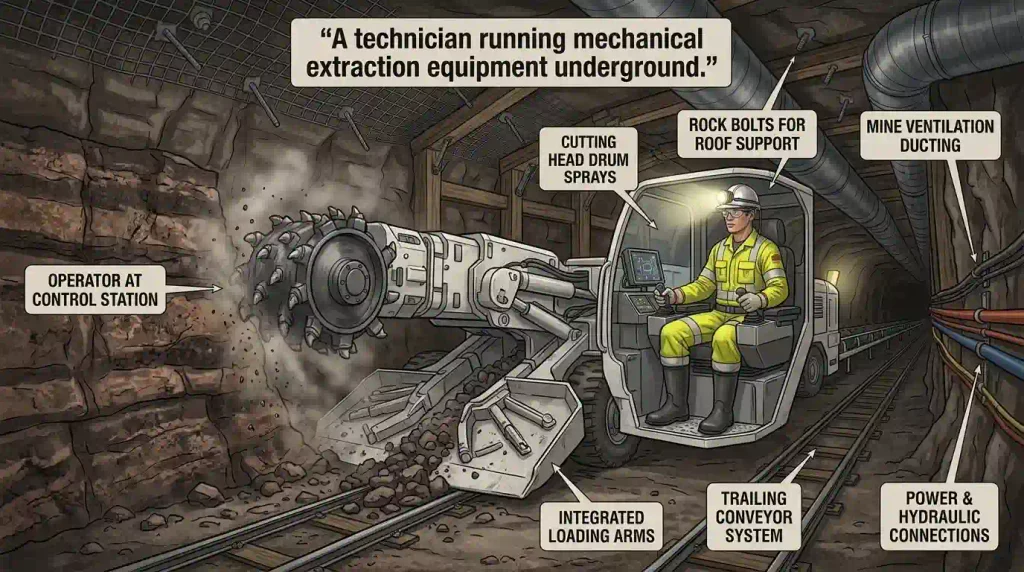
Sub-surface operator (Noun) — US /ˌsʌbˈsɝː.fɪs ˈɑː.pə.reɪ.tɚ/ / UK /ˌsʌbˈsɜː.fɪs ˈɒp.ə.reɪ.tə/
Meaning: A technician running mechanical extraction equipment underground.
Tone/Register: Professional, Modern
Example:
Each sub-surface operator monitored digital pressure gauges.
The automated rig required constant supervision by a sub-surface operator.
Rock-breaker (Noun) — US /ˈrɑːkˌbreɪ.kɚ/ / UK /ˈrɒkˌbreɪ.kə/
Meaning: A laborer or heavy machine task-oriented in shattering dense stone.
Tone/Register: Industrial, Direct
Example:
The heavy rock-breaker cleared the blockage in the tunnel chute.
Manual labor gave way to the mechanical rock-breaker over time.
Ore-extractor (Noun) — US /ˈɔːr ɪkˈstræk/.tɚ/ / UK /ˈɔːr ɪkˈstræk/.tə/
Meaning: An advanced unit or professional pulling refined ore from crude rock.
Tone/Register: Technical, Industrial
Example:
Chemical engineers designed a new ore-extractor for the facility.
The industrial ore-extractor processed tons of material daily.
Drift-miner (Noun) — US /ˈdrɪftˌmaɪ.nɚ/ / UK /ˈdrɪftˌmaɪ.نə/
Meaning: A worker who enters horizontal passages cut into the side of a hill.
Tone/Register: Specialized, Occupational
Example:
The drift-miner followed the horizontal coal seam deeper inside.
Ventilation is easier to manage for a drift-miner than a shaft worker.
Stope-worker (Noun) — US /ˈstoʊpˌwɝː.kɚ/ / UK /ˈstəʊpˌwɜː.kə/
Meaning: A laborer operating inside stepped underground cavity formations.
Tone/Register: Industry-Specific
Example:
The stope-worker placed wooden props to secure the overhead ceiling.
Precise communication kept every stope-worker safe during blasting.
Deep-diggers (Plural Noun) — US /ˈdiːpˌdɪɡ.ɚz/ / UK /ˈdiːpˌdɪɡ.əz/
Meaning: Workers who specialize in ultra-deep subterranean resource recovery.
Tone/Register: Descriptive, Conversational
Example:
Documentaries highlighted the extreme conditions faced by deep-diggers.
The deep-diggers descended miles beneath the earth’s crust.
Ground-breaker (Noun) — US /ˈɡraʊndˌbreɪ.kɚ/ / UK /ˈɡraʊndˌbreɪ.kə/
Meaning: Someone who initiates excavation or breaks virgin ground for development.
Tone/Register: Figurative, Professional
Example:
The lead engineer served as the primary ground-breaker for the project.
Pioneering companies act as a ground-breaker in new technological fields.
Tunnel-excavator (Noun) — US /ˈtʌn.əl ˈek.skə.veɪ.tɚ/ / UK /ˈtʌn.əl ˈeks.kə.veɪ.tə/
Meaning: A worker or giant mechanical borer creating transit or mine tunnels.
Tone/Register: Engineering, Technical
Example:
The massive tunnel-excavator carved through solid limestone.
Civil contractors inspected the progress of the tunnel-excavator team.
Vein-miner (Noun) — US /ˈveɪnˌmaɪ.nɚ/ / UK /ˈveɪnˌmaɪ.nə/
Meaning: A worker who focuses specifically on following narrow mineral veins.
Tone/Register: Occupational, Precise
Example:
The skilled vein-miner extracted the rich gold-bearing quartz safely.
Specialized tools allow the vein-miner to work in tight spaces.
Pit-maneuverer (Noun) — US /ˌpɪt məˈnuː.vər.ɚ/ / UK /ˌpɪt məˈnuː.vər.ə/
Meaning: An operator managing complex logistics and machinery within a pit.
Tone/Register: Niche, Industrial
Example:
The expert pit-maneuverer directed transport trucks near the site.
Coordination is vital for every pit-maneuverer on the floor.
Earth-excavator (Noun) — US /ˈɜːrθ ˈek.skə.veɪ.tɚ/ / UK /ˈɜːθ ˈeks.kə.veɪ.tə/
Meaning: A professional specialized in moving large quantities of surface dirt.
Tone/Register: Construction, Professional
Example:
The earth-excavator leveled the uneven terrain for building pads.
Heavy equipment was operated by a licensed earth-excavator operator.
Mineral-harvester (Noun) — US /ˈmɪn.ər.əl ˈhɑːr.vɪs.tɚ/ / UK /ˈmɪn.ər.əl ˈhɑː.vɪ.stə/
Meaning: A modern term emphasizing the collection of resources from the earth.
Tone/Register: Modern, Descriptive
Example:
Automated systems now function as an efficient mineral-harvester.
Environmental standards govern how each mineral-harvester operates.
Sinking-hand (Noun) — US /ˈsɪŋ.kɪŋ ˌhænd/ / UK /ˈsɪŋ/.kɪŋ ˌhænd/
Meaning: A traditional worker helping to sink vertical mine shafts.
Tone/Register: Historical, Occupational
Example:
Historical records praised the endurance of every sinking-hand.
The crew hired an experienced sinking-hand for the new vertical project.
Drift-worker (Noun) — US /ˈdrɪftˌwɝː.kɚ/ / UK /ˈdrɪftˌwɜː.kə/
Meaning: A laborer assigned to horizontal tunnel networks.
Tone/Register: Occupational, Standard
Example:
The drift-worker hauled excavated material out of the hillside.
Shift supervisors assigned tasks to each drift-worker in the morning.
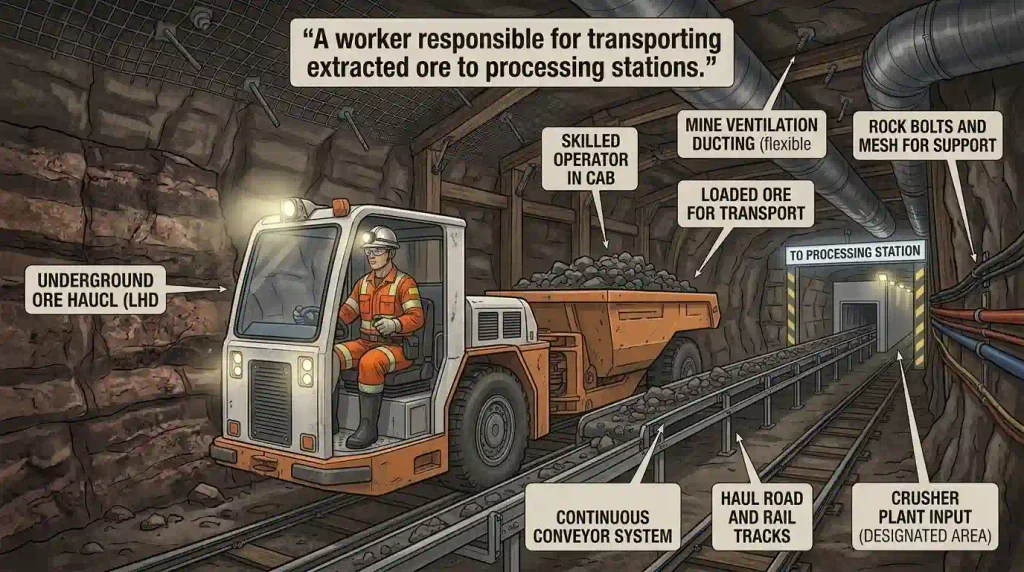
Ore-hauler (Noun) — US /ˈɔːrˌhɑː.lɚ/ / UK /ˈɔːˌhɔː.lə/
Meaning: A worker responsible for transporting extracted ore to processing stations.
Tone/Register: Industrial, Practical
Example:
The diligent ore-hauler dumped the load into the crushing hopper.
Fleet managers monitored the daily routes of every ore-hauler.
Synonyms for “Miner” by Tone
Word choice communicates attitude just as much as factual meaning. Selecting the correct register ensures your tone matches your context.
- Positive / Respectful: Pitman, Collier, Colliery worker (Honors traditional labor history and working-class grit).
- Neutral / Professional: Extractor, Excavator, Driller, Shaftman (Clean, factual terms used in modern business or journalism).
- Historical / Literary: Prospector, Panner, Mudlark (Evokes adventure, history, or frontier exploration).
- Informal / Conversational: Digger, Tunneler (Casual terms used in everyday storytelling).
Mini Comparison: Miner vs. Prospector vs. Extractor
- Miner: Refers strictly to a person who works inside an established mine to extract resources on a regular basis. Use this for steady industrial labor and coal or metal extraction.
- Prospector: Describes an adventurer or explorer searching new land for undiscovered mineral wealth. Use this when writing about historical gold rushes or wilderness exploration.
- Extractor: A broad, technical term that can describe either a human worker or industrial machinery pulling resources from raw earth. Use this in scientific, modern, or manufacturing reports.
Context-Based Usage
Daily Conversation
In casual speech, people usually say “miner” or “digger” when discussing local news, documentary shows, or blue-collar jobs. Furthermore, slang terms like “digger” pop up in friendly stories about backyard renovation or hobby metal detecting.
Writing or Blogging
Bloggers covering history, energy, or geography often swap “miner” with “pitman” or “collier” to add authentic local color and literary flavor. Therefore, varying your vocabulary keeps long articles engaging for readers scrolling on mobile phones.
Professional or Academic Tone
Research papers and corporate energy reports prefer precise technical terms like “extractor,” “driller,” or “ore-cutter.” Consequently, these formal words avoid emotional baggage and focus strictly on operational roles.
Common Mistakes & Native Usage
Common Mistakes Learners Make
- Confusing Miner with Major: Beginners often mix up spelling and pronunciation with the unrelated word “minor” (someone under legal age). Always check your spelling when writing essays.
- Overusing Slang: Using outdated terms like “sinker” in modern business writing sounds unnatural. Match your vocabulary to the correct century and context.
Register Notes
Native speakers instantly recognize “pitman” as a British regional term, whereas “prospector” evokes American Old West history. Pick your words according to your geographic setting and audience expectations.
Real-Life Mini Scenarios
- Workplace: The site manager briefed every driller and extractor on morning safety protocols before they entered the shaft.
- Social Situations: While watching a historical documentary, my friend asked what life was like for a 19th-century British collier.
- Media & Pop Culture: The adventure novel featured an optimistic prospector searching the snowy mountains for lost silver veins.
- Writing or Storytelling: The author described the exhausting daily routine of an underground pitman struggling through narrow seams of coal.
Conclusion
Expanding your vocabulary with accurate synonyms transforms your writing from repetitive to remarkably engaging. Whether you are crafting an essay, writing a blog post, or improving your daily conversational English, choosing precise words makes all your sentences shine.
Learning new terms takes a little bit of practice, but the payoff in clarity and confidence is huge. Furthermore, mastering these nuances helps you connect better with readers and native speakers alike.
Why not try using one new synonym today? Take a moment to practice writing a short email, essay sentence, or journal entry using a word like “prospector” or “extractor” to boost your active vocabulary right now.
Interactive Practice Quiz
1. Which term best describes an explorer searching uncharted land for gold?
- A) Pitman
- B) Prospector
- C) Extractor
- D) Shaftman
2. Which word is a traditional British term specifically for a coal worker?
- A) Collier
- B) Digger
- C) Blaster
- D) Driller
3. Which term works best in a formal engineering report about modern earth-removal machines?
- A) Mudlark
- B) Panner
- C) Extractor
- D) Sucker
4. What part of speech is the focus keyword “miner”?
- A) Verb
- B) Adjective
- C) Noun
- D) Adverb
5. Which synonym carries a strong historical tone related to river cleaning and scavenging?
- A) Mudlark
- B) Driller
- C) Stoper
- D) Ore-cutter
6. Which term describes someone who cuts stone or slate in an open-air site?
- A) Quarryman
- B) Pitman
- C) Colliery worker
- D) Tunneler
7. What is the main benefit of using synonyms in your writing?
- A) Making sentences longer
- B) Avoiding boring repetition
- C) Confusing your readers
- D) Increasing page count
8. Which word is most appropriate when discussing high-risk explosive handling underground?
- A) Panner
- B) Blaster
- C) Prospector
- D) Mudlark
9. How many syllables does the word “miner” contain?
- A) One
- B) Two
- C) Three
- D) Four
10. Which tone category does the word “prospector” best fit into?
- A) Negative
- B) Historical / Literary
- C) Highly informal slang
- D) Strict corporate legal
Answer Key: 1-B, 2-A, 3-C, 4-C, 5-A, 6-A, 7-B, 8-B, 9-B, 10-B
Reflection Task: Create your own original sentence using the synonym “prospector” in a modern context.
FAQs
1. What is the difference between a miner and a prospector?
A miner extracts known resources from established underground or surface sites, whereas a prospector searches new and uncharted terrain to discover fresh mineral deposits.
2. Is collier an outdated word in modern English?
Yes, “collier” is primarily found in historical texts, literature, and British regional contexts. Modern writers usually prefer “coal miner” or “colliery worker” in contemporary articles.
3. How do you pronounce miner in US and UK English?
In US English, it is pronounced as /ˈmaɪ.nɚ/, while UK English uses /ˈmaɪ.nə/, both featuring a distinct long “i” sound at the start.
4. Can extractor refer to a machine instead of a human?
Yes, “extractor” functions as a versatile technical term that describes either specialized industrial machinery or a human worker performing extraction operations.
5. Why should writers avoid repeating the word miner?
Repeating the same noun too often makes writing sound robotic and dull. Using varied semantic alternatives keeps your reader’s attention high and improves overall flow.

Shahzeena Shazadi is the founder and lead writer at VocablyHub.com, where she creates accurate, reader-focused English language content designed to help people communicate with clarity and confidence. She specializes in synonyms, antonyms, word meanings, idioms, and practical vocabulary guides that simplify complex language concepts for everyday use. Every article is carefully researched, fact-checked, and written in clear, accessible language using reliable references and real-world examples. Her goal is to provide helpful, trustworthy content that supports learners at every stage of their English language journey.
Her editorial approach focuses on accuracy, transparency, and user value while following modern content quality standards. She regularly reviews and updates content to keep information relevant, useful, and easy to understand. Through VocablyHub.com, Shahzeena Shazadi is committed to publishing reliable language resources that help students, writers, educators, professionals, and English learners expand their vocabulary, improve their writing skills, and communicate with confidence in academic, professional, and everyday situations.