
Finding the right words can make your English clearer, more precise, and more natural. If you are looking for synonyms for merged, you have several useful alternatives depending on the context, tone, and meaning you want to express.
The word merged usually means that two or more things have been combined into one. It can describe businesses, ideas, groups, files, colors, sounds, or other things that become united. Common alternatives include combined, united, integrated, blended, consolidated, joined, and fused.
However, these synonyms are not always interchangeable. For example, integrated often suggests that separate parts have been brought together into a functioning whole, while blended is commonly used when things mix smoothly. Understanding these differences can help you choose the most accurate word.
In this guide to synonyms for merged, you will discover clear alternatives with meanings and examples. Whether you are improving your vocabulary, writing professionally, or learning English, these words can help you communicate the idea of joining or combining things more effectively.
What Does “Merged” Really Mean?
The term merged primarily means to combine or unite two or more separate entities into a single unified whole.
It can also mean to blend smoothly together, such as two lanes of traffic coming together on a busy highway.
Native speakers use this past-tense verb seamlessly in both corporate acquisitions and everyday descriptive contexts.
Its part of speech is a past participle or past-tense verb derived from the Latin root mergere.
In simple English, it means joining separate things together so they form one single continuous group or organization.
Connotative Meaning
The emotional tone of this expression is mostly neutral, professional, or strategic depending entirely on the immediate context.
- Positive tone: Expressing successful corporate growth, unity, or harmonious team integration.
- Negative tone: Implying a hostile corporate takeover or forced loss of brand identity.
- Neutral tone: Simply stating a structural fact or a traffic pattern change.
- Connotation (the emotional or cultural association attached to a word beyond its literal definition).
Etymology
The term comes from the Latin verb mergere, which meant to dip, plunge, or immerse into liquid.
- Old English (450–1100): The root concept existed mostly through native Germanic equivalents like drincan or settan.
- Middle English (1100–1500): The Latin form entered via Old French, evolving to mean sinking or combining liquids.
- Modern English (1500–Present): It firmly secured its modern corporate and physical meaning of uniting separate entities.
Pronunciation & Syllables
- US: /mɜːrdʒd/
- UK: /mɜːdʒd/
- Syllables: mer-ged
- Affixation Pattern: A base verb combined with the past-tense inflectional suffix -ed.
Synonyms List
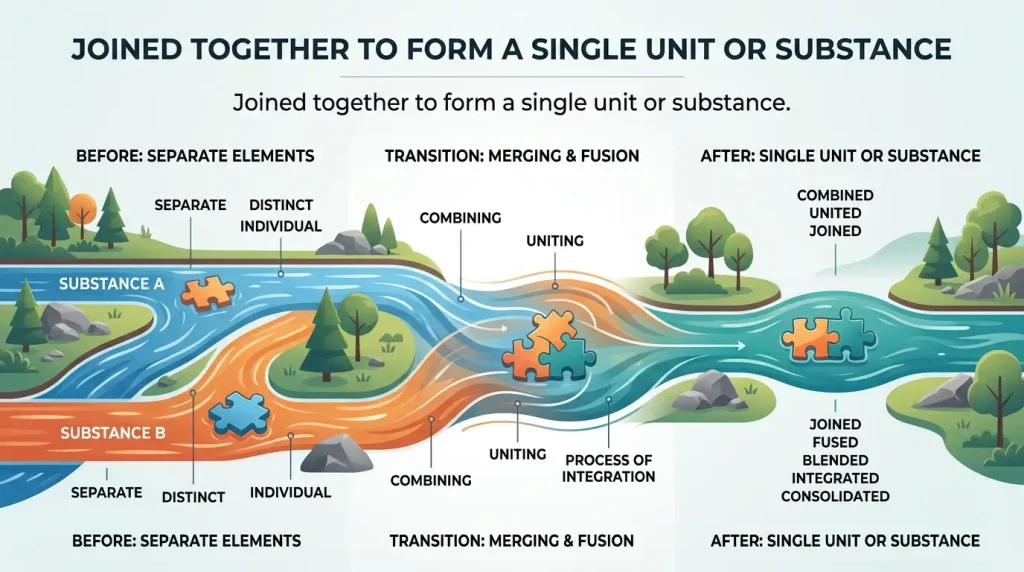
Combined (Verb) — US: /kəmˈbaɪnd/ | UK: /kəmˈbaɪnd/
Meaning: Joined together to form a single unit or substance.
Tone/Register: Standard, neutral, and widely accepted in all settings.
Examples:
They combined their resources to launch a successful startup.
The two teams combined efforts to finish the project early.
Amalgamated (Verb) — US: /əˈmælɡəmeɪtɪd/ | UK: /əˈmælɡəmeɪtɪd/
Meaning: Combined or united to form one organization or structure.
Tone/Register: Formal, corporate, and academic.
Examples:
The local banks amalgamated into a single regional institution.
Several smaller societies amalgamated to form a powerful coalition.
Consolidated (Verb) — US: /kənˈsɑːlɪdeɪtɪd/ | UK: /kənˈsɒlɪdeɪtɪd/
Meaning: Combined into a single, more effective or coherent whole.
Tone/Register: Business and professional.
Examples:
The company consolidated its offices into downtown headquarters.
She consolidated her student loans to secure a lower interest rate.
Integrated (Verb) — US: /ˈɪntɪɡreɪtɪd/ | UK: /ˈɪntɪɡreɪtɪd/
Meaning: Combined parts so that they work together effectively as a whole.
Tone/Register: Professional and technical.
Examples:
The software seamlessly integrated data from multiple external sources.
They integrated new marketing strategies into the existing campaign.
Blended (Verb) — US: /blɛndɪd/ | UK: /blɛndɪd/
Meaning: Mixed substances or elements together smoothly and thoroughly.
Tone/Register: Standard and descriptive.
Examples:
The chef blended the fresh ingredients into a smooth soup.
Their musical styles blended traditional folk with modern rock.
Fused (Verb) — US: /fjuːzd/ | UK: /fjuːzd/
Meaning: Joined or blended physically to form a single entity.
Tone/Register: Formal and scientific.
Examples:
The metals were fused under extreme heat in the laboratory.
His creative vision fused classic art with digital technology.
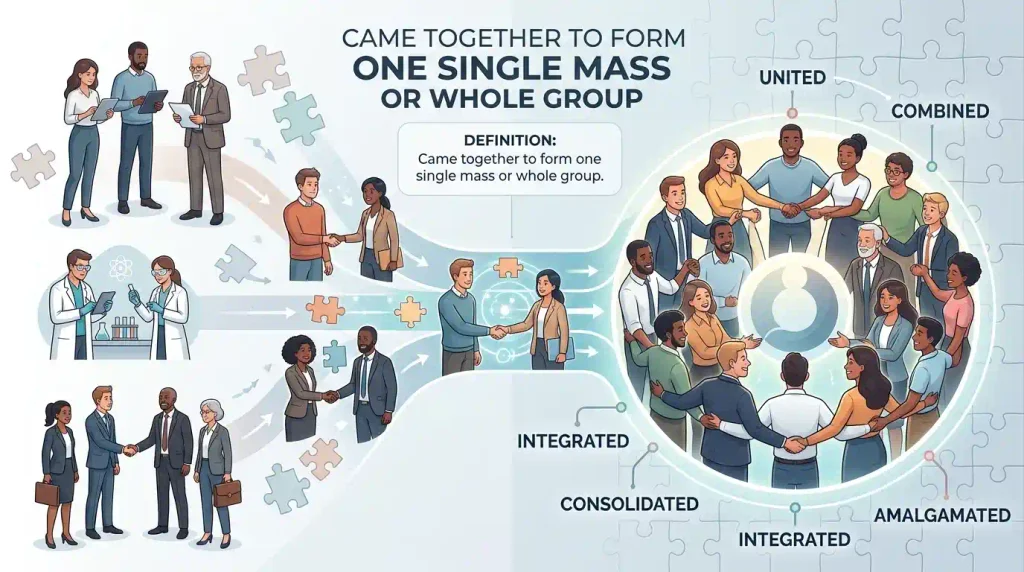
Coalesced (Verb) — US: /ˌkoʊəˈlɛst/ | UK: /ˌkəʊəˈlɛst/
Meaning: Came together to form one single mass or whole group.
Tone/Register: Literary and formal.
Examples:
Separate community groups coalesced into a unified protest movement.
The scattered ideas gradually coalesced into a clear business plan.
Unified (Verb) — US: /ˈjuːnɪfaɪd/ | UK: /ˈjuːnɪfaɪd/
Meaning: Made or became united into a single coherent whole.
Tone/Register: Formal and inspiring.
Examples:
The new leader unified the fractured political party successfully.
Their shared vision unified the entire team behind the goal.
United (Verb) — US: /juˈnaɪtɪd/ | UK: /juˈnaɪtɪd/
Meaning: Joined together for a common purpose or shared objective.
Tone/Register: Standard and widespread.
Examples:
Neighboring towns united to build a new public library.
The citizens united to support local business owners.
Incorporated (Verb) — US: /ɪnˈkɔːrpəreɪtɪd/ | UK: /ɪnˈkɔːpəreɪtɪd/
Meaning: Took in or included as part of a whole body or plan.
Tone/Register: Business and legal.
Examples:
She incorporated customer feedback into the new product design.
The firm incorporated several green technologies into its operations.
Synthesized (Verb) — US: /ˈsɪnθəsaɪzd/ | UK: /ˈsɪnθəsaɪzd/
Meaning: Made by combining different ideas, styles, or systems.
Tone/Register: Academic and scientific.
Examples:
The researcher synthesized data from fifty different clinical studies.
He synthesized complex theories into a single readable chapter.
Mingled (Verb) — US: /ˈmɪŋɡəld/ | UK: /ˈmɪŋɡəld/
Meaning: Mixed or caused to mix gently in a crowd or solution.
Tone/Register: Descriptive and literary.
Examples:
The sound of laughter mingled with soft background music.
Guests mingled freely during the opening networking reception.
Intertwined (Verb) — US: /ˌɪntərˈtwaɪnd/ | UK: /ˌɪntəˈtwaɪnd/
Meaning: Twisted together or closely connected.
Tone/Register: Literary and expressive.
Examples:
Their family histories were deeply intertwined over generations.
The plot lines of the novel became closely intertwined.
Interwoven (Verb) — US: /ˌɪntərˈwoʊvən/ | UK: /ˌɪntəˈwəʊvən/
Meaning: Woven or blended tightly into a single fabric.
Tone/Register: Formal and literary.
Examples:
Cultural traditions are interwoven with everyday local practices.
The narrative features interwoven stories of courage and loss.
Mapped (Verb) — US: /mæpt/ | UK: /mæpt/
Meaning: Associated or connected systems together structurally.
Tone/Register: Technical and analytical.
Examples:
The tech team mapped the database structures for the update.
They mapped operational workflows to find redundancy issues.
Bound (Verb) — US: /baʊnd/ | UK: /baʊnd/
Meaning: Tied or fastened together securely into a unit.
Tone/Register: Literary and traditional.
Examples:
The old books were bound in genuine leather covers.
They were bound by a strict agreement of mutual trust.
Attached (Verb) — US: /əˈtætʃt/ | UK: /əˈtætʃt/
Meaning: Fastened or joined one thing to another physically.
Tone/Register: Standard and everyday.
Examples:
Please review the documents attached to this email.
He attached a small label to every equipment box.
Affixed (Verb) — US: /əˈfɪkst/ | UK: /əˈfɪkst/
Meaning: Stuck or attached something firmly to a surface.
Tone/Register: Formal and administrative.
Examples:
She affixed her official signature to the legal contract.
A postage stamp was neatly affixed to the envelope corner.
Coupled (Verb) — US: /ˈkʌpəld/ | UK: /ˈkʌpəld/
Meaning: Linked or paired two things together in action or concept.
Tone/Register: Professional and technical.
Examples:
Smart marketing was coupled with high product quality.
The engine failure was coupled with electrical system issues.
Associated (Verb) — US: /əˈsoʊʃieɪtɪd/ | UK: /əˈsəʊʃieɪtɪd/
Meaning: Connected something with another thing in the mind.
Tone/Register: Academic and formal.
Examples:
High stress is often associated with long working hours.
The brand is closely associated with luxury and reliability.
Allied (Verb) — US: /əˈlaɪd/ | UK: /əˈlaɪd/
Meaning: Combined or joined by a treaty, agreement, or shared goal.
Tone/Register: Formal and political.
Examples:
The two tech giants allied to combat market competition.
Local merchants allied to promote downtown shopping events.
Partnered (Verb) — US: /ˈpɑːrtnərd/ | UK: /ˈpɑːtnəd/
Meaning: Associated or worked together as business partners.
Tone/Register: Commercial and cooperative.
Examples:
The bookstore partnered with local schools for a book fair.
They partnered on a project to improve public parks.
Banded (Verb) — US: /ˈbændɪd/ | UK: /ˈbændɪd/
Meaning: Formed a group or joined together for a mutual purpose.
Tone/Register: Conversational and cooperative.
Examples:
Residents banded together to clean up the neighborhood park.
The local shop owners banded against rising utility costs.
Grouped (Verb) — US: /ɡruːpt/ | UK: /ɡruːpt/
Meaning: Placed or organized items into categories or sets.
Tone/Register: Standard and organizational.
Examples:
The teacher grouped students by their reading proficiency levels.
Files were grouped neatly into separate project folders.
Bundled (Verb) — US: /ˈbʌndəld/ | UK: /ˈbʌndəld/
Meaning: Collected or packaged several items together as a single deal.
Tone/Register: Business and commercial.
Examples:
The telecom provider bundled internet and phone services.
They bundled software licenses to reduce overall customer costs.
Accumulated (Verb) — US: /əˈkjuːmjəleɪtɪd/ | UK: /əˈkjuːmjʊleɪtɪd/
Meaning: Gathered together or acquired an increasing number over time.
Tone/Register: Formal and analytical.
Examples:
She accumulated years of experience in digital marketing.
Dust had accumulated on the unused office equipment.
Assembled (Verb) — US: /əˈsɛmbəld/ | UK: /əˈsɛmbəld/
Meaning: Gathered together into one place for a common purpose.
Tone/Register: Standard and formal.
Examples:
Engineers assembled the machinery components in the workshop.
The committee assembled to review the annual financial report.
Aggregated (Verb) — US: /ˈæɡrɪɡeɪtɪd/ | UK: /ˈæɡrɪɡeɪtɪd/
Meaning: Formed a cluster or collected data from multiple sources.
Tone/Register: Technical and data-driven.
Examples: The news website aggregated stories from journalists worldwide.
Financial systems aggregated stock prices in real-time.
Gathered (Verb) — US: /ˈɡæðərd/ | UK: /ˈɡæðəd/
Meaning: Came together or brought things together into one group.
Tone/Register: Everyday and common.
Examples:
Family members gathered around the dining table for dinner.
He gathered rain samples for his high school science project.
Collected (Verb) — US: /kəˈlɛktɪd/ | UK: /kəˈlɛktɪd/
Meaning: Brought together from various sources into a single place.
Tone/Register: Standard and versatile.
Examples:
She collected antique stamps from across Europe.
The charity collected warm clothing for winter shelter residents.
Welded (Verb) — US: /ˈwɛldɪd/ | UK: /ˈwɛldɪd/
Meaning: Joined pieces of metal together by heating the surfaces.
Tone/Register: Technical and industrial.
Examples:
The mechanic welded the broken steel frame back together.
Strong team bonds welded the department into an elite unit.
Hooked (Verb) — US: /hʊkt/ | UK: /hʊkt/
Meaning: Connected or fastened securely using a hook or latch.
Tone/Register: Informal and practical.
Examples:
He hooked the trailer to the back of his pickup truck.
She hooked her scarf around her bag handle.
Knitted (Verb) — US: /ˈnɪtɪd/ | UK: /ˈnɪtɪd/
Meaning: Made garments by interlocking loops of yarn with needles.
Tone/Register: Traditional and craft-oriented.
Examples:
Grandmother knitted a warm woolen sweater for winter.
The community was tightly knit through shared values.
Wedded (Verb) — US: /ˈwɛdɪd/ | UK: /ˈwɛdɪd/
Meaning: Joined in marriage or closely united to a concept or belief.
Tone/Register: Literary and figurative.
Examples:
He was completely wedded to his traditional management style.
The two historic companies became legally wedded in 2026.
Interlocked (Verb) — US: /ˌɪntərˈlɑːkt/ | UK: /ˌɪntəˈlɒkt/
Meaning: Engaged with each other firmly to fit together.
Tone/Register: Technical and descriptive.
Examples:
The puzzle pieces interlocked perfectly to reveal the picture.
Their gears interlocked to drive the mechanical clock.
Bridged (Verb) — US: /brɪdʒd/ | UK: /brɪdʒd/
Meaning: Made a connection or closed a gap between two things.
Tone/Register: Professional and figurative.
Examples:
The new policy bridged the gap between remote and office staff.
Negotiators successfully bridged differences to secure a treaty.
Joined (Verb) — US: /dʒɔɪnd/ | UK: /dʒɔɪnd/
Meaning: Brought together to form a continuous whole.
Tone/Register: Everyday and common.
Examples:
Two rivers joined together near the eastern valley.
She joined the corporate training seminar online.
Connected (Verb) — US: /kəˈnɛktɪd/ | UK: /kəˈnɛktɪd/
Meaning: Brought together or linked by a communication path.
Tone/Register: Standard and technological.
Examples:
All office computers were connected to the secure network.
The new highway connected two major industrial districts.
Associated (Verb) — US: /əˈsoʊʃieɪtɪd/ | UK: /əˈsəʊʃieɪtɪd/
Meaning: Kept company with or linked conceptually in analysis.
Tone/Register: Academic and formal.
Examples:
Researchers associated specific genetic markers with the disease.
She associated closely with industry experts at the conference.
Affiliated (Verb) — US: /əˈfɪlieɪtɪd/ | UK: /əˈfɪlieɪtɪd/
Meaning: Officially attached or connected to a larger organization.
Tone/Register: Formal and corporate.
Examples:
The small clinic was affiliated with the city medical center.
Local clubs affiliated with the national sports federation.
Integrated (Verb) — US: /ˈɪntɪɡreɪtɪd/ | UK: /ˈɪntɪɡreɪtɪd/
Meaning: Brought into equal participation within a larger system.
Tone/Register: Professional and structural.
Examples:
New employees were quickly integrated into the company culture.
The design integrated accessibility features for disabled users.
Blended (Verb) — US: /blɛndɪd/ | UK: /blɛndɪd/
Meaning: Created a harmonious combination of different styles.
Tone/Register: Creative and descriptive.
Examples:
The restaurant blended modern cooking with rustic recipes.
Their portfolio blended high-risk stocks with safe bonds.
Assimilated (Verb) — US: /əˈsɪməleɪtɪd/ | UK: /əˈsɪməleɪtɪd/
Meaning: Took in and understood information or integrated into a group.
Tone/Register: Academic and formal.
Examples:
Students quickly assimilated complex physics formulas during lectures.
Immigrants assimilated into the local community over time.
Incorporated (Verb) — US: /ɪnˈkɔːrpəreɪtɪd/ | UK: /ɪnˈkɔːpəreɪtɪd/
Meaning: Formed into a legal corporation or united into a system.
Tone/Register: Legal and financial.
Examples:
The startup officially incorporated early last month.
They incorporated safety protocols into the daily shift schedule.
Unified (Verb) — US: /ˈjuːnɪfaɪd/ | UK: /ˈjuːnɪfaɪd/
Meaning: Brought diverse parts together into a single cohesive entity.
Tone/Register: Formal and administrative.
Examples:
The administration unified database systems across all branches.
A unified front helped management negotiate better contracts.

Synonyms by Tone
Understanding tone ensures your professional writing matches your exact communication goal.
- Positive Tone: Integrated, unified, combined, partnered, aligned.
- Neutral Tone: Consolidated, joined, connected, associated, grouped.
- Negative Tone: Forced, absorbed, swallowed, dismantled.
- Playful/Informal Tone: Bundled, hooked, mixed up.
Selecting the correct tone prevents misunderstandings in corporate documents and academic papers.
Mini Comparison
Consolidated vs. Integrated vs. Amalgamated
While all three words relate to bringing things together, their nuances differ significantly.
- Consolidated focuses on streamlining and gathering things into a more compact, effective whole.
- Integrated emphasizes making separate elements work smoothly together as a functioning system.
- Amalgamated is primarily used for formal corporate or organizational unions.
- Therefore, use consolidated for cost-cutting or streamlining, integrated for systems, and amalgamated for business mergers.
Context-Based Usage
In daily conversation, native speakers prefer simple words like combined or joined for clarity. However, professional business writing calls for terms like consolidated, integrated, or amalgamated. Academic and technical writing benefits greatly from precise verbs like synthesized or aggregated. Matching your vocabulary to your specific audience keeps your message clear and professional.
Common Mistakes & Native Usage
Common Mistakes Learners Make
- Using amalgamated for casual daily activities sounds overly pompous and unnatural.
- Confusing physical mixing, like blended, with corporate takeovers like merged can confuse readers.
- Overusing advanced words in basic emails makes your communication sound robotic.
Register Notes
- Spoken English favors short, familiar verbs like joined or combined.
- Written business reports reward precise single-word verbs for executive authority.
Real-Life Mini Scenarios
- Workplace: The two corporate departments consolidated operations to reduce overhead costs.
- Social Situations: Residents banded together to organize a community cleanup day.
- Media / Pop Culture: Tech news outlets reported how major software companies merged recently.
- Writing or Storytelling: The historian described how small feudal territories unified into a kingdom.
Conclusion
Choosing the right synonym can make your writing more precise and natural. The word merged describes things that have been combined, joined, or brought together into one. Depending on the context, words such as combined, united, integrated, blended, fused, consolidated, and joined can provide useful alternatives.
Each synonym has a slightly different meaning and tone. For example, integrated works well for systems or groups, while blended suits colors, sounds, or ingredients. Consolidated is often appropriate for businesses, information, or resources.
By understanding these synonyms for merged, you can avoid repetition and choose words that fit your message more accurately. Keep practicing these alternatives to make your everyday, academic, and professional English more varied and effective.

Interactive Practice Quiz
- Which synonym best fits a formal corporate acquisition or business union?
A) Combined
B) Amalgamated
C) Hooked
D) Bundled - Which word fits best when streamlining multiple offices into one location?
A) Consolidated
B) Blended
C) Mingled
D) Knitted - What does integrated primarily imply in a technical software setting?
A) Physical heating
B) Working smoothly together as a system
C) Legal punishment
D) Casual chatting - Which term works best for mixing physical liquids or ingredients?
A) Consolidated
B) Blended
C) Amalgamated
D) Incorporated - When discussing data collected from multiple sources, you might use:
A) Aggregated
B) Wedded
C) Banded
D) Bound - Which synonym implies forming a political or corporate alliance?
A) Allied
B) Mingled
C) Filtered
D) Separated - What is the tone of the word amalgamated in modern business writing?
A) Casual
B) Formal and corporate
C) Playful
D) Negative - Which word describes ideas coming together into a single plan?
A) Coalesced
B) Welded
C) Attached
D) Affixed - Where is the word welded most accurately applied in technical writing?
A) Metal structures and heavy industry
B) Human psychology
C) Financial accounting
D) Poetry writing - Why use synonyms instead of repeating merged in an essay?
A) To confuse readers
B) To improve professional vocabulary flow
C) To make text longer
D) To avoid spelling tests
Answer Key: 1. B, 2. A, 3. B, 4. B, 5. A, 6. A, 7. B, 8. A, 9. A, 10. B
Reflection Task: Write one original sentence using the word integrated to describe a new software tool in your workflow.
FAQs
1. What is the most professional synonym for merged in business reports?
Consolidated and amalgamated are the most professional synonyms for describing corporate mergers, restructuring, and organizational union in formal reports.
2. Can I use blended when talking about corporate acquisitions?
Blended is usually reserved for styles, cultures, or physical ingredients; using it for a legal corporate acquisition sounds too informal.
3. How do I choose between combined and integrated?
Use combined for simple additions of items, and choose integrated when separate components are designed to work together as a cohesive system.
4. Is merged only used for large businesses?
No, it is frequently used in everyday contexts, such as traffic lanes coming together or separate ideas coming together in a discussion.
5. What is a good academic alternative when discussing data synthesis?
Words like synthesized or aggregated serve as excellent academic alternatives when combining research data or studies into a single conclusion.

Shahzeena Shazadi is the founder and lead writer at VocablyHub.com, where she creates accurate, reader-focused English language content designed to help people communicate with clarity and confidence. She specializes in synonyms, antonyms, word meanings, idioms, and practical vocabulary guides that simplify complex language concepts for everyday use. Every article is carefully researched, fact-checked, and written in clear, accessible language using reliable references and real-world examples. Her goal is to provide helpful, trustworthy content that supports learners at every stage of their English language journey.
Her editorial approach focuses on accuracy, transparency, and user value while following modern content quality standards. She regularly reviews and updates content to keep information relevant, useful, and easy to understand. Through VocablyHub.com, Shahzeena Shazadi is committed to publishing reliable language resources that help students, writers, educators, professionals, and English learners expand their vocabulary, improve their writing skills, and communicate with confidence in academic, professional, and everyday situations.