
Every essay writer knows the red pen moment. Your teacher circles three words in your first paragraph, “due to the fact that,” and writes one word in the margin: because. Five words became one, and the sentence got stronger. That small edit is why people search for synonyms for the fact that: the phrase is grammatically correct, widely understood, and very often longer than the job requires.
But here is what the red pen does not tell you. “The fact that” is not just a long way of saying “because.” It is a building tool. It turns a whole clause into a noun, so a fact can become the subject of a sentence (“The fact that she resigned surprised everyone”) or the object of one (“He ignored the fact that the bridge was closed”). Because cannot do that job. Delete the phrase carelessly and the sentence falls apart.
So this guide treats synonyms for the fact that honestly, in two families. The first family replaces the phrase when it only means because: since, as, given that, seeing that. The second family keeps the noun job and changes the noun: the reality that, the point that, the possibility that, the risk that. All 50 alternatives come with meanings, pronunciations, and examples, sorted by tone, with the mistakes that make learners sound wordy instead of formal.
What “The Fact That” Is Doing in Your Sentence
Read these two sentences side by side. “She was late because the train stopped.” Now: “The fact that the train stopped annoyed everyone.” In the first, the train stopping is a reason, tucked into a subordinate clause. In the second, it has been promoted. It is the thing the sentence is about, the subject itself. That promotion is the phrase’s real work.
Once you spot the pattern, you see it everywhere. After prepositions: “despite the fact that,” “because of the fact that.” After verbs of knowing and saying: “the news that,” “the claim that,” “he mentioned the fact that.” English reaches for this construction whenever a whole event needs to be carried around the sentence like an object.
The practical rule follows from the grammar. If the phrase is only carrying a reason, a shorter conjunction like because or since will usually do the carrying better. If the phrase is the subject or object, keep a noun form and choose which noun: reality, point, possibility, evidence. Each one shades the meaning differently, and the list below is organised around exactly that choice.
Why Teachers and Editors Circle It
The phrase has a reputation problem. In student essays it often appears not because the grammar needs it, but because it sounds grown-up. “Due to the fact that” feels more academic than “because,” the way a borrowed suit feels more formal than your own clothes. Readers, especially examiners, can tell the difference. Padding a sentence rarely impresses the person marking it.
Used deliberately, though, the phrase earns its place. It slows a sentence down and gives the fact weight: “The fact that nobody checked the figures is the real scandal here.” That is not padding. That is emphasis, placed exactly where the writer wants the reader to stop. The skill is not avoiding the phrase. The skill is knowing which of the two you are doing.
A Short History of a Very Old Construction
“Fact” entered English from Latin factum, a thing done, by way of law courts, where it still lives in “facts of the case.” The construction “the fact that” grew up in legal and scholarly prose, where writers needed to handle whole statements as evidence. From there it spread into journalism and everyday writing, picking up its heavier cousins along the way: “in view of the fact that,” “owing to the fact that,” “in spite of the fact that.”
Style guides have been trimming it for a century. Orwell advised cutting any word that can be cut, and Fowler treated “the fact that” as a phrase to justify every time it appears. The construction survived both of them, because the grammar job it does is real. Modern advice is narrower and fairer: question it, do not ban it.
Saying the Phrase and Its Main Replacements
The fact that: US / UK: /ðə fækt ðət/. In natural speech the “that” shrinks to a weak /ðət/, which is why learners sometimes miss it entirely in listening exercises. The common replacements are all short and stress-light: because /bɪˈkɔːz/, since /sɪns/, given that /ˈɡɪvən ðæt/, and the deliberately formal inasmuch as /ˌɪnəzˈmʌtʃ æz/, a phrase that sounds like a courtroom even when it is written correctly.
50 Alternatives, in Two Families: Reason Words and Noun Phrases
The 50 alternatives below are kept in their original order, each with pronunciation, meaning, and examples. As you read, sort them mentally into the two families from the introduction. Entries 1 to 10 are the because family, the reason-givers. Most of the rest are noun phrases that keep the grammar job and change the shade: certainty (the reality that), uncertainty (the possibility that, the chance that), and judgement (the problem that, the benefit that, the risk that).
Not all expressions below are exact synonyms. Some replace the phrase directly, while others preserve its meaning by changing the sentence structure. Always choose an alternative that fits the intended relationship between ideas.
1. Because (Conjunction) — US / UK: /bɪˈkɔːz/
Meaning: Introduces the reason why something happens or is true.
Tone/Register: Neutral; common in speech and writing.
Examples:
We canceled the picnic because it started raining.
Because Maya had prepared carefully, she felt confident.
2. Since (Conjunction) — US / UK: /sɪns/
Meaning: Introduces a reason that the reader or listener can understand from the context.
Tone/Register: Neutral; conversational and professional.
Examples:
Since the office is closed, let’s meet online.
I took a taxi since the buses had stopped running.
3. As (Conjunction) — US / UK: /æz/
Meaning: Introduces a reason, often when the explanation is secondary to the main point.
Tone/Register: Neutral to formal.
Examples:
As the deadline was approaching, we submitted the draft.
As everyone agreed, the proposal moved forward.
4. Given That (Conjunction) — US / UK: /ˈɡɪvən ðæt/
Meaning: Introduces a circumstance that supports a conclusion or decision.
Tone/Register: Formal; useful in business and academic writing.
Examples:
Given that sales have improved, we can expand the campaign.
Given that the road is closed, we should take another route.
5. Considering That (Conjunction) — US / UK: /kənˈsɪdərɪŋ ðæt/
Meaning: Highlights a circumstance that should influence a judgment.
Tone/Register: Neutral to formal.
Examples:
Considering that she started yesterday, her progress is impressive.
Considering that we had little time, the event went smoothly.
6. Seeing That (Conjunction) — US / UK: /ˈsiːɪŋ ðæt/
Meaning: Introduces an obvious or relevant reason for an action.
Tone/Register: Conversational; more common in speech.
Examples:
Seeing that everyone was tired, we ended the meeting.
Seeing that the shop was closing, I paid quickly.
7. Inasmuch as (Conjunction) — US / UK: /ˌɪnəzˈmʌtʃ æz/
Meaning: Introduces a reason or limitation, often in formal argument.
Tone/Register: Very formal; legal or academic.
Examples:
The claim is relevant since it affects the final decision.
Since funding remains limited, the project must be selective.
8. In View of the Fact That (Prepositional Expression) — US / UK: /ɪn vjuː əv ðə fækt ðæt/
Meaning: Presents a circumstance as a reason for a decision or conclusion.
Tone/Register: Formal, but often wordier than necessary.
Examples:
In view of the fact that costs have risen, we revised the budget.
In view of the fact that the evidence is incomplete, further review is needed.
9. Due to the Fact That (Prepositional Expression) — US / UK: /ˈduː tuː ðə fækt ðæt/
Meaning: Introduces a cause or explanation.
Tone/Register: Formal; often unnecessarily wordy.
Examples:
The match was postponed due to the fact that the field was flooded.
Her absence was due to the fact that her train was canceled.
Usage tip: In many sentences, the shorter because or because of is clearer.
10. Owing to the Fact That (Prepositional Expression) — US / UK: /ˈoʊɪŋ tuː ðə fækt ðæt/
Meaning: Identifies a circumstance responsible for an outcome.
Tone/Register: Formal; common in reports.
Examples:
Owing to the fact that demand increased, deliveries took longer.
The schedule changed owing to the fact that two speakers withdrew.
11. The Reality That (Noun Phrase) — US / UK: /ðə riˈæləti ðæt/
Meaning: Emphasizes a real situation, especially one that must be acknowledged.
Tone/Register: Neutral to emphatic.
Examples:
The reality that housing costs are rising affects young families.
We must accept the reality that change takes time.
12. The Truth That (Noun Phrase) — US / UK: /ðə truːθ ðæt/
Meaning: Highlights a statement presented as true or an important truth.
Tone/Register: Neutral to emphatic.
Examples:
The truth that she cared about the team became clear.
He struggled with the truth that his plan had failed.
13. The Circumstance That (Noun Phrase) — US / UK: /ðə ˈsɜːrkəmstæns ðæt/
Meaning: Refers to a particular situation that matters to the discussion.
Tone/Register: Formal and analytical.
Examples:
The circumstance that funding arrived late affected the schedule.
They considered the circumstance that several witnesses were absent.
14. The Situation Where (Noun Phrase) — US / UK: /ðə ˌsɪtʃuˈeɪʃən wer/
Meaning: Introduces a situation in which something happens.
Tone/Register: Neutral; common in conversation and explanation.
Examples:
The situation where nobody knew the password was confusing.
We discussed the situation where a customer requests a refund.
Usage tip: Use in which instead of where when a more formal or precise construction is needed.
15. The Point That (Noun Phrase) — US / UK: /ðə pɔɪnt ðæt/
Meaning: Introduces a specific idea or consideration worth emphasizing.
Tone/Register: Neutral; argumentative or explanatory.
Examples:
The point that prices vary by region matters to our analysis.
She repeated the point that everyone deserves a fair chance.
16. The Evidence That (Noun Phrase) — US / UK: /ði ˈevɪdəns ðæt/
Meaning: Introduces information that supports a conclusion or claim.
Tone/Register: Academic, professional, or analytical.
Examples:
The evidence that the device overheated changed the investigation.
We reviewed the evidence that attendance had improved.
17. The Observation That (Noun Phrase) — US / UK: /ði ˌɑːbzərˈveɪʃən ðæt/
Meaning: Presents something noticed or recorded as relevant information.
Tone/Register: Formal; academic and scientific.
Examples:
The observation that plants grew faster in sunlight supported the hypothesis.
Her observation that the figures did not match prompted a review.
18. The Knowledge That (Noun Phrase) — US / UK: /ðə ˈnɑːlɪdʒ ðæt/
Meaning: Refers to awareness of a particular truth or circumstance.
Tone/Register: Neutral to formal; can be emotional.
Examples:
The knowledge that her family was safe brought relief.
He worked with the knowledge that time was running out.
19. The Understanding That (Noun Phrase) — US / UK: /ði ˌʌndərˈstændɪŋ ðæt/
Meaning: Introduces an accepted idea, assumption, or shared belief.
Tone/Register: Professional; common in agreements.
Examples:
We began with the understanding that everyone would contribute.
The agreement rests on the understanding that both sides will cooperate.
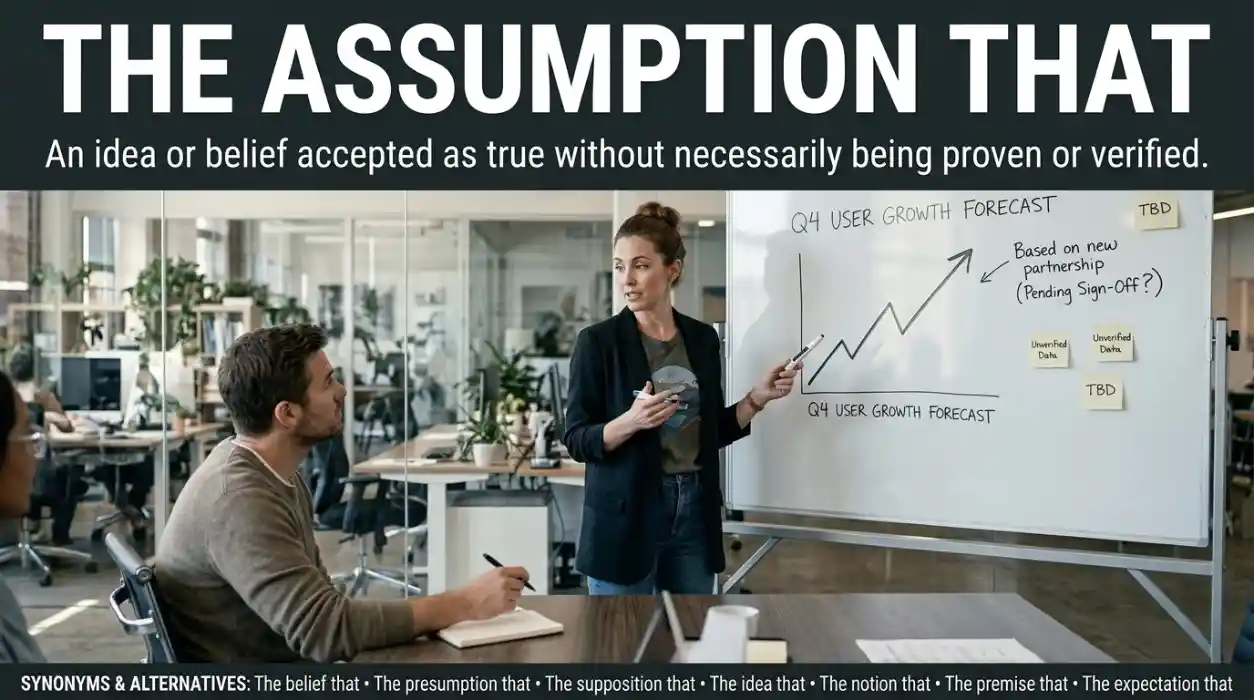
20. The Assumption That (Noun Phrase) — US / UK: /ði əˈsʌmpʃən ðæt/
Meaning: Introduces an idea accepted as true without necessarily being proven.
Tone/Register: Analytical; often neutral or critical.
Examples:
The assumption that everyone had read the email was incorrect.
Her argument relied on the assumption that demand would remain stable.
21. The Possibility That (Noun Phrase) — US / UK: /ðə ˌpɑːsəˈbɪləti ðæt/
Meaning: Introduces something that may be true or may happen.
Tone/Register: Neutral; cautious or speculative.
Examples:
The possibility that the flight could be delayed worried us.
They discussed the possibility that a new policy might help.
22. The Likelihood That (Noun Phrase) — US / UK: /ðə ˈlaɪklihʊd ðæt/
Meaning: Introduces the probability of an event or situation.
Tone/Register: Formal; analytical and predictive.
Examples:
The likelihood that prices will rise influenced our decision.
Researchers considered the likelihood that the results were affected by bias.
23. The Chance That (Noun Phrase) — US / UK: /ðə tʃæns ðæt/
Meaning: Introduces the possibility that something might happen.
Tone/Register: Neutral; everyday and conversational.
Examples:
The chance that we might miss the train made us hurry.
I hadn’t considered the chance that the shop would be closed.
24. The Idea That (Noun Phrase) — US / UK: /ði aɪˈdiːə ðæt/
Meaning: Introduces a thought, belief, or proposition.
Tone/Register: Neutral; useful in discussion and essays.
Examples:
The idea that mistakes help us learn changed my perspective.
She rejected the idea that success comes without effort.
25. The Claim That (Noun Phrase) — US / UK: /ðə kleɪm ðæt/
Meaning: Introduces an assertion that may need evidence or verification.
Tone/Register: Formal; journalism, debate, and academic writing.
Examples:
The claim that the product was unsafe required investigation.
We questioned the claim that the policy had reduced costs.
26. The Statement That (Noun Phrase) — US / UK: /ðə ˈsteɪtmənt ðæt/
Meaning: Introduces something someone has explicitly said or written.
Tone/Register: Formal and neutral.
Examples:
The statement that the service would improve raised expectations.
She challenged the statement that all applications had been reviewed.
27. The Report That (Noun Phrase) — US / UK: /ðə rɪˈpɔːrt ðæt/
Meaning: Introduces information attributed to a report or reported source.
Tone/Register: Journalistic and professional.
Examples:
The report that the bridge needed repairs prompted action.
We investigated the report that customer complaints had increased.
28. The News That (Noun Phrase) — US / UK: /ðə nuːz ðæt/
Meaning: Introduces newly received information, often with an emotional effect.
Tone/Register: Neutral; frequently emotional in context.
Examples:
The news that her application was accepted made her smile.
He was surprised by the news that the concert had sold out.
29. The Fact of (Noun Phrase) — US / UK: /ðə fækt əv/
Meaning: Refers to the existence or occurrence of something, usually before a noun or gerund.
Tone/Register: Formal.
Examples:
The fact of his arrival surprised the waiting team.
We cannot ignore the fact of rising demand.
Usage tip: Before a complete clause, the fact that is generally the more natural construction.
30. The Circumstance of (Noun Phrase) — US / UK: /ðə ˈsɜːrkəmstæns əv/
Meaning: Identifies a particular condition or situation, often followed by a noun or gerund.
Tone/Register: Formal and analytical.
Examples:
The circumstance of working remotely changed their routine.
They examined the circumstances of the agreement.
31. In Reality (Adverbial Phrase) — US / UK: /ɪn riˈæləti/
Meaning: Introduces what is actually true, sometimes contrasting it with appearances or assumptions.
Tone/Register: Neutral; can be emphatic.
Examples:
The task looked easy. In reality, it took three hours.
In reality, the two proposals were almost identical.
32. In Truth (Adverbial Phrase) — US / UK: /ɪn truːθ/
Meaning: Introduces what the speaker considers genuinely true.
Tone/Register: Formal or literary.
Examples:
In truth, neither candidate had enough experience.
The journey seemed simple, but in truth it was exhausting.
33. Actually (Adverb) — US / UK: /ˈæktʃuəli/
Meaning: Presents information as true, especially when correcting an assumption or adding clarification.
Tone/Register: Conversational to neutral.
Examples:
Actually, the meeting starts at ten, not nine.
I thought he was upset, but he was actually tired.
34. Indeed (Adverb) — US / UK: /ɪnˈdiːd/
Meaning: Emphasizes or confirms a statement.
Tone/Register: Formal to neutral; emphatic.
Examples:
The results were indeed better than expected.
She is indeed qualified to lead the project.
35. The Reason That (Noun Phrase) — US / UK: /ðə ˈriːzən ðæt/
Meaning: Introduces an explanation for why something happens.
Tone/Register: Neutral.
Examples:
The reason that we left early was the approaching storm.
I understand the reason that she changed her mind.
Usage tip: “The reason we left early was the approaching storm” is often more concise.
36. The Explanation That (Noun Phrase) — US / UK: /ði ˌekspləˈneɪʃən ðæt/
Meaning: Introduces an account of why something happened or what something means.
Tone/Register: Neutral to formal.
Examples:
The explanation that the server had failed made sense.
His explanation that he had missed the bus was believable.
37. The Result That (Noun Phrase) — US / UK: /ðə rɪˈzʌlt ðæt/
Meaning: Introduces an outcome or result relevant to the discussion.
Tone/Register: Neutral; analytical.
Examples:
The result that the team achieved exceeded expectations.
We discussed the result that emerged after several trials.
38. The Outcome That (Noun Phrase) — US / UK: /ði ˈaʊtkʌm ðæt/
Meaning: Introduces the eventual consequence of an action or process.
Tone/Register: Formal to neutral.
Examples:
The outcome that followed surprised both teams.
She accepted the outcome that the committee announced.
39. The Concern That (Noun Phrase) — US / UK: /ðə kənˈsɜːrn ðæt/
Meaning: Introduces a worry or issue that needs attention.
Tone/Register: Professional; often cautious or critical.
Examples:
The concern that costs might rise delayed approval.
They shared the concern that the deadline was unrealistic.
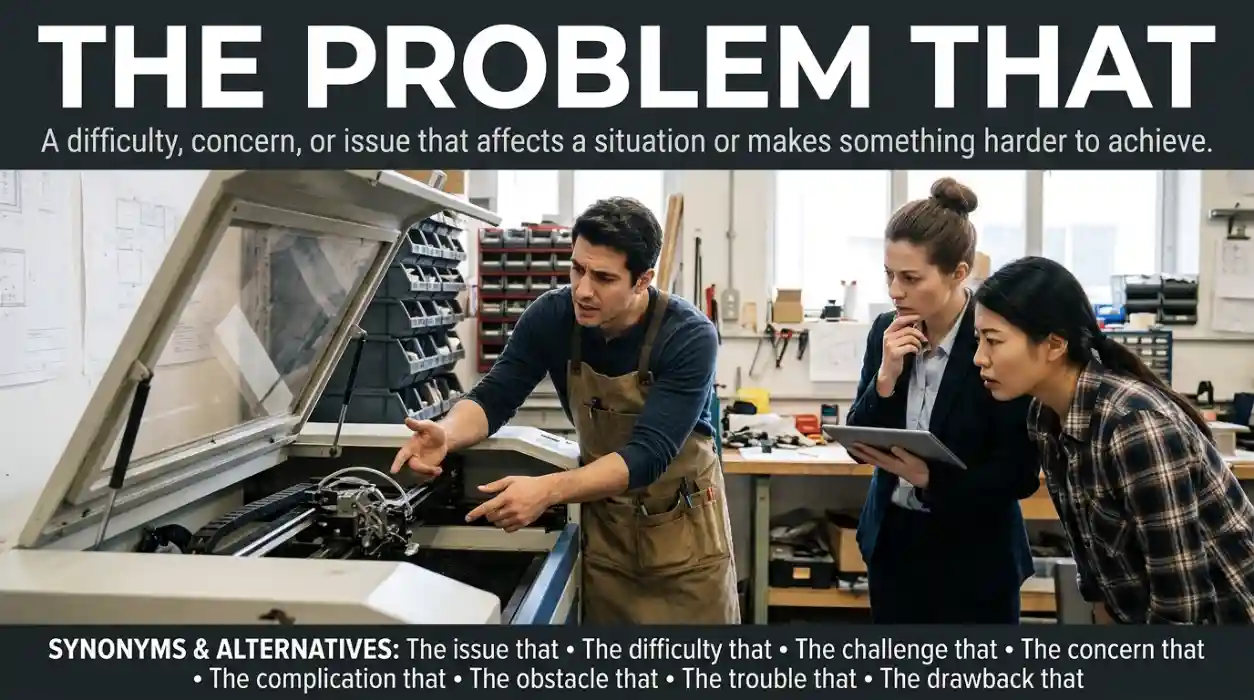
40. The Problem That (Noun Phrase) — US / UK: /ðə ˈprɑːbləm ðæt/
Meaning: Highlights a difficulty or issue that affects a situation.
Tone/Register: Neutral; sometimes critical.
Examples:
The problem that the data was incomplete slowed our analysis.
We addressed the problem that several files were missing.
41. The Benefit That (Noun Phrase) — US / UK: /ðə ˈbenɪfɪt ðæt/
Meaning: Introduces an advantage or positive effect.
Tone/Register: Neutral to positive; common in reports and discussion.
Examples:
The benefit that remote work offers is greater flexibility.
She explained the benefit that daily reading brings to children.
42. The Advantage That (Noun Phrase) — US / UK: /ði ədˈvæntɪdʒ ðæt/
Meaning: Highlights a favorable feature or circumstance.
Tone/Register: Neutral to positive.
Examples:
The advantage that this design offers is easier maintenance.
We discussed the advantage that experience gives an applicant.
43. The Risk That (Noun Phrase) — US / UK: /ðə rɪsk ðæt/
Meaning: Introduces a possible danger or undesirable outcome.
Tone/Register: Professional; cautionary.
Examples:
The risk that the files could be lost led us to make backups.
They considered the risk that the launch might fail.
44. The Danger That (Noun Phrase) — US / UK: /ðə ˈdeɪndʒər ðæt/
Meaning: Emphasizes the possibility of harm or serious trouble.
Tone/Register: Cautionary; more forceful than risk in many contexts.
Examples:
The danger that the river might overflow forced an evacuation.
She recognized the danger that misinformation could spread.
45. The Importance of (Noun Phrase) — US / UK: /ði ɪmˈpɔːrtəns əv/
Meaning: Highlights the value or significance of something, usually before a noun or gerund.
Tone/Register: Neutral to formal.
Examples:
The importance of checking sources cannot be overstated.
He explained the importance of saving a copy before editing.
Usage tip: This phrase emphasizes significance; it is not a direct substitute for every clause beginning with “the fact that.”
46. The Significance of (Noun Phrase) — US / UK: /ðə sɪɡˈnɪfɪkəns əv/
Meaning: Refers to the meaning, impact, or importance of something.
Tone/Register: Formal; academic and analytical.
Examples:
The significance of the discovery became clear over time.
We discussed the significance of the change in public opinion.
47. It Is True That (Clause) — US / UK: /ɪt ɪz truː ðæt/
Meaning: Explicitly acknowledges that a statement is true, often before adding a qualification.
Tone/Register: Neutral to formal.
Examples:
The plan indeed costs more, but it saves time.
She indeed made mistakes, yet she learned quickly.
48. The Point Is That (Clause) — US / UK: /ðə pɔɪnt ɪz ðæt/
Meaning: Directs attention to the main idea or most important consideration.
Tone/Register: Conversational to neutral; often emphatic.
Examples:
The point is that we need a decision before Friday.
The point is that nobody should feel pressured to agree.
49. What Matters Is That (Clause) — US / UK: /wʌt ˈmætərz ɪz ðæt/
Meaning: Emphasizes the most important consideration in a situation.
Tone/Register: Neutral; reassuring or persuasive.
Examples:
What matters is that everyone understands the instructions.
What matters is that you keep making progress.
50. The Circumstance of the Fact That (Noun Phrase) — US / UK: /ðə ˈsɜːrkəmstæns əv ðə fækt ðæt/
Meaning: This is an awkward combination rather than a recommended synonym; it illustrates how stacking similar phrases can make writing unnecessarily complicated.
Tone/Register: Overly formal and unnatural in most contexts.
Examples:
Awkward: “The circumstance of the fact that it rained changed our plans.”
Better: “The fact that it rained changed our plans.”
More direct: “Because it rained, we changed our plans.”
Sorting by Tone: Safe, Formal, and Handle-With-Care
Tone is where these alternatives succeed or fail. A school essay, a company report, and a message to a friend all need the same grammar and completely different words for it. The groups below sort the 50 by the impression they leave, from the warm and positive to the ones that should only appear in deliberate, formal writing.
Tone matters because a phrase can change how readers interpret your message. An academic report may need precise wording, while a friendly conversation benefits from simpler language.
Positive
Use these alternatives when emphasizing progress, value, reassurance, or a favorable result:
- The benefit that — highlights an advantage.
- The advantage that — draws attention to something helpful.
- What matters is that — emphasizes a reassuring or important point.
- The knowledge that — can express comfort or confidence.
- The significance of — emphasizes meaningful value or impact.
Example: “What matters is that everyone feels welcome.”
Neutral
These alternatives present information without adding a strong emotional judgment:
- Because
- Since
- Given that
- Considering that
- The reality that
- The situation where
- The statement that
- The explanation that
- The reason that
- Actually
Example: “Since the meeting has ended, we can leave.”
Negative or Cautionary
These expressions can highlight a problem, risk, disagreement, or unwanted truth:
- The problem that
- The risk that
- The danger that
- The concern that
- The claim that
- The assumption that
- The truth that
Example: “The concern that costs might increase deserves attention.”
These expressions are not automatically negative. Their tone depends on the sentence and context.
Playful or Informal
For everyday conversation, shorter alternatives often sound more natural:
- Because
- Actually
- The point is that
- The chance that
- The idea that
Example: “The point is that we need snacks before the movie!”
Avoid overly formal phrases in casual messages unless you deliberately want a humorous or dramatic effect.
Because, Since, As: Choosing the Right Replacement
Because is the default and usually the best answer. It is clear, neutral, and direct, and it can start a sentence without apology, whatever your school textbook told you. Choose it whenever the reason is the point.
Since works when the reason is already known to the reader, background information rather than news. “Since you asked, here is the file.” Its one weakness is ambiguity: since also measures time, and in “since he left, the office changed” the reader must decide which meaning you intended. When both readings are possible, because removes the doubt.
As is the lightest of the three, almost a gesture toward a reason. “As it was raining, we stayed in.” It suits reasons the reader can see for themselves, and it weakens any argument that needs force. Given that and considering that sit one step more formal, presenting the reason as agreed ground before the real claim arrives.
“The Fact That” at School, at Work, and at Home
Essays and Exams
Examiners reward precision and punish padding, so the essay rule is simple: because-family for reasons, noun-family for subjects. “The fact that the king raised taxes angered the barons” earns its length, because the fact is the subject doing the angering. “He raised taxes due to the fact that he needed money” does not, and since or because will score the same point in fewer words.
Reports and Office Writing
Professional writing uses the phrase most after verbs of record: noted the fact that, confirmed the fact that, despite the fact that. Even there, the modern office style is trimming it. “Please note that the deadline moved” now beats “please note the fact that the deadline moved” in most style guides, and the shorter sentence reads as more confident, not less.
News and Storytelling
Journalists keep the noun family because headlines and leads need facts as subjects: “The news that the minister resigned broke at dawn.” Fiction writers use the lightest forms, since and as, because their reasons usually belong inside a character’s head, where heavy constructions sound like a narrator clearing his throat.
Five Habits That Make This Phrase a Problem
1. Writing “due to the fact that” on autopilot
Four words doing the work of one. Unless a because-clause cannot fit the grammar, which is rare, the long form adds nothing but length. Search your drafts for it before submitting anything; it is the easiest mark an editor will ever give you back.
2. Deleting the phrase where the grammar needs a noun
The opposite error, and the reason this guide refuses to call the phrase useless. “The fact that she practiced daily showed in her playing” cannot lose its first four words and survive. If the clause is the subject or object, something must carry it. Change the noun if you like, but keep a noun.
3. Announcing possibilities as facts
“The fact that the treatment works” claims proof. “The possibility that the treatment works” claims a chance. Learners blur these constantly, and in science writing, medicine, and news the blur changes the truth of the sentence. Match the noun to your certainty.
4. Using courtroom forms in conversation
“Inasmuch as you are already here, in view of the fact that dinner is ready…” Nobody talks like this outside a parody. In speech, because and since cover nearly everything, and the heavy forms mark the speaker as someone performing English rather than using it.
5. Repeating the same construction in every paragraph
Even the right choice becomes a mannerism. If three paragraphs begin with noun phrases, “the point that,” “the fact that,” “the reality that,” vary the architecture: start one with because, one with a plain subject, one with the noun phrase that matters most.
Formal Essays vs. Everyday Talk
Think of the 50 alternatives as a staircase. At the bottom, everyday speech: because, since, as, actually, indeed. In the middle, educated neutral writing: given that, considering that, the point that, the reality that. At the top, formal and legal registers: inasmuch as, in view of the fact that, owing to the fact that. None of the steps is wrong. Standing on the wrong one for your audience is.
Watch It Shrink: The Same News, Four Ways
The Essay
First draft: “The character changes due to the fact that he loses his home.” Final draft: “The character changes because he loses his home, and the fact that he never complains about it makes the loss sadder.” One phrase cut, one kept, each where it belongs.
The Office Email
“Please be aware of the fact that the office will close early on Friday” becomes “Please note the office closes early on Friday.” The news survives. The ceremony around it does not, and nobody misses it.
The News Report
“The news that the bridge will reopen surprised drivers” keeps its construction, because the news is the subject. Shortening it to “that the bridge will reopen surprised drivers” produces a sentence readers must parse twice.
The Text Message
“Running late because the bus never came” is the whole story. Add “due to the fact that” and the same message becomes a small comedy, which is sometimes the point between friends, and never the point anywhere else.
Practice Quiz:
1. The outdoor concert was canceled ___ it was raining heavily
.because
the reality that
the assumption that
2. ___ the roads are icy, we should drive slowly.
The claim that
Given that
The truth that
3. Which phrase best introduces an idea that has not been proven?
The fact that
The evidence that
The assumption that
4. You want to correct a friend’s mistaken belief. Which word sounds natural?
Actually
Since
The circumstance that
5. You are writing a formal report about information that supports a conclusion.
The chance that
The evidence that
The point is that
6. Which phrase best introduces something that might happen?
The possibility that
The truth that
The benefit that
7. You want to reassure a friend by focusing on what is most important.
The danger that
What matters is that
The report that
8. Choose the clearest version: ‘The match was canceled because it snowed.’
The match was canceled because it snowed.
The match was canceled since the circumstance of snow.
Canceled the truth that it snowed.
9. Which phrase introduces a claim that may need checking?
The claim that
The benefit
in reality
10. You want to emphasize an actual situation rather than appearances.
The chance that
The reality that
The explanation that
Answer key:
1. because · 2. Given that · 3. The assumption that · 4. Actually · 5. The evidence that · 6. The possibility that · 7. What matters is that · 8. The match was canceled because it snowed. · 9. The claim that · 10. The reality that
Reflection task:
Write one sentence about your daily life using given that, the reality that, or what matters is that. Then rewrite it using a different expression without changing the main idea.
External Learning Sources
For authoritative definitions, pronunciation, and examples, consult these dictionaries:
Cambridge Dictionary — learner-friendly definitions and UK and US pronunciation.
Oxford Learner’s Dictionaries — usage examples, grammar patterns, and pronunciation guidance.
Merriam-Webster — definitions, word history, and American English usage.
The Short Version
Ask one question of every “the fact that” you write: is it carrying a reason, or carrying the sentence? Reasons usually belong to because and since, shorter and clearer. Sentences need their noun, so keep the construction and choose the noun that matches your certainty: reality for proof, possibility for doubt, point for emphasis. That single habit will clean up more prose than any list of banned phrases.
Frequently Asked Questions
1. What is the best synonym for “the fact that” in an academic essay?
The best alternative depends on the sentence’s purpose. Use given that to introduce a condition or supporting circumstance, the evidence that when discussing research, and the assumption that when examining an unproven belief. If the phrase simply explains a cause, because is often clearer. Academic writing benefits from precision, not just formal-sounding vocabulary.
2. Can I use “because” instead of “the fact that” in every sentence?
No. Because introduces a reason, while the fact that introduces information presented as true or relevant. For example, “The fact that she arrived early surprised me” emphasizes her arrival. “Because she arrived early, we started” explains why the meeting began. You can sometimes rewrite a sentence with because, but you may need to adjust its structure and meaning.
3. How can I avoid repeating “the fact that” in an essay?
First, decide whether the phrase adds useful emphasis. If not, remove it or rewrite the sentence. Replace cause-related constructions with because or since. Use given that for relevant circumstances and the reality that when emphasizing an actual situation. Read the revised paragraph aloud to check that the meaning remains clear and the sentences flow naturally.
4. Is “because ” grammatically correct?
Yes, ” because ” is used in English, but it often adds unnecessary words. In many sentences, because expresses the same reason more directly. For example, “The event was delayed because it snowed” can become “The event was delayed because it snowed.” Choose the longer expression only when it suits the sentence and register.
5. What is the difference between “the fact that” and “the reality that”?
“The fact that” presents information as true or relevant. “The reality that” places more emphasis on an actual situation, sometimes one that people may find difficult to accept. For example, “The fact that prices increased surprised us” reports a circumstance. “The reality that prices keep increasing is worrying” highlights the broader situation and its impact.

Shahzeena Shazadi is the founder and lead writer at VocablyHub.com, where she creates accurate, reader-focused English language content designed to help people communicate with clarity and confidence. She specializes in synonyms, antonyms, word meanings, idioms, and practical vocabulary guides that simplify complex language concepts for everyday use. Every article is carefully researched, fact-checked, and written in clear, accessible language using reliable references and real-world examples. Her goal is to provide helpful, trustworthy content that supports learners at every stage of their English language journey.
Her editorial approach focuses on accuracy, transparency, and user value while following modern content quality standards. She regularly reviews and updates content to keep information relevant, useful, and easy to understand. Through VocablyHub.com, Shahzeena Shazadi is committed to publishing reliable language resources that help students, writers, educators, professionals, and English learners expand their vocabulary, improve their writing skills, and communicate with confidence in academic, professional, and everyday situations.