
You are replying to a meeting invite and you type: “I can tentatively make Thursday.” Then you pause. Is there a better word, one that sounds less wishy-washy, or more professional? If you have been searching for synonyms for tentative, you will find fifty below, sorted by whether you mean “not yet decided,” “careful,” or “unsure.”
Tentative covers three related ideas. It can describe a plan that is not final (a tentative date), a manner that is cautious (a tentative handshake), or a conclusion that is not certain (tentative results). The right synonym depends on which of the three you mean, and picking the wrong one is how “a tentative agreement” turns into a misunderstanding.
This guide sorts synonyms for tentative by the job they do, with word-specific examples for emails, essays, labs, and stories. By the end, your sentences will say exactly what you intend: no weaker, no stronger.
Not Decided, Not Certain, Not Bold: The Three Faces of “Tentative”
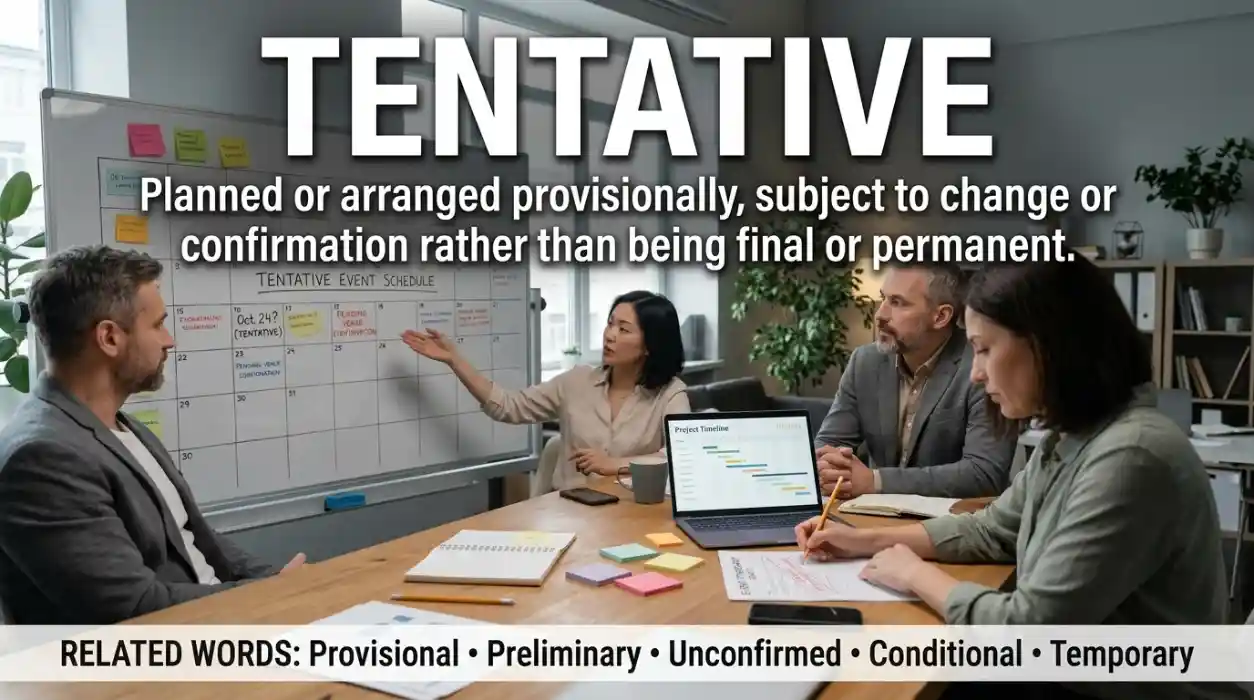
Face one is the unfinished plan. A tentative date, a tentative booking, a tentative agenda: each exists, but none is final. This is the most common use in offices and inboxes, and it is a feature, not a flaw. It tells everyone to pencil things in, not carve them in stone.
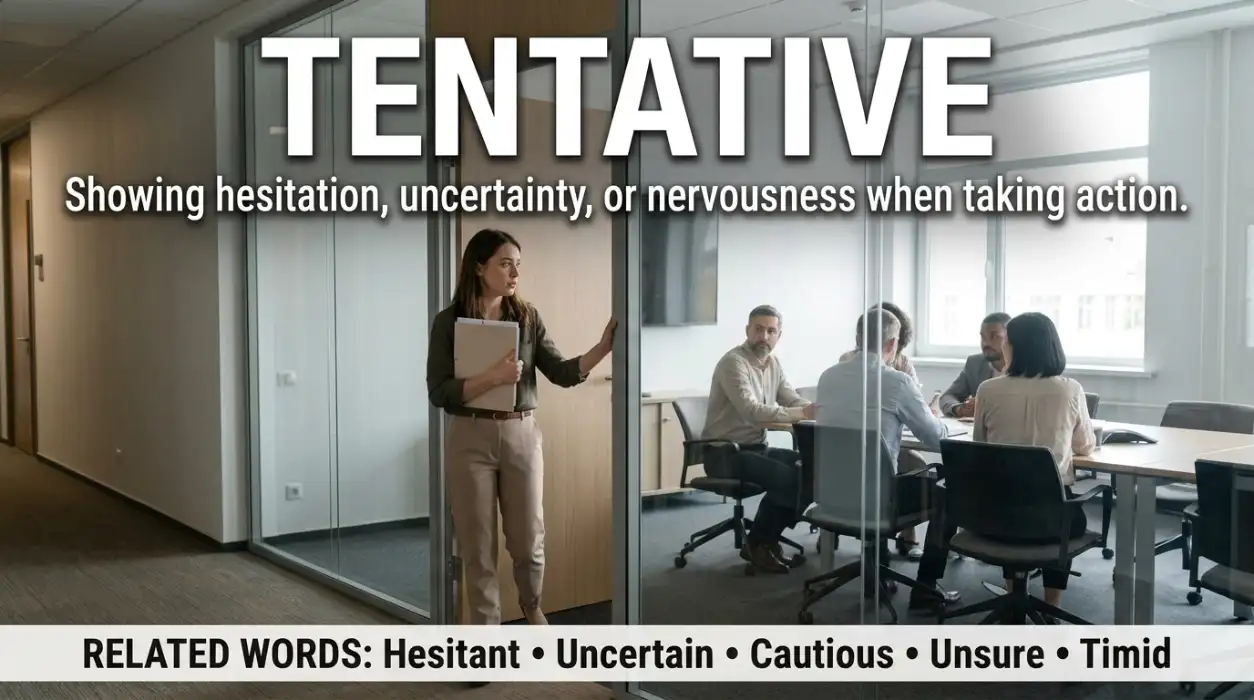
Face two is the cautious manner. A tentative step, a tentative smile, a tentative knock. Here the word describes how someone does something: carefully, as if testing the ground first. A tentative smile can betray nervousness or simple politeness; only the context tells you which.
Face three is the unproven conclusion. Tentative results, tentative findings, tentative approval. Scientists and officials use it as a honesty label: this is our best reading so far, not the final word. Remove it and “results show” claims far more than the evidence supports.
Grammatically it is an adjective, and its adverb is tentatively: “She tentatively raised her hand.” Keep the three faces separate in your mind, and the synonyms below will sort themselves.
The Feel of the Word: Careful, Polite, Sometimes Weak
At its best, tentative sounds prudent and open-minded. A “tentative agreement” keeps options alive without breaking trust. A “tentative yes” to a weekend plan is honest: it says “likely” instead of promising what you cannot deliver.
At its most neutral, it simply means “not final.” A tentative schedule is a draft. A tentative diagnosis awaits more tests. No judgment, just status.
But the word can slide toward weakness. “A tentative leader” is not praise; it suggests someone afraid to decide. “His argument was tentative” hints the reasoning itself wobbles. When confidence matters, synonyms like provisional or conditional carry more spine, because they sound like a choice rather than a wobble.
Testing the Waters: Where “Tentative” Comes From
Tentative comes from the Latin verb tentare, meaning to try, to test, to attempt. Through Medieval Latin tentativus, it entered English describing things done as a trial: a tentative experiment was literally an attempt, a test run.
That “trying” sense never left. A tentative plan is a plan being tried on for size. A tentative person tries each step before committing weight to it. The word’s history is a reminder of its core meaning: not yet proven, still being tested.
Over the centuries the meaning stretched in two directions. Toward caution: the hesitant manner, the careful step. And toward procedure: the provisional arrangement, the draft version. Both branches grew from the same Latin root, which is why one small word can cover a shaky handshake and a draft contract.
Saying It Right: TEN-tuh-tiv
American English says /ˈtɛntətɪv/, British English /ˈtentətɪv/: three syllables, TEN-tuh-tiv, with the stress on the first. The middle syllable is a quick, relaxed “tuh,” so the word almost hurries past its own middle.
The adverb is tentatively (TEN-tuh-tiv-lee), with four syllables. Learners sometimes stress the second syllable by mistake (“ten-TAY-tive”); keeping the weight on TEN fixes it instantly.
50 Alternatives to “Tentative,” Grouped by the Job They Do
No single synonym fits every use of tentative. Some alternatives describe a person who lacks confidence. Others describe a plan, decision, or conclusion that is not final. The distinctions below will help you choose accurately.
1. Uncertain (Adjective) — US / UK: /ʌnˈsɝːtən/ /ʌnˈsɜːtən/
Meaning: Not sure about something or unable to predict what will happen.
Tone/Register: Neutral, everyday.
Examples: I am uncertain whether the train leaves at six.
Let me check the schedule before we go.
2. Hesitant (Adjective) — US / UK: /ˈhɛzɪtənt/ /ˈhezɪtənt/
Meaning: Slow to act or speak because of doubt or nervousness.
Tone/Register: Neutral, personal.
Examples: Maya seemed hesitant to share her opinion.
She wanted to understand the situation first.
3. Provisional (Adjective) — US / UK: /prəˈvɪʒənəl/ /prəˈvɪʒənəl/
Meaning: Arranged or accepted temporarily until a final decision is made.
Tone/Register: Formal, professional.
Examples: The committee approved a provisional schedule.
Members will review it again next week.
4. Preliminary (Adjective) — US / UK: /prɪˈlɪməˌnɛri/ /prɪˈlɪmɪnəri/
Meaning: Happening at an early stage before a final result or decision.
Tone/Register: Academic, professional.
Examples: The team shared its preliminary findings.
Further research is needed before concluding.
5. Cautious (Adjective) — US / UK: /ˈkɔːʃəs/ /ˈkɔːʃəs/
Meaning: Careful to avoid mistakes, danger, or unnecessary risk.
Tone/Register: Neutral, often positive.
Examples: The doctor gave a cautious assessment.
She wanted more test results before making a recommendation.
6. Undecided (Adjective) — US / UK: /ˌʌndɪˈsaɪdɪd/ /ˌʌndɪˈsaɪdɪd/
Meaning: Not having chosen between available options.
Tone/Register: Neutral, conversational.
Examples: I am still undecided about which course to take.
Both programs offer useful opportunities.
7. Doubtful (Adjective) — US / UK: /ˈdaʊtfəl/ /ˈdaʊtfəl/
Meaning: Uncertain that something is true, possible, or likely to happen.
Tone/Register: Neutral, sometimes negative.
Examples: It is doubtful that the package will arrive today.
The delivery service has reported several delays.
8. Inconclusive (Adjective) — US / UK: /ˌɪnkənˈkluːsɪv/ /ˌɪnkənˈkluːsɪv/
Meaning: Not producing a clear or final answer.
Tone/Register: Academic, formal.
Examples: The initial experiment produced inconclusive results.
The researchers plan to repeat the test.
9. Provisionalized (Adjective) — US / UK: /prəˈvɪʒənəlaɪzd/ /prəˈvɪʒənəlaɪzd/
Meaning: Treated as temporary or provisional rather than fully final.
Tone/Register: Technical, uncommon.
Examples: The records were provisionalized during the review.
The team later replaced them with verified entries.
10. Preliminary-stage (Adjective) — US / UK: /prɪˈlɪməˌnɛri steɪdʒ/ /prɪˈlɪmɪnəri steɪdʒ/
Meaning: Belonging to an early phase before the process is complete.
Tone/Register: Technical, descriptive.
Examples: The project remains at the preliminary stage.
The developers are still evaluating the main requirements.
11. Provisional-minded (Adjective) — US / UK: /prəˈvɪʒənəl ˈmaɪndɪd/ /prəˈvɪʒənəl ˈmaɪndɪd/
Meaning: Inclined to treat ideas or decisions as temporary rather than settled.
Tone/Register: Uncommon, descriptive.
Examples: The researcher took a provisional-minded approach to the evidence.
She remained open to a different interpretation.
12. Ambivalent (Adjective) — US / UK: /æmˈbɪvələnt/ /æmˈbɪvələnt/
Meaning: Experiencing mixed or conflicting feelings about something.
Tone/Register: Neutral, psychological.
Examples: He felt ambivalent about moving abroad.
The opportunity excited him, but he would miss his family.
13. Indecisive (Adjective) — US / UK: /ˌɪndɪˈsaɪsɪv/ /ˌɪndɪˈsaɪsɪv/
Meaning: Having difficulty making decisions.
Tone/Register: Neutral, sometimes critical.
Examples: I become indecisive when too many options are available.
A short list usually helps me choose.
14. Reluctant (Adjective) — US / UK: /rɪˈlʌktənt/ /rɪˈlʌktənt/
Meaning: Unwilling or not eager to do something.
Tone/Register: Neutral, personal.
Examples: Nina was reluctant to sign the agreement.
She wanted to read every condition first.
15. Wavering (Adjective) — US / UK: /ˈweɪvərɪŋ/ /ˈweɪvərɪŋ/
Meaning: Showing a lack of firmness or consistency in a decision or belief.
Tone/Register: Literary, descriptive.
Examples: His wavering support worried the organizers.
They needed a clear commitment before announcing the event.
16. Unresolved (Adjective) — US / UK: /ˌʌnrɪˈzɑːlvd/ /ˌʌnrɪˈzɒlvd/
Meaning: Not yet settled, answered, or brought to a conclusion.
Tone/Register: Formal, neutral.
Examples: Several questions remain unresolved after the meeting.
The manager will address them tomorrow.
17. Open-ended (Adjective) — US / UK: /ˌoʊpənˈɛndɪd/ /ˌəʊpənˈendɪd/
Meaning: Not restricted to a fixed answer, outcome, or ending.
Tone/Register: Neutral, academic, professional.
Examples: The discussion included open-ended questions.
Participants could explain their views in their own words.
18. Insecure (Adjective) — US / UK: /ˌɪnsɪˈkjʊr/ /ˌɪnsɪˈkjʊə/
Meaning: Lacking confidence or feeling unsure about oneself or a situation.
Tone/Register: Personal, psychological.
Examples: He felt insecure about presenting his idea.
A little preparation helped him speak more comfortably.
19. Unconfirmed (Adjective) — US / UK: /ˌʌnkənˈfɝːmd/ /ˌʌnkənˈfɜːmd/
Meaning: Not officially verified or accepted as definite.
Tone/Register: Neutral, professional.
Examples: The meeting time is still unconfirmed.
We will send an update when the room is booked.
20. Temporary (Adjective) — US / UK: /ˈtɛmpəˌrɛri/ /ˈtɛmpərəri/
Meaning: Intended to last for a limited period rather than permanently.
Tone/Register: Neutral, everyday.
Examples: We made a temporary change to the work schedule.
The usual arrangement will return next month.
21. Conditional (Adjective) — US / UK: /kənˈdɪʃənəl/ /kənˈdɪʃənəl/
Meaning: Dependent on a particular condition being met.
Tone/Register: Formal, legal, professional.
Examples: Her acceptance is conditional on receiving a scholarship.
The university will confirm the result next week.
22. Contingent (Adjective) — US / UK: /kənˈtɪndʒənt/ /kənˈtɪndʒənt/
Meaning: Dependent on something else happening or being true.
Tone/Register: Formal, business.
Examples: The launch date is contingent on final approval.
The team will announce it after testing ends.
23. Pending (Adjective) — US / UK: /ˈpɛndɪŋ/ /ˈpendɪŋ/
Meaning: Awaiting a decision, approval, or completion.
Tone/Register: Formal, administrative.
Examples: Your application remains pending.
The office expects to review it within a few days.
24. Unsettled (Adjective) — US / UK: /ʌnˈsɛtəld/ /ʌnˈsetəld/
Meaning: Not yet resolved, decided, or made stable.
Tone/Register: Neutral, sometimes negative.
Examples: The final details are still unsettled.
We need to agree on the venue and guest list.
25. Probing (Adjective) — US / UK: /ˈproʊbɪŋ/ /ˈprəʊbɪŋ/
Meaning: Carefully exploring an issue before concluding.
Tone/Register: Analytical, academic.
Examples: The journalist asked probing questions about the proposal.
The answers revealed several overlooked problems.
26. Exploratory (Adjective) — US / UK: /ɪkˈsplɔːrəˌtɔːri/ /ɪkˈsplɒrətəri/
Meaning: Intended to investigate possibilities without a predetermined outcome.
Tone/Register: Academic, professional.
Examples: The team held an exploratory meeting with potential partners.
They wanted to see whether their goals aligned.
27. Experimental (Adjective) — US / UK: /ɪkˌspɛrəˈmɛntəl/ /ɪkˌsperɪˈmentəl/
Meaning: Based on a trial or new method that has not been fully tested.
Tone/Register: Scientific, creative.
Examples: The studio adopted an experimental approach to animation.
Some techniques worked better than others.
28. Preliminary-minded (Adjective) — US / UK: /prɪˈlɪməˌnɛri ˈmaɪndɪd/ /prɪˈlɪmɪnəri ˈmaɪndɪd/
Meaning: Focused on early findings rather than conclusions.
Tone/Register: Uncommon, descriptive.
Examples: The analyst took a preliminary-minded view of the figures.
She avoided making strong claims from limited data.
29. Provisional-looking (Adjective) — US / UK: /prəˈvɪʒənəl ˈlʊkɪŋ/ /prəˈvɪʒənəl ˈlʊkɪŋ/
Meaning: Appearing temporary or not fully finalized.
Tone/Register: Informal, descriptive.
Examples: The draft has a provisional-looking layout.
The designer will refine it after feedback.
30. Inchoate (Adjective) — US / UK: /ɪnˈkoʊət/ /ɪnˈkəʊət/
Meaning: Only partly formed or developed.
Tone/Register: Formal, literary.
Examples: She had an inchoate idea for a new community project.
A few conversations helped her define its purpose.
31. Nascent (Adjective) — US / UK: /ˈneɪsənt/ /ˈneɪsənt/
Meaning: Beginning to develop or emerge.
Tone/Register: Formal, academic.
Examples: The nascent partnership has already attracted attention.
Both organizations are exploring ways to cooperate.
32. Uncertain-minded (Adjective) — US / UK: /ʌnˈsɝːtən ˈmaɪndɪd/ /ʌnˈsɜːtən ˈmaɪndɪd/
Meaning: Characterized by doubt or a lack of settled conviction.
Tone/Register: Uncommon, descriptive.
Examples: He sounded uncertain-minded during the discussion.
He asked for more evidence before agreeing.
33. Noncommittal (Adjective) — US / UK: /ˌnɑːnkəˈmɪtəl/ /ˌnɒnkəˈmɪtəl/
Meaning: Avoiding a clear promise, opinion, or commitment.
Tone/Register: Neutral, professional.
Examples: The spokesperson gave a noncommittal response.
She did not want to promise a date before approval.
34. Guarded (Adjective) — US / UK: /ˈɡɑːrdɪd/ /ˈɡɑːdɪd/
Meaning: Careful about revealing thoughts, feelings, or intentions.
Tone/Register: Neutral, sometimes wary.
Examples: He offered a guarded reaction to the announcement.
He wanted to learn more before expressing support.
35. Qualified (Adjective) — US / UK: /ˈkwɑːləˌfaɪd/ /ˈkwɒlɪfaɪd/
Meaning: Limited or modified by conditions, exceptions, or reservations.
Tone/Register: Formal, academic.
Examples: The report gives qualified support to the proposal.
It identifies benefits but warns about possible risks.
36. Provisional in Nature (Adjective Phrase) — US / UK: /prəˈvɪʒənəl ɪn ˈneɪtʃər/ /prəˈvɪʒənəl ɪn ˈneɪtʃə/
Meaning: Temporary and subject to revision rather than final.
Tone/Register: Formal, administrative.
Examples: The agreement is provisional in nature.
Both parties must approve the final wording.
37. Tentatively Agreed (Adjective Phrase) — US / UK: /ˈtɛntətɪvli əˈɡriːd/ /ˈtentətɪvli əˈɡriːd/
Meaning: Accepted for now, although final confirmation or details may remain outstanding.
Tone/Register: Business, neutral.
Examples: We tentatively agreed to meet on Wednesday.
I will confirm once my travel plans are settled.
38. Hesitating (Adjective or Present Participle) — US / UK: /ˈhɛzɪˌteɪtɪŋ/ /ˈhezɪteɪtɪŋ/
Meaning: Pausing or delaying because of uncertainty or reluctance.
Tone/Register: Conversational, descriptive.
Examples: Her hesitant reply suggested that something was wrong.
I asked whether she wanted more time.
39. Diffident (Adjective) — US / UK: /ˈdɪfɪdənt/ /ˈdɪfɪdənt/
Meaning: Shy or lacking confidence in one’s abilities or opinions.
Tone/Register: Formal, literary.
Examples: The diffident student spoke quietly during the seminar.
Her written work, however, was exceptionally strong.
40. Timorous (Adjective) — US / UK: /ˈtɪmərəs/ /ˈtɪmərəs/
Meaning: Showing fear or nervousness about taking action.
Tone/Register: Literary, often negative.
Examples: He gave a timorous suggestion during the debate.
He worried that the others might reject it.
41. Fainthearted (Adjective) — US / UK: /ˌfeɪntˈhɑːrtɪd/ /ˌfeɪntˈhɑːtɪd/
Meaning: Lacking courage or confidence when facing a challenge.
Tone/Register: Literary, critical.
Examples: The difficult conversation was not for the fainthearted.
Everyone needed courage to address the conflict.
42. Uncommitted (Adjective) — US / UK: /ˌʌnkəˈmɪtɪd/ /ˌʌnkəˈmɪtɪd/
Meaning: Not firmly dedicated to a choice, position, or course of action.
Tone/Register: Neutral, professional.
Examples: Several voters remain uncommitted before the election.
They are waiting to hear the candidates’ final proposals.
43. Insecurely Held (Adjective Phrase) — US / UK: /ˌɪnsɪˈkjʊrli hɛld/ /ˌɪnsɪˈkjʊəli held/
Meaning: Held as a belief or position without strong confidence or firm support.
Tone/Register: Formal, analytical.
Examples: The assumption was insecurely held by the research team.
New evidence quickly challenged it.
44. Open to Revision (Adjective Phrase) — US / UK: /ˈoʊpən tə rɪˈvɪʒən/ /ˈəʊpən tə rɪˈvɪʒən/
Meaning: Willing or expected to change after feedback or new information.
Tone/Register: Professional, academic.
Examples: The proposed guidelines are open to revision.
Staff members can submit comments until Friday.
45. Provisional in Status (Adjective Phrase) — US / UK: /prəˈvɪʒənəl ɪn ˈsteɪtəs/ /prəˈvɪʒənəl ɪn ˈsteɪtəs/
Meaning: Having a temporary status that may change after review.
Tone/Register: Formal, administrative.
Examples: Her appointment is provisional in status.
The board will make a final decision next month.
46. Unfinalized (Adjective) — US / UK: /ʌnˈfaɪnəlaɪzd/ /ʌnˈfaɪnəlaɪzd/
Meaning: Not yet completed, approved, or made final.
Tone/Register: Business, administrative.
Examples: The contract remains unfinalized.
The legal team is reviewing two remaining clauses.
47. Provisional in Scope (Adjective Phrase) — US / UK: /prəˈvɪʒənəl ɪn skoʊp/ /prəˈvɪʒənəl ɪn skəʊp/
Meaning: Limited or temporary in its intended coverage until further decisions are made.
Tone/Register: Formal, technical.
Examples: The policy is provisional in scope.
It applies to the pilot program, not the entire organization.
48. Conjectural (Adjective) — US / UK: /kənˈdʒɛktʃərəl/ /kənˈdʒektʃərəl/
Meaning: Based on guesswork or inference rather than facts.
Tone/Register: Formal, academic.
Examples: The explanation remains conjectural.
Historians have not found enough evidence to confirm it.
49. Speculative (Adjective) — US / UK: /ˈspɛkjələtɪv/ /ˈspekjələtɪv/
Meaning: Based on possibilities or assumptions rather than confirmed information.
Tone/Register: Formal, analytical.
Examples: The article includes speculative predictions about future travel.
The author clearly separates them from verified facts.
50. Uncertain of Outcome (Adjective Phrase) — US / UK: /ʌnˈsɝːtən əv ˈaʊtkʌm/ /ʌnˈsɜːtən əv ˈaʊtkʌm/
Meaning: Describing a situation whose final result is not yet known.
Tone/Register: Neutral, descriptive.
Examples: The negotiations remain uncertain in outcome.
Both sides are still discussing the main terms.
Sorting the 50 by Tone: Careful, Neutral, Weak, Casual
Tone matters because the wrong synonym can make a careful person sound weak or make an ordinary delay sound like a serious problem. Select the word that reflects the actual situation.
Positive or Constructive
These words often present uncertainty as careful thinking, exploration, or openness to change.
- Cautious
- Exploratory
- Preliminary
- Open to revision
- Qualified
- Nascent
Example: “Our preliminary findings suggest that the new approach may work.”
The sentence communicates progress without overstating the evidence.
Neutral
These alternatives describe a state or arrangement without strong emotional judgment.
- Uncertain
- Provisional
- Temporary
- Unconfirmed
- Pending
- Unsettled
- Undecided
Example: “The appointment is provisional until the board approves it.”
The wording focuses on the status of the decision.
Negative or Critical
These words may suggest a lack of confidence, commitment, or decisiveness.
- Indecisive
- Timorous
- Diffident
- Fainthearted
- Wavering
- Noncommittal
Example: “His noncommittal reply left the team without a clear direction.”
The sentence suggests that the lack of commitment caused a problem.
Informal or Conversational
In casual conversations, simpler expressions often sound more natural than formal alternatives.
- Not sure
- Undecided
- Hesitant
- Still thinking
- Not confirmed yet
Example: “I’m still thinking about the offer.”
This sounds more natural in everyday speech than “My decision remains provisional.”
“Tentative” vs. “Hesitant” vs. “Provisional”: Which Doubt Is Yours?
These three are the most confused trio in the whole list. Each names a different kind of not-sure.
| Word | What kind of doubt | Tone | Use it for |
|---|---|---|---|
| Tentative | Not decided or not certain yet | Neutral, polite | Plans, findings, first attempts |
| Hesitant | Holding back from acting | Personal, often weak | People and manner: a hesitant speaker |
| Provisional | Temporary until confirmed | Formal, procedural | Arrangements and documents: a provisional license |
| Uncertain | Not knowing the outcome | Neutral | Minds and results: an uncertain future |
Quick rule: choose tentative for plans and findings that may change, hesitant for people holding back, provisional for official arrangements awaiting confirmation, and uncertain when the outcome itself is unknown.
Where You Will Meet “Tentative”: Inboxes, Classrooms, Labs, and Novels
In Work Emails
This is the word’s natural habitat. “Tentative agenda attached” tells colleagues the plan may move. “We have tentative approval” celebrates without overpromising. In business writing it is polite and precise, which is why alternatives like provisional or preliminary also thrive here.
In Classrooms
Teachers mark a “tentative thesis” on a draft to mean “good start, keep testing it.” Students who write “my tentative conclusion is” sound honest about the limits of their evidence, and examiners notice that honesty.
In Science and Research
“Tentative findings” is a standard honesty label in papers and press releases. It warns readers not to treat early data as proof. Here the precise synonyms are preliminary, inconclusive, and provisional; hesitant would sound odd applied to data.
In Fiction
Novelists use the manner sense for character work: “a tentative knock,” “her tentative smile.” In stories, the more vivid cousins often win: wary, diffident, or fainthearted show the feeling instead of labeling it.
Mistakes That Give Learners Away
1. Writing “Tentative” When You Mean “Temporary”
A temporary office lasts a short time; a tentative plan is simply unconfirmed. A “tentative employee” sounds like a person nobody trusts, while a “temporary employee” is just on a short contract. Keep time and certainty in separate boxes.
2. Confusing “Hesitant” with “Provisional”
A hesitant speaker lacks confidence; a provisional license is an official document awaiting its final version. One describes a feeling, the other a status. Swapping them makes people sound like paperwork and paperwork sound nervous.
3. Using “Speculative” as a General Synonym
Speculative means based on guessing, which is a stronger and riskier claim than tentative. Calling early results “speculative” suggests they might be fantasy; calling them “tentative” says they are early but real.
4. Making a Careful Decision Sound Weak
“A tentative yes” in a negotiation can signal you can be pushed. When you want to sound deliberate rather than doubtful, conditional (“a conditional yes, pending the budget”) or provisional carries more spine.
5. Labeling People Instead of Moments
“He is tentative” reads as a judgment of character. “His answer was tentative” describes one moment, kindly. Aim the word at the behavior, not the person, unless you truly mean the criticism.
How Formal Is “Tentative,” Really?
It sits comfortably in the middle. Tentative works in work emails, academic writing, news reports, and everyday conversation without sounding stiff or sloppy. It is one of the rare words that needs no register adjustment.
When you want to tilt formal, reach for provisional, preliminary, or contingent. When you want to sound casual, plain phrases do the job: “not sure yet,” “maybe,” “we’ll see.” And when you want color in fiction, wary, diffident, and fainthearted paint the feeling more vividly.
The practical tip for learners: in business writing, tentative is your polite default. Anywhere you need strength instead of politeness, pick a synonym with a firmer jaw.
“Tentative” at Work: Four Real Moments
The Monday Email
A manager sends the team a “tentative agenda” for Friday’s review. Nobody treats it as final, nobody panics when item three moves to next week, and that calm is exactly what the word was chosen to create.
The Weekend Plan
Maya gives a tentative yes to the road trip, waiting on her work rota. Her friends read it correctly: “likely, unless.” Had she said “maybe,” they would have counted her out; “tentative” keeps her in the car.
The Lab Report
A study reports “tentative evidence” linking sleep quality to memory. The adjective does quiet, honest work: it tells readers the signal is real but early, so nobody mistakes a first finding for a proven fact.
The Story’s First Knock
“He gave a tentative knock, then pushed the door open.” One adjective and the reader feels his nerves in their own hand. A bolder word would have spoiled the scene; tentative is the whole performance.
Practice Exercise
1. A meeting date has been suggested but not officially confirmed. Which word fits best?
A. Provisional
B. Timorous
C. Insecure
2. A student pauses because she is nervous about answering a question. Which word describes her behavior?
A. Pending
B. Hesitant
C. Conjectural
3. Researchers share early findings before completing their study. Which phrase is most suitable?
A. Preliminary findings
B. Permanent findings
C. Uncommitted findings
4. A person has not chosen between two university offers. Which word fits best?
A. Decisive
B. Undecided
C. Conclusive
5. A prediction relies mainly on assumptions rather than verified facts. Which word is most accurate?
A. Speculative
B. Temporary
C. Guarded
6. An application is waiting for an official decision. Which word should the office use?
A. Diffident
B. Pending
C. Timorous
7. A person feels both excited and worried about moving abroad. Which word describes the mixed feelings?
A. Ambivalent
B. Unfinalized
C. Inconclusive
8. A scientist avoids making a strong claim because the evidence is limited. Which description fits best?
A. Cautious
B. Fainthearted
C. Uncommitted
9. A company will approve a contract only if a specific condition is met. Which word describes the approval?
A. Conditional
B. Exploratory
C. Hesitating
10. A spokesperson avoids making a definite promise about the launch date. Which word fits the response?
A. Noncommittal
B. Nascent
C. Preliminary
Reflection Task
Write two sentences about a decision, plan, or conversation in your own life.
- In the first sentence, use tentative.
- In the second sentence, replace it with a synonym such as provisional, hesitant, or uncertain.
Answer key: 1-A, 2-B, 3-A, 4-B, 5-A, 6-B, 7-A, 8-A, 9-A, 10-A
Suggested External Sources
Consult these reliable references for definitions, pronunciation, usage examples, and word history:
- Merriam-Webster Dictionary — definitions, pronunciation, and usage.
- Cambridge Dictionary — learner-friendly meanings and UK/US pronunciation.
- Oxford English Dictionary — historical development and etymology.
- Collins English Dictionary — synonyms, related expressions, and contextual meanings.
- British Council LearnEnglish — practical English vocabulary and learning guidance.
When using a synonym in academic or professional writing, check its dictionary definition and example sentences. A small difference in meaning can change the message you communicate.
The Short Version
Learning synonyms for tentative comes down to naming your kind of not-sure: a plan that may change, a person holding back, or a finding that needs more proof. Match the synonym to the situation and your sentence will say exactly what you mean.
Practice with your own inbox. Take one “tentative” from a recent email and test three replacements: provisional, hesitant, preliminary. Only one will fit without changing the meaning. Finding it is the skill, and it works on every cautious word you meet next.
Frequently Asked Questions
1. What is the best synonym for tentative in a business email?
Provisional, pending, and unconfirmed are useful choices, depending on the situation. Use provisional for an arrangement that may change, pending when approval is still outstanding, and unconfirmed when details have not been verified. For example, “The meeting time remains unconfirmed” clearly communicates that the schedule is not final.
2. What does tentative approval mean?
Tentative approval means that a proposal has received preliminary acceptance but is not yet fully approved. Further conditions, checks, or decisions may remain. For example, a university might give tentative approval to an application while waiting for final documents. The phrase should not be treated as a guarantee because the decision may still change.
3. Is tentative a positive or negative word?
Tentative can be positive, negative, or neutral. In research, a tentative conclusion may show intellectual honesty because the evidence is incomplete. In a personal situation, a tentative response may suggest nervousness or reluctance.
4. What is the difference between tentative and uncertain?
Tentative often describes a plan, decision, answer, or action that remains provisional or lacks confidence. Uncertain more broadly describes doubt about facts, outcomes, or possibilities. A tentative appointment may be scheduled but not finalized. An uncertain person may not know whether the appointment will happen at all.
5. Can tentative be used to describe a person?
Yes, tentative can describe someone’s behavior, voice, smile, or response when they seem cautious or unsure. For example, “She gave a tentative smile” suggests that she smiled without complete confidence. However, describing an entire person as tentative may sound vague. Words such as hesitant or diffident may communicate the specific behavior more clearly.

Shahzeena Shazadi is the founder and lead writer at VocablyHub.com, where she creates accurate, reader-focused English language content designed to help people communicate with clarity and confidence. She specializes in synonyms, antonyms, word meanings, idioms, and practical vocabulary guides that simplify complex language concepts for everyday use. Every article is carefully researched, fact-checked, and written in clear, accessible language using reliable references and real-world examples. Her goal is to provide helpful, trustworthy content that supports learners at every stage of their English language journey.
Her editorial approach focuses on accuracy, transparency, and user value while following modern content quality standards. She regularly reviews and updates content to keep information relevant, useful, and easy to understand. Through VocablyHub.com, Shahzeena Shazadi is committed to publishing reliable language resources that help students, writers, educators, professionals, and English learners expand their vocabulary, improve their writing skills, and communicate with confidence in academic, professional, and everyday situations.