
A synonym for orchestrating can help when you want to describe someone carefully coordinating many actions. Imagine a manager bringing several teams together for one major project.
A director may be orchestrating a successful event by planning schedules, assigning tasks, and keeping everyone aligned. The word often suggests careful control.
Finding the right synonym for orchestrating makes your writing more precise. Students, bloggers, content writers, and daily English users can all benefit from these alternatives.
Whether you are writing an essay, email, article, or conversation, a useful synonym for orchestrating can make your meaning clearer and more natural.
What Does “Orchestrating” Really Mean?
Orchestrating means carefully organizing, coordinating, or controlling several people, actions, or elements so they work together toward a particular result.
The word comes from orchestrate, which is a verb. Orchestrating is its present participle and gerund form.
Native speakers often use orchestrating when many separate parts must work together. It can describe people, events, plans, campaigns, projects, negotiations, or even complex situations.
For example:
She was orchestrating the entire conference.
This means she was coordinating the different parts of the conference and making sure they worked together.
The word can sound neutral, positive, or negative depending on the context. A person may orchestrate a successful charity event, or they may orchestrate a secret scheme.
Simple Definition
Orchestrating means carefully coordinating different people or actions to achieve a planned result.
Connotative Meaning
Connotation (the feeling or association a word carries beyond its basic dictionary meaning) can change how orchestrating sounds.
Positive Tone
In a positive context, orchestrating can suggest skill, planning, leadership, and organization.
She orchestrated a successful community fundraiser.
Here, the word highlights effective coordination.
Negative Tone
In a negative context, it can suggest manipulation, secret planning, or deliberate control.
The group was accused of orchestrating the attack.
The word then sounds more suspicious or critical.
Neutral Tone
In neutral writing, orchestrating simply describes the coordination of several elements.
The producer was orchestrating the final stages of the project.
Etymology of “Orchestrating”
The word orchestrating comes from the verb orchestrate, which ultimately relates to orchestra.
The deeper origin goes back to Greek orkhēstra, meaning a space where a chorus performed or danced. The term later became connected with the musical orchestra.
Old English: 450–1100
Orchestrate did not exist in Old English. The concept and vocabulary of an orchestra developed much later.
Old English had words for arranging, directing, ordering, and managing activities, but not the modern musical verb orchestrate.
Middle English: 1100–1500
The modern word still had not entered English during most of the Middle English period.
English vocabulary continued to develop through French and Latin influence, creating many words connected with organization, direction, and arrangement.
Modern English: 1500–Present
Orchestrate developed in modern English from orchestra, especially through musical usage. It came to mean arranging music for an orchestra.
Later, its meaning expanded beyond music.
Today, orchestrate can mean carefully coordinate a complicated activity, event, plan, or series of actions.
Pronunciation of “Orchestrating”
- US: /ˈɔːrkəstreɪtɪŋ/
- UK: /ˈɔːkɪstreɪtɪŋ/
Syllables
or-ches-tra-ting
Affixation Pattern of “Orchestrating”
Root: orchestrate
Prefix: none
Suffix: -ing
The -ing ending changes the verb orchestrate into its present participle or gerund form.
Synonyms List:
Below are accurate alternatives that can replace orchestrating in suitable contexts. Each word has a slightly different meaning, level of formality, or emotional tone.
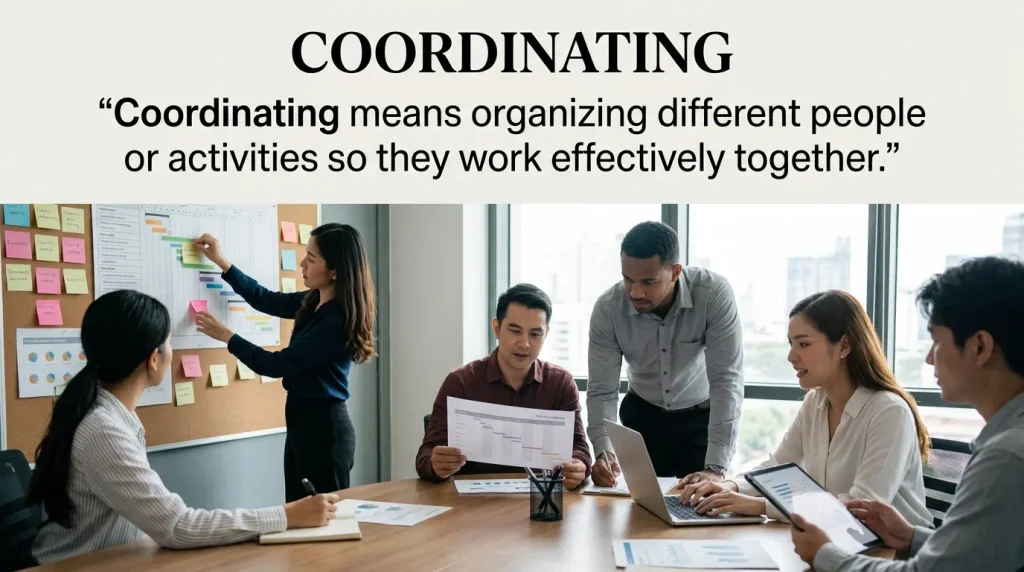
Coordinating (Verb) — US /koʊˈɔːrdəneɪtɪŋ/ | UK /kəʊˈɔːdɪneɪtɪŋ/
Meaning: Coordinating means organizing different people or activities so they work effectively together.
Examples:
- She is coordinating the volunteers for the event.
- Tom spent the morning coordinating the project teams.
Organizing (Verb) — US /ˈɔːrɡənaɪzɪŋ/ | UK /ˈɔːɡənaɪzɪŋ/
Meaning: Organizing means arranging people, tasks, or resources in a planned way.
Examples:
- Mia is organizing the school festival.
- He is organizing the files before the meeting.
Arranging (Verb) — US /əˈreɪndʒɪŋ/ | UK /əˈreɪndʒɪŋ/
Meaning: Arranging means putting different things or activities into a suitable order or plan.
Examples:
- We are arranging the final meeting for Friday.
- She spent hours arranging the event details.
Managing (Verb) — US /ˈmænɪdʒɪŋ/ | UK /ˈmænɪdʒɪŋ/
Meaning: Managing means controlling or handling people, tasks, or resources to achieve a goal.
Examples:
- He is managing the entire construction project.
- Sara is managing several teams this month.
Directing (Verb) — US /dəˈrɛktɪŋ/ | UK /daɪˈrɛktɪŋ/
Meaning: Directing means guiding people or activities toward a particular result.
Examples:
- The producer is directing the production team.
- She was directing everyone during the emergency.
Planning (Verb) — US /ˈplænɪŋ/ | UK /ˈplænɪŋ/
Meaning: Planning means deciding what should happen and how it should happen.
Examples:
- They are planning the annual conference.
- Jake is planning every stage of the campaign.
Engineering (Verb) — US /ˌɛndʒəˈnɪrɪŋ/ | UK /ˌendʒɪˈnɪərɪŋ/
Meaning: Engineering means deliberately designing or arranging a situation to produce a particular outcome.
Examples:
- The team engineered a peaceful agreement.
- She carefully engineered the meeting to encourage discussion.
Masterminding (Verb) — US /ˈmæstərmaɪndɪŋ/ | UK /ˈmɑːstəmaɪndɪŋ/
Meaning: Masterminding means planning and directing a complicated activity, often from a leading position.
Examples:
- He was masterminding the entire campaign.
- She masterminded the surprise celebration.
Choreographing (Verb) — US /ˈkɔːriəɡræfɪŋ/ | UK /ˈkɒriəɡrɑːfɪŋ/
Meaning: Choreographing means carefully arranging a series of actions so they happen in a planned sequence.
Examples:
- The director was choreographing the opening scene.
- They choreographed every movement for the performance.
Conducting (Verb) — US /kənˈdʌktɪŋ/ | UK /kənˈdʌktɪŋ/
Meaning: Conducting means leading or directing an activity, process, or group.
Examples:
- The researcher is conducting the study.
- She was conducting the meeting with confidence.
Synchronizing (Verb) — US /ˈsɪŋkrənaɪzɪŋ/ | UK /ˈsɪŋkrənaɪzɪŋ/
Meaning: Synchronizing means making separate actions happen together or at the right time.
Examples:
- The teams are synchronizing their schedules.
- We need to synchronize the final presentations.
Marshalling (Verb) — US /ˈmɑːrʃəlɪŋ/ | UK /ˈmɑːʃəlɪŋ/
Meaning: Marshalling means gathering and organizing people or resources for a particular purpose.
Examples:
- She is marshalling support for the project.
- The leader began marshalling the available resources.
Mobilizing (Verb) — US /ˈmoʊbəlaɪzɪŋ/ | UK /ˈməʊbəlaɪzɪŋ/
Meaning: Mobilizing means bringing people or resources together so they can act.
Examples:
- The charity is mobilizing volunteers for the campaign.
- They are mobilizing support for the new program.
Supervising (Verb) — US /ˈsuːpərvaɪzɪŋ/ | UK /ˈsuːpəvaɪzɪŋ/
Meaning: Supervising means watching and guiding work to make sure it is done properly.
Examples:
- She is supervising the renovation team.
- Mark was supervising the final preparations.
Overseeing (Verb) — US /ˌoʊvərˈsiːɪŋ/ | UK /ˌəʊvəˈsiːɪŋ/
Meaning: Overseeing means watching and guiding a process without necessarily handling every detail.
Examples:
- He is overseeing the development of the project.
- She oversees several departments at work.
Administering (Verb) — US /ədˈmɪnɪstərɪŋ/ | UK /ədˈmɪnɪstərɪŋ/
Meaning: Administering means managing the practical operation of a system, program, or organization.
Examples:
- The office is administering the new program.
- She is administering the scholarship process.
Implementing (Verb) — US /ˈɪmpləmentɪŋ/ | UK /ˈɪmplɪmentɪŋ/
Meaning: Implementing means putting a plan, decision, or system into action.
Examples:
- The company is implementing the new policy.
- They are implementing the plan this week.
Executing (Verb) — US /ˈɛksəˌkjuːtɪŋ/ | UK /ˈeksɪˌkjuːtɪŋ/
Meaning: Executing means carrying out a planned action or strategy.
Examples:
- The team is executing the launch plan.
- She executed the strategy exactly as planned.
Guiding (Verb) — US /ˈɡaɪdɪŋ/ | UK /ˈɡaɪdɪŋ/
Meaning: Guiding means helping direct people or activities toward a desired result.
Examples:
- She is guiding the team through the process.
- The teacher is guiding students through the activity.
Leading (Verb) — US /ˈliːdɪŋ/ | UK /ˈliːdɪŋ/
Meaning: Leading means directing or influencing people as they work toward a shared goal.
Examples:
- He is leading the project this year.
- Sara is leading a team of designers.
Steering (Verb) — US /ˈstɪrɪŋ/ | UK /ˈstɪərɪŋ/
Meaning: Steering means guiding a situation, group, or process toward a particular direction.
Examples:
- She is steering the discussion toward practical solutions.
- The manager is steering the project through a difficult stage.
Orchestrating → Arranging (Verb) — US /əˈreɪndʒɪŋ/ | UK /əˈreɪndʒɪŋ/
Meaning: Arranging focuses on putting people, events, or elements into an effective order.
Examples:
- He is arranging the speakers for the conference.
- She arranged the schedule around everyone’s needs.
Facilitating (Verb) — US /fəˈsɪləteɪtɪŋ/ | UK /fəˈsɪlɪteɪtɪŋ/
Meaning: Facilitating means making an activity or process easier to carry out.
Examples:
- She is facilitating the group discussion.
- The manager helped facilitate communication between teams.
Controlling (Verb) — US /kənˈtroʊlɪŋ/ | UK /kənˈtrəʊlɪŋ/
Meaning: Controlling means directing or limiting how something develops or operates.
Examples:
- He was controlling every part of the operation.
- The director kept controlling the pace of the project.
Manipulating (Verb) — US /məˈnɪpjəleɪtɪŋ/ | UK /məˈnɪpjəleɪtɪŋ/
Meaning: Manipulating means influencing people or circumstances, often in a skillful but unfair or secretive way.
Examples:
- He was manipulating the situation for personal gain.
- The story suggests that someone was manipulating events.
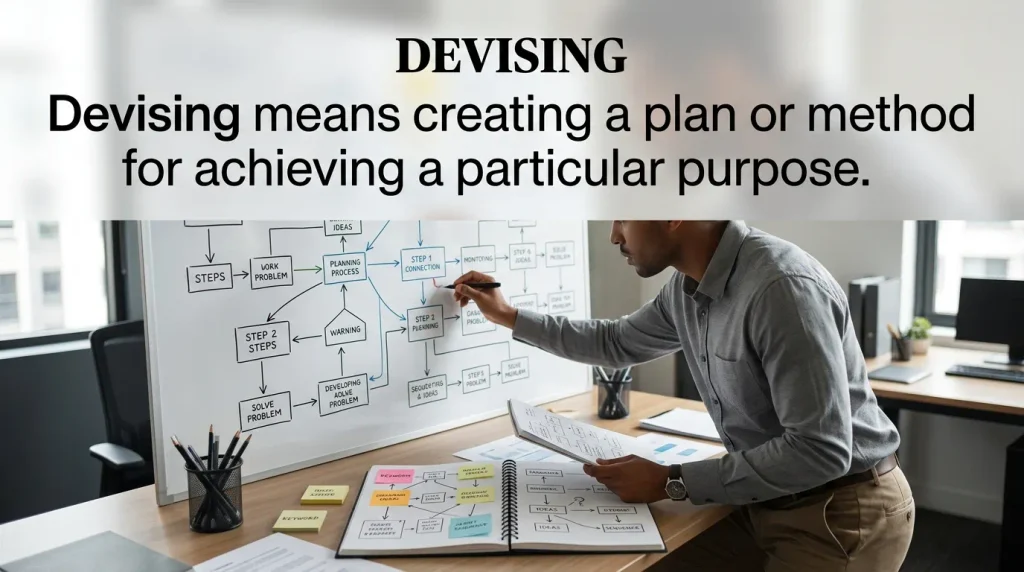
Devising (Verb) — US /dɪˈvaɪzɪŋ/ | UK /dɪˈvaɪzɪŋ/
Meaning: Devising means creating a plan or method for achieving a particular purpose.
Examples:
- The team is devising a new strategy.
- She spent the weekend devising a solution.
Crafting (Verb) — US /ˈkræftɪŋ/ | UK /ˈkrɑːftɪŋ/
Meaning: Crafting means carefully creating or developing something with attention to detail.
Examples:
- The writer is crafting a powerful story.
- They are crafting a detailed communication plan.
Plotting (Verb) — US /ˈplɑːtɪŋ/ | UK /ˈplɒtɪŋ/
Meaning: Plotting means secretly planning a particular action or event, often something questionable.
Examples:
- The characters were plotting their escape.
- The group was plotting against its rival.
Organizing (Verb) — US /ˈɔːrɡənaɪzɪŋ/ | UK /ˈɔːɡənaɪzɪŋ/
Meaning: Organizing means putting people, tasks, or resources into a planned and effective structure.
Examples:
- She is organizing the volunteers for the festival.
- He spent the afternoon organizing the project files.
Arranging (Verb) — US /əˈreɪndʒɪŋ/ | UK /əˈreɪndʒɪŋ/
Meaning: Arranging means putting different elements into a suitable order or plan.
Examples:
- They are arranging the speakers for the event.
- She arranged the meeting around everyone’s schedule.
Planning (Verb) — US /ˈplænɪŋ/ | UK /ˈplænɪŋ/
Meaning: Planning means deciding in advance what actions should happen and how they should be carried out.
Examples:
- We are planning the conference for next month.
- She spent weeks planning the campaign.
Coordinating (Verb) — US /koʊˈɔːrdəneɪtɪŋ/ | UK /kəʊˈɔːdɪneɪtɪŋ/
Meaning: Coordinating means making different people, activities, or resources work together effectively.
Examples:
- Jake is coordinating the different departments.
- She coordinated the volunteers during the event.
Scheduling (Verb) — US /ˈskedʒuːlɪŋ/ | UK /ˈʃedjuːlɪŋ/
Meaning: Scheduling means deciding when different activities or events will happen.
Examples:
- She is scheduling interviews for next week.
- The assistant scheduled all the meetings.
Delegating (Verb) — US /ˈdeləɡeɪtɪŋ/ | UK /ˈdelɪɡeɪtɪŋ/
Meaning: Delegating means assigning specific tasks or responsibilities to other people.
Examples:
- The manager is delegating tasks to her team.
- He improved the project by delegating routine work.
Supervising (Verb) — US /ˈsuːpərvaɪzɪŋ/ | UK /ˈsuːpəvaɪzɪŋ/
Meaning: Supervising means watching and guiding people as they complete their work.
Examples:
- Maria is supervising the construction crew.
- He spent the morning supervising the new employees.
Administering (Verb) — US /ədˈmɪnɪstərɪŋ/ | UK /ədˈmɪnɪstərɪŋ/
Meaning: Administering means managing the practical operation of a system, program, or organization.
Examples:
- She is administering the scholarship program.
- The office is administering the new policy.
Arranging (Verb) — US /əˈreɪndʒɪŋ/ | UK /əˈreɪndʒɪŋ/
Meaning: Arranging means preparing or organizing several parts so they fit together properly.
Examples:
- He is arranging the final details of the ceremony.
- We arranged everything before the guests arrived.
Allocating (Verb) — US /ˈæləkeɪtɪŋ/ | UK /ˈæləkeɪtɪŋ/
Meaning: Allocating means distributing money, time, people, or resources for specific purposes.
Examples:
- The director is allocating resources across departments.
- They are allocating extra staff to the project.
Deploying (Verb) — US /dɪˈplɔɪɪŋ/ | UK /dɪˈplɔɪɪŋ/
Meaning: Deploying means positioning or assigning people or resources for a particular purpose.
Examples:
- The company is deploying extra staff during the launch.
- The manager deployed the team across several locations.
Orchestrating → Integrating (Verb) — US /ˈɪntəɡreɪtɪŋ/ | UK /ˈɪntɪɡreɪtɪŋ/
Meaning: Integrating means combining separate parts so they function together as one system.
Examples:
- The team is integrating several departments into one unit.
- She integrated the new system into the existing process.
Consolidating (Verb) — US /kənˈsɑːlədeɪtɪŋ/ | UK /kənˈsɒlɪdeɪtɪŋ/
Meaning: Consolidating means bringing separate parts together into a stronger or more organized whole.
Examples:
- The company is consolidating its regional offices.
- She consolidated the project teams under one manager.
Aligning (Verb) — US /əˈlaɪnɪŋ/ | UK /əˈlaɪnɪŋ/
Meaning: Aligning means bringing people, plans, or goals into agreement or coordination.
Examples:
- The manager is aligning the teams around one goal.
- We need to align our plans before the launch.
Harmonizing (Verb) — US /ˈhɑːrmənaɪzɪŋ/ | UK /ˈhɑːmənaɪzɪŋ/
Meaning: Harmonizing means making different elements work together smoothly and consistently.
Examples:
- The committee is harmonizing the new regulations.
- The departments are harmonizing their procedures.
Unifying (Verb) — US /ˈjuːnəfaɪɪŋ/ | UK /ˈjuːnɪfaɪɪŋ/
Meaning: Unifying means bringing separate people or elements together around a common purpose.
Examples:
- The leader is unifying the different teams.
- The campaign helped unify the community.
Orchestrating → Synchronizing (Verb) — US /ˈsɪŋkrənaɪzɪŋ/ | UK /ˈsɪŋkrənaɪzɪŋ/
Meaning: Synchronizing means making separate activities happen together at the appropriate time.
Examples:
- The technicians are synchronizing the systems.
- We synchronized the presentations with the music.
Sequencing (Verb) — US /ˈsiːkwənsɪŋ/ | UK /ˈsiːkwənsɪŋ/
Meaning: Sequencing means putting actions or events into a deliberate order.
Examples:
- The editor is sequencing the scenes carefully.
- She sequenced the lessons from simple to advanced.
Structuring (Verb) — US /ˈstrʌktʃərɪŋ/ | UK /ˈstrʌktʃərɪŋ/
Meaning: Structuring means arranging parts into a clear and effective organization.
Examples:
- He is structuring the project around three main goals.
- The writer structured the presentation logically.
Orchestrating → Formulating (Verb) — US /ˈfɔːrmjəleɪtɪŋ/ | UK /ˈfɔːmjʊleɪtɪŋ/
Meaning: Formulating means developing a plan, strategy, or idea carefully.
Examples:
- The committee is formulating a new strategy.
- They formulated a response to the problem.
Conceiving (Verb) — US /kənˈsiːvɪŋ/ | UK /kənˈsiːvɪŋ/
Meaning: Conceiving means developing an idea or plan in the mind.
Examples:
- She conceived the idea for the campaign.
- The team conceived a new approach to the problem.
Initiating (Verb) — US /ɪˈnɪʃieɪtɪŋ/ | UK /ɪˈnɪʃieɪtɪŋ/
Meaning: Initiating means starting a planned action, process, or activity.
Examples:
- The director initiated the new program.
- They initiated discussions with the community.
Arranging → Setting Up (Phrasal Verb) — US /ˈsetɪŋ ʌp/ | UK /ˈsetɪŋ ʌp/
Meaning: Setting up means preparing the people, equipment, or conditions needed for something to happen.
Examples:
- She is setting up the conference room.
- They set up the event several hours early.
Organizing → Putting Together (Phrasal Verb) — US /ˈpʊtɪŋ təˈɡeðər/ | UK /ˈpʊtɪŋ təˈɡeðə/
Meaning: Putting together means combining different parts to create a complete plan, event, or project.
Examples:
- He is putting together a team for the project.
- She put together a great community event.
Bringing Together (Phrasal Verb) — US /ˈbrɪŋɪŋ təˈɡeðər/ | UK /ˈbrɪŋɪŋ təˈɡeðə/
Meaning: Bringing together means gathering separate people or elements so they can work toward a shared purpose.
Examples:
- The program is bringing together local artists.
- She brought together experts from several fields.
Rallying (Verb) — US /ˈræliɪŋ/ | UK /ˈræliɪŋ/
Meaning: Rallying means bringing people together and encouraging them to support or act for a common purpose.
Examples:
- The leader is rallying supporters around the cause.
- She rallied the team before the final match.
Galvanizing (Verb) — US /ˈɡælvənaɪzɪŋ/ | UK /ˈɡælvənaɪzɪŋ/
Meaning: Galvanizing means motivating people to take action quickly and with energy.
Examples:
- The announcement galvanized the community.
- Her speech galvanized the volunteers.
Orchestrating → Mustering (Verb) — US /ˈmʌstərɪŋ/ | UK /ˈmʌstərɪŋ/
Meaning: Mustering means gathering people, support, energy, or resources for a particular purpose.
Examples:
- He was mustering support for the proposal.
- She mustered enough volunteers for the event.
Recruiting (Verb) — US /rɪˈkruːtɪŋ/ | UK /rɪˈkruːtɪŋ/
Meaning: Recruiting means finding and bringing suitable people into a group, team, or activity.
Examples:
- The organizer is recruiting volunteers.
- They are recruiting experts for the project.
Assembling (Verb) — US /əˈsemblɪŋ/ | UK /əˈsemblɪŋ/
Meaning: Assembling means bringing people or separate parts together for a particular purpose.
Examples:
- She is assembling a team of specialists.
- The director assembled the crew before filming began.
Convening (Verb) — US /kənˈviːnɪŋ/ | UK /kənˈviːnɪŋ/
Meaning: Convening means bringing people together for a meeting or organized discussion.
Examples:
- The chair is convening a meeting this afternoon.
- They convened experts to discuss the issue.
Orchestrating → Orchestrating (Verb) — US /ˈɔːrkəstreɪtɪŋ/ | UK /ˈɔːkɪstreɪtɪŋ/
Meaning: Orchestrating means carefully coordinating several people, actions, or elements to achieve a planned result.
Examples:
- She was orchestrating the entire production.
- He spent months orchestrating the community project.

Synonyms by Tone
The best synonym for orchestrating depends heavily on the tone you want.
Positive
Words such as coordinating, organizing, guiding, leading, facilitating, crafting, and choreographing can sound positive.
They often suggest skill, cooperation, preparation, or successful leadership.
Neutral
Arranging, managing, overseeing, conducting, planning, synchronizing, administering, and implementing can work in neutral contexts.
These words focus more on the activity than on the speaker’s attitude.
Negative
Manipulating, controlling, plotting, and sometimes engineering can carry negative implications.
The surrounding context determines whether the action sounds deliberate and skillful or secretive and questionable.
Playful or Informal
Masterminding can sound dramatic or playful in casual writing.
For example:
Liam masterminded our surprise birthday plan.
The word can make an ordinary act of planning sound more exciting.
Why Tone Matters
Choosing a synonym is not only about matching the dictionary meaning.
For example, coordinating usually sounds professional and neutral, while manipulating can suggest unfair influence.
A good writer chooses the word that matches both the action and the attitude.
“Orchestrating” vs Close Alternatives
| Word | Meaning Difference | Tone | Best Use |
|---|---|---|---|
| Orchestrating | Carefully coordinating several elements | Neutral to positive or negative | Complex plans and activities |
| Coordinating | Making different parts work together | Neutral | Teams, schedules, projects |
| Managing | Handling people, tasks, or resources | Neutral/professional | Work and administration |
| Masterminding | Planning and directing something complex | Informal/dramatic | Major plans or clever schemes |
Orchestrating vs Coordinating
The term Orchestrating often suggests a higher level of careful planning.
Coordinating is broader and more common in everyday professional English.
She coordinated the teams.
This simply says she helped the teams work together.
She orchestrated the entire campaign.
This suggests that she carefully planned and directed many connected elements.
Orchestrating vs Managing
Managing focuses on handling people, resources, responsibilities, or operations.
Orchestrating emphasizes bringing multiple parts together into a planned result.
A manager may manage a department while orchestrating a major project involving several departments.
Orchestrating vs Masterminding
Masterminding often suggests that one person created or directed the main plan.
It can sound dramatic and sometimes suspicious.
Orchestrating is more flexible and works well in professional, academic, and general writing.
How “Orchestrating” Changes by Context
Daily Conversation
In everyday speech, orchestrating can describe someone who carefully organizes a complicated situation.
Mom was orchestrating everyone’s travel plans.
However, simpler words such as organizing or arranging may sound more natural in casual conversation.
Writing or Blogging
Bloggers can use orchestrating when describing complex campaigns, events, stories, or processes.
The editor was orchestrating a major content campaign.
It gives the sentence a sense of deliberate coordination.
Professional or Academic Tone
In professional writing, orchestrating can describe leadership across multiple departments or processes.
The research team was orchestrating a series of collaborative experiments.
For very formal writing, coordinating, managing, or implementing may sometimes be more precise.
Creative or Informal Use
Creative writers can use orchestrating to make an event feel carefully designed.
Behind the scenes, she was orchestrating every dramatic moment.
Masterminding, choreographing, and plotting can create stronger stylistic effects.
Common Mistakes Learners Make
Using “Orchestrating” for Simple Actions
Orchestrating usually works best when several parts are involved.
She orchestrated making tea.
This sounds unnecessarily dramatic.
She made tea.
Use orchestrating when the situation involves coordination or deliberate planning.
Assuming It Is Always Positive
The word does not automatically mean something good.
The team orchestrated a successful event.
This is positive.
They orchestrated a secret campaign.
This may sound suspicious depending on the context.
Confusing It With “Organizing”
The two words overlap, but orchestrating can imply more careful coordination among several moving parts.
Organizing is broader and more ordinary.
Overusing Dramatic Synonyms
Words such as masterminding, plotting, and manipulating should not replace orchestrating automatically.
They carry additional meanings.
Choose them only when those extra meanings are intended.
Register Notes
Orchestrating works in both spoken and written English.
It appears frequently in professional writing, journalism, business communication, academic discussions, and creative writing.
Coordinating and organizing are usually more common in everyday professional speech.
Masterminding and plotting are more informal or context-specific.
Administering tends to sound formal and is especially useful for systems, programs, and official processes.
For more vocabulary guidance, you can also explore related synonym-focused articles on your site when comparing similar English expressions.
Real-Life Mini Scenarios
Workplace
A project manager has designers, writers, developers, and researchers working on one launch.
She coordinates their schedules and deadlines.
You could say:
She was orchestrating the entire project.
Social Situation
A friend secretly plans a birthday celebration.
They contact guests, choose the location, order food, and arrange decorations.
You could say:
Alex was orchestrating the surprise party.
Media and Pop Culture
A film director coordinates actors, camera crews, music, lighting, and editing.
The production has many connected elements.
You could describe this as:
The director was orchestrating the production.
Writing and Storytelling
An author carefully controls several plot events, so they eventually connect.
The word orchestrating can describe this deliberate storytelling process.
The novelist was orchestrating several plotlines at once.
How to Choose the Right Synonym
When you need a synonym for orchestrating, first identify what kind of coordination you mean.
When different people need to work together, coordinating is a natural choice.
For general preparation or setup, organizing or arranging may fit better.
When the meaning centers on leadership and responsibility, consider managing, leading, or overseeing.
To describe guiding a situation toward a specific result, use steering or directing.
For an action involving deliberate strategy and careful design, engineering, devising, or crafting can work well.
A secretive or questionable form of influence may call for manipulating or plotting.
In situations involving a carefully planned sequence of movements or events, choreographing can be an effective choice.
This approach helps you avoid choosing a synonym simply because it looks similar in a dictionary.
Practice Exercise:
1.
The event manager was ________ dozens of volunteers during the festival.
A. plotting
B. coordinating
C. manipulating
D. devising
2.
The director carefully ________ every movement in the dance scene.
A. choreographed
B. administered
C. supervised
D. managed
3.
The company is ________ a new customer-support strategy.
A. plotting
B. devising
C. controlling
D. conducting
4.
She was secretly ________ against her business rival.
A. facilitating
B. organizing
C. plotting
D. guiding
5.
The department head is ________ several large projects at once.
A. managing
B. plotting
C. crafting
D. arranging
6.
The teacher helped ________ a productive classroom discussion.
A. manipulate
B. facilitate
C. mastermind
D. engineer
7.
The researcher is ________ a study on language learning.
A. conducting
B. plotting
C. steering
D. marshalling
8.
The manager is ________ the discussion toward a practical solution.
A. arranging
B. steering
C. plotting
D. administering
9.
The charity is ________ volunteers for the emergency response.
A. mobilizing
B. crafting
C. supervising
D. arranging
10.
The supervisor is ________ the renovation without handling every small task.
A. manipulating
B. plotting
C. devising
D. overseeing
11.
The producer was ________ all the technical elements of the show.
A. orchestrating
B. confessing
C. simplifying
D. ignoring
12.
The politician was accused of ________ public opinion through misleading tactics.
A. facilitating
B. organizing
C. manipulating
D. supervising
13.
The team spent weeks ________ a detailed campaign.
A. crafting
B. controlling
C. plotting
D. administering
14.
The staff members are ________ their schedules so everyone arrives at the same time.
A. synchronizing
B. masterminding
C. directing
D. devising
15.
The leader gathered available resources and began ________ them for the project.
A. marshalling
B. plotting
C. manipulating
D. choreographing
Reflection Task
Write one sentence using orchestrating, coordinating, managing, or another synonym from this article. Make the sentence about a real-life situation.
Answer Key
1. B | 2. A | 3. B | 4. C | 5. A | 6. B | 7. A | 8. B | 9. A | 10. D | 11. A | 12. C | 13. A | 14. A | 15. A
FAQs
1. What is the best synonym for orchestrating?
Coordinating is one of the closest general synonyms for orchestrating. It describes making different people, actions, or elements work together toward a shared goal.
2. Is orchestrating a positive word?
It can be positive, neutral, or negative. The tone depends on the situation. Orchestrating a successful event sounds positive, while orchestrating a secret scheme may sound negative.
3. What is a simple synonym for orchestrating?
Organizing is a simple and common alternative. However, orchestrating often suggests more careful coordination among several connected elements.
4. Is orchestrating formal English?
Yes. Orchestrating is suitable for professional, academic, journalistic, and creative writing. It can also appear in everyday conversation when the situation involves complex coordination.
5. What is the difference between orchestrating and coordinating?
Coordinating focuses on making different parts work together. Orchestrating often adds the idea of carefully planning and directing those parts toward a particular outcome.
6. Can orchestrating have a negative meaning?
Yes. The word can imply deliberate or secret control when used in a negative context.
7. Is masterminding the same as orchestrating?
They overlap, but masterminding usually emphasizes the person who creates or directs a complex plan. It can also sound more dramatic or suspicious.
8. Can I use orchestrating in academic writing?
Yes. It can work well when describing the coordination of research activities, teams, processes, or complex projects. Use a more specific alternative when that gives greater precision.
Conclusion
Learning a synonym for orchestrating helps you describe planning, coordination, leadership, and deliberate action with greater precision in everyday English and formal writing.
Words such as coordinating, organizing, managing, directing, and overseeing can make your emails, essays, and articles more natural and exact.
The right synonym for orchestrating also lets you express tone. Some alternatives sound professional, while others suggest creativity, control, secrecy, or strong leadership.
Keep practicing these words in short sentences. Try using them in emails, essays, blog posts, and daily conversations to build stronger vocabulary.

Shahzeena Shazadi is the founder and lead writer at VocablyHub.com, where she creates accurate, reader-focused English language content designed to help people communicate with clarity and confidence. She specializes in synonyms, antonyms, word meanings, idioms, and practical vocabulary guides that simplify complex language concepts for everyday use. Every article is carefully researched, fact-checked, and written in clear, accessible language using reliable references and real-world examples. Her goal is to provide helpful, trustworthy content that supports learners at every stage of their English language journey.
Her editorial approach focuses on accuracy, transparency, and user value while following modern content quality standards. She regularly reviews and updates content to keep information relevant, useful, and easy to understand. Through VocablyHub.com, Shahzeena Shazadi is committed to publishing reliable language resources that help students, writers, educators, professionals, and English learners expand their vocabulary, improve their writing skills, and communicate with confidence in academic, professional, and everyday situations.