
Synonyms for sand include words such as grit, grains, granules, sediment, particles, dust, and fine aggregate, depending on the context. There is no single perfect replacement for “sand” in every sentence because each alternative can describe a different texture, origin, size, or use.
Imagine walking along a beach and feeling tiny grains beneath your feet. You might simply call them sand, but a scientist may call them sediment, while a builder may call a particular material fine aggregate.
The word is common because sand appears on beaches, in deserts, in construction, art, and everyday descriptions. Learning synonyms for sand helps you describe texture, material, and setting more precisely.
For students, bloggers, and content writers, varied vocabulary makes descriptions stronger. Daily English users can also choose words that sound more natural for the situation.
This guide explores synonyms for sand from several angles. Some are close alternatives, while others work only in scientific, construction, literary, or descriptive contexts.
What Does “Sand” Really Mean?
Sand is a mass of very small mineral or rock grains, commonly found on beaches, in deserts, riverbeds, and other natural environments. Cambridge defines it as a substance made of very small grains of rock and notes its common use for beaches and deserts.
As a noun, sand is usually uncountable.
- We walked across the sand.
- The children played in the sand.
- Sand covered the floor.
The plural sands can describe broad sandy areas, especially near the sea, as in “the golden sands.”
Sand can also be a verb. To sand something means to make its surface smoother by rubbing it with sandpaper or a similar abrasive material.
Native speakers usually understand “sand” as a physical material rather than as a synonym for every small particle. That distinction matters.
Common contexts for “sand”
You will often see the word in:
- Beach descriptions
- Desert landscapes
- Construction
- Gardening
- Geology
- Children’s activities
- Art and crafts
- Manufacturing
- Surface finishing
- Literary descriptions
Connotative Meaning
Connotation (the emotional feeling or association that a word can carry beyond its basic dictionary meaning) varies with context.
Positive tone
Sand can suggest:
- Holidays
- Beaches
- Relaxation
- Summer
- Warmth
- Freedom
- Nature
Example:
We spent a peaceful afternoon walking barefoot on the warm sand.
Negative tone
Sand can suggest:
- Mess
- Irritation
- Instability
- Dryness
- Difficulty
Example:
Sand got into my shoes during the hike.
Neutral tone
In science, construction, and geography, sand is usually neutral and factual.
Example:
The sample contains a high proportion of sand.
Etymology of “Sand”
The noun sand has very old Germanic roots. Etymonline traces it to Old English sand, from Proto-Germanic sandam. Related forms appear in languages including Old Norse, Old Frisian, Middle Dutch, Dutch, and German.
Old English: 450–1100
Old English already had sand, referring to sandy material. The basic physical meaning was firmly established in early English.
The word also developed figurative associations. Historical sources note that sand could symbolize things that are numerous or unstable.
Middle English: 1100–1500
The word continued in Middle English with essentially the same core meaning. English also developed compounds and expressions connected with sandy places.
The plural sands later became useful for describing stretches of sandy ground near the sea.
Modern English: 1500–Present
Modern English uses sand for natural granular material, especially in beaches, deserts, construction, and industrial contexts.
The verb developed as well. Historical records show sand meaning to sprinkle or fill with sand and later to use sand for grinding or polishing surfaces.
Pronunciation
US: /sænd/
UK: /sænd/
Syllables
sand
It is a one-syllable word.
Affixation Pattern of “Sand”
Root: sand
Prefix: none
Suffix: none
The basic noun is a simple root word. Related words can take suffixes or combine with other words.
Examples:
- sandy
- sandiness
- sandcastle
- sandbank
- sandstorm
- sandstone
List of Synonyms
Important usage note: “Sand” has relatively few perfect one-word synonyms because it names a specific type of granular material. The 50 alternatives below include direct substitutes, close semantic alternatives, scientific terms, descriptive expressions, and context-specific terms. Use the meaning and register notes to choose accurately.
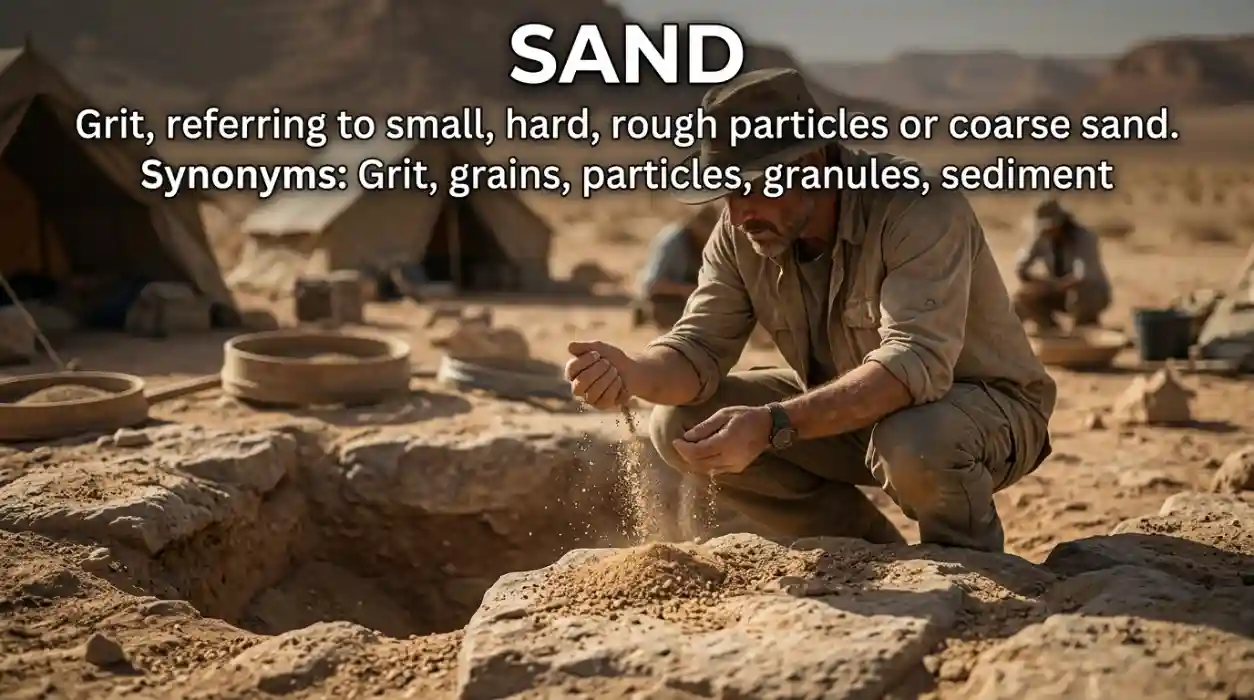
1. Grit (Noun) — US /ɡrɪt/ — UK /ɡrɪt/
Meaning: Grit refers to small, hard, rough particles and can sometimes describe coarse sand.
Tone/Register: Neutral, everyday.
Examples:
Fine grit covered the bottom of the container.
The road was covered with grit after the storm.
2. Grains (Noun) — US /ɡreɪnz/ — UK /ɡreɪnz/
Meaning: Grains are individual small particles, making this useful when focusing on the tiny pieces that make up sand.
Tone/Register: Neutral, descriptive.
Examples:
Tiny grains of sand stuck to her feet.
The grains felt warm after sitting in the sun.
3. Granules (Noun) — US /ˈɡræn.jəlz/ — UK /ˈɡræn.juːlz/
Meaning: Granules are small solid particles that may resemble or include sand-sized material.
Tone/Register: Scientific, technical.
Examples:
The mixture contains fine mineral granules.
The granules were separated by size.
4. Particles (Noun) — US /ˈpɑːr.tɪ.kəlz/ — UK /ˈpɑː.tɪ.kəlz/
Meaning: Particles are individual pieces of matter and can describe sand grains scientifically.
Tone/Register: Academic, scientific.
Examples:
Wind carried tiny particles across the field.
The filter removed larger particles from the sample.
5. Sediment (Noun) — US /ˈsed.ə.mənt/ — UK /ˈsed.ɪ.mənt/
Meaning: Sediment is material deposited by water, wind, ice, or other natural processes and can include sand.
Tone/Register: Scientific, academic.
Examples:
The river carried sediment toward the coast.
Scientists examined the sediment for mineral changes.
6. Fine Aggregate (Noun) — US /faɪn ˈæɡ.rə.ɡət/ — UK /faɪn ˈæɡ.rɪ.ɡət/
Meaning: Fine aggregate is a construction term for small granular material, often including natural or manufactured sand.
Tone/Register: Technical, construction.
Examples:
The concrete mixture requires fine aggregate.
The engineer checked the aggregate before mixing the concrete.
7. Mineral Grains (Noun Phrase) — US /ˈmɪn.ər.əl ɡreɪnz/ — UK /ˈmɪn.ər.əl ɡreɪnz/
Meaning: Mineral grains emphasize the geological composition of sand.
Tone/Register: Academic, geological.
Examples:
The beach contains rounded mineral grains.
The mineral grains were examined under a microscope.
8. Rock Grains (Noun Phrase) — US /rɑːk ɡreɪnz/ — UK /rɒk ɡreɪnz/
Meaning: Rock grains are tiny pieces of rock that can form sandy material.
Tone/Register: Scientific.
Examples:
Water slowly moved the rock grains downstream.
The rock grains had different colors.
9. Silica (Noun) — US /ˈsɪl.ɪ.kə/ — UK /ˈsɪl.ɪ.kə/
Meaning: Silica is a mineral compound commonly present in many sands, but it is not a universal synonym for sand.
Tone/Register: Scientific.
Examples:
The sample contains a large amount of silica.
Silica is important in many geological materials.
10. Quartz Grains (Noun Phrase) — US /kwɔːrts ɡreɪnz/ — UK /kwɔːts ɡreɪnz/
Meaning: Quartz grains describe sand particles made largely of quartz.
Tone/Register: Geological, academic.
Examples:
The beach is rich in quartz grains.
The quartz grains reflected the sunlight.
11. Mineral Particles (Noun Phrase) — US /ˈmɪn.ər.əl ˈpɑːr.tɪ.kəlz/ — UK /ˈmɪn.ər.əl ˈpɑː.tɪ.kəlz/
Meaning: Mineral particles is a broad scientific description that can include sand-sized material.
Tone/Register: Scientific.
Examples:
Wind transported mineral particles across the plain.
The mineral particles settled in the water.
12. Granular Material (Noun Phrase) — US /ˈɡræn.jə.lɚ məˈtɪr.i.əl/ — UK /ˈɡræn.jə.lə məˈtɪə.ri.əl/
Meaning: Granular material describes material made from many small separate particles.
Tone/Register: Technical.
Examples:
The machine is designed to handle granular material.
The granular material flowed through the opening.
13. Fine Grains (Noun Phrase) — US /faɪn ɡreɪnz/ — UK /faɪn ɡreɪnz/
Meaning: Fine grains highlights the small size of sand particles.
Tone/Register: Neutral, descriptive.
Examples:
Fine grains covered the surface.
The fine grains slipped between her fingers.
14. Fine Particles (Noun Phrase) — US /faɪn ˈpɑːr.tɪ.kəlz/ — UK /faɪn ˈpɑː.tɪ.kəlz/
Meaning: Fine particles are very small pieces of material and can describe sand in technical contexts.
Tone/Register: Academic, technical.
Examples:
Fine particles collected at the bottom of the jar.
The wind lifted the fine particles easily.
15. Coarse Grains (Noun Phrase) — US /kɔːrs ɡreɪnz/ — UK /kɔːs ɡreɪnz/
Meaning: Coarse grains describe relatively large or rough particles, including coarse sand.
Tone/Register: Technical, descriptive.
Examples:
Coarse grains made the beach uncomfortable to walk on.
The sample contained mostly coarse grains.
16. Fine Aggregate Material (Noun Phrase) — US /faɪn ˈæɡ.rə.ɡət məˈtɪr.i.əl/ — UK /faɪn ˈæɡ.rɪ.ɡət məˈtɪə.ri.əl/
Meaning: This construction phrase describes small granular material used in mixtures.
Tone/Register: Construction, technical.
Examples:
The contractor selected suitable fine aggregate material.
The material was tested before use.
17. Sandy Sediment (Noun Phrase) — US /ˈsæn.di ˈsed.ə.mənt/ — UK /ˈsæn.di ˈsed.ɪ.mənt/
Meaning: Sandy sediment is sediment containing a significant amount of sand-sized material.
Tone/Register: Scientific.
Examples:
The river deposited sandy sediment near the bank.
The researchers mapped the sandy sediment.
18. Beach Sediment (Noun Phrase) — US /biːtʃ ˈsed.ə.mənt/ — UK /biːtʃ ˈsed.ɪ.mənt/
Meaning: Beach sediment refers to loose material found along a beach, often dominated by sand.
Tone/Register: Scientific, geographical.
Examples:
Storm waves moved the beach sediment.
The beach sediment changed after heavy rain.
19. Desert Sediment (Noun Phrase) — US /ˈdez.ɚt ˈsed.ə.mənt/ — UK /ˈdez.ət ˈsed.ɪ.mənt/
Meaning: Desert sediment refers to loose mineral material found in desert environments.
Tone/Register: Geological.
Examples:
Wind carried desert sediment across the valley.
The desert sediment formed broad dunes.
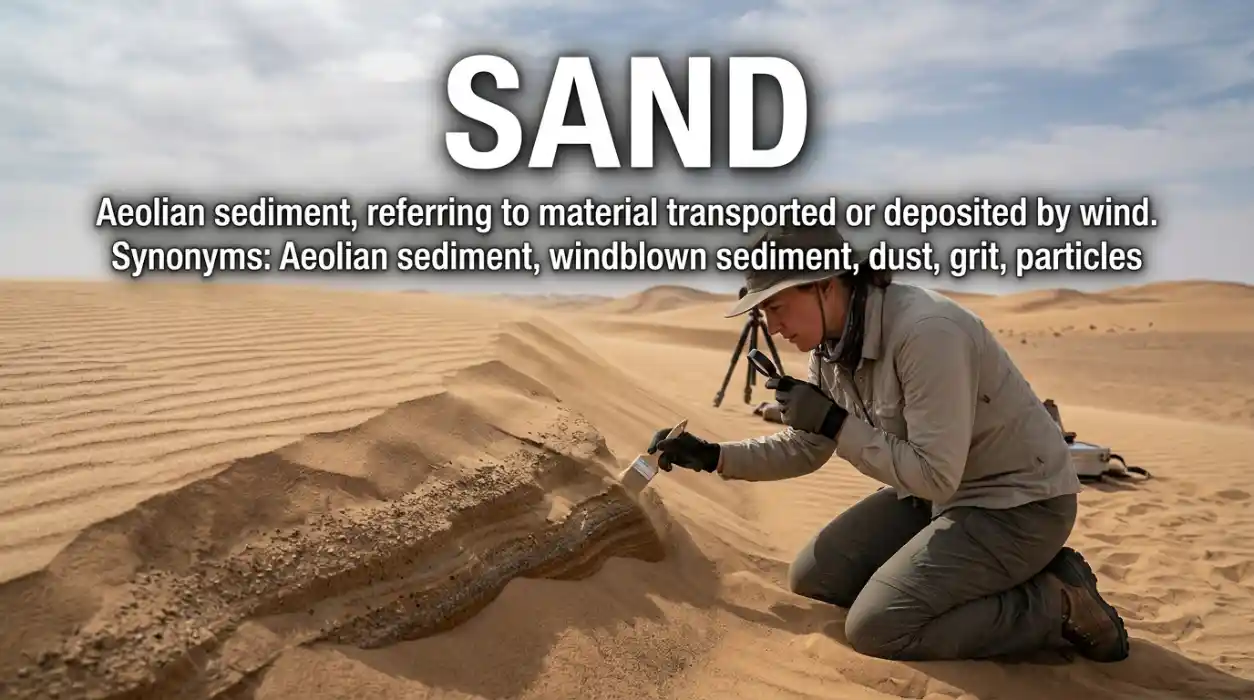
20. Aeolian Sediment (Noun Phrase) — US /iˈoʊ.li.ən ˈsed.ə.mənt/ — UK /iˈəʊ.li.ən ˈsed.ɪ.mənt/
Meaning: Aeolian sediment is material transported or deposited by wind.
Tone/Register: Highly technical, geological.
Examples:
The researchers studied aeolian sediment near the dune.
Aeolian sediment can travel long distances.
21. Loose Grains (Noun Phrase) — US /luːs ɡreɪnz/ — UK /luːs ɡreɪnz/
Meaning: Loose grains emphasize particles that are not tightly bound together.
Tone/Register: Neutral.
Examples:
Loose grains spilled from the bag.
The loose grains shifted beneath his shoes.
22. Loose Particles (Noun Phrase) — US /luːs ˈpɑːr.tɪ.kəlz/ — UK /luːs ˈpɑː.tɪ.kəlz/
Meaning: Loose particles are separate pieces of material that can move freely.
Tone/Register: Neutral, technical.
Examples:
Loose particles covered the path.
The wind pushed loose particles toward the road.
23. Granular Sediment (Noun Phrase) — US /ˈɡræn.jə.lɚ ˈsed.ə.mənt/ — UK /ˈɡræn.jə.lə ˈsed.ɪ.mənt/
Meaning: Granular sediment describes sediment made up of separate grains or particles.
Tone/Register: Academic.
Examples:
The study focused on granular sediment.
Water gradually sorted the granular sediment.
24. Abrasive (Noun) — US /əˈbreɪ.sɪv/ — UK /əˈbreɪ.sɪv/
Meaning: An abrasive is a substance used to wear, polish, or smooth a surface, and sand can serve this function.
Tone/Register: Technical.
Examples:
The worker chose a mild abrasive for the surface.
Sand can act as an abrasive during certain processes.
25. Scouring Material (Noun Phrase) — US /ˈskaʊr.ɪŋ məˈtɪr.i.əl/ — UK /ˈskaʊə.rɪŋ məˈtɪə.ri.əl/
Meaning: Scouring material is material used to scrub or wear away unwanted substances.
Tone/Register: Technical.
Examples:
The process uses a fine scouring material.
The scouring material removed the residue.
26. Polishing Medium (Noun Phrase) — US /ˈpɑː.lɪʃ.ɪŋ ˈmiː.di.əm/ — UK /ˈpɒl.ɪʃ.ɪŋ ˈmiː.di.əm/
Meaning: A polishing medium is a material used to smooth or polish a surface, sometimes including sand.
Tone/Register: Technical.
Examples:
The polishing medium must be evenly distributed.
The technician selected a suitable polishing medium.
27. Scrubbing Material (Noun Phrase) — US /ˈskrʌb.ɪŋ məˈtɪr.i.əl/ — UK /ˈskrʌb.ɪŋ məˈtɪə.ri.əl/
Meaning: Scrubbing material is a substance used to clean or abrade a surface.
Tone/Register: Practical, technical.
Examples:
The cleaner used a rough scrubbing material.
The scrubbing material removed the buildup.
28. Gritty Material (Noun Phrase) — US /ˈɡrɪt.i məˈtɪr.i.əl/ — UK /ˈɡrɪt.i məˈtɪə.ri.əl/
Meaning: Gritty material is material with a rough, grainy texture.
Tone/Register: Descriptive, informal.
Examples:
The water left a gritty material on the surface.
I noticed a gritty material inside the container.
29. Granular Substance (Noun Phrase) — US /ˈɡræn.jə.lɚ ˈsʌb.stəns/ — UK /ˈɡræn.jə.lə ˈsʌb.stəns/
Meaning: A granular substance consists of many small separate particles.
Tone/Register: Technical.
Examples:
Sand is a familiar granular substance.
The granular substance moved easily through the tube.
30. Grainy Material (Noun Phrase) — US /ˈɡreɪ.ni məˈtɪr.i.əl/ — UK /ˈɡreɪ.ni məˈtɪə.ri.əl/
Meaning: Grainy material has a noticeable texture made by small particles.
Tone/Register: Everyday, descriptive.
Examples:
The mixture felt grainy between my fingers.
The grainy material was difficult to spread.
31. Fine Mineral Material (Noun Phrase) — US /faɪn ˈmɪn.ər.əl məˈtɪr.i.əl/ — UK /faɪn ˈmɪn.ər.əl məˈtɪə.ri.əl/
Meaning: Fine mineral material describes small mineral particles, including some sandy materials.
Tone/Register: Academic.
Examples:
The cave floor contained fine mineral material.
Fine mineral material collected in the depression.
32. Beach Grains (Noun Phrase) — US /biːtʃ ɡreɪnz/ — UK /biːtʃ ɡreɪnz/
Meaning: Beach grains refers descriptively to individual grains found on a sandy beach.
Tone/Register: Descriptive.
Examples:
The beach grains sparkled in the sunlight.
Wet beach grains stuck to the child’s hands.
33. Shore Sediment (Noun Phrase) — US /ʃɔːr ˈsed.ə.mənt/ — UK /ʃɔː ˈsed.ɪ.mənt/
Meaning: Shore sediment is loose material deposited along a shoreline and may contain sand.
Tone/Register: Geographic, academic.
Examples:
Waves constantly rearrange the shore sediment.
The survey measured changes in shore sediment.
34. Dune Material (Noun Phrase) — US /duːn məˈtɪr.iəl/ — UK /djuːn məˈtɪə.ri.əl/
Meaning: Dune material describes loose material forming or covering dunes, commonly sand.
Tone/Register: Geographic.
Examples:
Wind pushed dune material toward the road.
The dune material was extremely dry.
35. Desert Grains (Noun Phrase) — US /ˈdez.ɚt ɡreɪnz/ — UK /ˈdez.ət ɡreɪnz/
Meaning: Desert grains refer to individual sandy particles in a desert environment.
Tone/Register: Literary, geographic.
Examples:
Desert grains blew across the empty road.
The desert grains felt warm in the afternoon sun.
36. Sandstone Particles (Noun Phrase) — US /ˈsænd.stoʊn ˈpɑːr.tɪ.kəlz/ — UK /ˈsænd.stəʊn ˈpɑː.tɪ.kəlz/
Meaning: Sandstone particles are particles derived from or associated with sandstone and should not be treated as a direct synonym for sand.
Tone/Register: Geological.
Examples:
The sample contained sandstone particles.
The particles came from weathered rock.
37. Rock Dust (Noun Phrase) — US /rɑːk dʌst/ — UK /rɒk dʌst/
Meaning: Rock dust consists of very fine rock particles and is generally finer than typical sand.
Tone/Register: Technical.
Examples:
Rock dust covered the equipment.
The workers wore protection against airborne rock dust.
38. Mineral Dust (Noun Phrase) — US /ˈmɪn.ər.əl dʌst/ — UK /ˈmɪn.ər.əl dʌst/
Meaning: Mineral dust describes extremely fine mineral particles and is not a precise synonym for ordinary sand.
Tone/Register: Scientific.
Examples:
Mineral dust rose from the dry ground.
The researchers measured mineral dust in the air.
39. Gravelly Material (Noun Phrase) — US /ˈɡræv.əl.i məˈtɪr.i.əl/ — UK /ˈɡræv.əl.i məˈtɪə.ri.əl/
Meaning: Gravelly material contains relatively coarse rock fragments and should not replace sand when particle size matters.
Tone/Register: Descriptive.
Examples:
The trail became gravelly near the river.
The gravelly material made walking difficult.
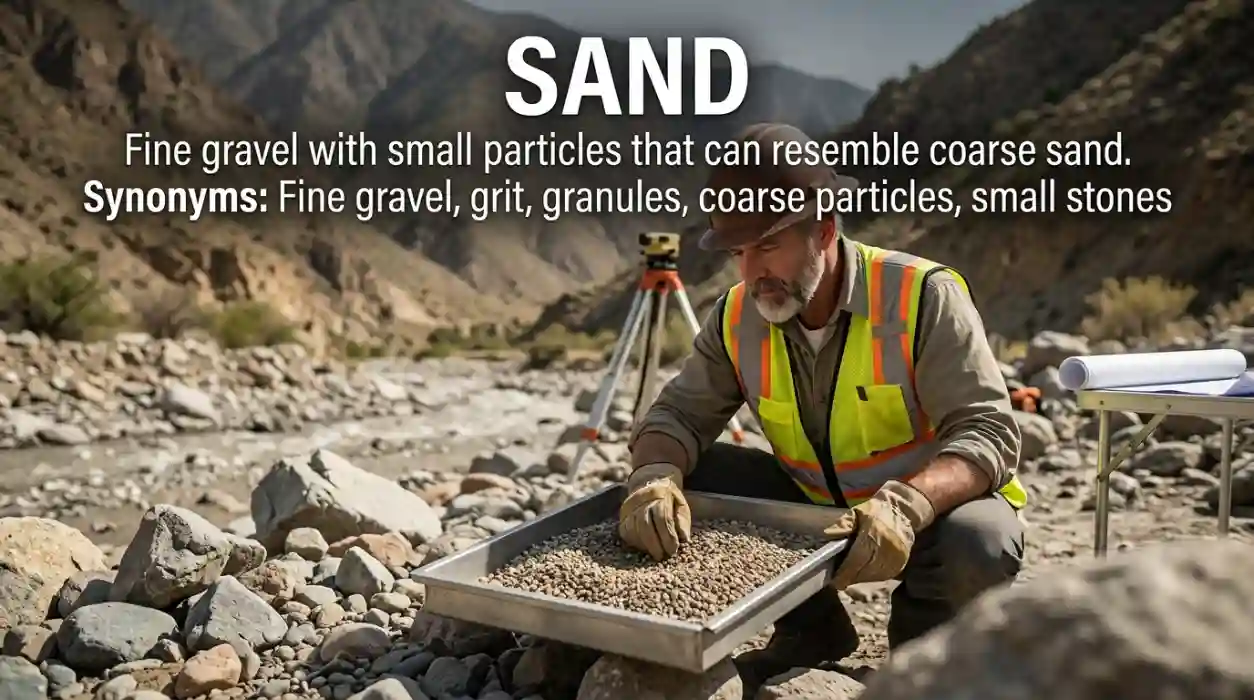
40. Fine Gravel (Noun Phrase) — US /faɪn ˈɡræv.əl/ — UK /faɪn ˈɡræv.əl/
Meaning: Fine gravel is still gravel, but its small size can make it resemble coarse sand.
Tone/Register: Construction, geological.
Examples:
The path was covered with fine gravel.
Fine gravel provided better drainage.
41. Earthy Material (Noun Phrase) — US /ˈɝː.θi məˈtɪr.i.əl/ — UK /ˈɜː.θi məˈtɪə.ri.əl/
Meaning: Earthy material is a broad description for natural soil-like or mineral material and is not a precise synonym for sand.
Tone/Register: Descriptive.
Examples:
An earthy material covered the floor.
The earthy material smelled damp after the rain.
42. Loose Earth (Noun Phrase) — US /luːs ɝːθ/ — UK /luːs ɜːθ/
Meaning: Loose earth refers to unconsolidated ground material and may include sand.
Tone/Register: Everyday.
Examples:
His boots sank into the loose earth.
Loose earth slid down the slope.
43. Dry Grains (Noun Phrase) — US /draɪ ɡreɪnz/ — UK /draɪ ɡreɪnz/
Meaning: Dry grains is a descriptive phrase for loose granular particles, including sand.
Tone/Register: Literary, descriptive.
Examples:
Dry grains slipped through her fingers.
The wind scattered the dry grains.
44. Sandy Matter (Noun Phrase) — US /ˈsæn.di ˈmæt̬.ɚ/ — UK /ˈsæn.di ˈmæt.ə/
Meaning: Sandy matter is a broad descriptive expression for material containing or resembling sand.
Tone/Register: Descriptive, neutral.
Examples:
Sandy matter covered the bottom of the tray.
The plant grew in loose sandy matter.
45. Sandy Material (Noun Phrase) — US /ˈsæn.di məˈtɪr.i.əl/ — UK /ˈsæn.di məˈtɪə.ri.əl/
Meaning: Sandy material describes material that contains a substantial amount of sand or has a sandy texture.
Tone/Register: Neutral, technical.
Examples:
The region has sandy material near the coast.
The sandy material drained water quickly.
46. Granular Aggregate (Noun Phrase) — US /ˈɡræn.jə.lɚ ˈæɡ.rə.ɡət/ — UK /ˈɡræn.jə.lə ˈæɡ.rɪ.ɡət/
Meaning: Granular aggregate is a technical construction term for collections of mineral particles of different sizes.
Tone/Register: Construction, engineering.
Examples:
The road requires a stable granular aggregate.
The aggregate was tested for strength.
47. Fine Mineral Aggregate (Noun Phrase) — US /faɪn ˈmɪn.ər.əl ˈæɡ.rə.ɡət/ — UK /faɪn ˈmɪn.ər.əl ˈæɡ.rɪ.ɡət/
Meaning: Fine mineral aggregate describes small mineral particles used in construction mixtures.
Tone/Register: Highly technical.
Examples:
The mixture contains fine mineral aggregate.
The engineer checked the aggregate quality.
48. Sandy Grains (Noun Phrase) — US /ˈsæn.di ɡreɪnz/ — UK /ˈsæn.di ɡreɪnz/
Meaning: Sandy grains is a descriptive phrase emphasizing particles with the texture or character of sand.
Tone/Register: Informal, descriptive.
Examples:
Sandy grains covered the towel.
She brushed the sandy grains from her hands.
49. Sands (Plural Noun) — US /sændz/ — UK /sændz/
Meaning: Sands can refer to broad stretches or areas of sandy ground, especially near the sea.
Tone/Register: Literary, British, geographical.
Examples:
We walked along the golden sands.
The sands stretched far beyond the village.
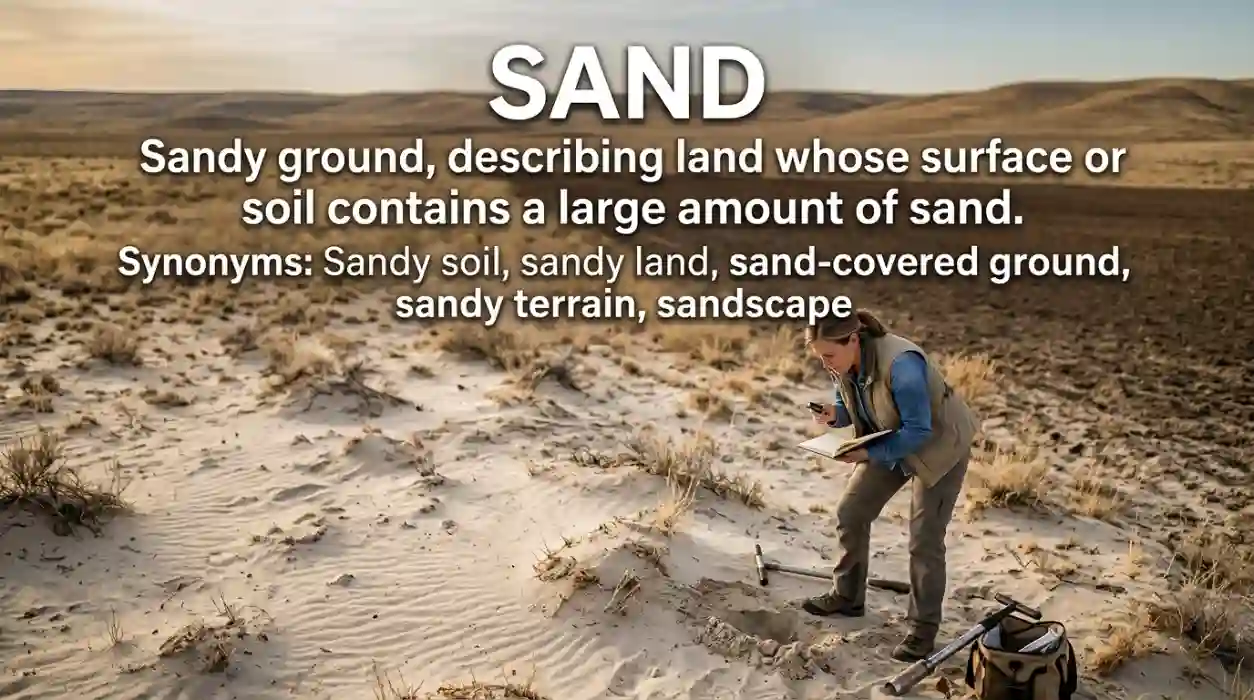
50. Sandy Ground (Noun Phrase) — US /ˈsæn.di ɡraʊnd/ — UK /ˈsæn.di ɡraʊnd/
Meaning: Sandy ground describes land whose surface or soil contains a large amount of sand.
Tone/Register: Everyday, descriptive.
Examples:
The trees grow well in sandy ground.
The path became sandy ground near the beach.
Synonyms by Tone
Not every alternative has the same tone. Choosing the right one makes your English sound more precise.
Positive or Pleasant
For relaxed, visual, or travel writing, these work naturally:
- golden sands
- beach grains
- sandy ground
- dry grains
- sandy material
These expressions can create a warm image without sounding overly technical.
Neutral
For ordinary communication, use:
- sand
- grains
- grit
- particles
- granules
- sandy material
- sandy ground
- sediment
These are flexible and easy to understand.
Negative or Rough
When sand is uncomfortable or irritating, descriptive words can help:
- grit
- gritty material
- loose particles
- coarse grains
- rock dust
Example:
Grit got inside my shoes.
That sounds more natural than simply saying:
Sand got inside my shoes.
Technical or Academic
For scientific and professional writing, consider:
- sediment
- mineral grains
- mineral particles
- aeolian sediment
- fine aggregate
- granular aggregate
- quartz grains
- beach sediment
These terms add precision, but they should not replace “sand” when the simpler word is more accurate.
Playful or Informal
For casual descriptions, phrases such as these can work:
- tiny grains
- gritty stuff
- sandy material
- loose grains
- beach grains
The phrase “gritty stuff” is conversational, but it is not suitable for academic writing.
“Sand” vs Close Alternatives
| Word | Meaning Difference | Tone | Best Use |
|---|---|---|---|
| Sand | Specific loose grains of rock or minerals | Neutral | Everyday English |
| Grit | Small, hard, rough particles | Casual/neutral | Texture, roads, discomfort |
| Sediment | Material deposited by natural processes | Academic | Geology and environmental writing |
| Grains | Individual particles of a material | Neutral/scientific | Describing individual pieces |
| Granules | Small solid particles | Technical | Science, manufacturing |
| Fine aggregate | Small aggregate used in construction | Technical | Concrete and engineering |
The key point is simple: sand is the material itself, while many alternatives describe its particles, texture, origin, or use.
How “Sand” Changes by Context
Daily Conversation
In everyday English, sand is usually the best word.
Say:
There is sand in my shoes.
You could say grit if the particles feel rough or annoying, but “sand” is clearer when you mean actual beach or desert material.
Writing and Blogging
Writers often use more descriptive phrases to avoid repetition.
Instead of:
The sand was everywhere. The sand covered the beach.
Try:
Fine grains covered the beach. Loose particles blew across the path.
This creates variety while keeping the image clear.
Professional or Academic Writing
Scientific writing needs greater precision.
Instead of:
The wind moved sand across the region.
You might write:
The wind transported aeolian sediment across the region.
Use the technical term only when it adds useful information.
Creative or Informal Writing
Creative writing can use sensory vocabulary.
Examples:
Warm grains slipped between her toes.
Grit clung to his wet hands.
The golden sands stretched toward the horizon.
These alternatives create different moods.
Common Mistakes and Native Usage
Mistake 1: Treating every particle word as a synonym
Dust, grit, sediment, and sand are not always interchangeable.
Sand has a particular particle-size range. Dust is generally much finer. Grit often suggests roughness. Sediment describes material deposited through natural processes.
Mistake 2: Using “gravel” for sand
Gravel is generally made of larger rock fragments. If particle size matters, replacing “sand” with “gravel” changes the meaning.
Mistake 3: Using “silica” as a complete synonym
Some sand contains a large amount of silica, but silica is a chemical substance. It is not simply another everyday word for sand.
Mistake 4: Overusing technical terms
A sentence such as:
We relaxed on the aeolian sediment.
sounds unnatural in ordinary conversation.
A native speaker would normally say:
We relaxed on the sand.
Mistake 5: Confusing “sand” with “sandy”
Sand is a noun.
Sandy is an adjective.
Correct:
The beach has soft sand.
The beach is sandy.
Register Notes
Informal: grit, gritty stuff, loose grains
Neutral: sand, grains, particles, sandy material
Academic: sediment, mineral grains, aeolian sediment
Technical: fine aggregate, granular aggregate, abrasive
For additional vocabulary study, an internal article about synonyms for dirt could naturally connect this topic with words describing soil, dust, and other loose materials.
Real-Life Mini Scenarios
Workplace
A construction worker may say:
We need more fine aggregate for the concrete.
A casual conversation might simply use:
We need more sand.
Social Situation
At the beach, someone might say:
I have sand all over my towel.
If the texture is irritating, they might say:
There is grit in my shoes.
Media and Pop Culture
A travel article may describe:
golden sands stretching along the coast.
A documentary may use:
desert sediment transported by strong winds.
The second version sounds more scientific.
Writing and Storytelling
A novelist can create a stronger sensory image:
Fine grains slipped through her fingers as the tide came in.
Here, grains avoid repeating “sand” while keeping the image vivid.
Why Synonyms for Sand Matter
Vocabulary variety is not about replacing simple words with complicated ones. It is about choosing the word that communicates the exact idea.
Compare:
Sand covered the road.
with:
Fine mineral particles covered the road.
The second sentence sounds scientific. It may be useful in a report, but the first is better for everyday conversation.
Good writers know when not to use a synonym.
If “sand” is the clearest word, keep it.
If you need to describe texture, size, origin, or purpose, choose a more specific alternative.
Practice Quiz
1. You are talking about tiny grains on a beach. Which word is most natural?
A. Sediment
B. Sand
C. Aggregate
D. Silica
2. A geology student is describing material deposited by a river. Which term fits best?
A. Sediment
B. Grit
C. Sandy stuff
D. Sandpaper
3. Your shoes contain rough particles after walking on a dusty road. Which word sounds natural?
A. Grit
B. Sands
C. Silica
D. Aggregate
4. A construction engineer discusses small particles used in concrete. Which term is most appropriate?
A. Golden sands
B. Fine aggregate
C. Beach grains
D. Dry grains
5. Which word focuses on individual pieces that make up sand?
A. Grains
B. Beach
C. Desert
D. Ground
6. Which sentence sounds most natural in casual conversation?
A. I have aeolian sediment in my shoes.
B. I have fine mineral aggregate in my shoes.
C. I have sand in my shoes.
D. I have granular sediment in my shoes.
7. Which word is more scientific than “sand”?
A. Sediment
B. Beach
C. Summer
D. Shore
8. Which term describes material transported by wind?
A. Aeolian sediment
B. Fine gravel
C. Sandy ground
D. Beach grains
9. Which word should not normally replace “sand” when you mean beach material?
A. Grains
B. Sediment
C. Gravel
D. Sandy material
10. Which sentence uses “sandy” correctly?
A. The beach has very sandy.
B. The beach is sandy.
C. The beach contains sandy.
D. The beach sands is soft.
Answer key: 1-B | 2-A | 3-A | 4-B | 5-A | 6-C | 7-A | 8-A | 9-C | 10-B
Reflection Task
Write one sentence about a beach, desert, construction site, or dusty road. Use sand first, then rewrite the sentence with a more precise alternative such as grains, grit, sediment, or fine aggregate.
External reference sources,
Cambridge Dictionary is useful for the core definition, pronunciation, noun/verb uses, and examples, while Etymonline is useful for the historical origin of sand. Cambridge Dictionary — sand; Etymonline — sand etymology
Conclusion
Learning synonyms for sand is really about learning precision. Words like grit, grains, sediment, and aggregate each show a slightly different view of the material.
The best synonym depends on your purpose. Use simple words in conversation, descriptive phrases in stories, and technical terms when accuracy matters.
A stronger vocabulary helps you write better essays, blogs, emails, and descriptions. It also makes everyday speaking more natural and expressive.
Try these alternatives in your own sentences today. Practice with real situations, and you will quickly learn which word sounds right for each context.
Frequently Asked Questions
1. What is the closest synonym for sand in everyday English?
The closest everyday alternatives are usually grains and grit, but neither is a perfect replacement. “Grains” focuses on the individual particles, while “grit” emphasizes rough or hard particles. In most ordinary situations, especially when discussing beaches or deserts, native speakers simply use sand because it is the clearest and most precise choice.
2. What is a scientific synonym for sand?
Sediment is a useful scientific alternative, but it is broader than sand. Sediment includes material deposited by water, wind, ice, or other processes, and it can contain sand, silt, clay, or other particles. In geology, terms such as mineral grains, quartz grains, and aeolian sediment can provide greater precision.
3. Is “grit” the same as “sand”?
Not exactly. Grit refers to small, hard, rough particles and can sometimes describe coarse sandy material. However, it often emphasizes texture rather than geological identity. For example, “sand in my shoes” describes the material, while “grit in my shoes” emphasizes the uncomfortable rough feeling.
4. Can “dust” be used as another word for sand?
Usually, no. Dust generally refers to much finer particles than sand. Both materials can be blown by wind, but they differ in typical particle size and physical behavior. Saying “dust” instead of “sand” can therefore change the meaning of a sentence, especially in scientific or geographical writing.
5. What are good synonyms for sand in creative writing?
Creative writers can use grains, golden sands, loose grains, sandy ground, beach grains, or descriptive phrases involving texture and movement. These alternatives can reduce repetition while creating stronger sensory images. For example, “warm grains slipped through her fingers” gives a more detailed image than repeating “sand” several times.

Shahzeena Shazadi is the founder and lead writer at VocablyHub.com, where she creates accurate, reader-focused English language content designed to help people communicate with clarity and confidence. She specializes in synonyms, antonyms, word meanings, idioms, and practical vocabulary guides that simplify complex language concepts for everyday use. Every article is carefully researched, fact-checked, and written in clear, accessible language using reliable references and real-world examples. Her goal is to provide helpful, trustworthy content that supports learners at every stage of their English language journey.
Her editorial approach focuses on accuracy, transparency, and user value while following modern content quality standards. She regularly reviews and updates content to keep information relevant, useful, and easy to understand. Through VocablyHub.com, Shahzeena Shazadi is committed to publishing reliable language resources that help students, writers, educators, professionals, and English learners expand their vocabulary, improve their writing skills, and communicate with confidence in academic, professional, and everyday situations.