
Synonyms for sprayed become useful when one word cannot show how liquid, paint, perfume, or particles were spread. The right choice makes the action clearer.
Imagine spraying water on dusty leaves. You might say you misted, sprinkled, doused, or soaked them, but each verb creates a different picture.
Synonyms for sprayed help students write precise essays and help bloggers, writers, and daily speakers avoid repeating the same common verb.
Because sprayed is used for liquids, gases, colors, and even bullets, context matters. Learning its alternatives helps you describe each action naturally.
What Does “Sprayed” Really Mean?
Sprayed is the past tense and past participle of spray.
It usually means causing a liquid, gas, powder, paint, or another substance to come out in small drops or particles and spread over an area or surface.
For example:
She sprayed water on the plants.
Here, the water was released in small drops.
The word can also describe paint, perfume, cleaning products, pesticides, cooking oil, or other substances.
He sprayed paint onto the wall.
In another context, sprayed can describe something being scattered rapidly over an area.
The machine sprayed dust across the floor.
It can even be used figuratively or in descriptions of weapons:
Bullets were sprayed across the target area.
Therefore, the exact synonym depends heavily on what was sprayed, how it was released, how much was used, and where it went.
Part of Speech
Sprayed is usually:
- Verb: the past tense of spray
- Past participle: used with forms of have or be
Examples:
- The gardener sprayed the roses.
- The roses were sprayed with water.
- She has sprayed the plants already.
Connotative Meaning of “Sprayed”
Connotation (the feeling, association, or impression connected with a word beyond its basic dictionary meaning) changes depending on context.
Positive Tone
Sprayed can suggest freshness, care, protection, or pleasant fragrance.
The room was sprayed with a light floral fragrance.
Words such as misted, perfumed, and coated can also sound positive when used in suitable contexts.
Negative Tone
The word can suggest force, mess, waste, or danger.
Mud was sprayed across the clean car.
Likewise, drenched, spattered, splashed, and peppered can create stronger or more unpleasant images.
Neutral Tone
In technical, scientific, gardening, cleaning, or manufacturing contexts, sprayed is often completely neutral.
The plants were sprayed with water.
No emotional judgment is required.
Etymology
The verb spray has Germanic roots and generally traces back to Middle Dutch forms such as spraien and related words meaning “to scatter, sprinkle, or spread.”
The modern English sense developed around the idea of sending small drops or particles outward.
Old English: 450–1100
The exact modern verb spray was not established in Old English with its present meaning.
Old English had several words for scattering, sprinkling, and spreading substances, but the modern form developed later.
Middle English: 1100–1500
During Middle English, related Germanic forms expressing the ideas of scattering and spreading influenced English vocabulary.
The concept behind spray became increasingly connected with small particles being dispersed through the air.
Modern English: 1500–Present
Modern spray developed into a highly productive verb and noun.
Today, it can describe water, perfume, paint, chemicals, cooking oil, cleaning products, droplets, particles, and even figurative or weapon-related dispersal.
The past form sprayed is pronounced with one syllable.

Pronunciation
US: /spreɪd/
UK: /spreɪd/
The vowel sound is the long a sound found in words such as day and train.
Syllables
sprayed
It has one syllable.
Affixation Pattern of “Sprayed”
Root: spray
Prefix: none
Suffix: -ed
The -ed ending marks the past tense or past participle.
spray → sprayed
Synonyms List
Misted (Verb) — US / UK: /ˈmɪstɪd/ / /ˈmɪstɪd/
Meaning: Misted means sprayed with very small, fine drops.
Tone/Register: Neutral; common in gardening, skincare, and weather descriptions.
Example:
She misted the leaves with clean water.
The plants were lightly misted every morning.
Sprinkled (Verb) — US / UK: /ˈsprɪŋkəld/ / /ˈsprɪŋkəld/
Meaning: Sprinkled means scattered or released in small amounts over a surface.
Tone/Register: Neutral; very common.
Example:
He sprinkled water over the seedlings.
A little salt was sprinkled over the salad.
Spattered (Verb) — US / UK: /ˈspætərd/ / /ˈspætərd/
Meaning: Spattered means scattered in small drops, often unevenly.
Tone/Register: Neutral; often descriptive.
Example:
Mud covered her shoes in splatters.
Paint covered the wall in splatters.
Splashed (Verb) — US / UK: /splæʃt/ / /splæʃt/
Meaning: Splashed means caused liquid to move or fall in scattered drops.
Tone/Register: Neutral; informal.
Example:
The child splashed water onto the pavement.
Rain splashed against the windows.
Doused (Verb) — US / UK: /daʊst/ / /daʊst/
Meaning: Doused means covered or soaked with a large amount of liquid.
Tone/Register: Strong; neutral to dramatic.
Example:
The firefighter doused the flames with water.
He was doused with cold water during the celebration.
Soaked (Verb) — US / UK: /soʊkt/ / /səʊkt/
Meaning: Soaked means made thoroughly wet by applying or absorbing a large amount of liquid.
Tone/Register: Neutral; common.
Example:
The sudden rain soaked my jacket.
The garden was soaked after the storm.
Saturated (Verb) — US / UK: /ˈsætʃəreɪtɪd/ / /ˈsætʃəreɪtɪd/
Meaning: Saturated means filled or thoroughly covered with as much liquid as something can hold.
Tone/Register: Formal; technical.
Example:
The water saturated the fabric.
Heavy rain saturated the soil
Coated (Verb) — US / UK: /ˈkoʊtɪd/ / /ˈkəʊtɪd/
Meaning: Coated means covered with a layer of a substance.
Tone/Register: Neutral to formal.
Example:
Protective paint coated the surface.
Cooking oil coated the vegetables.
Covered (Verb) — US / UK: /ˈkʌvərd/ / /ˈkʌvəd/
Meaning: Covered means spread over or placed across a surface.
Tone/Register: Neutral; very common.
Example:
The table was covered with cleaning solution.
Fine dust covered the windows.
Applied (Verb) — US / UK: /əˈplaɪd/ / /əˈplaɪd/
Meaning: Applied means put a substance onto a surface or object.
Tone/Register: Formal; academic and professional.
Example:
The doctor applied the treatment to the affected area.
The painter applied a thin layer of paint to the door.
Distributed (Verb) — US / UK: /dɪˈstrɪbjətɪd/ / /dɪˈstrɪbjətɪd/
Meaning: Distributed means spread something across an area or among different places.
Tone/Register: Formal; technical.
Example:
The process evenly distributed the liquid across the surface.
Air currents distributed the particles throughout the room.
Dispersed (Verb) — US / UK: /dɪˈspɜːrst/ / /dɪˈspɜːst/
Meaning: Dispersed means spread particles, drops, or substances widely through an area.
Tone/Register: Formal; scientific.
Example:
The wind dispersed the droplets into the air.
The workers dispersed the chemical over the field.
Diffused (Verb) — US / UK: /dɪˈfjuːzd/ / /dɪˈfjuːzd/
Meaning: Diffused means spread gradually through an area rather than staying concentrated.
Tone/Register: Formal; scientific.
Example:
The fragrance diffused through the room.
Fine particles were diffused into the surrounding air.
Atomized (Verb) — US / UK: /ˈætəmaɪzd/ / /ˈætəmaɪzd/
Meaning: Atomized means converted into extremely small droplets or particles.
Tone/Register: Technical; scientific.
Example:
The fuel injector atomized the fuel before combustion.
The nozzle atomized the liquid into a fine mist.
.
Aerosolized (Verb) — US / UK: /ˈerəsɔːlaɪzd/ / /ˈerəsɒlaɪzd/
Meaning: Aerosolized means dispersed as very small particles or droplets suspended in air.
Tone/Register: Technical; scientific or medical.
Example:
The process aerosolized the substance.
The device aerosolized the liquid into fine droplets.
Nebulized (Verb) — US / UK: /ˈnebjəlaɪzd/ / /ˈnebjʊlaɪzd/
Meaning: Nebulized means converted into a fine mist, usually for inhalation or specialized treatment.
Tone/Register: Medical; technical.
Example:
The nebulizer nebulized the medicine for inhalation.
The nebulizer nebulized the solution into tiny droplets.
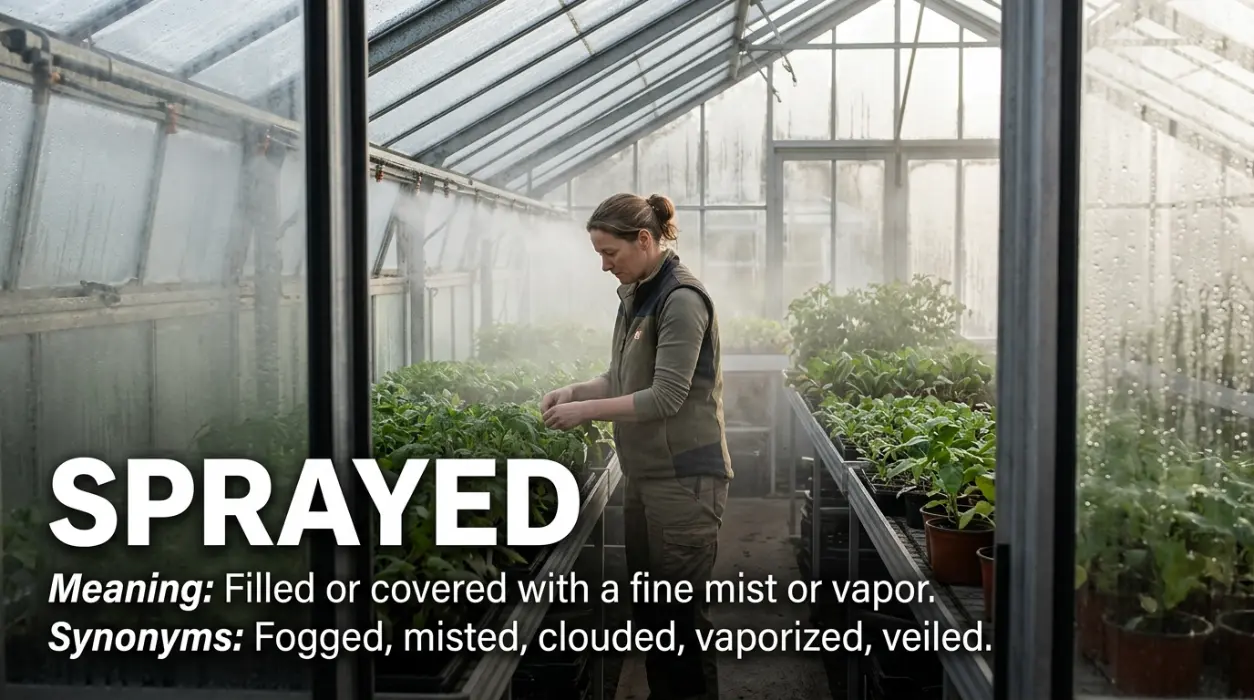
Fogged (Verb) — US / UK: /fɑːɡd/ / /fɒɡd/
Meaning: Fogged means filled or covered with a fine mist or vapor.
Tone/Register: Technical to neutral.
Example:
The workers fogged the greenhouse to raise humidity.
The workers lightly fogged the room with disinfectant.
Dusting (Verb) — US / UK: /ˈdʌstɪŋ/ / /ˈdʌstɪŋ/
Meaning: Dusting means spreading a small amount of powder or fine material over something.
Tone/Register: Neutral.
Example:
The baker was dusting the cake with sugar.
The plants were dusted with a fine powder.
Dusted (Verb) — US / UK: /ˈdʌstɪd/ / /ˈdʌstɪd/
Meaning: Dusted means covered lightly with a fine powder or particles.
Tone/Register: Neutral; common in cooking and agriculture.
Example:
The baker dusted the cookies with powdered sugar.
The gardener dusted the leaves with treatment powder.
Powdered (Verb) — US / UK: /ˈpaʊdərd/ / /ˈpaʊdəd/
Meaning: Powdered means covered or treated with powder.
Tone/Register: Neutral; context-specific.
Example:
Workers powdered the surface with a fine mineral.
Workers powdered the gloves before use.
Painted (Verb) — US / UK: /ˈpeɪntɪd/ / /ˈpeɪntɪd/
Meaning: Painted means covered with paint, sometimes by using a spray system.
Tone/Register: Neutral.
Example:
The workers painted the car bright blue.
The factory workers painted the metal panels at the factory.
Airbrushed (Verb) — US / UK: /ˈerbrʌʃt/ / /ˈerbrʌʃt/
Meaning: Airbrushed means painted or colored with a fine spray from an airbrush.
Tone/Register: Technical; artistic.
Example:
The artist airbrushed the background.
The image was carefully airbrushed to soften the colors.
Spritzed (Verb) — US / UK: /sprɪtst/ / /sprɪtst/
Meaning: Spritzed means sprayed lightly with a small amount of liquid.
Tone/Register: Informal; common in beauty, food, and lifestyle contexts.
Example:
She spritzed perfume on her wrists.
The salad was spritzed with lemon juice.
Perfumed (Verb) — US / UK: /ˈpɜːrfjuːmd/ / /ˈpɜːfjuːmd/
Meaning: Perfumed means given a pleasant smell by adding or spraying fragrance.
Tone/Register: Neutral; descriptive.
Example:
The room was lightly perfumed with lavender.
She perfumed the fabric before storing it.
Fragranced (Verb) — US / UK: /ˈfreɪɡrənst/ / /ˈfreɪɡrəns(t)/
Meaning: Fragranced means given a particular smell by adding fragrance.
Tone/Register: Neutral; product and descriptive writing.
Example:
The air was fragranced with citrus.
The candles had fragranced the room.
Scented (Verb) — US / UK: /ˈsentɪd/ / /ˈsentɪd/
Meaning: Scented means given a particular smell by applying a fragrant substance.
Tone/Register: Neutral.
Example:
The staff scented the room with vanilla.
The manufacturer scented the fabric with a light floral fragrance.
Hosed (Verb) — US / UK: /hoʊzd/ / /həʊzd/
Meaning: Hosed means sprayed or covered with water from a hose.
Tone/Register: Informal; practical.
Example:
He hosed the driveway after the storm.
The muddy boots were hosed clean.
Watered (Verb) — US / UK: /ˈwɔːtərd/ / /ˈwɔːtəd/
Meaning: Watered means supplied plants or soil with water, sometimes using a spray.
Tone/Register: Neutral; everyday gardening.
Example:
She watered the flowers before work.
The lawn was watered in the evening.
Irrigated (Verb) — US / UK: /ˈɪrəɡeɪtɪd/ / /ˈɪrɪɡeɪtɪd/
Meaning: Irrigated means supplied land or crops with water through a planned system.
Tone/Register: Formal; agricultural.
Example:
Farmers irrigated the fields during the dry season.
Farmers irrigate the crops with recycled water.
Treated (Verb) — US / UK: /ˈtriːtɪd/ / /ˈtriːtɪd/
Meaning: Treated means given a substance or process intended to protect, clean, improve, or change something.
Tone/Register: Neutral to formal.
Example:
Farmers treated the plants with an organic solution.
Workers treated the surface to prevent corrosion.
Disinfected (Verb) — US / UK: /ˌdɪsɪnˈfektɪd/ / /ˌdɪsɪnˈfektɪd/
Meaning: Disinfected means treated with a substance intended to kill or reduce harmful microorganisms.
Tone/Register: Formal; medical and practical.
Example:
The staff disinfected the counters after lunch.
The staff disinfected the equipment before use.
Sanitized (Verb) — US / UK: /ˈsænətaɪzd/ / /ˈsænɪtaɪzd/
Meaning: Sanitized means treated to reduce harmful microorganisms to an acceptable level.
Tone/Register: Formal; health and food contexts.
Example:
The staff sanitized the tables between customers.
The researchers sanitized all the equipment before the experiment.
Deodorized (Verb) — US / UK: /diːˈoʊdəraɪzd/ / /diːˈəʊdəraɪzd/
Meaning: Deodorized means treated to remove or reduce an unpleasant smell.
Tone/Register: Neutral.
Example:
The cleaning staff deodorized the room after the spill.
The cleaning staff deodorized the carpet before drying it.
Cleansed (Verb) — US / UK: /klenzd/ / /klenzd/
Meaning: Cleansed means cleaned by removing dirt, impurities, or unwanted substances.
Tone/Register: Formal or literary.
Example:
The surface was cleansed before painting.
Her face was gently cleansed with water.
Washed (Verb) — US / UK: /wɑːʃt/ / /wɒʃt/
Meaning: Washed means cleaned or covered with water or another liquid.
Tone/Register: Neutral; very common.
Example:
The vegetables were washed before cooking.
The pavement was washed after the event.
Rinsed (Verb) — US / UK: /rɪnst/ / /rɪnst/
Meaning: Rinsed means cleaned by applying and removing water or another liquid.
Tone/Register: Neutral; everyday.
Example:
The bottles were rinsed with clean water.
She rinsed the plants after applying the solution.
Wetted (Verb) — US / UK: /ˈwetɪd/ / /ˈwetɪd/
Meaning: Wetted means made slightly or completely wet by applying liquid.
Tone/Register: Technical to neutral.
Example:
The cloth was wetted before cleaning the surface.
The soil was wetted before the seeds were planted.

Moistened (Verb) — US / UK: /ˈmɔɪsənd/ / /ˈmɔɪsənd/
Meaning: Moistened means made slightly wet rather than completely soaked.
Tone/Register: Neutral; common in instructions.
Example:
The paper was moistened before folding.
The dry soil was lightly moistened.
Dampened (Verb) — US / UK: /ˈdæmpənd/ / /ˈdæmpənd/
Meaning: Dampened means made slightly wet or less dry.
Tone/Register: Neutral.
Example:
The cloth was dampened before use.
She dampened the sponge with warm water.
Soaked Through (Verb Phrase) — US / UK: /soʊkt θruː/ / /səʊkt θruː/
Meaning: Soaked through means made completely wet from one side to the other.
Tone/Register: Informal to neutral.
Example:
The rain soaked through my coat.
The towels were soaked through after the cleaning job.
Drenched (Verb) — US / UK: /drentʃt/ / /drentʃt/
Meaning: Drenched means made extremely wet by a large quantity of liquid.
Tone/Register: Strong; vivid.
Example:
The storm drenched the garden.
We were drenched within minutes.
Showered (Verb) — US / UK: /ˈʃaʊərd/ / /ˈʃaʊəd/
Meaning: Showered means covered or supplied with many small drops or pieces falling from above.
Tone/Register: Neutral; figurative use is common.
Example:
The plants were showered with fine water.
The players were showered with confetti after the match.
Poured (Verb) — US / UK: /pɔːrd/ / /pɔːd/
Meaning: Poured means caused a liquid to flow continuously rather than in small droplets.
Tone/Register: Neutral.
Example:
Water was poured over the dry soil.
She poured the cleaning solution into the bucket.
Ejected (Verb) — US / UK: /ɪˈdʒektɪd/ / /ɪˈdʒektɪd/
Meaning: Ejected means forced a substance or particles outward from a container or device.
Tone/Register: Formal; technical.
Example:
The nozzle ejected a fine stream of liquid.
The machine ejected particles during the test.
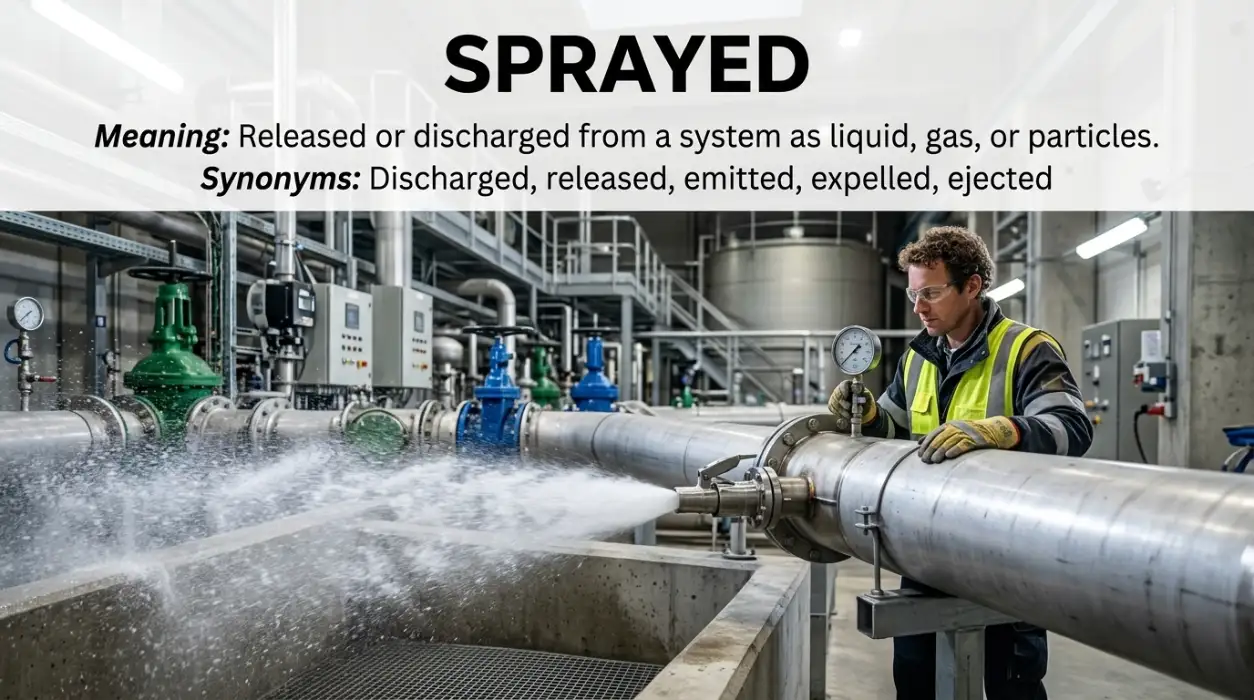
Discharged (Verb) — US / UK: /dɪsˈtʃɑːrdʒd/ / /dɪsˈtʃɑːrdʒd/
Meaning: Discharged means releasing a substance, liquid, gas, or particles from a system.
Tone/Register: Technical; formal.
Example:
The system discharged water through several nozzles.
The gas was discharged into a controlled chamber.
Synonyms by Tone
Neutral
These are the safest choices for everyday and general writing:
- sprinkled
- misted
- scattered
- spread
- covered
- coated
- applied
- released
- watered
- washed
- rinsed
- moistened
- dampened
Formal or Technical
These work particularly well in scientific, medical, agricultural, or professional contexts:
- atomized
- aerosolized
- nebulized
- dispersed
- diffused
- distributed
- discharged
- ejected
- irrigated
- sanitized
- disinfected
- saturated
Strong or Vivid
These create a stronger visual impression:
- doused
- drenched
- spattered
- splashed
- peppered
- rained
- bombarded
- riddled
Informal or Conversational
These can make everyday language feel more natural:
- spritzed
- hosed
- slathered
- flicked
Why Tone Matters
Tone tells readers how an action should feel.
For example, misted sounds gentle. Drenched sounds heavy. Atomized sounds technical. Spattered suggests disorder.
Therefore, choosing a synonym is not simply about replacing one word with another. It is about selecting the word that creates the intended picture.
“Sprayed” vs Close Alternatives
Misted vs Sprayed
Sprayed is broad. It can describe anything from a strong stream to a fine mist.
Misted is more specific. It normally suggests very small, light droplets.
Use misted when the substance is applied gently.
The leaves were misted with water.
Sprayed vs Sprinkled
Sprinkled usually means small amounts are distributed over an area.
It is especially natural for water, salt, seeds, powder, and similar materials.
She sprinkled water over the seedlings.
The action is usually lighter and more scattered than a typical spray.
Sprayed vs Doused
Doused suggests a much larger quantity of liquid.
Compare:
The plant was sprayed with water.
with:
The plant was doused with water.
The second sentence suggests much heavier wetting.
How “Sprayed” Changes by Context
Daily Conversation
In everyday speech, sprayed, sprinkled, misted, splashed, and doused are common choices.
I sprayed the plants this morning.
If you want to describe a very light application, misted is more precise.
If the plants became very wet, doused may be more appropriate.
Writing and Blogging
Writers should select a synonym that creates a clear mental image.
Instead of:
Water was sprayed everywhere.
you might write:
A fine mist drifted across the leaves.
The second version gives the reader more information.
However, do not replace simple words just to sound sophisticated. Clear language is usually stronger than unnecessarily difficult vocabulary.
Professional or Academic Writing
Professional writing often benefits from technical vocabulary.
For example:
The solution was atomized into fine droplets.
This is more precise than:
The solution was sprayed.
Similarly, dispersed, aerosolized, nebulized, and distributed may be appropriate when their technical meanings are intended.
Creative or Informal Use
Creative writing allows more vivid alternatives.
Rain splattered the windows.
The gardener misted the roses.
Confetti rained over the crowd.
Each sentence produces a different visual effect.
Common Mistakes and Native Usage
Mistake 1: Treating Every Synonym as Interchangeable
Misted, drenched, and atomized do not describe exactly the same action.
Native speakers notice these distinctions.
Choose the word according to the amount, texture, direction, and purpose of the substance.
Mistake 2: Using “Drenched” for a Light Spray
Drenched means extremely wet.
Therefore, this sentence sounds unusual:
The plant was drenched with two tiny drops of water.
Misted or sprinkled would be more natural.
Mistake 3: Using Technical Words in Casual Conversation
You probably would not say:
I atomized my perfume this morning.
In normal conversation, sprayed or spritzed is much more natural.
Mistake 4: Confusing “Sprayed” With “Painted”
A surface can be spray-painted, but painted is broader.
A wall may be painted with a brush, roller, or spray system.
Therefore, spray-painted gives more specific information.
Mistake 5: Ignoring the Substance
The noun after the verb often determines the best synonym.
- water → misted, sprinkled, doused
- perfume → spritzed, sprayed
- paint → coated, airbrushed, spray-painted
- powder → dusted, powdered
- medicine → nebulized, aerosolized
- crops → irrigated, treated
This is why context is more important than simply memorizing a synonym list.
Register Notes
Formal
Use:
- dispersed
- distributed
- atomized
- aerosolized
- nebulized
- discharged
- irrigated
- sanitized
Neutral
Use:
- sprayed
- misted
- sprinkled
- coated
- covered
- applied
- washed
- spread
Informal
Use:
- spritzed
- hosed
- slathered
- flicked
Technical
Use:
- atomized
- aerosolized
- nebulized
- diffused
- discharged
- ejected
Real-Life Mini Scenarios
Workplace
A cleaning worker applies disinfectant to a desk.
The desk was sprayed with disinfectant.
A more technical version could be:
The surface was disinfected before the next shift.
Gardening
A gardener applies a gentle layer of water.
She misted the seedlings.
If the entire garden receives a large amount of water, drenched or watered may fit better.
Cooking
A chef adds a small amount of oil.
He drizzled olive oil over the vegetables.
Here, sprayed would be possible with an oil spray, but drizzled gives a different image.
Beauty and Fragrance
Someone applies perfume lightly.
She spritzed perfume onto her wrists.
Spritzed sounds more natural and specific than doused.
Painting
An artist applies a fine layer of color.
The background was airbrushed with pale blue.
This is more precise than simply saying it was sprayed.
Weather
Heavy rain hits a window.
Rain splattered against the glass.
The verb creates a more vivid picture than the neutral sprayed.
Practice Quiz
1. The gardener applied a very fine layer of water to the leaves.
A. drenched
B. misted
C. poured
D. soaked
2. The firefighter covered the flames with a large amount of water.
A. spritzed
B. dusted
C. doused
D. flicked
3. The baker added a light layer of powdered sugar to the cake.
A. dusted
B. irrigated
C. rinsed
D. hosed
4. The doctor used a device to turn medicine into a fine mist.
A. sprinkled
B. nebulized
C. washed
D. smeared
5. The artist applied paint using a fine airbrush.
A. airbrushed
B. soaked
C. watered
D. rinsed
6. She applied a small amount of perfume to her wrists.
A. drenched
B. spritzed
C. saturated
D. irrigated
7. Heavy rain covered the windows with scattered drops.
A. splattered
B. sanitized
C. coated
D. irrigated
8. The liquid was turned into extremely small droplets.
A. atomized
B. washed
C. smeared
D. poured
9. The farmer supplied water to the crops through a planned system.
A. sprinkled
B. irrigated
C. flicked
D. perfumed
10. The cleaning solution was put over the surface to protect it.
A. treated
B. rained
C. peppered
D. broadcast
Answer key: 1-B, 2-C, 3-A, 4-B, 5-A, 6-B, 7-A, 8-A, 9-B, 10-A
Reflection Task
Write three short sentences using misted, doused, and coated. Then explain how the amount or manner of the substance changes in each sentence.
Conclusion
Understanding sprayed can help you describe the action of spreading a liquid, substance, or fine particles over an area or onto a surface. Learning its synonyms, meaning, and examples can improve your English vocabulary and make your communication more precise.
The word sprayed is commonly used when talking about water, paint, perfume, cleaning products, or other substances distributed in small drops or particles. Knowing its related synonyms can help you express ideas about misting, sprinkling, scattering, or dispersing in different ways.
By practicing sprayed in sentences and exploring related words, you can strengthen your vocabulary and writing skills. A clear understanding of this word will help you use it naturally, accurately, and confidently in different English contexts.
Frequently Asked Questions
1. What is the closest synonym for sprayed in everyday English?
The closest general alternatives are sprinkled, misted, splashed, and scattered, but the best choice depends on the action. Misted suggests very fine droplets, while sprinkled suggests small amounts distributed across a surface. Splashed suggests larger, less controlled drops. Therefore, there is no single replacement that works naturally in every sentence.
2. What is another word for sprayed with water?
Depending on the amount and method, useful alternatives include misted, sprinkled, splashed, watered, hosed, doused, drenched, and soaked. For a gentle application, misted works well. For a heavy amount, drenched or doused is stronger. If water comes from a hose, hosed is especially specific and natural.
3. What is a formal synonym for sprayed?
Formal or technical alternatives include dispersed, distributed, atomized, aerosolized, nebulized, discharged, and applied. The correct word depends on the process. For example, atomized means converted into very small droplets, while dispersed emphasizes distribution through an area. These words are useful in scientific, medical, agricultural, and professional writing.
4. What is a synonym for sprayed when talking about perfume?
For perfume, spritzed is one of the most natural alternatives when a small amount is applied. Scented, fragranced, and perfumed can also work, although they focus more on the resulting smell than on the physical spraying action. For example, “She spritzed perfume on her wrists” sounds natural in everyday English.
5. What is another word for sprayed when talking about paint?
For paint, alternatives include airbrushed, coated, painted, and spray-painted. Airbrushed specifically suggests a fine stream of paint from an airbrush. Coated emphasizes the resulting layer. Spray-painted is the most direct alternative when paint was applied using a spray can or spray system.

Shahzeena Shazadi is the founder and lead writer at VocablyHub.com, where she creates accurate, reader-focused English language content designed to help people communicate with clarity and confidence. She specializes in synonyms, antonyms, word meanings, idioms, and practical vocabulary guides that simplify complex language concepts for everyday use. Every article is carefully researched, fact-checked, and written in clear, accessible language using reliable references and real-world examples. Her goal is to provide helpful, trustworthy content that supports learners at every stage of their English language journey.
Her editorial approach focuses on accuracy, transparency, and user value while following modern content quality standards. She regularly reviews and updates content to keep information relevant, useful, and easy to understand. Through VocablyHub.com, Shahzeena Shazadi is committed to publishing reliable language resources that help students, writers, educators, professionals, and English learners expand their vocabulary, improve their writing skills, and communicate with confidence in academic, professional, and everyday situations.