
A synonym for smoking depends on the context. Common alternatives include smoking tobacco, puffing, inhaling smoke, and tobacco use. For the act of producing smoke, words such as smoldering may fit. The best choice depends on whether you mean tobacco consumption, visible smoke, or the process of combustion.
Imagine reading a news report that says, “Smoking is prohibited inside the building.” You might wonder whether tobacco use, cigarette smoking, or another expression would communicate the same message more precisely.
The word smoking appears in everyday conversation, health education, news articles, fiction, and workplace policies. Its meaning can change depending on whether the writer describes a habit, an activity, or something burning.
Learning a synonym for smoking helps students, bloggers, and content writers avoid repetitive wording. It also helps everyday English users understand health information and express ideas clearly.
The important point is context. A phrase describing cigarette use cannot always replace a word describing smoke rising from a fire. Understanding these differences makes your English more natural and accurate.
What Does “Smoking” Really Mean?
Smoking most commonly means inhaling and exhaling smoke produced by burning tobacco or another substance. It can also describe the process of producing smoke through combustion or, in cooking, exposing food to smoke for flavor and preservation.
The meaning depends on the sentence.
- Tobacco use: “Smoking can damage your health.”
- Combustion: “The smoking wood filled the room with smoke.”
- Food preparation: “Smoking the fish gave it a rich flavor.”
Part of Speech
The word smoking can function as a noun, a verb form, or an adjective.
As a verb form, it describes an action in progress. As an adjective, it can describe something that emits smoke or, in informal expressions, something exceptionally impressive.
Simple definition: Smoking is the act of inhaling smoke from a burning substance, or the process of producing smoke, depending on context.
Connotative Meaning
(Connotation is the emotional association or implied feeling attached to a word beyond its literal meaning.)
Positive tone: In cooking, smoking can suggest flavor, craftsmanship, or a traditional preparation method.
Example: “The chef prepared beautifully smoked vegetables.”
Negative tone: In health discussions, smoking often carries associations with addiction, disease, and secondhand smoke.
Example: “The report examined the risks associated with smoking.”
Neutral tone: In technical descriptions, smoking may simply describe smoke production or a process.
Example: “Smoking wood produced a steady stream of smoke.”
The word itself does not always carry the same emotional meaning. The subject and surrounding words shape the reader’s interpretation.
Etymology
The word smoking comes from the verb smoke, combined with the suffix -ing. The English word smoke has Germanic roots and is related to words in other Germanic languages that refer to smoke or fumes.
Historical Development
Old English (450–1100)
Old English used smoca as a noun meaning smoke, alongside related forms associated with smoking or emitting smoke. The language already had ways to describe the visible result of burning.
Middle English (1100–1500)
Middle English continued the use of smoke and related verb forms. The word described smoke production and the action of emitting smoke. The use of tobacco became more prominent in English after tobacco arrived in Europe from the Americas.
Modern English (1500–present)
In Modern English, smoking developed several established meanings. It can describe tobacco consumption, the emission of smoke, and a food-preparation method. Informal expressions such as smoking hot also developed separate figurative meanings.
Pronunciation: US and UK
- US IPA: /ˈsmoʊkɪŋ/
- UK IPA: /ˈsməʊkɪŋ/
Syllables
smok-ing
The word has two syllables, with stress on the first syllable.
Affixation Pattern
- Root/base: Smoke
- Prefix: None
- Suffix: -ing, used to form a present participle or a gerund
- Word formation: Smoke + ing = smoking
Related forms include smoke, smoker, smokeless, smoky, and smoked.
Synonyms List
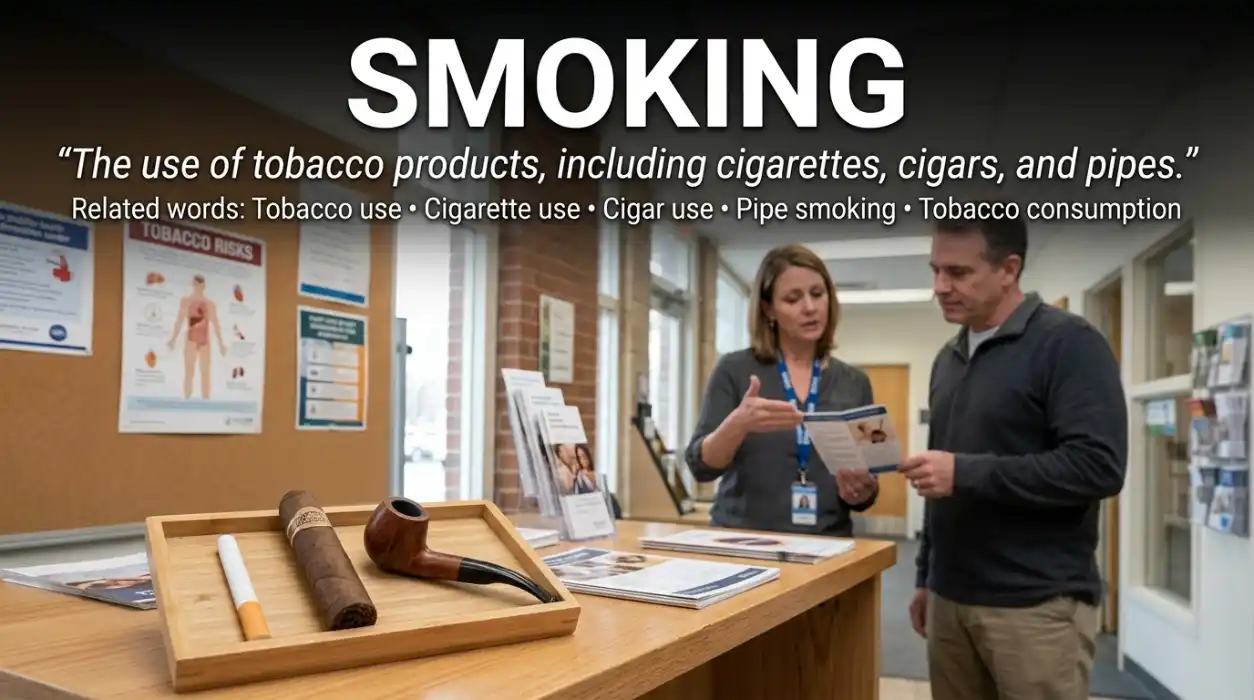
1. Tobacco Use (Noun Phrase) — US /təˈbækoʊ juːs/, UK /təˈbækəʊ juːs/
Meaning: The use of tobacco products, including cigarettes, cigars, and pipes.
Tone/Register: Formal, medical, academic.
Examples:
- The survey examined tobacco use among adults.
- The school introduced lessons about the risks of tobacco use.
2. Tobacco Consumption (Noun Phrase) — US /təˈbækoʊ kənˈsʌmpʃən/, UK /təˈbækəʊ kənˈsʌmpʃən/
Meaning: The act or pattern of consuming tobacco products.
Tone/Register: Academic, statistical, formal.
Examples:
- Researchers tracked changes in tobacco consumption.
- The report compared tobacco consumption across age groups.
3. Cigarette Smoking (Noun Phrase) — US /ˌsɪɡəˈrɛt ˈsmoʊkɪŋ/, UK /ˌsɪɡəˈret ˈsməʊkɪŋ/
Meaning: The act of smoking cigarettes specifically.
Tone/Register: Neutral, medical, everyday.
Examples:
- Cigarette smoking is prohibited inside the hospital.
- The article discusses the long-term effects of cigarette smoking.
4. Smoking Tobacco (Verb Phrase) — US /ˈsmoʊkɪŋ təˈbækoʊ/, UK /ˈsməʊkɪŋ təˈbækəʊ/
Meaning: Using tobacco by burning it and inhaling or drawing in the resulting smoke.
Tone/Register: Neutral, descriptive.
Examples:
- He stopped smoking tobacco several years ago.
- The campaign provides information about smoking tobacco.
5. Cigarette Use (Noun Phrase) — US /ˌsɪɡəˈrɛt juːs/, UK /ˌsɪɡəˈret juːs/
Meaning: The use of cigarettes, whether described as an individual behavior or a population trend.
Tone/Register: Neutral, research-oriented.
Examples:
- The study measured cigarette use among university students.
- The survey asked participants about their cigarette use.
6. Cigar Smoking (Noun Phrase) — US /ˈsɪɡɑːr ˈsmoʊkɪŋ/, UK /sɪˈɡɑː ˈsməʊkɪŋ/
Meaning: The act of smoking cigars rather than cigarettes.
Tone/Register: Neutral, descriptive.
Examples:
- The documentary examined the history of cigar smoking.
- The venue introduced restrictions on cigar smoking.
7. Pipe Smoking (Noun Phrase) — US /ˈpaɪp ˈsmoʊkɪŋ/, UK /ˈpaɪp ˈsməʊkɪŋ/
Meaning: The practice of burning tobacco in a pipe and drawing in its smoke.
Tone/Register: Neutral, historical, descriptive.
Examples:
- The novel describes pipe smoking in an earlier era.
- The museum displayed objects associated with pipe smoking.
8. Hookah Smoking (Noun Phrase) — US /ˈhʊkə ˈsmoʊkɪŋ/, UK /ˈhʊkə ˈsməʊkɪŋ/
Meaning: The practice of inhaling smoke from a water pipe, often called a hookah.
Tone/Register: Neutral, health-related.
Examples:
- The health lesson addressed hookah smoking.
- The researchers studied attitudes toward hookah smoking.
9. Shisha Smoking (Noun Phrase) — US /ˈʃiːʃə ˈsmoʊkɪŋ/, UK /ˈʃiːʃə ˈsməʊkɪŋ/
Meaning: Smoking flavored tobacco through a water pipe, commonly called shisha.
Tone/Register: Neutral, descriptive.
Examples:
- The article explains common misconceptions about shisha smoking.
- The health campaign includes information about shisha smoking.
10. Puffing (Noun or Verb Form) — US /ˈpʌfɪŋ/, UK /ˈpʌfɪŋ/
Meaning: Taking short draws or releasing small bursts of air or smoke.
Tone/Register: Informal, descriptive.
Examples:
- He was puffing on a cigarette outside the building.
- The chimney was puffing out clouds of smoke.
Usage note: Puffing can describe smoking, but it also refers to breathing heavily or producing bursts of air.
11. Taking a Puff (Verb Phrase) — US /ˈteɪkɪŋ ə pʌf/, UK /ˈteɪkɪŋ ə pʌf/
Meaning: Drawing a small amount of smoke from a cigarette, cigar, or pipe.
Tone/Register: Conversational.
Examples:
- The character took a puff before answering.
- He put the cigarette down after taking a puff.
12. Taking a Drag (Verb Phrase) — US /ˈteɪkɪŋ ə dræɡ/, UK /ˈteɪkɪŋ ə dræɡ/
Meaning: Inhaling smoke from a cigarette or similar smoking product.
Tone/Register: Informal, especially in American English.
Examples:
- The scene shows a character taking a drag from a cigarette.
- She noticed him taking a drag near the entrance.
13. Lighting Up (Phrasal Verb) — US /ˈlaɪtɪŋ ʌp/, UK /ˈlaɪtɪŋ ʌp/
Meaning: Igniting a cigarette or another smoking product to begin smoking.
Tone/Register: Informal.
Examples:
- He stepped outside without lighting up.
- The sign reminded visitors not to light up near the doorway.
14. Having a Cigarette (Verb Phrase) — US /ˈhævɪŋ ə ˌsɪɡəˈrɛt/, UK /ˈhævɪŋ ə ˌsɪɡəˈret/
Meaning: Smoking a cigarette, usually as a casual or temporary activity.
Tone/Register: Conversational.
Examples:
- He went outside to have a cigarette.
- They discussed the schedule while he was having a cigarette.
15. Having a Smoke (Verb Phrase) — US /ˈhævɪŋ ə smoʊk/, UK /ˈhævɪŋ ə sməʊk/
Meaning: Smoking tobacco, usually for a short period.
Tone/Register: Informal, conversational.
Examples:
- He asked whether anyone wanted to have a smoke.
- She took a walk instead of having a smoke.
16. Smoking Habit (Noun Phrase) — US /ˈsmoʊkɪŋ ˈhæbɪt/, UK /ˈsməʊkɪŋ ˈhæbɪt/
Meaning: A repeated pattern of smoking.
Tone/Register: Neutral, health-related.
Examples:
- He wanted to change his smoking habit.
- The counselor helped her discuss her smoking habit.
17. Tobacco Habit (Noun Phrase) — US /təˈbækoʊ ˈhæbɪt/, UK /təˈbækəʊ ˈhæbɪt/
Meaning: A repeated behavior involving tobacco use.
Tone/Register: Neutral, sometimes old-fashioned.
Examples:
- The biography mentions his tobacco habit.
- The discussion explored how a tobacco habit can develop.
18. Nicotine Use (Noun Phrase) — US /ˈnɪkətiːn juːs/, UK /ˈnɪkətiːn juːs/
Meaning: The use of nicotine-containing products, which may or may not involve smoking.
Tone/Register: Medical, scientific.
Examples:
- The survey measured nicotine use among adults.
- The report distinguished nicotine use from cigarette smoking.
Usage note: This is broader than smoking because nicotine can be consumed without burning tobacco.
19. Smoke Inhalation (Noun Phrase) — US /smoʊk ˌɪnhəˈleɪʃən/, UK /sməʊk ˌɪnhəˈleɪʃən/
Meaning: The act of breathing smoke into the respiratory system.
Tone/Register: Medical, technical, safety-related.
Examples:
- Firefighters checked the residents for smoke inhalation.
- The report described the effects of smoke inhalation.
Usage note: This phrase often refers to accidental exposure, not tobacco smoking.
20. Inhaling Smoke (Verb Phrase) — US /ɪnˈheɪlɪŋ smoʊk/, UK /ɪnˈheɪlɪŋ sməʊk/
Meaning: Drawing smoke into the lungs or respiratory tract.
Tone/Register: Neutral, medical, descriptive.
Examples:
- The warning explains the risks of inhaling smoke.
- The witness moved away to avoid inhaling smoke from the fire.
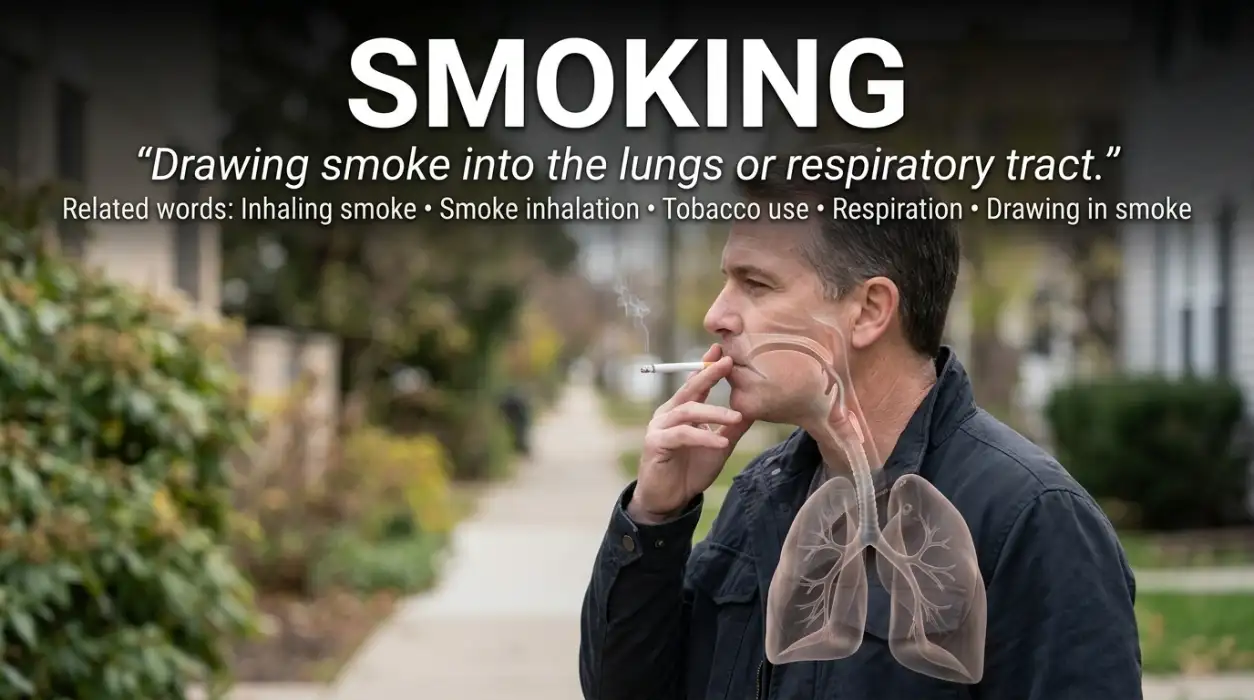
21. Exhaling Smoke (Verb Phrase) — US /ɛksˈheɪlɪŋ smoʊk/, UK /ɛksˈheɪlɪŋ sməʊk/
Meaning: Releasing smoke from the respiratory system after inhaling it.
Tone/Register: Descriptive, neutral.
Examples:
- The film showed a character exhaling smoke outdoors.
- The illustration depicts someone exhaling smoke into the air.
22. Drawing on a Cigarette (Verb Phrase) — US /ˈdrɔɪŋ ɑːn ə ˌsɪɡəˈrɛt/, UK /ˈdrɔːɪŋ ɒn ə ˌsɪɡəˈret/
Meaning: Pulling smoke through a cigarette by inhaling or drawing air through it.
Tone/Register: Descriptive, literary.
Examples:
- The character paused while drawing on a cigarette.
- He looked away after drawing on his cigarette.
23. Smoking a Cigarette (Verb Phrase) — US /ˈsmoʊkɪŋ ə ˌsɪɡəˈrɛt/, UK /ˈsməʊkɪŋ ə ˌsɪɡəˈret/
Meaning: Using a cigarette by burning its contents and drawing in the smoke.
Tone/Register: Neutral.
Examples:
- The photograph showed a man smoking a cigarette outside.
- Smoking a cigarette is prohibited in the designated area.
24. Smoking a Cigar (Verb Phrase) — US /ˈsmoʊkɪŋ ə sɪˈɡɑːr/, UK /ˈsməʊkɪŋ ə sɪˈɡɑː/
Meaning: Burning a cigar and drawing in its smoke.
Tone/Register: Neutral, descriptive.
Examples:
- The historical scene depicts a businessman smoking a cigar.
- The character was smoking a cigar on the balcony.
25. Smoking a Pipe (Verb Phrase) — US /ˈsmoʊkɪŋ ə paɪp/, UK /ˈsməʊkɪŋ ə paɪp/
Meaning: Burning material in a pipe and drawing in the resulting smoke.
Tone/Register: Neutral, historical, descriptive.
Examples:
- The portrait depicts an older man smoking a pipe.
- The story mentions a sailor smoking a pipe on deck.
26. Burning Tobacco (Verb Phrase) — US /ˈbɝːnɪŋ təˈbækoʊ/, UK /ˈbɜːnɪŋ təˈbækəʊ/
Meaning: Setting tobacco alight so that it produces smoke.
Tone/Register: Technical, descriptive.
Examples:
- Burning tobacco releases smoke and other substances.
- The experiment examined gases produced by burning tobacco.
27. Smoke Production (Noun Phrase) — US /smoʊk prəˈdʌkʃən/, UK /sməʊk prəˈdʌkʃən/
Meaning: The process or amount of smoke generated by burning or heating material.
Tone/Register: Scientific, technical.
Examples:
- The test measured smoke production during combustion.
- Ventilation reduced smoke production inside the chamber.
28. Emitting Smoke (Verb Phrase) — US /ɪˈmɪtɪŋ smoʊk/, UK /ɪˈmɪtɪŋ sməʊk/
Meaning: Releasing smoke into the surrounding air.
Tone/Register: Technical, descriptive.
Examples:
- The damaged engine was emitting smoke.
- The factory was emitting smoke from its chimney.
29. Giving Off Smoke (Verb Phrase) — US /ˈɡɪvɪŋ ɔːf smoʊk/, UK /ˈɡɪvɪŋ ɒf sməʊk/
Meaning: Producing and releasing smoke.
Tone/Register: Everyday, descriptive.
Examples:
- The overheated appliance was giving off smoke.
- The damp wood kept giving off smoke instead of burning cleanly.
30. Smoldering (Verb or Adjective) — US /ˈsmoʊldərɪŋ/, UK /ˈsməʊldərɪŋ/
Meaning: Burning slowly without producing a strong flame, often while releasing smoke.
Tone/Register: Descriptive, technical, literary.
Examples:
- The smoldering logs continued to release smoke.
- Firefighters inspected the smoldering debris.
Usage note: British English commonly spells this word smouldering.
31. Smouldering (Verb or Adjective) — US /ˈsmoʊldərɪŋ/, UK /ˈsməʊldərɪŋ/
Meaning: The British spelling of smoldering, describing slow, flameless burning.
Tone/Register: Descriptive, technical.
Examples:
- Smouldering material remained beneath the ash.
- The crew checked the site for smouldering embers.
32. Fuming (Verb or Adjective) — US /ˈfjuːmɪŋ/, UK /ˈfjuːmɪŋ/
Meaning: Producing or releasing fumes, smoke, or vapor; informally, also feeling very angry.
Tone/Register: Descriptive; context-dependent.
Examples:
- The machine was fuming after it overheated.
- The laboratory isolated the fuming chemical mixture.
Usage note: Fuming does not automatically mean smoking tobacco.
33. Billowing Smoke (Noun Phrase) — US /ˈbɪloʊɪŋ smoʊk/, UK /ˈbɪləʊɪŋ sməʊk/
Meaning: Large, expanding clouds of smoke moving through the air.
Tone/Register: Descriptive, journalistic, literary.
Examples:
- Billowing smoke rose above the burning building.
- The photograph captured billowing smoke across the skyline.
34. Smoke Emission (Noun Phrase) — US /smoʊk ɪˈmɪʃən/, UK /sməʊk ɪˈmɪʃən/
Meaning: The release of smoke into the environment.
Tone/Register: Technical, environmental.
Examples:
- The inspection measured smoke emissions from the boiler.
- Regulations limit smoke emissions from certain industrial processes.
35. Smoke Release (Noun Phrase) — US /smoʊk rɪˈliːs/, UK /sməʊk rɪˈliːs/
Meaning: The act or event of smoke escaping into the surrounding environment.
Tone/Register: Technical, safety-related.
Examples:
- The alarm activated after smoke release was detected.
- Investigators examined the cause of the sudden smoke release.
36. Smoke Exposure (Noun Phrase) — US /smoʊk ɪkˈspoʊʒər/, UK /sməʊk ɪkˈspəʊʒə/
Meaning: Contact with smoke in the air, whether from tobacco, a fire, or another source.
Tone/Register: Medical, environmental.
Examples:
- The study examined smoke exposure in the home.
- Staff received guidance on reducing workplace smoke exposure.
37. Secondhand Smoke Exposure (Noun Phrase) — US /ˈsɛkəndˌhænd smoʊk ɪkˈspoʊʒər/, UK /ˈsekəndˌhænd sməʊk ɪkˈspəʊʒə/
Meaning: Breathing smoke produced by someone else’s tobacco use.
Tone/Register: Medical, public health.
Examples:
- The campaign addresses secondhand smoke exposure in homes.
- The report examined children’s secondhand smoke exposure.
38. Passive Smoking (Noun Phrase) — US /ˈpæsɪv ˈsmoʊkɪŋ/, UK /ˈpæsɪv ˈsməʊkɪŋ/
Meaning: Exposure to other people’s tobacco smoke rather than directly smoking tobacco oneself.
Tone/Register: Medical, public health; especially common in British English.
Examples:
- The guidance explains the dangers of passive smoking.
- The study considered passive smoking in shared living spaces.
39. Environmental Tobacco Smoke (Noun Phrase) — US /ɪnˌvaɪrənˈmɛntəl təˈbækoʊ smoʊk/, UK /ɪnˌvaɪərənˈmentəl təˈbækəʊ sməʊk/
Meaning: Tobacco smoke present in the surrounding environment, including smoke exhaled by smokers and smoke from burning tobacco.
Tone/Register: Scientific, public health.
Examples:
- Researchers measured environmental tobacco smoke indoors.
- The report discussed environmental tobacco smoke in shared spaces.
40. Smoke Pollution (Noun Phrase) — US /smoʊk pəˈluːʃən/, UK /sməʊk pəˈluːʃən/
Meaning: Air contamination caused by smoke from fires, industrial processes, or other sources.
Tone/Register: Environmental, journalistic.
Examples:
- Smoke pollution reduced visibility across the city.
- The report examined smoke pollution near industrial sites.
41. Smoking Food (Verb Phrase) — US /ˈsmoʊkɪŋ fuːd/, UK /ˈsməʊkɪŋ fuːd/
Meaning: Exposing food to smoke to develop flavor, color, or preservation qualities.
Tone/Register: Culinary, instructional.
Examples:
- Smoking food requires attention to temperature and timing.
- The chef demonstrated smoking food with different types of wood.
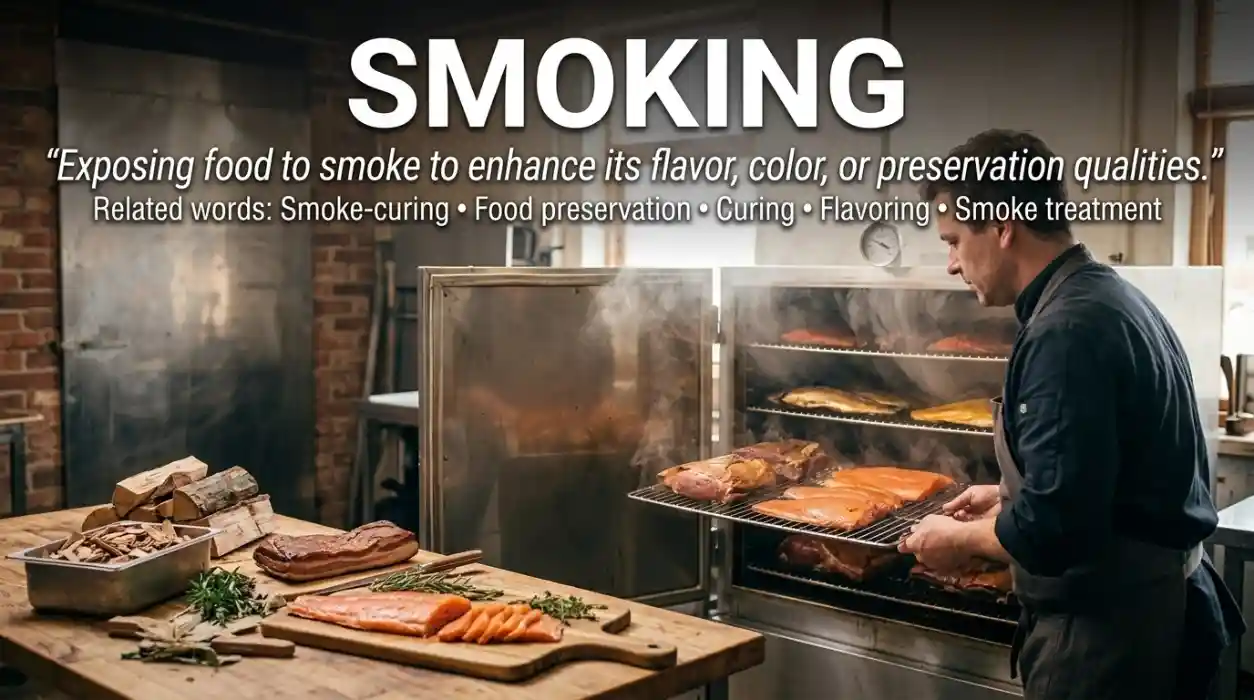
42. Food Smoking (Noun Phrase) — US /fuːd ˈsmoʊkɪŋ/, UK /fuːd ˈsməʊkɪŋ/
Meaning: The culinary process of treating food with smoke.
Tone/Register: Culinary, technical.
Examples:
- Food smoking has a long history in food preservation.
- The course covered traditional methods of food smoking.
43. Smoke Curing (Noun Phrase) — US /smoʊk ˈkjʊrɪŋ/, UK /sməʊk ˈkjʊərɪŋ/
Meaning: Treating food with smoke as part of a curing or preservation process.
Tone/Register: Culinary, technical.
Examples:
- Smoke curing can change the flavor and texture of food.
- The guide explains the role of smoke curing in traditional preparation.
44. Cold Smoking (Noun Phrase) — US /koʊld ˈsmoʊkɪŋ/, UK /kəʊld ˈsməʊkɪŋ/
Meaning: Exposing food to smoke at relatively low temperatures, without cooking it through the process.
Tone/Register: Culinary, technical.
Examples:
- Cold smoking adds smoky flavor without the usual cooking process.
- The chef explained how cold smoking differs from hot smoking.
45. Hot Smoking (Noun Phrase) — US /hɑːt ˈsmoʊkɪŋ/, UK /hɒt ˈsməʊkɪŋ/
Meaning: Cooking food while exposing it to smoke and heat.
Tone/Register: Culinary, technical.
Examples:
- Hot smoking cooks the fish while adding a smoky flavor.
- The recipe explains the difference between hot smoking and roasting.
46. Smoke-Drying (Noun or Verb Form) — US /smoʊk ˈdraɪɪŋ/, UK /sməʊk ˈdraɪɪŋ/
Meaning: Drying material or food through a process that combines smoke and drying conditions.
Tone/Register: Culinary, technical, historical.
Examples:
- Smoke-drying helped preserve food before refrigeration became widespread.
- The museum demonstrated traditional smoke-drying methods.
47. Smoke Treatment (Noun Phrase) — US /smoʊk ˈtriːtmənt/, UK /sməʊk ˈtriːtmənt/
Meaning: A process in which smoke is applied to an object or material for a particular purpose.
Tone/Register: Technical, industrial, culinary.
Examples:
- The experiment examined smoke treatment of the material.
- Smoke treatment can affect the surface and aroma of certain foods.
48. Smoke Infusion (Noun Phrase) — US /smoʊk ɪnˈfjuːʒən/, UK /sməʊk ɪnˈfjuːʒən/
Meaning: Introducing smoky flavor or aroma into food or drink.
Tone/Register: Culinary, descriptive.
Examples:
- The chef used smoke infusion to deepen the dish’s aroma.
- Smoke infusion gave the sauce a distinctive flavor.
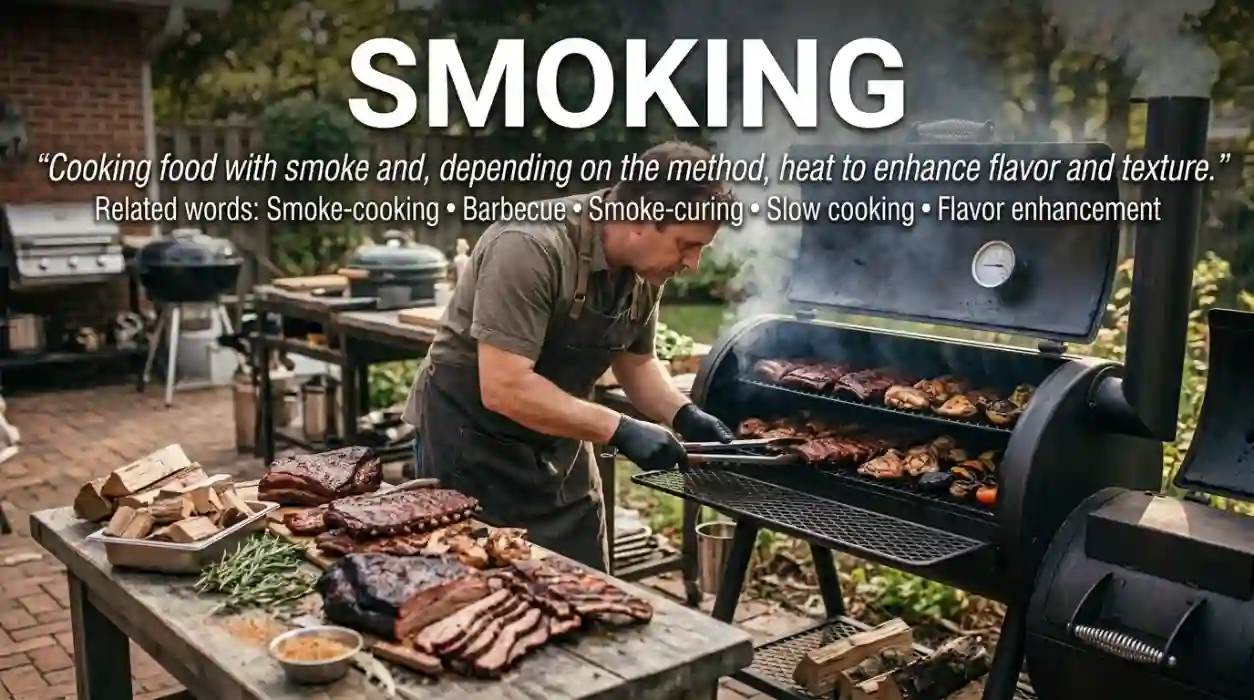
49. Smoke-Cooking (Noun or Verb Form) — US /smoʊk ˈkʊkɪŋ/, UK /sməʊk ˈkʊkɪŋ/
Meaning: Cooking food using smoke and, depending on the method, heat.
Tone/Register: Culinary, instructional.
Examples:
- Smoke-cooking gives some dishes a rich, distinctive taste.
- The demonstration compared smoke-cooking with conventional roasting.
50. Smoking Process (Noun Phrase) — US /ˈsmoʊkɪŋ ˈprɑːsɛs/, UK /ˈsməʊkɪŋ ˈprəʊses/
Meaning: The method or sequence of actions involved in smoking tobacco, producing smoke, or preparing food with smoke.
Tone/Register: Neutral, technical; context-dependent.
Examples:
- The article explains the smoking process used in food preservation.
- The health report describes how the smoking process exposes users to smoke.
Important distinction: These 50 alternatives are related by meaning or context, but they are not all exact synonyms. Tobacco use can replace smoking in many health discussions. Smoldering describes slow combustion, while cold smoking describes a culinary technique. Selecting the correct expression matters more than using the largest possible number of alternatives.
Synonyms by Tone
The word you choose should match your purpose. In particular, smoking-related vocabulary can refer to tobacco consumption, health effects, combustion, or cooking.
Neutral and Academic Alternatives
These expressions suit reports, essays, surveys, and factual descriptions.
- Tobacco use: Appropriate for public health research and general discussions of tobacco products.
- Tobacco consumption: Useful for discussing statistics, trends, and population behavior.
- Cigarette smoking: Specific to the use of cigarettes.
- Nicotine use: Broader than smoking because it includes non-smoking nicotine products.
- Smoke inhalation: Suitable for medical or emergency contexts.
- Smoke emission: Appropriate for environmental and technical reports.
Informal Alternatives
These expressions are more common in casual speech and dialogue.
- Having a smoke: A conversational way to describe a short smoking session.
- Having a cigarette: Specifically refers to smoking a cigarette.
- Lighting up: Means igniting a cigarette or another smoking product.
- Taking a puff: Describes one short draw of smoke.
- Taking a drag: An informal phrase for inhaling smoke.
Technical and Descriptive Alternatives
Use these when discussing smoke itself rather than tobacco consumption.
- Smoldering: Describes slow burning without a strong flame.
- Emitting smoke: Describes the release of smoke.
- Smoke production: Refers to the amount or process of generating smoke.
- Smoke pollution: Describes environmental contamination caused by smoke.
- Smoke exposure: Describes contact with smoke in the surrounding air.
Culinary Alternatives
In food preparation, smoking has a separate meaning. These expressions refer to applying smoke to food rather than consuming tobacco.
- Food smoking: The general culinary process.
- Smoke curing: A method associated with flavor development and preservation.
- Cold smoking: Applying smoke at relatively low temperatures.
- Hot smoking: Cooking food with heat and smoke.
- Smoke-drying: Combining smoke exposure with drying.
Why Tone Matters
Using having a smoke in a research paper may sound too informal. Using tobacco consumption in a casual conversation may sound unnecessarily technical.
Likewise, calling smoke inhalation “smoking” can create confusion. The first often describes exposure to smoke, while the second commonly refers to intentionally using a tobacco product.
The best vocabulary choice communicates the exact activity, not merely a related idea.
Smoking vs. Close Alternatives
Three distinctions are particularly important for learners.
| Word or phrase | Meaning | When to use it |
|---|---|---|
| Smoking | Commonly, inhaling smoke from burning tobacco; also used for other processes | General descriptions of the activity |
| Tobacco use | Using tobacco products, including products that may not involve smoking | Health education, research, and policy |
| Puffing | Taking short draws or releasing small bursts of smoke or air | Casual descriptions of individual actions |
| Smoldering | Burning slowly without a strong flame | Fires, embers, and combustion |
| Vaping | Inhaling an aerosol produced by a vaping device | Discussions of vaping, not as a synonym for smoking |
Smoking vs. Tobacco Use
Smoking usually refers to burning a substance and drawing in its smoke. Tobacco use is broader and can include products that do not involve burning tobacco.
Example: “The survey examined tobacco use among adults.”
This wording may be more appropriate than smoking when the study includes multiple types of tobacco products.
Smoking vs. Puffing
Smoking describes the broader activity. Puffing often describes a single action within that activity.
Example: “He was smoking outside and occasionally puffing on his cigarette.”
The words overlap, but they do not mean precisely the same thing.
Smoking vs. Smoldering
Smoking can refer to tobacco use or smoke production. Smoldering specifically describes slow combustion, usually without an open flame.
Example: “The smoldering wood continued to release smoke.”
Do not use smoldering as a replacement for tobacco consumption.
How to Use Smoking Synonyms in Different Contexts
Daily Conversation
Casual expressions such as having a smoke, lighting up, and taking a puff are common in everyday speech.
For example, “He stepped outside to have a cigarette” sounds natural in ordinary conversation.
Use these expressions carefully when talking about health. A conversational phrase should not obscure whether you mean smoking tobacco, vaping, or exposure to smoke.
Writing and Blogging
Content writers often benefit from more specific language.
For a general health article, tobacco use may be appropriate. In a story about a person taking a cigarette break, lighting up or having a cigarette may sound more natural.
Avoid inserting synonyms solely to increase keyword variety. Search-focused writing should remain clear and useful to readers.
Professional and Academic Writing
Choose terms that accurately describe the subject being studied.
For instance, cigarette smoking is more precise than smoking when the research excludes cigars, pipes, and other products. Smoke exposure is suitable when the focus is on the environment rather than personal tobacco use.
Medical writing should distinguish between tobacco consumption, nicotine exposure, secondhand smoke, and accidental smoke inhalation.
Creative and Informal Writing
Fiction often uses expressions such as taking a drag or lighting up to establish a character’s behavior.
Example: “He paused at the doorway, took a drag, and watched the rain.”
This type of phrasing creates a visual scene. It should not be mistaken for a formal definition of smoking.
Common Mistakes and Native Usage
Mistake 1: Treating Vaping as a Direct Synonym
Vaping involves inhaling an aerosol generated by a device. Conventional smoking involves smoke from combustion.
Although the activities can be discussed together, vaping is not an exact synonym for smoking.
Mistake 2: Confusing Smoke Exposure With Smoking
A person can experience secondhand smoke without smoking a cigarette.
Use secondhand smoke exposure or passive smoking when describing exposure to other people’s tobacco smoke.
Mistake 3: Using Smoldering for Every Smoking Context
Smoldering describes slow combustion. It does not normally describe the habit of smoking cigarettes.
Write “The wood was smoldering,” not “He was smoldering a cigarette,” when you mean that the wood was burning slowly.
Mistake 4: Confusing Smoking With Smoked Food
In culinary English, smoking describes applying smoke to food. This meaning is separate from tobacco consumption.
For example, “The chef is smoking salmon” refers to food preparation.
Mistake 5: Overusing Informal Expressions
Phrases such as taking a drag and lighting up work well in dialogue. They may be unsuitable for formal medical reports.
In academic writing, favor precise expressions such as cigarette smoking, tobacco use, or smoke exposure.
Register Notes
- Formal: Tobacco consumption, nicotine use, smoke emission.
- Neutral: Smoking, cigarette smoking, tobacco use.
- Informal: Having a smoke, lighting up, taking a drag.
- Technical: Smoke inhalation, smoldering, smoke production.
- Culinary: Cold smoking, hot smoking, smoke curing.
Real-Life Examples Using
Workplace
A workplace policy needs to explain where tobacco use is prohibited.
Example: “Smoking is not permitted inside the building.”
A more comprehensive policy might use tobacco use if it covers several types of tobacco products.
Social Situations
A friend wants to describe a short cigarette break.
Example: “He went outside to have a smoke.”
This informal expression is natural in conversation, although have a cigarette is more specific.
News and Public Health
A journalist reports on a new survey of cigarette users.
Example: “The study examined cigarette smoking among young adults.”
If the research covers multiple tobacco products, tobacco use may be more accurate.
Cooking and Storytelling
A chef describes a traditional method of preparing fish.
Example: “The restaurant uses hot smoking to cook the fish and develop its flavor.”
Here, smoking refers to a culinary process rather than tobacco use.
External Source
For additional vocabulary research, consult the Cambridge Dictionary for definitions and pronunciation. For reliable health information, see the World Health Organization’s tobacco fact sheet.
Practice Exercise
1. A public health report discusses people who use cigarettes, cigars, and other tobacco products. Which expression is most appropriate?
A. Smoldering
B. Tobacco use
C. Taking a puff
2. A person takes one short draw from a cigarette. Which expression fits best?
A. Smoke pollution
B. Smoke curing
C. Taking a puff
3. A piece of wood burns slowly without an open flame. Which word describes it?
A. Smoldering
B. Vaping
C. Tobacco consumption
4. A researcher studies the health effects of smoke produced by other people’s cigarettes. Which phrase is most suitable?
A. Lighting up
B. Secondhand smoke exposure
C. Having a smoke
5. A chef cooks fish using heat and smoke. Which expression describes the method?
A. Passive smoking
B. Smoke inhalation
C. Hot smoking
6. A character casually says he is going outside for a cigarette. Which expression sounds natural?
A. Having a smoke
B. Smoke emission
C. Environmental tobacco smoke
7. A machine releases smoke into the air. Which phrase best describes the action?
A. Tobacco consumption
B. Emitting smoke
C. Cigarette use
8. A researcher studies the use of nicotine products, including products that do not burn tobacco. Which term is most suitable?
A. Cigarette smoking
B. Pipe smoking
C. Nicotine use
9. A person begins smoking a cigarette by igniting it. Which expression fits best?
A. Lighting up
B. Smoke pollution
C. Smoke-drying
10. A report examines how much smoke an industrial process generates. Which phrase is appropriate?
A. Having a cigarette
B. Smoke production
C. Taking a drag
Reflection Task
Write one original sentence using smoking or one of its alternatives. Then rewrite the sentence using a different expression that fits the same context.
Answer key: 1-B, 2-C, 3-A, 4-B, 5-C, 6-A, 7-B, 8-C, 9-A, 10
Conclusion
Learning a synonym for smoking helps you describe tobacco use, smoke exposure, combustion, and food preparation with greater precision. Context determines the right choice.
A stronger vocabulary improves essays, blog posts, professional writing, and daily conversations. Precise terms help readers understand your meaning without confusion.
You do not need to memorize all 50 alternatives immediately. Begin with tobacco use, cigarette smoking, puffing, and smoldering.
Practice these expressions in short sentences, emails, and essays. Compare their meanings, check their pronunciation, and notice how native speakers use them.
FAQs
1. What is a more formal word for smoking in a health report?
Tobacco use and cigarette smoking are useful formal alternatives. Choose tobacco use when discussing multiple types of tobacco products. Use cigarette smoking when the subject specifically involves cigarettes. If your report focuses on breathing smoke from another source, terms such as smoke exposure or smoke inhalation may be more accurate.
2. What is a synonym for smoking that means taking a cigarette break?
The informal phrases having a smoke and having a cigarette describe a short smoking session. Lighting up refers specifically to starting to smoke by igniting a cigarette or another smoking product. These expressions are common in conversation and fiction, but more precise wording is usually preferable in formal health or workplace documents.
3. Is vaping another word for smoking?
No. Traditional smoking involves burning material and producing smoke, while vaping involves heating a liquid or other material to generate an aerosol. The terms are related because both can involve inhaling substances, but they describe different processes. Use vaping when referring to electronic vaping devices and smoking when discussing combustion-based activities.
4. What is the difference between smoking and smoke inhalation?
Smoking commonly refers to intentionally inhaling smoke from burning tobacco. Smoke inhalation refers to breathing smoke into the respiratory system and often appears in emergency, fire-safety, and medical contexts. Someone may experience smoke inhalation without using tobacco. The distinction is important because the words describe different circumstances and should not be substituted automatically.
5. What is the opposite of smoking in English?
There is no single universal antonym for smoking. Depending on the sentence, you could use not smoking, smoke-free, or abstaining from tobacco. For example, “The building is smoke-free” describes an environment, while “She stopped smoking” describes a behavior change. Choose the expression that fits the intended meaning and grammatical structure.

Shahzeena Shazadi is the founder and lead writer at VocablyHub.com, where she creates accurate, reader-focused English language content designed to help people communicate with clarity and confidence. She specializes in synonyms, antonyms, word meanings, idioms, and practical vocabulary guides that simplify complex language concepts for everyday use. Every article is carefully researched, fact-checked, and written in clear, accessible language using reliable references and real-world examples. Her goal is to provide helpful, trustworthy content that supports learners at every stage of their English language journey.
Her editorial approach focuses on accuracy, transparency, and user value while following modern content quality standards. She regularly reviews and updates content to keep information relevant, useful, and easy to understand. Through VocablyHub.com, Shahzeena Shazadi is committed to publishing reliable language resources that help students, writers, educators, professionals, and English learners expand their vocabulary, improve their writing skills, and communicate with confidence in academic, professional, and everyday situations.