
Synonyms for rigidity include inflexibility, stiffness, strictness, stubbornness, immovability, intransigence, unyieldingness, and fixedness. The best choice depends on context. Physical rigidity usually means stiffness or resistance to bending, while behavioral rigidity often means unwillingness to change.
Synonyms for rigidity become useful when one word feels too blunt. A strict policy may show inflexibility, while a hard material may simply have stiffness.
Imagine a manager refusing every schedule change. Calling this rigidity is clear, but stubbornness or intransigence can reveal a sharper shade of meaning.
Students, bloggers, and content writers use synonyms to avoid repetition and match tone. Daily speakers also gain precision when describing rules, people, or materials.
Learning synonyms for rigidity helps you choose words that sound natural. The right alternative can make an essay clearer, a post sharper, or a conversation more exact.
What Does “Rigidity” Really Mean?
Rigidity is a noun that describes the quality of being stiff, fixed, strict, or resistant to change.
It has two major uses.
The first is physical. A rigid object does not bend or move easily. For example, a metal frame can have high rigidity.
The second is figurative. A person, rule, system, or belief can show rigidity when it does not allow flexibility or adjustment.
Native speakers often hear a negative tone when rigidity describes behavior, policies, or thinking. However, the word can be neutral in technical contexts.
For example:
- “The rigidity of the frame improves its stability.”
- “The rigidity of the policy caused problems.”
The first sentence is technical and neutral. The second suggests that excessive strictness is causing difficulty.
The word is common in engineering, science, education, management, psychology, law, politics, business writing, and everyday English.
Oxford defines rigidity as the condition of being very strict and difficult to change, an unwillingness to change ideas or behavior, or physical stiffness. Cambridge similarly identifies both physical stiffness and resistance to change as major meanings.
Connotative Meaning
Connotation (the emotional or implied meaning that a word carries beyond its basic dictionary definition) can change how “rigidity” sounds.
Positive Tone
In technical writing, rigidity can have a positive or neutral effect.
A rigid structure may provide stability, safety, or strength.
Example:
“The rigidity of the bridge supports helps maintain structural stability.”
Here, rigidity is useful.
Negative Tone
When rigidity describes a person or system, it often sounds critical.
Example:
“Her rigidity made it difficult to negotiate a compromise.”
The word suggests an unwillingness to adapt.
Neutral Tone
In scientific or engineering contexts, rigidity can simply describe a measurable property.
Example:
“The material was selected for its high rigidity.”
The sentence does not criticize the material.
Etymology
The noun rigidity entered English in the early 17th century. Etymonline dates the noun to the 1620s, with the meaning “stiffness” or “inflexibility.” It comes from Latin rigiditas, meaning “stiffness,” from rigidus, meaning “hard, stiff, rough, severe.”
The related adjective rigid is older. Oxford traces it to late Middle English and Latin rigidus, from rigere, meaning “to be stiff.”
Old English: 450–1100
The modern noun rigidity was not an Old English word. English speakers in the Old English period used native words connected with ideas such as hardness, stiffness, firmness, and strictness.
The Latin root behind “rigid” had not yet produced the modern English form.
Middle English: 1100–1500
The related adjective rigid entered English during the late Middle English period through Latin influence. The basic idea remained connected with being stiff, hard, or unyielding.
This created the foundation for later abstract nouns such as rigidity.
Modern English: 1500–Present
By the early 1600s, rigidity was established as a noun for physical stiffness and resistance to change. Its use later expanded into figurative areas such as rules, thinking, institutions, and behavior.

Pronunciation of “Rigidity”
US: /rɪˈdʒɪd.ə.t̬i/
UK: /rɪˈdʒɪd.ə.ti/
Cambridge gives these UK and US pronunciations, with the main stress on the second syllable.
Syllables
ri-gid-i-ty
There are four syllables.
Affixation Pattern of “Rigidity”
Root: rigid
Prefix: none
Suffix: -ity
The suffix -ity commonly turns an adjective into a noun expressing a quality or state.
For example:
- rigid → rigidity
- flexible → flexibility
- active → activity
- equal → equality
Synonym List
Not every alternative below can replace rigidity in every sentence. English synonymy depends heavily on context. Some words describe physical stiffness, while others describe strict rules, fixed thinking, or refusal to compromise.
1. Inflexibility (noun) — US /ˌɪn.flek.səˈbɪl.ə.t̬i/ | UK /ˌɪn.flek.səˈbɪl.ə.ti/
Meaning: The quality of being unwilling or unable to change, adapt, or bend.
Tone/Register: Neutral to negative; formal and widely used.
Example:
“The manager’s inflexibility frustrated the team.”
“The policy needs flexibility rather than inflexibility.”
2. Stiffness (noun) — US /ˈstɪf.nəs/ | UK /ˈstɪf.nəs/
Meaning: The quality of being difficult to bend, move, or change.
Tone/Register: Neutral; common in everyday and technical English.
Example:
“The stiffness of the material makes it useful for construction.”
“She noticed stiffness in the old chair.”
3. Strictness (noun) — US /ˈstrɪkt.nəs/ | UK /ˈstrɪkt.nəs/
Meaning: The quality of demanding exact obedience to rules or standards.
Tone/Register: Neutral to negative; common in education and management.
Example:
“The strictness of the school rules surprised new students.”
“His strictness sometimes made discussion difficult.”
4. Stubbornness (noun) — US /ˈstʌb.ɚn.nəs/ | UK /ˈstʌb.ən.nəs/
Meaning: The refusal to change an opinion, decision, or behavior.
Tone/Register: Informal to neutral; usually negative.
Example:
“Her stubbornness prevented a simple solution.”
“He finally admitted that his stubbornness had caused the delay.”
5. Intransigence (noun) — US /ɪnˈtræn.sə.dʒəns/ | UK /ɪnˈtræn.sɪ.dʒəns/
Meaning: A strong refusal to change a position or reach an agreement.
Tone/Register: Formal; common in politics, negotiations, and journalism.
Example:
“The talks failed because of continued intransigence.”
“Both sides were criticized for their intransigence.”
6. Unyieldingness (noun) — US /ʌnˈjiːl.dɪŋ.nəs/ | UK /ʌnˈjiːl.dɪŋ.nəs/
Meaning: The quality of refusing to give way, bend, or compromise.
Tone/Register: Formal and descriptive.
Example:
“The unyieldingness of the rules created unnecessary delays.”
“His unyieldingness impressed some colleagues but annoyed others.”
7. Fixedness (noun) — US /ˈfɪkst.nəs/ | UK /ˈfɪkst.nəs/
Meaning: The condition of being fixed and resistant to alteration.
Tone/Register: Formal or academic.
Example:
“The fixedness of the schedule made planning easier.”
“The theory’s fixedness became a weakness when new evidence appeared.”
8. Immovability (noun) — US /ɪˌmuː.vəˈbɪl.ə.t̬i/ | UK /ɪˌmuː.vəˈbɪl.ə.ti/
Meaning: The quality of being impossible or very difficult to move or persuade.
Tone/Register: Formal; physical or figurative.
Example:
“The immovability of the stone made the task impossible.”
“Her immovability during negotiations surprised everyone.”
9. Firmness (noun) — US /ˈfɝːm.nəs/ | UK /ˈfɜːm.nəs/
Meaning: The quality of being strong, steady, or determined.
Tone/Register: Neutral to positive.
Example:
“The teacher handled the situation with firmness.”
“The firmness of the surface made the equipment stable.”
10. Unbendingness (noun) — US /ʌnˈben.dɪŋ.nəs/ | UK /ʌnˈben.dɪŋ.nəs/
Meaning: A refusal to compromise, soften, or change.
Tone/Register: Formal; usually negative.
Example:
“His unbendingness made the negotiation difficult.”
“The committee was known for its unbendingness.”
11. Obstinacy (noun) — US /ˈɑːb.stə.nə.si/ | UK /ˈɒb.stɪ.nə.si/
Meaning: Stubborn resistance to changing an opinion or action.
Tone/Register: Formal; strongly negative.
Example:
“His obstinacy delayed the project.”
“She recognized the problem but refused to change course out of obstinacy.”
12. Inflexibleness (noun) — US /ɪnˈflek.sə.bəl.nəs/ | UK /ɪnˈflek.sə.bəl.nəs/
Meaning: The state of being unable or unwilling to adapt.
Tone/Register: Formal but less common than “inflexibility.”
Example:
“The inflexibility of the procedure caused confusion.”
“Her inflexibility was noticeable during the discussion.”
13. Uncompromisingness (noun) — US /ʌnˈkɑːm.prəˌmaɪ.zɪŋ.nəs/ | UK /ʌnˈkɒm.prəˌmaɪ.zɪŋ.nəs/
Meaning: The quality of refusing to accept a compromise.
Tone/Register: Formal; often negative.
Example:
“His uncompromisingness made collaboration harder.”
“The policy’s uncompromisingness left little room for exceptions.”
14. Inelasticity (noun) — US /ˌɪn.ɪ.læˈstɪs.ə.t̬i/ | UK /ˌɪn.ɪ.læˈstɪs.ə.ti/
Meaning: The quality of resisting change in shape, size, or response.
Tone/Register: Technical, scientific, or economic.
Example:
“The material’s inelasticity limits its practical use.”
“Price inelasticity can affect how consumers respond to changes.”
15. Staunchness (noun) — US /ˈstɔːntʃ.nəs/ | UK /ˈstɔːntʃ.nəs/
Meaning: Strong loyalty or determination that does not easily weaken.
Tone/Register: Formal; can be positive.
Example:
“Her staunchness earned the team’s respect.”
“His staunch support remained unchanged.”
16. Persistence (noun) — US /pɚˈsɪs.təns/ | UK /pəˈsɪs.təns/
Meaning: Continued effort or determination despite difficulty.
Tone/Register: Neutral to positive.
Example:
“Her persistence helped solve the problem.”
“Persistence is useful, but it should not become rigidity.”
17. Tenacity (noun) — US /təˈnæs.ə.t̬i/ | UK /təˈnæs.ə.ti/
Meaning: Strong determination to continue despite obstacles.
Tone/Register: Positive or neutral.
Example:
“His tenacity kept the research project moving.”
“Her tenacity impressed the entire team.”
18. Resolve (noun) — US /rɪˈzɑːlv/ | UK /rɪˈzɒlv/
Meaning: Firm determination to achieve or maintain a position.
Tone/Register: Formal and often positive.
Example:
“She showed remarkable resolve during the crisis.”
“His resolve helped the team stay focused.”
19. Determination (noun) — US /dɪˌtɝː.məˈneɪ.ʃən/ | UK /dɪˌtɜː.mɪˈneɪ.ʃən/
Meaning: A strong decision to continue toward a goal.
Tone/Register: Neutral to positive.
Example:
“Her determination helped her finish the course.”
“Determination is useful when it does not become inflexibility.”
20. Perseverance (noun) — US /ˌpɝː.səˈvɪr.əns/ | UK /ˌpɜː.sɪˈvɪə.rəns/
Meaning: Continued effort despite setbacks or difficulties.
Tone/Register: Formal, academic, and positive.
Example:
“His perseverance eventually paid off.”
“Students often need perseverance when learning difficult skills.”

21. Conservatism (noun) — US /kənˈsɝː.və.tɪ.zəm/ | UK /kənˈsɜː.və.tɪ.zəm/
Meaning: A tendency to favor established methods and resist rapid change.
Tone/Register: Formal; context-dependent.
Example:
“Organizational conservatism slowed the adoption of new methods.”
“The company’s conservatism was visible in its cautious decisions.”
22. Traditionalism (noun) — US /trəˈdɪʃ.ə.nəˌlɪ.zəm/ | UK /trəˈdɪʃ.ən.əˌlɪ.zəm/
Meaning: Strong attachment to traditional customs or established practices.
Tone/Register: Formal and academic.
Example:
“Traditionalism shaped the school’s teaching methods.”
“His traditionalism made him cautious about new technology.”
23. Dogmatism (noun) — US /ˈdɑːɡ.mə.tɪ.zəm/ | UK /ˈdɒɡ.mə.tɪ.zəm/
Meaning: Insistence that beliefs or opinions are unquestionably correct.
Tone/Register: Formal; strongly negative.
Example:
“Dogmatism can prevent productive debate.”
“The article criticized the dogmatism of the organization.”
24. Rigidness (noun) — US /ˈrɪdʒ.əd.nəs/ | UK /ˈrɪdʒ.ɪd.nəs/
Meaning: The quality of being rigid or resistant to bending or change.
Tone/Register: Neutral; less common than “rigidity.”
Example:
“The rigidness of the material made it difficult to shape.”
“The rigidness of the procedure frustrated employees.”
25. Severity (noun) — US /səˈver.ə.t̬i/ | UK /səˈver.ə.ti/
Meaning: Extreme strictness, harshness, or seriousness.
Tone/Register: Formal; often negative.
Example:
“The severity of the rules surprised the new staff.”
“The judge considered the severity of the violation.”
26. Strictness of principle (noun phrase) — US /ˈstrɪkt.nəs əv ˈprɪn.sə.pəl/ | UK /ˈstrɪkt.nəs əv ˈprɪn.sə.pəl/
Meaning: Strong adherence to a principle without allowing exceptions.
Tone/Register: Formal and academic.
Example:
“Her strictness of principle shaped every decision.”
“Strictness of principle can be admirable but sometimes impractical.”
27. Resistance to change (noun phrase) — US /rɪˈzɪs.təns tə tʃeɪndʒ/ | UK /rɪˈzɪs.təns tə tʃeɪndʒ/
Meaning: An unwillingness to accept new ideas, methods, or conditions.
Tone/Register: Neutral; widely useful.
Example:
“Resistance to change slowed the company’s progress.”
“The team’s resistance to change was discussed openly.”
28. Resistance (noun) — US /rɪˈzɪs.təns/ | UK /rɪˈzɪs.təns/
Meaning: Opposition to movement, pressure, influence, or change.
Tone/Register: Neutral; technical and everyday.
Example:
“The material provides resistance to bending.”
“Management faced resistance when it introduced the new system.”
29. Permanence (noun) — US /ˈpɝː.mə.nəns/ | UK /ˈpɜː.mə.nəns/
Meaning: The quality of lasting or remaining unchanged.
Tone/Register: Formal and neutral.
Example:
“The design emphasizes permanence and stability.”
“She questioned the permanence of the arrangement.”
30. Constancy (noun) — US /ˈkɑːn.stən.si/ | UK /ˈkɒn.stən.si/
Meaning: The quality of remaining stable or unchanged.
Tone/Register: Formal; often positive.
Example:
“His constancy gave the team confidence.”
“The constancy of the temperature was important for the experiment.”
31. Stability (noun) — US /stəˈbɪl.ə.t̬i/ | UK /stəˈbɪl.ə.ti/
Meaning: The condition of remaining steady rather than changing suddenly.
Tone/Register: Neutral to positive; very common.
Example:
“The frame provides excellent stability.”
“The policy was designed to create financial stability.”
32. Solidity (noun) — US /səˈlɪd.ə.t̬i/ | UK /səˈlɪd.ə.ti/
Meaning: The quality of being solid, strong, or firm.
Tone/Register: Neutral; technical or descriptive.
Example:
“The solidity of the structure was tested.”
“Her argument had impressive solidity.”
33. Firmness of structure (noun phrase) — US /ˈfɝːm.nəs əv ˈstrʌk.tʃɚ/ | UK /ˈfɜːm.nəs əv ˈstrʌk.tʃə/
Meaning: The quality that makes a physical structure strong and resistant to movement.
Tone/Register: Technical and neutral.
Example:
“The firmness of the structure improved safety.”
“Engineers tested the firmness of the support.”
34. Unchangeability (noun) — US /ʌnˌtʃeɪndʒ.əˈbɪl.ə.t̬i/ | UK /ʌnˌtʃeɪndʒ.əˈbɪl.ə.ti/
Meaning: The quality of being unable or unlikely to change.
Tone/Register: Formal.
Example:
“The rule’s unchangeability became a problem.”
“She questioned the supposed unchangeability of the tradition.”
35. Inalterability (noun) — US /ɪnˌɔːl.tɚ.əˈbɪl.ə.t̬i/ | UK /ɪnˌɔːl.tər.əˈbɪl.ə.ti/
Meaning: The quality of not being capable of alteration.
Tone/Register: Formal or academic.
Example:
“The contract was criticized for its apparent inalterability.”
“The inalterability of the design limited later improvements.”
36. Irrevocability (noun) — US /ɪˌrev.əˈkɑː.bəl.ə.t̬i/ | UK /ɪˌrev.əˈkɒv.ə.bəl.ə.ti/
Meaning: The quality of being impossible to reverse or cancel.
Tone/Register: Formal and legal.
Example:
“The agreement emphasized the irrevocability of the decision.”
“Legal advice was needed because of its irrevocability.”
37. Intransigency (noun) — US /ɪnˈtræn.zə.dʒən.si/ | UK /ɪnˈtræn.zɪ.dʒən.si/
Meaning: Persistent refusal to compromise or alter a position.
Tone/Register: Formal; less common than “intransigence.”
Example:
“His intransigency blocked further negotiations.”
“The debate revealed serious intransigence on both sides.”
38. Adamancy (noun) — US /ˈæd.mən.si/ | UK /ˈæd.mən.si/
Meaning: The quality of refusing to change a decision or opinion.
Tone/Register: Formal to neutral.
Example:
“Her adamancy surprised the rest of the committee.”
“His adamancy prevented a quick agreement.”
39. Obduracy (noun) — US /ˈɑːb.dʊr.ə.si/ | UK /ˈɒb.djʊə.rə.si/
Meaning: Stubborn refusal to change an opinion or course of action.
Tone/Register: Formal and strongly negative.
Example:
“The negotiator’s obduracy prolonged the dispute.”
“His obduracy made compromise almost impossible.”
40. Inertia (noun) — US /ɪˈnɝː.ʃə/ | UK /ɪˈnɜː.ʃə/
Meaning: A tendency to remain unchanged or inactive.
Tone/Register: Academic, professional, or everyday.
Example:
“Organizational inertia delayed the reform.”
“People sometimes stay with old habits because of inertia.”

41. Entrenchment (noun) — US /ɪnˈtrentʃ.mənt/ | UK /ɪnˈtrentʃ.mənt/
Meaning: The process of becoming firmly established and difficult to change.
Tone/Register: Formal, academic, and business.
Example:
“The entrenchment of old practices slowed innovation.”
“Years of entrenchment made the system difficult to reform.”
42. Fossilization (noun) — US /ˌfɑː.səl.əˈzeɪ.ʃən/ | UK /ˌfɒs.əl.aɪˈzeɪ.ʃən/
Meaning: The process of becoming fixed and resistant to development or change.
Tone/Register: Academic; often figurative.
Example:
“The fossilization of outdated procedures hurt the department.”
“Language learners can experience fossilization of repeated errors.”
43. Ossification (noun) — US /ˌɑː.sə.fəˈkeɪ.ʃən/ | UK /ˌɒs.ɪ.fɪˈkeɪ.ʃən/
Meaning: The process of becoming fixed, inflexible, or resistant to change.
Tone/Register: Formal and metaphorical.
Example:
“Bureaucratic ossification made reform difficult.”
“The organization suffered from years of institutional ossification.”
44. Uncompromisingness (noun) — US /ʌnˈkɑːm.prəˌmaɪ.zɪŋ.nəs/ | UK /ʌnˈkɒm.prəˌmaɪ.zɪŋ.nəs/
Meaning: A refusal to accept concessions or middle positions.
Tone/Register: Formal.
Example:
“His uncompromisingness became a barrier to cooperation.”
“The group was admired for its principles but criticized for its uncompromisingness.”
45. Unyieldingness (noun) — US /ʌnˈjiːl.dɪŋ.nəs/ | UK /ʌnˈjiːl.dɪŋ.nəs/
Meaning: The quality of remaining firm despite pressure.
Tone/Register: Formal and descriptive.
Example:
“The unyieldingness of the material made it difficult to cut.”
“Her unyieldingness during the dispute was widely noticed.”
46. Steadfastness (noun) — US /ˈsted.fæst.nəs/ | UK /ˈsted.fɑːst.nəs/
Meaning: Firm loyalty or determination that does not easily change.
Tone/Register: Formal and positive.
Example:
“His steadfastness helped the team through the crisis.”
“Her steadfastness was a source of confidence.”
47. Rigour (noun) — US /ˈrɪɡ.ɚ/ | UK /ˈrɪɡ.ə/
Meaning: Strictness or exactness, especially in standards, methods, or reasoning.
Tone/Register: Formal, academic, and professional.
Example:
“The study was conducted with scientific rigour.”
“The course demands intellectual rigour.”
Note: “Rigour” is related to rigidity but is not interchangeable in every context.
48. Severity (noun) — US /səˈver.ə.t̬i/ | UK /səˈver.ə.ti/
Meaning: Harshness or strictness, especially in treatment, judgment, or rules.
Tone/Register: Formal.
Example:
“The severity of the regulations created concern.”
“The teacher reduced the severity of the punishment.”
49. Hardness (noun) — US /ˈhɑːrd.nəs/ | UK /ˈhɑːd.nəs/
Meaning: The quality of being physically hard or resistant to pressure or damage.
Tone/Register: Neutral; technical and everyday.
Example:
“The hardness of the metal makes it suitable for tools.”
“Researchers measured the hardness of the surface.”
50. Firmness of mind (noun phrase) — US /ˈfɝːm.nəs əv maɪnd/ | UK /ˈfɜːm.nəs əv maɪnd/
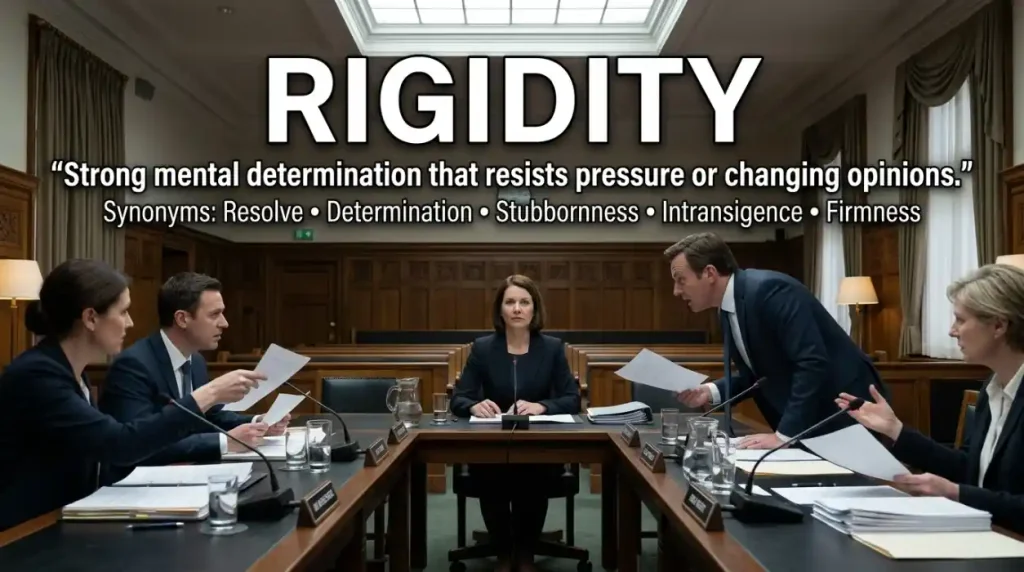
Meaning: Strong mental determination that resists pressure or changing opinions.
Tone/Register: Formal and literary.
Example:
“She showed remarkable firmness of mind under pressure.”
“His firmness of mind helped him remain calm during the debate.”
Synonyms by Tone
Positive or constructive
Some alternatives can describe a useful form of strength rather than an undesirable lack of flexibility.
- Firmness
- Stability
- Tenacity
- Determination
- Perseverance
- Resolve
- Steadfastness
- Constancy
- Solidity
These are useful when you want to emphasize strength, reliability, persistence, or stability.
Neutral
These words can describe a condition without strongly criticizing it.
- Stiffness
- Rigidity
- Fixedness
- Resistance
- Permanence
- Inelasticity
- Hardness
- Immovability
- Stability
They work especially well in technical, scientific, or descriptive writing.
Negative
These alternatives often suggest an inability or unwillingness to adapt.
- Inflexibility
- Stubbornness
- Obstinacy
- Intransigence
- Dogmatism
- Obduracy
- Intractability
- Unbendingness
- Uncompromisingness
- Entrenchment
Why Tone Matters
Choosing a synonym is not simply about finding another word with a similar dictionary definition.
Compare:
“Her rigidity impressed the team.”
This sounds unusual because rigidity often carries criticism.
“Her steadfastness impressed the team.”
This sounds more positive.
Likewise:
“The rigidity of the frame improved stability.”
Here, rigidity is technical and useful.
Understanding tone helps your writing sound natural rather than mechanically substituted.
“Rigidity” vs Close Alternatives
Inflexibility vs Rigidity
Rigidity is broader. It can describe physical stiffness, rules, systems, or thinking.
Inflexibility usually focuses on an unwillingness or inability to adapt.
Use rigidity for both physical and figurative situations. Use inflexibility when the main idea is lack of adaptation.
Rigidity vs Stubbornness
Rigidity can describe a system, rule, structure, or person.
Stubbornness normally describes a person or their behavior.
You can say:
“The rigidity of the schedule caused problems.”
But:
“The stubbornness of the schedule” sounds unnatural.
Rigidity vs Intransigence
Intransigence is much more specific. It describes refusal to compromise, especially during disagreements or negotiations.
“Rigidity” is broader.
“The policy showed rigidity.”
“The negotiator showed intransigence.”
The second sentence strongly suggests refusal to compromise.
How “Rigidity” Changes by Context
Daily Conversation
In everyday speech, people often prefer simpler alternatives.
Instead of:
“His rigidity is frustrating.”
You might hear:
“He’s being stubborn.”
Instead of:
“The rules have excessive rigidity.”
A speaker may simply say:
“The rules are too strict.”
This does not make “rigidity” incorrect. It simply makes the alternative more conversational.
Writing and Blogging
Bloggers often use rigidity, inflexibility, stubbornness, and strictness.
The choice depends on the subject.
For example:
- workplace rules → inflexibility
- personal behavior → stubbornness
- school regulations → strictness
- physical materials → stiffness or rigidity
- outdated systems → institutional rigidity or inertia
Using precise alternatives improves readability without forcing unnecessary vocabulary.
Professional and Academic Writing
Formal writing often benefits from terms such as:
- inelasticity
- intransigence
- inflexibility
- entrenchment
- ossification
- dogmatism
- rigidity
However, specialized vocabulary should only be used when it communicates a real distinction.
“Rigidity” is often better than a complicated alternative when the context is already clear.
Creative or Informal Use
Creative writers may choose words such as unyieldingness, obstinacy, stubbornness, hardness, or steadfastness to shape a character.
For example:
“His stubbornness was obvious.”
This is direct.
“His unyieldingness gave him an almost iron-like presence.”
This is more literary.
Common Mistakes Learners Make
Mistake 1: Using “stubbornness” for objects
“Stubbornness” normally describes people or behavior.
Incorrect:
“The stubbornness of the steel.”
Better:
“The stiffness of the steel.”
Mistake 2: Using “intransigence” everywhere
Intransigence is not simply another word for physical rigidity.
It usually involves refusal to compromise.
Mistake 3: Treating “firmness” as always negative
Firmness can be positive.
A firm decision may show confidence.
Rigidity usually suggests excessive resistance to change when it describes behavior.
Mistake 4: Confusing rigidity with strength
A rigid object may be strong, but the two concepts are not identical.
Rigidity concerns resistance to bending or deformation. Strength concerns the ability to withstand force or failure.
Mistake 5: Replacing every use of rigidity
Synonyms should not be inserted merely to avoid repetition.
If “rigidity” is the most accurate word, keep it.
Good vocabulary means choosing the right word, not constantly choosing a different word.
Register Notes
Formal: intransigence, obduracy, inelasticity, ossification, entrenchment
Neutral: rigidity, stiffness, inflexibility, strictness, resistance
Conversational: stubbornness, being too strict, refusing to change
Positive: firmness, steadfastness, determination, resolve, perseverance
Technical: rigidity, stiffness, inelasticity, hardness, structural stability
For related vocabulary, an internal link such as “synonyms for flexibility” can help readers compare the opposite semantic field.
Real-Life Mini Scenarios
Workplace
A team has a deadline, but one employee refuses every reasonable adjustment.
A manager might describe this as rigidity or inflexibility.
If the employee refuses to compromise during a dispute, intransigence may be more precise.
Social Situation
A friend insists that plans must always happen exactly as originally arranged.
You might casually call this stubbornness.
In a formal discussion, you might describe it as rigidity.
Media and Pop Culture
A fictional villain may follow a strict code without considering circumstances.
A writer could describe the character’s dogmatism, rigidity, or uncompromisingness.
Each word creates a slightly different impression.
Writing and Storytelling
A novelist describing an old iron gate might write about its stiffness, hardness, or rigidity.
Describing a character’s refusal to change would call for stubbornness, obstinacy, or unyieldingness instead.
Practice Quiz
1. A metal frame cannot bend easily. Which word fits best?
A. Stubbornness
B. Stiffness
C. Dogmatism
D. Intransigence
2. A manager refuses to consider any alternative schedule.
A. Hardness
B. Solidity
C. Inflexibility
D. Permanence
3. Two negotiators refuse to make any compromise.
A. Intransigence
B. Stability
C. Stiffness
D. Firmness
4. A student continues working despite repeated failures.
A. Obstinacy
B. Perseverance
C. Strictness
D. Inelasticity
5. A company keeps using an outdated system because nobody wants to change it.
A. Inertia
B. Firmness
C. Hardness
D. Tenacity
6. A teacher applies rules very strictly.
A. Strictness
B. Solidity
C. Constancy
D. Hardness
7. A person refuses to change an opinion even after hearing strong evidence.
A. Stability
B. Obstinacy
C. Stiffness
D. Permanence
8. A scientific material resists deformation.
A. Stubbornness
B. Dogmatism
C. Rigidity
D. Obduracy
9. A leader remains determined during a difficult crisis.
A. Steadfastness
B. Inflexibility
C. Intransigence
D. Ossification
10. An organization has developed deeply established practices that are difficult to reform.
A. Entrenchment
B. Firmness
C. Hardness
D. Stiffness
Answer key: 1-B | 2-C | 3-A | 4-B | 5-A | 6-A | 7-B | 8-C | 9-A | 10-A
Reflection Task
Write one sentence using rigidity, then rewrite the same sentence with a more precise alternative such as inflexibility, stiffness, stubbornness, intransigence, or steadfastness.
External Source
For authoritative reference and further study, useful sources include Oxford Learner’s Dictionaries — rigidity, Cambridge Dictionary — rigidity, and Etymonline — rigidity etymology. These support the core definitions, pronunciation, usage distinctions, and historical information used above.
Conclusion
Learning synonyms for rigidity gives you more control over tone. You can describe strict rules, stiff materials, stubborn behavior, or stable structures with greater precision.
A strong vocabulary also improves essays, blogs, emails, presentations, and everyday conversations. The goal is accuracy, not simply using complicated words.
Keep practicing by replacing repeated words in your own writing. Try one new alternative in an email, essay, journal entry, or daily conversation.
The best synonym is the one that fits the meaning naturally. Practice these choices regularly, and your English will become clearer, sharper, and more confident.
Frequently Asked Questions
1. What is the best synonym for rigidity when describing strict rules?
Inflexibility is often the closest choice when strict rules cannot easily be changed. Strictness works when the focus is on how demanding the rules are. Rigidity is broader and can suggest that the rules are excessively fixed. In professional writing, choose the word that highlights the exact problem rather than replacing “rigidity” automatically.
2. Which synonym for rigidity is best for describing a stubborn person?
Stubbornness is the most natural everyday choice. It directly describes someone who refuses to change their opinion or behavior. In formal writing, obstinacy, intransigence, or obduracy may be more precise. The difference depends on whether you want to emphasize persistence, refusal to compromise, or general resistance to change.
3. What is a good synonym for rigidity in academic writing?
The best academic alternative depends on the subject. Inflexibility works for systems or policies, intransigence suits refusal to compromise, inertia describes resistance to movement or reform, and ossification can describe systems that have become deeply fixed. Avoid choosing a sophisticated word simply because it sounds academic; precision matters more than complexity.
4. What is the difference between rigidity and inflexibility?
Rigidity can describe physical stiffness as well as resistance to change in ideas, rules, or behavior. Inflexibility focuses more strongly on an inability or unwillingness to adapt. You can describe a rigid metal frame, but “inflexible metal frame” may sound more figurative. For policies and attitudes, the two words often overlap.
5. Can rigidity have a positive meaning?
Yes. In technical contexts, rigidity can be useful because a rigid structure may provide stability, support, or resistance to deformation. The word becomes more negative when it describes a person, rule, or system that refuses reasonable change. Context therefore determines whether rigidity sounds like a strength, a neutral property, or a weakness.

Shahzeena Shazadi is the founder and lead writer at VocablyHub.com, where she creates accurate, reader-focused English language content designed to help people communicate with clarity and confidence. She specializes in synonyms, antonyms, word meanings, idioms, and practical vocabulary guides that simplify complex language concepts for everyday use. Every article is carefully researched, fact-checked, and written in clear, accessible language using reliable references and real-world examples. Her goal is to provide helpful, trustworthy content that supports learners at every stage of their English language journey.
Her editorial approach focuses on accuracy, transparency, and user value while following modern content quality standards. She regularly reviews and updates content to keep information relevant, useful, and easy to understand. Through VocablyHub.com, Shahzeena Shazadi is committed to publishing reliable language resources that help students, writers, educators, professionals, and English learners expand their vocabulary, improve their writing skills, and communicate with confidence in academic, professional, and everyday situations.