
Synonyms for one after another can make your English more natural when people, actions, or events happen in sequence. Instead of repeating the same phrase, you can choose a better-fitting alternative.
Imagine guests arriving at a wedding one after another. You could also say they arrived one by one, in succession, or in turn, depending on the exact situation.
For students, bloggers, and content writers, synonyms for one after another add variety and precision. They help essays, stories, articles, and everyday descriptions sound smoother and more engaging.
Learning synonyms for one after another is also useful in daily conversations. Once you understand the small differences between these expressions, choosing the right word becomes much easier.
What Does “One After Another” Really Mean?
“One after another” means that people, things, or events happen or appear successively, with each following the previous one.
For example:
The guests arrived one after another.
This means the guests did not all arrive at exactly the same moment. Instead, each person arrived after the previous person.
The phrase is generally neutral. It can describe ordinary, positive, or negative situations.
Native speakers commonly use it in conversations, storytelling, news reports, essays, workplace communication, and general descriptions.
Part of Speech
“One after another” is an adverbial phrase because it explains how an action happens.
Simple definition: Something happens in sequence, with one person, thing, or event following another.
Connotative Meaning
Connotation (the feeling or association suggested by a word beyond its basic meaning) can change slightly depending on the alternative you select.
Positive tone: Words such as smoothly or phrases such as in orderly succession can suggest organized progress when the context supports that meaning.
Negative tone: Back-to-back or relentlessly can sometimes suggest pressure or an overwhelming series of events.
Neutral tone: One by one, successively, in turn, and in sequence usually describe order without strong emotion.
Therefore, word choice matters. The best synonym depends on the exact situation.
Etymology of “One After Another”
The phrase consists of words with deep Germanic and Old English roots.
One comes from Old English ān, meaning “one” or “a single person or thing.”
After comes from Old English æfter, referring to something that follows in time, position, or order.
Another developed from an other, meaning “an additional or different one.”
Old English: 450–1100
The individual elements were already present in Old English. Ān expressed the idea of one, while æfter described something following another thing.
The exact modern phrase was not necessarily used in its present form.
Middle English: 1100–1500
During Middle English, English grammar and vocabulary gradually moved toward modern structures. Expressions involving one, after, and other became more familiar in forms closer to today’s English.
Modern English: 1500–Present
Modern English established one after another as a common expression for sequential events, actions, objects, and people.
Today, it remains a natural and widely understood phrase.
Pronunciation
US: /wʌn ˈæftər əˈnʌðər/
UK: /wʌn ˈɑːftə əˈnʌðə/
Syllables
one-af-ter-a-noth-er
Affixation Pattern of “One After Another”
The expression is a multi-word phrase rather than a single word, so it does not have a normal prefix-and-suffix structure.
Root elements:
- one — Old English ān
- after — Old English æfter
- another — historically related to an other
Prefix: None.
Suffix: None attached to the complete phrase.
Synonyms List:
Successively (Adverb) — US: /səkˈsesɪvli/ | UK: /səkˈsesɪvli/
Meaning: Happening or appearing one after another in sequence.
Tone/Register: Formal, academic, professional
Example: The speakers presented their ideas successively.
The warnings appeared successively on the screen.

Consecutively (Adverb) — US: /kənˈsekjətɪvli/ | UK: /kənˈsekjətɪvli/
Meaning: Happening continuously in an uninterrupted sequence.
Tone/Register: Formal, neutral
Example: She won four matches consecutively.
He worked six days consecutively.
Sequentially (Adverb) — US: /sɪˈkwenʃəli/ | UK: /sɪˈkwenʃəli/
Meaning: Happening according to a defined sequence or order.
Tone/Register: Academic, technical
Example: Read the chapters sequentially.
The system processes each request sequentially.
In Succession (Adverbial Phrase) — US: /ɪn səkˈseʃən/ | UK: /ɪn səkˈseʃən/
Meaning: Happening one after another in a continuous or established sequence.
Tone/Register: Formal, neutral
Example: Three managers spoke in succession.
The bells rang several times in succession.
In Sequence (Adverbial Phrase) — US: /ɪn ˈsiːkwəns/ | UK: /ɪn ˈsiːkwəns/
Meaning: Happening according to a particular order.
Tone/Register: Neutral, academic
Example: The pictures appeared in sequence.
The instructions should be followed in sequence.
One by One (Adverbial Phrase) — US: /wʌn baɪ wʌn/ | UK: /wʌn baɪ wʌn/
Meaning: Happening individually, with each person or thing following another.
Tone/Register: Neutral, conversational
Example: The children entered one by one.
She opened the gifts one by one.
In Turn (Adverbial Phrase) — US: /ɪn tɝːn/ | UK: /ɪn tɜːn/
Meaning: Happening separately as each person or thing takes their opportunity.
Tone/Register: Neutral, conversational
Example: The students answered in turn.
Each guest introduced themselves in turn.
In a Row (Adverbial Phrase) — US: /ɪn ə roʊ/ | UK: /ɪn ə rəʊ/
Meaning: Happening repeatedly without interruption.
Tone/Register: Informal, conversational
Example: He missed three classes in a row.
The team won five games in a row.
Back-to-Back (Adverbial Phrase) — US: /ˌbæk tə ˈbæk/ | UK: /ˌbæk tə ˈbæk/
Meaning: Happening immediately one after another with little or no break.
Tone/Register: Informal, modern
Example: I have two back-to-back meetings.
The singer performed back-to-back shows.
In Order (Adverbial Phrase) — US: /ɪn ˈɔːrdər/ | UK: /ɪn ˈɔːdə/
Meaning: Happening according to an established arrangement or sequence.
Tone/Register: Neutral
Example: The names were called in order.
Put the documents in order.
In Series (Adverbial Phrase) — US: /ɪn ˈsɪriz/ | UK: /ɪn ˈsɪəriːz/
Meaning: Happening as part of a connected sequence of events.
Tone/Register: Neutral, formal
Example: The experiments were conducted in series.
The episodes were released in series.
Following One Another (Verb Phrase) — US: /ˈfɑːloʊɪŋ wʌn əˈnʌðər/ | UK: /ˈfɒləʊɪŋ wʌn əˈnʌðə/
Meaning: Coming or occurring with one following the previous one.
Tone/Register: Neutral, descriptive
Example: Storms came following one another.
New questions kept following one another.
Following in Succession (Verb Phrase) — US: /ˈfɑːloʊɪŋ ɪn səkˈseʃən/ | UK: /ˈfɒləʊɪŋ ɪn səkˈseʃən/
Meaning: Coming one after another in an established sequence.
Tone/Register: Formal, literary
Example: Several leaders spoke, following in succession.
The scenes unfold in succession.
Consecutively Ordered (Adjectival Phrase) — US: /kənˈsekjətɪvli ˈɔːrdərd/ | UK: /kənˈsekjətɪvli ˈɔːdəd/
Meaning: Arranged in uninterrupted order.
Tone/Register: Formal, academic
Example: The records were consecutively ordered.
The files were consecutively ordered by date.
Sequentially Ordered (Adjectival Phrase) — US: /sɪˈkwenʃəli ˈɔːrdərd/ | UK: /sɪˈkwenʃəli ˈɔːdəd/
Meaning: Arranged according to a specific sequence.
Tone/Register: Academic, technical
Example: The data were sequentially ordered.
The steps are sequentially ordered for clarity.
In Chronological Order (Adverbial Phrase) — US: /ɪn ˌkrɑːnəˈlɑːdʒɪkəl ˈɔːrdər/ | UK: /ɪn ˌkrɒnəˈlɒdʒɪkəl ˈɔːdə/
Meaning: Happening according to when events occur in time.
Tone/Register: Academic, formal
Example: The historical events are listed in chronological order.
Arrange the photographs in chronological order.
Chronologically (Adverb) — US: /ˌkrɑːnəˈlɑːdʒɪkli/ | UK: /ˌkrɒnəˈlɒdʒɪkli/
Meaning: According to the order in which events happen in time.
Tone/Register: Academic, formal
Example: The story is told chronologically.
The documents were organized chronologically.
Individually (Adverb) — US: /ˌɪndɪˈvɪdʒuəli/ | UK: /ˌɪndɪˈvɪdʒuəli/
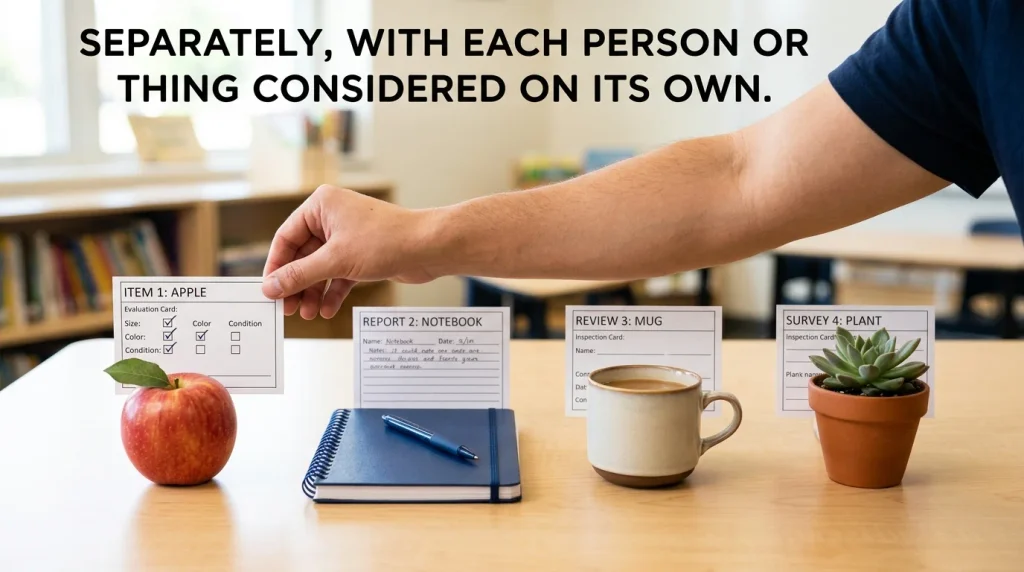
Meaning: Separately, with each person or thing considered on its own.
Tone/Register: Neutral, professional
Example: The applicants were interviewed individually.
Each case was examined individually.
Separately (Adverb) — US: /ˈsepərətli/ | UK: /ˈsepərətli/
Meaning: Apart from others rather than at the same time.
Tone/Register: Neutral, professional
Example: The guests entered separately.
The issues were discussed separately.
Individually in Order (Adverbial Phrase) — US: /ˌɪndɪˈvɪdʒuəli ɪn ˈɔːrdər/ | UK: /ˌɪndɪˈvɪdʒuəli ɪn ˈɔːdə/
Meaning: Happening separately while maintaining a particular order.
Tone/Register: Formal, explanatory
Example: The candidates were evaluated individually in order.
The samples were examined individually in order.
In a Sequence (Adverbial Phrase) — US: /ɪn ə ˈsiːkwəns/ | UK: /ɪn ə ˈsiːkwəns/
Meaning: Happening as connected steps or events in a particular order.
Tone/Register: Neutral
Example: The lights switched on in a sequence.
The events occurred in a sequence.
In Continuous Succession (Adverbial Phrase) — US: /ɪn kənˈtɪnjuəs səkˈseʃən/ | UK: /ɪn kənˈtɪnjuəs səkˈseʃən/
Meaning: Happening repeatedly without a significant interruption.
Tone/Register: Formal
Example: New alerts arrived in continuous succession.
The changes occurred in continuous succession.
In Rapid Succession (Adverbial Phrase) — US: /ɪn ˈræpɪd səkˈseʃən/ | UK: /ɪn ˈræpɪd səkˈseʃən/
Meaning: Happening one after another very quickly.
Tone/Register: Formal, descriptive
Example: Three questions came in rapid succession.
The flashes appeared in rapid succession.
In Quick Succession (Adverbial Phrase) — US: /ɪn kwɪk səkˈseʃən/ | UK: /ɪn kwɪk səkˈseʃən/
Meaning: Happening one after another within a short period.
Tone/Register: Neutral, descriptive
Example: Two buses arrived in quick succession.
Several messages appeared in quick succession.
In Close Succession (Adverbial Phrase) — US: /ɪn kloʊs səkˈseʃən/ | UK: /ɪn kləʊs səkˈseʃən/
Meaning: Happening one after another with little time between them.
Tone/Register: Formal
Example: Several visitors arrived in close succession.
The announcements came in close succession.
In Rapid Sequence (Adverbial Phrase) — US: /ɪn ˈræpɪd ˈsiːkwəns/ | UK: /ɪn ˈræpɪd ˈsiːkwəns/
Meaning: Happening one after another at high speed.
Tone/Register: Formal, descriptive
Example: The images changed in rapid sequence.
Events unfolded in rapid sequence.
In Quick Sequence (Adverbial Phrase) — US: /ɪn kwɪk ˈsiːkwəns/ | UK: /ɪn kwɪk ˈsiːkwəns/
Meaning: Happening in a short and orderly progression.
Tone/Register: Neutral
Example: The doors opened in quick sequence.
The players scored in quick succession.
In Succession to One Another (Adverbial Phrase) — US: /ɪn səkˈseʃən tə wʌn əˈnʌðər/ | UK: /ɪn səkˈseʃən tə wʌn əˈnʌðə/
Meaning: Happening with each event directly following another.
Tone/Register: Formal
Example: The scenes appear in succession to one another.
The announcements followed in succession to one another.
One Following the Other (Adverbial Phrase) — US: /wʌn ˈfɑːloʊɪŋ ði ˈʌðər/ | UK: /wʌn ˈfɒləʊɪŋ ði ˈʌðə/
Meaning: One person or thing comes after another.
Tone/Register: Neutral, descriptive
Example: The cars passed, one following the other.
The runners crossed the line, one following the other.
One After the Other (Adverbial Phrase) — US: /wʌn ˈæftər ði ˈʌðər/ | UK: /wʌn ˈɑːftə ði ˈʌðə/
Meaning: Each person or thing follows the previous one.
Tone/Register: Neutral, conversational
Example: The questions arrived one after the other.
The children came one after the other.
In Succession to Each Other (Adverbial Phrase) — US: /ɪn səkˈseʃən tə iːtʃ ˈʌðər/ | UK: /ɪn səkˈseʃən tə iːtʃ ˈʌðə/
Meaning: Occurring one after another in an ordered series.
Tone/Register: Formal
Example: The leaders addressed the audience in succession to each other.
The events occurred in succession to each other.
In Sequence One After Another (Adverbial Phrase) — US: /ɪn ˈsiːkwəns wʌn ˈæftər əˈnʌðər/ | UK: /ɪn ˈsiːkwəns wʌn ˈɑːftə əˈnʌðə/
Meaning: Following a clear sequence where each item comes after the previous one.
Tone/Register: Explanatory
Example: The numbers appeared in sequence, one after another.
The steps were completed in sequence, one after another.
In Order of Appearance (Adverbial Phrase) — US: /ɪn ˈɔːrdər əv əˈpɪrəns/ | UK: /ɪn ˈɔːdə əv əˈpɪərəns/
Meaning: Presented according to when each person or thing appears.
Tone/Register: Formal, academic
Example: The actors were listed in order of appearance.
The photographs were displayed in order of appearance.
In Order of Arrival (Adverbial Phrase) — US: /ɪn ˈɔːrdər əv əˈraɪvəl/ | UK: /ɪn ˈɔːdə əv əˈraɪvəl/
Meaning: Arranged according to when people or things arrive.
Tone/Register: Neutral, formal
Example: Customers were served in order of arrival.
The vehicles were parked in order of arrival.
In Order of Occurrence (Adverbial Phrase) — US: /ɪn ˈɔːrdər əv əˈkɝːəns/ | UK: /ɪn ˈɔːdə əv əˈkʌrəns/
Meaning: Presented according to when events happen.
Tone/Register: Formal, academic
Example: The incidents were recorded in order of occurrence.
The report lists the events in order of occurrence.
In Order of Events (Adverbial Phrase) — US: /ɪn ˈɔːrdər əv ɪˈvents/ | UK: /ɪn ˈɔːdə əv ɪˈvents/
Meaning: Following the sequence in which events happen.
Tone/Register: Neutral
Example: Tell the story in order of events.
The report explains the process in order of events.
Step by Step (Adverbial Phrase) — US: /step baɪ step/ | UK: /step baɪ step/
Meaning: Progressing through separate stages in sequence.
Tone/Register: Neutral, instructional
Example: We solved the problem step by step.
The teacher explained the process step by step.
Stage by Stage (Adverbial Phrase) — US: /steɪdʒ baɪ steɪdʒ/ | UK: /steɪdʒ baɪ steɪdʒ/
Meaning: Progressing through separate stages in an ordered way.
Tone/Register: Professional, explanatory
Example: The project developed stage by stage.
The plan was reviewed stage by stage.
Phase by Phase (Adverbial Phrase) — US: /feɪz baɪ feɪz/ | UK: /feɪz baɪ feɪz/
Meaning: Happening through distinct phases in sequence.
Tone/Register: Professional, technical
Example: The construction work continued phase by phase.
The program was introduced phase by phase.
Serially (Adverb) — US: /ˈsɪriəli/ | UK: /ˈsɪəriəli/
Meaning: Happening one at a time as part of an ordered series.
Tone/Register: Technical, formal
Example: The machines were tested serially.
The applications were processed serially.
Serially Arranged (Adjectival Phrase) — US: /ˈsɪriəli əˈreɪndʒd/ | UK: /ˈsɪəriəli əˈreɪndʒd/
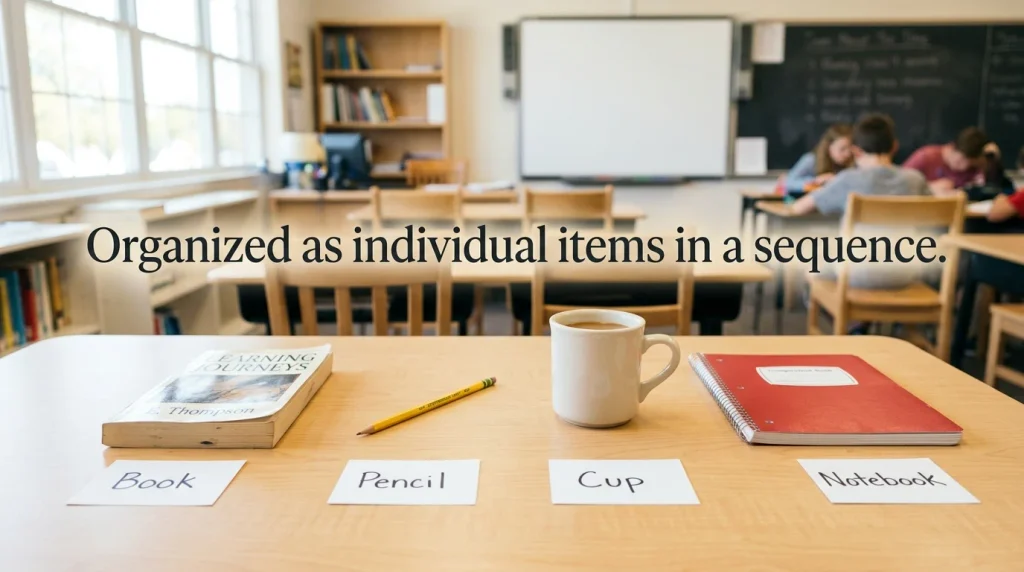
Meaning: Organized as individual items in a sequence.
Tone/Register: Technical, formal
Example: The samples were serially arranged.
The records were serially arranged by number.
In Orderly Succession (Adverbial Phrase) — US: /ɪn ˈɔːrdərli səkˈseʃən/ | UK: /ɪn ˈɔːdəli səkˈseʃən/
Meaning: Happening one after another in a neat and organized manner.
Tone/Register: Formal, descriptive
Example: The guests entered in orderly succession.
The stages appeared in orderly succession.
In Regular Succession (Adverbial Phrase) — US: /ɪn ˈreɡjələr səkˈseʃən/ | UK: /ɪn ˈreɡjələ səkˈseʃən/
Meaning: Happening repeatedly in a predictable sequence.
Tone/Register: Formal, literary
Example: New visitors arrived in regular succession.
The announcements appeared in regular succession.

Synonyms by Tone
Positive and Orderly
Use in orderly succession, in sequence, successively, or in turn when the sequence feels organized and controlled.
For example, a well-planned ceremony may have speakers presenting ideas one after another in an orderly way.
Neutral
The most flexible choices include one by one, one after the other, in turn, in order, and following one another.
These expressions work in ordinary conversations and general writing.
Formal and Academic
For academic or professional writing, successively, consecutively, sequentially, chronologically, and in succession are useful.
However, simple language is still preferable when it communicates the idea more clearly.
Informal
For casual speech, one by one, in a row, and back-to-back are especially natural.
These expressions sound conversational and are common in everyday situations.
Fast or Intense
When events happen very quickly, use in rapid succession, in quick succession, in rapid sequence, or in close succession.
These alternatives add information about speed or timing.
Why Tone Matters in Word Choice
Not every synonym has the same meaning.
For example, one by one emphasizes individuality, while consecutively emphasizes uninterrupted repetition.
Similarly, chronologically is specifically connected with time. Therefore, it should not be used for every type of sequence.
Meanwhile, back-to-back suggests little or no break between events. As a result, it is especially useful for meetings, appointments, games, performances, or other closely timed activities.
“One After Another” vs Close Alternatives
One After Another vs One by One
One after another focuses on sequence. One by one focuses on individual action.
“Guests arrived one after another” describes their arrival pattern.
“The guests were interviewed one by one” emphasizes that each guest received individual treatment.
One After Another vs Consecutively
Consecutively usually suggests uninterrupted or continuous repetition.
“He worked five days consecutively” sounds more formal.
“He worked five days in a row” is more conversational.
One After Another vs Sequentially
Sequentially suggests a defined or organized sequence.
It is especially useful for procedures, instructions, data, technical systems, and academic explanations.
One After Another vs In Turn
In turn often involves people taking their opportunity.
For example, students may answer questions in turn.
The phrase can therefore imply participation rather than merely physical or chronological order.
One After Another vs Back-to-Back
Back-to-back strongly suggests that events occur with little or no break.
For example, “I have back-to-back meetings” sounds natural when meetings are scheduled closely together.
How “One After Another” Changes by Context
Daily Conversation
Simple expressions are usually best in casual speech.
For example, “The kids came in one by one” sounds natural and friendly.
You can also say, “The buses arrived one after another.”
Writing and Blogging
Writers can vary their language by choosing alternatives that match the exact context.
Instead of repeatedly using “one after another,” you can use successively, in turn, in sequence, or following one another.
This improves vocabulary variety without making the writing difficult.
Professional Writing
Professional English often favors precision.
Use consecutively when uninterrupted repetition matters.
Use sequentially when a defined order matters.
Use in order of arrival when people or items must be processed according to arrival time.
Academic Writing
Academic writers often need to explain processes clearly.
Terms such as sequentially, chronologically, successively, and in succession can help describe research stages, historical events, experiments, or procedures.
Creative Writing
Creative writing gives you more freedom.
“One by one, the windows went dark” creates a visual image.
“The windows went dark successively” is more detached and formal.
Therefore, the best choice depends on the mood you want to create.
Common Mistakes Learners Make
Mistake 1: Using “Consecutively” Everywhere
Consecutively is not a universal replacement.
It works best when something happens continuously or repeatedly without interruption.
Mistake 2: Confusing “One by One” With “At the Same Time”
“One by one” means separately.
If everyone acts simultaneously, this expression is incorrect.
Mistake 3: Using “Chronologically” for Every Sequence
Chronological order means time order.
If books are arranged by size, for example, chronological language would be inappropriate.
Mistake 4: Overusing Technical Words
“Sequentially” is correct, but it may sound overly technical in casual conversation.
In everyday situations, one by one or in order is often more natural.
Mistake 5: Assuming Every Alternative Has the Same Meaning
Synonyms often overlap, but they are rarely identical.
Always consider whether you want to emphasize order, speed, continuity, individuality, or timing.
Native Usage and Register Notes
Native speakers usually prefer the simplest expression that fits the situation.
One by one is common in conversation.
In turn is useful when people take turns.
In a row is common for repeated results.
Back-to-back is informal and often describes closely scheduled events.
Successively, consecutively, and sequentially are more formal.
Therefore, do not choose a synonym simply because it sounds sophisticated. Choose it because it expresses your intended meaning accurately.
Real-Life Mini Scenarios
Workplace
A manager may interview candidates one by one.
An employee may have three back-to-back meetings.
Social Situations
Guests may arrive one after another at a party.
During a discussion, people may speak in turn.
School and Education
Students may answer questions in turn.
A teacher may explain a difficult process step by step.
Media and News
A reporter may describe events in chronological order.
A series of announcements may arrive in rapid succession.
Sports
A team may win several games consecutively.
A player may score three times in a row.
Storytelling
A writer may describe doors closing one by one.
A dramatic scene may show several events happening in quick succession.
Quick Guide to Choosing the Right Alternative
Use one by one when people or things are handled individually.
Use in turn when people take turns.
Use consecutively when events occur continuously.
Use sequentially when events follow a defined process.
Use chronologically when events are arranged by time.
Use back-to-back when events happen with almost no break.
Use in a row for repeated events, especially in casual speech.
Use in succession for a polished formal description.
Use in rapid succession when events happen very quickly.
Use step by step when a process develops through separate stages.
Interactive Practice Quiz
Choose the best answer for each situation.
1. The students entered the room ___.
A. one by one
B. simultaneously
C. randomly
D. together
2. She won five matches ___.
A. separately
B. consecutively
C. individually
D. occasionally
3. Read the instructions ___.
A. sequentially
B. randomly
C. emotionally
D. separately
4. The students answered the teacher ___.
A. in turn
B. simultaneously
C. accidentally
D. randomly
5. I have three ___ meetings this afternoon.
A. chronological
B. back-to-back
C. individual
D. serial
6. The historical events were presented ___.
A. in chronological order
B. back-to-back
C. individually
D. randomly
7. The children received their certificates ___.
A. in turn
B. simultaneously
C. unpredictably
D. together
8. The team suffered three defeats ___.
A. successively
B. separately
C. individually
D. occasionally
9. Arrange the documents ___.
A. in order
B. emotionally
C. suddenly
D. loudly
10. The images appeared ___ on the screen.
A. in sequence
B. randomly
C. simultaneously
D. independently
11. Which option sounds most conversational?
A. Sequentially
B. Consecutively
C. One by one
D. Chronologically
12. Which option is most suitable for academic writing?
A. Sequentially
B. Back-to-back
C. In a row
D. One by one
13. Which alternative specifically refers to time order?
A. In turn
B. Chronologically
C. Individually
D. Back-to-back
14. Which phrase suggests almost no break between events?
A. Back-to-back
B. Separately
C. Chronologically
D. Individually
15. Which phrase emphasizes individual treatment?
A. One by one
B. Consecutively
C. Sequentially
D. Successively
Reflection Task: Write one sentence about something you experienced recently using any synonym or alternative for “one after another.”
Answer Key: 1-A, 2-B, 3-A, 4-A, 5-B, 6-A, 7-A, 8-A, 9-A, 10-A, 11-C, 12-A, 13-B, 14-A, 15-A
FAQs
1. What are the best synonyms for one after another in everyday English?
The most natural everyday alternatives are one by one, in turn, one after the other, and in a row, depending on the context. “One by one” is especially useful when people or objects are handled separately. “In a row” works well for repeated events, while “in turn” often describes people taking individual opportunities.
2. What is a formal synonym for one after another?
Successively, consecutively, sequentially, and in succession are strong formal alternatives. However, each has a slightly different use. “Sequentially” emphasizes an established order, while “consecutively” emphasizes continuous occurrence. “Successively” is broader and works well when several events happen in sequence.
3. Is one by one the same as one after another?
They are closely related but not completely identical. One by one emphasizes that people or things act individually. One after another focuses more on the sequence in which they occur. For example, “The students were interviewed one by one” highlights individual interviews, while “The students arrived one after another” highlights their arrival sequence.
4. What is the difference between sequentially and consecutively?
Sequentially means according to a particular order or sequence. Consecutively means continuously, with events following one another without interruption. A set of instructions may be completed sequentially, while a player may score in three consecutive games. The words overlap, but their emphasis is different.
5. Can one after another describe negative events?
Yes. The expression is neutral and can describe positive, negative, or ordinary events. You could say that problems appeared one after another, that customers arrived one after another, or that exciting opportunities came one after another. The emotional meaning comes mainly from the surrounding words and situation.
6. Which synonym for one after another is best for academic writing?
For academic writing, sequentially, successively, consecutively, and chronologically can be useful. The correct choice depends on the relationship being described. Use “chronologically” for time order, “sequentially” for an established sequence, and “consecutively” for uninterrupted repetition.
7. What is a casual way to say one after another?
In casual English, one by one, one after the other, in a row, and back-to-back are common choices. “One by one” works especially well for people or objects. “In a row” describes repeated events, while “back-to-back” suggests events happening with very little time between them.
8. How can ESL learners practice these alternatives?
Start by choosing three expressions with different meanings: one by one, consecutively, and sequentially. Then write one sentence for each. Next, use them in an email, short story, or conversation. Practicing them in realistic situations helps you remember not only the words but also the context in which native speakers use them.
Conclusion
Learning synonyms for one after another gives you more flexible ways to describe people, actions, events, and processes that follow a clear sequence. Each alternative can add a slightly different meaning or tone.
For students, writers, bloggers, and daily English users, synonyms for one after another can reduce repetition and make communication more precise. Words like successively, consecutively, sequentially, and one by one work best in different contexts.
By practicing synonyms for one after another in essays, emails, stories, and conversations, you can gradually build stronger vocabulary. Choose a few alternatives today, create your own sentences, and use them naturally in real-life English.

Shahzeena Shazadi is the founder and lead writer at VocablyHub.com, where she creates accurate, reader-focused English language content designed to help people communicate with clarity and confidence. She specializes in synonyms, antonyms, word meanings, idioms, and practical vocabulary guides that simplify complex language concepts for everyday use. Every article is carefully researched, fact-checked, and written in clear, accessible language using reliable references and real-world examples. Her goal is to provide helpful, trustworthy content that supports learners at every stage of their English language journey.
Her editorial approach focuses on accuracy, transparency, and user value while following modern content quality standards. She regularly reviews and updates content to keep information relevant, useful, and easy to understand. Through VocablyHub.com, Shahzeena Shazadi is committed to publishing reliable language resources that help students, writers, educators, professionals, and English learners expand their vocabulary, improve their writing skills, and communicate with confidence in academic, professional, and everyday situations.