
A synonym for orderly can help when “orderly” feels too plain. Imagine a tidy desk where every book has its place, and nothing looks out of control.
In daily English, orderly describes things that are neat, organized, or well arranged. A synonym for orderly can make your writing more precise and natural.
Students can use these alternatives in essays and assignments. Bloggers and writers can avoid repetition, while daily English users can speak with greater confidence.
Learning a synonym for orderly also shows how small word choices change tone. You may need “tidy” for a room or “methodical” for a careful working style.
What Does “Orderly” Really Mean?
Orderly means arranged, organized, neat, or controlled sensibly.
It is most commonly used as an adjective. It can describe a room, workplace, process, event, queue, person, or general situation.
For example:
- The classroom was clean and orderly.
- She keeps her notes in an orderly fashion.
- The visitors formed an orderly line.
- He has an orderly approach to his work.
Native speakers usually understand orderly as positive or neutral. It suggests that things are under control and arranged properly.
The exact meaning depends on context. For a physical space, orderly often means tidy. In the context of behavior, it can suggest being disciplined, controlled, or well-behaved.
When describing a process, it may mean systematic, structured, or methodical.
Part of Speech
Orderly is primarily an adjective.
It can also function as a noun in specific contexts, especially in medical or institutional settings. As a noun, an orderly may refer to a hospital worker who performs various support duties.
For synonym purposes, however, the adjective meaning is the main focus.
Connotative Meaning of “Orderly”
Connotation means the feeling, attitude, or association that a word can suggest beyond its basic dictionary meaning.
Positive Tone
Orderly can suggest cleanliness, discipline, efficiency, calmness, and good organization.
For example, an orderly office may create the impression that its workers are prepared and responsible.
Negative Tone
Orderly is not normally negative. However, in some contexts, it can suggest excessive control or a lack of spontaneity.
For example, describing someone’s life as extremely orderly could imply that it is rigid or overly controlled, depending on the speaker’s attitude.
Neutral Tone
In most everyday situations, orderly is neutral.
It simply states that something is properly arranged, controlled, or organized.
Etymology
The word orderly comes from order, which ultimately traces back to Latin ordo, meaning “row,” “series,” “rank,” or “arrangement.”
Latin ordo passed into Old French as ordre and then into Middle English as ordre or related forms.
The suffix -ly developed the adjective form associated with having the qualities of order or being in an ordered condition.
Old English: 450–1100
The modern word orderly did not exist in its present form during Old English.
However, Old English had related ideas expressed through words connected with arranging, ranking, governing, and putting things into proper places.
The concept of order was already important in descriptions of social organization and proper conduct.
Middle English: 1100–1500
After the Norman Conquest, English absorbed many French and Latin words.
Forms related to order became established in Middle English. The concept referred to arrangement, rank, organization, and proper conduct.
Modern English: 1500–Present
The adjective orderly developed into its modern sense of being well arranged, organized, disciplined, or controlled.
Today, it appears in everyday speech as well as academic, professional, institutional, and descriptive writing.
Pronunciation of “Orderly”
- US: /ˈɔːrdərli/
- UK: /ˈɔːdəli/
Syllables
or-der-ly
Affixation Pattern of “Orderly”
Root: order
Prefix: none
Suffix: -ly
The base word order supplies the central meaning, while -ly forms the adverb.
Synonyms List:
The best synonym depends on what you are describing.
A tidy room is not the same as a systematic process. Likewise, a disciplined person is different from a neat desk.
Below are accurate alternatives that cover the main meanings of orderly.
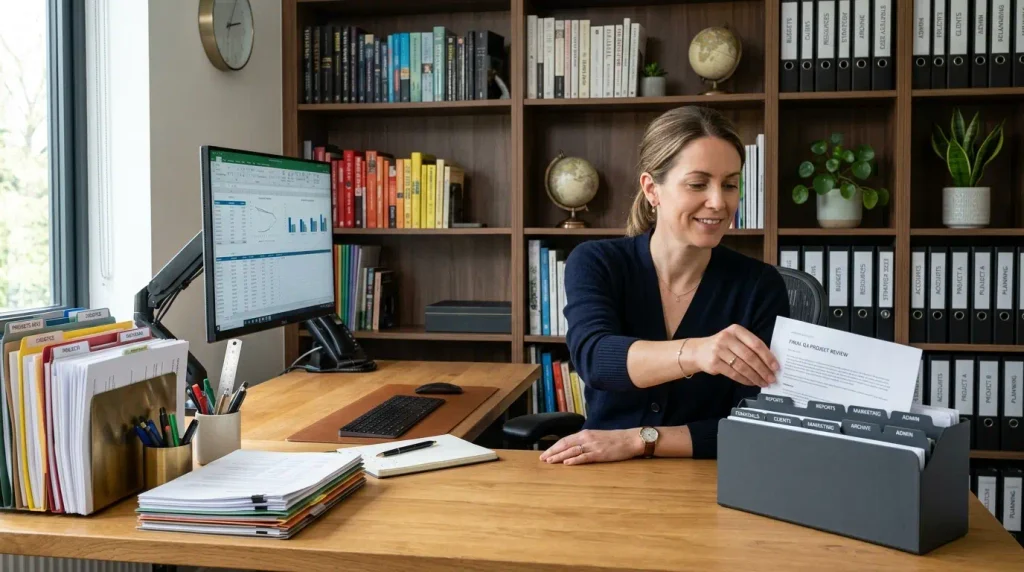
Organized (Adjective) — US /ˈɔːrɡənaɪzd/ | UK /ˈɔːɡənaɪzd/
Meaning: Organized means arranged in a planned and sensible way.
Examples:
- Her files are carefully organized.
- We need an organized plan for the event.
Tone: Neutral and highly common.
Best use: Workplaces, files, schedules, projects, rooms, and plans.
Neat (Adjective) — US /niːt/ | UK /niːt/
Meaning: Neat means clean, tidy, and arranged without unnecessary mess.
Examples:
- Your handwriting is very neat.
- He keeps his bedroom neat.
Tone: Friendly and everyday.
Best use: Rooms, desks, handwriting, clothing, and appearance.
Tidy (Adjective) — US /ˈtaɪdi/ | UK /ˈtaɪdi/
Meaning: Tidy means clean and arranged so that things are not scattered or messy.
Examples:
- Please keep the kitchen tidy.
- Her workspace always looks tidy.
Tone: Neutral and conversational.
Best use: Physical spaces and personal belongings.
Systematic (Adjective) — US /ˌsɪstəˈmætɪk/ | UK /ˌsɪstəˈmætɪk/
Meaning: Systematic means following a clear and organized method.
Examples:
- The researcher took a systematic approach.
- We need a systematic way to review these records.
Tone: Formal and professional.
Best use: Research, analysis, procedures, planning, and problem-solving.
Methodical (Adjective) — US /məˈθɑːdɪkəl/ | UK /məˈθɒdɪkəl/
Meaning: Methodical means doing things carefully according to a planned method.
Examples:
- She is methodical when checking reports.
- He made a methodical search of the room.
Tone: Professional and precise.
Best use: Work habits, research, investigations, and careful tasks.
Structured (Adjective) — US /ˈstrʌktʃərd/ | UK /ˈstrʌktʃəd/
Meaning: Structured means organized according to a clear system or framework.
Examples:
- The course has a structured format.
- We followed a structured process.
Tone: Neutral to formal.
Best use: Courses, writing, meetings, plans, systems, and processes.
Well-Organized (Adjective) — US /ˌwel ˈɔːrɡənaɪzd/ | UK /ˌwel ˈɔːɡənaɪzd/
Meaning: Well-organized means arranged efficiently and sensibly.
Examples:
- She is a well-organized manager.
- The conference was well-organized.
Tone: Positive and professional.
Best use: People, events, projects, offices, and schedules.
Well-Ordered (Adjective) — US /ˌwel ˈɔːrdərd/ | UK /ˌwel ˈɔːdəd/
Meaning: Well-ordered means carefully arranged according to a clear order.
Examples:
- The archive is well-ordered.
- They created a well-ordered system.
Tone: Formal and polished.
Best use: Systems, collections, records, and formal writing.
Arranged (Adjective) — US /əˈreɪndʒd/ | UK /əˈreɪndʒd/
Meaning: Arranged means placed or organized in a particular way.
Examples:
- The chairs were neatly arranged.
- The books are arranged by subject.
Tone: Neutral.
Best use: Objects, furniture, information, and events.
Disciplined (Adjective) — US /ˈdɪsəplɪnd/ | UK /ˈdɪsəplɪnd/
Meaning: Disciplined means behaving in a controlled and organized way.
Examples:
- She has a disciplined study routine.
- The team remained disciplined during the match.
Tone: Positive and strong.
Best use: People, teams, habits, routines, and behavior.
Well-Regulated (Adjective) — US /ˌwel ˈreɡjəleɪtɪd/ | UK /ˌwel ˈreɡjəleɪtɪd/
Meaning: Well-regulated means controlled according to clear rules or standards.
Examples:
- The facility has a well-regulated system.
- Traffic remained well-regulated throughout the event.
Tone: Formal.
Best use: Systems, organizations, public activities, and procedures.
Uncluttered (Adjective) — US /ʌnˈklʌtərd/ | UK /ʌnˈklʌtəd/
Meaning: Uncluttered means free from unnecessary objects, details, or mess.
Examples:
- I prefer an uncluttered desk.
- The website has a clean, uncluttered design.
Tone: Positive and modern.
Best use: Rooms, desks, websites, designs, and visual spaces.
Well-Kept (Adjective) — US /ˌwel ˈkept/ | UK /ˌwel ˈkept/
Meaning: Well-kept means maintained in a clean, neat, and attractive condition.
Examples:
- They live in a well-kept house.
- The garden is beautifully well-kept.
Tone: Positive.
Best use: Homes, gardens, buildings, clothing, and possessions.
Trim (Adjective) — US /trɪm/ | UK /trɪm/
Meaning: Trim means neat, clean, and carefully maintained in appearance.
Examples:
- The garden looks trim and attractive.
- He keeps the front yard trim.
Tone: Neutral to positive.
Best use: Appearance, gardens, buildings, and physical surroundings.
Shipshape (Adjective) — US /ˈʃɪpʃeɪp/ | UK /ˈʃɪpʃeɪp/
Meaning: Shipshape means neat, clean, and in good order.
Examples:
- We got the office shipshape before the meeting.
- The garage is finally shipshape.
Tone: Informal and slightly playful.
Best use: Rooms, workplaces, boats, garages, and casual conversation.
Sorted (Adjective) — US /ˈsɔːrtɪd/ | UK /ˈsɔːtɪd/
Meaning: Sorted means organized or dealt with so that everything is in its proper place.
Examples:
- The documents are sorted by date.
- Once the files are sorted, we can begin.
Tone: Neutral; especially common in British English.
Best use: Files, belongings, tasks, and practical situations.
Precise (Adjective) — US /prɪˈsaɪs/ | UK /prɪˈsaɪs/
Meaning: Precise means exact and carefully controlled.
Examples:
- Her instructions were precise.
- The technician made precise adjustments.
Tone: Formal and professional.
Best use: Instructions, measurements, language, procedures, and technical work.
Native usage note: Precise is not a direct synonym for orderly in every situation. It works when orderly emphasizes careful control or exactness.
Regular (Adjective) — US /ˈreɡjələr/ | UK /ˈreɡjʊlə/
Meaning: Regular can mean arranged in an even, consistent, or repeated pattern.
Examples:
- The tiles form a regular pattern.
- The garden has regular rows of plants.
Tone: Neutral.
Best use: Patterns, shapes, arrangements, and repeated structures.
Formal (Adjective) — US /ˈfɔːrməl/ | UK /ˈfɔːməl/
Meaning: Formal means following established rules, conventions, or controlled arrangements.
Examples:
- The meeting followed a formal structure.
- She used a formal process for the application.
Tone: Professional and serious.
Best use: Meetings, writing, procedures, events, and institutional settings.
Native usage note: Formal does not automatically mean orderly. Use it when the sense involves rules, conventions, or official behavior.
Coordinated (Adjective) — US /koʊˈɔːrdəneɪtɪd/ | UK /kəʊˈɔːdɪneɪtɪd/
Meaning: Coordinated means arranged so that different parts work effectively together.
Examples:
- The departments made a coordinated effort.
- The emergency response was carefully coordinated.
Tone: Professional and positive.
Best use: Teams, activities, projects, and organized responses.

Controlled (Adjective) — US /kənˈtroʊld/ | UK /kənˈtrəʊld/
Meaning: Controlled means kept within planned or acceptable limits.
Examples:
- The experiment took place in a controlled environment.
- The crowd remained controlled.
Tone: Neutral to formal.
Best use: Situations, environments, behavior, experiments, and processes.
Disciplinedly (Adverb) — US /ˈdɪsəplɪndli/ | UK /ˈdɪsəplɪndli/
Meaning: Disciplinedly means in a controlled and organized manner.
Examples:
- The players worked disciplinedly throughout the game.
- She approached the task disciplinedly.
Tone: Formal and less common.
Native usage note: Native speakers usually prefer in a disciplined way instead of this adverb.
Neatly (Adverb) — US /ˈniːtli/ | UK /ˈniːtli/
Meaning: Neatly means in a clean, careful, or well-arranged manner.
Examples:
- She folded the clothes neatly.
- The papers were stacked neatly.
Tone: Neutral and everyday.
Best use: Physical arrangements, writing, clothing, and presentation.
Systematically (Adverb) — US /ˌsɪstəˈmætɪkli/ | UK /ˌsɪstəˈmætɪkli/
Meaning: Systematically means in a planned and organized way.
Examples:
- We checked each record systematically.
- The team worked systematically through the list.
Tone: Formal and academic.
Best use: Research, analysis, investigation, and professional procedures.
Methodically (Adverb) — US /məˈθɑːdɪkli/ | UK /məˈθɒdɪkli/
Meaning: Methodically means carefully following an established method or sequence.
Examples:
- He methodically reviewed every page.
- She methodically organized the evidence.
Tone: Formal and precise.
Best use: Research, detailed work, investigations, and careful processes.
Clean-Cut (Adjective) — US /ˌkliːn ˈkʌt/ | UK /ˌkliːn ˈkʌt/
Meaning: Clean-cut can describe something that looks neat, clear, and well-defined.
Examples:
- The design has a clean-cut appearance.
- We need a clean-cut solution to the problem.
Tone: Informal to neutral.
Best use: Appearance, designs, boundaries, and clearly defined situations.
Systematized (Adjective) — US /ˈsɪstəməˌtaɪzd/ | UK /ˈsɪstəmətaɪzd/
Meaning: Systematized means organized according to a clear and deliberate system.
Examples:
- The company has systematized its filing process.
- Her notes are carefully systematized.
Categorized (Adjective) — US /ˈkætəɡəˌraɪzd/ | UK /ˈkætəɡəraɪzd/
Meaning: Categorized means arranged into groups based on shared features.
Examples:
- The documents are categorized by topic.
- The library has categorized the new books.
Classified (Adjective) — US /ˈklæsəˌfaɪd/ | UK /ˈklæsɪfaɪd/
Meaning: Classified means arranged into specific groups or categories.
Examples:
- The records are classified by year.
- The files were carefully classified.
Sequenced (Adjective) — US /ˈsiːkwənst/ | UK /ˈsiːkwənst/
Meaning: Sequenced means arranged in a particular order or progression.
Examples:
- The lessons are carefully sequenced.
- The instructions are logically sequenced.
Ordered (Adjective) — US /ˈɔːrdərd/ | UK /ˈɔːdəd/
Meaning: Ordered means arranged according to a particular sequence or system.
Examples:
- The results are ordered by date.
- The items were neatly ordered on the shelves.
Aligned (Adjective) — US /əˈlaɪnd/ | UK /əˈlaɪnd/
Meaning: Aligned means positioned or arranged so that parts correspond correctly.
Examples:
- The chairs were perfectly aligned.
- Make sure the pages are properly aligned.
Symmetrical (Adjective) — US /səˈmetrɪkəl/ | UK /sɪˈmetrɪkəl/
Meaning: Symmetrical means arranged so that corresponding parts have a balanced relationship.
Examples:
- The garden has a symmetrical design.
- The furniture was arranged in a symmetrical pattern.
Balanced (Adjective) — US /ˈbælənst/ | UK /ˈbælənt/
Meaning: Balanced means arranged so that different parts are evenly distributed.
Examples:
- The room has a balanced layout.
- The design feels balanced and calm.
Coherent (Adjective) — US /koʊˈhɪrənt/ | UK /kəʊˈhɪərənt/
Meaning: Coherent means logically connected and easy to understand as a whole.
Examples:
- Her presentation was coherent and clear.
- The report gives a coherent explanation.
Logical (Adjective) — US /ˈlɑːdʒɪkəl/ | UK /ˈlɒdʒɪkəl/
Meaning: Logical means arranged or developed according to clear reasoning.
Examples:
- The information follows a logical sequence.
- He presented his ideas in a logical order.
Consistent (Adjective) — US /kənˈsɪstənt/ | UK /kənˈsɪstənt/
Meaning: Consistent means following the same pattern, standard, or approach.
Examples:
- Her work is consistent and carefully presented.
- The formatting remains consistent throughout the report.
Uniform (Adjective) — US /ˈjuːnəfɔːrm/ | UK /ˈjuːnɪfɔːm/
Meaning: Uniform means consistent in appearance, arrangement, or form.
Examples:
- The books were placed at a uniform height.
- The tiles create a uniform pattern.
Regularized (Adjective) — US /ˈreɡjələrˌaɪzd/ | UK /ˈreɡjʊləraɪzd/
Meaning: Regularized means made more regular, consistent, or organized.
Examples:
- The process was regularized across all departments.
- They regularized the filing procedure.
Regulated (Adjective) — US /ˈreɡjəˌleɪtɪd/ | UK /ˈreɡjʊleɪtɪd/
Meaning: Regulated means controlled according to established rules or standards.
Examples:
- The industry operates under a regulated system.
- The process is carefully regulated.
Disciplined (Adjective) — US /ˈdɪsəplɪnd/ | UK /ˈdɪsəplɪnd/
Meaning: Disciplined means controlled and guided by rules or a consistent routine.
Examples:
- The team followed a disciplined routine.
- She takes a disciplined approach to studying.
Note: This word was already included in the previous article, so it should not be counted as a new synonym.
Ordered-up (Adjective) — US /ˌɔːrdərd ˈʌp/ | UK /ˌɔːdəd ˈʌp/
Meaning: Ordered-up describes something arranged or prepared according to a specific requirement.
Examples:
- The materials were ordered-up before the project began.
- Everything was ordered-up for the inspection.
Native usage note: This is uncommon in general English and is not recommended as a standard replacement for orderly.
Composed (Adjective) — US /kəmˈpoʊzd/ | UK /kəmˈpəʊzd/
Meaning: Composed can mean calm and controlled in behavior.
Examples:
- She remained composed during the meeting.
- He gave a composed response to the criticism.
Calm (Adjective) — US /kɑːm/ | UK /kɑːm/
Meaning: Calm means peaceful and free from confusion, disturbance, or excitement.
Examples:
- The crowd remained calm throughout the event.
- The classroom was quiet and calm.
Peaceable (Adjective) — US /ˈpiːsəbəl/ | UK /ˈpiːsəbəl/
Meaning: Peaceable means peaceful and free from conflict or disorder.
Examples:
- The demonstration remained peaceable.
- They reached a peaceable agreement.
Unruffled (Adjective) — US /ʌnˈrʌfəld/ | UK /ʌnˈrʌfəld/
Meaning: Unruffled means calm and not disturbed by problems or pressure.
Examples:
- She remained unruffled during the busy afternoon.
- He looked completely unruffled by the delay.
Synchronized (Adjective) — US /ˈsɪŋkrəˌnaɪzd/ | UK /ˈsɪŋkrənaɪzd/
Meaning: Synchronized means coordinated so that actions or events happen together.
Examples:
- The dancers moved in synchronized steps.
- The teams used a synchronized schedule.
Harmonized (Adjective) — US /ˈhɑːrməˌnaɪzd/ | UK /ˈhɑːmənaɪzd/
Meaning: Harmonized means arranged so that different parts work smoothly together.
Examples:
- The departments have harmonized their procedures.
- The colors are harmonized throughout the room.
Integrated (Adjective) — US /ˈɪntəˌɡreɪtɪd/ | UK /ˈɪntɪɡreɪtɪd/
Meaning: Integrated means combined into a coordinated and functional whole.
Examples:
- The system uses an integrated approach.
- The new schedule is fully integrated.
Streamlined (Adjective) — US /ˈstriːmlaɪnd/ | UK /ˈstriːmlaɪnd/
Meaning: Streamlined means made simpler, more efficient, and better organized.
Examples:
- The company streamlined its approval process.
- We need a streamlined system for handling requests.
Uncomplicated (Adjective) — US /ˌʌnˈkɑːmpləkeɪtɪd/ | UK /ˌʌnˈkɒmplɪkeɪtɪd/
Meaning: Uncomplicated means simple and free from unnecessary complexity or confusion.
Examples:
- The instructions are clear and uncomplicated.
- We wanted an uncomplicated way to organize the event.
Regimental (Adjective) — US /ˌredʒəˈmentəl/ | UK /ˌredʒɪˈmentəl/
Meaning: Regimental means highly organized, strict, and controlled according to a fixed routine.
Examples:
- His daily routine is almost regimental.
- The training followed a regimental schedule.
Tone: Formal and sometimes slightly negative because it can suggest excessive strictness.

Native usage note: Clean-cut is more about appearance or clarity than organization, so it should not replace orderly in every sentence.
Quick Guide to Choosing a Synonym
Choosing the right synonym depends on the exact idea behind orderly.
Use neat when you are talking about a clean physical space.
Use organized or well-organized when people, materials, plans, or activities are arranged effectively.
Choose systematic or methodical when someone follows a clear process.
Use structured when something has a clear framework.
Choose disciplined when the focus is on controlled behavior or habits.
Use uncluttered when you want to emphasize the absence of unnecessary objects or details.
Choose shipshape when you want a casual and slightly playful expression.
Synonyms for Orderly by Tone
Positive
These words often create a favorable impression:
- Organized
- Well-organized
- Neat
- Tidy
- Disciplined
- Structured
- Uncluttered
- Well-kept
- Shipshape
They can suggest preparation, care, efficiency, or responsibility.
Neutral
These alternatives mainly describe arrangement without adding a strong emotional judgment:
- Orderly
- Arranged
- Regular
- Controlled
- Coordinated
- Sorted
Formal or Professional
These words are especially useful in academic and workplace writing:
- Systematic
- Methodical
- Structured
- Well-regulated
- Precise
- Systematically
- Methodically
Informal or Playful
Shipshape is the clearest informal option.
Sorted can also sound casual, particularly in British English.
Why Tone Matters
Two words can share a basic meaning but create different impressions.
For example, calling a desk tidy sounds everyday and friendly.
Calling a process systematic sounds more analytical.
Calling a person disciplined highlights behavior rather than physical organization.
The right synonym makes your sentence more accurate.
“Orderly” vs Close Alternatives
| Word | Main Meaning | Tone | Best Context |
|---|---|---|---|
| Orderly | Properly arranged or controlled | Neutral | General use |
| Organized | Planned and arranged effectively | Neutral/positive | Work, plans, people |
| Tidy | Clean and free from mess | Everyday | Rooms and belongings |
| Systematic | Following a clear method | Formal | Research and processes |
| Methodical | Careful and step-by-step | Formal | Detailed tasks |
| Disciplined | Controlled and consistent | Positive | People and habits |
The difference is often subtle.
For example, “an orderly desk” emphasizes arrangement.
“An organized desk” emphasizes effective organization.
“A tidy desk” emphasizes cleanliness and lack of mess.
For a research project, systematic is usually more precise because it highlights a planned method.
How “Orderly” Changes by Context
Daily Conversation
In everyday conversation, orderly commonly describes rooms, queues, desks, homes, and general behavior.
For example, you might say, “The children stood in an orderly line.”
However, tidy, neat, and organized often sound more natural in casual speech.
Writing and Blogging
Writers can use orderly when describing an organized process, environment, or sequence.
For example:
“The article presents the information in an orderly sequence.”
A blogger can replace repeated uses of orderly with structured, organized, or systematic when the context supports those meanings.
This makes the writing more varied without sacrificing clarity.
Professional or Academic English
Professional writing often benefits from precise alternatives.
Systematic works well for research.
Structured fits reports, training programs, and processes.
Methodical describes careful work.
Well-regulated works when rules or controls are important.
Creative or Informal English
Creative writing gives you more freedom.
Shipshape can create a relaxed tone.
Tidy can make a description feel familiar.
Uncluttered works well when describing a clean visual environment.
The goal is not to use the most complicated word. The goal is to use the word that creates the intended meaning.
Common Mistakes Learners Make
Using “Tidy” for Every Meaning
Tidy usually focuses on physical cleanliness or arrangement.
You would naturally say:
“The bedroom is tidy.”
But if you are describing a carefully planned research process, systematic is more appropriate.
Using “Systematic” for a Room
A room can technically be organized systematically, but native speakers normally say tidy, neat, or organized when talking about ordinary household spaces.
Confusing “Disciplined” and “Orderly”
These words overlap when describing behavior.
However, disciplined focuses more strongly on self-control, rules, and consistent behavior.
Orderly focuses more on proper arrangement or controlled conditions.
Assuming “Formal” Means “Orderly”
Formal and orderly can overlap in official settings, but they are not interchangeable.
Formal concerns style, rules, conventions, or official behavior.
Orderly concerns arrangement, organization, or control.
Overusing Advanced Synonyms
Using a sophisticated word does not automatically improve your writing.
If tidy communicates your meaning clearly, there is no need to replace it with a more formal expression.
Good vocabulary is about precision, not complexity.
Register Notes
Orderly works in both spoken and written English.
It has a neutral register and can appear in everyday descriptions as well as professional contexts.
Tidy and neat are especially natural in everyday conversation.
Systematic, methodical, and well-regulated are more common in formal or professional writing.
Shipshape is informal and can add personality to casual writing.
Sorted is widely understood in English and is particularly natural in British usage.
Internal Linking Opportunity
If your vocabulary site covers related terms, an internal link to another page about organized synonyms can help readers explore connected vocabulary naturally.
Real-Life Mini Scenarios Using “Orderly”
Workplace
A manager walks into the office before an important meeting.
The desks are clear, documents are arranged, and the presentation materials are ready.
She might describe the workplace as orderly or well-organized.
Social Situation
People arrive at a busy event and form a line.
Nobody pushes, and everyone waits for their turn.
The crowd is behaving in an orderly manner.
Media and Pop Culture
A documentary may show a highly organized kitchen where every tool has a designated place.
The narrator might describe the workspace as orderly, tidy, or uncluttered.
Writing and Storytelling
A novelist may describe a character who carefully follows the same morning routine every day.
Words such as methodical, disciplined, and orderly can highlight different aspects of that personality.
How to Remember the Difference
A simple memory trick can make these words easier.
A simple way to remember these words is to connect each one with its main idea.
Orderly represents the broad idea of being well arranged or controlled.
Tidy focuses on keeping things clean and free from mess.
Organized suggests that things are planned and arranged effectively.
Systematic describes an approach that follows a clear system.
Methodical highlights careful, step-by-step action.
Disciplined suggests controlled and consistent behavior.
Structured refers to something built around a clear framework.
Uncluttered describes a space or design that is free from unnecessary things.
This approach helps you choose a synonym based on meaning rather than memorizing a long list.
Practice Exercise:
Choose the word that fits each sentence most naturally.
1. A student keeps every notebook, folder, and assignment in its proper place.
A. Methodical
B. Organized
C. Formal
D. Controlled
2. The bedroom has no scattered clothes or unnecessary objects.
A. Tidy
B. Systematic
C. Disciplined
D. Precise
3. The scientist followed the same careful process during every stage of the experiment.
A. Shipshape
B. Neat
C. Systematic
D. Trim
4. The employee checks every document carefully and follows the same sequence each time.
A. Methodical
B. Tidy
C. Formal
D. Uncluttered
5. The garden is clean, maintained, and free from overgrown areas.
A. Disciplined
B. Well-kept
C. Systematic
D. Coordinated
6. The emergency teams worked together so their activities supported one another.
A. Neat
B. Trim
C. Coordinated
D. Tidy
7. A desk has very few objects on it and looks visually clean.
A. Uncluttered
B. Disciplined
C. Well-regulated
D. Regular
8. The children waited quietly in a properly managed line.
A. Orderly
B. Precise
C. Methodical
D. Shipshape
9. A casual speaker says that the garage is finally clean and in good order.
A. Systematic
B. Shipshape
C. Formal
D. Disciplined
10. A training program follows a clear framework with defined stages.
A. Structured
B. Tidy
C. Trim
D. Neat
11. Someone follows a strict exercise routine every morning.
A. Uncluttered
B. Disciplined
C. Arranged
D. Regular
12. Books are placed on shelves according to subject.
A. Arranged
B. Formal
C. Controlled
D. Clean-cut
Answer Key
1. B, 2. A, 3. C, 4. A, 5. B, 6. C, 7. A, 8. A, 9. B, 10. A, 11. B, 12. A
Reflection Task
Write one sentence about your room, workplace, study routine, or daily habits using one synonym for orderly.
Try to choose a word that matches the exact meaning you want to express.
FAQs
1. What is the closest synonym for orderly?
Organized is one of the closest general synonyms for orderly. Depending on context, neat, tidy, structured, or systematic may be more precise.
2. What is a simple synonym for orderly?
Neat, tidy, and organized are simple and commonly used alternatives.
3. Is “organized” the same as “orderly”?
They are very similar, but not identical in every context. Organized emphasizes planning and effective arrangement, while orderly can also emphasize calmness or controlled behavior.
4. What is a synonym for orderly behavior?
Depending on the context, disciplined, controlled, well-regulated, or well-behaved may work.
5. What is a synonym for an orderly room?
Tidy, neat, organized, uncluttered, and well-kept can describe an orderly room.
6. What is the formal synonym for orderly?
Systematic, methodical, structured, and well-regulated can provide a more formal alternative when their specific meanings fit.
7. Is “methodical” a synonym for orderly?
Yes, in contexts involving careful organization and a planned process. Methodical focuses more on how someone performs a task.
8. Is “tidy” a synonym for orderly?
Yes, when orderly describes a clean and well-arranged physical space. Tidy is more strongly associated with physical neatness.
9. What is the opposite of orderly?
Common opposites include disorganized, messy, untidy, chaotic, and disorderly.
The best opposite depends on the context.
10. Can orderly describe a person?
Yes. When describing a person, orderly can suggest that the person is organized, disciplined, or careful about keeping things arranged.
11. Is orderly formal or informal?
Orderly is neutral. It works in everyday conversation, professional writing, academic contexts, and descriptive writing.
12. What is the difference between orderly and systematic?
Orderly broadly describes something that is properly arranged or controlled.
Systematic specifically emphasizes a planned method or organized procedure.
Conclusion
Learning a synonym for orderly gives you more ways to describe clean spaces, organized plans, controlled behavior, and carefully structured processes.
Words such as tidy suit everyday English, while systematic and methodical add precision to academic and professional writing.
Using varied vocabulary can make essays, blogs, emails, and conversations sound clearer and more natural. The key is choosing words by meaning, not difficulty.
Keep practicing these alternatives in real sentences. Try them in emails, essays, and daily conversations to build stronger vocabulary and more confident English.

Shahzeena Shazadi is the founder and lead writer at VocablyHub.com, where she creates accurate, reader-focused English language content designed to help people communicate with clarity and confidence. She specializes in synonyms, antonyms, word meanings, idioms, and practical vocabulary guides that simplify complex language concepts for everyday use. Every article is carefully researched, fact-checked, and written in clear, accessible language using reliable references and real-world examples. Her goal is to provide helpful, trustworthy content that supports learners at every stage of their English language journey.
Her editorial approach focuses on accuracy, transparency, and user value while following modern content quality standards. She regularly reviews and updates content to keep information relevant, useful, and easy to understand. Through VocablyHub.com, Shahzeena Shazadi is committed to publishing reliable language resources that help students, writers, educators, professionals, and English learners expand their vocabulary, improve their writing skills, and communicate with confidence in academic, professional, and everyday situations.