
Finding the right words can make everyday conversations clearer, more natural, and more expressive. If you are searching for synonyms for never mind, you may want alternatives that fit different situations, from casual conversations to polite or professional communication.
The phrase “never mind” can have several meanings depending on context. It may mean that something is no longer important, that someone should ignore a previous question, or that you do not want to continue discussing a topic. Because of these different uses, choosing the right alternative can help you communicate your exact meaning.
This guide explores useful synonyms for never mind with simple meanings, pronunciation, tone, and examples. You will find options that work in friendly conversations, formal writing, apologetic situations, and moments when you simply want someone to disregard what you just said.
Learning different synonyms for never mind can also improve your vocabulary and help you avoid repeating the same phrase. Whether you are an English learner, a student, a writer, or someone looking for more natural expressions, these alternatives will help you choose the right phrase for every situation.
Never mind is a common English phrase used to tell someone to disregard what was just said because it is no longer important. The emotional tone is typically dismissive, reassuring, or casually brushing off a minor mistake. Native speakers understand it as a polite way to drop a subject without causing awkwardness. It appears frequently in casual text messages, spoken arguments, and friendly chats. It functions as an idiom or a fixed phrasal expression in everyday grammar.
What Does “Never Mind” Really Mean?
Never mind is a common English phrase used to tell someone to disregard what was just said because it is no longer important. The emotional tone is typically dismissive, reassuring, or casually brushing off a minor mistake. Native speakers understand it as a polite way to drop a subject without causing awkwardness. It appears frequently in casual text messages, spoken arguments, and friendly chats. It functions as an idiom or a fixed phrasal expression in everyday grammar.
Connotative Meaning
- Positive tone: Reassuring someone that a small error does not matter.
- Negative tone: Showing mild annoyance or dismissing someone abruptly.
- Neutral tone: Simply moving on to a new topic without strong feelings. (Connotation is the emotional or cultural feeling associated with a word beyond its literal dictionary definition.)
Etymology:
- Old English (450–1100): Rooted in Germanic terms related to memory, attention, and mental care.
- Middle English (1100–1500): Evolved into phrases instructing listeners not to trouble their minds.
- Modern English (1500–Present): Standardized into the fixed idiom used globally today.
Pronunciation (US & UK – IPA)
- US: /ˈnɛvər maɪnd/
- UK: /ˈnɛvə maɪnd/
Syllables
- Never mind. Affixation Pattern: Compound idiomatic expression consisting of an adverb and a noun functioning as a verb phrase.
- Root: Mind (from Proto-Germanic *gaminþiją)
- Prefix: None
- Suffix: None
Synonym list:
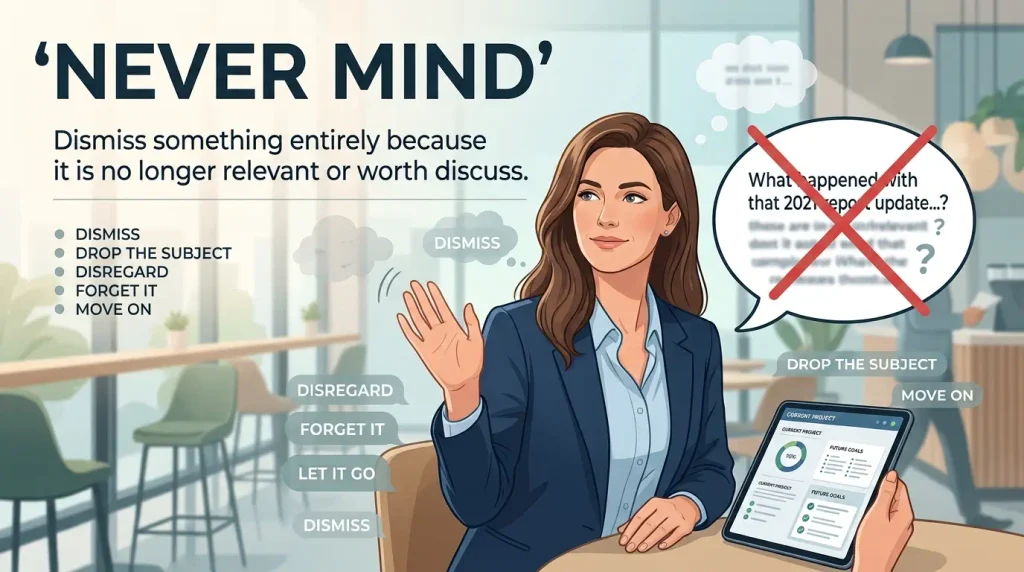
Forget it (VP) — US: /ˈfɔːrɡɛt ɪt/ | UK: /fəˈɡɛt ɪt/
Meaning: Dismiss something entirely because it is no longer relevant or worth discussing.
Tone/Register: Informal, casual spoken English.
Example:
Forget it, I can buy my own coffee today.
I already solved the issue, so just forget it.
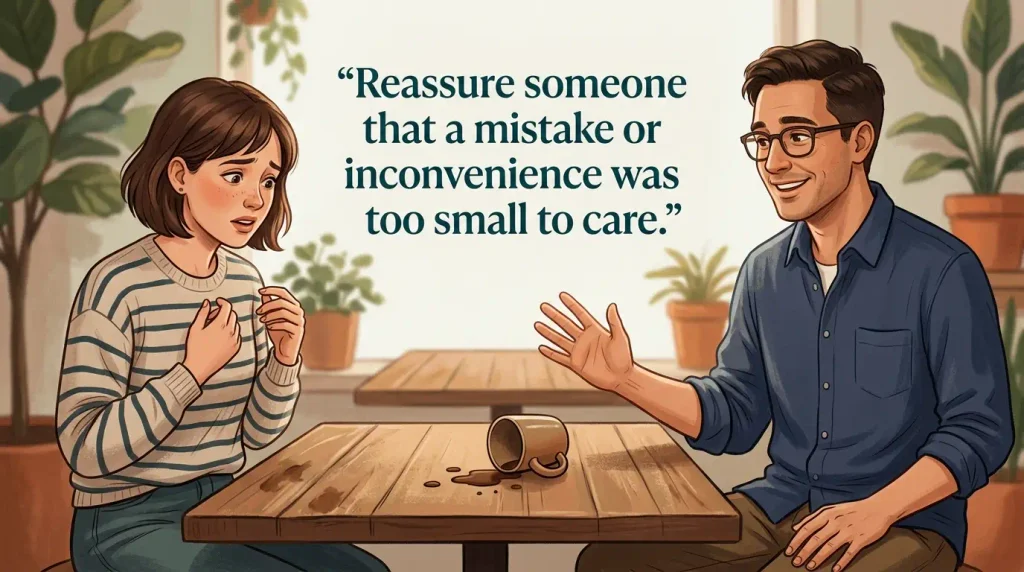
Don’t worry about it (VP) — US: /ˈdoʊnt ˈwɜːri əˈbaʊt ɪt/ | UK: /dəʊnt ˈwʌri əˈbaʊt ɪt/
Meaning: Reassure someone that a mistake or inconvenience was too small to care about.
Tone/Register: Friendly, supportive, conversational.
Example:
Don’t worry about it; we all make mistakes sometimes.
Don’t worry about it; the broken glass was old anyway.
Skip it (VP) — US: /ˈskɪp ɪt/ | UK: /ˈskɪp ɪt/
Meaning: Decide to omit or pass over a topic or action entirely.
Tone/Register: Very informal, rapid speech.
Example:
Let’s skip it and watch a different movie instead.
If the instructions are too confusing, skip it.
It doesn’t matter (VP) — US: /ˈɪt ˈdʌzənt ˈmætər/ | UK: /ɪt ˈdʌznt ˈmætə/
Meaning: State neutrally that an issue holds no consequence or importance.
Tone/Register: Neutral, factual, everyday conversation.
Example:
It doesn’t matter if we arrive five minutes late.
It doesn’t matter which route we take home.
Leave it (VP) — US: /ˈliːv ɪt/ | UK: /ˈliːv ɪt/
Meaning: Stop pursuing a task, question, or line of inquiry.
Tone/Register: Casual, direct, spoken.
Example:
Leave it; I will wash those dishes later tonight.
If you cannot find the keys, just leave it.
Think nothing of it (VP) — US: /ˈθɪŋk ˈnʌθɪŋ ʌv ɪt/ | UK: /ˈθɪŋk ˈnʌθɪŋ ʌv ɪt/
Meaning: Politely minimize a favor you performed for someone else.
Tone/Register: Polite, gracious, formal-leaning casual.
Example:
Think nothing of it; helping friends is what I do.
Think nothing of it; carrying those boxes was easy.
It’s no big deal (VP) — US: /ˈɪts noʊ bɪɡ diːl/ | UK: /ɪts nəʊ bɪɡ diːl/
Meaning: Reassure someone that an error caused no actual harm.
Tone/Register: Informal, comforting.
Example:
It’s no big deal that you missed the bus.
It’s no big deal if the cake burnt slightly.
Drop it (VP) — US: /ˈdrɑːp ɪt/ | UK: /drɒp ɪt/
Meaning: Command someone to stop talking about a sensitive or annoying subject.
Tone/Register: Direct, stern, informal.
Example:
I do not want to argue more, so drop it.
Drop it before this disagreement gets out of hand.
No worries (VP) — US: /ˈnoʊ ˈwɜːriz/ | UK: /nəʊ ˈwʌriz/
Meaning: Brush off a minor inconvenience or apology with total ease.
Tone/Register: Casual, friendly, modern slang-adjacent.
Example:
No worries, I can easily reschedule our meeting.
No worries about spilling water on the table.
Let it go (VP) — US: /ˈlɛt ɪt ɡoʊ/ | UK: /lɛt ɪt ɡəʊ/
Meaning: Release emotional attachment to a past mistake or annoyance.
Tone/Register: Conversational, reflective, advice-oriented.
Example:
You cannot change the past, so let it go.
Let it go and focus on the upcoming project.
N.B. (Not a big deal) (Phrase) — US: /ˈnɑːt ə bɪɡ diːl/ | UK: /ˈnɒt ə bɪɡ diːl/
Meaning: Treat a situation as trivial or not worth stressing about.
Tone/Register: Casual, text-speak, youthful.
Example:
Losing my pen was N.B.
I have ten more. That minor typo in the report is N.B.
Never you mind (VP) — US: /ˈnɛvər juː maɪnd/ | UK: /ˈnɛvə juː maɪnd/
Meaning: Tell someone playfully or sharply to mind their own business.
Tone/Register: Old-fashioned, slightly cheeky, informal.
Example:
Never mind what is inside this wrapped box.
Never mind how much money I spent.
Think twice (VP) — US: /ˈθɪŋk twaɪs/ | UK: /θɪŋk twaɪs/
Meaning: Pause before acting, though sometimes used to dismiss reckless plans.
Tone/Register: Conversational warning.
Example:
Think twice before quitting your job abruptly.
Think twice about buying that expensive gadget.
Pay no heed (VP) — US: /ˈpeɪ noʊ hiːd/ | UK: /peɪ nəʊ hiːd/
Meaning: Disregard unwanted advice or distracting background noise.
Tone/Register: Literary, formal, slightly archaic.
Example:
Pay no heed to critics who doubt your vision.
Pay no heed to the barking dogs outside.
Put it out of your mind (VP) — US: /ˈpʊt ɪt aʊt ʌv jʊər maɪnd/ | UK: /pʊt ɪt aʊt ʌv jɔː maɪnd/
Meaning: Consciously stop worrying about an unsettling thought.
Tone/Register: Compassionate, advisory.
Example:
Put it out of your mind and get some sleep.
Put it out of your mind before exam day arrives.
Sweep it under the rug (VP) — US: /ˈswiːp ɪt ˈʌndər ðə rʌɡ/ | UK: /swiːp ɪt ˈʌndə ðə rʌɡ/
Meaning: Ignore a problem, hoping it will disappear on its own.
Tone/Register: Idiomatic, critical, expressive.
Example:
Do not just sweep it under the rug; fix it.
They tried to sweep the accounting error under the rug.
Pay it no mind (VP) — US: /ˈpeɪ ɪt noʊ maɪnd/ | UK: /peɪ ɪt nəʊ maɪnd/
Meaning: Choose not to focus attention on an irritating occurrence.
Tone/Register: Casual, rustic, folksy.
Example:
Pay it no mind; the weather will clear soon.
Pay it no mind when rude people complain.
Dismiss it (VP) — US: /dɪsˈmɪs ɪt/ | UK: /dɪsˈmɪs ɪt/
Meaning: Reject an idea or statement as unworthy of consideration.
Tone/Register: Formal, professional.
Example:
The manager chose to dismiss it as an outlier.
Dismiss it and move on to the next agenda item.
Disregard it (VP) — US: /ˌdɪsrɪˈɡɑːrd ɪt/ | UK: /ˌdɪsrɪˈɡɑːd ɪt/
Meaning: Pay no official attention to a prior instruction or error.
Tone/Register: Formal, administrative.
Example:
Please disregard it if you received duplicate emails.
Disregard it because the data was completely outdated.
Ignore it (VP) — US: /ɪɡˈnɔːr ɪt/ | UK: /ɪɡˈnɔː ɪt/
Meaning: Refuse to take notice of a stimulus or statement.
Tone/Register: Direct, neutral.
Example:
Try to ignore it when construction noise starts.
Ignore it if trolls leave silly comments online.
Think nothing of the sort (VP) — US: /ˈθɪŋk ˈnʌθɪŋ ʌv ðə sɔːrt/ | UK: /ˈθɪŋk ˈnʌθɪŋ ʌv ðə sɔːt/
Meaning: Strongly reject a negative assumption someone holds about you.
Tone/Register: Polite, expressive, formal.
Example:
Think nothing of the sort; you worked very hard.
Think nothing of the sort regarding your recent presentation.
Think nothing of it all (VP) — US: /ˈθɪŋk ˈnʌθɪŋ ʌv ɪt ɔːl/ | UK: /ˈθɪŋk ˈnʌθɪŋ ʌv ɪt ɔːl/
Meaning: Offer absolute reassurance that an action required no effort.
Tone/Register: Warm, supportive, conversational.
Example:
Think nothing of it all; I am happy to help.
Think nothing of it all; cleaning up took two seconds.
Pay no attention (VP) — US: /ˈpeɪ noʊ əˈtɛnʃən/ | UK: /peɪ nəʊ əˈtɛnʃn/
Meaning: Direct your focus away from a distraction or mistake.
Tone/Register: Instructional, calm.
Example:
Pay no attention to the minor flickering bulb.
Pay no attention to the background chatter.
Pay it no heed (VP) — US: /ˈpeɪ ɪt noʊ hiːd/ | UK: /peɪ ɪt nəʊ hiːd/
Meaning: Pass over a trivial annoyance without letting it bother you.
Tone/Register: Calm, reassuring, steady.
Example:
Pay it no heed; people say strange things online.
Pay it no heed and continue with your meal.
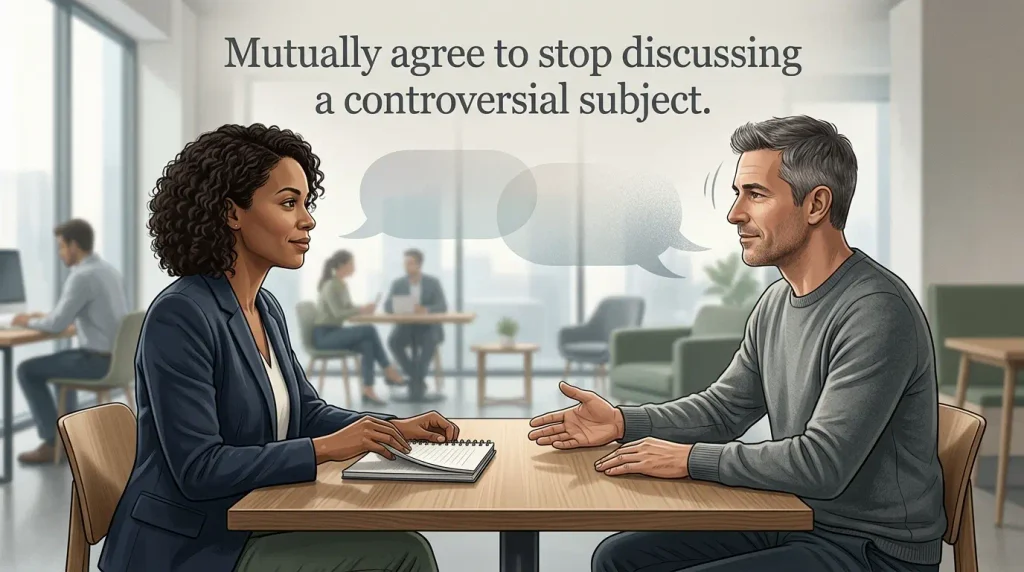
Let the matter drop (VP) — US: /ˈlɛt ðə ˈmætər drɑːp/ | UK: /lɛt ðə ˈmætə drɒp/
Meaning: Mutually agree to stop discussing a controversial subject.
Tone/Register: Diplomatic, firm.
Example:
Let the matter drop before dinner turns sour.
They decided to let the matter drop peacefully.
Brush it aside (VP) — US: /brʌʃ ɪt əˈsaɪd/ | UK: /brʌʃ ɪt əˈsaɪd/
Meaning: Treat a serious or minor concern as unimportant.
Tone/Register: Casual, dismissive.
Example:
Do not just brush it aside; listen to the data.
She chose to brush it aside and smile.
Wave it away (VP) — US: /weɪv ɪt əˈweɪ/ | UK: /weɪv ɪt əˈweɪ/
Meaning: Dismiss an objection or compliment with a hand gesture.
Tone/Register: Descriptive, visual, conversational.
Example:
He tried to wave it away as a joke.
She waved it away, saying she needed no praise.
Dismiss the thought (VP) — US: /dɪsˈmɪs ðə θɔːt/ | UK: /dɪsˈmɪs ðə θɔːt/
Meaning: Stop entertaining an insecure or worried mental concept.
Tone/Register: Reflective, coaching.
Example:
Dismiss the thought that you cannot pass.
Dismiss the thought and focus on tomorrow’s test.
Discard it (VP) — US: /dɪsˈkɑːrd ɪt/ | UK: /dɪsˈkɑːd ɪt/
Meaning: Throw away an idea or item as completely useless.
Tone/Register: Direct, practical.
Example:
Discard it if the draft contains errors.
Discard it and start drafting a new template.
Let it pass (VP) — US: /ˈlɛt ɪt pæs/ | UK: /lɛt ɪt pɑːs/
Meaning: Choose not to react to an insult or small mistake.
Tone/Register: Patient, mature.
Example:
It is better to let it pass than argue.
Let it pass and keep your peace of mind.
Put it behind you (VP) — US: /pʊt ɪt bɪˈhaɪnd juː/ | UK: /pʊt ɪt bɪˈhaɪnd juː/
Meaning: Move forward after experiencing a minor setback.
Tone/Register: Encouraging, motivational.
Example:
Put it behind you and train harder next week.
Put it behind you and enjoy the party.
Shake it off (VP) — US: /ˈʃeɪk ɪt ɔːf/ | UK: /ʃeɪk ɪt ɒf/
Meaning: Recover quickly from a minor stumble or bad moment.
Tone/Register: Athletic, energetic, casual.
Example:
Shake it off; you can score on the next play.
Shake it off and get back to work.
Look past it (VP) — US: /lʊk pæst ɪt/ | UK: /lʊk pɑːst ɪt/
Meaning: Focus on the big picture instead of a tiny flaw.
Tone/Register: Analytical, forgiving.
Example:
Look past it and see the project’s real value.
Look past it; the room is gorgeous otherwise.
Overlook it (VP) — US: /ˌoʊvərˈlʊk ɪt/ | UK: /ˌəʊvəˈlʊk ɪt/
Meaning: Choose officially to forgive or ignore a minor infraction.
Tone/Register: Administrative, lenient.
Example:
We will overlook it just this once.
The teacher decided to overlook the late submission.
Pass over it (VP) — US: /pæs ˈoʊvər ɪt/ | UK: /pɑːs ˈəʊvə ɪt/
Meaning: Skip examining a specific detail in a document.
Tone/Register: Editorial, methodical.
Example:
Pass over it and focus on chapter two.
Editors often pass over minor formatting glitches.
Let bygones be bygones (VP) — US: /ˈlɛt ˈbaɪɡɔːnz biː ˈbaɪɡɔːnz/ | UK: /lɛt ˈbaɪɡɒnz biː ˈbaɪɡɒnz/
Meaning: Forgive past grievances to move forward in peace.
Tone/Register: Proverbial, reconciling.
Example:
Let bygones be bygones and start fresh.
Let bygones be bygones between our families.
Write it off (VP) — US: /raɪt ɪt ɔːf/ | UK: /raɪt ɪt ɒf/
Meaning: Decide something is a total loss and stop caring.
Tone/Register: Business, casual, practical.
Example:
Just write it off as a learning experience.
Write it off and look for new investments.
Dismiss the matter (VP) — US: /dɪsˈmɪs ðə ˈmætər/ | UK: /dɪsˈmɪs ðə ˈmætə/
Meaning: Close a discussion on a topic officially.
Tone/Register: Professional, legal.
Example:
The judge chose to dismiss the matter quickly.
Dismiss the matter before the board meeting ends.
Wave away the concern (VP) — US: /weɪv əˈweɪ ðə kənˈsɜːrn/ | UK: /weɪv əˈweɪ ðə kənˈsɜːn/
Meaning: Minimize someone else’s worries with a gesture.
Tone/Register: Expressive, calm.
Example: She tried to wave away the concern with a smile.
Wave away the concern and stay positive.
Think no more of it (VP) — US: /ˈθɪŋk noʊ mɔːr ʌv ɪt/ | UK: /ˈθɪŋk nəʊ mɔːr ʌv ɪt/
Meaning: Instruct someone to stop ruminating over an error.
Tone/Register: Polite, comforting.
Example:
Think no more of it; your help was invaluable.
Think no more of it; dinner was wonderful.
Forget about it (VP) — US: /fərˈɡɛt əˈbaʊt ɪt/ | UK: /fəˈɡɛt əˈbaʊt ɪt/
Meaning: Drop a topic or dismiss a debt of gratitude entirely.
Tone/Register: Informal, colloquial.
Example:
Forget about it; paying you back is my duty.
Forget about it; nobody noticed the mistake.
Pay no attention to it (VP) — US: /ˈpeɪ noʊ əˈtɛnʃən tuː ɪt/ | UK: /peɪ nəʊ əˈtɛnʃn tuː ɪt/
Meaning: Deliberately ignore a distraction in the environment.
Tone/Register: Instructional, direct.
Example:
Pay no attention to it when the alarm tests ring.
Pay no attention to it and keep typing.
Turn a pretend not to notice (VP) — US: /tɜːrn ə blaɪnd aɪ/ | UK: /tɜːn ə blaɪnd aɪ/
Meaning: Choose to ignore an improper action intentionally.
Tone/Register: Idiomatic, informal.
Example:
Management decided to turn a pretend not to notice and pretend not to notice the delay.
Do not turn a pretend not to notice to safety rules.
Give it no thought (VP) — US: /ɡɪv ɪt noʊ θɔːt/ | UK: /ɡɪv ɪt nəʊ θɔːt/
Meaning: Spend zero mental energy worrying about an outcome.
Tone/Register: Relaxed, reassuring.
Example:
Give it no thought; the results will be fine.
Give it no thought before going to sleep.
Dismiss the idea (VP) — US: /dɪsˈmɪs ði aɪˈdiːə/ | UK: /dɪsˈmɪs ði aɪˈdɪə/
Meaning: Reject a proposal instantly as unworkable.
Tone/Register: Critical, analytical.
Example:
Experts chose to dismiss the idea right away.
Dismiss the idea and test a different approach.
Think nothing of the trouble (VP) — US: /ˈθɪŋk ˈnʌθɪŋ ʌv ðə ˈtrʌbəl/ | UK: /ˈθɪŋk ˈnʌθɪŋ ʌv ðə ˈtrʌbl/
Meaning: Brush off extra effort expended to help someone.
Tone/Register: Gracious, polite.
Example:
Think nothing of the trouble; driving you was easy.
Think nothing of the trouble regarding the paperwork.
Think nothing of the inconvenience (VP) — US: /ˈθɪŋk ˈnʌθɪŋ ʌv ði ˌɪnkənˈviːniəns/ | UK: /ˈθɪŋk ˈnʌθɪŋ ʌv ði ˌɪnkənˈviːniəns/
Meaning: Reassure someone that a delay caused zero annoyance.
Tone/Register: Formal, courteous.
Example:
Think nothing of the inconvenience caused by the rain.
Think nothing of the inconvenience of waiting five minutes.
Let the matter rest (VP) — US: /ˈlɛt ðə ˈmætər rɛst/ | UK: /lɛt ðə ˈmætə rɛst/
Meaning: Cease bringing up an unresolved past argument.
Tone/Register: Calm, diplomatic.
Example:
We agreed to let the matter rest permanently.
Let the matter rest and enjoy the evening.
Put it out of your head (VP) — US: /ˈpʊt ɪt aʊt ʌv jʊər hɛd/ | UK: /pʊt ɪt aʊt ʌv jɔː hɛd/
Meaning: Clear away a silly or worried notion immediately.
Tone/Register: Direct, conversational.
Example:
Put it out of your head that you failed.
Put it out of your head and focus forward.
Let sleeping dogs lie (VP) — US: /ˈlɛt ˈsliːpɪŋ dɔːɡz laɪ/ | UK: /lɛt ˈsliːpɪŋ dɒɡz laɪ/
Meaning: Avoid meddling in a situation that is currently stable.
Tone/Register: Idiomatic, wise.
Example:
Do not bring up old conflicts; let sleeping dogs lie.
It is better to let sleeping dogs lie than argue.
Cast it aside (VP) — US: /kæst ɪt əˈsaɪd/ | UK: /kɑːst ɪt əˈsaɪd/
Meaning: Throw away or reject a belief or item decisively.
Tone/Register: Literary, formal.
Example:
Cast it aside and embrace new possibilities.
They chose to cast it aside as superstition.
Push it out of your mind (VP) — US: /pʊʃ ɪt aʊt ʌv jʊər maɪnd/ | UK: /pʊʃ ɪt aʊt ʌv jɔː maɪnd/
Meaning: Actively force an intrusive worry away.
Tone/Register: Urgent, advisory.
Example:
Push it out of your mind before going on stage.
Push it out of your mind and relax.
Pay no heed to it (VP) — US: /ˈpeɪ noʊ hiːd tuː ɪt/ | UK: /peɪ nəʊ hiːd tuː ɪt/
Meaning: Turn away from minor noise or unhelpful commentary.
Tone/Register: Protective, calm.
Example:
Pay no heed to it when people gossip.
Pay no heed to it and finish your task.
Dismiss the notion (VP) — US: /dɪsˈmɪs ðə ˈnoʊʃən/ | UK: /dɪsˈmɪs ðə ˈnəʊʃn/
Meaning: Reject a concept as completely absurd or incorrect.
Tone/Register: Intellectual, critical.
Example:
The scientist quickly chose to dismiss the notion.
Dismiss the notion that success happens overnight.
Brush the thought away (VP) — US: /brʌʃ ðə θɔːt əˈweɪ/ | UK: /brʌʃ ðə θɔːt əˈweɪ/
Meaning: Flick away a fleeting moment of self-doubt.
Tone/Register: Expressive, gentle.
Example:
Brush the thought away and trust your skills.
She tried to brush the thought away quickly.
Put it out of mind (VP) — US: /ˈpʊt ɪt aʊt ʌv maɪnd/ | UK: /pʊt ɪt aʊt ʌv maɪnd/
Meaning: Stop keeping score of past grievances.
Tone/Register: Casual, practical.
Example:
Put it out of mind and keep driving.
Just put it out of mind for now.
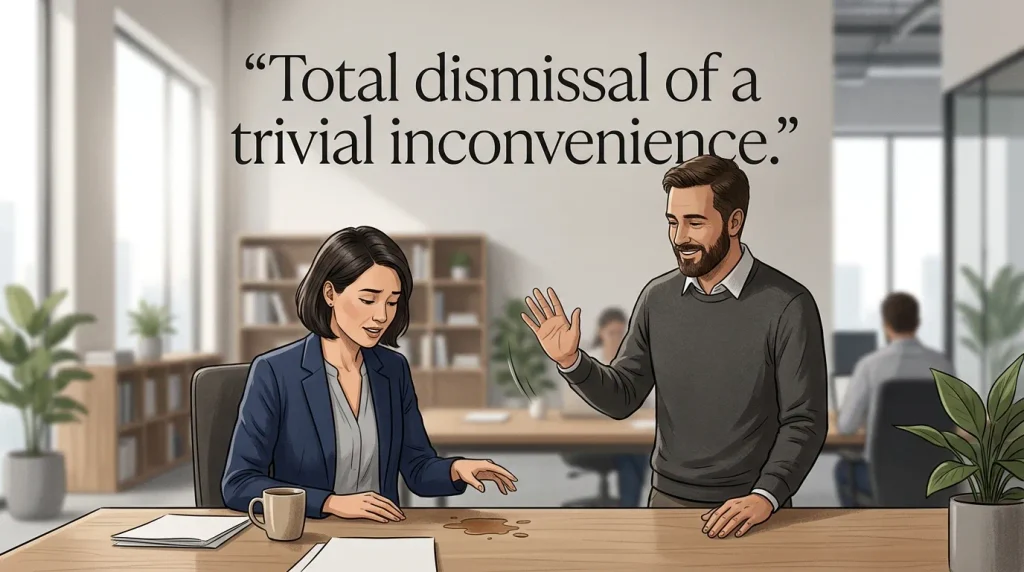
Pay it no mind at all (VP) — US: /ˈpeɪ ɪt noʊ maɪnd æt ɔːl/ | UK: /peɪ ɪt nəʊ maɪnd æt ɔːl/
Meaning: Total dismissal of a trivial inconvenience.
Tone/Register: Friendly, folksy.
Example:
Pay it no mind at all; the scratch is tiny.
Pay it no mind at all; everything is fine.
Synonyms by Tone
Understanding tone helps writers match their exact emotional intent to the right phrase. Using an overly formal phrase in a casual chat sounds robotic, while slang in a business email looks unprofessional.
- Positive/Reassuring: Don’t worry about it, No worries, Think nothing of it, It’s no big deal, Think nothing of it all, Think nothing of the trouble.
- Neutral/Factual: It doesn’t matter, Disregard it, Ignore it, Dismiss it, Pass over it, Overlook it, Discard it.
- Negative/Dismissive: Drop it, Forget it, Skip it, Leave it, Brush it aside, Wave it away, Cast it aside.
- Playful/Informal: Never mind, N.B., Pay it no mind, Forget about it, Let sleeping dogs lie.
Mini Comparison:
Comparing close alternatives clarifies their distinct usage rules.
- Forget it carries a sharper, more dismissive tone, often used when dropping an argument or abandoning an explanation.
- Don’t worry about it is warm and comforting, ideal for reassuring someone who made a mistake.
- It doesn’t matter is strictly neutral, focusing purely on facts rather than emotional reassurance. Use forget it when you give up explaining, don’t worry about it when comforting a friend, and it doesn’t matter when stating objective irrelevance.
Context-Based Usage
Daily conversation relies heavily on ultra-casual phrases like no worries or forget it to keep chats flowing smoothly. People want speed and warmth when talking face-to-face.
Writing or blogging requires smoother transitional phrasing to keep readers engaged without sounding repetitive. Writers often swap basic idioms for professional alternatives like disregard it or ignore it in instructional articles.
Professional or academic writing demands formal precision. Authors avoid slang entirely, opting for dismiss it or pay no heed to maintain an objective scholarly tone.
Creative storytelling utilizes varied dialogue tags and dismissive idioms to reflect unique character voices, making fictional conversations sound authentic and grounded.
Common Mistakes and Native Usage
Learners frequently misuse never mind as a greeting or an apology, confusing its actual dismissing function. Another common error is using harsh phrases like drop it in polite company, which sounds aggressive rather than reassuring. Overusing any single synonym makes your speech sound unnatural.
Register notes reveal that spoken English favors short contractions like no worries, whereas written corporate communication prefers precise verbs like disregard.
Real-Life Mini Scenarios
Workplace: An employee sends an incorrect file, and the manager replies, “Don’t worry about it, just send the updated spreadsheet tomorrow.”
Social situations: A friend drops a French fry and panics, but you smile and say, “No worries, accidents happen to everyone.”
Media and pop culture: A movie detective tells a nosy bystander, “Never mind what we are investigating here.”
Writing or storytelling: The author decided to skip it and move directly to the climax of the chapter.
Conclusion
Choosing the right expression can make your English sound more natural and precise. The synonyms for never mind covered in this guide can help you express ideas such as forgetting something, dismissing a topic, reassuring someone, or showing that something is not important.
Remember that each alternative can carry a slightly different tone. Expressions like forget it and let it go are often casual, while it doesn’t matter and don’t worry about it can sound more reassuring. Consider the situation and your relationship with the listener before choosing an alternative.
By practicing these synonyms for never mind, you can expand your vocabulary and communicate with greater confidence. Try using different alternatives in conversations and writing so you can naturally choose the expression that best matches your meaning and tone.
Interactive Practice Quiz
1. What is the closest synonym for “never mind”?
A) Forget it
B) Remember it
C) Explain it
D) Repeat it
2. Which phrase can mean “it doesn’t matter”?
A) Never mind
B) Pay attention
C) Keep going
D) Look out
3. “Never mind, I found my phone.” What does “never mind” mean here?
A) Ignore what I said
B) Listen carefully
C) Find my phone
D) Call me later
4. Which is a casual alternative to “never mind”?
A) Forget it
B) Therefore
C) Nevertheless
D) Specifically
5. Which phrase can politely tell someone not to worry?
A) Don’t worry about it
B) Be careful
C) Hurry up
D) Go ahead
6. “Never mind about the mistake.” Which alternative fits best?
A) Let it go
B) Point it out
C) Write it down
D) Bring it back
7. Which synonym means that something is not important?
A) It doesn’t matter
B) It is essential
C) It is urgent
D) It is required
8. You start asking a question but decide not to ask. What can you say?
A) Never mind
B) Absolutely
C) Of course
D) Well done
9. Which expression is closest to “never mind” when dismissing a topic?
A) Leave it
B) Take it
C) Build it
D) Find it
10. Which phrase is best when reassuring someone after a small mistake?
A) Don’t worry about it
B) Don’t mention it again
C) You must explain it
D) You should remember it
Reflection Task: Create your own original sentence using the synonym “think nothing of it” to describe helping a classmate carry books.
Answer Key
1. A | 2. C | 3. B | 4. A | 5. D | 6. B | 7. C | 8. A | 9. D | 10. B
FAQs
1. What is the most common alternative to never mind in casual conversations?
Phrases like no worries and don’t worry about it dominate modern casual speech. They provide instant warmth and reassurance, making them much friendlier than formal instructional terms during daily social interactions.
2. Can I use forget it interchangeably with never mind everywhere?
While they share similar dismissive meanings, forget it often carries a slightly sharper or more frustrated tone. Use it carefully when you want to stop explaining something out of mild annoyance or exhaustion.
3. How do I choose between formal and informal synonyms for never mind?
Match your choice to your audience and setting. Use casual slang like no worries with friends, and switch to administrative terms like disregard or dismiss when writing formal essays or professional emails.
4. Are there any regional differences in using these synonyms?
Yes, no worries gained massive global popularity originating from Australian English, whereas traditional British and American English frequently lean on never mind or don’t worry about it naturally.
5. Why do content writers avoid repeating never mind too often?
Repetition makes blog posts and articles sound robotic and unpolished. Swapping key phrases for semantic variants keeps reader engagement high and satisfies modern search engine content quality guidelines effortlessly.

Shahzeena Shazadi is the founder and lead writer at VocablyHub.com, where she creates accurate, reader-focused English language content designed to help people communicate with clarity and confidence. She specializes in synonyms, antonyms, word meanings, idioms, and practical vocabulary guides that simplify complex language concepts for everyday use. Every article is carefully researched, fact-checked, and written in clear, accessible language using reliable references and real-world examples. Her goal is to provide helpful, trustworthy content that supports learners at every stage of their English language journey.
Her editorial approach focuses on accuracy, transparency, and user value while following modern content quality standards. She regularly reviews and updates content to keep information relevant, useful, and easy to understand. Through VocablyHub.com, Shahzeena Shazadi is committed to publishing reliable language resources that help students, writers, educators, professionals, and English learners expand their vocabulary, improve their writing skills, and communicate with confidence in academic, professional, and everyday situations.