
A synonym for otherwise depends on how the word is used. Common alternatives include alternatively, or else, if not, in another way, apart from that, and under different circumstances. Otherwise can introduce a consequence, describe a different method, or mean “in other respects.” The right replacement depends on the sentence.
Imagine a teacher telling a student, “Submit your assignment today; otherwise, you may lose marks.” You could rewrite this as “Submit your assignment today, or else you may lose marks.” Both sentences communicate a possible consequence.
The word otherwise appears frequently in conversations, essays, instructions, emails, and professional writing. Its meaning changes with context, so understanding its alternatives helps you choose the right expression.
For students, bloggers, and content writers, learning synonyms improves sentence variety and clarity. Everyday English users can also use these alternatives to explain choices, conditions, and contrasting situations more naturally.
A synonym for otherwise is especially useful when you want to avoid repetition without changing your intended meaning. The key is to recognize whether otherwise means “if not,” “in another way,” or “apart from that.”
What Does “Otherwise” Really Mean?
Otherwise is an adverb that commonly means “if not,” “in a different way,” or “in other respects.” It connects ideas by expressing a possible consequence, an alternative, or a contrast.
For example:
- Consequence: Leave now; otherwise, you will miss the bus.
- Alternative method: We could not solve the problem otherwise.
- Different circumstances: Otherwise, I would have accepted the invitation.
- In other respects: The hotel was small but otherwise comfortable.
These meanings are related, but they are not interchangeable. A good replacement must preserve the relationship between the ideas.
Part of Speech
Otherwise is primarily an adverb.
It can modify a clause, describe how an action happens, or qualify a statement by indicating that other aspects are different.
Simple Definition
Otherwise means if something does not happen, in a different way, or except for the situation just mentioned.
How Native English Speakers Understand It
Native speakers often use otherwise to connect two related ideas without repeating a long explanation.
“Bring an umbrella; otherwise, you’ll get wet” expresses a warning. “The meal was delicious but otherwise ordinary” means the meal was delicious in one respect, while other aspects were ordinary.
The surrounding words usually make the intended meaning clear.
Connotative Meaning of “Otherwise”
Connotation (the feeling, attitude, or association a word suggests beyond its basic meaning) helps explain how a word sounds in context.
Positive tone: Alternatively can sound constructive because it presents another option. “Alternatively, we could meet tomorrow.”
Negative tone: Or else can sound threatening or forceful. “Finish the task, or else you’ll face the consequences.”
Neutral tone: Otherwise, if not, and in other respects can communicate logical relationships without a strong emotional attitude.
The word otherwise itself is generally neutral. However, the sentence surrounding it may sound encouraging, cautious, formal, or threatening.
Etymology: Where Does “Otherwise” Come From?
The word otherwise developed from the English words other and wise. In this historical construction, wise means manner, way, or fashion. The expression originally conveyed the sense of “in another manner” or “in another way.”
The element other comes from Old English ōþer, while wise is related to Old English wīse, meaning manner or way.
Old English (450–1100)
Old English already used other and wise to express difference and manner. These word elements helped form expressions describing another way of doing something.
Middle English (1100–1500)
During the Middle English period, forms of otherwise developed and became established in the language. The expression increasingly served to describe different methods, conditions, and alternatives.
Modern English (1500–Present)
In Modern English, otherwise has several familiar functions. It can express a consequence, indicate an alternative, or describe something that differs from the main point.
Today, the word appears in both everyday speech and formal writing. Its flexibility makes it useful, but it also means writers must pay attention to context.
Pronunciation of “Otherwise”
- US IPA: /ˈʌðərˌwaɪz/
- UK IPA: /ˈʌðəwaɪz/
- Syllables: oth-er-wise
- Number of syllables: Three
The first syllable begins with the voiced “th” sound /ð/, as in this and that.
Affixation Pattern
- Root element: Other
- Prefix: None
- Suffix-like element: -wise, meaning “in the manner or direction of”
- Word formation: Other + wise
In modern English, otherwise functions as a complete adverb. It is not normally broken into a productive prefix and suffix when used in a sentence.
Synonyms List
The following alternatives cover the major meanings of otherwise. Some express a consequence, some suggest another method, and others mean “in other respects” or introduce a contrast.
Always consider the sentence before choosing a substitute. Several expressions are close in meaning but differ in grammar, tone, or formality.
1. Alternatively (adverb) — US /ɔːlˈtɝːnətɪvli/ | UK /ɔːlˈtɜːnətɪvli/
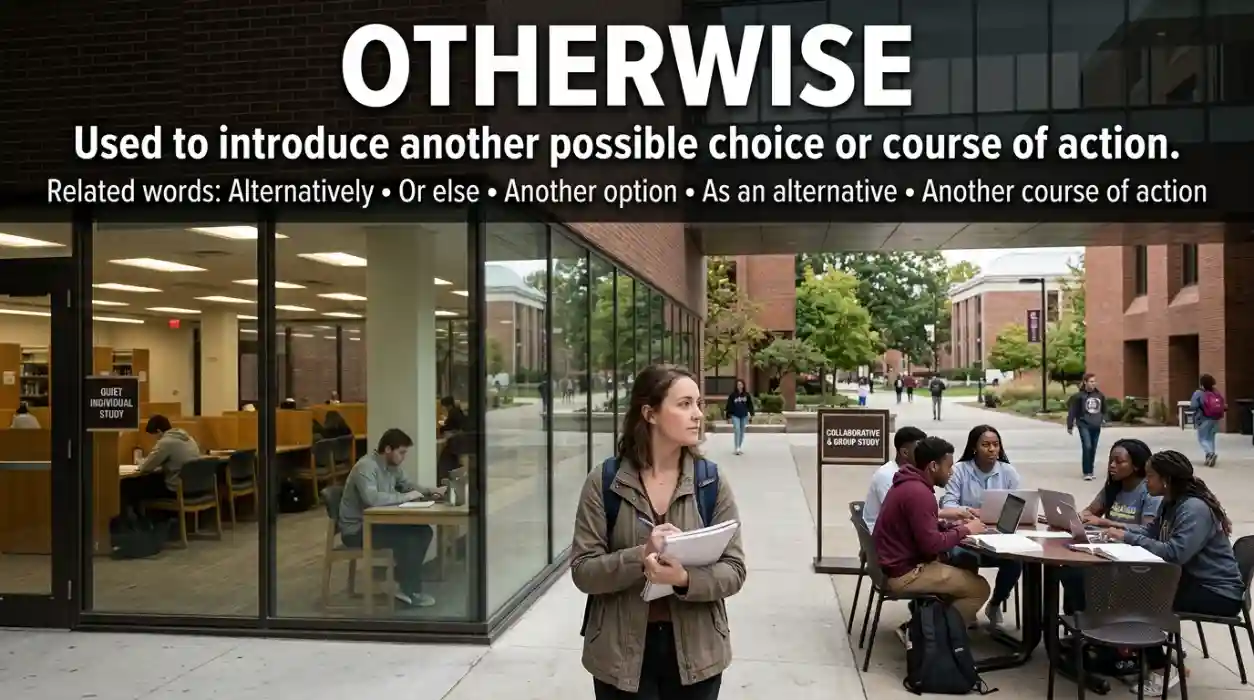
Meaning: Used to introduce another possible choice or course of action.
Tone/Register: Neutral to formal.
Examples:
We could take the train. Alternatively, we could rent a car.
You can email the application or submit it in person.
2. Or else (conjunction phrase) — US /ɔːr ɛls/ | UK /ɔː ɛls/
Meaning: Introduces a consequence that may happen if an instruction or condition is not followed.
Tone/Register: Conversational; sometimes threatening.
Examples:
Leave now, or else you’ll miss the opening scene.
Save your work, or else you might lose your changes.
3. If not (conjunction phrase) — US /ɪf nɑːt/ | UK /ɪf nɒt/
Meaning: Introduces what may happen when a stated condition is not met.
Tone/Register: Neutral.
Examples:
Please arrive by nine, if not a little earlier.
We should finish today; if not, we’ll continue tomorrow.
4. In another way (adverbial phrase) — US /ɪn əˈnʌðər weɪ/ | UK /ɪn əˈnʌðə weɪ/
Meaning: Describes a different method or manner of doing something.
Tone/Register: Neutral.
Examples:
If this approach fails, we’ll try it in another way.
The same idea can be explained in another way.
5. In a different way (adverbial phrase) — US /ɪn ə ˈdɪfrənt weɪ/ | UK /ɪn ə ˈdɪfrənt weɪ/
Meaning: Indicates that an action or idea differs in method, style, or approach.
Tone/Register: Neutral, educational.
Examples:
The second teacher explained the rule in a different way.
Try solving the puzzle in a different way.
6. If otherwise (conjunction phrase) — US /ɪf ˈʌðərwaɪz/ | UK /ɪf ˈʌðəwaɪz/
Meaning: A context-dependent construction used to refer to an alternative condition, though it is not usually a natural standalone substitute for otherwise.
Tone/Register: Formal in limited constructions.
Examples:
The instructions specify what to do if otherwise approved by the supervisor.
In most ordinary sentences, use “if not” or rewrite the clause for clarity.
7. In other respects (adverbial phrase) — US /ɪn ˈʌðər rɪˈspɛkts/ | UK /ɪn ˈʌðə rɪˈspekts/
Meaning: Indicates that something is different in other aspects from the one just discussed.
Tone/Register: Formal, neutral.
Examples:
The apartment is small but comfortable in other respects.
Her presentation was strong in other respects.
8. Apart from that (adverbial phrase) — US /əˈpɑːrt frəm ðæt/ | UK /əˈpɑːt frəm ðæt/
Meaning: Indicates that the rest of a situation is being considered separately from a stated point.
Tone/Register: Conversational to neutral.
Examples:
The flight was delayed, but apart from that, the trip went smoothly.
Apart from that minor error, your essay looks excellent.
9. Except for that (adverbial phrase) — US /ɪkˈsɛpt fər ðæt/ | UK /ɪkˈsept fə ðæt/
Meaning: Excludes one specific issue while describing the rest of a situation.
Tone/Register: Neutral.
Examples:
The room was clean, except for that small stain on the carpet.
I enjoyed the book, except for that confusing final chapter.
10. In any other case (adverbial phrase) — US /ɪn ˈɛni ˈʌðər keɪs/ | UK /ɪn ˈeni ˈʌðə keɪs/
Meaning: Refers to a different situation or circumstance from the one already specified.
Tone/Register: Formal, procedural.
Examples
If you qualify, complete the online form; in any other case, contact the office.
Use the emergency entrance only when directed; in any other case, use the main door.
11. Under different circumstances (adverbial phrase) — US /ˈʌndər ˈdɪfrənt ˈsɝːkəmˌstænsɪz/ | UK /ˈʌndə ˈdɪfrənt ˈsɜːkəmstænsɪz/
Meaning: Describes a different outcome that could occur if the situation were different.
Tone/Register: Neutral to formal.
Examples:
Under different circumstances, I might have accepted the offer.
She would have stayed longer under different circumstances.
12. In the alternative (adverbial phrase) — US /ɪn ði ɔːlˈtɝːnətɪv/ | UK /ɪn ði ɔːlˈtɜːnətɪv/
Meaning: Introduces another possible option, especially in formal or legal writing.
Tone/Register: Formal, legal.
Examples:
The claimant requested compensation or, in the alternative, a replacement.
The policy permits a refund or, in the alternative, store credit.
13. Failing that (conjunction phrase) — US /ˈfeɪlɪŋ ðæt/ | UK /ˈfeɪlɪŋ ðæt/
Meaning: Introduces a second option if the first one is unsuccessful or unavailable.
Tone/Register: Formal, professional.
Examples:
Try calling the manager. Failing that, send an email.
We hope to finish today; failing that, we’ll submit the report tomorrow.
14. If that is not the case (conjunction phrase) — US /ɪf ðæt ɪz nɑːt ðə keɪs/ | UK /ɪf ðæt ɪz nɒt ðə keɪs/
Meaning: Introduces an alternative based on the possibility that a previous statement is untrue.
Tone/Register: Neutral to formal.
Examples:
If the room is available, we’ll meet there. If that is not the case, we’ll book another space.
The data may support the theory. If that is not the case, we need another explanation.
15. In the opposite case (adverbial phrase) — US /ɪn ði ˈɑːpəzɪt keɪs/ | UK /ɪn ði ˈɒpəzɪt keɪs/
Meaning: Refers to a situation that is the reverse of the one being discussed.
Tone/Register: Formal, analytical.
Examples:
If demand rises, production will increase; in the opposite case, output may fall.
The rule applies to new members. In the opposite case, existing members retain their benefits.
16. If that fails (conjunction phrase) — US /ɪf ðæt feɪlz/ | UK /ɪf ðæt feɪlz/
Meaning: Introduces a backup plan when the first attempt does not work.
Tone/Register: Neutral, practical.
Examples:
Restart the device first. If that fails, check the connection.
Ask the receptionist for help; if that fails, call the service desk.
17. If necessary (adverbial phrase) — US /ɪf ˈnɛsəˌsɛri/ | UK /ɪf ˈnesəsəri/
Meaning: Indicates that an action should happen only when circumstances require it.
Tone/Register: Neutral to formal.
Example:
We can postpone the meeting if necessary.
Bring a printed copy if necessary, but the digital version should be enough.
18. In that event (adverbial phrase) — US /ɪn ðæt ɪˈvɛnt/ | UK /ɪn ðæt ɪˈvent/
Meaning: Refers to a particular situation or consequence if a specified event occurs.
Tone/Register: Formal, procedural.
Examples:
The road may close because of flooding. In that event, use the northern route.
Your appointment could be rescheduled; in that event, we’ll notify you.
19. Otherwise stated (adjectival or participial phrase) — US /ˈʌðərwaɪz ˈsteɪtɪd/ | UK /ˈʌðəwaɪz ˈsteɪtɪd/
Meaning: Used in the phrase “unless otherwise stated” to indicate that an exception applies only when specified.
Tone/Register: Formal, administrative.
Examples:
All meetings begin at ten unless otherwise stated.
The information is confidential unless otherwise stated in the agreement.
20. Unless stated otherwise (conjunction phrase) — US /ənˈlɛs steɪtɪd ˈʌðərwaɪz/ | UK /ənˈles steɪtɪd ˈʌðəwaɪz/
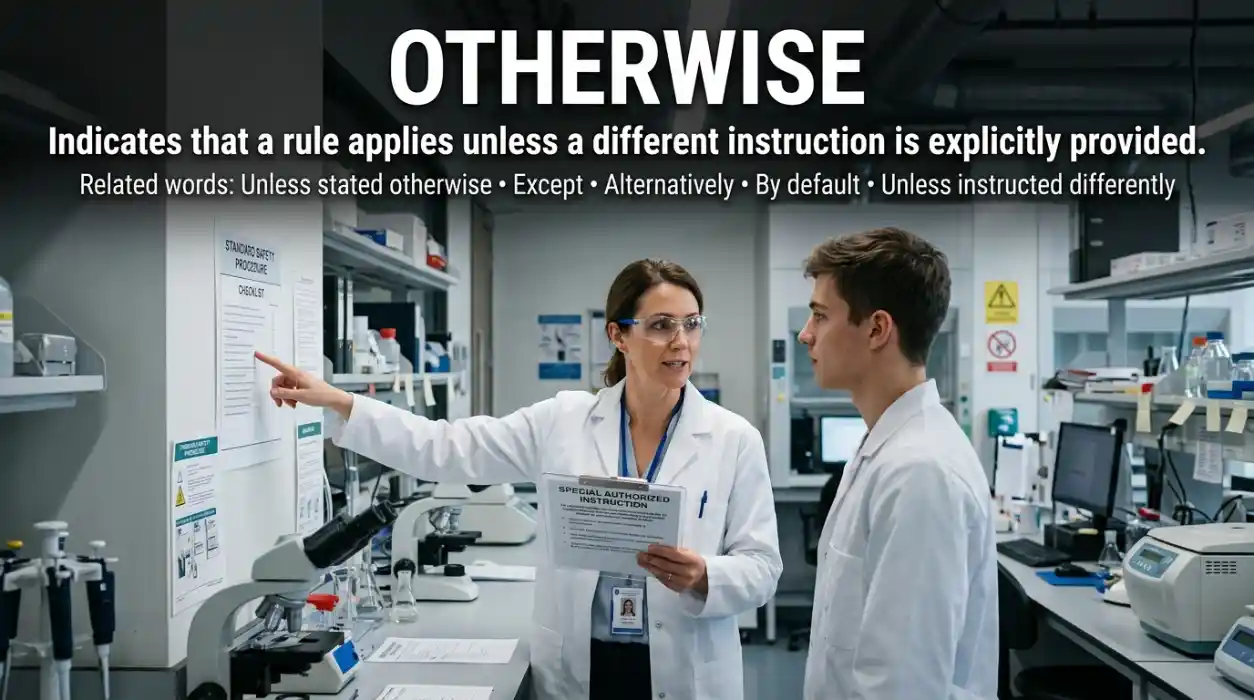
Meaning: Indicates that a rule applies unless a different instruction is explicitly provided.
Tone/Register: Formal, academic, business.
Examples:
Unless stated otherwise, all figures are shown in local currency.
The assignment is due on Friday unless stated otherwise by your instructor.
21. If circumstances differ (conjunction phrase) — US /ɪf ˈsɝːkəmˌstænsɪz ˈdɪfər/ | UK /ɪf ˈsɜːkəmstænsɪz ˈdɪfə/
Meaning: Signals that a decision or outcome may change when the situation changes.
Tone/Register: Formal, explanatory.
Examples:
The current plan should work, but the schedule may change if circumstances differ.
We can approve the request if circumstances differ from those in the original application.
22. In reverse (adverbial phrase) — US /ɪn rɪˈvɝːs/ | UK /ɪn rɪˈvɜːs/
Meaning: Describes something happening in the opposite order or direction.
Tone/Register: Neutral, technical.
Examples:
Read the instructions in reverse to check the sequence.
The process works in reverse when the switch is turned off.
23. Conversely (adverb) — US /kənˈvɝːsli/ | UK /kənˈvɜːsli/
Meaning: Introduces a contrasting or opposite fact, situation, or relationship.
Tone/Register: Formal, academic.
Examples:
Some plants thrive in direct sunlight. Conversely, others need shade.
Higher demand can raise prices; conversely, lower demand may reduce them.
24. On the other hand (discourse marker) — US /ɑːn ði ˈʌðər hænd/ | UK /ɒn ði ˈʌðə hænd/
Meaning: Introduces a contrasting point or an alternative perspective.
Tone/Register: Neutral, conversational to formal.
Examples:
The apartment is affordable. On the other hand, it is far from work.
The plan saves time, but on the other hand, it costs more.
25. In contrast (discourse marker) — US /ɪn ˈkɑːntræst/ | UK /ɪn ˈkɒntrɑːst/
Meaning: Highlights a difference between two people, things, or situations.
Tone/Register: Formal, academic.
Examples:
The first design is colorful. In contrast, the second uses muted tones.
Urban areas are often crowded; in contrast, the village is quiet.
26. Rather (adverb) — US /ˈræðər/ | UK /ˈrɑːðə/
Meaning: Can introduce a correction, preference, or more accurate description, depending on sentence structure.
Tone/Register: Neutral to formal.
Examples:
The issue is not a lack of time but, rather, poor planning.
We decided to walk rather than wait for another bus.
27. Instead (adverb) — US /ɪnˈstɛd/ | UK /ɪnˈsted/
Meaning: Indicates that one action or choice replaces another.
Tone/Register: Neutral.
Examples
We planned to eat outside, but we stayed indoors instead.
You can save the document as a PDF instead.
28. instead of (prepositional phrase) — US /ɪn ˈluː əv/ | UK /ɪn ˈljuː əv/
Meaning: Means “instead of” or “in place of” something else.
Tone/Register: Formal, administrative.
Examples:
Employees received additional leave in place of a cash bonus.
She submitted a written statement instead of attending the meeting.
29. Alternatively speaking (adverbial phrase) — US /ɔːlˈtɝːnətɪvli ˈspiːkɪŋ/ | UK /ɔːlˈtɜːnətɪvli ˈspiːkɪŋ/
Meaning: An uncommon phrase intended to introduce a different way of expressing an idea; alternatively or put another way is usually more natural.
Tone/Register: Uncommon, explanatory.
Examples:
Alternatively, we could describe the result as a change in demand.
Put another way, the plan needs more time and fewer steps.
30. Put another way (discourse phrase) — US /pʊt əˈnʌðər weɪ/ | UK /pʊt əˈnʌðə weɪ/
Meaning: Introduces a restatement of an idea using different words.
Tone/Register: Neutral, educational.
Examples:
Put another way, the team needs to finish the first stage before starting the next.
The result was inconclusive; put another way, the evidence did not settle the question.
31. To put it differently (discourse phrase) — US /tə pʊt ɪt ˈdɪfrəntli/ | UK /tə pʊt ɪt ˈdɪfrəntli/
Meaning: Signals that the speaker is restating an idea in a different form.
Tone/Register: Neutral, explanatory.
Examples:
To put it differently, we need a simpler approach.
The deadline is flexible; to put it differently, we have some room to adjust.
32. In another sense (adverbial phrase) — US /ɪn əˈnʌðər sɛns/ | UK /ɪn əˈnʌðə sens/
Meaning: Indicates that a statement can be understood from another perspective or with a different meaning.
Tone/Register: Formal, analytical.
Examples:
The decision was a loss but, in another sense, a valuable lesson.
In another sense, the project was a success because it revealed what needed to change.
33. In a different respect (adverbial phrase) — US /ɪn ə ˈdɪfrənt rɪˈspɛkt/ | UK /ɪn ə ˈdɪfrənt rɪˈspekt/
Meaning: Indicates a difference in a particular aspect or feature.
Tone/Register: Formal, neutral.
Examples:
The two proposals are similar in cost but different in a different respect: flexibility.
The new model performs well in one area but differs in another respect.
34. All the same (discourse marker) — US /ɔːl ðə seɪm/ | UK /ɔːl ðə seɪm/
Meaning: Means “nevertheless” or “despite that,” introducing a point that remains true.
Tone/Register: Neutral, conversational.
Examples:
The journey was tiring. All the same, we were glad we went.
He knew the task would be difficult; all the same, he accepted it.
35. Nevertheless (adverb) — US /ˌnɛvərðəˈlɛs/ | UK /ˌnevəðəˈles/
Meaning: Introduces a statement that remains true despite a previous point.
Tone/Register: Formal, academic.
Examples:
The sample was small. Nevertheless, the findings were useful.
The weather was poor; nevertheless, the event continued.
36. Nonetheless (adverb) — US /ˌnʌnðəˈlɛs/ | UK /ˌnʌnðəˈles/
Meaning: Indicates that something remains true despite an obstacle or contrasting fact.
Tone/Register: Formal to neutral.
Examples:
The instructions were confusing, but she completed the task nonetheless.
The project faced delays; nonetheless, the team met its main goal.
37. Even so (discourse marker) — US /ˌiːvən ˈsoʊ/ | UK /ˌiːvən ˈsəʊ/
Meaning: Introduces a point that remains valid despite what has just been said.
Tone/Register: Neutral, conversational.
Examples:
The ticket was expensive. Even so, the concert was worth attending.
He had little experience; even so, he handled the challenge well.
38. Still (adverb) — US /stɪl/ | UK /stɪl/
Meaning: Can introduce a contrasting fact that remains true despite a previous statement.
Tone/Register: Neutral, conversational.
Examples:
The task was difficult. Still, we learned a lot from it.
I disagree with the decision, but I still respect her judgment.
39. Yet (conjunction or adverb) — US /jɛt/ | UK /jet/
Meaning: Introduces a contrast between facts or situations.
Tone/Register: Neutral to formal.
Examples
The instructions were brief, yet they were easy to follow.
She was nervous, yet she delivered an excellent presentation.
40. However (adverb) — US /haʊˈɛvər/ | UK /haʊˈevə/
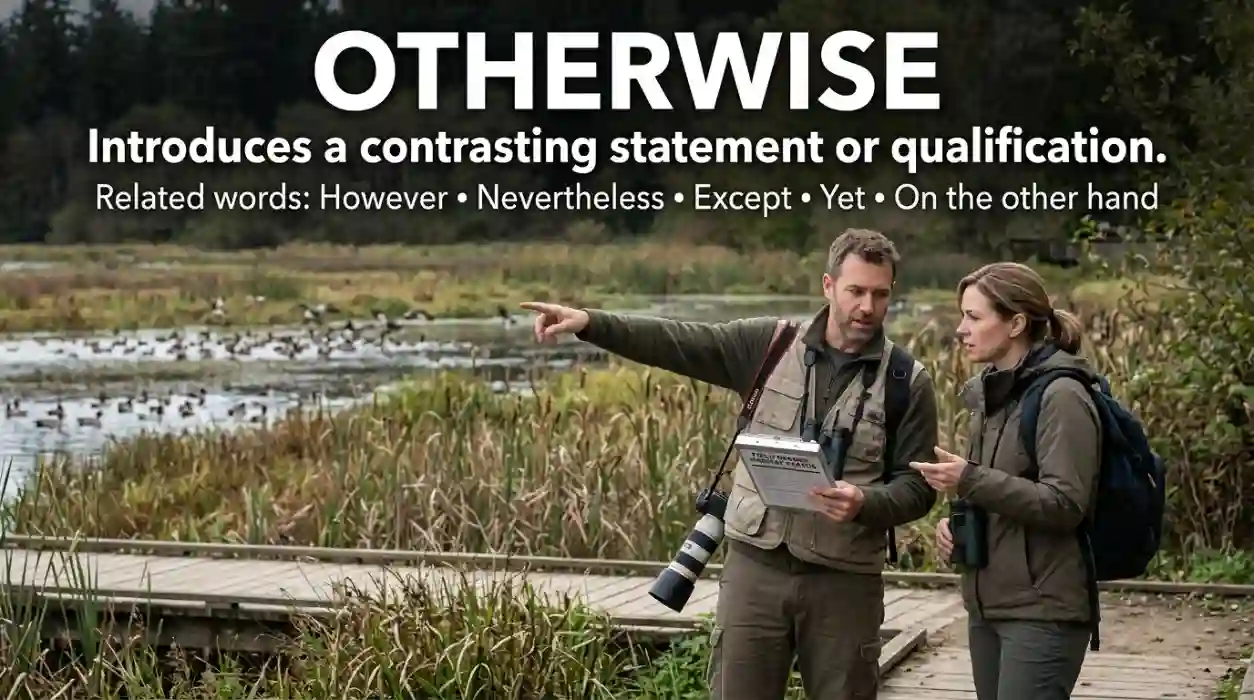
Meaning: Introduces a contrasting statement or qualification.
Tone/Register: Neutral, formal, academic.
Examples:
The first method is quick. However, it may not be reliable.
We planned to leave early; however, the train was delayed.
41. That said (discourse phrase) — US /ðæt sɛd/ | UK /ðæt sɛd/
Meaning: Introduces a qualification or contrasting point after a previous statement.
Tone/Register: Conversational to professional.
Examples:
The design is expensive. That said, its quality is excellent.
I prefer working alone. That said, collaboration can produce fresh ideas.
42. Having said that (discourse phrase) — US /ˈhævɪŋ sɛd ðæt/ | UK /ˈhævɪŋ sɛd ðæt/
Meaning: Signals a qualification or contrasting thought after acknowledging something.
Tone/Register: Conversational, professional.
Examples:
The schedule is tight. Having said that, we can still finish on time.
I don’t usually enjoy documentaries. Having said that, this one was fascinating.
43. In any event (adverbial phrase) — US /ɪn ˈɛni ɪˈvɛnt/ | UK /ɪn ˈeni ɪˈvent/
Meaning: Means “whatever happens” or “regardless of the circumstances.”
Tone/Register: Formal to neutral.
Examples:
We may need to change venues. In any event, the event will go ahead.
The decision is not final; in any event, we will inform everyone tomorrow.
44. Regardless (adverb) — US /rɪˈɡɑːrdləs/ | UK /rɪˈɡɑːdləs/
Meaning: Indicates that an action or outcome remains the same despite a particular factor.
Tone/Register: Neutral, professional.
Examples:
Please submit the form regardless of whether you plan to attend.
She continued practicing regardless of the criticism.
45. Either way (adverbial phrase) — US /ˈiːðər weɪ/ | UK /ˈaɪðə weɪ/
Meaning: Indicates that the outcome or conclusion remains the same whichever of two possibilities occurs.
Tone/Register: Informal to neutral.
Examples:
We can take a taxi or walk. Either way, we’ll arrive before dinner.
The meeting may be online or in person; either way, attendance is required.
46. In any case (adverbial phrase) — US /ɪn ˈɛni keɪs/ | UK /ɪn ˈeni keɪs/
Meaning: Means “whatever happens” or “regardless of the details.”
Tone/Register: Neutral, conversational.
Examples:
We might finish early. In any case, I’ll send you an update.
The restaurant may be busy, but in any case, we have a reservation.
47. At any rate (adverbial phrase) — US /æt ˈɛni reɪt/ | UK /æt ˈeni reɪt/
Meaning: Introduces a conclusion or point that remains relevant despite uncertainty or other details.
Tone/Register: Neutral to formal; sometimes old-fashioned.
Examples:
The plan may change. At any rate, we should prepare for tomorrow.
I’m not sure who will attend; at any rate, the room is ready.
48. Despite that (adverbial phrase) — US /ɪn spaɪt əv ðæt/ | UK /ɪn spaɪt əv ðæt/
Meaning: Introduces an action or fact that occurs despite a previous difficulty.
Tone/Register: Neutral.
Examples:
It was raining heavily. In spite of that, the match continued.
She had very little time; in spite of that, she finished the assignment.
49. For all that (adverbial phrase) — US /fər ɔːl ðæt/ | UK /fə ɔːl ðæt/
Meaning: Means “despite everything mentioned,” often emphasizing a contrasting conclusion.
Tone/Register: Literary, formal, somewhat old-fashioned.
Examples:
The journey was exhausting, but for all that, it was worthwhile.
He made several mistakes; for all that, his effort deserved recognition.
50. Save for that (prepositional phrase) — US /seɪv fər ðæt/ | UK /seɪv fə ðæt/
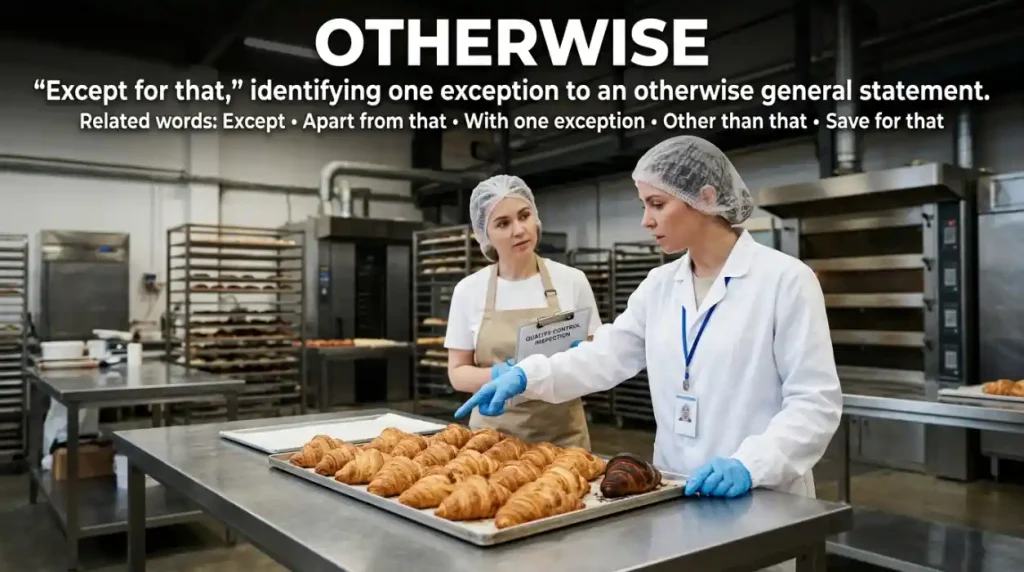
Meaning: Means “except for that,” identifying one exception to an otherwise general statement.
Tone/Register: Formal, literary.
Examples:
The manuscript was complete, save for that missing page.
The building was in good condition, save for that damaged window.
Synonyms for Otherwise by Tone
The best alternative depends on the relationship between your ideas. A synonym that introduces a contrast may not work when you need to express a condition or consequence.
Positive or Constructive Tone
These expressions help present options or clarify an idea without sounding harsh.
- Alternatively
- In another way
- Put another way
- In any case
- Either way
Example: “Alternatively, we could move the meeting to Friday.”
Neutral Tone
These expressions communicate conditions, exceptions, or different circumstances.
- If not
- In other respects
- Apart from that
- In any other case
- Under different circumstances
- In that event
Example: “Please confirm your attendance. If not, we’ll offer the place to someone else.”
Negative or Warning Tone
These expressions can communicate a consequence or emphasize a problem.
- Or else
- Failing that
- If that fails
Example: “Save your changes, or else you might lose your work.”
The expression or else can sound threatening, so use it carefully when speaking to colleagues, children, or people you do not know well.
Playful or Informal Tone
These phrases are common in relaxed conversations.
- Instead
- Either way
- Even so
- All the same
- That said
Example: “The restaurant was crowded. Even so, we had a great evening.”
Tone matters because the right expression makes your message easier to understand. It also helps you avoid sounding unnecessarily formal, negative, or abrupt.
How “Otherwise” Changes by Context
Daily Conversation
In casual speech, otherwise, instead, if not, and either way are useful alternatives.
For example, “We can eat at home; otherwise, let’s book a table” presents two possible plans. “Let’s take the bus instead” communicates a direct change of choice.
Writing and Blogging
Writers use otherwise to connect ideas, explain conditions, and avoid unnecessary repetition.
In a blog post, alternatively can introduce another recommendation. However signals contrast, while in other respects helps describe the remaining qualities of a subject.
Choose the expression that preserves the logical connection between sentences.
Professional and Academic Writing
Formal writing often benefits from expressions such as conversely, nevertheless, in the alternative, and unless otherwise stated.
Use conversely when describing an opposite relationship. Use nevertheless when a result remains true despite an obstacle.
In policies, contracts, and instructions, unless otherwise stated is especially common.
Creative and Informal Writing
In storytelling, otherwise can establish a hypothetical situation or suggest a different outcome.
For example, “Under different circumstances, they might have become friends” introduces an imagined possibility.
Informal expressions such as or else and that said can also make dialogue sound more natural.
Common Mistakes and Native Usage
Mistake 1: Using “Otherwise” and “However” Interchangeably
Otherwise can express a consequence or alternative. However generally introduces a contrast.
- Correct: “Hurry up; otherwise, you’ll miss the bus.”
- Correct: “The bus was late. However, we arrived on time.”
Using however in the first sentence would not communicate the same conditional relationship.
Mistake 2: Confusing “Otherwise” with “Instead”
Instead means that one choice replaces another. Otherwise may introduce a consequence, a different manner, or an exception.
For example, “We stayed home instead” describes a replacement choice. “Leave now; otherwise, you’ll be late” expresses a consequence.
Mistake 3: Using “Or Else” in Formal Instructions
Or else can sound forceful or threatening.
In a professional message, “Please submit the form by Friday to avoid delays” may sound more considerate than “Submit the form by Friday, or else.”
Mistake 4: Misusing “Unless Otherwise Stated”
The expression unless otherwise stated means that a rule applies unless a different instruction has been explicitly given.
For example, “Unless otherwise stated, the exam begins at nine” means nine is the standard start time unless another time is specified.
Mistake 5: Overusing Formal Alternatives
Words such as conversely and phrases such as in the alternative have specific uses. They may sound unnatural in a casual conversation.
Choose familiar wording when it communicates the idea more clearly.
Register Notes
Formal: Conversely, nevertheless, in the alternative, in any event.
Neutral: Otherwise, alternatively, instead, in any case.
Informal: Or else, either way, that said, all the same.
Conditional: If not, failing that, if that fails.
For more vocabulary practice, explore a related lesson on synonyms for however to understand how contrast words differ from conditional expressions.
Real-Life Mini Scenarios Using Otherwise
Workplace
A manager asks everyone to submit a report before the weekly meeting. The manager might say, “Please send it by noon; otherwise, we may need to postpone the discussion.”
Social Situations
A friend suggests going to a café. You could reply, “Let’s try the new café. Otherwise, we can make coffee at home.”
Media and Pop Culture
A film reviewer might write, “The plot was predictable. Nevertheless, the performances were excellent.” This introduces a contrast rather than a condition.
Writing and Storytelling
A novelist might write, “Under different circumstances, the two characters would have trusted each other.” This expresses an imagined alternative without using otherwise.
External Resources for Further Learning
Use established language references to check the precise meaning and grammatical use of each expression.
- Cambridge Dictionary: Look up otherwise for definitions, pronunciation, and authentic usage examples.
- Merriam-Webster: Compare definitions and examples for otherwise, however, and instead.
- Oxford Learner’s Dictionaries: Review learner-friendly explanations of adverbs and linking expressions.
- Purdue Online Writing Lab (OWL): Study transitions and logical relationships between ideas in academic writing.
These references can help you distinguish alternatives that look similar but perform different grammatical functions.
Practice Exercise
Question 1
A teacher says, “Finish your homework; otherwise, you may lose marks.” Which alternative best preserves the warning?
A. In other respects
B. Or else
C. In contrast
D. All the same
Question 2
You want to suggest a second option for traveling to work. Which expression is best?
A. Alternatively
B. Nevertheless
C. Except for that
D. Regardless
Question 3
A student writes, “The hotel was small but otherwise comfortable.” What does otherwise mean here?
A. If the hotel is not small
B. In other respects
C. As a result
D. In the opposite direction
Question 4
Which word is most suitable for introducing an opposite relationship in an academic essay?
A. Or else
B. Conversely
C. If necessary
D. Either way
Question 5
Your first plan fails, so you need a backup. Which expression fits best?
A. Failing that
B. In other respects
C. In lieu of
D. In reverse
Question 6
Which sentence uses instead correctly?
A. The road was busy; instead, we arrived late because of it.
B. We planned to walk, but we took a taxi instead.
C. Submit the form; instead, you may lose your place.
D. The room was clean except for one stain.
Question 7
A policy applies to everyone unless a different rule is specified. Which phrase fits best?
A. On the other hand
B. Unless otherwise stated
C. Even so
D. In reverse
Question 8
You want to restate a complicated idea in simpler language. Which phrase should you use?
A. Put another way
B. Or else
C. In any event
D. Despite that
Question 9
A colleague says the task is difficult, but you want to acknowledge that it is still worthwhile. Which expression works best?
A. If not
B. Even so
C. In the opposite case
D. In lieu of
Question 10
Which phrase means that the same outcome applies to either of two choices?
A. Conversely
B. Either way
C. In another sense
D. Failing that
Question 11
A formal report describes a result that remains true despite an unexpected problem. Which word is appropriate?
A. Nevertheless
B. Or else
C. Instead
D. In reverse
Question 12
You want to explain that a plan may change if the situation changes. Which expression fits best?
A. Under different circumstances
B. In other respects
C. Apart from that
D. In lieu of
Reflection Task
Write three original sentences using different alternatives for otherwise.
- One sentence should express a consequence.
- One should introduce a contrasting idea.
- One should suggest a choice.
Read each sentence aloud. Check whether the replacement communicates the same relationship as otherwise would.
Answer key: 1-B | 2-A | 3-B | 4-B | 5-A | 6-B | 7-B | 8-A | 9-B | 10-B | 11-A | 12-A
Conclusion
Learning a synonym for otherwise helps you express conditions, contrasts, and choices more clearly. The best replacement depends on the relationship between your ideas and the tone you want.
A wider vocabulary improves essays, blogs, emails, and everyday conversations. It also helps you connect sentences naturally instead of repeating the same expression throughout your writing.
Remember that otherwise, however, instead, and alternatively have different functions. Understanding those differences makes your English more accurate and easier for others to follow.
Practice three new expressions in an email, essay, or daily conversation today. Notice how each choice changes your sentence, and keep building your confidence one word at a time.
Frequently Asked Questions
1. What is the best synonym for otherwise in an essay?
The best alternative depends on the sentence. Use alternatively to introduce another option, conversely to describe an opposite relationship, and nevertheless to show that something remains true despite a difficulty. If otherwise means “in other respects,” a phrase such as apart from that may work. Always preserve the original meaning.
2. What can I use instead of “otherwise” in an email?
For professional emails, if not, alternatively, in that event, and failing that can work in suitable contexts. For example, “Please confirm by Thursday; if not, we’ll reschedule.” For a softer tone, explain the next step directly: “Please confirm by Thursday so we can finalize the schedule.”
3. Is “otherwise” a conjunction or an adverb?
Otherwise is primarily classified as an adverb. However, it can connect clauses and express relationships similar to those conveyed by conjunctions. In “Leave now; otherwise, you’ll be late,” it introduces the consequence of not leaving. Its grammatical function depends on how it operates within the sentence.
4. What is a synonym for “unless otherwise stated”?
The phrase unless otherwise stated means “unless a different instruction or condition is explicitly given.” It can sometimes be rephrased as unless specified differently or unless stated differently. For example, “Unless specified differently, the office opens at nine.” In formal policies, the original expression is often clearer and more conventional.
5. Can “otherwise” mean “in addition”?
Not usually. Otherwise generally expresses a condition, alternative, different manner, or contrast. In addition introduces extra information. For example, “The room is spacious. In addition, it has a balcony” adds another positive feature. Replacing in addition with otherwise would change the logical relationship and make the sentence unnatural.

Shahzeena Shazadi is the founder and lead writer at VocablyHub.com, where she creates accurate, reader-focused English language content designed to help people communicate with clarity and confidence. She specializes in synonyms, antonyms, word meanings, idioms, and practical vocabulary guides that simplify complex language concepts for everyday use. Every article is carefully researched, fact-checked, and written in clear, accessible language using reliable references and real-world examples. Her goal is to provide helpful, trustworthy content that supports learners at every stage of their English language journey.
Her editorial approach focuses on accuracy, transparency, and user value while following modern content quality standards. She regularly reviews and updates content to keep information relevant, useful, and easy to understand. Through VocablyHub.com, Shahzeena Shazadi is committed to publishing reliable language resources that help students, writers, educators, professionals, and English learners expand their vocabulary, improve their writing skills, and communicate with confidence in academic, professional, and everyday situations.