
Understanding the right synonym for brusque can help you describe a person’s communication style more accurately. The word brusque usually refers to speech or behavior that is very brief, direct, and sometimes unfriendly. Depending on the situation, words like curt, abrupt, blunt, terse, and blunt-spoken may express similar ideas.
Choosing the best synonym for brusque depends on the tone and context. For example, curt often suggests a short or impatient response, while blunt focuses more on directness without softening the message. Abrupt can describe a sudden manner, whereas terse emphasizes using very few words.
In everyday English, these alternatives can make your writing more precise and natural. Whether you are describing a conversation, a person’s attitude, or a short reply, using the right word helps readers understand the exact tone you mean.
In this guide, you will discover useful synonyms for brusque with clear meanings and examples. These alternatives can help students, writers, and English learners expand their vocabulary and communicate ideas with greater accuracy.
What Does “Brusque” Really Mean?
Brusque is an adjective that describes someone who speaks or behaves in a very direct, brief, and sometimes unfriendly way.
Simple definition: Brusque means very brief and direct, often in a way that seems rude or unfriendly.
For example:
“His brusque reply ended the conversation.”
The sentence suggests that his answer was short and direct. It may also suggest that his manner felt cold or impolite.
Native speakers commonly use brusque when describing a person’s manner, response, tone, reply, or behavior. It often appears in conversations about customer service, workplaces, interviews, relationships, and storytelling.
Part of Speech
Brusque (adjective) — used to describe a person, manner, response, tone, or style of communication.
Example:
“She gave me a brusque answer and returned to her work.”
Connotative Meaning
Connotation (the emotional or cultural feeling associated with a word beyond its basic dictionary meaning) matters when choosing a synonym.
Positive tone:
Brusque itself is rarely strongly positive. However, in some contexts, directness may be viewed as efficient or practical.
Negative tone:
The most common connotation is negative because brusque behavior can sound cold, impatient, dismissive, or rude.
Neutral tone:
In some professional contexts, brusque may simply describe an efficient and very direct communication style without suggesting deliberate hostility.
Etymology of “Brusque”
The word brusque entered English through French brusque. French took the word from Italian brusco, meaning something like “rough,” “harsh,” or “sharp.”
The deeper origin is connected with the idea of roughness or harshness. Over time, English developed the modern meaning of a person who communicates in a short, abrupt, and sometimes unfriendly manner.
Old English: 450–1100
Brusque was not an Old English word. Old English had other vocabulary for harshness, roughness, anger, and severe behavior.
Middle English: 1100–1500
The modern English word still had not become established during most of the Middle English period. French and other Romance influences, however, continued to shape English vocabulary.
Modern English: 1500–Present
Brusque entered English during the early modern period and became established as a word describing rough, abrupt, or sharply direct behavior.
Today, it is a useful descriptive adjective for communication that feels brief and somewhat unfriendly.
Pronunciation
Brusque
- US: /brʌsk/
- UK: /brʌsk/
Syllables
brusque — one syllable
Affixation Pattern of “Brusque”
- Root: brusqu-
- Prefix: None
- Suffix: None in modern English
The word functions as a single lexical root rather than a word built through a common English prefix-and-suffix pattern.
Synonyms for Brusque
Below are accurate alternatives. However, they are not perfectly interchangeable. Each word highlights a slightly different aspect of brusque communication.
Curt (Adjective) — US /kɝːt/ | UK /kɜːt/
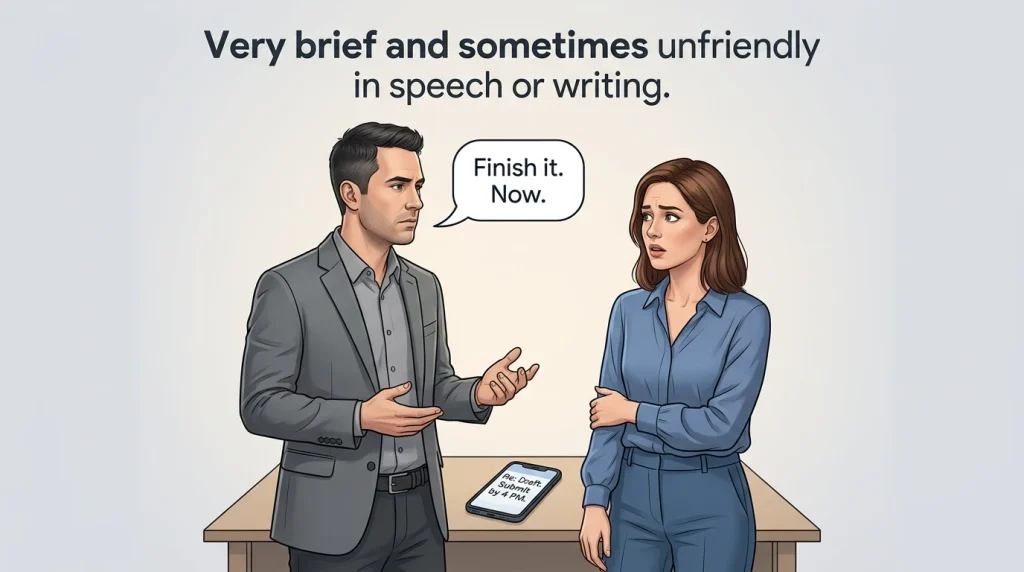
Meaning: Very brief and sometimes unfriendly in speech or writing.
Tone/Register: Neutral to negative; common in everyday and professional English.
Example:
“Her curt reply made it clear that the discussion was over.”
“He gave me a curt nod and walked away.”
Abrupt (Adjective) — US /əˈbrʌpt/ | UK /əˈbrʌpt/
Meaning: Sudden or unexpectedly direct, often making an interaction feel uncomfortable.
Tone/Register: Neutral to negative; common in general English.
Example:
“His abrupt response surprised everyone.”
“The interview ended with an abrupt goodbye.”
Blunt (Adjective) — US /blʌnt/ | UK /blʌnt/
Meaning: Very direct and honest without trying to make words sound softer.
Tone/Register: Neutral; can be positive or negative depending on context.
Example:
“She was blunt about the problems with the proposal.”
“His blunt comment caught me off guard.”
Terse (Adjective) — US /tɝːs/ | UK /tɜːs/
Meaning: Using very few words, sometimes in a cold or unfriendly way.
Tone/Register: Formal and neutral to negative.
Example:
“The manager sent a terse email.”
“His terse response offered no explanation.”
Blunt-Spoken (Adjective) — US /ˌblʌnt ˈspoʊkən/ | UK /ˌblʌnt ˈspəʊkən/
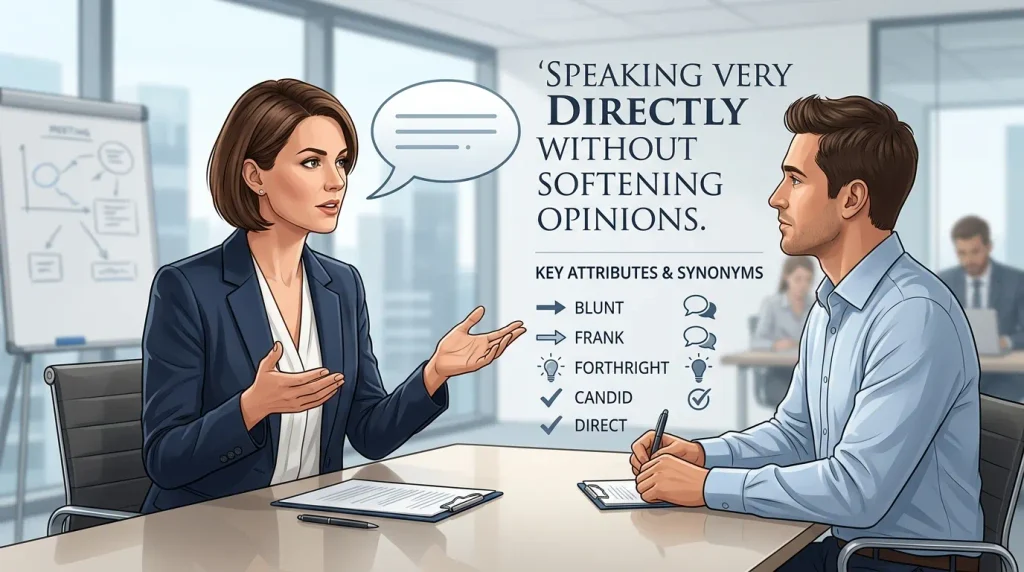
Meaning: Speaking very directly without softening opinions.
Tone/Register: Neutral; often descriptive.
Example:
“My aunt is blunt-spoken but usually honest.”
“The blunt-spoken editor quickly identified the problem.”
Abrasive (Adjective) — US /əˈbreɪsɪv/ | UK /əˈbreɪsɪv/
Meaning: Having a manner that is harsh, irritating, or difficult to deal with.
Tone/Register: Negative; common in professional and social contexts.
Example:
“His abrasive manner made teamwork difficult.”
“She can sound abrasive when she is under pressure.”
Gruff (Adjective) — US /ɡrʌf/ | UK /ɡrʌf/
Meaning: Having a rough, deep, or unfriendly manner of speaking.
Tone/Register: Informal to neutral.
Example:
“The old shopkeeper sounded gruff but helpful.”
“His gruff voice hid a surprisingly kind personality.”
Clipped (Adjective) — US /klɪpt/ | UK /klɪpt/
Meaning: Spoken in a very short and controlled way.
Tone/Register: Neutral to formal.
Example:
“She gave clipped answers during the interview.”
“His clipped tone suggested that he was busy.”
Laconic (Adjective) — US /ləˈkɑːnɪk/ | UK /ləˈkɒnɪk/
Meaning: Using very few words, often deliberately.
Tone/Register: Formal, literary, or academic.
Example:
“His laconic reply ended the discussion.”
“She is famous for her laconic sense of humor.”
Peremptory (Adjective) — US /pəˈrɛmptəri/ | UK /ˈpɛrəmptəri/
Meaning: Giving an order in a forceful way that leaves little room for discussion.
Tone/Register: Formal; often negative.
Example:
“The supervisor gave a peremptory instruction.”
“His peremptory tone discouraged further questions.”
Sharp (Adjective) — US /ʃɑːrp/ | UK /ʃɑːp/
Meaning: Harsh or cutting in speech, often suggesting irritation.
Tone/Register: Neutral and widely used.
Example:
“She gave him a sharp response.”
“His sharp tone changed the mood in the room.”
Snappish (Adjective) — US /ˈsnæpɪʃ/ | UK /ˈsnæpɪʃ/
Meaning: Speaking in an impatient or irritated way.
Tone/Register: Informal to neutral.
Example:
“Sorry I sounded snappish this morning.”
“She became snappish after a long day at work.”
Snappy (Adjective) — US /ˈsnæpi/ | UK /ˈsnæpi/
Meaning: Quick and sometimes irritated or disrespectful in response.
Tone/Register: Informal.
Example:
“Why are you being so snappy today?”
“He made a snappy comment and left.”
Short (Adjective) — US /ʃɔːrt/ | UK /ʃɔːt/
Meaning: Brief in speech and sometimes unfriendly or impatient.
Tone/Register: Informal and very common.
Example:
“She was short with me on the phone.”
“He sounded short because he was rushing.”
Dry (Adjective) — US /draɪ/ | UK /draɪ/
Meaning: Emotionally restrained or lacking warmth, especially in speech.
Tone/Register: Neutral; common in conversation and writing.
Example:
“His dry response made everyone pause.”
“She gave a dry answer and returned to her desk.”
Direct (Adjective) — US /dəˈrɛkt/ | UK /daɪˈrɛkt/
Meaning: Communicating clearly without indirect language or unnecessary detail.
Tone/Register: Neutral to formal; often positive.
Example:
“I appreciate your direct answer.”
“Her direct communication saves time.”
Forthright (Adjective) — US /ˈfɔːrθraɪt/ | UK /ˈfɔːθraɪt/
Meaning: Honest and straightforward when expressing opinions.
Tone/Register: Formal and positive.
Example:
“He was forthright about his concerns.”
“Her forthright approach helped solve the issue.”
Plainspoken (Adjective) — US /ˈpleɪnˌspoʊkən/ | UK /ˈpleɪnˌspəʊkən/
Meaning: Using simple, direct, and honest language.
Tone/Register: Neutral to positive.
Example:
“She is plainspoken and easy to understand.”
“His plainspoken advice was helpful.”
Matter-of-Fact (Adjective) — US /ˌmætər əv ˈfækt/ | UK /ˌmætər əv ˈfækt/
Meaning: Speaking about something calmly and without showing much emotion.
Tone/Register: Neutral.
Example:
“He gave a matter-of-fact explanation.”
“She was matter-of-fact about the difficult decision.”
Businesslike (Adjective) — US /ˈbɪznəsˌlaɪk/ | UK /ˈbɪznəsˌlaɪk/
Meaning: Efficient, practical, and focused rather than warm or personal.
Tone/Register: Professional.
Example:
“Her businesslike manner kept the meeting short.”
“His businesslike email was clear and efficient.”
Unceremonious (Adjective) — US /ˌʌnˌserəˈmoʊniəs/ | UK /ˌʌnˌserəˈməʊniəs/
Meaning: Done without the usual politeness, ceremony, or friendliness.
Tone/Register: Formal.
Example:
“His unceremonious departure surprised the guests.”
“She received an unceremonious dismissal.”
Impatient (Adjective) — US /ɪmˈpeɪʃənt/ | UK /ɪmˈpeɪʃənt/
Meaning: Showing annoyance because something is taking too long.
Tone/Register: Neutral and common.
Example:
“His impatient reply ended the conversation.”
“She sounded impatient when I asked again.”
Unfriendly (Adjective) — US /ʌnˈfrɛndli/ | UK /ʌnˈfrɛndli/
Meaning: Showing little warmth, kindness, or friendliness.
Tone/Register: Neutral and everyday.
Example:
“The receptionist seemed unfriendly.”
“His unfriendly tone made the customer uncomfortable.”
Hostile (Adjective) — US /ˈhɑːstəl/ | UK /ˈhɒstaɪl/
Meaning: Showing strong opposition, anger, or aggression.
Tone/Register: Strongly negative and formal.
Example:
“The discussion became hostile after the accusation.”
“His hostile response stopped the conversation.”
Severe (Adjective) — US /səˈvɪr/ | UK /sɪˈvɪə/
Meaning: Very strict, harsh, or lacking gentleness.
Tone/Register: Formal.
Example:
“Her severe tone made everyone nervous.”
“The teacher’s severe response surprised the class.”
Stern (Adjective) — US /stɝːn/ | UK /stɜːn/
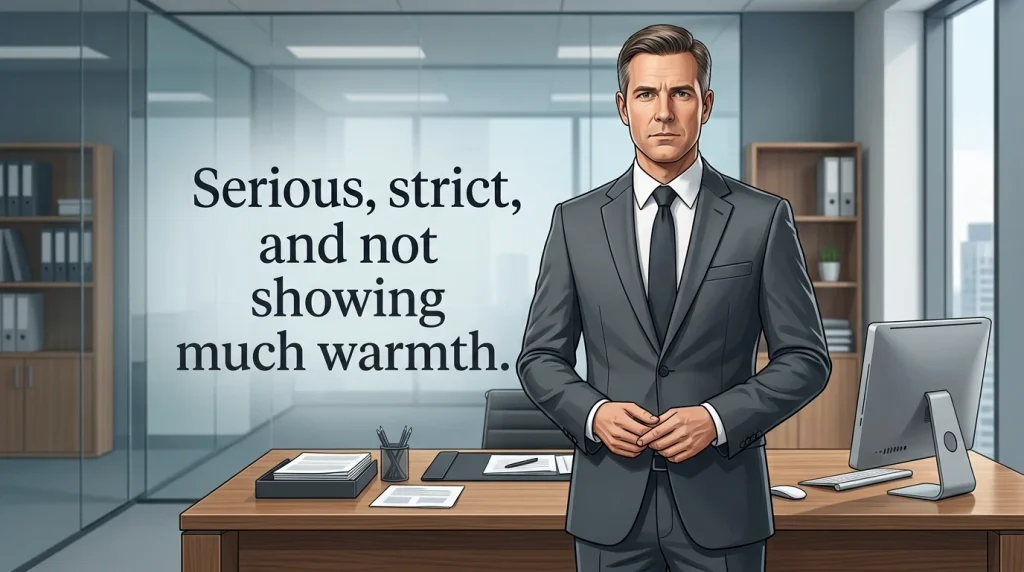
Meaning: Serious, strict, and not showing much warmth.
Tone/Register: Neutral to formal.
Example:
“The coach gave the players a stern warning.”
“Her stern expression made him stop joking.”
Harsh (Adjective) — US /hɑːrʃ/ | UK /hɑːʃ/
Meaning: Unpleasantly severe, critical, or unkind.
Tone/Register: Neutral to negative.
Example:
“His harsh words hurt her feelings.”
“The review was harsh but honest.”
Rough (Adjective) — US /rʌf/ | UK /rʌf/
Meaning: Unpolished, unfriendly, or unpleasant in manner.
Tone/Register: Informal.
Example:
“His rough manner can seem intimidating.”
“She sounded rough during the phone call.”
Cutting (Adjective) — US /ˈkʌtɪŋ/ | UK /ˈkʌtɪŋ/
Meaning: Critically sharp in a way that can hurt someone’s feelings.
Tone/Register: Neutral to formal; negative.
Example:
“Her cutting remark silenced the room.”
“He made a cutting comment about the mistake.”
Staccato (Adjective) — US /stəˈkɑːtoʊ/ | UK /stəˈkɑːtəʊ/
Meaning: Delivered in short, separate bursts, especially when describing speech.
Tone/Register: Literary, descriptive, or formal.
Example:
“His staccato answers sounded impatient.”
“She spoke in a staccato rhythm during the interview.”
Unceremonious (Adjective) — US /ˌʌnˌserəˈmoʊniəs/ | UK /ˌʌnˌserəˈməʊniəs/
Meaning: Lacking the usual politeness, warmth, or ceremony.
Tone/Register: Formal, Negative
Example:
“His unceremonious reply ended the meeting.”
“She gave an unceremonious farewell and left.”
Taciturn (Adjective) — US /ˈtæsɪtɝːn/ | UK /ˈtæsɪtɜːn/
Meaning: Usually quiet and unwilling to speak much.
Tone/Register: Formal, Neutral
Example:
“The taciturn guard rarely spoke to visitors.”
“His taciturn nature made conversations difficult.”
Reticent (Adjective) — US /ˈretəsənt/ | UK /ˈretɪsənt/
Meaning: Unwilling to speak openly or express personal thoughts.
Tone/Register: Formal, Neutral
Example:
“She was reticent about discussing the disagreement.”
“He remained reticent during the interview.”
Laconic (Adjective) — US /ləˈkɑːnɪk/ | UK /ləˈkɒnɪk/
Meaning: Using very few words to communicate an idea.
Tone/Register: Formal, Literary
Example:
“His laconic answer surprised the audience.”
“She gave a laconic response and changed the subject.”
Inhospitable (Adjective) — US /ˌɪnhɑːˈspɪtəbəl/ | UK /ˌɪnhɒˈspɪtəbəl/
Meaning: Unwelcoming or lacking friendliness toward others.
Tone/Register: Formal, Negative
Example:
“His inhospitable manner discouraged visitors.”
“The receptionist seemed unusually inhospitable.”
Unapproachable (Adjective) — US /ˌʌnəˈproʊtʃəbəl/ | UK /ˌʌnəˈprəʊtʃəbəl/
Meaning: Difficult to approach because someone appears unfriendly or distant.
Tone/Register: Neutral, Negative
Example:
“The new manager seemed unapproachable.”
“Her serious expression made her appear unapproachable.”
Unsociable (Adjective) — US /ʌnˈsoʊʃəbəl/ | UK /ʌnˈsəʊʃəbəl/
Meaning: Not enjoying or encouraging social interaction.
Tone/Register: Neutral, Informal
Example:
“He became unsociable after a stressful week.”
“Her unsociable mood made the gathering awkward.”
Dismissive (Adjective) — US /dɪˈsmɪsɪv/ | UK /dɪˈsmɪsɪv/
Meaning: Showing that you consider someone or something unimportant.
Tone/Register: Neutral, Negative
Example:
“His dismissive answer upset his colleague.”
“She gave a dismissive wave and walked away.”
Brusque-Mannered (Adjective) — US /ˈbrʌsk ˌmænərd/ | UK /ˈbrʌsk ˌmænəd/
Meaning: Having a communication style that is noticeably short and lacking warmth.
Tone/Register: Descriptive, Negative
Example:
“The brusque-mannered supervisor rarely smiled.”
“His brusque-mannered approach confused the new employees.”
Unaffectionate (Adjective) — US /ˌʌnəˈfekʃənət/ | UK /ˌʌnəˈfekʃənət/
Meaning: Showing little warmth, tenderness, or emotional closeness.
Tone/Register: Neutral, Negative
Example:
“His unaffectionate tone sounded unusually cold.”
“She seemed unaffectionate during the conversation.”
Unresponsive (Adjective) — US /ˌʌnrɪˈspɑːnsɪv/ | UK /ˌʌnrɪˈspɒnsɪv/
Meaning: Giving little or no reaction, communication, or engagement.
Tone/Register: Neutral, Formal
Example:
“The customer remained unresponsive to repeated questions.”
“His unresponsive manner made the discussion difficult.”
Unbending (Adjective) — US /ˌʌnˈbendɪŋ/ | UK /ˌʌnˈbendɪŋ/
Meaning: Very strict and unwilling to change one’s attitude or behavior.
Tone/Register: Formal, Negative
Example:
“Her unbending attitude made negotiations difficult.”
“The director remained unbending during the meeting.”
Hard-Edged (Adjective) — US /ˌhɑːrd ˈedʒd/ | UK /ˌhɑːd ˈedʒd/
Meaning: Having a tough, severe, or emotionally cold quality.
Tone/Register: Descriptive, Negative
Example:
“His hard-edged comments changed the mood.”
“She adopted a hard-edged tone during the debate.”
Cold (Adjective) — US /koʊld/ | UK /kəʊld/
Meaning: Showing little warmth, kindness, or friendliness.
Tone/Register: Everyday, Negative
Example:
“His cold response made her uncomfortable.”
“She gave me a cold look before leaving.”
Sternly Direct (Adjective Phrase) — US /ˈstɝːnli dəˈrekt/ | UK /ˈstɜːnli dəˈrekt/
Meaning: Communicating firmly and directly without much softness.
Tone/Register: Formal, Descriptive
Example:
“The supervisor spoke in a sternly direct manner about the deadline.”
“Her sternly direct approach left no room for confusion.”
Synonyms by Tone
Tone matters because two words can describe similar behavior while creating very different impressions.
Positive or Mostly Positive
- Direct
- Forthright
- Plainspoken
- Matter-of-fact
- Businesslike
These words can describe efficiency and honesty without strongly suggesting rudeness.
Neutral
- Abrupt
- Terse
- Clipped
- Short
- Dry
- Laconic
These alternatives mainly describe brevity or restraint. Their emotional effect depends on context.
Negative
- Curt
- Blunt
- Abrasive
- Gruff
- Snappish
- Peremptory
- Harsh
- Cutting
- Hostile
- Stern
These choices make the negative or unfriendly side of the original meaning clearer.
Informal or Conversational
- Snappy
- Short
- Gruff
- Rough
These work well in everyday descriptions but may be less suitable for formal academic writing.
“Brusque” vs. Close Alternatives
Brusque describes a manner that is brief, direct, and somewhat unfriendly. Curt focuses more strongly on the shortness of the response.
Use brusque when describing someone’s overall manner. Use curt when describing a particularly brief reply.
Brusque vs. Blunt
Brusque often suggests a lack of warmth. Blunt mainly describes directness without softening.
Someone can be blunt but kind. However, a brusque person often sounds less welcoming.
Brusque vs. Abrupt
Brusque usually concerns manner or communication. Abrupt can describe communication, but it can also describe sudden actions or changes.
For example, “an abrupt ending” does not necessarily involve rudeness.
How “Brusque” Changes by Context
Daily Conversation
In everyday conversation, brusque often describes a person who gives short answers or seems impatient.
For example, you might say, “The cashier was a little brusque today.” This does not necessarily mean the person was intentionally rude.
Instead, it suggests that their manner lacked warmth.
Writing and Blogging
Writers often use brusque to create a clear impression of a character.
For instance:
“He gave a brusque reply and closed the door.”
The word quickly tells the reader that the character is direct and not particularly welcoming.
Bloggers can also use alternatives such as curt, blunt, or abrupt to avoid repetition.
Professional or Academic English
In professional writing, word choice should be precise.
If you mean someone communicates efficiently, direct or businesslike may be better than brusque. If the person appears unfriendly, brusque, curt, or terse may be more accurate.
In academic writing, terse, abrupt, and forthright can be useful depending on the intended meaning.
Creative and Informal Writing
Creative writers have more freedom to choose emotionally powerful alternatives.
Words such as gruff, snappish, cutting, and sharp can create a stronger character impression.
For example:
“Her sharp response made him rethink his question.”
The word sharp adds emotional tension without directly saying that she was rude.
Common Mistakes Learners Make
One common mistake is treating every synonym as a perfect replacement.
For example, direct is not always negative. A direct person may communicate clearly and respectfully. By contrast, abrasive strongly suggests that someone’s manner is unpleasant.
Another mistake is using hostile when you only mean brusque. Hostile suggests active opposition or aggression, so it is much stronger.
Learners also sometimes use terse to mean angry. However, terse primarily means using few words. The surrounding context creates the feeling of anger or coldness.
Native Usage Tip
Native speakers usually choose the synonym based on the exact shade they want.
If the main issue is brevity, terse or curt works best. For directness, consider blunt or forthright. When the tone feels unfriendly, brusque or abrasive is more accurate.
Register Notes
Brusque is common in both spoken and written English, especially when describing someone’s manner.
For formal settings, terse, forthright, peremptory, and matter-of-fact can work well.
For casual conversation, short, snappy, gruff, and rough may sound more natural.
Real-Life Mini Scenarios
Workplace
A manager answers every question with one or two words and does not explain further. A colleague might describe the manager as brusque or terse.
If the manager is simply efficient rather than rude, businesslike may be a better choice.
Social Situation
A friend asks, “Do you want to come with us?”
You answer, “No. I’m busy.”
If you say it coldly, someone might describe your response as curt or brusque.
Media and Pop Culture
A detective character may use blunt or gruff language because the character values honesty over politeness.
This vocabulary can make dialogue feel more realistic and distinctive.
Writing and Storytelling
A novelist may write, “The stranger gave a brusque nod.”
This is more vivid than simply saying, “The stranger nodded.” It adds information about the character’s manner.
Why Choosing the Right Synonym Matters
A strong vocabulary is not simply about knowing more words. It is about knowing which word fits best.
For example, curt highlights brevity. Blunt highlights directness. Abrasive highlights unpleasant behavior. Forthright highlights honest openness.
Therefore, understanding these distinctions makes your writing more precise.
It also helps English learners sound more natural because native speakers choose vocabulary according to context, tone, and intention.

Interactive Practice Quiz
1. Your colleague answers “No” without explanation and walks away. Which word fits best?
A. Forthright
B. Curt
C. Playful
D. Warm
2. A person always tells the truth directly, even when it is uncomfortable. Which word is best?
A. Forthright
B. Hostile
C. Snappish
D. Rough
3. Someone strongly gives an order and expects immediate action. Which word fits?
A. Laconic
B. Peremptory
C. Friendly
D. Plainspoken
4. A writer wants to describe speech that uses very few words. Which word is most precise?
A. Terse
B. Hostile
C. Abrasive
D. Stern
5. Someone speaks honestly without trying to soften criticism. Which word fits best?
A. Blunt
B. Businesslike
C. Dry
D. Quiet
6. A person speaks roughly but is actually kind. Which word can describe them?
A. Gruff
B. Cutting
C. Hostile
D. Peremptory
7. Someone’s reply is sudden and unexpected. Which word fits best?
A. Abrupt
B. Forthright
C. Plainspoken
D. Businesslike
8. A manager communicates efficiently and focuses only on work. Which word is most suitable?
A. Businesslike
B. Hostile
C. Snappish
D. Cutting
9. Someone makes a remark that is deliberately hurtful and sharply critical. Which word fits?
A. Matter-of-fact
B. Cutting
C. Direct
D. Plainspoken
10. A person speaks very little and shows almost no emotion. Which word may fit?
A. Laconic
B. Hostile
C. Rough
D. Abrasive
11. Someone becomes irritated and answers impatiently after being asked the same question several times. Which word fits?
A. Snappish
B. Forthright
C. Businesslike
D. Plainspoken
12. You want a positive alternative that emphasizes clear communication rather than rudeness. Which word should you choose?
A. Abrasive
B. Direct
C. Hostile
D. Cutting
Reflection Task: Write one sentence using brusque, curt, blunt, terse, or forthright to describe a real-life communication situation.
Answer Key: 1-B | 2-A | 3-B | 4-A | 5-A | 6-A | 7-A | 8-A | 9-B | 10-A | 11-A | 12-B
FAQs
1. What is the best synonym for brusque in professional English?
The best choice depends on your intended meaning. Terse works well when someone uses very few words. Direct is better when you want a neutral or positive meaning. Curt is suitable when a professional response is short and unfriendly.
2. Is brusque a positive or negative word?
Brusque is usually neutral to negative. It commonly suggests that someone is brief, direct, and lacking warmth. However, the word does not always imply deliberate rudeness. Context can make the behavior seem efficient rather than hostile.
3. What is the difference between brusque and blunt?
Brusque usually emphasizes a cold or unfriendly manner, while blunt emphasizes directness and a lack of softened language. A person can be blunt while remaining friendly, but brusque communication more often feels uncomfortable or dismissive.
4. Can I use terse instead of brusque?
Yes, but the meaning changes slightly. Terse mainly means using very few words, while brusque adds the idea of a sharp or unfriendly manner. Therefore, terse is useful when brevity is the main point.
5. What is a polite alternative to brusque?
Direct, forthright, plainspoken, and matter-of-fact can be more positive alternatives. These words describe clear communication without automatically suggesting rudeness. Choose one based on whether you want to emphasize honesty, efficiency, simplicity, or emotional restraint.
6. Is abrupt the same as brusque?
Not exactly. Abrupt can describe something sudden or unexpected, including an action, change, ending, or response. Brusque mainly describes a person’s manner or communication. When used for speech, the two words can overlap.
Conclusion
Learning a synonym for brusque is more than memorizing vocabulary. It helps you understand how small word choices can change tone, emotion, and meaning.
Words such as curt, terse, blunt, abrupt, and direct overlap with brusque, yet each one highlights a different part of the idea.
For students and writers, these distinctions make essays and articles clearer. For daily speakers, they make conversations more accurate and natural.
The best way to remember these words is to use them regularly. Practice them in emails, essays, stories, and everyday conversations to build confident vocabulary.
Keep exploring related words, compare their tones, and create your own examples. With regular practice, choosing the right alternative will become easier and more natural.

Shahzeena Shazadi is the founder and lead writer at VocablyHub.com, where she creates accurate, reader-focused English language content designed to help people communicate with clarity and confidence. She specializes in synonyms, antonyms, word meanings, idioms, and practical vocabulary guides that simplify complex language concepts for everyday use. Every article is carefully researched, fact-checked, and written in clear, accessible language using reliable references and real-world examples. Her goal is to provide helpful, trustworthy content that supports learners at every stage of their English language journey.
Her editorial approach focuses on accuracy, transparency, and user value while following modern content quality standards. She regularly reviews and updates content to keep information relevant, useful, and easy to understand. Through VocablyHub.com, Shahzeena Shazadi is committed to publishing reliable language resources that help students, writers, educators, professionals, and English learners expand their vocabulary, improve their writing skills, and communicate with confidence in academic, professional, and everyday situations.