
Synonyms for dryness become useful when your skin feels rough, the air lacks moisture, or soil needs water. Choosing the right word makes your meaning clearer.
Imagine walking outside on a hot afternoon. Your lips feel dry, the ground looks cracked, and the air feels moisture-free. Several words can describe it.
The best synonym for dryness depends on context. For example, aridity suits climate, while desiccation sounds more scientific or formal.
Learning alternatives to synonyms for dryness can strengthen vocabulary for students, bloggers, content writers, and everyday English users. Moreover, varied words make writing more precise.
What Does “Dryness” Really Mean?
Dryness is the state or condition of having little or no moisture, liquid, or humidity.
In simple English, dryness means a lack of water or moisture in something. It can describe skin, air, soil, food, plants, climate, or other materials.
For example:
- The dryness of the air made my throat uncomfortable.
- The cream helped reduce the dryness of her skin.
- The extreme dryness of the soil damaged the crops.
Native speakers usually understand dryness as a neutral word. However, its exact meaning changes according to context.
Part of Speech
Dryness is a noun.
Simple definition: The condition of being dry or having little moisture.
Connotative Meaning
Connotation (the feeling or association a word creates beyond its basic dictionary meaning) can change how a synonym sounds.
Positive tone: Words such as crispness can sometimes suggest freshness or an appealing quality, especially when discussing food or weather.
Negative tone: Desiccation, parchedness, and dehydration can suggest damage, discomfort, or severe lack of moisture.
Neutral tone: Dryness, aridity, and lack of moisture are generally factual and objective.
Therefore, choosing a synonym is not only about meaning. It is also about tone and context.
Etymology of “Dryness”
The word dryness comes from the adjective dry, combined with the noun-forming suffix -ness.
The English word dry comes from Old English dryge, meaning dry or lacking moisture. Over time, its spelling and pronunciation developed into the modern English dry.
Old English: 450–1100
In Old English, dryge described something without moisture or water. The basic physical meaning was already similar to today’s meaning.
Middle English: 1100–1500
During Middle English, forms such as drie and dry developed. The word continued to describe a lack of moisture.
Modern English: 1500–Present
Modern English expanded dry into several figurative meanings. Likewise, dryness can now describe physical moisture, climate, skin, food, humor, and other qualities.
Pronunciation
US: /ˈdraɪnəs/
UK: /ˈdraɪnəs/
Syllables
dry-ness
Affixation Pattern of “Dryness”
Root: dry
Prefix: None
Suffix: -ness
The suffix -ness turns the adjective dry into the noun dryness, describing the condition or quality of being dry.
Synonyms List:
Below are accurate alternatives. However, they are not interchangeable in every sentence. Each word carries its own shade of meaning.
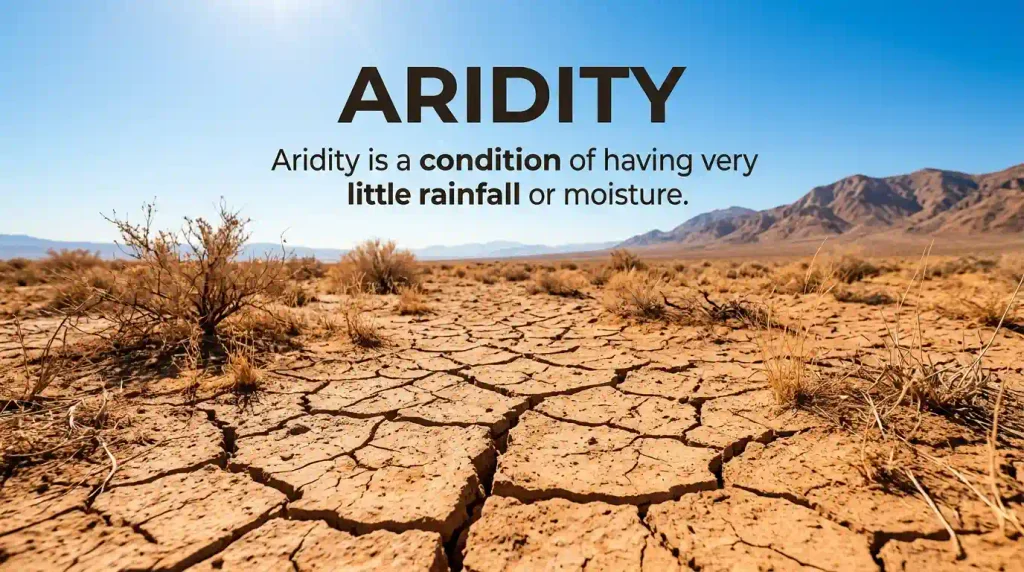
Aridity (Noun) — US: /əˈrɪdəti/ | UK: /əˈrɪdəti/
Meaning: Aridity is a condition of having very little rainfall or moisture.
Tone/Register: Formal, Academic, Environmental
Example:
The region is known for its extreme aridity.
Farmers struggle to grow crops in such an arid climate.
Desiccation (Noun) — US: /ˌdɛsɪˈkeɪʃən/ | UK: /ˌdɛsɪˈkeɪʃən/
Meaning: Desiccation refers to the process of becoming extremely dry.
Tone/Register: Formal, Scientific
Example:
The heat caused rapid desiccation of the exposed plants.
Scientists monitored the soil for signs of desiccation.
Dehydration (Noun) — US: /ˌdiːhaɪˈdreɪʃən/ | UK: /ˌdiːhaɪˈdreɪʃən/
Meaning: Dehydration means losing water or having an insufficient amount of water.
Tone/Register: Medical, Formal, Everyday
Example:
Drinking water can help prevent dehydration during exercise.
The doctor warned him about dehydration in hot weather.
Parchedness (Noun) — US: /ˈpɑːrtʃtnəs/ | UK: /ˈpɑːtʃtnəs/
Meaning: Parchedness describes an intense or uncomfortable state of dryness.
Tone/Register: Literary, Descriptive
Example:
The parchedness of the land was impossible to ignore.
After the hike, I noticed the parchedness of my lips.
Drying (Noun) — US: /ˈdraɪɪŋ/ | UK: /ˈdraɪɪŋ/
Meaning: Drying is the process through which moisture is removed.
Tone/Register: Neutral, Everyday
Example:
The drying of the clothes took several hours.
Sunlight speeds up the drying process.
Dryness of the Skin (Noun Phrase) — US: /ˈdraɪnəs/ | UK: /ˈdraɪnəs/
Meaning: This phrase specifically describes a lack of natural moisture in the skin.
Tone/Register: Everyday, Medical
Example:
Cold weather can increase skin dryness.
The moisturizer helped soothe the dryness on her hands.
Lack of Moisture (Noun Phrase) — US: /ˌlæk əv ˈmɔɪstʃər/ | UK: /ˌlæk əv ˈmɔɪstʃə/
Meaning: This phrase directly describes a condition in which something does not contain enough moisture.
Tone/Register: Neutral, Technical
Example:
The plant died because of a lack of moisture.
The fabric became brittle due to a lack of moisture.
Moisturelessness (Noun) — US: /ˈmɔɪstʃərləsnəs/ | UK: /ˈmɔɪstʃələsnəs/
Meaning: Moisturelessness means the complete or near-complete absence of moisture.
Tone/Register: Formal, Descriptive
Example:
The moisturelessness of the desert air was noticeable.
The material survived well in conditions of moisturelessness.
Aridness (Noun) — US: /ˈærɪdnəs/ | UK: /ˈærɪdnəs/
Meaning: Aridness describes extreme dryness, especially in land or climate.
Tone/Register: Formal, Environmental
Example:
The aridness of the landscape made farming difficult.
Scientists studied the increasing aridness of the region.
Desiccation State (Noun Phrase) — US: /ˌdɛsɪˈkeɪʃən/ | UK: /ˌdɛsɪˈkeɪʃən/
Meaning: This phrase describes a condition in which something has become severely dry.
Tone/Register: Scientific, Technical
Example:
The seeds entered a state of desiccation.
The researchers recorded the material’s desiccation state.
Parched Condition (Noun Phrase) — US: /pɑːrtʃt kənˈdɪʃən/ | UK: /pɑːtʃt kənˈdɪʃən/
Meaning: A parched condition describes something extremely dry or thirsty for moisture.
Tone/Register: Descriptive, Everyday
Example:
The grass was in a parched condition after weeks without rain.
The farmer noticed the parched condition of the field.
Brittleness (Noun) — US: /ˈbrɪtənəs/ | UK: /ˈbrɪtəlnəs/
Meaning: Brittleness describes a tendency to break easily, which can sometimes result from dryness.
Tone/Register: Technical, Neutral
Example:
The dryness caused brittleness in the old paper.
The material developed unexpected brittleness after storage.
Crumbliness (Noun) — US: /ˈkrʌmbəlinəs/ | UK: /ˈkrʌmbəlinəs/
Meaning: Crumbliness describes a texture that breaks apart easily, often because something has become dry.
Tone/Register: Everyday, Food-related
Example:
The bread’s crumbliness showed that it was past its best.
I disliked the excessive crumbliness of the cake.
Toughness (Noun) — US: /ˈtʌfnəs/ | UK: /ˈtʌfnəs/
Meaning: Toughness can describe a dry, firm texture that is difficult to chew or break.
Tone/Register: Everyday, Food-related
Example:
The meat‘s toughness made it difficult to eat.
Overcooking increased the toughness of the chicken.
Staleness (Noun) — US: /ˈsteɪlnəs/ | UK: /ˈsteɪlnəs/
Meaning: Staleness describes food that has lost freshness and may have become dry.
Tone/Register: Everyday
Example:
The staleness of the bread was obvious after one bite.
Proper storage can slow down staleness.
Dustiness (Noun) — US: /ˈdʌstinəs/ | UK: /ˈdʌstinəs/
Meaning: Dustiness describes a dry, dusty quality on a surface or in the air.
Tone/Register: Everyday, Descriptive
Example:
The room had a noticeable dustiness after months of neglect.
The old books gave the shelf a dusty appearance.
Bleakness (Noun) — US: /ˈbliːknəs/ | UK: /ˈbliːknəs/
Meaning: Bleakness can describe a dry, barren landscape when the focus is on its harsh appearance.
Tone/Register: Literary, Descriptive
Example:
The bleakness of the dry valley created a dramatic scene.
The novel captures the bleakness of the landscape.
Barrenness (Noun) — US: /ˈbærənəs/ | UK: /ˈbærənəs/
Meaning: Barrenness describes land or an environment that lacks vegetation or productive moisture.
Tone/Register: Formal, Literary
Example:
The barrenness of the field followed years of drought.
The photograph emphasizes the barrenness of the landscape.
Waterlessness (Noun) — US: /ˈwɔːtərləsnəs/ | UK: /ˈwɔːtərləsnəs/
Meaning: Waterlessness refers to the absence or extreme scarcity of water.
Tone/Register: Formal, Descriptive
Example:
The waterlessness of the desert creates severe challenges.
Animals must travel far because of the area’s waterlessness.
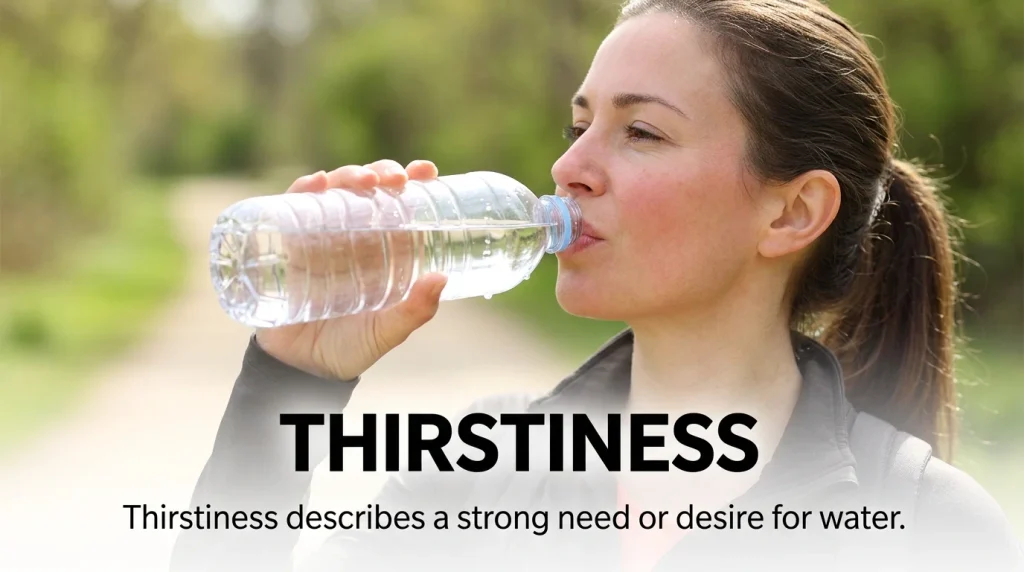
Thirstiness (Noun) — US: /ˈθɜːrstinəs/ | UK: /ˈθɜːstɪnəs/
Meaning: Thirstiness describes a strong need or desire for water.
Tone/Register: Everyday
Example:
My thirstiness disappeared after I drank some water.
The salty meal increased my thirstiness.
Roughness (Noun) — US: /ˈrʌfnəs/ | UK: /ˈrʌfnəs/
Meaning: Roughness can describe a dry, uneven skin or surface texture.
Tone/Register: Neutral, Everyday
Example:
The cold weather increased the roughness of my hands.
The cream reduced the roughness around her elbows.
Flakiness (Noun) — US: /ˈfleɪkinəs/ | UK: /ˈfleɪkɪnəs/
Meaning: Flakiness describes a surface that produces small dry flakes, especially skin.
Tone/Register: Everyday, Beauty/Medical
Example:
The new soap caused flakiness around my cheeks.
Gentle care helped reduce the skin’s flakiness.
Tightness (Noun) — US: /ˈtaɪtnəs/ | UK: /ˈtaɪtnəs/
Meaning: Tightness can describe the uncomfortable feeling caused by very dry skin.
Tone/Register: Everyday, Medical
Example:
I noticed tightness after washing my face.
Cold air often causes facial tightness.
Chapping (Noun) — US: /ˈtʃæpɪŋ/ | UK: /ˈtʃæpɪŋ/
Meaning: Chapping is dryness that causes skin to become rough, cracked, or sore.
Tone/Register: Everyday, Medical
Example:
Wind can cause chapping around the lips.
Lip balm helped prevent further chapping.
Roughened Condition (Noun Phrase) — US: /ˈrʌfənd/ | UK: /ˈrʌfənd/
Meaning: A roughened condition describes a surface that has become less smooth, often because of dryness.
Tone/Register: Neutral, Descriptive
Example:
The wood developed a roughened condition over time.
Dry weather left the surface roughened.
Crackling Dryness (Noun Phrase) — US: /ˈkræklɪŋ ˈdraɪnəs/ | UK: /ˈkræklɪŋ ˈdraɪnəs/
Meaning: Crackling dryness describes extreme dryness associated with cracking or a brittle texture.
Tone/Register: Literary, Descriptive
Example:
The crackling dryness of the leaves signaled the end of summer.
The soil showed signs of crackling dryness after the heatwave.
Brittled State (Noun Phrase) — US: /ˈbrɪtəld steɪt/ | UK: /ˈbrɪtəld steɪt/
Meaning: A brittle state describes material that has become fragile and breakable, often through drying.
Tone/Register: Technical
Example:
The clay reached a brittle state after prolonged exposure.
The paper was in a brittle state because of age and dryness.
Humidity Deficit (Noun Phrase) — US: /hjuːˈmɪdəti ˈdɛfəsɪt/ | UK: /hjuːˈmɪdəti ˈdɛfɪsɪt/
Meaning: Humidity deficit describes air containing less moisture than expected or needed.
Tone/Register: Technical, Scientific
Example:
The humidity deficit made the room feel unusually dry.
Plants can respond poorly to a prolonged humidity deficit.
Moisture Deficiency (Noun) — US: /ˈmɔɪstʃər dɪˈfɪʃənsi/ | UK: /ˈmɔɪstʃə dɪˈfɪʃənsi/
Meaning: Moisture deficiency means there is not enough moisture for a particular purpose.
Tone/Register: Academic, Technical
Example:
Moisture deficiency can weaken young plants.
The crop showed visible signs of moisture deficiency.
Water Deficiency (Noun) — US: /ˈwɔːtər dɪˈfɪʃənsi/ | UK: /ˈwɔːtə dɪˈfɪʃənsi/
Meaning: Water deficiency refers to an insufficient supply of water.
Tone/Register: Academic, Environmental
Example:
The trees suffered from water deficiency during the summer.
Farmers monitored the fields for signs of water deficiency.
Extreme Dryness (Noun Phrase) — US: /ɪkˈstriːm ˈdraɪnəs/ | UK: /ɪkˈstriːm ˈdraɪnəs/
Meaning: Extreme dryness emphasizes an unusually severe lack of moisture.
Tone/Register: Neutral, Descriptive
Example:
The extreme dryness damaged several crops.
The skin became uncomfortable because of the extreme dryness.
Parched State (Noun Phrase) — US: /pɑːrtʃt steɪt/ | UK: /pɑːtʃt steɪt/
Meaning: A parched state describes something severely dried out or desperately lacking moisture.
Tone/Register: Descriptive, Literary
Example:
The grass remained in a parched state throughout August.
The soil was left in a parched state after the heatwave.
Dryness (Noun) — US: /ˈdraɪnəs/ | UK: /ˈdraɪnəs/
Meaning: Dryness itself refers to the general condition of having little or no moisture.
Tone/Register: Neutral, Everyday
Example:
The dryness in the room bothered me.
Winter often makes the dryness of my skin worse.
Crispy Dryness (Noun Phrase) — US: /ˈkrɪspi ˈdraɪnəs/ | UK: /ˈkrɪspi ˈdraɪnəs/
Meaning: A noticeably dry and crisp quality, especially in food or leaves.
Tone/Register: Descriptive, Everyday
Example:
The crispy dryness of the toast made it satisfying.
The leaves had a pleasant crispy dryness after several sunny days.
Desiccatedness (Noun) — US: /ˈdɛsɪkeɪtɪdnəs/ | UK: /ˈdɛsɪkeɪtɪdnəs/
Meaning: The condition of being thoroughly dried out.
Tone/Register: Formal, Scientific
Example:
The desiccatedness of the sample was measured carefully.
The researchers observed increased desiccatedness after exposure to heat.
Evaporation (Noun) — US: /ɪˌvæpəˈreɪʃən/ | UK: /ɪˌvæpəˈreɪʃən/
Meaning: The process in which liquid changes into vapor, potentially resulting in dryness.
Tone/Register: Scientific, Academic
Example:
Rapid evaporation left the surface completely dry.
Sunlight increased the evaporation of water from the soil.
Depletion (Noun) — US: /dɪˈpliːʃən/ | UK: /dɪˈpliːʃən/
Meaning: The reduction or exhaustion of an available supply of moisture or water.
Tone/Register: Formal, Academic
Example:
Water depletion has affected local agriculture.
Moisture depletion caused the plants to wilt.
Exhaustion (Noun) — US: /ɪɡˈzɔːstʃən/ | UK: /ɪɡˈzɔːstʃən/
Meaning: The complete or substantial loss of an available moisture supply.
Tone/Register: Formal, Technical
Example:
The exhaustion of soil moisture threatened the crop.
Water reserves approached complete exhaustion during the drought.
Depletion of Moisture (Noun Phrase) — US: /dɪˈpliːʃən əv ˈmɔɪstʃər/ | UK: /dɪˈpliːʃən əv ˈmɔɪstʃə/
Meaning: The gradual reduction of moisture in a material, surface, or environment.
Tone/Register: Technical, Academic
Example:
The depletion of moisture weakened the wooden structure.
Researchers tracked the depletion of moisture in the soil.
Moisture Loss (Noun Phrase) — US: /ˈmɔɪstʃər lɔːs/ | UK: /ˈmɔɪstʃə lɒs/
Meaning: The removal or disappearance of moisture from something.
Tone/Register: Neutral, Technical
Example:
The packaging helps prevent moisture loss.
Excessive heat can increase moisture loss from plants.
Water Loss (Noun Phrase) — US: /ˈwɔːtər lɔːs/ | UK: /ˈwɔːtə lɒs/
Meaning: A reduction in the amount of water contained in something.
Tone/Register: Neutral, Scientific
Example:
The plant showed signs of water loss during the heatwave.
Water loss increased when the leaves were exposed to direct sunlight.
Dehumidification (Noun) — US: /diːˌhjuːmɪdɪfɪˈkeɪʃən/ | UK: /diːˌhjuːmɪdɪfɪˈkeɪʃən/
Meaning: The process of removing moisture from the air.
Tone/Register: Technical, Professional
Example:
Dehumidification reduced the moisture inside the storage room.
The building uses controlled dehumidification during humid seasons.
Dry-Air Condition (Noun Phrase) — US: /ˈdraɪ er kənˈdɪʃən/ | UK: /ˈdraɪ eə kənˈdɪʃən/
Meaning: A condition in which the surrounding air contains very little moisture.
Tone/Register: Neutral, Descriptive
Example:
The dry-air condition made my throat uncomfortable.
Some plants struggle under prolonged dry-air conditions.
Scorching Dryness (Noun Phrase) — US: /ˈskɔːrtʃɪŋ ˈdraɪnəs/ | UK: /ˈskɔːtʃɪŋ ˈdraɪnəs/
Meaning: Severe dryness accompanied by intense heat.
Tone/Register: Descriptive, Literary
Example:
The scorching dryness of the desert was exhausting.
The landscape reflected months of scorching dryness.
Desiccated Condition (Noun Phrase) — US: /ˈdɛsɪkeɪtɪd kənˈdɪʃən/ | UK: /ˈdɛsɪkeɪtɪd kənˈdɪʃən/
Meaning: A state in which something has lost most or nearly all of its moisture.
Tone/Register: Formal, Scientific
Example:
The leaves were found in a desiccated condition.
The material remained stable in its desiccated condition.
Droughtiness (Noun) — US: /ˈdraʊtinəs/ | UK: /ˈdraʊtɪnəs/
Meaning: A quality suggesting drought-like dryness or a prolonged lack of water.
Tone/Register: Descriptive, Environmental
Example:
The droughtiness of the landscape was striking.
The photograph captured the region’s droughtiness beautifully.
Drought Stress (Noun Phrase) — US: /draʊt strɛs/ | UK: /draʊt strɛs/
Meaning: A condition in which plants or ecosystems suffer because of insufficient water.
Tone/Register: Scientific, Agricultural
Example:
The trees showed clear signs of drought stress.
Farmers monitored the crops for drought stress.
Moisture Scarcity (Noun Phrase) — US: /ˈmɔɪstʃər ˈskɛrsəti/ | UK: /ˈmɔɪstʃə ˈskeəsəti/
Meaning: A condition in which moisture is unusually limited or difficult to obtain.
Tone/Register: Formal, Environmental
Example:
Moisture scarcity can reduce crop production.
The plants adapted to long periods of moisture scarcity.
Water Scarcity (Noun Phrase) — US: /ˈwɔːtər ˈskɛrsəti/ | UK: /ˈwɔːtə ˈskeəsəti/
Meaning: A shortage of available water in an area or system.
Tone/Register: Academic, Environmental
Example:
Water scarcity remains a major challenge for farmers.
The community developed new methods to manage water scarcity.
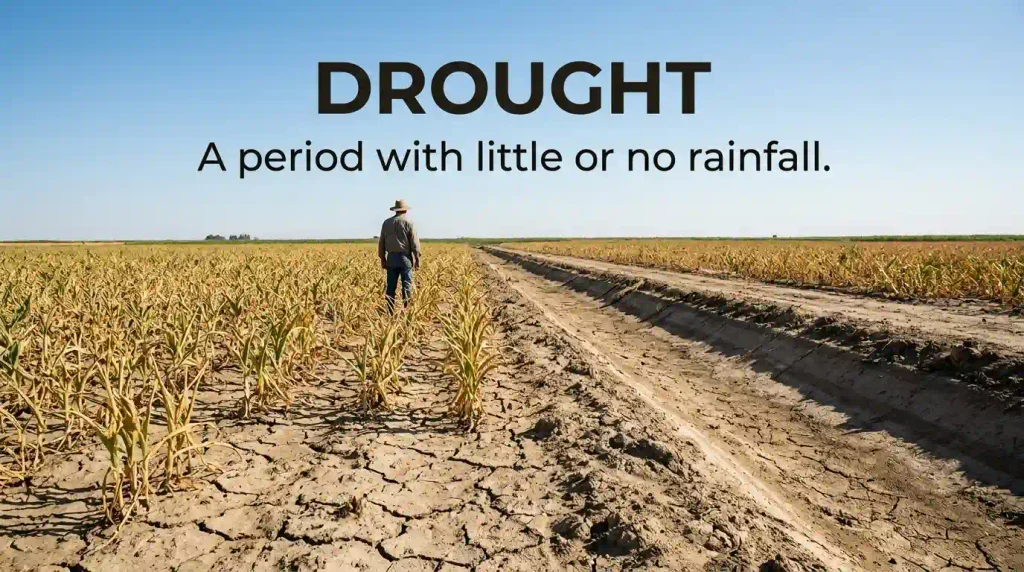
Dry Spell (Noun Phrase) — US: /draɪ spɛl/ | UK: /draɪ spɛl/
Meaning: A period with little or no rainfall.
Tone/Register: Everyday, Weather-related
Example:
The crops suffered during the long dry spell.
A short dry spell can quickly affect shallow soil.
Rainlessness (Noun) — US: /ˈreɪnləsnəs/ | UK: /ˈreɪnləsnəs/
Meaning: The condition of experiencing little or no rain.
Tone/Register: Formal, Literary
Example:
The prolonged rainlessness affected the entire valley.
The plants could not survive the area’s extreme rainlessness.
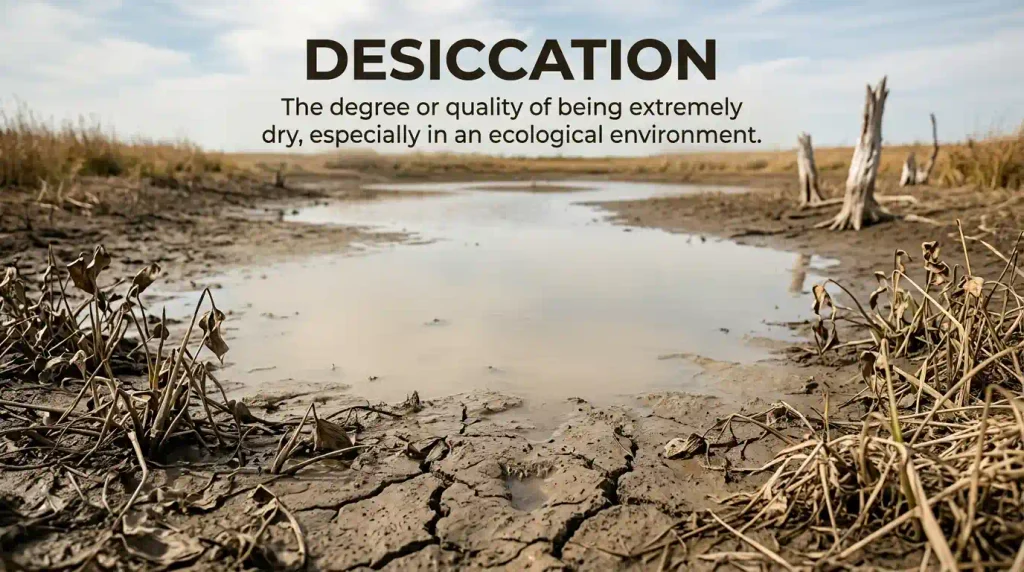
Xericity (Noun) — US: /zɪˈrɪsəti/ | UK: /zɪˈrɪsəti/
Meaning: The degree or quality of being extremely dry, especially in an ecological environment.
Tone/Register: Scientific, Academic
Example:
The researchers measured the xericity of the habitat.
Several species have adapted to high levels of xericity.
Synonyms for Dryness by Tone
Different contexts call for different words. Therefore, choosing a synonym based on tone can make your English sound much more natural.
Positive or Pleasant
- Crispness — can describe a pleasantly dry texture or atmosphere.
- Light dryness — useful when dryness is mild and acceptable.
- Dry character — sometimes used positively for food and beverages.
Neutral
- Dryness
- Lack of moisture
- Moisture deficiency
- Water deficiency
- Drying
- Aridity
- Humidity deficit
These choices work well in factual, educational, and general writing.
Negative
- Desiccation
- Parchedness
- Dehydration
- Flakiness
- Chapping
- Brittleness
- Extreme dryness
- Waterlessness
These words often emphasize severity, discomfort, or damage.
Playful or Informal
- Parchedness
- Thirstiness
- Cracked-up dryness
- Bone-dryness
These expressions can work in casual or creative writing, although some are more expressive than literal.
“Dryness” vs Close Alternatives
| Word | Main Difference | Best Use |
|---|---|---|
| Dryness | General lack of moisture | Everyday English |
| Aridity | Severe lack of moisture, especially climate | Geography and environment |
| Desiccation | Process of becoming extremely dry | Science and technical writing |
| Dehydration | Loss or lack of water | People, animals, food, medicine |
| Parchedness | Intense, often uncomfortable dryness | Descriptive and literary writing |
For example, dryness is the broadest choice. However, aridity is more specific when discussing climate, while desiccation focuses on the drying process.
How “Dryness” Changes by Context
Daily Conversation
In everyday speech, dryness is simple and natural.
You might say, “The dryness in the air is bothering me,” or “This lotion helps with skin dryness.”
However, native speakers often choose a more specific word when the situation is obvious. For example, chapping works better for cracked lips.
Writing and Blogging
Bloggers can use dryness as the main term and then introduce specific alternatives.
For example, a skincare article may use flakiness, roughness, tightness, and dehydration. As a result, the writing becomes more precise and useful.
Professional or Academic Writing
Formal writing often benefits from terms such as aridity, desiccation, moisture deficiency, and humidity deficit.
For example, an environmental report may discuss increasing aridity. Meanwhile, a scientific paper may refer to desiccation.
Creative or Informal Use
Creative writing allows more expressive choices.
Words such as parchedness, barrenness, and waterlessness can create a stronger image. Therefore, they are useful when you want readers to visualize an extremely dry setting.
Common Mistakes Learners Make
One common mistake is treating every alternative as a perfect replacement for dryness.
For example, dehydration is not always appropriate. It normally involves water loss or insufficient water in a person, animal, food, or biological system.
Another mistake is using aridity for ordinary objects. Saying “the aridity of my towel” sounds unnatural. In that situation, dryness is much better.
Similarly, desiccation is formal. Therefore, it may sound overly technical in casual conversation.
Native Usage Tip
For general situations, dryness is the safest and most natural option. When talking about a dry climate or landscape, aridity is more precise. In scientific contexts, desiccation works better, while parchedness adds a vivid descriptive touch. For skin-related contexts, words such as flakiness and chapping can describe specific types of dryness more accurately.
For more vocabulary practice, you can also connect this topic with other synonym-focused vocabulary lessons.
Real-Life Mini Scenarios
Workplace
A gardener explains that the plants are suffering from moisture deficiency.
A scientist reports that prolonged desiccation affected the samples.
Social Situation
Someone might say, “My lips are suffering from chapping because of the cold weather.”
This sounds more natural than simply saying, “My lips have dryness.”
Media and Pop Culture
A travel documentary may describe the aridity of a desert landscape.
Meanwhile, a food reviewer may complain about the staleness or toughness of a dish.
Writing and Storytelling
A novelist might describe the barrenness of a forgotten village.
A poet could use parchedness to make a summer scene feel intense and emotional.
Interactive Practice Quiz
Choose the best answer for each situation.
1. Which word best describes a very dry climate?
A. Chapping
B. Aridity
C. Flakiness
D. Thirstiness
2. Which term sounds most scientific?
A. Desiccation
B. Dryness
C. Roughness
D. Thirstiness
3. Your lips are cracked because of cold weather. Which word fits best?
A. Aridity
B. Chapping
C. Waterlessness
D. Humidity deficit
4. Which word describes losing too much water from the body?
A. Dehydration
B. Barrenness
C. Dustiness
D. Brittleness
5. Which word best describes land with almost no vegetation?
A. Barrenness
B. Flakiness
C. Tightness
D. Staleness
6. Which expression is most suitable for an academic report about soil?
A. Thirstiness
B. Moisture deficiency
C. Crackling dryness
D. Dry character
7. Which word describes dry skin producing small flakes?
A. Flakiness
B. Aridity
C. Waterlessness
D. Staleness
8. Which word is safest for general everyday use?
A. Dryness
B. Desiccation
C. Humidity deficit
D. Moisturelessness
9. Which word emphasizes something becoming extremely dry?
A. Desiccation
B. Tightness
C. Roughness
D. Thirstiness
10. Which word best describes old bread that has lost freshness?
A. Staleness
B. Aridity
C. Water deficiency
D. Humidity deficit
11. Which term can describe dry, dusty surfaces?
A. Dustiness
B. Dehydration
C. Chapping
D. Parchedness
12. Which word can describe an uncomfortable dry feeling on the skin?
A. Tightness
B. Barrenness
C. Aridity
D. Waterlessness
13. Which word is especially useful for a vivid literary description?
A. Parchedness
B. Moisture deficiency
C. Humidity deficit
D. Water deficiency
Reflection Task
Write one sentence using aridity, desiccation, parchedness, dehydration, or flakiness. Then compare your sentence with an ordinary sentence using dryness.
Answer Key
1-B | 2-A | 3-B | 4-A | 5-A | 6-B | 7-A | 8-A | 9-A | 10-A | 11-A | 12-A | 13-A
FAQs
1. What is the best synonym for dryness in everyday English?
The best general synonym is usually lack of moisture because it clearly communicates the basic idea without sounding overly technical. However, dryness itself is often the most natural choice. If you are describing a specific situation, a more precise word may work better, such as chapping for cracked skin or aridity for a dry climate.
2. What is a formal synonym for dryness in academic writing?
Aridity, desiccation, and moisture deficiency are useful formal alternatives, depending on the subject. Aridity commonly describes dry climates or environments, while desiccation focuses on the process or state of extreme drying. In scientific or agricultural writing, moisture deficiency can clearly describe insufficient moisture in soil or plants.
3. What is the difference between dryness and dehydration?
Dryness is a broad term for a lack of moisture. Dehydration specifically refers to losing or lacking water, especially in people, animals, food, or biological systems. For example, dry skin can be described as having dryness, while a person who has lost too much body water may experience dehydration.
4. What is the best synonym for dryness of skin?
The best choice depends on the exact symptom. Flakiness describes skin that produces visible flakes, while chapping suggests rough or cracked skin. Tightness describes an uncomfortable stretched feeling. Therefore, these words are more precise than simply using dryness when discussing particular skin experiences.
5. Which synonym for dryness is best for describing a desert?
Aridity is usually the strongest choice for a desert or extremely dry climate. It is commonly used in geography, environmental studies, and climate discussions. You can also use waterlessness when emphasizing the lack of available water, or barrenness when focusing on the absence of vegetation.
6. Is desiccation a synonym for dryness?
Yes, but desiccation has a more specific meaning. It refers to the process or condition of becoming extremely dry, particularly when moisture is deliberately or naturally removed. Because it sounds technical, it is more appropriate for scientific, medical, environmental, or academic writing than casual conversation.
7. Can dryness have a figurative meaning?
Yes. Although physical lack of moisture is the primary meaning, English can use dry and related forms figuratively. For example, dry humor describes understated humor. However, dryness in that sense does not mean lack of water, so context is essential when selecting synonyms.
Conclusion
Learning the right synonym for dryness helps you describe moisture, climate, skin, food, and environments with greater accuracy. Moreover, precise vocabulary makes communication stronger.
Instead of repeating dryness, you can choose aridity, desiccation, parchedness, or moisture deficiency. Each option gives your sentence a different level of precision.
For students and writers, these alternatives can improve essays, blogs, reports, and everyday conversations. Therefore, learning synonyms is a simple way to build confident vocabulary.
Now, practice these words in your own emails, essays, stories, and daily conversations. Start with one synonym today, create a sentence, and gradually expand your vocabulary.

Shahzeena Shazadi is the founder and lead writer at VocablyHub.com, where she creates accurate, reader-focused English language content designed to help people communicate with clarity and confidence. She specializes in synonyms, antonyms, word meanings, idioms, and practical vocabulary guides that simplify complex language concepts for everyday use. Every article is carefully researched, fact-checked, and written in clear, accessible language using reliable references and real-world examples. Her goal is to provide helpful, trustworthy content that supports learners at every stage of their English language journey.
Her editorial approach focuses on accuracy, transparency, and user value while following modern content quality standards. She regularly reviews and updates content to keep information relevant, useful, and easy to understand. Through VocablyHub.com, Shahzeena Shazadi is committed to publishing reliable language resources that help students, writers, educators, professionals, and English learners expand their vocabulary, improve their writing skills, and communicate with confidence in academic, professional, and everyday situations.