
Synonyms for strategist include planner, tactician, mastermind, adviser, architect, campaigner, policymaker, and long-range thinker. The best choice depends on whether you mean someone skilled at planning, competition, leadership, policy, or problem-solving.
Imagine a manager preparing three moves ahead before a difficult meeting. That person is acting as a strategist, not simply making a quick decision.
In business, sports, politics, writing, and daily life, synonyms for strategist help describe different kinds of planning skills with greater precision.
Students can use these alternatives to expand essays, while bloggers and content writers can avoid repetitive wording. Daily English users gain more natural choices.
The word is common because modern life often involves goals, decisions, competition, and long-term planning. Learning synonyms for strategist makes those ideas easier to express.
What Does “Strategist” Really Mean?
A strategist is a person who develops a plan for achieving an important goal, especially when the situation involves competition, uncertainty, limited resources, or several possible outcomes.
A simple definition is:
Strategist: a person who thinks carefully about long-term goals and creates plans to achieve them.
The noun strategist usually describes a person rather than an action.
Native speakers commonly use it in business, sports, military discussions, politics, marketing, technology, leadership, and personal planning.
For example:
She is a brilliant strategist who always considers the next step.
The word often suggests deliberate thinking. A strategist normally looks beyond an immediate action and considers consequences, alternatives, risks, and opportunities.
However, strategist does not automatically mean someone intelligent, successful, or morally admirable. It simply describes a person known for strategic planning.
Connotative Meaning
Connotation (the emotional or associated meaning a word can suggest beyond its basic dictionary definition) can change how strategist feels in context.
Positive tone
Strategist can suggest foresight, intelligence, discipline, creativity, and strong planning ability.
Negative tone
In some contexts, it can imply someone who is overly calculating, manipulative, or focused on winning.
Neutral tone
In professional or academic writing, strategist is often simply a factual description of someone’s role or skill.
Etymology
The word strategist ultimately comes from the Greek strategos, meaning a military commander or general. The related Greek word strategia referred to generalship or the art of military leadership.
The concept later expanded beyond warfare. English speakers began using strategy for organized planning toward a goal, and strategist developed naturally as the term for someone who creates or applies such plans.
Old English: 450–1100
The modern word strategist was not an Old English native form. Old English had its own vocabulary for leadership, counsel, planning, and warfare, but the Greek-derived strategic terminology came much later through other European languages.
Middle English: 1100–1500
During Middle English, English absorbed many French and Latin terms connected with government, warfare, leadership, and organization. The intellectual tradition surrounding military strategy continued to develop.
Modern English: 1500–Present
The modern vocabulary of strategy, strategic, and strategist became increasingly established as English developed. Today, strategist applies far beyond military contexts, including business, sports, politics, communications, technology, and organizational leadership.
Pronunciation of “Strategist”
- US: /ˈstrætədʒɪst/
- UK: /ˈstrætədʒɪst/
Syllables
strat-e-gist
Affixation Pattern of “Strategist”
- Root: strateg-
- Prefix: none
- Suffix: -ist
The suffix -ist commonly forms nouns referring to people associated with a particular activity, belief, discipline, or profession.
Synonyms List
Some emphasize long-term planning. Others focus on tactics, advice, leadership, competition, policy, or creative planning.
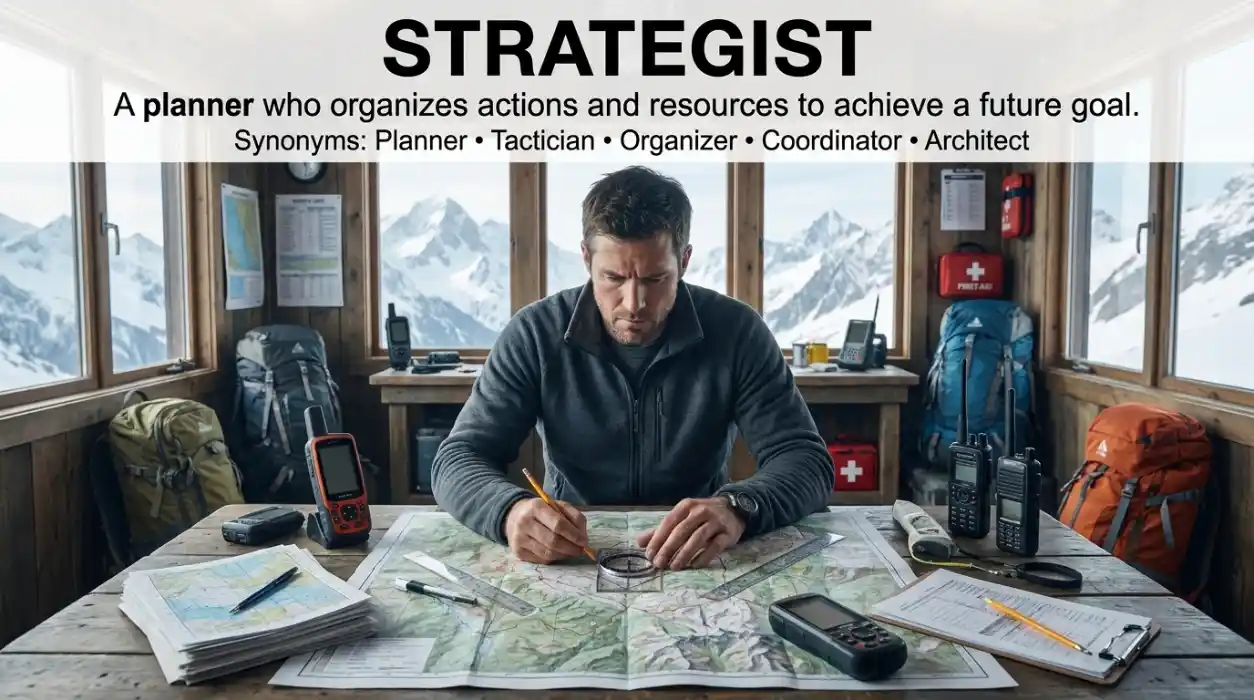
Planner (Noun) — US /ˈplænər/ | UK /ˈplænə/
Meaning: A planner is someone who organizes actions and resources to achieve a future goal.
Tone/Register: Neutral, professional, everyday.
Example:
The event planner created a detailed schedule for the conference.
Her careful planning prevented several problems.
Tactician (Noun) — US /tækˈtɪʃən/ | UK /tækˈtɪʃən/
Meaning: A tactician focuses on practical moves that help achieve an objective, often in a competitive situation.
Tone/Register: Professional, military, sports.
Example:
The coach is a clever tactician during close matches.
He changed the formation at halftime.
Mastermind (Noun) — US /ˈmæstərˌmaɪnd/ | UK /ˈmɑːstəmaɪnd/
Meaning: A mastermind is a person credited with designing or directing a complex plan.
Tone/Register: Informal, dramatic.
Example:
She was the mastermind behind the surprise event.
Everyone admired how smoothly the plan came together.
Planner-Thinker (Noun phrase) — US /ˈplænər ˈθɪŋkər/ | UK /ˈplænə ˈθɪŋkə/
Meaning: This phrase describes someone who combines organized planning with careful consideration.
Tone/Register: Neutral, descriptive.
Example:
He is a planner-thinker who rarely makes rushed decisions.
His approach gives the team time to prepare.
Adviser (Noun) — US /ədˈvaɪzər/ | UK /ədˈvaɪzə/
Meaning: An adviser provides recommendations that help another person or organization make strategic decisions.
Tone/Register: Formal, professional.
Example:
The director consulted an adviser before changing the policy.
Her adviser presented several possible approaches.
Consultant (Noun) — US /kənˈsʌltənt/ | UK /kənˈsʌltənt/
Meaning: A consultant is a specialist who gives expert advice about a particular problem or goal.
Tone/Register: Business, professional.
Example:
The company hired a consultant to rethink its growth plan.
The consultant identified several weaknesses.
Architect (Noun) — US /ˈɑːrkətekt/ | UK /ˈɑːkɪtekt/
Meaning: An architect can metaphorically mean someone who designs and shapes a complex plan or system.
Tone/Register: Formal, figurative, professional.
Example:
She was the architect of the organization’s five-year plan.
His ideas shaped the entire project.
Visionary (Noun) — US /ˈvɪʒəneri/ | UK /ˈvɪʒənəri/
Meaning: A visionary imagines ambitious future possibilities and often develops plans around them.
Tone/Register: Positive, professional.
Example:
The founder was known as a visionary in the industry.
She imagined possibilities that others had overlooked.
Planner (Noun) — US /ˈplænər/ | UK /ˈplænə/
Meaning: In strategic contexts, a planner organizes future actions around a specific objective.
Tone/Register: Neutral.
Example:
The campaign planner mapped out the next six months.
Every stage had a clear purpose.
Organizer (Noun) — US /ˈɔːrɡənaɪzər/ | UK /ˈɔːɡənaɪzə/
Meaning: An organizer coordinates people, tasks, or resources to make a plan work.
Tone/Register: Neutral, everyday, professional.
Example:
She is an excellent organizer who keeps complex projects moving.
The team always knows what happens next.
Coordinator (Noun) — US /koʊˈɔːrdəneɪtər/ | UK /kəʊˈɔːdɪneɪtə/
Meaning: A coordinator connects different people or activities so that a larger plan operates smoothly.
Tone/Register: Professional.
Example:
The project coordinator brought the departments together.
Good coordination kept the launch on schedule.
Adviser-Strategist (Noun phrase) — US /ədˈvaɪzər ˈstrætədʒɪst/ | UK /ədˈvaɪzə ˈstrætədʒɪst/
Meaning: This phrase describes someone who both provides advice and develops strategic plans.
Tone/Register: Professional, business.
Example:
The executive relied on an adviser-strategist during the transition.
His recommendations focused on long-term goals.
Policy Planner (Noun phrase) — US /ˈpɑːləsi ˈplænər/ | UK /ˈpɒləsi ˈplænə/
Meaning: A policy planner develops structured approaches for public, organizational, or institutional goals.
Tone/Register: Formal, academic, governmental.
Example:
The policy planner studied several possible reforms.
Her report explained the expected effects.
Campaign Planner (Noun phrase) — US /kæmˈpeɪn ˈplænər/ | UK /kæmˈpeɪn ˈplænə/
Meaning: A campaign planner develops the timing, messaging, and actions of a coordinated campaign.
Tone/Register: Professional.
Example:
The campaign planner prepared the communication calendar.
Each stage had a specific objective.
Long-Range Planner (Noun phrase) — US /ˌlɔːŋ ˈreɪndʒ ˈplænər/ | UK /ˌlɒŋ ˈreɪndʒ ˈplænə/
Meaning: A long-range planner focuses primarily on distant goals and future consequences.
Tone/Register: Professional, formal.
Example:
She is a long-range planner who thinks years ahead.
Her decisions reflect future needs.
Forward Thinker (Noun phrase) — US /ˈfɔːrwərd ˈθɪŋkər/ | UK /ˈfɔːwəd ˈθɪŋkə/
Meaning: A forward thinker considers future developments rather than focusing only on current conditions.
Tone/Register: Positive, professional.
Example:
He is a forward thinker who prepares for changing customer habits.
That approach helps the team adapt.
Long-Term Thinker (Noun phrase) — US /ˌlɔːŋ ˈtɜːrm ˈθɪŋkər/ | UK /ˌlɒŋ ˈtɜːm ˈθɪŋkə/
Meaning: A long-term thinker evaluates decisions according to their future effects.
Tone/Register: Neutral, professional.
Example:
A long-term thinker will not chase every short-term trend.
She prefers sustainable progress.
Problem Solver (Noun phrase) — US /ˈprɑːbləm ˌsɑːlvər/ | UK /ˈprɒbləm ˌsɒlvə/
Meaning: A problem solver finds practical ways to overcome obstacles.
Tone/Register: Neutral, positive, everyday.
Example:
Our team needs a strong problem solver for this project.
He quickly identified the main obstacle.
Decision Maker (Noun phrase) — US /dɪˈsɪʒən ˌmeɪkər/ | UK /dɪˈsɪʒən ˌmeɪkə/
Meaning: A decision maker is someone responsible for choosing between possible actions.
Tone/Register: Professional, business.
Example:
The decision maker reviewed the risks before approving the plan.
She wanted evidence before committing.
Game Planner (Noun phrase) — US /ˈɡeɪm ˌplænər/ | UK /ˈɡeɪm ˌplænə/
Meaning: A game planner develops an approach for achieving an advantage in a competitive setting.
Tone/Register: Sports, informal.
Example:
The coach is a brilliant game planner.
His preparation changed the team’s performance.
Game Theorist (Noun) — US /ˈɡeɪm ˌθiːərɪst/ | UK /ˈɡeɪm ˌθɪərɪst/
Meaning: A game theorist studies strategic choices involving competing or interacting decision makers.
Tone/Register: Academic, technical.
Example:
The economist approached the negotiation like a game theorist.
She considered how each side might respond.
Planner-Advisor (Noun phrase) — US /ˈplænər ədˌvaɪzər/ | UK /ˈplænə ədˌvaɪzə/
Meaning: A planner-advisor combines practical planning with guidance for decision-makers.
Tone/Register: Professional.
Example:
The planner-advisor suggested three possible routes.
The manager chose the option with the lowest risk.
Strategist-Advisor (Noun phrase) — US /ˈstrætədʒɪst ədˌvaɪzər/ | UK /ˈstrætədʒɪst ədˌvaɪzə/
Meaning: This phrase emphasizes both strategic thinking and advisory responsibility.
Tone/Register: Formal, professional.
Example:
The strategist-advisor prepared the leadership team for several scenarios.
Her recommendations focused on resilience.
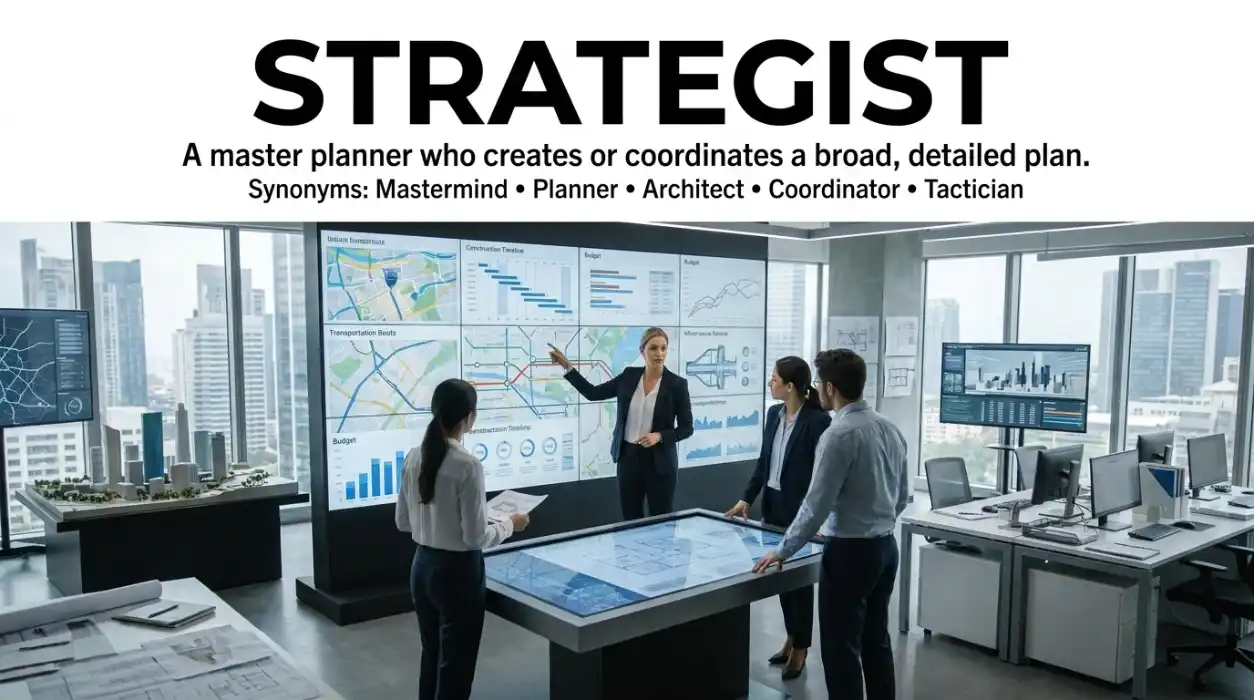
Master Planner (Noun phrase) — US /ˈmæstər ˌplænər/ | UK /ˈmɑːstə ˌplænə/
Meaning: A master planner is someone who creates or coordinates a broad, detailed plan.
Tone/Register: Positive, informal to professional.
Example:
She is the master planner behind the annual conference.
Every detail has been considered.
Game Changer (Noun phrase) — US /ˈɡeɪm ˌtʃeɪndʒər/ | UK /ˈɡeɪm ˌtʃeɪndʒə/
Meaning: A game changer is not a direct synonym for strategist but can describe a person whose strategic idea significantly changes a situation.
Tone/Register: Informal, contemporary.
Example:
His new approach became a game changer for the team.
One strategic shift changed the project.
Leader (Noun) — US /ˈliːdər/ | UK /ˈliːdə/
Meaning: A leader directs or influences people, while a strategist specifically focuses on planning and goals.
Tone/Register: Neutral, professional.
Example:
The leader asked the team to consider several future scenarios.
Her strategic thinking supported the group’s direction.
Commander (Noun) — US /kəˈmændər/ | UK /kəˈmɑːndə/
Meaning: A commander directs people or forces, often within a military or highly structured setting.
Tone/Register: Formal, military.
Example:
The commander developed a careful response plan.
His decisions depended on changing conditions.
General (Noun) — US /ˈdʒenərəl/ | UK /ˈdʒenərəl/
Meaning: A general is a senior military leader who may be responsible for large-scale strategic planning.
Tone/Register: Formal, military.
Example:
The general considered several possible outcomes.
His strategy required careful coordination.
Campaigner (Noun) — US /kæmˈpeɪnər/ | UK /kæmˈpeɪnə/
Meaning: A campaigner actively works toward a particular cause or objective and may use strategic planning to advance it.
Tone/Register: Civic, professional, social.
Example:
The campaigner organized a series of public events.
Her approach relied on careful communication.
Policymaker (Noun) — US /ˈpɑːləsiˌmeɪkər/ | UK /ˈpɒləsiˌmeɪkə/
Meaning: A policymaker helps develop or decide policies, often using strategic analysis.
Tone/Register: Formal, academic, governmental.
Example:
The policymaker examined the long-term effects of the proposal.
Several alternatives were considered.
Architect of a Plan (Noun phrase) — US /ˈɑːrkətekt əv ə plæn/ | UK /ˈɑːkɪtekt əv ə plæn/
Meaning: This figurative phrase describes the person who designs the central structure of a plan.
Tone/Register: Formal, figurative.
Example:
She was the architect of the new organizational strategy.
Her framework guided the entire project.
Master Planner (Noun phrase) — US /ˈmæstər ˌplænər/ | UK /ˈmɑːstə ˌplænə/
Meaning: This phrase emphasizes exceptional skill in organizing multiple stages toward one objective.
Tone/Register: Informal, emphatic.
Example:
My sister is a master planner when arranging family trips.
She always has a backup plan.
Chess Player (Noun phrase) — US /ˈtʃes ˌpleɪər/ | UK /ˈtʃes ˌpleɪə/
Meaning: A chess player is not inherently a strategist, but the phrase can describe someone who thinks several moves ahead when used metaphorically.
Tone/Register: Figurative, informal.
Example:
In negotiations, he plays like a chess player.
He considers several responses before speaking.
Calculating Planner (Noun phrase) — US /ˈkælkjəleɪtɪŋ ˈplænər/ | UK /ˈkælkjəleɪtɪŋ ˈplænə/
Meaning: A calculating planner carefully evaluates possible results before choosing an action.
Tone/Register: Neutral to negative.
Example:
She is a calculating planner who rarely acts spontaneously.
Every decision is measured against a possible outcome.
Strategic Thinker (Noun phrase) — US /strəˈtiːdʒɪk ˈθɪŋkər/ | UK /strəˈtiːdʒɪk ˈθɪŋkə/
Meaning: A strategic thinker considers goals, consequences, resources, and alternatives before acting.
Tone/Register: Professional, academic.
Example:
The new director is a strategic thinker.
He looks at the entire system rather than one problem.
Strategic Planner (Noun phrase) — US /strəˈtiːdʒɪk ˈplænər/ | UK /strəˈtiːdʒɪk ˈplænə/
Meaning: A strategic planner specializes in creating organized plans connected to long-term objectives.
Tone/Register: Business, formal.
Example:
The strategic planner created a three-year roadmap.
The document gave every department a clear direction.
Goal Setter (Noun phrase) — US /ˈɡoʊl ˌsetər/ | UK /ˈɡəʊl ˌsetə/
Meaning: A goal setter actively establishes targets, although the term does not necessarily imply complex strategy.
Tone/Register: Neutral, everyday.
Example:
She is a disciplined goal setter.
Her targets are specific and measurable.
Vision Planner (Noun phrase) — US /ˈvɪʒən ˌplænər/ | UK /ˈvɪʒən ˌplænə/
Meaning: A vision planner connects a broad future vision with practical steps.
Tone/Register: Professional, organizational.
Example:
The vision planner helped the team define its future direction.
The next steps became much clearer.
Operations Planner (Noun phrase) — US /ˌɑːpəˈreɪʃənz ˈplænər/ | UK /ˌɒpəˈreɪʃənz ˈplænə/
Meaning: An operations planner organizes practical activities and resources needed to execute a larger plan.
Tone/Register: Business, technical.
Example:
The operations planner adjusted the schedule after the delay.
The team quickly reorganized its workload.
Project Planner (Noun phrase) — US /ˈprɑːdʒekt ˌplænər/ | UK /ˈprɒdʒekt ˌplænə/
Meaning: A project planner organizes timelines, tasks, resources, and milestones for a project.
Tone/Register: Professional.
Example:
The project planner updated the timeline.
Everyone could see which tasks needed attention.
Policy Strategist (Noun phrase) — US /ˈpɑːləsi ˈstrætədʒɪst/ | UK /ˈpɒləsi ˈstrætədʒɪst/
Meaning: A policy strategist develops long-term approaches related to institutional or public policy goals.
Tone/Register: Formal, academic.
Example:
The policy strategist examined several possible approaches.
The report focused on long-term effects.
Business Planner (Noun phrase) — US /ˈbɪznəs ˌplænər/ | UK /ˈbɪznəs ˌplænə/
Meaning: A business planner develops plans connected with organizational goals, operations, or growth.
Tone/Register: Business, professional.
Example:
The business planner reviewed the company’s future objectives.
Her recommendations centered on sustainable growth.
Growth Planner (Noun phrase) — US /ˈɡroʊθ ˌplænər/ | UK /ˈɡrəʊθ ˌplænə/
Meaning: A growth planner focuses on methods for expanding an organization, project, audience, or activity.
Tone/Register: Professional.
Example:
The growth planner studied new opportunities.
The team then selected several areas for development.
Roadmap Designer (Noun phrase) — US /ˈroʊdˌmæp dɪˈzaɪnər/ | UK /ˈrəʊdˌmæp dɪˈzaɪnə/
Meaning: A roadmap designer creates a structured sequence showing how a goal can be reached over time.
Tone/Register: Professional, technical.
Example:
The roadmap designer divided the project into four stages.
Each milestone had a clear purpose.
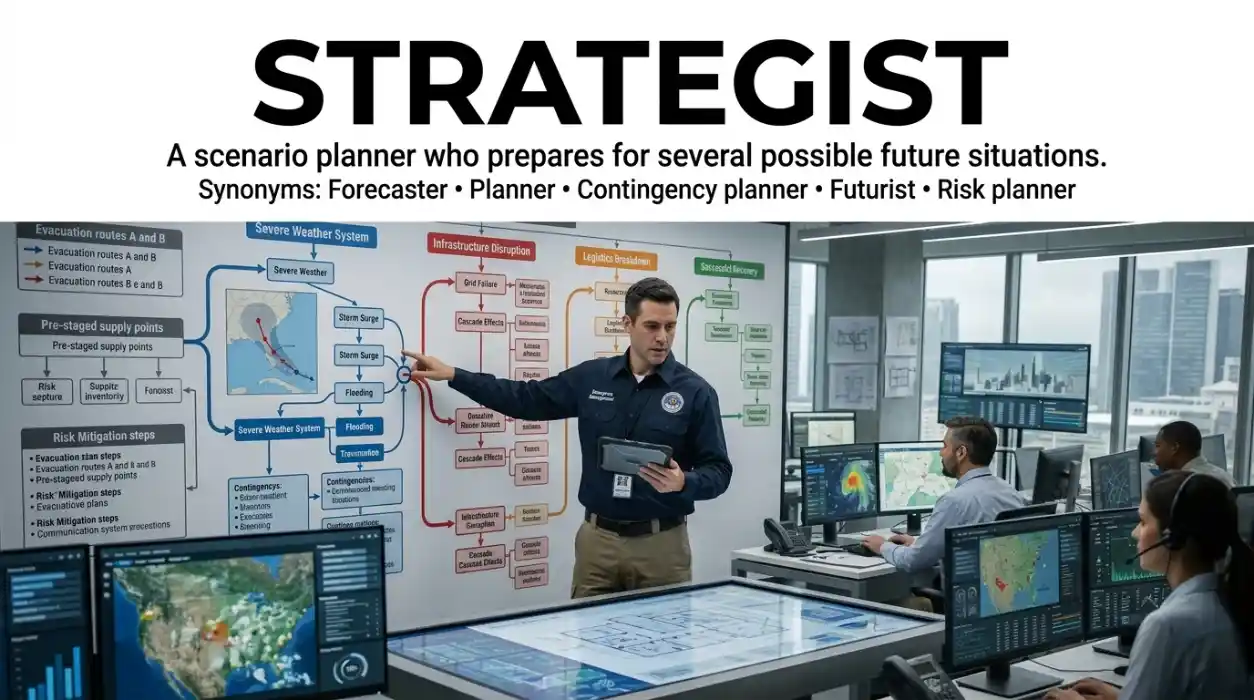
Scenario Planner (Noun phrase) — US /səˈnɛrioʊ ˌplænər/ | UK /səˈnɑːriəʊ ˌplænə/
Meaning: A scenario planner prepares for several possible future situations.
Tone/Register: Academic, business, professional.
Example:
The scenario planner prepared three possible forecasts.
The team discussed how it would respond to each one.
Foresight Specialist (Noun phrase) — US /ˈfɔːrsaɪt ˈspeʃəlɪst/ | UK /ˈfɔːsaɪt ˈspeʃəlɪst/
Meaning: A foresight specialist studies possible future developments to support better long-term decisions.
Tone/Register: Formal, academic, professional.
Example:
The foresight specialist examined emerging trends.
Her research helped the organization prepare for uncertainty.
Strategic Adviser (Noun phrase) — US /strəˈtiːdʒɪk ədˈvaɪzər/ | UK /strəˈtiːdʒɪk ədˈvaɪzə/
Meaning: A strategic adviser gives guidance focused on long-term objectives and major decisions.
Tone/Register: Formal, professional.
Example:
The strategic adviser reviewed the proposed expansion.
He highlighted several long-term risks.
Tactical Planner (Noun phrase) — US /ˈtæktɪkəl ˌplænər/ | UK /ˈtæktɪkəl ˌplænə/
Meaning: A tactical planner concentrates on the practical steps needed to support a broader strategy.
Tone/Register: Professional, sports, military.
Example:
The tactical planner adjusted the team’s immediate approach.
The larger objective remained unchanged.
Competitive Planner (Noun phrase) — US /kəmˈpetətɪv ˌplænər/ | UK /kəmˈpetətɪv ˌplænə/
Meaning: A competitive planner develops actions with competitors, opponents, or rival goals in mind.
Tone/Register: Business, sports.
Example:
The competitive planner studied rival teams before the season.
That research shaped the training plan.
Decision Strategist (Noun phrase) — US /dɪˈsɪʒən ˈstrætədʒɪst/ | UK /dɪˈsɪʒən ˈstrætədʒɪst/
Meaning: A decision strategist focuses on improving the quality and structure of important choices.
Tone/Register: Professional, analytical.
Example:
The decision strategist helped the board compare several options.
The process made the trade-offs clearer.
Planning Expert (Noun phrase) — US /ˈplænɪŋ ˈekspɜːrt/ | UK /ˈplænɪŋ ˈekspɜːt/
Meaning: A planning expert is someone with advanced knowledge or experience in developing effective plans.
Tone/Register: Neutral, professional.
Example:
She is a planning expert with years of project experience.
Her advice simplified the process.
Strategic Leader (Noun phrase) — US /strəˈtiːdʒɪk ˈliːdər/ | UK /strəˈtiːdʒɪk ˈliːdə/
Meaning: A strategic leader combines leadership responsibility with long-term planning and direction.
Tone/Register: Professional, formal.
Example:
The strategic leader gave the department a clear direction.
He connected daily tasks to broader goals.
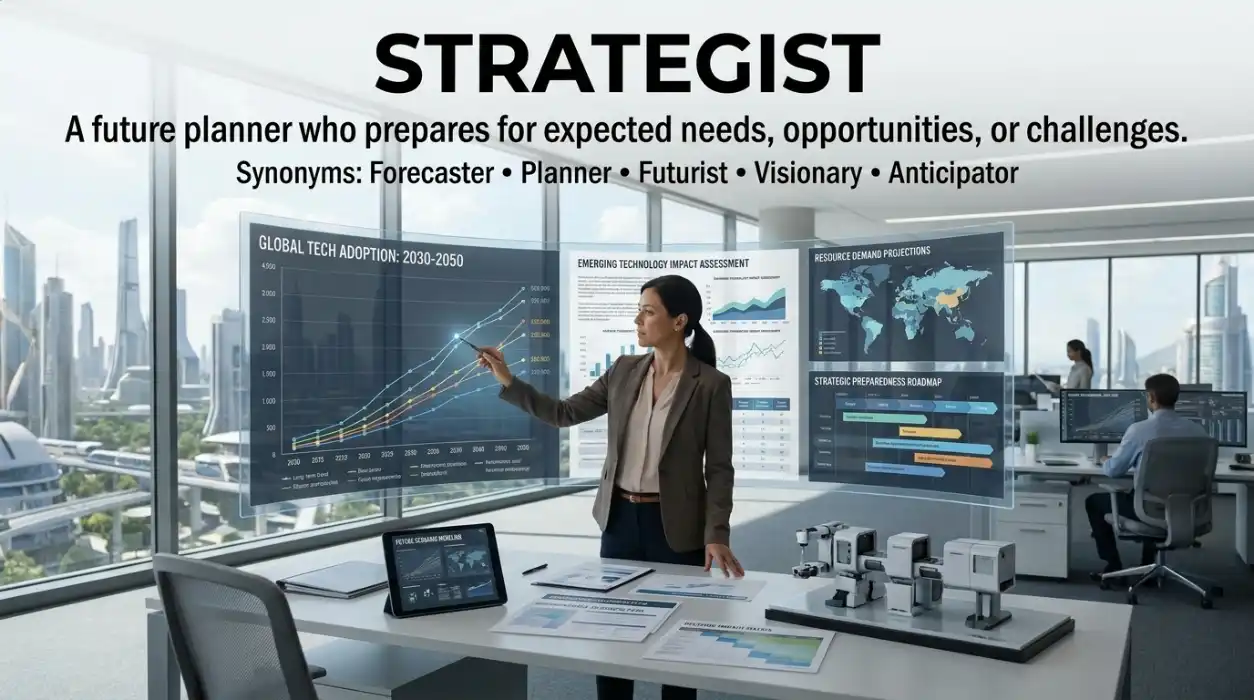
Future Planner (Noun phrase) — US /ˈfjuːtʃər ˌplænər/ | UK /ˈfjuːtʃə ˌplænə/
Meaning: A future planner focuses on preparing for expected needs, opportunities, or challenges.
Tone/Register: Neutral, professional.
Example:
The future planner considered how technology might change the industry.
Her recommendations focused on preparation rather than reaction.
Synonyms by Tone
Positive
Words such as visionary, forward thinker, strategic thinker, foresight specialist, architect, and strategic leader often carry positive associations.
They emphasize insight, preparation, creativity, or leadership.
Neutral
Planner, coordinator, organizer, consultant, adviser, project planner, and decision maker are generally neutral.
They describe a function without strongly praising or criticizing the person.
Negative or Potentially Negative
Calculating planner can suggest excessive calculation or emotional distance.
Mastermind can also become negative when it is used to describe someone directing a harmful or secretive plan.
The surrounding context determines the tone.
Playful or Informal
Mastermind, game changer, chess player, and master planner can sound more conversational or dramatic.
They work well in informal writing but may feel too colorful for a formal academic paper.
Why Tone Matters
A synonym is not merely a replacement word. It also communicates attitude.
Calling someone a strategic leader sounds professional. Calling the same person a mastermind sounds more dramatic.
Choose the word that matches both your meaning and your intended tone.
“Strategist” vs Close Alternatives
Planner vs Strategist
A strategist normally considers broad goals, competition, consequences, and future possibilities.
A planner may focus more on organizing tasks, schedules, resources, or practical steps.
Use strategist for big-picture thinking. Use planner when organization is the main idea.
Tactician vs Strategist
A strategist usually thinks about the overall direction.
A tactician focuses more closely on immediate moves and practical execution.
For example, a football coach might develop a season strategy while making tactical changes during a particular match.
Adviser vs. Strategist
A strategist develops strategic approaches.
An adviser provides guidance to someone making decisions.
One person can perform both roles, but the words emphasize different responsibilities.
How “Strategist” Changes by Context
Daily Conversation
In everyday English, strategist often appears when discussing games, sports, career decisions, personal goals, or someone who plans carefully.
You might say:
My brother is a real strategist when it comes to saving money.
This sounds natural when the person thinks ahead and chooses actions deliberately.
Writing and Blogging
Writers often use strategist when discussing business, communication, branding, leadership, sports, or organizational planning.
However, repeating strategist too often can make an article feel mechanical.
Alternatives such as planner, strategic thinker, adviser, architect, or forward thinker can add useful variation when their meanings fit.
Professional or Academic English
Professional writing benefits from precise distinctions.
For example, scenario planner is useful when someone develops multiple future possibilities, while policy strategist specifically connects strategic thinking with policy.
Academic writing should favor accuracy over impressive-sounding vocabulary.
Creative or Informal English
Creative writing gives you more freedom.
You can describe a character as a chess player, mastermind, or master planner to create a particular image.
These choices add personality that the neutral word strategist may not provide.
Common Mistakes Learners Make
Mistake 1: Treating every synonym as identical
A planner is not always a strategist. A leader is not automatically a strategist either.
Each term highlights a different part of strategic behavior.
Mistake 2: Using “mastermind” in formal contexts
Mastermind can sound dramatic or informal.
In a formal report, strategic planner or strategic adviser may be more appropriate.
Mistake 3: Confusing strategy with tactics
Strategy concerns broader direction.
Tactics usually concern specific actions used to achieve that direction.
Mistake 4: Assuming “strategist” always sounds positive
The word can be neutral, but context may make it sound calculating or manipulative.
Read the surrounding sentence before choosing a replacement.
Mistake 5: Choosing impressive words instead of accurate ones
Vocabulary variety is useful only when the replacement preserves the intended meaning.
A simple planner is better than an unusual word that changes the message.
Register Notes
Strategist works comfortably in professional, academic, journalistic, and everyday contexts.
Tactician is more specialized. Mastermind is more informal and dramatic. Strategic adviser and foresight specialist are more professional.
For additional vocabulary practice, connect this topic with other articles about synonyms for leadership, planning, and decision-making.
Real-Life Examples Using
Workplace
A department needs to enter a new market. The strategist studies competitors, resources, risks, and possible long-term outcomes before recommending a direction.
Social Situations
A person organizing a large family gathering may act like a strategist by considering schedules, personalities, transportation, and backup plans.
Media and Pop Culture
Sports commentators often describe coaches and players as strategists when their decisions show careful preparation and awareness of opponents.
Writing and Storytelling
A novelist might create a character who is a strategist because that character solves problems by thinking several steps ahead.
Practice Quiz
1. Which word best describes someone who focuses on immediate moves during a competitive match?
A. Visionary
B. Tactician
C. Policymaker
D. Organizer
2. A person who designs a five-year organizational plan is most naturally called a:
A. Strategic planner
B. Campaigner
C. Chess player
D. Coordinator
3. Which word can sound dramatic or informal?
A. Mastermind
B. Adviser
C. Policymaker
D. Consultant
4. Someone who studies several possible futures is a:
A. Scenario planner
B. Commander
C. Goal setter
D. Organizer
5. Which term emphasizes future possibilities and innovative thinking?
A. Visionary
B. Coordinator
C. Decision maker
D. Operations planner
6. A person who gives expert recommendations to a company is often called a:
A. Consultant
B. Chess player
C. Campaigner
D. Mastermind
7. Which phrase best describes someone who connects daily actions to broad organizational goals?
A. Strategic leader
B. Goal setter
C. Game changer
D. Organizer
8. Which term may suggest someone is overly calculating?
A. Forward thinker
B. Calculating planner
C. Visionary
D. Coordinator
9. A person who organizes timelines, tasks, and milestones is a:
A. Project planner
B. General
C. Visionary
D. Campaigner
10. Which word most strongly relates to military leadership?
A. General
B. Blogger
C. Consultant
D. Coordinator
Answer key: 1-B | 2-A | 3-A | 4-A | 5-A | 6-A | 7-A | 8-B | 9-A | 10-A
Reflection Task
Choose one synonym from this article and write a sentence about a real person, fictional character, workplace situation, or personal goal.
External Reference Sources
For dictionary-level pronunciation, definitions, usage notes, and etymology, useful references include:
- Cambridge Dictionary
- Merriam-Webster
- Oxford English Dictionary
Conclusion
Learning synonyms for strategist helps you describe planning, foresight, leadership, and decision-making with greater precision in everyday and professional English.
The right alternative depends on context. A tactician focuses on moves, while a strategic thinker looks at goals, consequences, and future possibilities.
Students, bloggers, and content writers can use these distinctions to avoid repetition and make their writing sound clearer, more natural, and more confident.
Practice these words in emails, essays, conversations, and short writing exercises. The more you use them, the easier precise vocabulary becomes.
Frequently Asked Questions
What is the closest synonym for strategist?
The closest general synonym for strategist is usually strategic planner or strategic thinker. Both describe someone who develops plans around broader goals and future outcomes. However, the best choice depends on context. Tactician emphasizes immediate moves, while planner is broader and may focus on organization rather than strategic thinking.
What is a professional word for strategist?
Strategic adviser, strategic planner, strategic thinker, and strategic leader are useful professional alternatives. The best term depends on the person’s actual role. For example, a person who advises executives may be a strategic adviser, while someone responsible for developing long-term organizational plans may be a strategic planner.
What is another word for a person who thinks several steps ahead?
Several expressions can describe this idea, including strategist, forward thinker, long-term thinker, strategic thinker, and, in informal contexts, chess player. Strategist is the most direct general term. Chess player is metaphorical and suggests someone who anticipates responses before acting.
Is “tactician” the same as “strategist”?
No. The two words overlap, but they emphasize different levels of planning. A strategist generally considers broad objectives and long-term direction. A tactician focuses more on specific actions and immediate circumstances. Someone can be both, especially in sports, military planning, business competition, or complex negotiations.
What is a good synonym for strategist in an essay?
For an essay, strategic thinker, planner, tactician, adviser, or strategic planner can work depending on the sentence. Academic writing should prioritize precision. Avoid choosing a dramatic alternative such as mastermind simply to make the vocabulary sound more sophisticated.

Shahzeena Shazadi is the founder and lead writer at VocablyHub.com, where she creates accurate, reader-focused English language content designed to help people communicate with clarity and confidence. She specializes in synonyms, antonyms, word meanings, idioms, and practical vocabulary guides that simplify complex language concepts for everyday use. Every article is carefully researched, fact-checked, and written in clear, accessible language using reliable references and real-world examples. Her goal is to provide helpful, trustworthy content that supports learners at every stage of their English language journey.
Her editorial approach focuses on accuracy, transparency, and user value while following modern content quality standards. She regularly reviews and updates content to keep information relevant, useful, and easy to understand. Through VocablyHub.com, Shahzeena Shazadi is committed to publishing reliable language resources that help students, writers, educators, professionals, and English learners expand their vocabulary, improve their writing skills, and communicate with confidence in academic, professional, and everyday situations.