
synonyms for straining include exerting, struggling, stretching, taxing, filtering, sieving, overexerting, and pressing. The best alternative depends on whether straining means using effort, experiencing pressure, stretching something, or filtering a liquid.
You are lifting a heavy box and feel every muscle working. You are straining. Later, you strain soup through a sieve. One word now describes a completely different action.
Learning synonyms for straining helps students understand these meaning changes. It also gives writers more precise ways to describe effort, pressure, tension, and filtering.
The word straining is common because strain applies to the body, mind, objects, relationships, and cooking. Context tells native speakers which meaning is intended.
For students, bloggers, content writers, and everyday English users, these alternatives make communication more exact. They help you replace repetition without changing the original idea.
What Does “Synonyms for Straining” Really Mean?
The word straining comes from the verb strain. Its central idea involves pressure, force, tension, or separation, but its exact meaning changes with context.
Consider these examples:
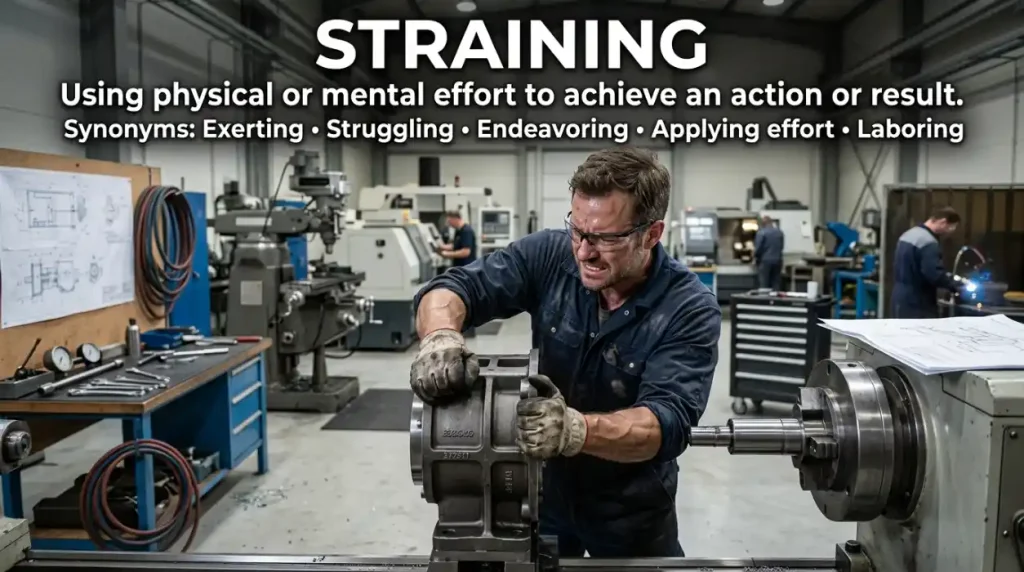
She was straining to lift the suitcase.
Here, straining means using strong physical effort.
I was straining to hear the announcement.
She was straining the soup.
Here, it means filtering liquid to remove solid material.
The dispute was straining their friendship.
This range makes straining an interesting vocabulary word. There is no single synonym that works perfectly in all four examples.
Part of Speech
Straining is normally a verb form.
It is the present participle of strain. It can also function as a gerund.
Verb:
He is straining to move the table.
Gerund:
Straining the sauce removes unwanted particles.
Simple Definition
Straining means using strong effort, experiencing pressure, stretching something under tension, or filtering something, depending on context.
How Native Speakers Understand It
Native speakers usually understand straining from the words around it.
The phrase straining to hear signals difficulty with perception.
The phrase straining a relationship signals emotional or social pressure.
That is why memorizing synonyms as isolated lists is less useful than learning them in sentences.
🧠 Connotative Meaning
Connotation (the feeling, association, or emotional suggestion connected with a word beyond its basic literal meaning) depends on how straining is used.
Positive Tone
When straining describes determined effort, it can suggest persistence.
She was straining to reach her goal.
Still, straining itself is not strongly positive. Words such as striving or exerting can better emphasize determination.
Negative Tone
Straining often suggests discomfort, excessive effort, pressure, or difficulty.
The constant workload was straining the team.
The negative suggestion becomes stronger with words such as overexerting, overloading, burdening, or agonizing.
Neutral Tone
In cooking, straining is usually neutral.
Straining the broth removes the herbs.
There is no emotional judgment. It simply describes a useful process.
📖 Etymology of “Straining”
The word straining comes from strain, which entered Middle English through Anglo-French and Old French forms related to Latin stringere, meaning “to draw tight,” “bind,” or “compress.”
The history connects many modern senses of strain. Physical tension, pressure, difficulty, and stretching all relate to the older idea of drawing something tight.
Old English: 450–1100
The modern verb strain was not a native Old English verb in its present form. Old English had Germanic vocabulary for ideas involving pulling, stretching, tightening, and force.
The later French-derived word entered English after the Norman Conquest.
Middle English: 1100–1500
During Middle English, forms related to strain entered English through French influence. The word developed meanings connected with force, tension, stretching, and exertion.
These meanings gradually expanded into figurative uses.
Modern English: 1500–Present
Modern English uses strain across many fields. We can strain a muscle, strain to hear, strain a relationship, strain a material, or strain a liquid.
The form straining is created by adding -ing to strain.
Pronunciation of “Straining”
US: /ˈstreɪnɪŋ/
UK: /ˈstreɪnɪŋ/
Syllables
strain-ing — 2 syllables
Affixation Pattern of “Straining”
Root: strain
Prefix: none
Suffix: -ing
The -ing ending creates the present participle or gerund form.
Synonyms List
Exerting (Verb) — US /ɪɡˈzɜːrtɪŋ/ — UK /ɪɡˈzɜːtɪŋ/
Meaning: Applying physical or mental effort to achieve an action or result.
Tone/Register: Neutral to formal.
Example:
She was exerting considerable force on the handle.
He kept exerting himself throughout the exercise.
Struggling (Verb) — US /ˈstrʌɡəlɪŋ/ — UK /ˈstrʌɡəlɪŋ/
Meaning: Trying to do something difficult while facing resistance or problems.
Tone/Register: Everyday, neutral.
Example:
He was struggling to carry the suitcase.
I was struggling to understand the final question.
Striving (Verb) — US /ˈstraɪvɪŋ/ — UK /ˈstraɪvɪŋ/
Meaning: Making a determined effort to achieve something.
Tone/Register: Formal, positive-neutral.
Example:
She is striving to improve her pronunciation.
The team is striving for better results.
Laboring (Verb) — US /ˈleɪbərɪŋ/ — UK /ˈleɪbərɪŋ/
Meaning: Working with considerable physical or mental effort.
Tone/Register: Formal, literary.
Example:
The workers were laboring under difficult conditions.
He was laboring to complete the final chapter.
Trying Hard (Verb Phrase) — US /ˈtraɪɪŋ hɑːrd/ — UK /ˈtraɪɪŋ hɑːd/
Meaning: Making a strong effort to accomplish something.
Tone/Register: Informal, everyday.
Example:
She was trying hard to remember the address.
The child was trying hard to open the jar.
Pushing (Verb) — US /ˈpʊʃɪŋ/ — UK /ˈpʊʃɪŋ/
Meaning: Applying effort or pressure to move something or achieve a result.
Tone/Register: Informal to neutral.
Example:
He was pushing against the locked door.
She kept pushing until the drawer opened.
Forcing (Verb) — US /ˈfɔːrsɪŋ/ — UK /ˈfɔːsɪŋ/
Meaning: Using force to make something move, open, or happen.
Tone/Register: Neutral.
Example:
He was forcing the lid open.
Do not force the stuck handle.
Heaving (Verb) — US /ˈhiːvɪŋ/ — UK /ˈhiːvɪŋ/
Meaning: Moving or lifting something heavy with great physical effort.
Tone/Register: Informal, vivid.
Example:
They were heaving the old sofa upstairs.
He was heaving the equipment into the truck.
Tugging (Verb) — US /ˈtʌɡɪŋ/ — UK /ˈtʌɡɪŋ/
Meaning: Pulling something with short or repeated forceful movements.
Tone/Register: Neutral, descriptive.
Example:
The puppy was tugging at the leash.
She kept tugging the loose thread.
Pulling Hard (Verb Phrase) — US /ˈpʊlɪŋ hɑːrd/ — UK /ˈpʊlɪŋ hɑːd/
Meaning: Using substantial force while pulling something.
Tone/Register: Everyday.
Example:
He was pulling hard on the rope.
The workers were pulling hard to move the cart.
Overexerting (Verb) — US /ˌoʊvərɪɡˈzɜːrtɪŋ/ — UK /ˌəʊvərɪɡˈzɜːtɪŋ/
Meaning: Using more physical or mental effort than is reasonable.
Tone/Register: Formal, health-related.
Example:
She was overexerting herself during the workout.
The coach warned him against overexerting his muscles.
Taxing (Verb) — US /ˈtæksɪŋ/ — UK /ˈtæksɪŋ/
Meaning: Placing a heavy demand on someone’s body, mind, time, or resources.
Tone/Register: Formal to neutral.
Example:
The long journey was taxing for everyone.
The exam was mentally taxing.
Stressing (Verb) — US /ˈstresɪŋ/ — UK /ˈstresɪŋ/
Meaning: Placing pressure on a person, system, relationship, or resource.
Tone/Register: Neutral.
Example:
The extra workload is stressing the team.
The repeated delays are stressing the schedule.
Pressuring (Verb) — US /ˈpreʃərɪŋ/ — UK /ˈpreʃərɪŋ/
Meaning: Applying pressure that encourages or forces a response.
Tone/Register: Neutral.
Example:
The deadline was pressuring the entire department.
They felt pressured to respond immediately.
Burdening (Verb) — US /ˈbɜːrdənɪŋ/ — UK /ˈbɜːdənɪŋ/
Meaning: Placing a heavy responsibility, demand, or difficulty on someone or something.
Tone/Register: Formal.
Example:
The extra paperwork was burdening the staff.
The added costs were burdening the organization.
Overloading (Verb) — US /ˌoʊvərˈloʊdɪŋ/ — UK /ˌəʊvəˈləʊdɪŋ/
Meaning: Giving something more work, weight, or demand than it can reasonably handle.
Tone/Register: Professional, neutral.
Example:
The new schedule is overloading the staff.
Too many requests were overloading the system.
Grappling (Verb) — US /ˈɡræpəlɪŋ/ — UK /ˈɡræpəlɪŋ/
Meaning: Struggling physically or mentally with something difficult.
Tone/Register: Formal, literary.
Example:
The committee is grappling with a complex issue.
She was grappling with a difficult decision.
Wrestling (Verb) — US /ˈresəlɪŋ/ — UK /ˈresəlɪŋ/
Meaning: Struggling against physical or figurative resistance.
Tone/Register: Informal, vivid.
Example:
He was wrestling with the heavy suitcase.
She was wrestling with a difficult concept.
Battling (Verb) — US /ˈbætəlɪŋ/ — UK /ˈbætəlɪŋ/
Meaning: Making a determined effort against a difficult condition or obstacle.
Tone/Register: Informal, vivid.
Example:
The hikers were battling strong winds.
She was battling to finish the assignment.
Overworking (Verb) — US /ˌoʊvərˈwɜːrkɪŋ/ — UK /ˌəʊvəˈwɜːkɪŋ/
Meaning: Making a person or system work excessively hard.
Tone/Register: Neutral, professional.
Example:
The company was overworking its employees.
He realized he had been overworking himself.
Stretching (Verb) — US /ˈstretʃɪŋ/ — UK /ˈstretʃɪŋ/
Meaning: Pulling or extending something so that it becomes longer or wider.
Tone/Register: Neutral.
Example:
The fabric was stretching around the frame.
The elastic kept stretching under the weight.
Tightening (Verb) — US /ˈtaɪtənɪŋ/ — UK /ˈtaɪtənɪŋ/
Meaning: Making something tighter or causing it to become tighter.
Tone/Register: Neutral.
Example:
The rope was tightening around the package.
The knot kept tightening as he pulled.
Pulling Tight (Verb Phrase) — US /ˈpʊlɪŋ taɪt/ — UK /ˈpʊlɪŋ taɪt/
Meaning: Pulling something firmly until it becomes tight.
Tone/Register: Everyday.
Example:
She was pulling the rope tight.
He pulled the fabric tight before sewing.
Drawing Tight (Verb Phrase) — US /ˈdrɔːɪŋ taɪt/ — UK /ˈdrɔːɪŋ taɪt/
Meaning: Becoming tight or causing something to become tight through pulling.
Tone/Register: Literary, descriptive.
Example:
The rope was drawing tight around the bundle.
The sail drew tight in the strong wind.
Compressing (Verb) — US /kəmˈpresɪŋ/ — UK /kəmˈpresɪŋ/
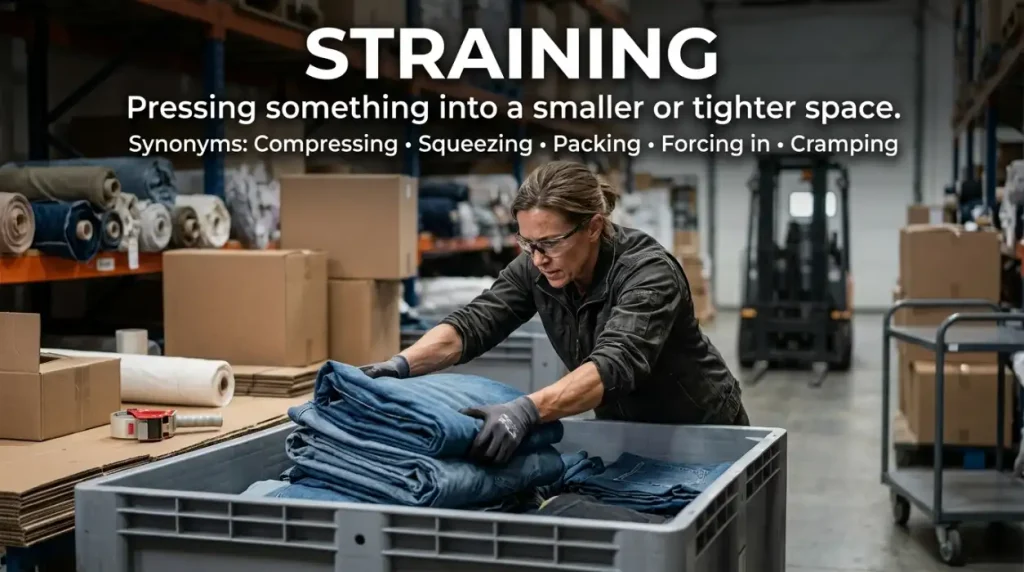
Meaning: Pressing something into a smaller or tighter space.
Tone/Register: Technical.
Example:
The machine was compressing the material.
Pressure was compressing the soft surface.
Constricting (Verb) — US /kənˈstrɪktɪŋ/ — UK /kənˈstrɪktɪŋ/
Meaning: Making something narrower or tighter.
Tone/Register: Formal, technical.
Example:
The band was constricting the tube.
The opening was constricting as the pressure increased.
Applying Force (Verb Phrase) — US /əˈplaɪɪŋ fɔːrs/ — UK /əˈplaɪɪŋ fɔːs/
Meaning: Using physical strength or pressure to affect something.
Tone/Register: Technical, formal.
Example:
The machine is applying force to the surface.
He applied force to the lever.
Bearing Down (Phrasal Verb) — US /ˈberɪŋ daʊn/ — UK /ˈbeərɪŋ daʊn/
Meaning: Applying strong physical or mental effort to something.
Tone/Register: Informal, vivid.
Example:
He was bearing down on the heavy lever.
She bore down and finished the last section.
Pressing (Verb) — US /ˈpresɪŋ/ — UK /ˈpresɪŋ/
Meaning: Applying pressure to something.
Tone/Register: Neutral.
Example:
She was pressing firmly against the door.
He kept pressing the handle downward.
Struggling With (Phrasal Verb) — US /ˈstrʌɡəlɪŋ wɪð/ — UK /ˈstrʌɡəlɪŋ wɪð/
Meaning: Having difficulty dealing with a task, problem, feeling, or situation.
Tone/Register: Neutral.
Example:
He is struggling with the new schedule.
She has been struggling with the decision.
Straining to Hear (Verb Phrase) — US /ˈstreɪnɪŋ tə hɪr/ — UK /ˈstreɪnɪŋ tə hɪər/
Meaning: Making an effort because a sound is difficult to hear.
Tone/Register: Everyday.
Example:
I was straining to hear the announcement.
She moved closer because she was straining to hear.
Straining to See (Verb Phrase) — US /ˈstreɪnɪŋ tə siː/ — UK /ˈstreɪnɪŋ tə siː/
Meaning: Making an effort to see something that is distant, small, or unclear.
Tone/Register: Everyday.
Example:
He was straining to see the road sign.
I was straining to see through the fog.
Straining to Remember (Verb Phrase) — US /ˈstreɪnɪŋ tə rɪˈmembər/ — UK /ˈstreɪnɪŋ tə rɪˈmembə/
Meaning: Making a strong mental effort to recall information.
Tone/Register: Neutral.
Example:
She was straining to remember his name.
I was straining to remember where we had met.
Straining One’s Voice (Verb Phrase) — US /ˈstreɪnɪŋ wʌnz vɔɪs/ — UK /ˈstreɪnɪŋ wʌnz vɔɪs/
Meaning: Using the voice with excessive force or effort.
Tone/Register: Neutral.
Example:
He was straining his voice above the crowd.
She stopped talking after straining her voice for hours.
Straining a Muscle (Verb Phrase) — US /ˈstreɪnɪŋ ə ˈmʌsəl/ — UK /ˈstreɪnɪŋ ə ˈmʌsəl/
Meaning: Putting excessive force on a muscle.
Tone/Register: Everyday, health-related.
Example:
He was careful about straining a muscle.
Lift slowly so you do not strain your back.
Straining a Relationship (Verb Phrase) — US /ˈstreɪnɪŋ ə rɪˈleɪʃənʃɪp/ — UK /ˈstreɪnɪŋ ə rɪˈleɪʃənʃɪp/
Meaning: Creating pressure or tension within a personal or professional relationship.
Tone/Register: Neutral, formal.
Example:
The disagreement was straining their relationship.
Repeated arguments were straining the friendship.
Straining Relations (Verb Phrase) — US /ˈstreɪnɪŋ rɪˈleɪʃənz/ — UK /ˈstreɪnɪŋ rɪˈleɪʃənz/
Meaning: Making relations between people or groups more tense or difficult.
Tone/Register: Formal.
Example:
The dispute was straining relations between the departments.
The incident continued to strain relations.
Taxing Oneself (Verb Phrase) — US /ˈtæksɪŋ wʌnˈself/ — UK /ˈtæksɪŋ wʌnˈself/
Meaning: Placing excessive demands on one’s own physical or mental resources.
Tone/Register: Formal, health-related.
Example:
He was taxing himself with an unrealistic schedule.
She realized she was taxing herself too heavily.
Putting Pressure On (Verb Phrase) — US /ˈpʊtɪŋ ˈpreʃər ɑːn/ — UK /ˈpʊtɪŋ ˈpreʃə ɒn/
Meaning: Creating demands or tension for a person, system, or relationship.
Tone/Register: Neutral, very common.
Example:
The deadline is putting pressure on the team.
Higher demand is putting pressure on the service.
Filtering (Verb) — US /ˈfɪltərɪŋ/ — UK /ˈfɪltərɪŋ/
Meaning: Separating unwanted material from a liquid, gas, or other substance.
Tone/Register: Neutral, technical.
Example:
She was filtering the water through a clean material.
The machine is filtering dust from the air.
Sieving (Verb) — US /ˈsɪvɪŋ/ — UK /ˈsɪvɪŋ/
Meaning: Separating particles by passing a substance through a sieve.
Tone/Register: Cooking, technical.
Example:
He was sieving the flour into the bowl.
She spent a minute sieving the dry ingredients.
Straining Out (Phrasal Verb) — US /ˈstreɪnɪŋ aʊt/ — UK /ˈstreɪnɪŋ aʊt/
Meaning: Removing unwanted solid material from a liquid.
Tone/Register: Everyday, culinary.
Example:
She was straining out the seeds.
I strained out the herbs before serving the soup.
Draining (Verb) — US /ˈdreɪnɪŋ/ — UK /ˈdreɪnɪŋ/
Meaning: Removing liquid from something rather than emphasizing the separation of fine particles.
Tone/Register: Neutral.
Example:
He was draining the pasta in the sink.
She drained the vegetables before adding the sauce.
Filtering Through (Phrasal Verb) — US /ˈfɪltərɪŋ θruː/ — UK /ˈfɪltərɪŋ θruː/
Meaning: Passing a liquid or gas through a filtering material.
Tone/Register: Technical, neutral.
Example:
The liquid was filtering through the cloth.
We filtered the mixture through a fine mesh.
Screening (Verb) — US /ˈskriːnɪŋ/ — UK /ˈskriːnɪŋ/
Meaning: Separating material by passing it through a screen.
Tone/Register: Technical, industrial.
Example:
The workers were screening the sand.
The process removes larger pieces by screening.
Screening Out (Phrasal Verb) — US /ˈskriːnɪŋ aʊt/ — UK /ˈskriːnɪŋ aʊt/
Meaning: Removing unwanted material through a screening process.
Tone/Register: Technical, professional.
Example:
The filter is screening out larger particles.
The machine screens out unwanted material.
Sifting (Verb) — US /ˈsɪftɪŋ/ — UK /ˈsɪftɪŋ/
Meaning: Passing dry material through a sieve to separate fine particles from larger ones.
Tone/Register: Cooking, everyday.
Example:
She was sifting flour into the mixing bowl.
He sifted the powdered sugar before decorating the cake.
Separating (Verb) — US /ˈsepəreɪtɪŋ/ — UK /ˈsepəreɪtɪŋ/
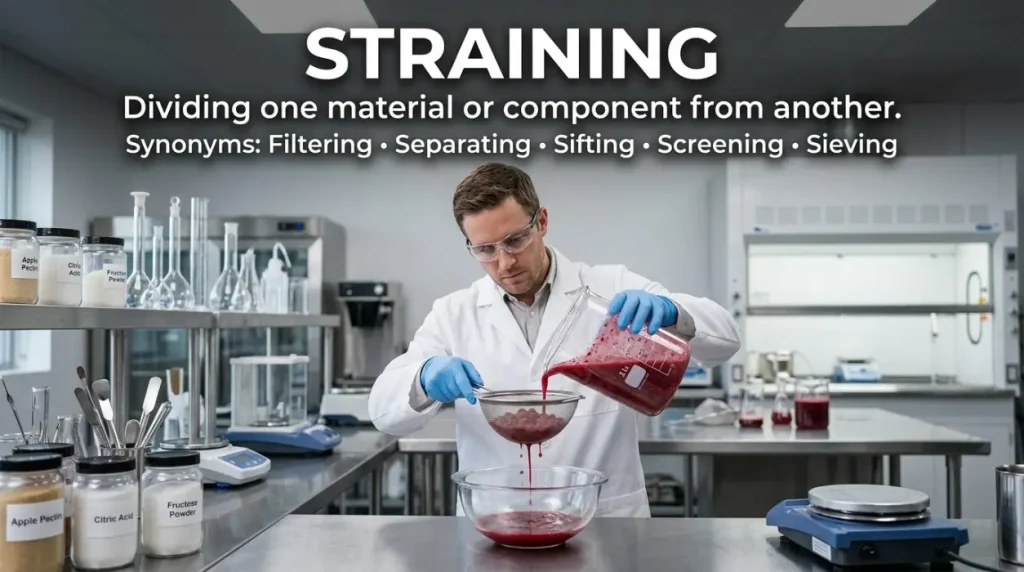
Meaning: Dividing one material or component from another.
Tone/Register: Neutral, broad.
Example:
The process is separating solids from liquid.
She was separating the useful pieces from the waste.
Distilling (Verb) — US /dɪˈstɪlɪŋ/ — UK /dɪˈstɪlɪŋ/
Meaning: Purifying or separating a liquid through evaporation and condensation.
Tone/Register: Scientific, technical.
Example:
The laboratory was distilling the liquid.
The process separates components through controlled heating.
Filtering Out (Phrasal Verb) — US /ˈfɪltərɪŋ aʊt/ — UK /ˈfɪltərɪŋ aʊt/
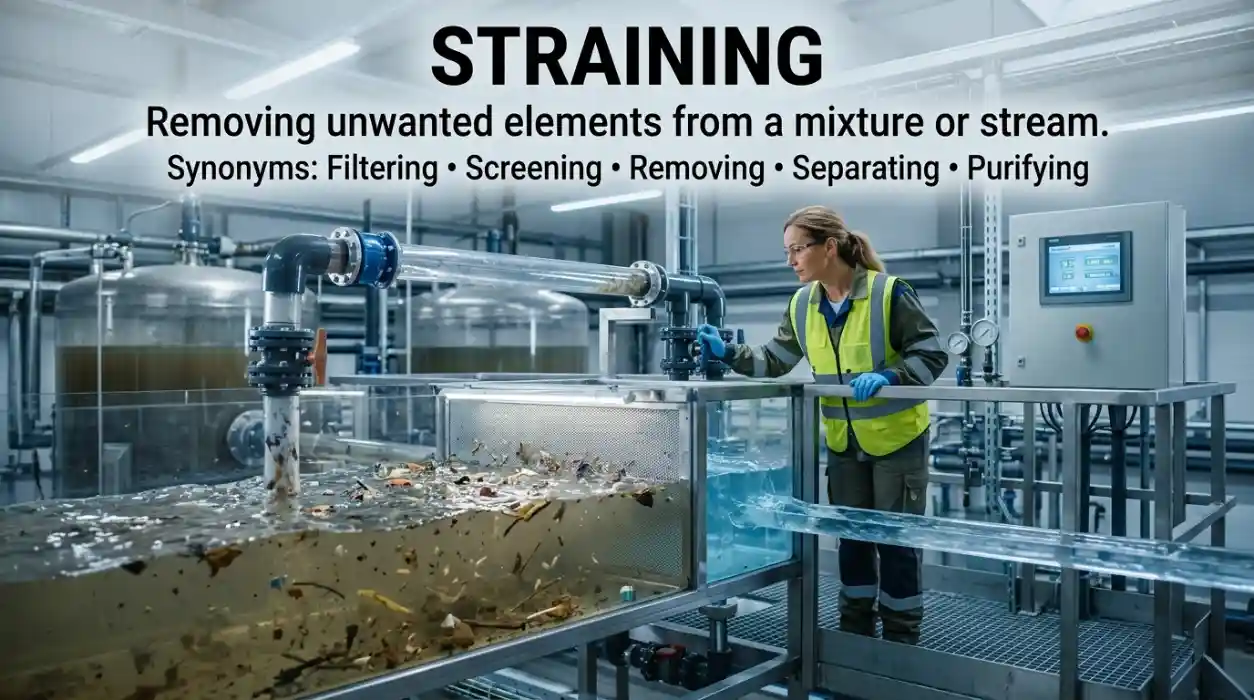
Meaning: Removing unwanted elements from a mixture or stream.
Tone/Register: Neutral to technical.
Example:
The filter is filtering out tiny particles.
The system filters out unwanted material.
Synonyms by Tone
The right alternative depends not only on meaning but also on emotional strength.
Positive or Determined
These terms can emphasize effort and persistence:
- Striving
- Exerting
- Trying hard
- Pushing
- Battling
For example, striving often sounds purposeful, while battling creates a more dramatic image.
Neutral
These words usually describe the action without adding strong emotion:
- Struggling
- Stretching
- Pressing
- Filtering
- Sieving
- Draining
- Separating
- Screening
They work well in everyday explanations.
Negative or Pressure-Related
These alternatives can highlight excessive demand or difficulty:
- Overexerting
- Taxing
- Stressing
- Burdening
- Overloading
- Overworking
- Agonizing
These choices are useful when the situation involves discomfort, pressure, or emotional difficulty.
Playful or Informal
For vivid everyday writing, consider:
- Heaving
- Wrestling
- Grappling
- Bearing down
- Pushing
They create stronger physical or emotional imagery.
Why Tone Matters
Compare these sentences:
She was straining to finish the assignment.
She was striving to finish the assignment.
The first can suggest difficulty. The second emphasizes determination.
Now compare:
The workload was straining the team.
The workload was overloading the team.
The second sentence suggests that the workload has become excessive.
Good synonym selection is therefore about meaning plus tone, not vocabulary variety alone.
“Straining” vs Close Alternatives
Struggling vs Straining
Straining focuses on effort or tension.
Struggling focuses more strongly on difficulty.
He was straining to lift the box.
He was struggling to understand the instructions.
Both can work in some physical contexts, but struggling does not necessarily imply physical tension.
Straining vs Exerting
Exerting emphasizes the application of effort or force.
She was exerting pressure on the lever.
Straining often suggests that the effort feels difficult or excessive.
She was straining to move the lever.
Use exerting in formal descriptions of force. Use straining when difficulty or tension is part of the meaning.
Straining vs Filtering
These are not general synonyms.
Straining can mean filtering a liquid.
Filtering is broader and can apply to liquids, gases, data, information, and other systems.
She was straining the broth.
The machine was filtering the air.
The context determines which word is accurate.
How “Straining” Changes by Context
Daily Conversation
In casual speech, straining often describes physical effort or difficulty.
“I was straining to hear you.”
“Don’t strain yourself.”
For less formal speech, trying hard, struggling, and pushing may sound more conversational.
Writing and Blogging
Writers can use semantic alternatives to avoid repetitive sentences.
Instead of:
“The athlete was straining to finish. He was straining to keep going.”
You might write:
“The athlete was struggling to finish. He kept pushing despite the fatigue.”
The second version varies the wording while preserving the central idea of effort.
Professional or Academic Writing
Professional writing often needs greater precision.
A report might use overloading, taxing, exerting, compressing, or filtering, depending on the subject.
For example:
“The increased workload is placing pressure on the department.”
This tells the reader exactly what kind of strain is involved.
Creative or Informal Use
Creative writing can use vivid alternatives.
“He was heaving the suitcase up the stairs.”
This creates a stronger physical image than simply saying:
“He was moving the suitcase.”
Words such as wrestling and battling can also add drama when the context supports them.
Common Mistakes Learners Make
Mistake 1: Treating Every Alternative as Interchangeable
This is the most serious mistake.
You can strain soup or filter soup, depending on the exact process.
You can strain to hear or struggle to hear.
But you cannot replace straining with filtering when someone is lifting a box.
Mistake 2: Confusing “Straining” With “Stretching”
Both words can describe tension.
However, stretching focuses on extension.
Straining often suggests pressure, effort, or excessive tension.
The rubber band is stretching.
The rubber band is straining under the load.
The second sentence suggests greater stress.
Mistake 3: Confusing “Straining” With “Taxing”
A person can strain to lift something.
A difficult task can be taxing.
You would not normally say:
“She was taxing to lift the box.”
Instead:
“Lifting the box was taxing.”
Mistake 4: Using “Agonizing” Too Casually
Agonizing is much stronger than straining in many mental contexts.
She was agonizing over the decision.
This suggests intense emotional difficulty.
It would sound excessive for a trivial choice.
Mistake 5: Forgetting Grammar
Some alternatives require different structures.
Strain to do something
He strained to reach the shelf.
Struggle to do something
He struggled to reach the shelf.
Exert oneself
She exerted herself during the workout.
Filter something
They filtered the water.
The synonym must fit the grammar as well as the meaning.
Native Usage and Register Notes
Everyday: straining, struggling, trying hard, pushing, pulling hard
Formal: exerting, striving, laboring, taxing, burdening
Professional: overloading, stressing, applying force, screening
Technical: filtering, sieving, compressing, constricting, distilling
Literary: grappling, laboring, bearing down, battling
Native speakers usually choose the simplest word that communicates the intended idea.
If straining is already clear, there is no need to replace it. Synonyms become valuable when you need greater precision, variation, or a different tone.
An internal vocabulary page about words for effort and difficulty can also help readers explore related distinctions without forcing unrelated synonyms into this article.
Real-Life Mini Scenarios
Workplace
A manager may explain that an unusually heavy workload is straining the team.
A more specific description could be:
“The additional tasks are overloading the department.”
The second version emphasizes excessive workload.
Social Situation
Imagine talking with a friend in a noisy café.
“I was straining to hear you.”
A casual alternative is:
“I was struggling to hear you.”
Both are natural, but the second focuses more directly on the difficulty.
Cooking
A recipe may ask you to strain the broth.
Depending on the process, filter, sieve, or strain out may provide a more specific description.
For example:
“Strain out the seeds before serving.”
Fitness and Physical Activity
Someone lifting a heavy object might say:
“I was straining to move it.”
If the effort became excessive, overexerting may be more precise:
“I was overexerting myself.”
Media and Sports Writing
Sports writers often use pushing, battling, and striving to describe intense effort.
These words add energy and movement.
A neutral report might simply say:
“The runner was struggling to maintain the pace.”
Storytelling
Creative writers can choose vivid verbs:
“He was heaving the trunk across the room.”
Or:
“She was wrestling with the stubborn lock.”
These alternatives give readers a clearer physical picture.
Interactive Practice Quiz
1. A student is having great difficulty understanding a difficult concept.
A. Filtering
B. Grappling
C. Draining
D. Sieving
2. Someone uses too much physical effort during exercise.
A. Overexerting
B. Screening
C. Separating
D. Filtering
3. A chef removes seeds from juice.
A. Straining out
B. Pushing
C. Taxing
D. Wrestling
4. A machine separates larger particles from sand.
A. Striving
B. Screening
C. Battling
D. Heaving
5. Someone pulls a rope with repeated short movements.
A. Tugging
B. Taxing
C. Filtering
D. Burdening
6. A difficult project places heavy demands on employees.
A. Sieving
B. Taxing
C. Stretching
D. Draining
7. A runner makes a determined effort to reach a goal.
A. Striving
B. Filtering
C. Screening
D. Compressing
8. Fabric becomes longer under tension.
A. Stretching
B. Struggling
C. Taxing
D. Burdening
9. A person has difficulty hearing a speaker in a noisy room.
A. Straining to hear
B. Straining out
C. Applying force
D. Drawing tight
10. A worker lifts a heavy piece of furniture with great effort.
A. Heaving
B. Sieving
C. Filtering
D. Distilling
Answer key: 1-B | 2-A | 3-A | 4-B | 5-A | 6-B | 7-A | 8-A | 9-A | 10-A
Reflection and Application Task
Write four short sentences using four different alternatives: one for physical effort, one for mental difficulty, one for pressure, and one for filtering.
Then ask yourself: Could I replace “straining” with this word without changing the meaning?
That final check is one of the easiest ways to develop native-level synonym awareness
External sources:
For pronunciation, definitions, usage examples, and etymology, reputable references such as Cambridge Dictionary, Merriam-Webster, and the Oxford English Dictionary can be used for independent verification.
Conclusion
Understanding the Synonyms for straining can help you describe effort, tension, pressure, or difficulty more accurately. Depending on the context, words such as struggling, exerting, stretching, forcing, and laboring may be suitable alternatives.
The Synonyms for Straining can have slightly different meanings depending on how the word is used. For example, “struggling” may describe difficulty, while “exerting” focuses more on applying physical or mental effort. Choosing the right synonym can make your writing clearer and more precise.
Learning different Synonyms for straining can expand your vocabulary and improve your everyday communication. By selecting an alternative that fits the specific situation, you can make your sentences more natural, descriptive, and engaging.
Frequently Asked Questions
1. What is another word for straining when lifting something heavy?
When straining describes physical effort while lifting, exerting, struggling, heaving, and pushing may work. Exerting emphasizes applied force, struggling emphasizes difficulty, and heaving suggests heavy physical movement. If the effort is excessive, overexerting oneself is more precise. The best choice depends on exactly what the person is doing.
2. What are good synonyms for straining to hear?
Useful alternatives include struggling to hear, trying hard to hear, and having difficulty hearing. Straining to hear emphasizes active effort caused by poor sound, distance, background noise, or low volume. In casual conversation, “I was struggling to hear you” is especially natural. The phrase “trying hard to hear” is simpler and more conversational.
3. What is the difference between straining and filtering?
When straining refers to cooking or separating material, filtering can be a close alternative. However, filtering has a broader meaning and applies to liquids, gases, information, and other systems. Straining is especially common in cooking. For example, you might strain broth to remove herbs or seeds before serving it.
4. Which synonym for straining means using too much effort?
Overexerting is the most precise choice when the idea is excessive effort. Straining does not always mean that the effort is excessive. Someone can strain to reach a shelf without necessarily overexerting themselves. Use overexerting when the sentence specifically emphasizes that a person is demanding too much from their physical or mental resources.
5. What is a synonym for straining in “straining a relationship”?
Depending on the sentence, you can use putting pressure on, creating tension in, or damaging a relationship. These alternatives emphasize the social effect rather than physical effort. For example, “The repeated arguments are putting pressure on their friendship” communicates the same general idea while making the source of the tension explicit.

Shahzeena Shazadi is the founder and lead writer at VocablyHub.com, where she creates accurate, reader-focused English language content designed to help people communicate with clarity and confidence. She specializes in synonyms, antonyms, word meanings, idioms, and practical vocabulary guides that simplify complex language concepts for everyday use. Every article is carefully researched, fact-checked, and written in clear, accessible language using reliable references and real-world examples. Her goal is to provide helpful, trustworthy content that supports learners at every stage of their English language journey.
Her editorial approach focuses on accuracy, transparency, and user value while following modern content quality standards. She regularly reviews and updates content to keep information relevant, useful, and easy to understand. Through VocablyHub.com, Shahzeena Shazadi is committed to publishing reliable language resources that help students, writers, educators, professionals, and English learners expand their vocabulary, improve their writing skills, and communicate with confidence in academic, professional, and everyday situations.