
Synonyms for neglected become useful when one simple word cannot express the exact kind of care or attention that is missing.
Imagine an old garden filled with weeds and dry plants. You might call it neglected, unmaintained, or simply uncared-for.
In everyday English, synonyms for neglected help you describe forgotten duties, ignored problems, poorly cared-for places, and undervalued people more precisely.
For students, bloggers, content writers, and daily English users, learning these alternatives builds stronger vocabulary and makes writing and speaking more natural.
What Does “Neglected” Really Mean?
Neglected means not receiving the care, attention, maintenance, consideration, or support that something or someone needs.
The word can describe people, places, objects, duties, relationships, problems, responsibilities, talents, and opportunities. For example, a neglected garden lacks regular care, while a neglected problem receives too little attention.
In emotional contexts, “neglected” can suggest that someone feels forgotten, ignored, or unvalued. In physical contexts, it can suggest poor maintenance or deterioration.
Part of speech: Adjective and past participle of the verb neglect.
Simple definition: Not given enough care, attention, or consideration.
Connotative Meaning
Connotation (the feeling or association connected with a word beyond its literal meaning) matters when choosing a synonym.
Positive or constructive tone: Words such as underused, unrecognized, and undervalued can suggest hidden potential rather than simple failure.
Negative tone: Abandoned, forsaken, uncared-for, and dilapidated create stronger negative impressions.
Neutral tone: Ignored, overlooked, unattended, and unused can describe situations without adding strong emotion.
Etymology of “Neglected”
The English word neglect ultimately comes from Latin neglectus, related to the idea of not attending to or disregarding something. English adopted the term through French influence after the Norman Conquest.
Old English: 450–1100
Old English did not use the modern form neglected. Speakers instead used native expressions for failing to care for, observe, or attend to something.
Middle English: 1100–1500
During Middle English, French and Latin vocabulary strongly influenced English. Forms related to neglect became increasingly established in written language.
Modern English: 1500–Present
Modern English uses neglect, neglected, neglectful, and negligent across everyday, professional, legal, academic, and literary contexts.
Pronunciation and Word Structure
US: /nɪˈɡlektɪd/
UK: /nɪˈɡlektɪd/
Syllables: ne-glect-ed
Root: neglect
Prefix: none
Suffix: -ed
Synonyms List:
Ignored (Adjective) — US /ɪɡˈnɔːrd/ | UK /ɪɡˈnɔːd/
Meaning: Not given attention or consideration.
Tone/Register: Neutral, everyday.
Example: The warning was ignored for weeks.
She felt ignored during the discussion.
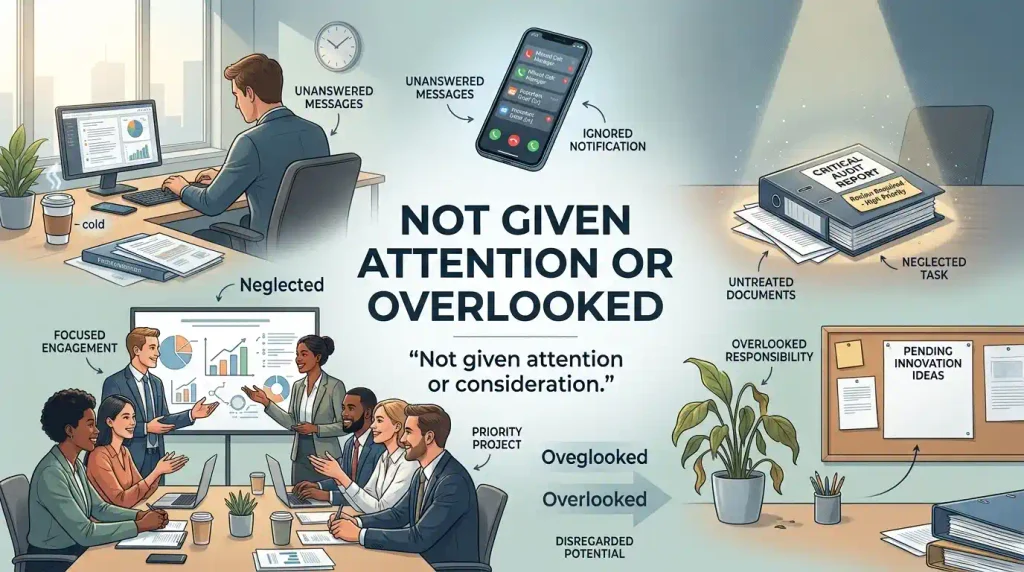
Overlooked (Adjective) — US /ˌoʊvərˈlʊkt/ | UK /ˌəʊvəˈlʊkt/
Meaning: Missed or failed to receive attention, often unintentionally.
Tone/Register: Neutral, professional.
Example: The editor overlooked a small error.
One important detail was overlooked.
Abandoned (Adjective) — US /əˈbændənd/ | UK /əˈbændənd/
Meaning: Completely left without care or support.
Tone/Register: Strong, emotional.
Example: They discovered an abandoned house.
The project looked abandoned after the team left.
Unmaintained (Adjective) — US /ˌʌnmeɪnˈteɪnd/ | UK /ˌʌnmeɪnˈteɪnd/
Meaning: Not regularly cared for or kept in good condition.
Tone/Register: Neutral, practical.
Example: The unmaintained road became difficult to use.
An unmaintained garden quickly becomes messy.
Unaddressed (Adjective) — US /ˌʌnəˈdrest/ | UK /ˌʌnəˈdrest/
Meaning: Not dealt with or given proper attention.
Tone/Register: Formal, professional.
Example: Several complaints remain unaddressed.
The report identifies unaddressed concerns.
Unresolved (Adjective) — US /ˌʌnrɪˈzɑːlvd/ | UK /ˌʌnrɪˈzɒlvd/
Meaning: Still lacking a solution or final decision.
Tone/Register: Formal, academic.
Example: The dispute remains unresolved.
Several questions stayed unresolved after the meeting.
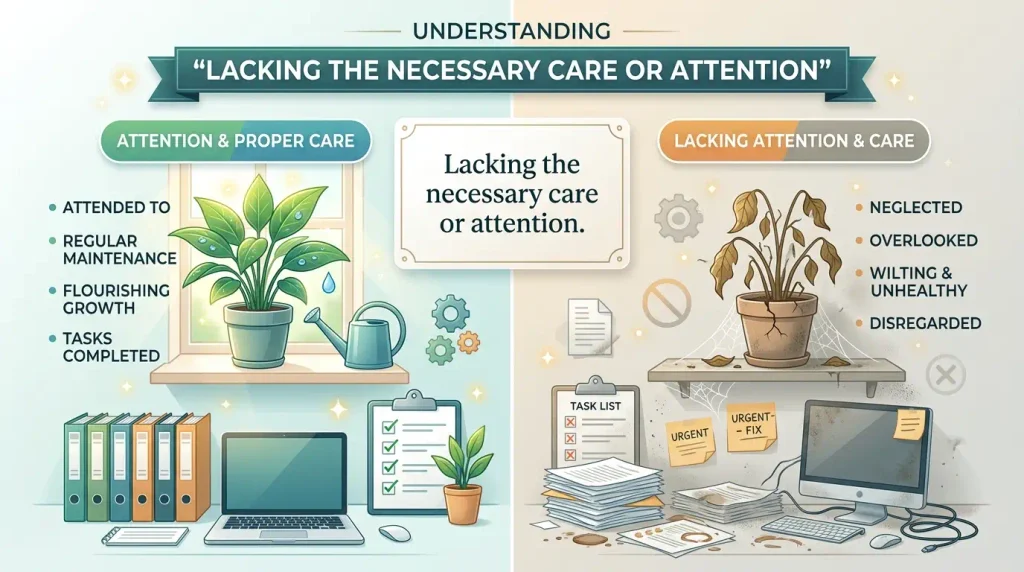
Uncared-for (Adjective) — US /ˌʌnˈkerd fɔːr/ | UK /ˌʌnˈkeəd fɔː/
Meaning: Lacking the necessary care or attention.
Tone/Register: Neutral, descriptive.
Example: The uncared-for plants had turned brown.
The shelter rescued several uncared-for animals.
Unvalued (Adjective) — US /ˌʌnˈvæljuːd/ | UK /ˌʌnˈvæljuːd/
Meaning: Not appreciated or considered important enough.
Tone/Register: Emotional, professional.
Example: He felt unvalued at work.
Her ideas often seemed unvalued.
Run-down (Adjective) — US /ˈrʌn daʊn/ | UK /ˈrʌn daʊn/
Meaning: Worn or shabby because of age or poor care.
Tone/Register: Informal.
Example: They lived in a run-down apartment.
Several run-down buildings stood nearby.
Dilapidated (Adjective) — US /dɪˈlæpɪdeɪtɪd/ | UK /dɪˈlæpɪdeɪtɪd/
Meaning: In very poor physical condition.
Tone/Register: Formal, descriptive.
Example: The hikers found a dilapidated cabin.
A dilapidated fence surrounded the property.
Disregarded (Adjective) — US /ˌdɪsrɪˈɡɑːrdɪd/ | UK /ˌdɪsrɪˈɡɑːdɪd/
Meaning: Treated as unimportant or unworthy of attention.
Tone/Register: Formal.
Example: His advice was disregarded.
The committee disregarded several recommendations.
Unattended (Adjective) — US /ˌʌnəˈtendɪd/ | UK /ˌʌnəˈtendɪd/
Meaning: Left without supervision or care.
Tone/Register: Neutral.
Example: The bag remained unattended.
Never leave young children unattended.
Forgotten (Adjective) — US /fərˈɡɑːtən/ | UK /fəˈɡɒtən/
Meaning: No longer remembered or given attention.
Tone/Register: Neutral, emotional.
Example: The tradition has been forgotten.
She discovered a forgotten notebook.
Unnoticed (Adjective) — US /ˌʌnˈnoʊtɪst/ | UK /ˌʌnˈnəʊtɪst/
Meaning: Not seen, recognized, or noticed.
Tone/Register: Neutral.
Example: The mistake went unnoticed.
Her talent remained unnoticed for years.
Unconsidered (Adjective) — US /ˌʌnkənˈsɪdərd/ | UK /ˌʌnkənˈsɪdəd/
Meaning: Not given enough thought or consideration.
Tone/Register: Academic, formal.
Example: The plan contains unconsidered risks.
Several factors remained unconsidered.
Unheeded (Adjective) — US /ʌnˈhiːdɪd/ | UK /ʌnˈhiːdɪd/
Meaning: Not listened to or acted upon.
Tone/Register: Formal, literary.
Example: Her warnings went unheeded.
The repeated advice remained unheeded.
Unloved (Adjective) — US /ˌʌnˈlʌvd/ | UK /ˌʌnˈlʌvd/
Meaning: Not receiving enough affection or emotional care.
Tone/Register: Emotional, literary.
Example: The child felt unloved.
The lonely dog looked unloved.
Unwanted (Adjective) — US /ˌʌnˈwɑːntɪd/ | UK /ˌʌnˈwɒntɪd/
Meaning: Not desired, welcomed, or valued.
Tone/Register: Everyday, emotional.
Example: He felt unwanted at the gathering.
The unwanted furniture remained outside.
Forsaken (Adjective) — US /fərˈseɪkən/ | UK /fəˈseɪkən/
Meaning: Completely abandoned or left without support.
Tone/Register: Literary, dramatic.
Example: The village looked forsaken.
The novel describes a forsaken child.
Deserted (Adjective) — US /dɪˈzɜːrtɪd/ | UK /dɪˈzɜːtɪd/
Meaning: Left empty, isolated, or without people.
Tone/Register: Neutral, descriptive.
Example: We walked down a deserted street.
The old station appeared deserted.
Negligent (Adjective) — US /ˈneɡlɪdʒənt/ | UK /ˈneɡlɪdʒənt/
Meaning: Failing to provide proper care or fulfill a responsibility.
Tone/Register: Formal, legal.
Example: The company acted negligently.
Negligent behavior can cause serious problems.
Neglectful (Adjective) — US /nɪˈɡlektfəl/ | UK /nɪˈɡlektfəl/
Meaning: Regularly failing to give necessary care or attention.
Tone/Register: Formal, critical.
Example: His neglectful habits damaged the garden.
The report criticized neglectful practices.
Inattentive (Adjective) — US /ˌɪnəˈtentɪv/ | UK /ˌɪnəˈtentɪv/
Meaning: Not paying enough attention.
Tone/Register: Neutral, academic.
Example: The inattentive student missed the instructions.
An inattentive driver can create danger.
Indifferent (Adjective) — US /ɪnˈdɪfrənt/ | UK /ɪnˈdɪfrənt/
Meaning: Showing little interest or concern.
Tone/Register: Neutral to negative.
Example: She seemed indifferent to the criticism.
His indifferent response surprised everyone.
Apathetic (Adjective) — US /ˌæpəˈθetɪk/ | UK /ˌæpəˈθetɪk/
Meaning: Showing little interest, energy, or concern.
Tone/Register: Formal, academic.
Example: The apathetic audience barely reacted.
He became apathetic about the project.
Careless (Adjective) — US /ˈkerləs/ | UK /ˈkeərləs/
Meaning: Failing to give enough attention or thought.
Tone/Register: Everyday, critical.
Example: A careless mistake changed the result.
Her careless handling damaged the file.
Thoughtless (Adjective) — US /ˈθɔːtləs/ | UK /ˈθɔːtləs/
Meaning: Showing little consideration for others.
Tone/Register: Informal, critical.
Example: His thoughtless comment hurt her.
That was a thoughtless thing to say.
Inconsiderate (Adjective) — US /ˌɪnkənˈsɪdərət/ | UK /ˌɪnkənˈsɪdərət/
Meaning: Failing to consider other people’s needs or feelings.
Tone/Register: Everyday.
Example: It was inconsiderate to cancel suddenly.
Her inconsiderate behavior annoyed the neighbors.
Unmindful (Adjective) — US /ʌnˈmaɪndfəl/ | UK /ʌnˈmaɪndfəl/
Meaning: Not paying attention to something important.
Tone/Register: Formal, literary.
Example: He was unmindful of the warning.
The driver seemed unmindful of the weather.
Unobservant (Adjective) — US /ˌʌnəbˈzɜːrvənt/ | UK /ˌʌnəbˈzɜːvənt/
Meaning: Failing to notice important details.
Tone/Register: Neutral, academic.
Example: An unobservant reader might miss the clue.
His unobservant nature caused small errors.
Unresponsive (Adjective) — US /ˌʌnrɪˈspɑːnsɪv/ | UK /ˌʌnrɪˈspɒnsɪv/
Meaning: Showing little or no response or attention.
Tone/Register: Professional.
Example: The department remained unresponsive.
Her unresponsive attitude frustrated the team.
Unconcerned (Adjective) — US /ˌʌnkənˈsɜːrnd/ | UK /ˌʌnkənˈsɜːnd/
Meaning: Showing little concern about something.
Tone/Register: Neutral.
Example: He seemed unconcerned about the delay.
She remained unconcerned by the criticism.
Dormant (Adjective) — US /ˈdɔːrmənt/ | UK /ˈdɔːmənt/
Meaning: Inactive for a period and not currently developing.
Tone/Register: Neutral, formal.
Example: The account remained dormant.
Her dormant talent returned after years of practice.
Idle (Adjective) — US /ˈaɪdəl/ | UK /ˈaɪdəl/
Meaning: Not active, used, or productive.
Tone/Register: Everyday, neutral.
Example: The machine sat idle for weeks.
Several rooms remained idle during winter.
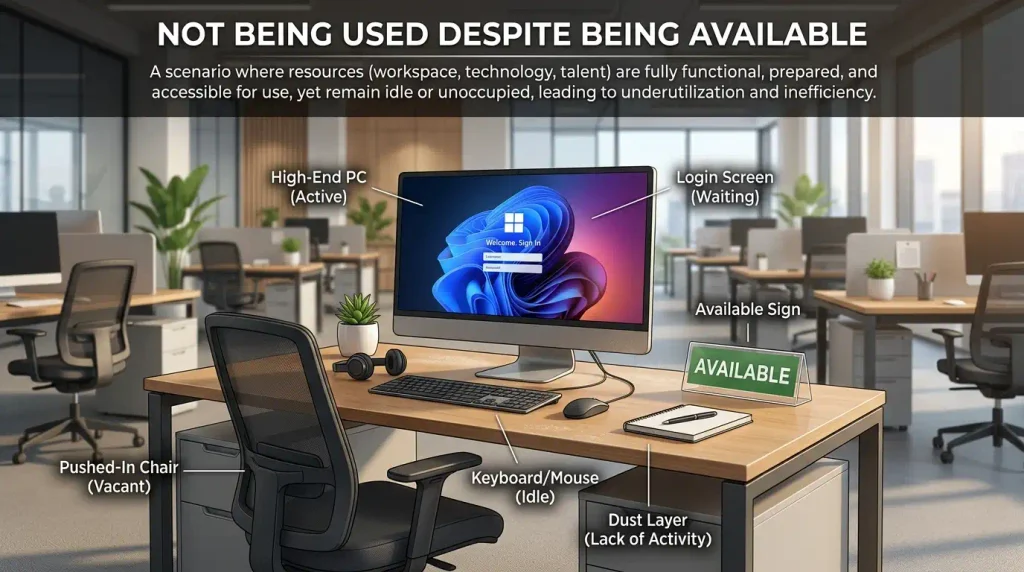
Unused (Adjective) — US /ˌʌnˈjuːzd/ | UK /ˌʌnˈjuːzd/
Meaning: Not being used despite being available.
Tone/Register: Neutral.
Example: The unused room collected dust.
Several unused resources could help.
Unexploited (Adjective) — US /ˌʌnɪkˈsplɔɪtɪd/ | UK /ˌʌnɪkˈsplɔɪtɪd/
Meaning: Not developed or used to its full potential.
Tone/Register: Formal, academic.
Example: The region has unexploited resources.
Her unexploited talent deserves attention.
Underused (Adjective) — US /ˌʌndərˈjuːzd/ | UK /ˌʌndəˈjuːzd/
Meaning: Used less than its full potential.
Tone/Register: Neutral, professional.
Example: The classroom is underused.
His writing skills remain underused.
Undervalued (Adjective) — US /ˌʌndərˈvæljuːd/ | UK /ˌʌndəˈvæljuːd/
Meaning: Not appreciated as much as deserved.
Tone/Register: Professional, emotional.
Example: Good employees can feel undervalued.
The artist’s early work was undervalued.
Underappreciated (Adjective) — US /ˌʌndər əˈpriːʃieɪtɪd/ | UK /ˌʌndər əˈpriːʃieɪtɪd/
Meaning: Not appreciated enough for its value or contribution.
Tone/Register: Neutral, professional.
Example: Teachers often feel underappreciated.
Her hard work remained underappreciated.
Unrecognized (Adjective) — US /ˌʌnˈrekəɡnaɪzd/ | UK /ˌʌnˈrekəɡnaɪzd/
Meaning: Not noticed, acknowledged, or given credit.
Tone/Register: Neutral, professional.
Example: His contribution remained unrecognized.
The problem went unrecognized for years.
Unacknowledged (Adjective) — US /ˌʌnəkˈnɑːlɪdʒd/ | UK /ˌʌnəkˈnɒlɪdʒd/
Meaning: Not openly recognized or admitted.
Tone/Register: Formal, academic.
Example: The study contains an unacknowledged assumption.
Her contribution remained unacknowledged.
Left-behind (Adjective) — US /ˌleft bɪˈhaɪnd/ | UK /ˌleft bɪˈhaɪnd/
Meaning: Left without adequate support, development, or attention.
Tone/Register: Conversational.
Example: Some communities feel left behind.
The old equipment was left behind.
Passed-over (Adjective) — US /ˌpæst ˈoʊvər/ | UK /ˌpɑːst ˈəʊvə/
Meaning: Ignored or not selected for an expected opportunity.
Tone/Register: Informal, workplace.
Example: She felt passed over for promotion.
His suggestion was passed over.
Set-aside (Adjective) — US /ˌset əˈsaɪd/ | UK /ˌset əˈsaɪd/
Meaning: Put aside and given little immediate attention.
Tone/Register: Neutral.
Example: The proposal was set aside temporarily.
Several tasks were set aside during the crisis.
Under-cared-for (Adjective) — US /ˌʌndər ˈkerd fɔːr/ | UK /ˌʌndə ˈkeəd fɔː/
Meaning: Receiving less care than necessary.
Tone/Register: Descriptive.
Example: The under-cared-for garden looked dry.
The shelter helped under-cared-for animals.
Unused-up (Adjective) — US /ˌʌnˈjuːzd ʌp/ | UK /ˌʌnˈjuːzd ʌp/
Meaning: Still available because nobody has used or developed it.
Tone/Register: Informal.
Example: The unused-up potential deserves attention.
Several ideas remained unused-up after the project ended.
Overworked (Adjective) — US /ˌoʊvərˈwɜːrkt/ | UK /ˌəʊvəˈwɜːkt/
Meaning: Suffering from too much work or use without enough rest or care.
Tone/Register: Neutral, everyday.
Example: The overworked machine finally stopped.
The overworked employee needed a break.
Bypassed (Adjective) — US /ˈbaɪpæst/ | UK /ˈbaɪpɑːst/
Meaning: Ignored or passed over while attention was given elsewhere.
Tone/Register: Neutral, professional.
Example: Her concerns were bypassed during the meeting.
The small community felt bypassed by the new policy.
Disowned (Adjective) — US /dɪsˈoʊnd/ | UK /dɪsˈəʊnd/
Meaning: Rejected or deliberately cut off by someone who previously accepted responsibility for it.
Tone/Register: Emotional, formal.
Example: The organization disowned the controversial project.
He felt disowned by his former group.
Rejected (Adjective) — US /rɪˈdʒektɪd/ | UK /rɪˈdʒektɪd/
Meaning: Refused, dismissed, or not accepted as worthy of attention or support.
Tone/Register: Neutral, emotional.
Example: Her proposal was rejected without discussion.
The rejected idea deserved another look.
Dismissed (Adjective) — US /dɪˈmɪst/ | UK /dɪˈmɪst/
Meaning: Treated as unimportant or not worthy of serious consideration.
Tone/Register: Neutral, professional.
Example: His concerns were dismissed too quickly.
The warning should not have been dismissed.
Disregarded (Adjective) — US /ˌdɪsrɪˈɡɑːrdɪd/ | UK /ˌdɪsrɪˈɡɑːdɪd/
Meaning: Treated as unimportant or ignored despite being worthy of attention.
Tone/Register: Formal.
Example: The safety rules were disregarded.
Several recommendations were disregarded.
Unsupervised (Adjective) — US /ˌʌnˈsuːpərvaɪzd/ | UK /ˌʌnˈsuːpəvaɪzd/
Meaning: Left without someone providing necessary supervision or guidance.
Tone/Register: Neutral, professional.
Example: The children were left unsupervised.
The equipment should never remain unsupervised.
Unprotected (Adjective) — US /ˌʌnprəˈtektɪd/ | UK /ˌʌnprəˈtektɪd/
Meaning: Left without necessary protection, support, or care.
Tone/Register: Neutral, formal.
Example: The exposed plants remained unprotected.
Several vulnerable groups felt unprotected.
Uncultivated (Adjective) — US /ʌnˈkʌltɪveɪtɪd/ | UK /ʌnˈkʌltɪveɪtɪd/
Meaning: Not developed, cared for, or used for cultivation.
Tone/Register: Formal, descriptive.
Example: Large areas of uncultivated land surrounded the village.
The uncultivated field quickly became overgrown.
Untended (Adjective) — US /ʌnˈtendɪd/ | UK /ʌnˈtendɪd/
Meaning: Left without the care or attention it requires.
Tone/Register: Formal, literary.
Example: The untended garden became overgrown.
An untended fire can become dangerous.
Unrepaired (Adjective) — US /ˌʌnrɪˈperd/ | UK /ˌʌnrɪˈpeəd/
Meaning: Not fixed or restored after damage.
Tone/Register: Neutral, practical.
Example: The roof remained unrepaired after the storm.
Several unrepaired windows made the house look empty.
Unrenovated (Adjective) — US /ˌʌnˈrenəveɪtɪd/ | UK /ˌʌnˈrenəveɪtɪd/
Meaning: Not updated, restored, or improved despite needing attention.
Tone/Register: Neutral, descriptive.
Example: They bought an old, unrenovated apartment.
The unrenovated building needs extensive work.
Unkempt (Adjective) — US /ʌnˈkempt/ | UK /ʌnˈkempt/
Meaning: Untidy or poorly cared for in appearance.
Tone/Register: Neutral, descriptive.
Example: His unkempt yard needed regular care.
The building had an unkempt appearance.
Unpolished (Adjective) — US /ʌnˈpɑːlɪʃt/ | UK /ʌnˈpɒlɪʃt/
Meaning: Not improved, refined, or developed enough.
Tone/Register: Neutral, professional.
Example: Her first draft was talented but unpolished.
The presentation still looked unpolished.
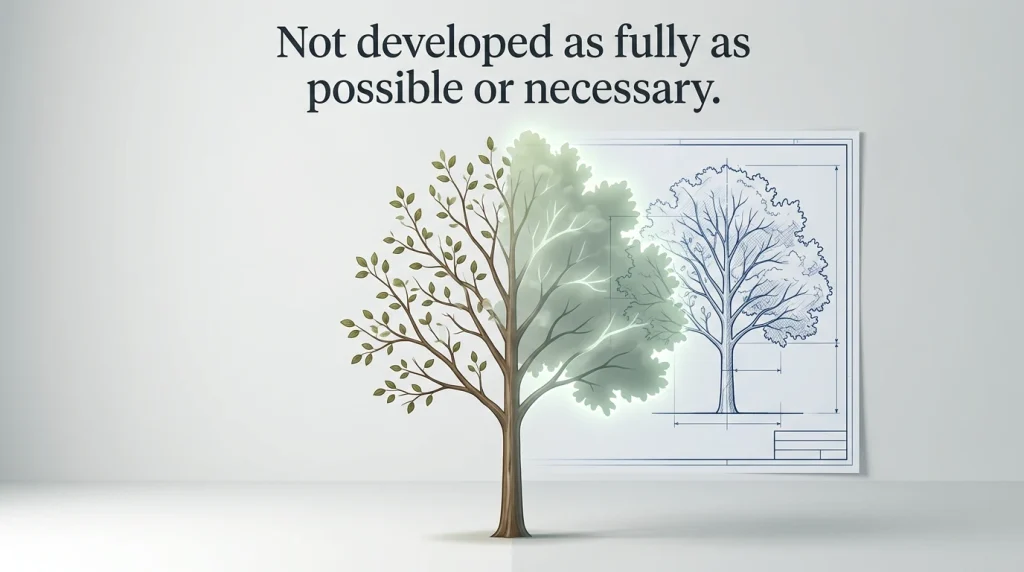
Underdeveloped (Adjective) — US /ˌʌndərdɪˈveləpt/ | UK /ˌʌndədɪˈveləpt/
Meaning: Not developed as fully as possible or necessary.
Tone/Register: Academic, professional.
Example: The report highlights several underdeveloped areas.
His underdeveloped skills need more practice.
Synonyms for “Neglected” by Tone
Positive or Constructive
For constructive writing, choose underused, unexploited, dormant, unrecognized, undervalued, or underappreciated. These words can highlight potential instead of simply criticizing a lack of care.
Neutral
For factual writing, use ignored, overlooked, unattended, unused, unnoticed, unmaintained, unaddressed, or unconsidered. These options describe the situation without excessive emotion.
Negative
When the situation feels serious, choose abandoned, forsaken, unloved, uncared-for, negligent, neglectful, dilapidated, or run-down.
Informal
In casual speech, run-down, left-behind, passed-over, and set-aside can sound natural. Therefore, always consider your audience before selecting a synonym.
“Neglected” vs Close Alternatives
Ignored vs Neglected
Neglected often suggests a continuing lack of care. Ignored focuses more directly on a failure to notice or respond. A garden can become neglected, while a message can be ignored.
Neglected vs Overlooked
Overlooked often suggests an accidental omission. Neglected usually suggests insufficient attention over time. An editor may overlook a typo, while a garden may remain neglected for months.
Neglected vs Abandoned
Abandoned carries a stronger meaning. It suggests complete departure or withdrawal of care. Something can be neglected while its owner remains responsible for it.
How “Neglected” Changes by Context
Daily Conversation
In everyday speech, “neglected” can describe hobbies, homes, gardens, duties, relationships, or personal needs. For example, “I have neglected my hobbies lately” suggests that other priorities received more attention.
Writing and Blogging
Writers can replace repeated uses of “neglected” with precise alternatives. For example, unaddressed works for problems, underused works for resources, and unrecognized works for achievements.
Professional and Academic English
Formal writing often benefits from unaddressed, unresolved, unconsidered, negligent, unrecognized, and unexploited. These terms make the exact problem clearer.
Creative Writing
Creative writers can use forsaken, abandoned, dilapidated, unloved, or run-down to create stronger images. As a result, readers can visualize the situation more easily.
Common Mistakes and Native Usage
One common mistake is assuming every synonym can replace “neglected” in every sentence. Context matters. Dilapidated normally describes physical structures, while unresolved usually describes problems, conflicts, questions, or issues.
Another mistake is using overlooked when the meaning requires prolonged lack of care. “Overlooked” can sound accidental, whereas “neglected” can suggest repeated failure.
Also, avoid using very formal words in casual conversations when a simple alternative sounds more natural. “Ignored” often works better than “disregarded” in ordinary speech.
Register Notes
Everyday: ignored, overlooked, unattended, unused, careless.
Professional: unaddressed, unresolved, undervalued, unrecognized.
Academic: unconsidered, unexploited, unacknowledged.
Literary: forsaken, unheeded, unloved.
Informal: run-down, left-behind, passed-over.
Real-Life Mini Scenarios
Workplace
An unaddressed complaint can create frustration when managers repeatedly postpone action. Similarly, an undervalued employee may lose motivation when their contributions receive little recognition.
Social Situations
Someone may feel ignored when friends repeatedly cancel plans. In a deeper emotional situation, a person may feel unloved when a relationship lacks warmth or support.
Media and Pop Culture
A documentary might introduce an unrecognized artist whose work never received enough attention. Meanwhile, a movie may use a forsaken town to create a mysterious atmosphere.
Writing and Storytelling
A novelist might describe a dilapidated mansion with broken windows and cracked walls. Likewise, an abandoned playground can create an immediate feeling of loneliness.
Quick Word-Choice Guide
For a lack of attention, ignored is usually the most natural choice.
When something was missed, especially accidentally, overlooked works better.
If something has been completely left behind, abandoned gives the clearest meaning.
For poor physical upkeep, unmaintained is a precise option.
A problem that receives no response can be described as unaddressed.
When an issue still lacks a solution, unresolved is the better choice.
For something that lacks necessary care, use uncared-for.
If appreciation is missing, undervalued expresses the idea clearly.
Structures in very poor physical condition are often described as dilapidated.
Finally, underused fits something that has potential but does not receive enough use.
Interactive Practice Quiz
1. Which word best describes a garden that nobody maintains?
A. Unresolved
B. Unmaintained
C. Unrecognized
D. Unresponsive
2. Which word suggests that something was accidentally missed?
A. Abandoned
B. Overlooked
C. Forsaken
D. Dilapidated
3. Which alternative best describes a building in very poor condition?
A. Unvalued
B. Unnoticed
C. Dilapidated
D. Unheeded
4. Which word best describes a problem nobody has dealt with?
A. Unaddressed
B. Unloved
C. Idle
D. Run-down
5. Which word means not appreciated enough?
A. Undervalued
B. Deserted
C. Unattended
D. Dormant
6. Which word suggests that something was completely left behind?
A. Abandoned
B. Unused
C. Unobservant
D. Careless
7. Which word fits formal academic writing best?
A. Run-down
B. Unaddressed
C. Left-behind
D. Thoughtless
8. Which word describes a talent that has not reached its potential?
A. Underused
B. Deserted
C. Unwanted
D. Unheeded
9. Which word suggests a lack of emotional affection?
A. Unloved
B. Unmaintained
C. Unresolved
D. Unconsidered
10. Which word means not listened to or acted upon?
A. Unheeded
B. Underused
C. Unrecognized
D. Idle
11. Which word describes someone who does not pay enough attention?
A. Inattentive
B. Dilapidated
C. Abandoned
D. Unused
12. Which word describes failure to fulfill a responsibility properly?
A. Negligent
B. Dormant
C. Unnoticed
D. Forgotten
Reflection Task: Write one sentence using any synonym for “neglected.” Then explain why your chosen synonym fits the context better.
Answer Key: 1-B, 2-B, 3-C, 4-A, 5-A, 6-A, 7-B, 8-A, 9-A, 10-A, 11-A, 12-A
Conclusion
Learning synonyms for neglected gives you more control over tone and meaning. Instead of repeating one word, you can describe the exact type of missing care.
For example, “overlooked” sounds softer than “abandoned,” while “undervalued” focuses on appreciation rather than physical neglect.
These alternatives can strengthen essays, blog posts, emails, stories, workplace writing, and everyday conversations. Therefore, vocabulary becomes clearer and more expressive.
Keep practicing these words in real sentences. Try them in an email, essay, or daily conversation, and notice how each choice changes the meaning.
FAQs
1. What is the best synonym for neglected in everyday English?
Ignored is one of the most natural alternatives in everyday English, especially when something receives little attention. However, the best choice depends on context. Use overlooked for something missed accidentally, unmaintained for poor upkeep, and abandoned when someone has completely left something behind.
2. What is a formal synonym for neglected?
Useful formal alternatives include unaddressed, unresolved, unconsidered, negligent, unrecognized, and unexploited. The correct choice depends on the subject. For example, “unaddressed concerns” works well in professional writing, while “negligent behavior” fits formal or legal contexts.
3. What is the difference between neglected and overlooked?
Neglected usually suggests insufficient care or attention over time. Overlooked often means someone failed to notice or consider something, sometimes accidentally. A garden may become neglected after months without care, while a small spelling error may simply be overlooked during editing.
4. Which synonym for neglected describes an old damaged building?
Dilapidated is especially useful for a building or structure in very poor physical condition. Run-down also works in informal English. “The dilapidated house had broken windows” sounds more specific than simply saying “The house was neglected.”
5. What is a synonym for neglected when describing feelings?
Ignored, unloved, unvalued, and underappreciated can describe emotional neglect. Choose ignored when someone receives little attention, unloved when affection is missing, and unvalued when a person’s worth or contribution receives too little recognition.
6. Can neglected describe a person?
Yes. “Neglected” can describe someone who does not receive enough physical, emotional, or social care. For example, “The child felt neglected” suggests a serious lack of attention or support. The exact synonym should match the situation because “unloved” adds emotional meaning, while “ignored” focuses on attention.
7. Which synonym for neglected is best for academic writing?
Academic writing often benefits from precise terms such as unaddressed, unresolved, unconsidered, unrecognized, and unexploited. These words identify the exact type of missing attention. For example, “unaddressed research gaps” is more precise than repeatedly using “neglected research gaps.”
8. How does learning synonyms for neglected improve English?
These alternatives help learners match vocabulary to meaning, tone, and context. Instead of repeating “neglected,” you can select “overlooked,” “unmaintained,” “undervalued,” or “abandoned” based on the exact idea. This makes essays, blogs, emails, stories, and conversations more natural and expressive.

Shahzeena Shazadi is the founder and lead writer at VocablyHub.com, where she creates accurate, reader-focused English language content designed to help people communicate with clarity and confidence. She specializes in synonyms, antonyms, word meanings, idioms, and practical vocabulary guides that simplify complex language concepts for everyday use. Every article is carefully researched, fact-checked, and written in clear, accessible language using reliable references and real-world examples. Her goal is to provide helpful, trustworthy content that supports learners at every stage of their English language journey.
Her editorial approach focuses on accuracy, transparency, and user value while following modern content quality standards. She regularly reviews and updates content to keep information relevant, useful, and easy to understand. Through VocablyHub.com, Shahzeena Shazadi is committed to publishing reliable language resources that help students, writers, educators, professionals, and English learners expand their vocabulary, improve their writing skills, and communicate with confidence in academic, professional, and everyday situations.