
Synonyms for textual is the search students type at 11 p.m., halfway through an essay, right after a teacher has written “support this with evidence” in the margin. The word they need is the one that means “from the text itself”: written, text-based, documentary, verbatim. Each of these 50 alternatives points at words on a page, but each points in a slightly different direction, and picking the wrong one can change what your sentence claims.
Here is the problem in one line. “Textual” is not really about writing in general. It describes something that belongs to, comes from, or is based on a specific text. A textual detail is a detail inside the passage. A textual scholar studies the exact wording of old manuscripts. Once you see that narrow job, the synonyms sort themselves out: some name the material (written, print-based), some name the method (analytical, interpretive), and some name the source (documentary, scriptural).
This guide gives you all 50 synonyms for textual with meanings, pronunciations, and fresh examples, then shows you the three confusions that trip up almost every learner: textual vs. written, textual vs. verbal, and textual vs. text-based. By the end you will know which word an examiner, an editor, or a professor actually expects.
What “Textual” Actually Covers, and What It Does Not
At its core, “textual” means relating to a text or to the exact words of a text. If a question asks for textual evidence, it is not asking for your opinion or for a summary from memory. It is asking you to point at lines on the page and say: it is here, in these words.
That focus on exact wording explains the word’s favourite partners. Teachers ask for textual evidence and textual analysis. Lawyers argue about the textual meaning of a clause. Editors compare textual variants when two editions of a book print different lines. In every case, the written words themselves are the subject.
Just as useful is what “textual” does not mean. It does not mean “sent by text message” (that is a modern mix-up worth avoiding in formal work), and it is weaker than “documentary” when real records are involved. If your source is a birth certificate or an archive file, “documentary” says it more precisely.
The Feel of the Word: Precise, Academic, Slightly Formal
“Textual” carries a studious tone. It sounds at home in a seminar room, a courtroom, or a journal article, and slightly overdressed in a casual email. Nobody tells a friend, “Send me a textual summary of the match.” They say “written” or just “text me the details.”
That formality is also its strength. In academic writing, “textual” signals that you are handling evidence carefully, not guessing. The risk is the opposite one: stacking it into every sentence to sound clever. One well-placed “textual” per paragraph is precision. Five in a row is costume.
Woven Words: Where “Textual” Comes From
“Textual” comes from the Latin textus, meaning something woven, from the verb texere, to weave. Roman writers already used the metaphor we still use today: an author weaves words together the way a weaver threads a loom, and the finished cloth is the text. English borrowed the idea through medieval Latin and French, and by the 1400s scholars were using “textual” for anything concerned with the wording of an original, especially scripture.
The family resemblance is still visible. Textile is cloth from the same loom. A texture is how a surface feels, woven or not. Even context is, at root, the weaving around a passage, the words that surround it and hold its meaning in place.
Saying It Right: TEKS-choo-uhl
Textual: US: /ˈtɛks.tʃu.əl/ | UK: /ˈtɛks.tʃu.əl/. Three syllables, with the stress on the first: TEKS-choo-uhl. The one trap is the middle: the “tu” softens into “choo,” so it does not rhyme with a flat “TEKST-yoo-al” read letter by letter.
Close relatives follow the same pattern: textuality (teks-choo-AL-uh-tee) and textually (TEKS-choo-uh-lee). If you can say the base word cleanly, the whole family behaves.
50 Alternatives to “Textual,” Grouped by the Job They Do
The list below keeps the 50 alternatives from the original guide, each with its meaning, tone, and examples. Read them by job, not just alphabetically: words 1 to 10 cover everyday written material, the middle of the list turns technical (lexical, syntactic, philological), and the last stretch is for precision work, where verbatim, literal, and word-for-word live.
The alternatives below cover several related meanings. Some are close synonyms, while others are useful substitutes in specific contexts. Always check whether the sentence refers to written words, language, a document, or the interpretation of a passage.
1. Written (Adjective) — US: /ˈrɪt.ən/ | UK: /ˈrɪt.ən/
Meaning: Expressed or recorded using written words rather than speech.
Tone/Register: Neutral; suitable for everyday, academic, and professional English.
Examples:
Please provide written instructions before the workshop.
The researcher compared the written records from both years.
2. Text-Based (Adjective) — US: /ˈtɛkst beɪst/ | UK: /ˈtɛkst beɪst/
Meaning: Built around, communicated through, or primarily involving text.
Tone/Register: Neutral to technical.
Examples:
The course includes text-based activities for language learners.
We use a text-based interface for this simple application.
3. Word-Based (Adjective) — US: /ˈwɝːd beɪst/ | UK: /ˈwɜːd beɪst/
Meaning: Organized around words rather than images, sound, or other forms of information.
Tone/Register: Neutral to technical.
Examples:
The exercise uses word-based clues to teach vocabulary.
The study compared word-based tasks with visual activities.
4. Linguistic (Adjective) — US: /lɪŋˈɡwɪs.tɪk/ | UK: /lɪŋˈɡwɪs.tɪk/
Meaning: Relating to language, its structure, or its use.
Tone/Register: Academic and professional.
Examples:
The article examines linguistic patterns in online discussions.
Her linguistic analysis explains why the phrase sounds unnatural.
5. Literary (Adjective) — US: /ˈlɪt̬.ə.rer.i/ | UK: /ˈlɪt.ər.ər.i/
Meaning: Relating to literature, written works, or the artistic use of language.
Tone/Register: Academic, creative, or formal.
Examples:
The professor discussed the novel’s literary themes.
His literary style combines humor with detailed descriptions.
6. Verbal (Adjective) — US: /ˈvɝː.bəl/ | UK: /ˈvɜː.bəl/
Meaning: Relating to words or language, whether spoken or expressed in words.
Tone/Register: Neutral to formal.
Examples:
The instructions were verbal rather than written.
The agreement contains both verbal explanations and supporting documents.
Usage note: In many contexts, verbal means spoken. It is not always a direct substitute for textual.
7. Documentary (Adjective) — US: /ˌdɑː.kjəˈmen.t̬ɚ.i/ | UK: /ˌdɒk.jəˈmen.tər.i/
Meaning: Relating to documents, records, or materials that provide evidence.
Tone/Register: Formal, legal, historical, or academic.
Examples:
The historian gathered documentary evidence from local archives.
The investigation relied on documentary records rather than personal recollections.
8. Document-Based (Adjective) — US: /ˈdɑː.kjə.mənt beɪst/ | UK: /ˈdɒk.jə.mənt beɪst/
Meaning: Developed from or dependent on written documents.
Tone/Register: Academic and professional.
Examples:
The students completed a document-based history assignment.
Our review used document-based evidence to verify the timeline.
9. Scriptural (Adjective) — US: /ˈskrɪp.tʃɚ.əl/ | UK: /ˈskrɪp.tʃər.əl/
Meaning: Relating to sacred writings or their wording and interpretation.
Tone/Register: Religious and academic.
Examples:
The scholar examined scriptural references in the commentary.
The discussion focused on scriptural interpretation across different editions.
10. Literary-Textual (Adjective) — US: /ˈlɪt̬.ə.rer.i ˈtɛks.tʃu.əl/ | UK: /ˈlɪt.ər.ər.i ˈtɛks.tʃu.əl/
Meaning: Relating to both the literary qualities and the wording of a written work.
Tone/Register: Specialized academic.
Examples:
The study combines literary-textual analysis with historical research.
Her thesis explores literary-textual changes across several editions.
11. Lexical (Adjective) — US: /ˈlek.sɪ.kəl/ | UK: /ˈlek.sɪ.kəl/
Meaning: Relating to words, vocabulary, or the words used in a language.
Tone/Register: Linguistic and academic.
Examples:
The editor identified several lexical differences between the translations.
The lesson explores lexical choices in professional emails.
12. Semantic (Adjective) — US: /sɪˈmæn.tɪk/ | UK: /sɪˈmæn.tɪk/
Meaning: Relating to the meaning of words, phrases, or sentences.
Tone/Register: Academic and technical.
Examples:
The researchers found a semantic difference between the two statements.
A small semantic change can alter the meaning of a contract clause.
13. Syntactic (Adjective) — US: /sɪnˈtæk.tɪk/ | UK: /sɪnˈtæk.tɪk/
Meaning: Relating to the arrangement of words and phrases in sentences.
Tone/Register: Academic and linguistic.
Examples:
The editor corrected several syntactic errors in the essay.
The study examines syntactic patterns in student writing.
14. Grammatical (Adjective) — US: /ɡrəˈmæt̬.ɪ.kəl/ | UK: /ɡrəˈmæt.ɪ.kəl/
Meaning: Relating to grammar or the rules governing sentence structure.
Tone/Register: Neutral to academic.
Examples:
The teacher highlighted grammatical problems in the paragraph.
A grammatical change made the sentence easier to understand.
15. Written-Word (Adjective) — US: /ˌrɪt.ən ˈwɝːd/ | UK: /ˌrɪt.ən ˈwɜːd/
Meaning: Relating specifically to words expressed in writing.
Tone/Register: Neutral to formal.
Examples:
The museum preserves the written-word traditions of the region.
The project studies how the written word shapes public opinion.
16. Print-Based (Adjective) — US: /ˈprɪnt beɪst/ | UK: /ˈprɪnt beɪst/
Meaning: Centered on printed text or physical printed materials.
Tone/Register: Educational and professional.
Examples:
The library still offers print-based reference materials.
The course combines print-based exercises with online reading.
17. Manuscript-Based (Adjective) — US: /ˈmæn.jə.skrɪpt beɪst/ | UK: /ˈmæn.jə.skrɪpt beɪst/
Meaning: Based on the wording or evidence found in manuscripts.
Tone/Register: Scholarly and historical.
Examples:
The researcher used manuscript-based evidence to date the poem.
The exhibition includes manuscript-based studies of early translations.
18. Source-Based (Adjective) — US: /ˈsɔːrs beɪst/ | UK: /ˈsɔːs beɪst/
Meaning: Grounded in a particular source or set of sources.
Tone/Register: Academic and professional.
Examples:
Students wrote source-based responses to the historical documents.
The report includes source-based claims and supporting references.
19. Record-Based (Adjective) — US: /ˈrek.ɚd beɪst/ | UK: /ˈrek.ɔːd beɪst/
Meaning: Derived from information contained in records.
Tone/Register: Administrative and professional.
Examples:
The review used record-based evidence to establish the dates.
Our record-based summary avoids unsupported assumptions.
20. Page-Based (Adjective) — US: /ˈpeɪdʒ beɪst/ | UK: /ˈpeɪdʒ beɪst/
Meaning: Organized around pages or information presented on pages.
Tone/Register: Technical and educational.
Examples:
The textbook uses page-based exercises to build reading skills.
The archive provides page-based references for each historical entry.
21. Phrase-Based (Adjective) — US: /ˈfreɪz beɪst/ | UK: /ˈfreɪz beɪst/
Meaning: Organized around phrases or groups of words rather than individual words.
Tone/Register: Linguistic and educational.
Examples:
The lesson uses phrase-based examples to teach natural English.
The analysis focuses on phrase-based patterns in online reviews.
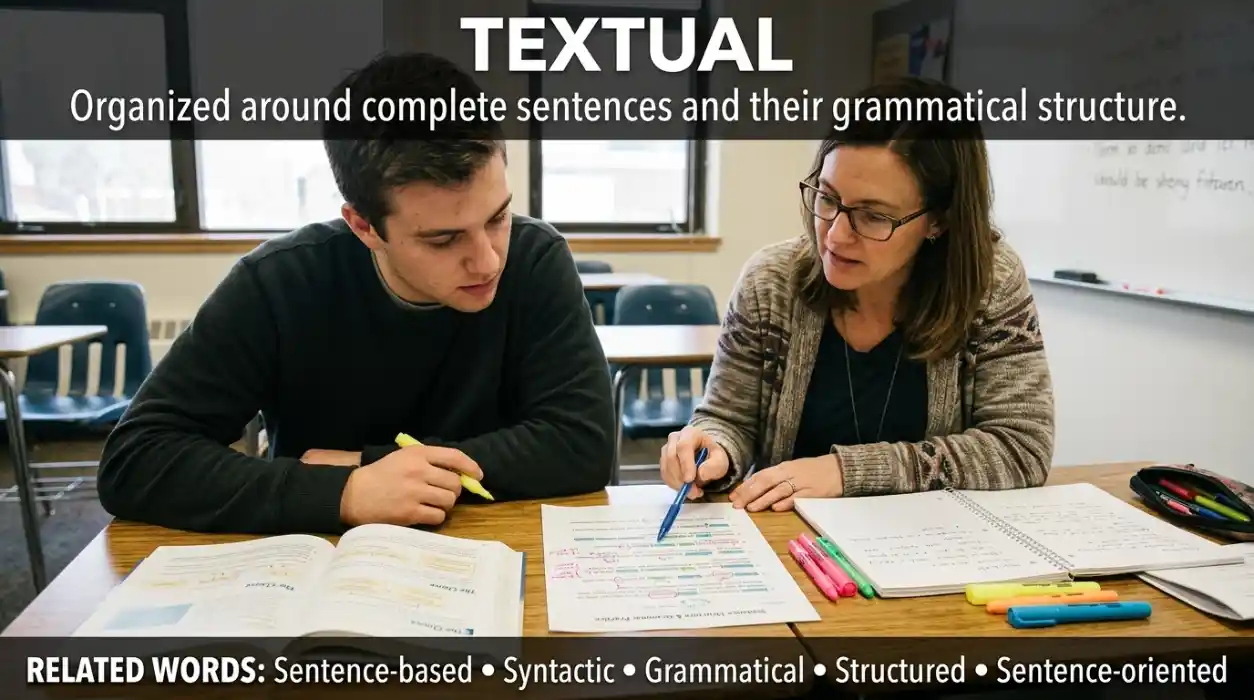
22. Sentence-Based (Adjective) — US: /ˈsen.təns beɪst/ | UK: /ˈsen.təns beɪst/
Meaning: Organized around complete sentences or their structure.
Tone/Register: Educational and technical.
Examples:
The app offers sentence-based practice for beginners.
The researcher used sentence-based comparisons to identify changes.
23. Prose-Based (Adjective) — US: /ˈproʊz beɪst/ | UK: /ˈprəʊz beɪst/
Meaning: Centered on prose, the ordinary written form of language rather than poetry.
Tone/Register: Literary and academic.
Examples:
The course includes prose-based exercises in interpretation.
Her research compares prose-based narratives from different periods.
24. Narrative (Adjective) — US: /ˈner.ə.t̬ɪv/ | UK: /ˈnær.ə.tɪv/
Meaning: Relating to the telling of a story or the sequence of events in a text.
Tone/Register: Literary and academic.
Examples:
The researcher examined narrative structure in the novel.
The article uses a narrative approach to explain the historical events.
25. Descriptive (Adjective) — US: /dɪˈskrɪp.tɪv/ | UK: /dɪˈskrɪp.tɪv/
Meaning: Providing details about a person, place, object, or experience.
Tone/Register: Neutral and academic.
Examples:
The report contains descriptive passages about the coastal landscape.
The writer used descriptive language to make the setting vivid.
26. Expository (Adjective) — US: /ɪkˈspɑː.zə.tɔːr.i/ | UK: /ɪkˈspɒz.ɪ.tər.i/
Meaning: Intended to explain information or clarify a subject.
Tone/Register: Academic and formal.
Examples:
The essay uses an expository style to explain climate patterns.
Students practiced expository writing before their final assignment.
27. Interpretive (Adjective) — US: /ɪnˈtɝː.prə.t̬ɪv/ | UK: /ɪnˈtɜː.prɪ.tɪv/
Meaning: Involving an explanation of meaning, especially in a text or work of art.
Tone/Register: Academic and analytical.
Examples:
The seminar encouraged interpretive reading of the poem.
Her interpretive comments offered a fresh perspective on the passage.
28. Analytical (Adjective) — US: /ˌæn.əˈlɪt̬.ɪ.kəl/ | UK: /ˌæn.əˈlɪt.ɪ.kəl/
Meaning: Involving careful examination of details, structure, or evidence.
Tone/Register: Academic and professional.
Examples:
The students prepared an analytical response to the article.
His analytical approach revealed inconsistencies in the document.
29. Editorial (Adjective) — US: /ˌed.əˈtɔːr.i.əl/ | UK: /ˌed.ɪˈtɔː.ri.əl/
Meaning: Relating to the preparation, revision, or evaluation of written material for publication.
Tone/Register: Publishing and professional.
Examples:
The manuscript underwent a detailed editorial review.
Her editorial notes clarified several confusing sentences.
30. Literary-Critical (Adjective) — US: /ˈlɪt̬.ə.rer.i ˈkrɪt̬.ɪ.kəl/ | UK: /ˈlɪt.ər.ər.i ˈkrɪt.ɪ.kəl/
Meaning: Relating to the analysis and evaluation of literature.
Tone/Register: Scholarly and academic.
Examples:
The paper adopts a literary-critical perspective on the novel.
His literary-critical essay examines symbolism and narrative voice.
31. Philological (Adjective) — US: /ˌfɪl.əˈlɑː.dʒɪ.kəl/ | UK: /ˌfɪl.əˈlɒdʒ.ɪ.kəl/
Meaning: Relating to the historical study of language and written texts.
Tone/Register: Specialized academic.
Examples:
The scholar applied philological methods to the medieval manuscript.
A philological study can reveal how a word changed over time.
32. Paleographic (Adjective) — US: /ˌpeɪ.li.əˈɡræf.ɪk/ | UK: /ˌpeɪ.li.əˈɡræf.ɪk/
Meaning: Relating to the study and interpretation of ancient or historical handwriting.
Tone/Register: Specialized historical and academic.
Examples:
The team used paleographic analysis to examine the handwritten notes.
Paleographic evidence helped identify the manuscript’s likely period.
33. Orthographic (Adjective) — US: /ˌɔːr.θəˈɡræf.ɪk/ | UK: /ˌɔː.θəˈɡræf.ɪk/
Meaning: Relating to the conventional spelling and written representation of a language.
Tone/Register: Linguistic and academic.
Examples:
The editor identified orthographic differences between the editions.
The lesson explains orthographic conventions in British English.
34. Typographic (Adjective) — US: /ˌtaɪ.pəˈɡræf.ɪk/ | UK: /ˌtaɪ.pəˈɡræf.ɪk/
Meaning: Relating to the appearance, arrangement, or style of printed letters and text.
Tone/Register: Publishing and design.
Examples:
The designer corrected typographic inconsistencies in the brochure.
Typographic choices can affect how easily readers follow a page.
35. Verbatim (Adjective or Adverb) — US: /vɚˈbeɪ.tɪm/ | UK: /vɜːˈbeɪ.tɪm/
Meaning: Using exactly the original words without changing the wording.
Tone/Register: Formal and academic.
Examples:
The student included a verbatim quotation from the original letter.
Please reproduce the instruction verbatim in the transcript.
36. Literal (Adjective) — US: /ˈlɪt̬.ɚ.əl/ | UK: /ˈlɪt.ər.əl/
Meaning: Following the exact or basic meaning of words rather than a figurative interpretation.
Tone/Register: Neutral to academic.
Examples:
The translator provided a literal rendering of the sentence.
A literal reading may miss the humor in the passage.
37. Exact (Adjective) — US: /ɪɡˈzækt/ | UK: /ɪɡˈzækt/
Meaning: Completely accurate or matching the original without meaningful differences.
Tone/Register: Neutral and professional.
Examples:
The editor checked the exact wording of the quotation.
We need the exact sentence from the original document.
38. Word-for-Word (Adjective or Adverb) — US: /ˌwɝːd fər ˈwɝːd/ | UK: /ˌwɜːd fə ˈwɜːd/
Meaning: Following or reproducing each word in the same order as the original.
Tone/Register: Neutral to technical.
Examples:
The interpreter avoided a word-for-word translation where it sounded unnatural.
The two passages were compared word-for-word.
39. Documentary-Textual (Adjective) — US: /ˌdɑː.kjəˈmen.tɚ.i ˈtɛks.tʃu.əl/ | UK: /ˌdɒk.jəˈmen.tər.i ˈtɛks.tʃu.əl/
Meaning: Relating to both documentary evidence and the wording found in documents.
Tone/Register: Specialized academic.
Examples:
The research combines documentary-textual evidence from several archives.
A documentary-textual comparison helped clarify the disputed wording.
40. Corpus-Based (Adjective) — US: /ˈkɔːr.pəs beɪst/ | UK: /ˈkɔː.pəs beɪst/
Meaning: Based on a large, organized collection of real language examples.
Tone/Register: Linguistic and research-focused.
Examples:
The team conducted a corpus-based study of common English phrases.
Corpus-based evidence showed how the expression changed across decades.
41. Textual-Linguistic (Adjective) — US: /ˈtɛks.tʃu.əl lɪŋˈɡwɪs.tɪk/ | UK: /ˈtɛks.tʃu.əl lɪŋˈɡwɪs.tɪk/
Meaning: Relating to language patterns and linguistic features within a text.
Tone/Register: Specialized academic.
Examples:
The thesis examines textual-linguistic features of political speeches.
Her textual-linguistic analysis focuses on cohesion and sentence flow.
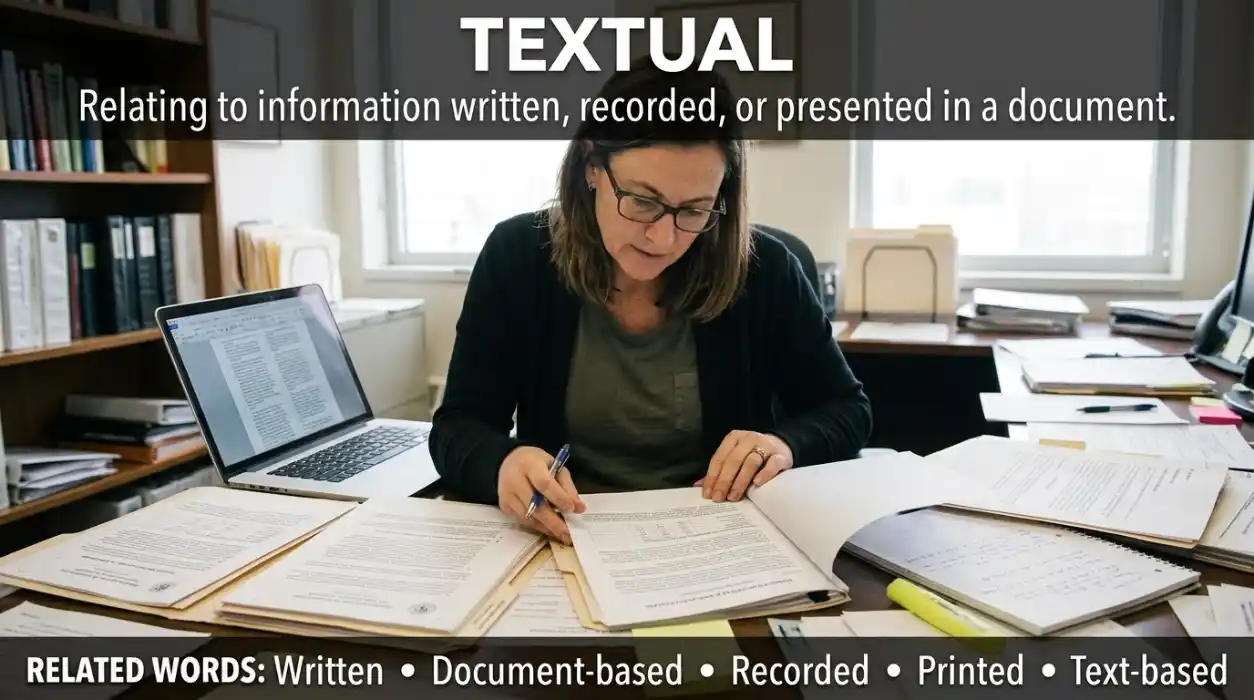
42. Written-Document (Adjective) — US: /ˈrɪt.ən ˈdɑː.kjə.mənt/ | UK: /ˈrɪt.ən ˈdɒk.jə.mənt/
Meaning: Relating to information recorded in a written document.
Tone/Register: Professional and administrative.
Examples:
The committee requested written-document evidence for the claim.
The archive preserves written-document records from the early twentieth century.
43. Textual-Evidence-Based (Adjective) — US: /ˈtɛks.tʃu.əl ˈev.ə.dəns beɪst/ | UK: /ˈtɛks.tʃu.əl ˈev.ɪ.dəns beɪst/
Meaning: Grounded in specific wording or details found in a text.
Tone/Register: Academic.
Examples:
Students must provide textual-evidence-based arguments in their essays.
The interpretation remains textual-evidence-based rather than speculative.
44. Text-Oriented (Adjective) — US: /ˈtɛkst ˌɔːr.iˈen.tɪd/ | UK: /ˈtɛkst ˌɔː.riˈen.tɪd/
Meaning: Focused mainly on text or written information.
Tone/Register: Neutral to technical.
Examples:
The course takes a text-oriented approach to language learning.
Our text-oriented review examines wording before visual design.
45. Text-Centered (Adjective) — US: /ˈtɛkst ˌsen.tɚd/ | UK: /ˈtɛkst ˌsen.təd/
Meaning: Giving primary attention to the text itself rather than outside assumptions or context.
Tone/Register: Academic and analytical.
Examples:
The professor encouraged a text-centered reading of the poem.
Their text-centered approach examined repeated words and images.
46. Textualist (Adjective or Noun) — US: /ˈtɛks.tʃu.ə.lɪst/ | UK: /ˈtɛks.tʃu.ə.lɪst/
Meaning: Relating to textualism, an approach that emphasizes the actual wording of a legal or other authoritative text.
Tone/Register: Legal and specialized.
Examples:
The judge adopted a textualist approach to interpreting the statute.
The article compares textualist and purposive methods of legal interpretation.
47. Epigraphic (Adjective) — US: /ˌep.ɪˈɡræf.ɪk/ | UK: /ˌep.ɪˈɡræf.ɪk/
Meaning: Relating to inscriptions written on durable materials such as stone, metal, or monuments.
Tone/Register: Specialized historical and academic.
Examples:
The researcher examined epigraphic evidence on the ancient monument.
Epigraphic analysis helped scholars interpret the inscription.
48. Inscriptional (Adjective) — US: /ɪnˈskrɪp.ʃən.əl/ | UK: /ɪnˈskrɪp.ʃən.əl/
Meaning: Relating to words or messages engraved, carved, or written as inscriptions.
Tone/Register: Historical and scholarly.
Examples:
The team documented inscriptional differences across the artifacts.
Inscriptional evidence revealed the names of earlier rulers.
49. Orthographic-Textual (Adjective) — US: /ˌɔːr.θəˈɡræf.ɪk ˈtɛks.tʃu.əl/ | UK: /ˌɔː.θəˈɡræf.ɪk ˈtɛks.tʃu.əl/
Meaning: Relating to both spelling conventions and the written form of a text.
Tone/Register: Specialized linguistic and editorial.
Examples:
The editor cataloged orthographic-textual variations across the editions.
The study distinguishes spelling changes from broader textual revisions.
50. Textual-Analytical (Adjective) — US: /ˈtɛks.tʃu.əl ˌæn.əˈlɪt̬.ɪ.kəl/ | UK: /ˈtɛks.tʃu.əl ˌæn.əˈlɪt.ɪ.kəl/
Meaning: Relating to close examination of a text’s wording, structure, or meaning.
Tone/Register: Academic and analytical.
Examples:
The assignment requires a textual-analytical response to the short story.
Her textual-analytical method identifies recurring themes and language choices.
Sorting the 50 by Tone: Precise, Neutral, Critical, Technical
The same list, resorted the way a careful writer thinks about it. If you are writing for a teacher, stay in the precise and neutral rows. The critical row is for reviews and analysis. The technical row earns its place only when your reader shares the vocabulary.
The right alternative depends on your audience and the aspect of the text you want to emphasize.
Positive or Precise
These words can convey accuracy, careful interpretation, or a clear focus on language.
- Exact: emphasizes accuracy.
- Verbatim: highlights unchanged wording.
- Analytical: suggests systematic examination.
- Text-centered: emphasizes close attention to the text.
- Textual-evidence-based: signals that claims rely on evidence from a passage.
Example: “The conclusion is based on exact wording from the original report.”
Neutral
These alternatives describe written material without adding strong emotional meaning.
- Written
- Text-based
- Document-based
- Lexical
- Grammatical
- Descriptive
- Documentary
Example: “The course includes written exercises and document-based activities.”
Negative or Critical
These words are not inherently negative. However, they can appear when a writer identifies problems, limitations, or overly narrow interpretations.
- Literal: can imply an interpretation that misses figurative meaning.
- Verbatim: may describe a quotation copied without sufficient explanation.
- Text-centered: can be criticized when broader historical context is ignored.
- Textualist: may be used in debates about the limits of text-focused interpretation.
Example: “A purely literal reading may overlook the author’s irony.”
Technical or Academic
These terms are best suited to specialized subjects.
- Philological
- Paleographic
- Orthographic
- Semantic
- Syntactic
- Corpus-based
- Epigraphic
Example: “The researchers used paleographic evidence to examine the manuscript.”
Why Tone Matters
Tone affects how accessible your writing feels. A student essay may benefit from written or word-based, while a linguistics paper may require lexical or syntactic.
Choose the simplest accurate word for your audience. Specialized vocabulary is useful when it adds precision, not when it merely makes a sentence sound complicated.
“Textual” vs. “Written” vs. “Verbal”: The Three-Way Mix-Up
Textual vs. written. “Written” is the wide word: any words put down anywhere, from a shopping list to a constitution. “Textual” is the narrow one: it points into a particular text and its exact wording. “She gave written feedback” is normal. “She gave textual feedback” sounds as if she annotated the wording line by line, which may even be true in an editing class, but it is a different claim.
Textual vs. verbal. This is the trap with real consequences. In careful English, “verbal” means spoken, or relating to words in general, not specifically written. A “verbal agreement” in everyday speech usually means an oral one, the opposite of what many learners intend. When a contract matters, write “written agreement” and leave “verbal” out of it.
Textual vs. text-based. “Text-based” describes the medium something runs on: a text-based game, a text-based course, a text-based interface. “Textual” describes a relationship to a text’s content. Swapping them produces sentences like “a textual interface,” which readers will understand but quietly mark as off.
Where You Will Meet “Textual”: Essays, Exams, Editing, and Code
In the Classroom
School is where most people first meet the word, usually inside the instruction “use textual evidence.” Exam rubrics reward it directly: a claim about a character, backed by a quoted line, earns marks that a general impression does not. Students who learn to hunt for the exact sentence before writing the paragraph find their grades move first.
In Essays and Blogging
Writers use “textual” when they discuss how a piece of writing is built: its structure, its word choices, its gaps. A book review that compares the novel with its film version is doing textual comparison whether it uses the term or not. Put otherwise, and the same review is just opinion. The word marks the difference between reacting to a story and examining it.
At Work and in Professional Writing
Outside the classroom, “textual” appears in editing, law, and research. Editors flag “textual inconsistencies” when a report calls the same figure by two numbers. Legal teams argue “textual interpretation” when a contract’s plain wording is the whole dispute. Researchers write “textual data” when their material is documents rather than interviews. In each office, the word is doing the same job: pointing at the words as evidence.
In Casual and Creative Use
In everyday speech the word mostly stays home. Creative writers, though, borrow it for play: a “textual relationship” in a novel might be one conducted entirely through letters. Know the serious meaning first, and the playful uses will read as wit instead of error.
Mistakes That Give Learners Away
1. Reaching for “textual” when “written” is the honest word
If no specific passage is being examined, “textual” is decoration. “Please send a textual report” asks for something nobody can picture. “Please send a written report” asks for exactly what you want.
2. Trusting “verbal” to mean “written”
Covered above because it deserves repeating: in contracts, instructions, and exams, “verbal” will be read as spoken by careful readers. It is the single most expensive confusion in this word family.
3. Using the technical row on a general reader
Philological, paleographic, and epigraphic are real words with real jobs, all of them inside specialist scholarship. Dropped into a school essay or a business email, they do not make the writing look advanced. They make it look borrowed.
4. Forgetting that “textual” needs a text
The word points at a source. Sentences like “the textual weather” collapse because there is no text for the adjective to hold onto. Before using it, ask: which text? If you cannot name one, choose another synonym.
5. Mixing British and American spellings inside one document
Small, but markers and editors notice: analyse with a z in a British essay, or “organised” in an American report. Pick the variety your reader uses and keep the whole document in it.
How Formal Is “Textual,” Really?
Place it on the shelf between “written” (everyday) and “philological” (specialist). “Textual” is formal but not rare: comfortable in a university essay, a quality newspaper, or a policy paper, and unnecessary in a text message. Its closest everyday partners, “text-based” and “written,” cover casual ground so completely that reaching for “textual” in speech will usually sound like a quotation.
“Textual” at Work: Four Real Moments
The Essay Feedback
“Your argument is interesting, but where is the textual evidence?” the teacher writes. The student goes back to chapter four, finds the two lines where the character hesitates, and quotes them. The next draft does not just sound better. It proves its point.
The Editor’s Desk
A magazine editor circles a date in a feature draft: the article says the festival began in 1998, the photo caption says 1989. Her note in the margin is one line long. “Textual inconsistency, please check the source.”
The Contract Dispute
Two partners disagree about what their agreement allows. Their lawyer does not ask what either of them intended at the signing dinner. She opens the document and reads the clause aloud, because the case will turn on textual interpretation: what the words on the page actually say.
The Study Group
Before the literature exam, three friends split the work. One lists themes, one lists characters, and one collects quotations, the textual evidence bank they all draw from. It is the quotations that save them in the essay questions.
Practice Quiz:
1. You need instructions that someone can read later. Which word fits best?
A. Written
B. Spoken
C. Musical
D. Visual
2. A researcher studies the meaning of vocabulary choices in a passage. Which term is most precise?
A. Lexical
B. Paleographic
C. Documentary
D. Typographic
3. A student copies a sentence exactly from a book. Which word describes the quotation?
A. Narrative
B. Verbatim
C. Descriptive
D. Semantic
4. A linguist examines the order of words in sentences. Which term applies?
A. Syntactic
B. Editorial
C. Epigraphic
D. Documentary
5. An editor checks spelling conventions in two editions. Which term fits best?
A. Orthographic
B. Narrative
C. Literary
D. Expository
6. A historian studies handwriting in a centuries-old manuscript. Which field is most relevant?
A. Paleographic
B. Semantic
C. Text-based
D. Descriptive
7. A report explains a topic clearly and factually. Which writing style is most suitable?
A. Expository
B. Inscriptional
C. Verbatim
D. Scriptural
8. A student examines how a poem tells its story. Which word is most relevant?
A. Narrative
B. Orthographic
C. Record-based
D. Typographic
9. A study uses a large collection of real language examples. Which term describes its method?
A. Corpus-based
B. Print-based
C. Page-based
D. Documentary
10. A publisher checks spacing, fonts, and the appearance of letters. Which term applies?
A. Typographic
B. Semantic
C. Scriptural
D. Verbal
Reflection Task
Write two sentences about a book, article, or document you recently read. Use textual in one sentence and a suitable alternative in the other. Explain how the meaning changes.
Answer key: 1-A, 2-A, 3-B, 4-A, 5-A, 6-A, 7-A, 8-A, 9-A, 10-A
The Short Version
“Textual” means: it is in the words, go and look. Keep “written” for everyday material, “documentary” for records, “verbatim” and “word-for-word” when exact copying is the point, and save the technical family for readers who work with texts for a living. Choose by the job, and the synonym will never embarrass you.
FAQs
1. What is the best synonym for “textual” in academic writing?
The best alternative depends on the subject. Written works for material recorded in words. Linguistic is appropriate when discussing language structure or use. Lexical focuses on vocabulary, while semantic concerns meaning. If you are examining a passage closely, text-based or text-centered may work, but neither replaces textual in every established academic phrase.
2. What is another way to say “textual evidence” in an essay?
You can use evidence from the text, written evidence, or passage-based evidence, depending on the assignment. “Evidence from the text” is particularly clear for general readers and school essays. In literary analysis, the phrase textual evidence remains widely understood and precise. Whichever phrase you choose, support your interpretation with specific words, quotations, or details from the source.
3. Is “textual” the same as “written”?
Not exactly. Written means expressed or recorded in writing. Textual usually means relating to a text, its wording, or its interpretation. For example, written instructions are directions presented in writing, while textual analysis examines the language and structure of a passage. The words overlap, but textual often carries a more analytical or academic meaning.
4. What is the difference between textual and linguistic analysis?
Textual analysis examines a particular text, including its wording, structure, themes, and possible meanings. Linguistic analysis examines language features such as grammar, vocabulary, pronunciation, or sentence patterns. The two methods can overlap. For example, a researcher may use linguistic analysis to investigate sentence structure within a novel, while textual analysis considers how those sentences contribute to the work’s meaning.
5. Can I use “text-based” instead of “textual” in SEO writing?
Sometimes. Text-based is useful when describing content, activities, interfaces, or learning methods built around text. Textual is more suitable for established expressions such as textual analysis, textual evidence, and textual variation. In SEO writing, choose the phrase that accurately matches the reader’s intent. Avoid replacing a precise term merely to increase keyword variation.

Shahzeena Shazadi is the founder and lead writer at VocablyHub.com, where she creates accurate, reader-focused English language content designed to help people communicate with clarity and confidence. She specializes in synonyms, antonyms, word meanings, idioms, and practical vocabulary guides that simplify complex language concepts for everyday use. Every article is carefully researched, fact-checked, and written in clear, accessible language using reliable references and real-world examples. Her goal is to provide helpful, trustworthy content that supports learners at every stage of their English language journey.
Her editorial approach focuses on accuracy, transparency, and user value while following modern content quality standards. She regularly reviews and updates content to keep information relevant, useful, and easy to understand. Through VocablyHub.com, Shahzeena Shazadi is committed to publishing reliable language resources that help students, writers, educators, professionals, and English learners expand their vocabulary, improve their writing skills, and communicate with confidence in academic, professional, and everyday situations.