
Synonyms for tapestry include woven artwork, wall hanging, fabric, textile, weave, mosaic, patchwork, and rich blend. The best alternative depends on whether you mean decorative woven material or a complex combination of people, events, ideas, and experiences.
Have you ever described a community as a beautiful mix of cultures? The word tapestry captures that richness. The right synonym can make your description even clearer.
Imagine writing about a city filled with different languages, traditions, and stories. Calling it a mosaic or a rich blend can freshly express its diversity.
Synonyms for tapestry help students, bloggers, and content writers avoid repetition. They also help everyday English users describe art, culture, history, and relationships more precisely.
Learning these alternatives makes your vocabulary more flexible. You can choose words that suit a formal essay, a personal story, or a friendly conversation without losing your intended meaning.
What Does “Tapestry” Really Mean?
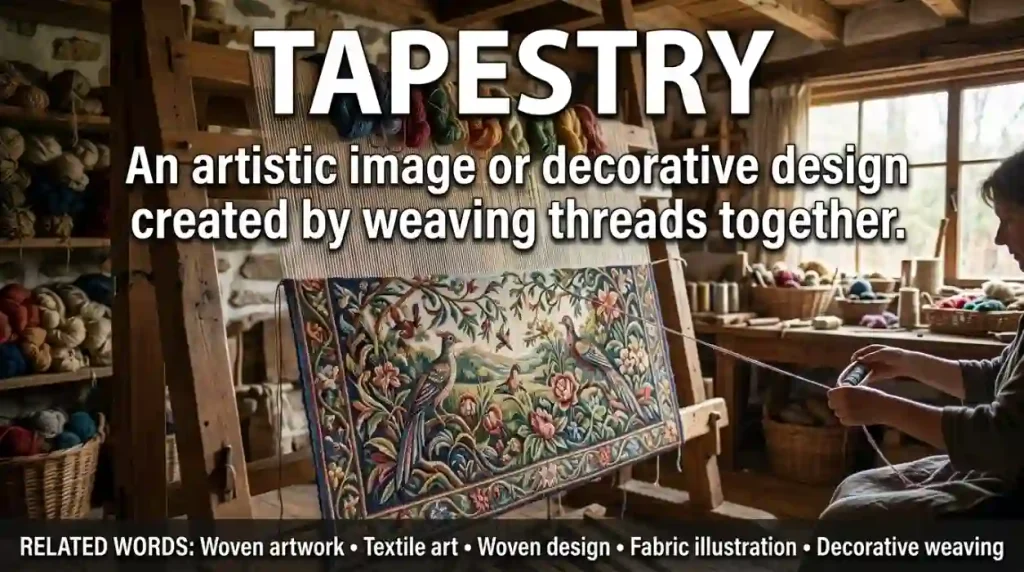
Tapestry is a noun with two main meanings. It refers to a thick decorative textile made by weaving colored threads into a picture or design. It also describes a complex combination of different elements that form an interesting whole.
In its literal sense, a tapestry may hang on a wall or decorate a historic building. Traditional tapestries often depict landscapes, historical events, religious scenes, or symbolic patterns.
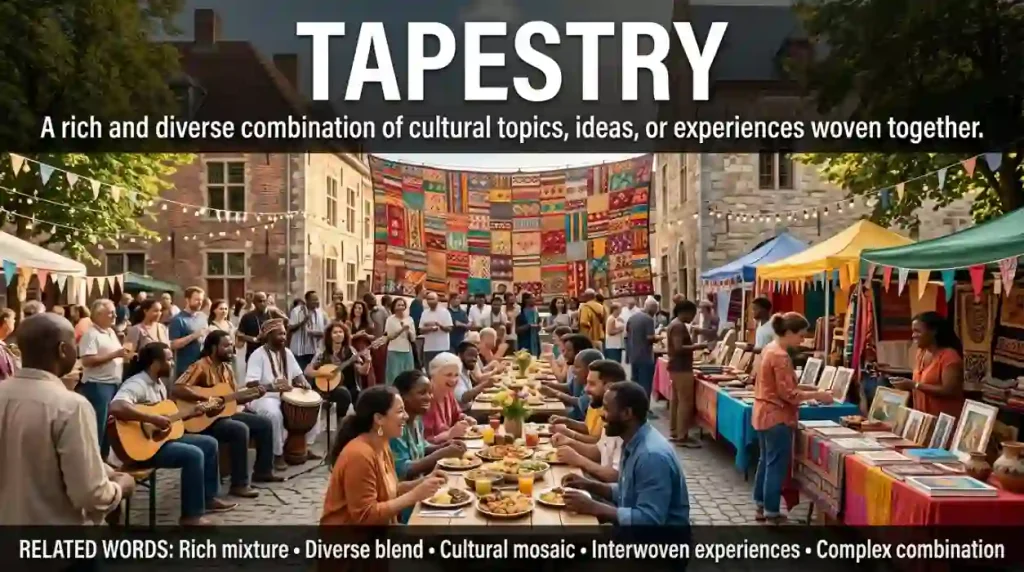
In its figurative sense, the word describes something made rich by variety. A tapestry of cultures, for example, suggests that different traditions contribute to the character of a community.
Native English speakers often use tapestry in art, history, literature, journalism, and reflective writing. It can make a description sound vivid, thoughtful, and expressive.
Part of Speech
- Noun: A woven decorative textile or a complex combination of different elements.
- Plural: Tapestries.
Example: The museum displayed a medieval tapestry.
Figurative example: The novel explores a tapestry of family memories and personal struggles.
Connotative Meaning
(Connotation is the emotional or cultural association a word carries beyond its basic dictionary meaning.)
- Positive tone: Suggests beauty, richness, harmony, diversity, and creativity.
- Negative tone: Can suggest tangled complexity or overwhelming variety when the surrounding context is critical.
- Neutral tone: Simply identifies a woven textile or describes a collection of connected elements.
The word usually has positive or neutral associations. Its emotional effect depends on the words around it.
Etymology
The English word tapestry entered the language through Old French tapisserie, meaning decorative textile work or the making of carpets and wall hangings. The word is related to tapis, meaning a carpet or covering, which ultimately traces back to Greek tápēs, meaning a carpet.
Historical Development
Old English (450–1100)
Tapestry was not an established Old English word in its modern form. Decorative woven textiles existed, but English speakers used other vocabulary to describe cloth, weaving, and embroidered decoration.
Middle English (1100–1500)
After the Norman Conquest, French vocabulary strongly influenced English. Words associated with luxury goods, textiles, and decorative arts became more common. Forms related to tapestry developed through French influence.
Modern English (1500–present)
Tapestry became established as a term for decorative woven fabric. Over time, writers increasingly used it metaphorically to describe complex combinations of events, traditions, identities, and experiences.
Today, the word appears in discussions of art and textiles as well as in literature, education, journalism, and everyday descriptive writing.
Pronunciation
- US: /ˈtæpəstri/
- UK: /ˈtæpɪstri/
Pronunciation can vary slightly by accent.
Syllables
Tap-es-try — three syllables.
Affixation Pattern of Tapestry
- Root: Tapestry is a borrowed word whose historical development comes through French.
- Prefix: None in the modern English word.
- Suffix: No productive English suffix is added to form the modern noun.
- Related form: Tapestries is the plural form.
Synonyms List
1. Woven Artwork (Noun Phrase) — US / UK: /ˈwoʊvən ˈɑːrtwɝːk/ /ˈwəʊvən ˈɑːtwɜːk/
Meaning: An artistic image or design created by weaving threads together.
Tone/Register: Neutral, artistic.
Examples: The gallery displayed a woven artwork showing village life.
Visitors admired the fine details in every thread.
2. Wall Hanging (Noun) — US / UK: /ˈwɔːl ˌhæŋɪŋ/ /ˈwɔːl ˌhæŋɪŋ/
Meaning: A decorative textile or other artwork designed to hang on a wall.
Tone/Register: Neutral, everyday.
Examples: My grandmother gave me a colorful wall hanging.
It brightens the room above the sofa.
3. Textile (Noun) — US / UK: /ˈtɛkstaɪl/ /ˈtɛkstaɪl/
Meaning: A material made from natural or synthetic fibers, including woven decorative fabrics.
Tone/Register: Formal, technical.
Examples: The museum preserves rare historical textiles.
Researchers examined the fibers to identify their age.
4. Fabric (Noun) — US / UK: /ˈfæbrɪk/ /ˈfæbrɪk/
Meaning: Cloth produced by weaving, knitting, or other methods.
Tone/Register: Neutral, everyday.
Examples: This fabric features a detailed floral pattern.
The designer chose it for a decorative panel.
5. Weave (Noun) — US / UK: /wiːv/ /wiːv/
Meaning: A structure or pattern formed by interlacing threads.
Tone/Register: Neutral, technical or artistic.
Examples: The weave creates a striking geometric design.
Each thread contributes to the finished pattern.
6. Wall Tapestry (Noun Phrase) — US / UK: /ˈwɔːl ˈtæpəstri/ /ˈwɔːl ˈtæpɪstri/
Meaning: A tapestry specifically intended for display on a wall.
Tone/Register: Neutral, descriptive.
Examples: A wall tapestry covers the space above the fireplace.
Its rich colors match the room’s traditional style.
7. Embroidered Panel (Noun Phrase) — US / UK: /ɪmˈbrɔɪdərd ˈpænəl/ /ɪmˈbrɔɪdəd ˈpænəl/
Meaning: A piece of fabric decorated with stitched designs.
Tone/Register: Artistic, descriptive.
Examples: The artisan created an embroidered panel of birds.
It took several weeks to complete the delicate stitching.
8. Woven Cloth (Noun Phrase) — US / UK: /ˈwoʊvən klɔːθ/ /ˈwəʊvən klɒθ/
Meaning: Fabric made by crossing threads over and under one another.
Tone/Register: Neutral, practical.
Examples: The exhibition includes woven cloth from several regions.
Each piece demonstrates a different weaving tradition.
9. Brocade (Noun) — US / UK: /broʊˈkeɪd/ /brəˈkeɪd/
Meaning: A richly decorated fabric featuring raised patterns, often woven with ornamental threads.
Tone/Register: Formal, luxurious.
Examples: She wore a jacket made from gold brocade.
The raised floral pattern caught the light.
10. Jacquard (Noun) — US / UK: /ˈdʒækɑːrd/ /ˈdʒækɑːd/
Meaning: A patterned fabric made using a weaving process that controls individual threads.
Tone/Register: Technical, fashion-related.
Examples: The designer selected jacquard for the statement coat.
Its woven pattern added depth without printed decoration.
11. Mosaic (Noun) — US / UK: /moʊˈzeɪɪk/ /məʊˈzeɪɪk/
Meaning: A combination of different pieces that forms a complete image or figurative whole.
Tone/Register: Literary, descriptive.
Examples: The neighborhood is a mosaic of languages and traditions.
Every community contributes something distinctive.
12. Patchwork (Noun) — US / UK: /ˈpætʃwɝːk/ /ˈpætʃwɜːk/
Meaning: A whole made from different pieces, literally stitched together or figuratively combined.
Tone/Register: Neutral; sometimes critical.
Examples: The quilt is a patchwork of colorful fabric scraps.
The final design reflects years of family memories.
13. Tapestry of Life (Noun Phrase) — US / UK: /ˈtæpəstri əv laɪf/ /ˈtæpɪstri əv laɪf/
Meaning: A figurative expression for the varied experiences that make up human life.
Tone/Register: Literary, reflective.
Examples: The memoir explores the tapestry of life in a small town.
Its stories include joy, loss, friendship, and change.
14. Rich Blend (Noun Phrase) — US / UK: /rɪtʃ blɛnd/ /rɪtʃ blend/
Meaning: A varied combination of elements that complement one another.
Tone/Register: Positive, conversational.
Examples: The festival offers a rich blend of music and food.
Visitors can experience traditions from many countries.
15. Mixture (Noun) — US / UK: /ˈmɪkstʃər/ /ˈmɪkstʃə/
Meaning: A combination of different things that remain distinguishable.
Tone/Register: Neutral, everyday.
Examples: The documentary presents a mixture of interviews and archival footage.
Together, they explain the town’s changing identity.
16. Blend (Noun) — US / UK: /blɛnd/ /blend/
Meaning: A combination of elements that work together as a whole.
Tone/Register: Neutral to positive.
Examples: The restaurant reflects a blend of regional cooking styles.
Its menu combines familiar dishes with new flavors.
17. Combination (Noun) — US / UK: /ˌkɑːmbəˈneɪʃən/ /ˌkɒmbɪˈneɪʃən/
Meaning: Two or more elements brought together.
Tone/Register: Neutral, professional.
Examples: The building features a combination of old and modern designs.
This contrast gives it a distinctive character.
18. Array (Noun) — US / UK: /əˈreɪ/ /əˈreɪ/
Meaning: An impressive or organized range of different items.
Tone/Register: Formal, descriptive.
Examples: The exhibition features an array of traditional crafts.
Each display highlights a different artistic skill.
19. Spectrum (Noun) — US / UK: /ˈspɛktrəm/ /ˈspɛktrəm/
Meaning: A continuous range of different qualities, positions, or experiences.
Tone/Register: Academic, analytical.
Examples: The survey captures a spectrum of public opinions.
The findings reveal both agreement and disagreement.
20. Range (Noun) — US / UK: /reɪndʒ/ /reɪndʒ/
Meaning: A variety of different types, qualities, or possibilities.
Tone/Register: Neutral, practical.
Examples: The course covers a wide range of cultural topics.
Students explore art, language, and social history.
21. Diversity (Noun) — US / UK: /daɪˈvɝːsəti/ /daɪˈvɜːsəti/
Meaning: The presence of meaningful differences within a group or collection.
Tone/Register: Positive, academic, professional.
Examples: The city’s diversity shapes its public celebrations.
Different communities bring their own traditions and stories.
22. Variety (Noun) — US / UK: /vəˈraɪəti/ /vəˈraɪəti/
Meaning: The presence of several different types of something.
Tone/Register: Neutral, everyday.
Examples: The book offers a variety of personal perspectives.
Each chapter approaches the subject differently.
23. Assemblage (Noun) — US / UK: /əˈsɛmblɪdʒ/ /əˈsemblɪdʒ/
Meaning: A collection of different objects or elements gathered into one whole.
Tone/Register: Formal, artistic.
Examples: The artist created an assemblage from discarded materials.
The finished piece explores waste and renewal.
24. Collection (Noun) — US / UK: /kəˈlɛkʃən/ /kəˈlekʃən/
Meaning: A group of related objects, works, or items brought together.
Tone/Register: Neutral, professional.
Examples: The archive holds a collection of historical textiles.
Researchers visit to study their patterns and origins.
25. Compendium (Noun) — US / UK: /kəmˈpɛndiəm/ /kəmˈpendiəm/
Meaning: A comprehensive collection or summary of information on a subject.
Tone/Register: Formal, academic.
Examples: The book is a compendium of regional folk traditions.
It brings together material from dozens of communities.
26. Confluence (Noun) — US / UK: /ˈkɑːnfluəns/ /ˈkɒnfluəns/
Meaning: A coming together of different ideas, influences, or forces.
Tone/Register: Formal, literary.
Examples: The city’s cuisine reflects a confluence of cultural influences.
Its signature dishes developed through centuries of exchange.
27. Fusion (Noun) — US / UK: /ˈfjuːʒən/ /ˈfjuːʒən/
Meaning: A joining of different elements to create something distinctive.
Tone/Register: Neutral to positive, creative.
Examples: The album is a fusion of jazz and traditional folk music.
Its unusual sound appeals to several generations.
28. Interweaving (Noun) — US / UK: /ˌɪntərˈwiːvɪŋ/ /ˌɪntəˈwiːvɪŋ/
Meaning: The process of connecting different strands, themes, or elements.
Tone/Register: Literary, analytical.
Examples: The novel relies on the interweaving of three family histories.
Their stories gradually reveal a shared secret.
29. Interplay (Noun) — US / UK: /ˈɪntərpleɪ/ /ˈɪntəpleɪ/
Meaning: The way different factors influence and affect one another.
Tone/Register: Academic, analytical.
Examples: The study examines the interplay of language and identity.
It explains how speech can shape belonging.
30. Network (Noun) — US / UK: /ˈnɛtwɝːk/ /ˈnetwɜːk/
Meaning: A connected system of people, ideas, or elements.
Tone/Register: Neutral, professional.
Examples: The community developed a network of cultural organizations.
These groups collaborate on local events.
31. Web (Noun) — US / UK: /wɛb/ /web/
Meaning: A connected set of relationships, influences, or circumstances.
Tone/Register: Neutral; sometimes negative.
Examples: The investigation uncovered a web of political connections.
Several relationships had remained hidden for years.
32. Fabric of Society (Noun Phrase) — US / UK: /ˈfæbrɪk əv səˈsaɪəti/ /ˈfæbrɪk əv səˈsaɪəti/
Meaning: The relationships, institutions, and shared values that hold a society together.
Tone/Register: Formal, social commentary.
Examples: Trust is essential to the fabric of society.
Communities struggle when people stop cooperating.
33. Cultural Mosaic (Noun Phrase) — US / UK: /ˈkʌltʃərəl moʊˈzeɪɪk/ /ˈkʌltʃərəl məʊˈzeɪɪk/
Meaning: A society in which different cultural groups maintain distinctive identities within a larger community.
Tone/Register: Academic, positive.
Examples: The city is a cultural mosaic shaped by migration.
Its neighborhoods preserve many languages and customs.
34. Melting Pot (Noun Phrase) — US / UK: /ˈmɛltɪŋ pɑːt/ /ˈmeltɪŋ pɒt/
Meaning: A place or society where different cultures mix and influence one another.
Tone/Register: Informal to academic; context-dependent.
Examples: The port became a melting pot of languages and customs.
Over time, its food developed distinctive local flavors.
35. Patchwork Quilt (Noun Phrase) — US / UK: /ˈpætʃwɝːk kwɪlt/ /ˈpætʃwɜːk kwɪlt/
Meaning: A quilt made from joined fabric pieces, often used figuratively for a varied whole.
Tone/Register: Descriptive, sometimes affectionate.
Examples: Her scrapbook is a patchwork quilt of family memories.
Photographs and handwritten notes fill every page.
36. Kaleidoscope (Noun) — US / UK: /kəˈlaɪdəˌskoʊp/ /kəˈlaɪdəskəʊp/
Meaning: A changing mixture of colors, patterns, or experiences.
Tone/Register: Vivid, literary.
Examples: The parade was a kaleidoscope of color and movement.
Every group brought a different performance.
37. Panorama (Noun) — US / UK: /ˌpænəˈræmə/ /ˌpænəˈrɑːmə/
Meaning: A broad or comprehensive view of a place, subject, or series of events.
Tone/Register: Formal, descriptive.
Examples: The documentary offers a panorama of rural life.
It follows families across several generations.
38. Portrait (Noun) — US / UK: /ˈpɔːrtrət/ /ˈpɔːtrɪt/
Meaning: A representation of a person, group, place, or situation.
Tone/Register: Literary, journalistic.
Examples: The film paints a portrait of a changing neighborhood.
Its residents explain what the changes mean to them.
39. Chronicle (Noun) — US / UK: /ˈkrɑːnɪkəl/ /ˈkrɒnɪkəl/
Meaning: A record of events presented in the order they happened.
Tone/Register: Formal, historical.
Examples: The family diary is a chronicle of migration.
Its entries record journeys, setbacks, and new beginnings.
40. Narrative (Noun) — US / UK: /ˈnærətɪv/ /ˈnærətɪv/
Meaning: A connected account that gives events or experiences a meaningful structure.
Tone/Register: Neutral, academic, literary.
Examples: The novel builds a narrative around three generations.
Each character adds a different perspective.
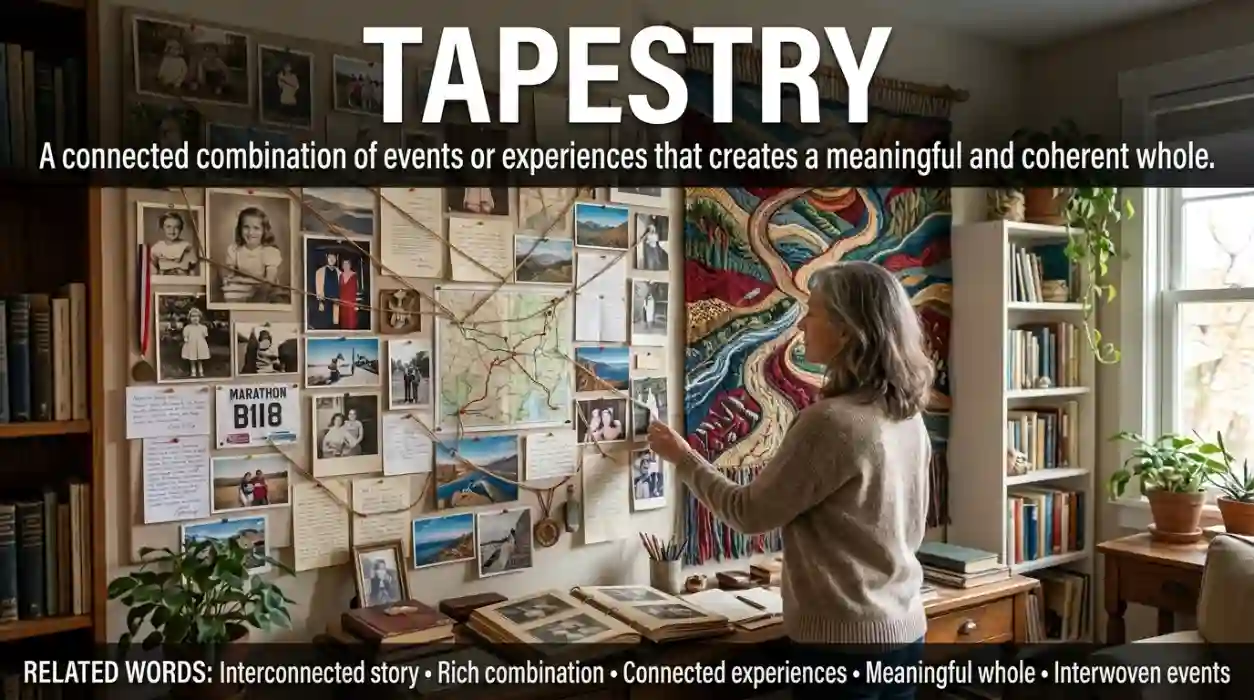
41. Tapestry of Experiences (Noun Phrase) — US / UK: /ˈtæpəstri əv ɪkˈspɪriənsɪz/ /ˈtæpɪstri əv ɪkˈspɪəriənsɪz/
Meaning: A figurative description of many experiences that collectively shape a person’s life.
Tone/Register: Reflective, literary.
Examples: Travel gave her a tapestry of experiences to remember.
Each journey challenged her assumptions.
42. Rich Tapestry (Noun Phrase) — US / UK: /rɪtʃ ˈtæpəstri/ /rɪtʃ ˈtæpɪstri/
Meaning: A particularly varied and meaningful combination of elements.
Tone/Register: Positive, descriptive.
Examples: The region has a rich tapestry of musical traditions.
Its songs reflect many historical influences.
43. Cultural Fabric (Noun Phrase) — US / UK: /ˈkʌltʃərəl ˈfæbrɪk/ /ˈkʌltʃərəl ˈfæbrɪk/
Meaning: The shared customs, values, practices, and relationships that shape a culture.
Tone/Register: Formal, analytical.
Examples: Local festivals strengthen the cultural fabric of the town.
They connect younger residents with older traditions.
44. Rich Texture (Noun Phrase) — US / UK: /rɪtʃ ˈtɛkstʃər/ /rɪtʃ ˈtekstʃə/
Meaning: A combination of varied qualities that creates depth and complexity.
Tone/Register: Literary, descriptive.
Examples: The play has a rich texture of humor and grief.
Its contrasting moods make the characters believable.
45. Layering (Noun) — US / UK: /ˈleɪərɪŋ/ /ˈleɪərɪŋ/
Meaning: The arrangement of multiple levels, elements, or meanings.
Tone/Register: Artistic, analytical.
Examples: The painting uses layering to create visual depth.
Thin washes of color remain visible beneath the surface.
46. Intricate Pattern (Noun Phrase) — US / UK: /ˈɪntrɪkət ˈpætərn/ /ˈɪntrɪkət ˈpætən/
Meaning: A detailed arrangement of connected shapes, lines, or elements.
Tone/Register: Neutral, descriptive.
Examples: The carpet features an intricate pattern of leaves and stars.
The repeating shapes create a sense of movement.
47. Patchwork of Cultures (Noun Phrase) — US / UK: /ˈpætʃwɝːk əv ˈkʌltʃərz/ /ˈpætʃwɜːk əv ˈkʌltʃəz/
Meaning: A figurative description of different cultural groups or traditions existing together.
Tone/Register: Descriptive; occasionally suggests unevenness.
Examples: The district is a patchwork of cultures and communities.
Each street has its own character.
48. Tapestry of History (Noun Phrase) — US / UK: /ˈtæpəstri əv ˈhɪstəri/ /ˈtæpɪstri əv ˈhɪstəri/
Meaning: A figurative expression for historical events and influences woven together over time.
Tone/Register: Literary, historical.
Examples: The old harbor forms part of the tapestry of history.
Its buildings reveal centuries of trade and migration.
49. Constellation (Noun) — US / UK: /ˌkɑːnstəˈleɪʃən/ /ˌkɒnstəˈleɪʃən/
Meaning: A group of related people, ideas, or things viewed as a meaningful pattern.
Tone/Register: Literary, analytical.
Examples: The project brought together a constellation of local artists.
Their different skills shaped the final exhibition.
50. Complex Whole (Noun Phrase) — US / UK: /ˈkɑːmplɛks hoʊl/ /ˈkɒmpleks həʊl/
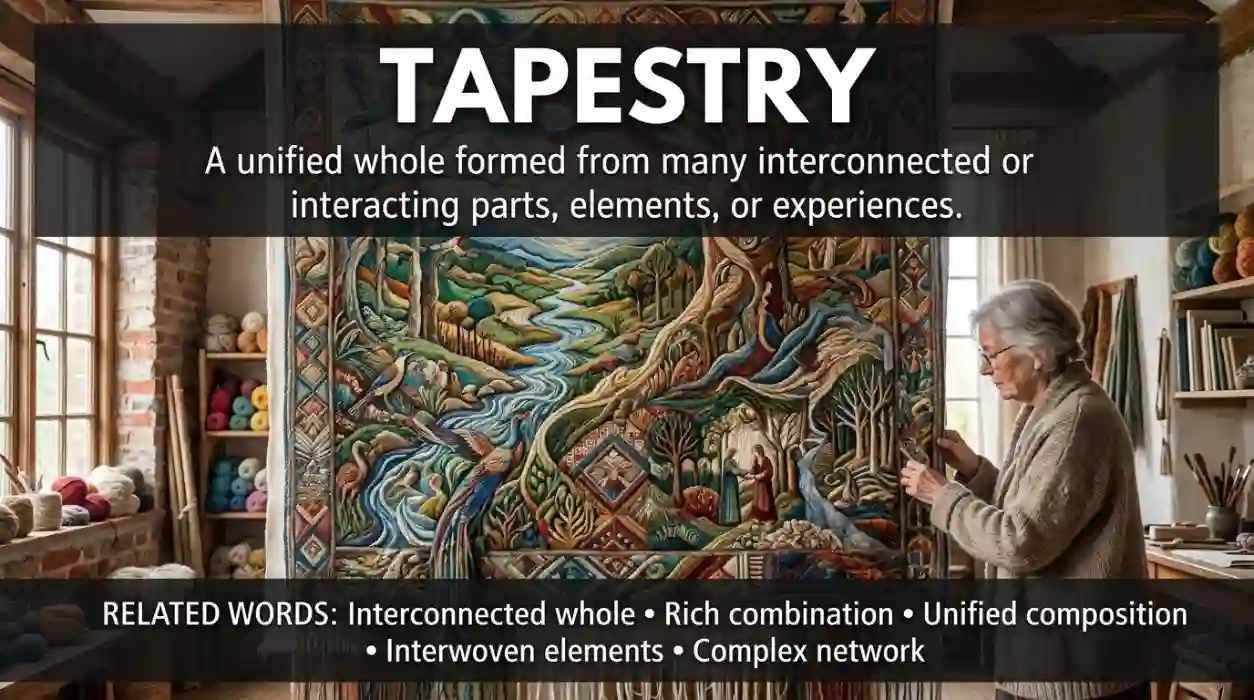
Meaning: A unified entity made from many connected or interacting parts.
Tone/Register: Formal, academic.
Example: The researcher treats the ecosystem as a complex whole.
Every species plays a role in its balance.
Synonyms by Tone
The emotional effect of a synonym matters as much as its dictionary meaning. Choose a word that fits your audience and purpose.
Positive Synonyms
Use these words to emphasize beauty, harmony, richness, or creative variety.
- Rich blend
- Mosaic
- Diversity
- Fusion
- Kaleidoscope
- Rich texture
- Cultural mosaic
- Confluence
Example: “The festival celebrates a rich blend of music and traditions.”
This wording emphasizes variety as a strength.
Neutral Synonyms
These alternatives describe materials, collections, or combinations without adding much emotional judgment.
- Textile
- Fabric
- Woven cloth
- Mixture
- Combination
- Collection
- Range
- Weave
Example: “The museum holds a collection of historic textiles.”
The sentence focuses on factual information.
Negative or Critical Synonyms
These terms can suggest disorder, fragmentation, or excessive complexity in the right context.
- Patchwork
- Web
- Mixture
- Network
- Complex whole
Example: “The new policy created a patchwork of inconsistent rules.”
Here, patchwork suggests a lack of coordination. These words are not inherently negative; context determines their tone.
Playful or Informal Alternatives
Use these expressions in casual writing or vivid storytelling.
- Melting pot
- Kaleidoscope
- Patchwork quilt
- Rich blend
Example: “Our family dinner was a melting pot of recipes and stories.”
This phrase sounds conversational and welcoming.
Tapestry vs. Close Alternatives
Several words overlap with tapestry, but their meanings are not identical.
| Word | Meaning difference | Tone | Best use |
|---|---|---|---|
| Tapestry | A woven textile or a complex combination of elements | Literary, descriptive | Creative writing, culture, history |
| Mosaic | Distinct pieces form a meaningful whole | Vivid, often positive | Communities, identities, art |
| Patchwork | Separate pieces are joined together | Neutral or critical | Quilts, mixed systems, uneven arrangements |
| Fabric | Material or the underlying structure of a group | Neutral to formal | Textiles or social relationships |
Quick rule: Choose tapestry for richness and complexity, mosaic for distinct elements forming a whole, and patchwork when the separate parts remain noticeable, or the result feels uneven.
How Tapestry Changes by Context
Daily Conversation
In everyday speech, people often choose simpler alternatives. Mix, blend, and variety sound natural when discussing food, music, neighborhoods, or experiences.
Example: “The party had a great mix of people and music.”
This sounds more conversational than “The party presented a rich tapestry of cultures.”
Writing and Blogging
Bloggers can use mosaic, kaleidoscope, and rich blend to create more vivid descriptions. These words work well when describing travel, food, communities, art, and personal experiences.
Avoid using tapestry repeatedly in the same article. Choose alternatives based on the exact point you want to make.
Professional or Academic Writing
In academic writing, spectrum, interplay, assemblage, and confluence can communicate specific relationships between ideas. Use them only when their meanings fit the evidence.
Example: “The report examines the interplay of migration and economic change.”
This is more precise than using tapestry as a general label for every complex situation.
Creative and Informal Writing
In fiction, memoirs, and personal essays, figurative expressions can make descriptions more memorable. Tapestry of memories creates a reflective mood, while kaleidoscope of experiences emphasizes constant change.
Example: “Her childhood was a patchwork of summers spent in different countries.”
The image suggests variety without requiring a long explanation.
Common Mistakes Learners Make
1. Treating Every Alternative as an Exact Synonym
A tapestry is a particular kind of woven textile. A mosaic traditionally uses small pieces of materials such as stone or glass. The words overlap figuratively, but they do not describe the same physical object.
2. Using Decorative Language in Every Sentence
Phrases such as rich tapestry, kaleidoscope of experiences, and mosaic of cultures can sound impressive. However, repeated use makes writing feel predictable.
Use a direct word such as mix or range when it communicates the idea more clearly.
3. Ignoring Negative Connotations
Patchwork can imply a poorly coordinated result. Calling a community a patchwork is not necessarily offensive, but it may sound less harmonious than calling it a mosaic.
Check whether the word supports your intended message.
4. Confusing Textiles with Figurative Meaning
Brocade, jacquard, and embroidered panel describe specific textile types or techniques. They are not general replacements for a figurative tapestry of experiences.
Register Notes
- Formal writing: Use confluence, spectrum, assemblage, or interplay when they accurately describe the relationship.
- Informal speech: Prefer mix, blend, or variety.
- Creative writing: Use mosaic, kaleidoscope, or rich texture when a vivid image helps.
- Technical textile writing: Choose the precise material or technique rather than a broad figurative alternative.
For further vocabulary practice, explore related word-choice topics such as synonyms for diverse and complex in your English learning notes.
Real-Life Mini Scenarios
Workplace
A team includes designers, researchers, and customer support staff. A manager might call their different perspectives a rich blend of expertise rather than a tapestry of skills.
Social Situations
At a neighborhood gathering, people share recipes and stories from different backgrounds. Describing the gathering as a mosaic of cultures highlights the distinct contributions of each group.
Media and Pop Culture
A film follows several characters whose lives gradually connect. A reviewer might describe it as an interweaving of personal narratives because the stories affect one another.
Writing and Storytelling
A novelist wants to describe a family’s history across five generations. The phrase tapestry of memories creates a reflective mood and suggests that individual events contribute to a larger story.
Practice Quiz:
1. A museum displays a decorative textile woven with a historical scene. Which term fits best?
A. Spectrum
B. Tapestry
C. Network
2. A writer describes a city where several cultural groups maintain distinct identities. Which phrase is most suitable?
A. Cultural mosaic
B. Compendium
C. Chronicle
3. A researcher studies how language and identity influence one another. Which word is most precise?
A. Brocade
B. Interplay
C. Wall hanging
4. A designer uses raised floral patterns woven into luxurious fabric. Which textile term fits best?
A. Jacquard
B. Brocade
C. Narrative
5. A report describes a continuous range of public opinions. Which synonym works best?
A. Spectrum
B. Quilt
C. Portrait
6. A manager criticizes rules that differ from one department to another. Which word communicates inconsistency?
A. Mosaic
B. Patchwork
C. Fusion
7. A documentary presents an overview of rural life across several generations. Which term is appropriate?
A. Panorama
B. Fabric
C. Embroidered panel
8. A musician combines jazz with traditional folk music. Which word describes this combination?
A. Fusion
B. Chronicle
C. Textile
9. A historian records events in the order they happened. Which word should they use?
A. Weave
B. Chronicle
C. Diversity
10. An artist creates a detailed image by crossing colored threads. Which description is clearest?
A. Woven artwork
B. Network
C. Melting pot
Reflection Task
Write two short sentences about a place, family, community, or artwork.
- In the first sentence, use tapestry.
- In the second sentence, replace it with a synonym that changes or sharpens the meaning.
Answer key: 1-B, 2-A, 3-B, 4-B, 5-A, 6-B, 7-A, 8-A, 9-B, 10-A,
External Sources
For reliable definitions, pronunciation, and word history, consult these established reference sources:
- Merriam-Webster Dictionary — definitions, usage notes, and pronunciation.
- Cambridge Dictionary — learner-friendly meanings and UK/US pronunciation.
- Oxford English Dictionary — historical development and etymology.
- Encyclopaedia Britannica — background on tapestry as a textile art.
- British Council LearnEnglish — vocabulary development and English-learning guidance.
Use dictionary definitions to verify precise meanings, and consult textile-history references when writing about weaving techniques or historical objects.
Conclusion
Learning synonyms for tapestry helps you describe art, culture, history, and human experiences with greater precision. Each alternative offers a slightly different meaning and emotional effect.
Students can use these words to strengthen essays. Bloggers and content writers can create more engaging descriptions, while everyday speakers can express complex ideas in simpler language.
The key is to choose meaningful words, not just variety. A clear mix may work better than a grand metaphor, while mosaic or interplay may communicate a more specific idea.
Practice using these alternatives in emails, essays, stories, and daily conversations. Write a few original sentences, compare their tones, and build a vocabulary that feels natural and confident.
Frequently Asked Questions
1. What is the best synonym for tapestry in academic writing?
The best choice depends on the relationship you want to describe. Interplay works when different factors influence one another. Confluence emphasizes ideas or influences coming together. Spectrum describes a range of positions or qualities. Use tapestry when the complexity and richness of the whole matter more than a specific analytical relationship.
2. What is another word for tapestry in interior design?
Depending on the object, you can use wall hanging, woven artwork, decorative textile, or woven panel. A wall hanging is a broad term for an item displayed on a wall. A tapestry is more specific because it traditionally refers to a decorative textile created through weaving. Choose the term that accurately describes how the item was made.
3. Can tapestry be used as a metaphor for culture?
Yes. Writers commonly use tapestry to describe cultures shaped by different traditions, languages, histories, and experiences. The metaphor suggests that distinct elements contribute to a larger, connected whole. For example, “The region’s cultural tapestry reflects centuries of migration.” A cultural mosaic is another option when you want to emphasize the distinct identities of different groups.
4. What is the difference between a tapestry and a mosaic?
A tapestry is traditionally a decorative textile made by weaving threads into a design. A mosaic is an image or pattern formed from small pieces of materials such as stone, glass, or tile. Figuratively, both can describe a complex whole. However, mosaic often emphasizes distinct pieces, while tapestry suggests elements woven into a connected structure.
5. What are some simple synonyms for tapestry for ESL learners?
Useful beginner-friendly alternatives include mix, blend, variety, fabric, and wall hanging. Their meanings differ slightly. Use mix or blend for different elements brought together, variety for several kinds of something, and wall hanging for decorative artwork displayed on a wall. Learning these common words helps English learners communicate clearly without relying on elaborate expressions.

Shahzeena Shazadi is the founder and lead writer at VocablyHub.com, where she creates accurate, reader-focused English language content designed to help people communicate with clarity and confidence. She specializes in synonyms, antonyms, word meanings, idioms, and practical vocabulary guides that simplify complex language concepts for everyday use. Every article is carefully researched, fact-checked, and written in clear, accessible language using reliable references and real-world examples. Her goal is to provide helpful, trustworthy content that supports learners at every stage of their English language journey.
Her editorial approach focuses on accuracy, transparency, and user value while following modern content quality standards. She regularly reviews and updates content to keep information relevant, useful, and easy to understand. Through VocablyHub.com, Shahzeena Shazadi is committed to publishing reliable language resources that help students, writers, educators, professionals, and English learners expand their vocabulary, improve their writing skills, and communicate with confidence in academic, professional, and everyday situations.