
A synonym for soonest is a word or phrase that means at the earliest possible time or before any other suitable time. Common alternatives include as soon as possible, at the earliest opportunity, at the earliest, and without delay. The best choice depends on urgency, context, and tone.
Imagine your manager asks you to send an important report. You want to promise quick action without sounding rude. Saying “I’ll send it as soon as possible” sounds natural and professional.
The word soonest is common in messages, emails, appointments, requests, and everyday conversations. It helps people communicate when something can happen at the earliest available time.
Learning a synonym for soonest helps you avoid repetition. Students can improve essays, bloggers can write clearer instructions, and content writers can adjust their tone for different audiences.
For example, “Please reply soonest” may sound abrupt in some situations. “Please reply at your earliest convenience” sounds more courteous, although it does not always communicate the same urgency.
What Does “Soonest” Really Mean?
Soonest means at the earliest possible time or earlier than any other available option. It refers to the first time something can happen, rather than simply a time in the near future.
For example, “What is the soonest you can meet?” asks for the earliest time the person is available. It does not necessarily mean “right now.”
Part of Speech and Simple Definition
- Part of speech: Adverb, often used in questions and time expressions.
- Simple definition: At the earliest possible time.
- Base adjective/adverb: Soon
- Comparative form: Sooner
- Superlative form: Soonest
Example: Please let me know the soonest you can arrive.
This asks the listener to identify the earliest time they can realistically get there.
Soonest also appears in common expressions such as “as soon as possible” and “at your earliest convenience.” These phrases overlap in meaning, but they do not always communicate the same degree of urgency.
Connotative Meaning of Soonest
(Connotation is the feeling or association a word communicates beyond its basic meaning.)
- Positive tone: Soonest can suggest prompt action, efficiency, and readiness.
- Negative tone: In a demanding message, it can sound impatient or pressuring.
- Neutral tone: In a question about schedules, it simply identifies the earliest available time.
Compare “Please call me soonest” with “What is the soonest time you could call?” The first may sound like a demand. The second is a neutral question about availability.
Etymology
The word soonest comes from the Old English word sōna, meaning “immediately,” “at once,” or “before long.” The modern form adds the superlative ending -est to soon.
Its meaning has gradually developed around the idea of the earliest point in time.
Old English Period (450–1100)
Old English used sōna to express immediacy or something happening before long. The word belonged to the everyday vocabulary of time and sequence. Its descendants retain this central idea of something happening quickly or early.
Middle English Period (1100–1500)
During Middle English, the form soon developed into a familiar expression for something happening in a short time. English continued to use comparative and superlative forms to compare timing, including sooner and soonest.
Modern English Period (1500–Present)
Today, soonest commonly refers to the earliest possible time for an action, appointment, delivery, or response. It appears in spoken English, business correspondence, scheduling, and online communication.

Pronunciation
- US IPA: /ˈsuː.nɪst/
- UK IPA: /ˈsuː.nɪst/
- Syllables: soon-est
- Word stress: The first syllable receives the main stress: SOON-est.
Affixation Pattern
- Root/base: soon
- Prefix: None
- Suffix: -est, which forms the superlative.
The word follows a regular pattern: soon → sooner → soonest. Use soonest when comparing possible times and identifying the earliest one.
Synonyms List
The best alternative depends on what you want to express. Some phrases stress urgency, while others ask politely about availability or describe an early date. The following list includes common alternatives and related expressions. A few are context-specific rather than exact replacements, so check the examples before using them.
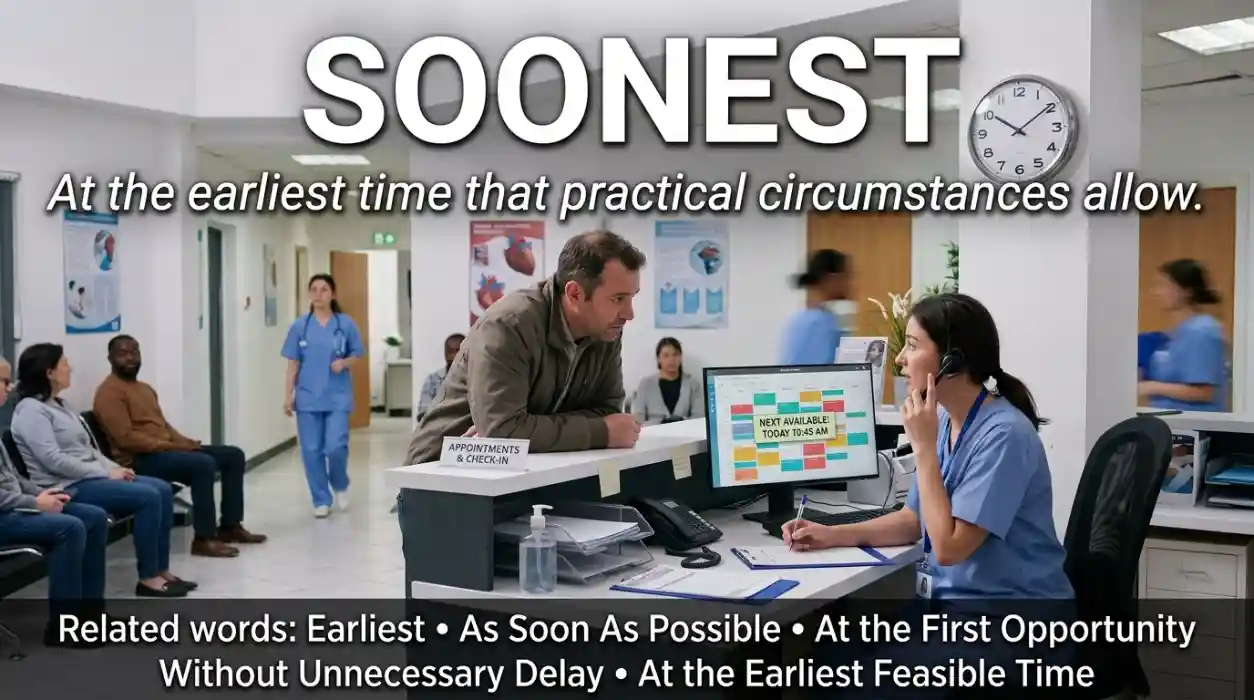
1. As Soon as Possible (Adverbial Phrase) — US / UK: /əz suːn əz ˈpɑː.sə.bəl/; UK /əz suːn əz ˈpɒs.ə.bəl/
Meaning: At the earliest time that circumstances allow.
Tone/Register: Neutral to professional; commonly abbreviated as ASAP.
Examples:
Please send me the updated file as soon as possible.
I’ll contact the team as soon as possible.
2. At the Earliest (Adverbial Phrase) — US / UK: /æt ði ˈɝː.li.əst/; UK /æt ði ˈɜː.li.əst/
Meaning: At the first possible time, often when discussing a schedule or deadline.
Tone/Register: Neutral to formal.
Examples:
The replacement should arrive at the earliest on Friday.
We can discuss the proposal at the earliest opportunity.
3. At the Earliest Opportunity (Adverbial Phrase) — US / UK: /æt ði ˈɝː.li.əst ˌɑː.pɚˈtuː.nə.t̬i/; UK /æt ði ˈɜː.li.əst ˌɒp.əˈtʃuː.nə.ti/
Meaning: As soon as a suitable chance becomes available.
Tone/Register: Polite and professional.
Examples:
Please review the document at the earliest opportunity.
I’ll speak with the supervisor at the earliest opportunity.
4. Without Delay (Adverbial Phrase) — US / UK: /wɪˈðaʊt dɪˈleɪ/
Meaning: Immediately or without allowing unnecessary time to pass.
Tone/Register: Formal; can sound firm or urgent.
Examples:
Report any safety concerns without delay.
The office processed the urgent request without delay.
5. Immediately (Adverb) — US / UK: /ɪˈmiː.di.ət.li/
Meaning: At once, with virtually no waiting time.
Tone/Register: Neutral to formal; often signals urgency.
Examples:
Please leave the building immediately.
I’ll call you immediately after the meeting.
6. Right Away (Adverbial Phrase) — US / UK: /ˌraɪt əˈweɪ/
Meaning: At once or very soon after the current moment.
Tone/Register: Conversational and common in American English.
Examples:
I’ll check the schedule right away.
Can you bring the documents over right away?
7. Straightaway (Adverb) — US / UK: /ˌstreɪt.əˈweɪ/
Meaning: Immediately, without stopping or postponing the action.
Tone/Register: Neutral; especially common in British English.
Examples:
She recognized the mistake and corrected it straightaway.
I’ll send you the address straightaway.
8. At Once (Adverbial Phrase) — US / UK: /æt ˈwʌns/
Meaning: Immediately, with no delay.
Tone/Register: Neutral to formal; may sound commanding in an order.
Examples:
The technician came to inspect the fault at once.
Please respond at once if your plans change.
9. Promptly (Adverb) — US / UK: /ˈprɑːmpt.li/; UK /ˈprɒmpt.li/
Meaning: Quickly and without unnecessary delay.
Tone/Register: Professional and neutral.
Examples:
The support team replied promptly to my email.
Please arrive promptly for the interview.
10. As Quickly as Possible (Adverbial Phrase) — US / UK: /əz ˈkwɪk.li əz ˈpɑː.sə.bəl/; UK /əz ˈkwɪk.li əz ˈpɒs.ə.bəl/
Meaning: At the greatest reasonable speed, given the circumstances.
Tone/Register: Neutral; useful for requests and instructions.
Examples:
Please finish the repair as quickly as possible.
We need to share the update as quickly as possible.
11. At the First Opportunity (Adverbial Phrase) — US / UK: /æt ðə fɝːst ˌɑː.pɚˈtuː.nə.t̬i/; UK /æt ðə fɜːst ˌɒp.əˈtʃuː.nə.ti/
Meaning: As soon as a suitable chance to act presents itself.
Tone/Register: Neutral to formal.
Examples:
I’ll ask the doctor at the first opportunity.
Please confirm your attendance at the first opportunity.
12. At Your Earliest Convenience (Adverbial Phrase) — US / UK: /æt jʊr ˈɝː.li.əst kənˈviː.ni.əns/; UK /æt jɔː ˈɜː.li.əst kənˈviː.ni.əns/
Meaning: At the earliest time that works for the recipient.
Tone/Register: Polite and professional; usually less urgent than “immediately.”
Examples:
Please review the attached form at your earliest convenience.
Could you call me at your earliest convenience?
13. At the First Possible Moment (Adverbial Phrase) — US / UK: /æt ðə fɝːst ˈpɑː.sə.bəl ˈmoʊ.mənt/; UK /æt ðə fɜːst ˈpɒs.ə.bəl ˈməʊ.mənt/
Meaning: At the earliest moment when an action can realistically happen.
Tone/Register: Neutral and explanatory.
Examples:
She informed her family at the first possible moment.
I’ll update the records at the first possible moment.
14. At the Earliest Possible Time (Adverbial Phrase) — US / UK: /æt ði ˈɝː.li.əst ˈpɑː.sə.bəl taɪm/; UK /æt ði ˈɜː.li.əst ˈpɒs.ə.bəl taɪm/
Meaning: At the first time that practical circumstances permit.
Tone/Register: Formal and precise.
Examples:
The appointment will be arranged at the earliest possible time.
Please notify the residents at the earliest possible time.
15. Forthwith (Adverb) — US / UK: /fɔːrθˈwɪθ/; UK /fɔːθˈwɪð/
Meaning: Immediately or without delay.
Tone/Register: Very formal, legal, or old-fashioned.
Examples:
The notice instructed the tenant to vacate the premises forthwith.
The committee requested that the records be submitted forthwith.
16. Posthaste (Adverb) — US / UK: /ˌpoʊstˈheɪst/
Meaning: With great speed or urgency.
Tone/Register: Old-fashioned or playful; sometimes used for dramatic effect.
Examples:
The captain ordered the messenger to return posthaste.
Send the revised invitation posthaste before the event begins.
17. Pronto (Adverb) — US / UK: /ˈprɑːn.toʊ/; UK /ˈprɒn.təʊ/
Meaning: Quickly or immediately.
Tone/Register: Informal; often conversational and emphatic.
Examples:
We need those chairs moved pronto.
Call me pronto if the venue changes.
18. Now (Adverb) — US / UK: /naʊ/
Meaning: At present, with no waiting until later.
Tone/Register: Everyday and direct; can sound urgent or demanding.
Examples:
I need the final number now.
Let’s discuss the issue now instead of putting it off.
19. This Instant (Adverbial Phrase) — US / UK: /ðɪs ˈɪn.stənt/
Meaning: Immediately, at the very moment of speaking.
Tone/Register: Strong, emphatic, and sometimes impatient.
Examples:
Please stop the machine this instant.
She wanted an answer this instant, but the facts needed checking.
20. As Early as Possible (Adverbial Phrase) — US / UK: /əz ˈɝː.li əz ˈpɑː.sə.bəl/; UK /əz ˈɜː.li əz ˈpɒs.ə.bəl/
Meaning: At the earliest time that practical circumstances allow.
Tone/Register: Neutral to professional; useful for plans and deadlines.
Examples:
We hope to open registration as early as possible.
Please book your appointment as early as possible.
21. Sooner Rather Than Later (Adverbial Phrase) — US / UK: /ˈsuː.nɚ ˈræð.ɚ ðən ˈleɪ.t̬ɚ/; UK /ˈsuː.nə ˈrɑː.ðə ðən ˈleɪ.tə/
Meaning: At an earlier time instead of postponing something unnecessarily.
Tone/Register: Conversational and neutral.
Examples:
We should discuss the budget sooner rather than later.
I’d rather make the decision sooner rather than later.
22. At the First Available Time (Adverbial Phrase) — US / UK: /æt ðə fɝːst əˈveɪ.lə.bəl taɪm/; UK /æt ðə fɜːst əˈveɪ.lə.bəl taɪm/
Meaning: At the earliest time that is actually open or available.
Tone/Register: Neutral to professional; especially useful for scheduling.
Examples:
The clinic offered me an appointment at the first available time.
Please arrange a follow-up at the first available time.
23. At the Earliest Date (Adverbial Phrase) — US / UK: /æt ði ˈɝː.li.əst deɪt/; UK /æt ði ˈɜː.li.əst deɪt/
Meaning: On the first possible calendar date, rather than necessarily at the first hour.
Tone/Register: Formal; common in scheduling and administrative writing.
Examples:
The hearing will be rescheduled for the earliest date available.
Please submit the application by the earliest date the office accepts it.
24. At the Earliest Possible Date (Adverbial Phrase) — US / UK: /æt ði ˈɝː.li.əst ˈpɑː.sə.bəl deɪt/; UK /æt ði ˈɜː.li.əst ˈpɒs.ə.bəl deɪt/
Meaning: On the first date that circumstances or official schedules permit.
Tone/Register: Formal and administrative.
Examples:
The inspection has been scheduled for the earliest possible date.
We will publish the revised timetable at the earliest possible date.
25. At the Earliest Moment Available (Adverbial Phrase) — US / UK: /æt ði ˈɝː.li.əst ˈmoʊ.mənt əˈveɪ.lə.bəl/; UK /æt ði ˈɜː.li.əst ˈməʊ.mənt əˈveɪ.lə.bəl/
Meaning: As soon as there is a genuine opportunity to act.
Tone/Register: Formal and explanatory.
Examples:
The nurse contacted the family at the earliest moment available.
I’ll explain the changes at the earliest moment available.
26. With All Possible Speed (Adverbial Phrase) — US / UK: /wɪð ɔːl ˈpɑː.sə.bəl spiːd/; UK /wɪð ɔːl ˈpɒs.ə.bəl spiːd/
Meaning: As quickly as circumstances permit.
Tone/Register: Formal, emphatic, and somewhat old-fashioned.
Examples:
The crew worked with all possible speed to secure the site.
Please forward the documents with all possible speed.
27. With No Delay (Adverbial Phrase) — US / UK: /wɪð noʊ dɪˈleɪ/; UK /wɪð nəʊ dɪˈleɪ/
Meaning: Without waiting or postponing the action.
Tone/Register: Formal and direct.
Examples:
The office confirmed the booking with no delay.
Any changes must be reported with no delay.
28. At the First Chance (Adverbial Phrase) — US / UK: /æt ðə fɝːst tʃæns/; UK /æt ðə fɜːst tʃɑːns/
Meaning: As soon as an opportunity becomes available.
Tone/Register: Conversational and neutral.
Examples:
I’ll tell you what happened at the first chance.
She checked her messages at the first chance she had.
29. At the Next Opportunity (Adverbial Phrase) — US / UK: /æt ðə nekst ˌɑː.pɚˈtuː.nə.t̬i/; UK /æt ðə nekst ˌɒp.əˈtʃuː.nə.ti/
Meaning: As soon as the next suitable chance occurs.
Tone/Register: Neutral; appropriate when immediate action is not possible.
Examples:
Please raise the issue at the next opportunity.
I’ll ask the coordinator at the next opportunity.
30. At the First Convenient Time (Adverbial Phrase) — US / UK: /æt ðə fɝːst kənˈviː.ni.ənt taɪm/; UK /æt ðə fɜːst kənˈviː.ni.ənt taɪm/
Meaning: At the earliest time that is practical for the people involved.
Tone/Register: Polite and neutral.
Examples:
Could you call me at the first convenient time?
We’ll arrange the discussion at the first convenient time for everyone.
31. At Your Earliest Possible Convenience (Adverbial Phrase) — US / UK: /æt jʊr ˈɝː.li.əst ˈpɑː.sə.bəl kənˈviː.ni.əns/; UK /æt jɔː ˈɜː.li.əst ˈpɒs.ə.bəl kənˈviː.ni.əns/
Meaning: As early as the recipient can reasonably manage.
Tone/Register: Formal and courteous, though slightly wordy.
Examples:
Please confirm the meeting details at your earliest possible convenience.
Could you return the signed form at your earliest possible convenience?
32. At the First Reasonable Time (Adverbial Phrase) — US / UK: /æt ðə fɝːst ˈriː.zən.ə.bəl taɪm/; UK /æt ðə fɜːst ˈriː.zən.ə.bəl taɪm/
Meaning: At the earliest time that makes practical sense in the circumstances.
Tone/Register: Neutral to formal; useful when some preparation is necessary.
Examples:
We’ll review the complaint at the first reasonable time.
Please contact the family at the first reasonable time.
33. With All Speed (Adverbial Phrase) — US / UK: /wɪð ɔːl spiːd/
Meaning: As quickly as possible, often with a sense of urgency.
Tone/Register: Formal or literary; uncommon in casual speech.
Examples:
The rescue team moved with all speed toward the village.
The request was forwarded with all speed.
34. Speedily (Adverb) — US / UK: /ˈspiː.dəl.i/
Meaning: Quickly and without taking much time.
Tone/Register: Formal to neutral; less common in casual conversation than quickly.
Examples:
The clerk handled the paperwork speedily.
We hope the dispute will be resolved speedily.
35. Expeditiously (Adverb) — US / UK: /ˌek.spəˈdɪʃ.əs.li/
Meaning: Promptly and efficiently, avoiding unnecessary delay.
Tone/Register: Formal, administrative, or business-oriented.
Examples:
The department promised to process the request expeditiously.
Please handle the complaint expeditiously and keep a written record.
36. Swiftly (Adverb) — US / UK: /ˈswɪft.li/
Meaning: Quickly, often with an emphasis on the speed of the action.
Tone/Register: Neutral to formal; useful in reports and storytelling.
Examples:
The team responded swiftly to the unexpected change.
She moved swiftly to prevent further confusion.
37. Quickly (Adverb) — US / UK: /ˈkwɪk.li/
Meaning: At a fast pace or within a short amount of time.
Tone/Register: Neutral and widely used.
Examples:
Can you get back to me quickly?
The staff quickly found an alternative meeting room.
38. Rapidly (Adverb) — US / UK: /ˈræp.ɪd.li/
Meaning: At a fast rate or with little time between stages.
Tone/Register: Neutral to formal; common in reports and explanations.
Examples:
The situation changed rapidly after the announcement.
Please update the records rapidly as new details arrive.
39. In Short Order (Adverbial Phrase) — US / UK: /ɪn ˌʃɔːrt ˈɔːr.dɚ/; UK /ɪn ˌʃɔːt ˈɔː.də/
Meaning: Within a short period of time.
Tone/Register: Conversational, especially in American English; it means soon, not necessarily immediately.
Examples:
The technician fixed the connection in short order.
We’ll have the final schedule ready in short order.
40. Before Long (Adverbial Phrase) — US / UK: /bɪˈfɔːr lɔːŋ/; UK /bɪˈfɔː lɒŋ/
Meaning: After a short period of time.
Tone/Register: Neutral and conversational; less precise than soonest.
Examples:
The rain stopped, and sunlight appeared before long.
You’ll hear from the admissions office before long.

41. Shortly (Adverb) — US / UK: /ˈʃɔːrt.li/; UK /ˈʃɔːt.li/
Meaning: In a short time or a little while from now.
Tone/Register: Neutral to formal; common in announcements.
Examples:
The presentation will begin shortly.
I’ll send the meeting link shortly.
42. In the Near Future (Adverbial Phrase) — US / UK: /ɪn ðə nɪr ˈfjuː.tʃɚ/; UK /ɪn ðə nɪə ˈfjuː.tʃə/
Meaning: At some point in the coming period, without specifying the earliest possible moment.
Tone/Register: Neutral to formal.
Examples:
The school plans to announce its new policy in the near future.
We expect to revisit the proposal in the near future.
43. Before Anything Else (Adverbial Phrase) — US / UK: /bɪˈfɔːr ˈen.i.θɪŋ els/; UK /bɪˈfɔː ˈen.i.θɪŋ els/
Meaning: As the priority, before other tasks or actions.
Tone/Register: Neutral and conversational; emphasizes priority rather than exact timing.
Examples:
Before anything else, let’s make sure everyone is safe.
I need to check the facts before anything else.
44. First Thing (Adverbial Phrase) — US / UK: /ˌfɝːst ˈθɪŋ/; UK /ˌfɜːst ˈθɪŋ/
Meaning: At the beginning of a day or activity, often as an early priority.
Tone/Register: Informal to neutral.
Examples:
I’ll call the office first thing tomorrow.
Let’s review the feedback first thing in the morning.
45. First Thing Tomorrow (Adverbial Phrase) — US / UK: /ˌfɝːst ˈθɪŋ təˈmɑːr.oʊ/; UK /ˌfɜːst ˈθɪŋ təˈmɒr.əʊ/
Meaning: At the start of the following day.
Tone/Register: Conversational and professional.
Examples:
I’ll send you the final draft first thing tomorrow.
The manager will review the figures first thing tomorrow.
46. At the Earliest Stage (Adverbial Phrase) — US / UK: /æt ði ˈɝː.li.əst steɪdʒ/; UK /æt ði ˈɜː.li.əst steɪdʒ/
Meaning: At the first phase of a process or development.
Tone/Register: Formal or academic; refers to stages rather than clock time.
Examples:
Please identify potential risks at the earliest stage.
The team tested the design at the earliest stage of development.
47. At the First Possible Chance (Adverbial Phrase) — US / UK: /æt ðə fɝːst ˈpɑː.sə.bəl tʃæns/; UK /æt ðə fɜːst ˈpɒs.ə.bəl tʃɑːns/
Meaning: As soon as a realistic opportunity allows.
Tone/Register: Neutral; conversational but slightly emphatic.
Examples:
I’ll explain the delay at the first possible chance.
She checked on her neighbor at the first possible chance.
48. With Immediate Effect (Adverbial Phrase) — US / UK: /wɪð ɪˈmiː.di.ət ɪˈfekt/
Meaning: Starting now, rather than at a later date.
Tone/Register: Formal, official, or administrative.
Examples:
The revised safety rule takes effect with immediate effect.
The old access policy was withdrawn with immediate effect.
49. At the Earliest Possible Opportunity (Adverbial Phrase) — US / UK: /æt ði ˈɝː.li.əst ˈpɑː.sə.bəl ˌɑː.pɚˈtuː.nə.t̬i/; UK /æt ði ˈɜː.li.əst ˈpɒs.ə.bəl ˌɒp.əˈtʃuː.nə.ti/
Meaning: At the first practical opportunity to do something.
Tone/Register: Formal and precise.
Examples:
Please notify the organizer at the earliest possible opportunity.
The team will review the safety plan at the earliest possible opportunity.
50. As Early as Circumstances Permit (Adverbial Phrase) — US / UK: /əz ˈɝː.li əz ˈsɝː.kəm.stæn.sɪz pɚˈmɪt/; UK /əz ˈɜː.li əz ˈsɜː.kəm.stæn.sɪz pəˈmɪt/
Meaning: At the earliest time allowed by practical conditions.
Tone/Register: Formal and explanatory; useful when timing depends on external factors.
Examples:
The repairs will begin as early as circumstances permit.
We’ll share the confirmed date as early as circumstances permit.
Synonyms by Tone
The expression you choose can make a request sound polite, urgent, formal, or demanding. Match the wording to the relationship and situation.
Positive and Cooperative
These alternatives encourage prompt action while keeping the message constructive:
- As soon as possible: Communicates a need for timely action.
- At your earliest convenience: Respects the recipient’s schedule.
- At the earliest opportunity: Sounds professional and considerate.
- Promptly: Suggests efficient action.
- As early as possible: Emphasizes making an early start.
Neutral
Use these options to discuss schedules or timing without adding strong emotion:
- At the earliest: Identifies the first possible time.
- Shortly: Suggests something will happen in a short time.
- Right away: Common in everyday conversation.
- At the first available time: Focuses on actual availability.
- At the first convenient time: Allows for practical scheduling.
- Quickly: Focuses on speed.
- Before long: Suggests a short wait without promising an exact time.
Urgent or Forceful
These expressions communicate a stronger demand for immediate action:
- Immediately: No meaningful delay is expected.
- At once: Direct and potentially commanding.
- Without delay: Formal and firm.
- This instant: Strongly emphatic and sometimes impatient.
- Forthwith: Very formal or legalistic.
- Pronto: Informal but emphatic.
Use these only when the circumstances justify the urgency. In ordinary professional correspondence, an overly forceful phrase may damage the tone of your message.
Playful or Informal
These alternatives can make a message sound more relaxed or expressive:
- Pronto: Casual and energetic.
- Posthaste: Dramatic, old-fashioned, or humorous.
- Right away: Friendly and direct.
- First thing tomorrow: Natural when arranging a task for the next morning.
- Sooner rather than later: Conversational and gently persuasive.
Why tone matters: A request for a quick reply can sound cooperative or demanding depending on the words you choose. If you are unsure, explain the deadline clearly and politely instead of relying on an ambiguous expression.
“Soonest” vs. Close Alternatives
| Expression | Meaning and tone | Best use |
|---|---|---|
| Soonest | The earliest possible time among available options | Asking about availability: “What’s the soonest you can arrive?” |
| As soon as possible | As early as circumstances allow; may signal urgency | Requesting action: “Please send the file as soon as possible.” |
| Immediately | At once, with virtually no delay | Emergencies, urgent instructions, or actions that must start now |
| At your earliest convenience | When the recipient can reasonably manage it | Courteous professional requests that are not necessarily urgent |
| Shortly | In a short time, without identifying the earliest possible moment | Announcements and brief updates |
Consider the difference between these questions:
- “What’s the soonest you can finish?” asks for the earliest realistic completion time.
- “Can you finish as soon as possible?” requests the earliest practical completion.
- “Can you finish immediately?” suggests that the work should start or be completed without delay.
- “Could you finish at your earliest convenience?” sounds more courteous but may communicate less urgency.
These expressions overlap, but they are not interchangeable in every situation.
How “Soonest” Changes by Context
Daily Conversation
In casual speech, people often say right away, as soon as possible, or first thing tomorrow. These expressions sound natural and clearly communicate timing.
For example, “I’ll call you right away” sounds direct and friendly. “I’ll contact you forthwith” would sound unusually formal in most everyday conversations.
Writing and Blogging
Writers use timing expressions to give instructions, explain schedules, or establish a sense of urgency. Avoid repeating soonest several times in one paragraph.
Instead, vary the wording according to meaning. Use shortly for a brief wait, at the earliest opportunity for a suitable chance to act, and as early as possible when an early start matters.
Professional and Academic English
Business emails often need a balance between urgency and courtesy. “Please send the report as soon as possible” communicates urgency, while “Please send the report at your earliest convenience” gives the recipient more flexibility.
For academic writing, choose precise time expressions. If a deadline is fixed, state the date and time rather than relying on a vague word such as soon.
Creative and Informal Writing
Stories often benefit from expressions that match a character’s personality. Pronto can make dialogue lively, while without delay can create a more formal or dramatic mood.
“Before long, the lights came back on” creates a sense of a short wait. “Immediately, the lights came back on” suggests there was no noticeable delay.
Common Mistakes Learners Make
Mistake 1: Treating “Soonest” and “Soon” as Identical
Soon means in a short time. Soonest identifies the earliest available time or the earliest among alternatives.
“What time can you arrive soonest?” asks about the earliest possible arrival. “I’ll arrive soon” simply says the arrival will happen in the near future.
Mistake 2: Assuming “ASAP” Always Sounds Polite
ASAP is common in workplaces and messages, but it can feel abrupt when a request has no explanation. A courteous alternative is “Could you send this as soon as possible? We need it for tomorrow’s meeting.”
Giving a reason helps the recipient understand the urgency.
Mistake 3: Using “At Your Earliest Convenience” for an Emergency
This expression allows the recipient to choose a practical time. It may be too weak when immediate action is essential.
For an urgent safety issue, use a direct instruction such as “Please contact the emergency team immediately.” Always match the phrase to the real level of urgency.
Mistake 4: Confusing Speed With Early Timing
Quickly usually focuses on how fast an action happens. Soonest focuses on the earliest possible time an action can occur.
A person might start a task soon but complete it slowly. Conversely, someone might complete a task quickly after starting it much later.
Mistake 5: Using “Forthwith” in Casual Messages
Forthwith is formal and may sound old-fashioned or legalistic. In an ordinary message to a friend, “Please reply right away” is usually more natural.
Register Notes
- Formal: forthwith, expeditiously, without delay, at the earliest opportunity.
- Neutral: soonest, promptly, quickly, as soon as possible.
- Conversational: right away, first thing tomorrow, sooner rather than later.
- Strongly urgent: immediately, at once, this instant.
One useful writing habit is to read your message aloud before sending it. If the wording sounds harsher or more formal than you intend, choose a simpler alternative.
Real-Life Mini Scenarios
Workplace
Your manager needs a report before a meeting. You can say, “I’ll send the report as soon as possible.” If the deadline is fixed, specify it: “I’ll send it by 10 a.m. tomorrow.”
Social Situation
A friend asks when you can meet. Instead of promising an unrealistic time, say, “Saturday is the soonest I can make it.” This clearly identifies your earliest availability.
Media and Public Announcements
An organization needs to share an urgent update. “Further details will be released shortly” tells the audience to expect information soon without promising an exact minute.
Writing and Storytelling
A character receives a warning and acts at once. “She left without delay” creates a sense of urgency, while “She left at the earliest opportunity” suggests she had to wait until circumstances allowed her to go.

Practice Exercise
1. Your colleague needs a document urgently, but you want to sound professional. Which phrase fits best?
A. Posthaste
B. As soon as possible
C. This instant
D. Before long
2. You want to ask a clinic for its earliest available appointment. What should you ask?
A. What’s the soonest appointment available?
B. Can you come right away?
C. Please respond forthwith.
D. Will it happen before long?
3. A safety officer tells people to leave a dangerous area immediately. Which phrase is clearest?
A. At your earliest convenience
B. In the near future
C. Immediately
D. Sooner rather than later
4. You are writing a polite email to ask a colleague to review a non-urgent form. Which expression is suitable?
A. This instant
B. At your earliest convenience
C. Forthwith
D. At once
5. Your friend asks when you can call, and you can do it now. Which reply sounds natural?
A. I’ll call right away.
B. I’ll call in the near future.
C. I’ll call expeditiously.
D. I’ll call forthwith.
6. A public announcement says that a presentation will start in a few minutes. Which word is most suitable?
A. Promptly
B. Shortly
C. Posthaste
D. Immediately
7. You want to describe a task being completed efficiently and without unnecessary delay in a formal report. Which word fits best?
A. Pronto
B. Expeditiously
C. This instant
D. Before long
8. Your team needs to discuss a growing problem, but it is not an emergency. Which phrase communicates that it should not be postponed?
A. Sooner rather than later
B. This instant
C. With immediate effect
D. At once
9. A character in a humorous story tells a messenger to hurry in a deliberately old-fashioned way. Which expression could the character use?
A. At your earliest convenience
B. Posthaste
C. Shortly
D. Quickly
Answer Key
1-B | 2-A | 3-C | 4-B | 5-A | 6-B | 7-B | 8-A | 9-B
Reflection Task
Write three short sentences about a task you need to complete. Use as soon as possible, at your earliest convenience, and immediately in different contexts.
Suggested External Sources
For reliable definitions, pronunciation, and examples, consult these established dictionary references:
- Cambridge Dictionary — search for soon, sooner, and soonest.
- Merriam-Webster — check the word’s meaning and usage.
- Oxford Learner’s Dictionaries — review examples and grammatical patterns.
These references can help you confirm how a phrase works before using it in formal writing.
Conclusion
Choosing the right synonym for soonest helps you communicate timing clearly. Whether you need urgency or politeness, a precise phrase makes your message easier to understand.
A wider vocabulary improves essays, blogs, emails, and everyday conversations. Learning the difference between promptly, shortly, and immediately helps you express your intentions accurately.
You do not need to memorize all 50 alternatives today. Start with a few common expressions, then notice how native speakers use them in real conversations and professional messages.
Practice by writing three sentences with different timing expressions. Try them in an email, an essay, or a daily conversation, and build confidence one phrase at a time.
Frequently Asked Questions About “Soonest”
1. Is “soonest” grammatically correct in professional emails?
Yes, soonest is grammatically correct when asking about the earliest possible time. For example, “Could you let me know the soonest you can send the report?” sounds natural. In formal emails, it is often helpful to specify a deadline or explain why you need a quick response. This prevents confusion about the level of urgency.
2. What is the difference between “at the soonest” and “at the earliest”?
At the earliest is the more established expression in standard English. For example, “The package will arrive on Friday at the earliest” means Friday is the earliest possible arrival date. At the soonest appears in some informal usage, but many speakers prefer at the earliest for polished writing.
3. Can I use “soonest” when discussing future dates?
Yes. You can use soonest to ask about the earliest possible date, appointment, delivery, or completion time. For example, “What is the soonest date available for an interview?” is clear and natural. When a date matters, giving the specific day or deadline makes your message more useful than saying only that something will happen soon.
4. Is “ASAP” rude in workplace communication?
ASAP is not automatically rude, but its tone depends on context, workplace culture, and the relationship between the sender and recipient. A short message containing only “Send this ASAP” can sound demanding. A more considerate version is “Could you send this ASAP? We need it for tomorrow’s meeting.” Explaining the reason helps communicate urgency respectfully.
5. Which alternative to “soonest” is best for a formal letter?
At the earliest opportunity and as soon as possible are useful in formal correspondence. The first emphasizes acting when a suitable opportunity becomes available. The second communicates a stronger need for prompt action. If the request is not urgent, at your earliest convenience is often more courteous. Choose the phrase that accurately reflects your intended deadline.

Shahzeena Shazadi is the founder and lead writer at VocablyHub.com, where she creates accurate, reader-focused English language content designed to help people communicate with clarity and confidence. She specializes in synonyms, antonyms, word meanings, idioms, and practical vocabulary guides that simplify complex language concepts for everyday use. Every article is carefully researched, fact-checked, and written in clear, accessible language using reliable references and real-world examples. Her goal is to provide helpful, trustworthy content that supports learners at every stage of their English language journey.
Her editorial approach focuses on accuracy, transparency, and user value while following modern content quality standards. She regularly reviews and updates content to keep information relevant, useful, and easy to understand. Through VocablyHub.com, Shahzeena Shazadi is committed to publishing reliable language resources that help students, writers, educators, professionals, and English learners expand their vocabulary, improve their writing skills, and communicate with confidence in academic, professional, and everyday situations.