
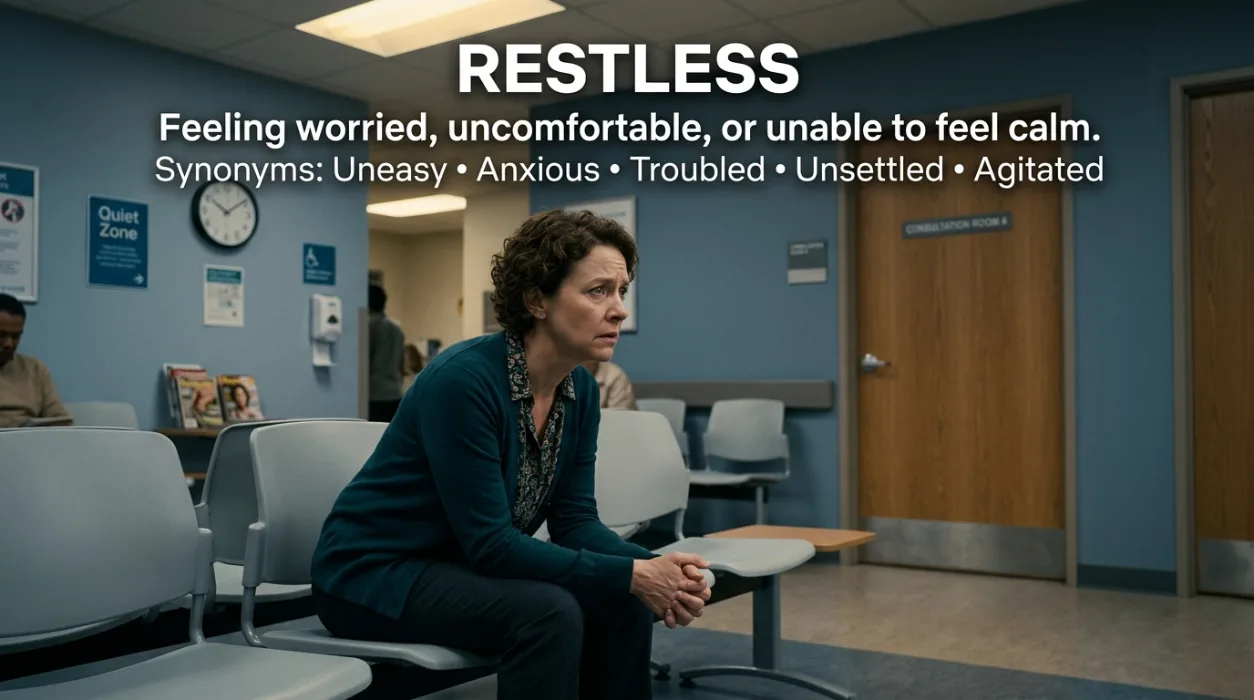
Synonyms for restless include uneasy, agitated, fidgety, restless, unsettled, impatient, and restive. The best choice depends on whether you mean physical movement, nervousness, boredom, dissatisfaction, or a strong desire for change.
Synonyms for restless become useful when one word feels too repetitive. A student may write “restless” several times, while a better synonym can make each sentence more precise.
Picture a student waiting for an important exam result. They keep checking their phone and walking around. They are not simply bored; they feel restless.
This everyday word appears often because people experience physical or emotional unease. Learning synonyms for restless helps students, bloggers, writers, and daily English users express those feelings naturally.
The right synonym can also change the mood. Fidgety sounds physical, anxious highlights worry, and impatient suggests frustration with waiting or delay.
What Does “Restless” Really Mean?
Restless is an adjective that describes someone or something unable or unwilling to remain still, calm, satisfied, or at ease.
In simple English, restless means unable to relax or stay still.
It can describe physical movement:
“The child became restless during the long meeting.”
It can also describe poor sleep:
“I had a restless night.”
The word can describe dissatisfaction or a desire for change:
“After years in the same job, she felt restless.”
Oxford identifies these major meanings: being unable to stay still or happy where you are, and having poor or disturbed rest or sleep.
Native speakers therefore understand restless as a flexible word. It can describe the body, mind, sleep, a crowd, an audience, or even a broader social mood.
Common contexts include:
- Long journeys
- Waiting rooms
- Classrooms
- Workplaces
- Difficult nights
- Anxiety and worry
- Boredom
- Desire for change
- Creative frustration
- Social or political dissatisfaction
Connotative Meaning
Connotation (the emotional feeling or association a word carries beyond its literal meaning) is important when choosing a synonym.
Positive Tone
Restless can sometimes suggest energy, ambition, curiosity, or a desire to explore.
For example:
“Her restless curiosity pushed her to learn three languages.”
Here, restless feels energetic rather than negative.
Negative Tone
The word often suggests discomfort, nervousness, impatience, dissatisfaction, or inability to relax.
“The restless audience began talking during the delay.”
Neutral Tone
Restless can simply describe movement or poor sleep without judging the person.
“The baby had a restless night.”
Cambridge notes that restless can describe movement caused by worry or boredom and can also describe someone who is dissatisfied with their situation and wants change.
Etymology of Restless
The history of restless is quite direct.
The word comes from Old English ræstlēas, meaning “deprived of sleep” or lacking rest. It combines rest with the suffix -less, meaning “without” or “lacking.”
Old English: 450–1100
Old English had the form ræstlēas.
The structure was essentially:
rest + -less = without rest
The Old English noun related to rest referred to rest, repose, or a period of relaxation.
Middle English: 1100–1500
In Middle English, forms such as restles and restelees appeared.
The basic idea remained connected with lacking rest, sleep, or peace.
Modern English: 1500–Present
The modern form restless developed broader meanings.
It came to describe not only a lack of sleep but also continual movement, mental unease, dissatisfaction, and a desire for change. The meaning “stirring constantly” is recorded from the late 15th century.
Pronunciation
US: /ˈrest.ləs/
UK: /ˈrest.ləs/
Syllables
rest-less
Affixation Pattern of Restless
Root: rest
Prefix: None
Suffix: -less
The suffix -less means “without” or “lacking.”
So, at its simplest:
rest + less = without rest
This same suffix appears in words such as careless, hopeless, sleepless, and fearless.
Synonyms List
Restless has several meanings, so the most accurate replacement depends on the exact situation. Some alternatives focus on physical movement, others on anxiety, impatience, boredom, dissatisfaction, or a desire for change.
Uneasy (adjective) — US /ʌnˈiː.zi/ | UK /ʌnˈiː.zi/
Meaning: Feeling worried, uncomfortable, or unable to feel calm.
Tone/Register: Neutral, common.
Examples:
“I felt uneasy before the interview.”
“She seemed uneasy during the conversation.”
Agitated (adjective) — US /ˈædʒ.ə.teɪ.tɪd/ | UK /ˈædʒ.ɪ.teɪ.tɪd/
Meaning: Emotionally disturbed, upset, or visibly unable to remain calm.
Tone/Register: Formal, medical, professional.
Examples:
“He became agitated after the delay.”
“She looked agitated while waiting for the results.”
Fidgety (adjective) — US /ˈfɪdʒ.ə.ti/ | UK /ˈfɪdʒ.ə.ti/
Meaning: Frequently moving because it is difficult to sit still.
Tone/Register: Informal, everyday.
Examples:
“The children grew fidgety during the lecture.”
“He gets fidgety during long meetings.”
Anxious (adjective) — US /ˈæŋk.ʃəs/ | UK /ˈæŋk.ʃəs/
Meaning: Worried or nervous about something that may happen.
Tone/Register: Neutral, common.
Examples:
“She felt anxious before the announcement.”
“He sounded anxious on the phone.”
Nervous (adjective) — US /ˈnɝː.vəs/ | UK /ˈnɜː.vəs/
Meaning: Worried, tense, or uncertain about a situation.
Tone/Register: Neutral, everyday.
Examples:
“I was nervous before speaking.”
“She looked nervous in the waiting room.”
Agitatedly (adverb) — US /ˈædʒ.ə.teɪ.tɪd.li/ | UK /ˈædʒ.ɪ.teɪ.tɪd.li/
Meaning: In a visibly upset, disturbed, or restless manner.
Tone/Register: Formal.
Examples:
“He paced agitatedly across the room.”
“She spoke agitatedly about the problem.”
Fretful (adjective) — US /ˈfret.fəl/ | UK /ˈfret.fəl/
Meaning: Worried, uncomfortable, or irritable in a way that makes calm difficult.
Tone/Register: Literary, somewhat formal.
Examples:
“The baby was fretful all afternoon.”
“She had a fretful night before the trip.”
Restive (adjective) — US /ˈres.tɪv/ | UK /ˈres.tɪv/
Meaning: Impatient or unable to remain calm, especially while waiting or being controlled.
Tone/Register: Formal, literary.
Examples:
“The restive crowd demanded an explanation.”
“The horse grew restive near the starting gate.”
Unsettled (adjective) — US /ʌnˈset̬.əld/ | UK /ʌnˈset.əld/
Meaning: Not calm, stable, or emotionally comfortable.
Tone/Register: Neutral, versatile.
Examples:
“I felt unsettled after the strange phone call.”
“The sudden change left everyone unsettled.”
Impatient (adjective) — US /ɪmˈpeɪ.ʃənt/ | UK /ɪmˈpeɪ.ʃənt/
Meaning: Unable or unwilling to wait calmly for something.
Tone/Register: Neutral, common.
Examples:
“She became impatient in the long queue.”
“He was impatient for the meeting to end.”
Agitating (adjective) — US /ˈædʒ.ə.teɪ.tɪŋ/ | UK /ˈædʒ.ɪ.teɪ.tɪŋ/
Meaning: Causing emotional disturbance, irritation, or unease.
Tone/Register: Formal.
Examples:
“The uncertainty was deeply agitating.”
“The constant noise became agitating.”
Distracted (adjective) — US /dɪˈstræk.tɪd/ | UK /dɪˈstræk.tɪd/
Meaning: Unable to concentrate because the mind is occupied by other thoughts.
Tone/Register: Neutral, common.
Examples:
“I was too distracted to finish the report.”
“She seemed distracted throughout dinner.”
Distraught (adjective) — US /dɪˈstrɑːt/ | UK /dɪˈstrɔːt/
Meaning: Extremely upset and emotionally distressed.
Tone/Register: Formal, strong.
Examples:
“He was distraught after hearing the news.”
“She sounded distraught during the call.”
Tense (adjective) — US /tens/ | UK /tens/
Meaning: Physically or emotionally tight, nervous, or unable to relax.
Tone/Register: Neutral, common.
Examples:
“The room felt tense before the decision.”
“I was tense throughout the interview.”
Jittery (adjective) — US /ˈdʒɪt̬.ər.i/ | UK /ˈdʒɪt.ər.i/
Meaning: Nervous and physically unable to stay calm.
Tone/Register: Informal.
Examples:
“Too much coffee makes me jittery.”
“He felt jittery before going on stage.”
On Edge (adjective phrase) — US /ɑːn edʒ/ | UK /ɒn edʒ/
Meaning: Nervous, worried, or unable to relax because something feels uncertain.
Tone/Register: Informal, conversational.
Examples:
“Everyone was on edge before the announcement.”
“I’ve been on edge all morning.”
Wired (adjective) — US /waɪrd/ | UK /waɪəd/
Meaning: Extremely alert, energetic, or unable to relax.
Tone/Register: Informal.
Examples:
“I drank coffee too late and now I’m wired.”
“She was too wired to sleep.”
Hyperactive (adjective) — US /ˌhaɪ.pərˈæk.tɪv/ | UK /ˌhaɪ.pərˈæk.tɪv/
Meaning: Extremely active or unable to remain still, often describing behavior rather than a temporary feeling.
Tone/Register: Medical, educational.
Examples:
“The child was unusually hyperactive that afternoon.”
“The teacher noticed his constant movement.”
Excitable (adjective) — US /ɪkˈsaɪ.t̬ə.bəl/ | UK /ɪkˈsaɪ.tə.bəl/
Meaning: Easily stimulated or emotionally energized.
Tone/Register: Neutral.
Examples:
“The puppy is very excitable.”
“She became excitable when the band appeared.”
Energetic (adjective) — US /ˌen.ərˈdʒet̬.ɪk/ | UK /ˌen.əˈdʒet.ɪk/
Meaning: Full of energy and physical or mental activity.
Tone/Register: Positive, neutral.
Examples:
“He is energetic even after a long day.”
“She brought an energetic mood to the room.”
Active (adjective) — US /ˈæk.tɪv/ | UK /ˈæk.tɪv/
Meaning: Frequently moving or engaged in activity.
Tone/Register: Neutral.
Examples:
“The children stayed active all afternoon.”
“He prefers an active lifestyle.”
Moving (adjective) — US /ˈmuː.vɪŋ/ | UK /ˈmuː.vɪŋ/
Meaning: Characterized by continuous or frequent movement.
Tone/Register: Neutral.
Examples:
“The film has a constantly moving rhythm.”
“The crowd remained moving throughout the event.”
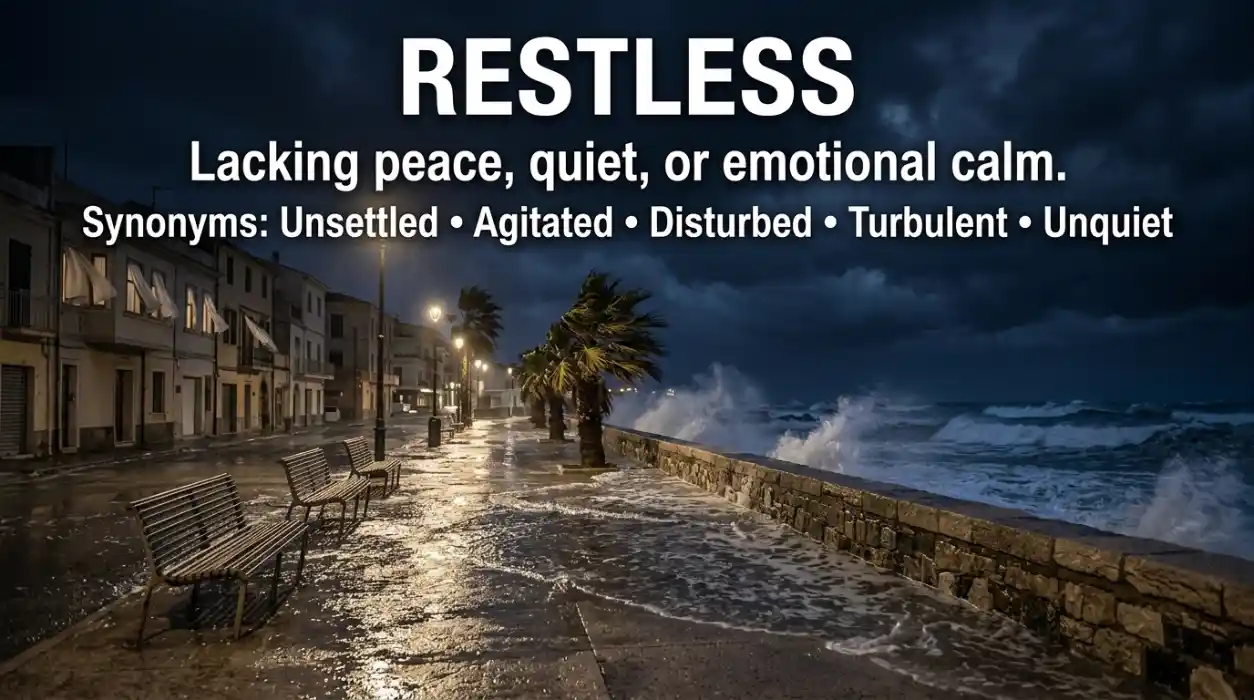
Unquiet (adjective) — US /ʌnˈkwaɪət/ | UK /ʌnˈkwaɪət/
Meaning: Lacking peace, quiet, or emotional calm.
Tone/Register: Literary, formal.
Examples:
“She spent an unquiet night.”
“The city felt unquiet after the announcement.”
Discontented (adjective) — US /ˌdɪs.kənˈtent̬.ɪd/ | UK /ˌdɪs.kənˈtent.ɪd/
Meaning: Unhappy because the current situation does not feel satisfactory.
Tone/Register: Formal, academic.
Examples:
“He became discontented with his routine.”
“She felt discontented in her old role.”
Dissatisfied (adjective) — US /dɪˈsæt̬.ɪs.faɪd/ | UK /dɪˈsæt.ɪs.faɪd/
Meaning: Not pleased with a situation, result, or experience.
Tone/Register: Neutral, formal.
Examples:
“Customers were dissatisfied with the service.”
“She felt dissatisfied with her progress.”
Bored (adjective) — US /bɔːrd/ | UK /bɔːd/
Meaning: Uninterested because something feels dull or repetitive.
Tone/Register: Everyday.
Examples:
“The students were bored after two hours.”
“I get bored when meetings run too long.”
Tired of (adjective phrase) — US /taɪərd əv/ | UK /taɪəd əv/
Meaning: No longer interested in or satisfied with something because it has continued too long.
Tone/Register: Conversational.
Examples:
“She was tired of doing the same task.”
“He was tired of waiting for an answer.”
Weary (adjective) — US /ˈwɪr.i/ | UK /ˈwɪə.ri/
Meaning: Physically or emotionally tired, often after prolonged difficulty.
Tone/Register: Formal, literary.
Examples:
“After months of delays, they felt weary.”
“He gave a weary sigh.”
Disquieted (adjective) — US /dɪsˈkwaɪət̬ɪd/ | UK /dɪsˈkwaɪətɪd/
Meaning: Made worried or uneasy by something disturbing.
Tone/Register: Formal, literary.
Examples:
“The strange message left her disquieted.”
“He looked disquieted by the sudden silence.”
Perturbed (adjective) — US /pərˈtɝːbd/ | UK /pəˈtɜːbd/
Meaning: Worried or upset because something has disturbed your peace of mind.
Tone/Register: Formal.
Examples:
“She seemed perturbed by the comment.”
“He was visibly perturbed by the delay.”
Troubled (adjective) — US /ˈtrʌb.əld/ | UK /ˈtrʌb.əld/
Meaning: Emotionally worried or disturbed by a problem.
Tone/Register: Neutral, literary.
Examples:
“He looked troubled after the meeting.”
“She had a troubled night.”
Turbulent (adjective) — US /ˈtɝː.bjə.lənt/ | UK /ˈtɜː.bjə.lənt/
Meaning: Characterized by disorder, conflict, or continual change.
Tone/Register: Formal, descriptive.
Examples:
“The country entered a turbulent period.”
“She had a turbulent year.”
Chaotic (adjective) — US /keɪˈɑː.tɪk/ | UK /keɪˈɒt.ɪk/
Meaning: Completely disorganized, unpredictable, or lacking order.
Tone/Register: Neutral, strong.
Examples:
“The morning became chaotic.”
“The station was chaotic during the delay.”
Erratic (adjective) — US /ɪˈræt̬.ɪk/ | UK /ɪˈræt.ɪk/
Meaning: Unpredictable or lacking a regular pattern.
Tone/Register: Formal, analytical.
Examples:
“His sleep schedule has become erratic.”
“The machine showed erratic movement.”
Volatile (adjective) — US /ˈvɑːlət̬əl/ | UK /ˈvɒlətaɪl/
Meaning: Likely to change suddenly, especially in an unstable or emotional way.
Tone/Register: Formal, professional.
Examples:
“The situation remained volatile.”
“His mood became increasingly volatile.”
Fussy (adjective) — US /ˈfʌs.i/ | UK /ˈfʌs.i/
Meaning: Easily annoyed, difficult to satisfy, or uncomfortable.
Tone/Register: Informal.
Examples:
“The baby was fussy all evening.”
“He gets fussy when he is tired.”
Squirmy (adjective) — US /ˈskwɝː.mi/ | UK /ˈskwɜː.mi/
Meaning: Frequently moving the body because sitting still feels difficult.
Tone/Register: Informal, playful.
Examples:
“The toddler became squirmy during the story.”
“He gets squirmy during long car rides.”
Twitchy (adjective) — US /ˈtwɪtʃ.i/ | UK /ˈtwɪtʃ.i/
Meaning: Nervous or physically tense, with small sudden movements.
Tone/Register: Informal.
Examples:
“I get twitchy when I have too much coffee.”
“He looked twitchy before the interview.”
Antsy (adjective) — US /ˈænt.si/ | UK /ˈænt.si/
Meaning: Unable to relax because you are bored, nervous, or eager for something to happen.
Tone/Register: Informal, especially North American.
Examples:
“The kids were getting antsy in the car.”
“I felt antsy waiting for the results.”
Edgy (adjective) — US /ˈedʒ.i/ | UK /ˈedʒ.i/
Meaning: Nervous, tense, or easily irritated.
Tone/Register: Informal.
Examples:
“He seemed edgy after the argument.”
“She was a little edgy before the presentation.”
Uptight (adjective) — US /ˌʌpˈtaɪt/ | UK /ˌʌpˈtaɪt/
Meaning: Very tense, worried, or unable to relax.
Tone/Register: Informal.
Examples:
“Try not to get so uptight about the schedule.”
“He seemed uptight during the meeting.”
Impetuous (adjective) — US /ɪmˈpetʃ.u.əs/ | UK /ɪmˈpetʃ.u.əs/
Meaning: Acting suddenly and without enough thought.
Tone/Register: Formal, literary.
Examples:
“His restless energy led to an impetuous decision.”
“She made an impetuous move.”
Unsettled-minded (adjective) — US /ʌnˈset̬.əld maɪndɪd/ | UK /ʌnˈset.əld maɪndɪd/
Meaning: Mentally uncertain or unable to settle on a stable thought or direction.
Tone/Register: Literary, descriptive.
Examples:
“He remained unsettled-minded after the move.”
“She felt unsettled-minded about her future.”
Inconstant (adjective) — US /ɪnˈkɑːn.stənt/ | UK /ɪnˈkɒn.stənt/
Meaning: Frequently changing in interests, feelings, or behavior.
Tone/Register: Formal, literary.
Examples:
“His inconstant attention made studying difficult.”
“She had an inconstant approach to her plans.”
Change-seeking (adjective) — US /ˈtʃeɪndʒ ˌsiː.kɪŋ/ | UK /ˈtʃeɪndʒ ˌsiː.kɪŋ/
Meaning: Wanting new experiences or a different situation instead of remaining where you are.
Tone/Register: Modern, descriptive.
Examples:
“Her change-seeking nature led her abroad.”
“He has always been change-seeking.”
Itchy-footed (adjective) — US /ˌɪtʃ.i ˈfʊt̬ɪd/ | UK /ˌɪtʃ. i ˈfʊt.ɪd/
Meaning: Eager to travel or move rather than remain in one place.
Tone/Register: Informal, idiomatic.
Examples:
“After graduation, she felt itchy-footed.”
“He is too itchy-footed to stay home for long.”

Wanderlust-driven (adjective) — US /ˈwɑːn.dər.lʌst ˌdrɪvən/ | UK /ˈwɒn.də.lʌst ˌdrɪvən/
Meaning: Motivated by a strong desire to travel and experience new places.
Tone/Register: Informal, creative.
Examples:
“His wanderlust-driven lifestyle keeps him moving.”
“She has a wanderlust-driven approach to life.”
Perpetually Active (adjective phrase) — US /pərˈpetʃ.u.ə.li ˈæk.tɪv/ | UK /pəˈpetʃ.u.ə.li ˈæk.tɪv/
Meaning: Almost constantly engaged in movement or activity.
Tone/Register: Neutral, descriptive.
Examples:
“She is perpetually active and rarely sits down.”
“The puppy is perpetually active.”
Unable to Settle (adjective phrase) — US /ʌnˈeɪ.bəl tə ˈset̬.əl/ | UK /ʌnˈeɪ.bəl tə ˈset.əl/
Meaning: Unable to become physically or emotionally calm or settled.
Tone/Register: Neutral, descriptive.
Examples:
“He was unable to settle after the argument.”
“The baby was unable to settle at bedtime.”
Unable to Relax (adjective phrase) — US /ʌnˈeɪ.bəl tə rɪˈlæks/ | UK /ʌnˈeɪ.bəl tə rɪˈlæks/
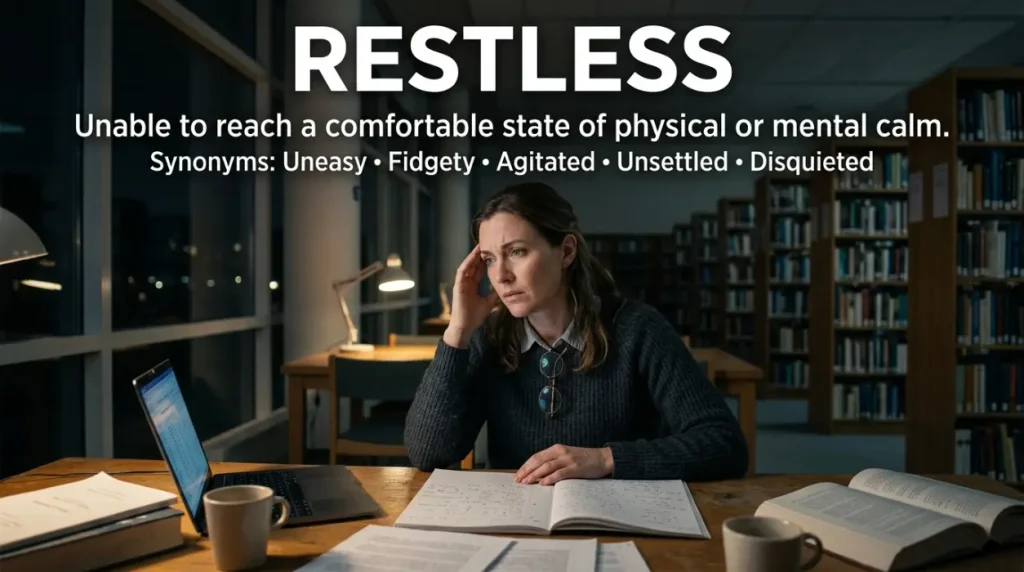
Meaning: Unable to enter a comfortable state of physical or mental calm.
Tone/Register: Neutral, everyday.
Examples:
“I was unable to relax before the flight.”
“She felt unable to relax after work.”
Synonyms by Tone
Positive
- Energetic
- Eager
- Excitable
- Active
- Change-seeking
- Itchy-footed
- Wanderlust-driven
These words can emphasize energy, curiosity, enthusiasm, or a desire for new experiences.
Neutral
- Uneasy
- Unsettled
- Restless
- Nervous
- Tense
- Distracted
- Impatient
- Sleepless
- Unable to relax
- Unable to settle
These are useful when you want to describe the feeling without strongly judging it.
Negative
- Agitated
- Distraught
- Discontented
- Dissatisfied
- Disquieted
- Perturbed
- Troubled
- Volatile
- Chaotic
- Uptight
These alternatives generally carry a stronger sense of emotional difficulty or instability.
Playful or Informal
- Fidgety
- Jittery
- Ansy
- Squirmy
- Twitchy
- Fussy
- Wired
- Edgy
These fit casual conversations and descriptions of everyday behavior.
Why Tone Matters
Consider these sentences:
“The child was fidgety.”
“The child was anxious.”
“The child was impatient.”
This suggests frustration with waiting.
“The child was energetic.”
This can sound positive.
The situation has not necessarily changed. The speaker’s focus has changed.
Restless vs Close Alternatives
Anxious vs Restless
Restless focuses on an inability to relax or remain still.
Anxious focuses more directly on worry or fear.
Use restless when movement or discomfort matters.
Use anxious when concern about a possible outcome matters.
Restless vs Fidgety
Restless is broader.
It can describe physical movement, poor sleep, dissatisfaction, or a desire for change.
Fidgety mainly describes small, repeated physical movements.
A child can be fidgety during class without feeling deeply worried.
Restless vs Restive
These words look similar but have different usage patterns.
Restless is common and flexible.
Restive is more formal and often describes impatience, resistance, or inability to remain controlled.
For everyday English, restless is usually more natural.
How “Restless” Changes by Context
Daily Conversation
In everyday speech, restless often describes people who cannot sit still or relax.
“The kids are getting restless.”
This sounds completely natural.
For casual speech, antsy and fidgety can also work.
Writing and Blogging
Blog writers can use restless when discussing travel, productivity, boredom, creativity, lifestyle changes, or emotional experiences.
For example:
“A restless mind often searches for something new.”
A synonym can then prevent repetition.
“That uneasy feeling may appear when your routine becomes predictable.”
Professional or Academic Tone
Academic writing often benefits from precision.
Instead of writing:
“The participants felt restless.”
you might need a more specific word.
If the participants were worried, anxious may be more accurate.
If they were dissatisfied, discontented may be more precise.
Creative or Informal Use
Creative writing gives restless more freedom.
A writer might describe:
- A restless ocean
- A restless city
- A restless mind
- A restless generation
- A restless ambition
- A restless night
The word can create movement and emotional tension without explaining everything directly.
Common Mistakes Learners Make
Mistake 1: Treating Every Synonym as Identical
Restless, anxious, and impatient overlap, but they are not interchangeable in every sentence.
Choose the word that explains the specific feeling.
Mistake 2: Using “Restive” as a Direct Replacement Everywhere
Restive is less common and more formal.
Replacing every occurrence of restless with restive can make ordinary writing sound unnatural.
Mistake 3: Confusing Restless With Restful
These words have opposite meanings in many contexts.
Restless: unable to rest or relax.
Restful: providing or characterized by rest.
Compare:
“I had a restless night.”
“I had a restful night.”
Mistake 4: Using “Hyperactive” Too Casually
Hyperactive can carry a specific clinical or behavioral meaning.
Do not automatically use it whenever someone moves a lot.
For ordinary situations, active, fidgety, or restless may be more appropriate.
Mistake 5: Using “Nervous” When You Mean Bored
Someone may become restless because they are bored.
That does not necessarily mean they are nervous.
“The students became restless during the long lecture.”
This does not automatically mean:
“The students became nervous.”
Mistake 6: Overusing Restless
Repeatedly using the same adjective can make writing feel flat.
Instead, identify the exact shade:
- Movement → fidgety
- Worry → anxious
- Waiting → impatient
- Dissatisfaction → discontented
- Poor sleep → sleepless
- Nervous tension → jittery
Register Notes
Formal: agitated, perturbed, disquieted, discontented, restive
Neutral: restless, uneasy, unsettled, tense, nervous
Informal: antsy, fidgety, jittery, wired, uptight, edgy
Literary: fretful, unquiet, weary, disquieted, restless
Positive: energetic, eager, active, excitable
Professional: agitated, unsettled, anxious, volatile
For broader vocabulary practice, an internal guide to synonyms for anxious and nervous can help learners compare nearby emotional words.
Real-Life Mini Scenarios
Workplace
An employee may feel restless after doing the same task for several years.
If the main feeling is dissatisfaction, discontented may be more precise.
Social Situation
A person waiting for a late friend may become impatient.
Someone worried about the friend’s safety may feel anxious.
Media and Pop Culture
A movie may describe a character as restless when they cannot accept an ordinary life.
A reviewer might call the character ambitious, unsettled, or change-seeking, depending on the intended meaning.
Writing and Storytelling
A novelist can use restless to create tension:
“The restless sea kept him awake.”
A different word creates a different image:
“The turbulent sea kept him awake.”
The first suggests continuous movement.
The second suggests greater violence or disorder.
Practice Quiz
1. The children keep moving in their seats during a two-hour lecture.
A. Discontented
B. Fidgety
C. Sleepless
D. Volatile
2. Maria is worried about her job interview tomorrow.
A. Anxious
B. Energetic
C. Bored
D. Active
3. The customer has waited an hour and wants the service to begin.
A. Eager
B. Impatient
C. Sleepless
D. Fretful
4. After ten years in the same job, Daniel wants a major change.
A. Fidgety
B. Discontented
C. Jittery
D. Fussy
5. The baby could not sleep well throughout the night.
A. Restless
B. Energetic
C. Impetuous
D. Excitable
6. Someone drinks too much coffee and cannot relax.
A. Wired
B. Weary
C. Discontented
D. Unquiet
7. A writer wants a formal word for someone impatient and difficult to control.
A. Fidgety
B. Restive
C. Squirmy
D. Bored
8. A toddler keeps wriggling during a long car journey.
A. Squirmy
B. Perturbed
C. Dissatisfied
D. Volatile
9. A person is upset because something disturbing happened.
A. Disquieted
B. Energetic
C. Eager
D. Active
10. A person feels tense and worried before an important announcement.
A. Anxious
B. Itchy-footed
C. Fussy
D. Active
Answer key: 1-B | 2-A | 3-B | 4-B | 5-A | 6-A | 7-B | 8-A | 9-A | 10-A
Reflection Task
Write one sentence using restless, then rewrite it using one of the 50 synonyms above.
Ask yourself: Did the emotional meaning change?
That small exercise helps turn passive vocabulary into active vocabulary.
Conclusion
Learning synonyms for restless gives you more than a longer vocabulary list. It helps you identify whether a person feels worried, bored, impatient, energetic, dissatisfied, or simply unable to relax.
The most useful choices include uneasy, anxious, fidgety, impatient, unsettled, agitated, restive, and discontented. Each word adds a slightly different shade to your message.
Better synonym knowledge can strengthen essays, blogs, stories, emails, conversations, and everyday communication. Precise vocabulary helps readers understand not only what happened, but how it felt.
Keep practicing by replacing restless with different alternatives in your own sentences. Try them in an email, an essay, and a daily conversation to make the differences natural.
External sources
For authoritative definitions, usage, pronunciation, and learner examples, consult the Oxford Learner’s Dictionaries, Cambridge Dictionary, and Etymonline
Frequently Asked Questions
1. What are the best synonyms for restless when describing a person?
The best synonym depends on the reason for the restlessness. Fidgety works for physical movement, anxious for worry, impatient for difficulty waiting, and discontented for dissatisfaction. Uneasy is a flexible choice when someone feels uncomfortable or unable to relax without a clearly defined cause.
2. What is a good synonym for restless in writing?
Uneasy, unsettled, agitated, fidgety, anxious, and impatient can all work, depending on context. For creative writing, restless itself is often powerful because it can describe a person, mind, night, sea, city, or atmosphere. Choose a more specific synonym when you want to highlight one particular cause or emotion.
3. What is the difference between restless and anxious?
Restless describes an inability to relax, stay still, or feel satisfied. Anxious specifically emphasizes worry, nervousness, or concern about something. A person can be restless without being anxious, such as when they are bored. However, anxiety can also cause physical restlessness.
4. Is “restive” a synonym for restless?
Yes, but restive is more formal and has a narrower use. It often describes impatience, resistance, or an inability to remain calm under control or while waiting. Restless is much more common in everyday English. For ordinary conversation, restless will usually sound more natural.
5. What is the difference between restless and fidgety?
Restless has several meanings, including physical movement, poor sleep, dissatisfaction, and a desire for change. Fidgety specifically suggests repeated small movements, such as tapping your foot, shifting in your chair, or playing with your hands. Therefore, fidgety is more focused on visible physical behavior.

Shahzeena Shazadi is the founder and lead writer at VocablyHub.com, where she creates accurate, reader-focused English language content designed to help people communicate with clarity and confidence. She specializes in synonyms, antonyms, word meanings, idioms, and practical vocabulary guides that simplify complex language concepts for everyday use. Every article is carefully researched, fact-checked, and written in clear, accessible language using reliable references and real-world examples. Her goal is to provide helpful, trustworthy content that supports learners at every stage of their English language journey.
Her editorial approach focuses on accuracy, transparency, and user value while following modern content quality standards. She regularly reviews and updates content to keep information relevant, useful, and easy to understand. Through VocablyHub.com, Shahzeena Shazadi is committed to publishing reliable language resources that help students, writers, educators, professionals, and English learners expand their vocabulary, improve their writing skills, and communicate with confidence in academic, professional, and everyday situations.