
Synonyms for randomness include unpredictability, chance, uncertainty, arbitrariness, haphazardness, irregularity, chaos, fortuity, happenstance, and stochasticity. The best choice depends on context. Use unpredictability for uncertain outcomes, chance for possibility, chaos for disorder, and stochasticity for technical writing.
Synonyms for randomness can make a sentence sharper when “randomness” appears too often. A student may need a more precise word for an essay.
Imagine a friend saying, “The result was pure randomness.” In another context, “chance,” “coincidence,” or “unpredictability” may sound more natural.
The word is common because it describes events we cannot fully predict or control. Its alternatives help students, bloggers, and writers show finer shades.
Daily English users also benefit. The right synonym can make a message sound clearer, more natural, technical, playful, or thoughtful.
What Does “Randomness” Really Mean?
Randomness is the quality of happening without a predictable pattern, fixed order, deliberate plan, or clearly determined outcome.
It is a noun.
In simple English, randomness means that you cannot reliably predict what will happen next because there is no obvious pattern guiding the result.
For example:
“The winner was selected by randomness.”
A more natural sentence would often be:
“The winner was selected at random.”
Randomness is common in everyday conversation, statistics, science, mathematics, games, technology, research, storytelling, and casual descriptions.
Native speakers usually understand it as a neutral concept. It does not automatically mean something is bad.
The emotional effect depends on context.
Randomness can describe a fun surprise, an unpredictable event, a scientific process, a disorganized situation, or an outcome that seems completely uncontrolled.
What Is the Connotation of “Randomness”?
Connotation (the feeling, association, or emotional shade that a word carries beyond its basic dictionary meaning) can change how randomness sounds.
Positive Tone
Randomness can suggest surprise, freedom, creativity, discovery, or spontaneity.
For example, an unexpected song recommendation may feel exciting rather than confusing.
Negative Tone
Randomness can suggest disorder, carelessness, confusion, or lack of control.
For example, a manager may criticize the randomness of a poorly organized process.
Neutral Tone
In mathematics, science, statistics, and ordinary factual writing, randomness is often neutral.
It simply describes a lack of predictable pattern or a process influenced by chance.
Etymology of “Randomness”
The word randomness comes from the adjective random, with the suffix -ness added to form a noun describing a quality or state.
The deeper history of random is connected to Middle English randon, influenced by Anglo-French and Old French terms associated with great speed, force, impetuosity, or disorderly movement.
Over time, the word developed toward the modern idea of something occurring without a fixed plan or predictable pattern.
Old English: 450–1100
There was no direct modern noun randomness in Old English.
English vocabulary of the period included words for chance, uncertainty, disorder, and unpredictable events, but random had not yet developed into its modern English form.
Middle English: 1100–1500
During Middle English, forms related to random entered English through French influence.
The word could describe uncontrolled movement or acting without restraint. Its sense gradually moved toward ideas of disorder and lack of direction.
Modern English: 1500–Present
In Modern English, random developed broader meanings connected with chance and unpredictability.
The noun randomness later became useful for describing the quality or condition of being random.
Today, the word has especially important meanings in mathematics, statistics, science, computing, games, and everyday English.
Pronunciation of “Randomness”
US: /ˈrændəmnəs/
UK: /ˈrændəmnəs/
Syllables
ran-dom-ness
Affixation Pattern of “Randomness”
Root: random
Prefix: none
Suffix: -ness
The suffix -ness turns an adjective into a noun describing a state, quality, or condition.
For example:
- random → randomness
- happy → happiness
- dark → darkness
- kind → kindness
Synonyms List
The following list includes direct synonyms, close alternatives, technical terms, and useful phrase-level substitutes.
Not every item can replace randomness in every sentence. Some describe a particular type of randomness, such as chance, disorder, unpredictability, variation, or lack of purpose.
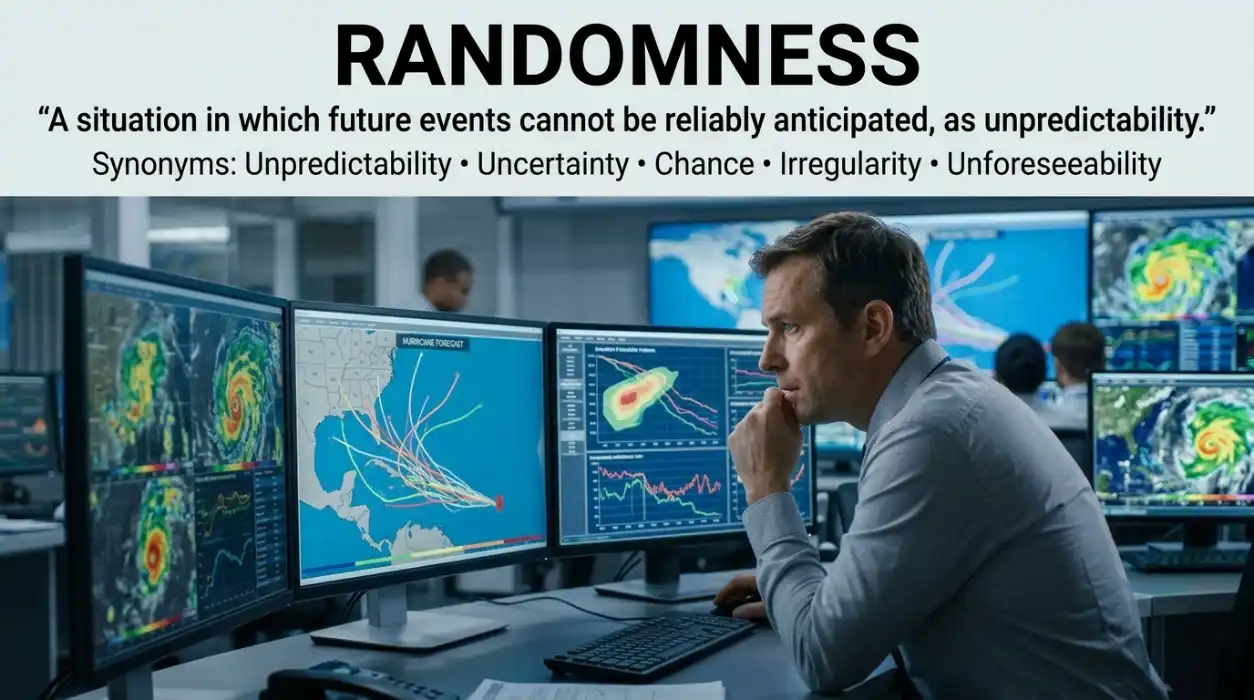
Unpredictability (Noun) — US /ˌʌnprɪˌdɪktəˈbɪləti/ — UK /ˌʌnprɪˌdɪktəˈbɪləti/
Meaning: Unpredictability describes a situation in which future events cannot be reliably anticipated.
Tone/Register: Neutral; common in everyday, professional, and academic English.
Examples:
The unpredictability of the weather made our travel plans difficult.
Her unpredictability makes every conversation interesting.
Chance (Noun) — US /tʃæns/ — UK /tʃɑːns/
Meaning: Chance refers to events or outcomes that happen without being deliberately controlled or guaranteed.
Tone/Register: Neutral; extremely common.
Examples:
We met by chance at the airport.
There is a good chance that the plan will change.
Uncertainty (Noun) — US /ʌnˈsɝːtənti/ — UK /ʌnˈsɜːtənti/
Meaning: Uncertainty describes a lack of knowledge or confidence about what will happen.
Tone/Register: Neutral to formal; common in academic and professional writing.
Examples:
The uncertainty surrounding the results caused concern.
Market uncertainty affected the team’s plans.
Haphazardness (Noun) — US /hæpˈhæzərdnəs/ — UK /hæpˈhæzədnəs/
Meaning: Haphazardness describes a lack of organization, planning, or care.
Tone/Register: Neutral to negative; common in critical writing.
Examples:
The haphazardness of the filing system caused delays.
The project suffered from haphazardness rather than a clear plan.
Arbitrariness (Noun) — US /ˌɑːrbəˈtrɛrinəs/ — UK /ˌɑːbɪˈtreərɪnəs/
Meaning: Arbitrariness describes decisions or choices made without a clear rule, reason, or consistent principle.
Tone/Register: Formal and academic.
Example: Students questioned the arbitrariness of the decision.
The rule seemed arbitrary rather than carefully designed.
Irregularity (Noun) — US /ɪˌrɛɡjəˈlærəti/ — UK /ɪˌreɡjʊˈlærəti/
Meaning: Irregularity describes a lack of consistent pattern, timing, or form.
Tone/Register: Neutral to formal.
Examples:
The irregularity of the signals made them difficult to analyze.
We noticed an irregularity in the usual schedule.
Disorder (Noun) — US /dɪsˈɔːrdər/ — UK /dɪsˈɔːdə/
Meaning: Disorder emphasizes a lack of organization, structure, or arrangement.
Tone/Register: Neutral to negative.
Examples:
The room was left in complete disorder.
The disorder of the data made the pattern difficult to see.
Chaos (Noun) — US /ˈkeɪɑːs/ — UK /ˈkeɪɒs/
Meaning: Chaos describes extreme disorder in which events or things seem uncontrolled.
Tone/Register: Strong, informal to neutral.
Examples:
The office descended into chaos after the system failed.
Traffic was complete chaos after the accident.
Fortuity (Noun) — US /fɔːrˈtuːəti/ — UK /fɔːˈtjuːəti/
Meaning: Fortuity refers to an event or result that occurs by chance.
Tone/Register: Formal or literary.
Examples:
Their meeting was a result of pure fortuity.
The discovery depended partly on fortuity.
Happenstance (Noun) — US /ˈhæpənstæns/ — UK /ˈhæpənstæns/
Meaning: Happenstance describes an event that occurs by chance rather than by design.
Tone/Register: Neutral to literary.
Examples:
Their friendship began through happenstance.
By happenstance, we chose the same restaurant.
Coincidence (Noun) — US /koʊˈɪnsɪdəns/ — UK /kəʊˈɪnsɪdəns/
Meaning: A coincidence is an unexpected connection between events that happen without an obvious causal plan.
Tone/Register: Neutral; very common.
Examples:
Meeting my old teacher there was a strange coincidence.
It was a coincidence that both families arrived together.
Serendipity (Noun) — US /ˌserənˈdɪpəti/ — UK /ˌserənˈdɪpəti/
Meaning: Serendipity describes a fortunate discovery or outcome that happens unexpectedly.
Tone/Register: Positive, literary, and conversational.
Examples:
Finding that little bookstore was pure serendipity.
Their unexpected meeting led to a wonderful friendship.
Stochasticity (Noun) — US /ˌstoʊkæˈstɪsəti/ — UK /ˌstɒkəˈstɪsəti/
Meaning: Stochasticity refers to behavior or variation involving probability and random processes.
Tone/Register: Technical and academic.
Examples:
Researchers modeled the stochasticity of the system.
The stochasticity of the process affected the results.
Variability (Noun) — US /ˌveriəˈbɪləti/ — UK /ˌveəriəˈbɪləti/
Meaning: Variability describes the degree to which something changes or differs across situations.
Tone/Register: Neutral to academic.
Examples:
There is considerable variability in the test results.
Weather variability makes long-term planning difficult.
Fluctuation (Noun) — US /ˌflʌktʃuˈeɪʃən/ — UK /ˌflʌktʃuˈeɪʃən/
Meaning: Fluctuation describes repeated changes, especially rises and falls.
Tone/Register: Neutral to formal.
Examples:
Daily fluctuations made the numbers difficult to compare.
Small fluctuations were recorded throughout the experiment.
Volatility (Noun) — US /ˌvɑːləˈtɪləti/ — UK /ˌvɒləˈtɪləti/
Meaning: Volatility describes a tendency to change rapidly and unpredictably.
Tone/Register: Formal; common in business, finance, and technical contexts.
Examples:
The volatility of demand made planning difficult.
The system showed unexpected volatility during testing.
Capriciousness (Noun) — US /kəˈprɪʃəsnəs/ — UK /kəˈprɪʃəsnəs/
Meaning: Capriciousness describes unpredictable changes caused by sudden or seemingly unreasonable choices.
Tone/Register: Formal to literary; often negative.
Examples:
The capriciousness of the weather surprised the hikers.
His capriciousness made the schedule hard to trust.
Spontaneity (Noun) — US /ˌspɑːntəˈniːəti/ — UK /ˌspɒntəˈniːəti/
Meaning: Spontaneity describes actions that happen naturally without planning.
Tone/Register: Usually positive or neutral.
Examples:
I enjoy the spontaneity of weekend trips.
Her spontaneity brought energy to the event.
Contingency (Noun) — US /kənˈtɪndʒənsi/ — UK /kənˈtɪndʒənsi/
Meaning: Contingency refers to a possible future event that depends on circumstances and cannot be completely controlled.
Tone/Register: Formal and professional.
Examples:
We prepared a backup plan for every major contingency.
The schedule depends on several contingencies.
Accident (Noun) — US /ˈæksɪdənt/ — UK /ˈæksɪdənt/
Meaning: An accident is an unplanned event that occurs unintentionally.
Tone/Register: Neutral; extremely common.
Examples:
I discovered the mistake by accident.
The meeting happened by accident rather than by arrangement.
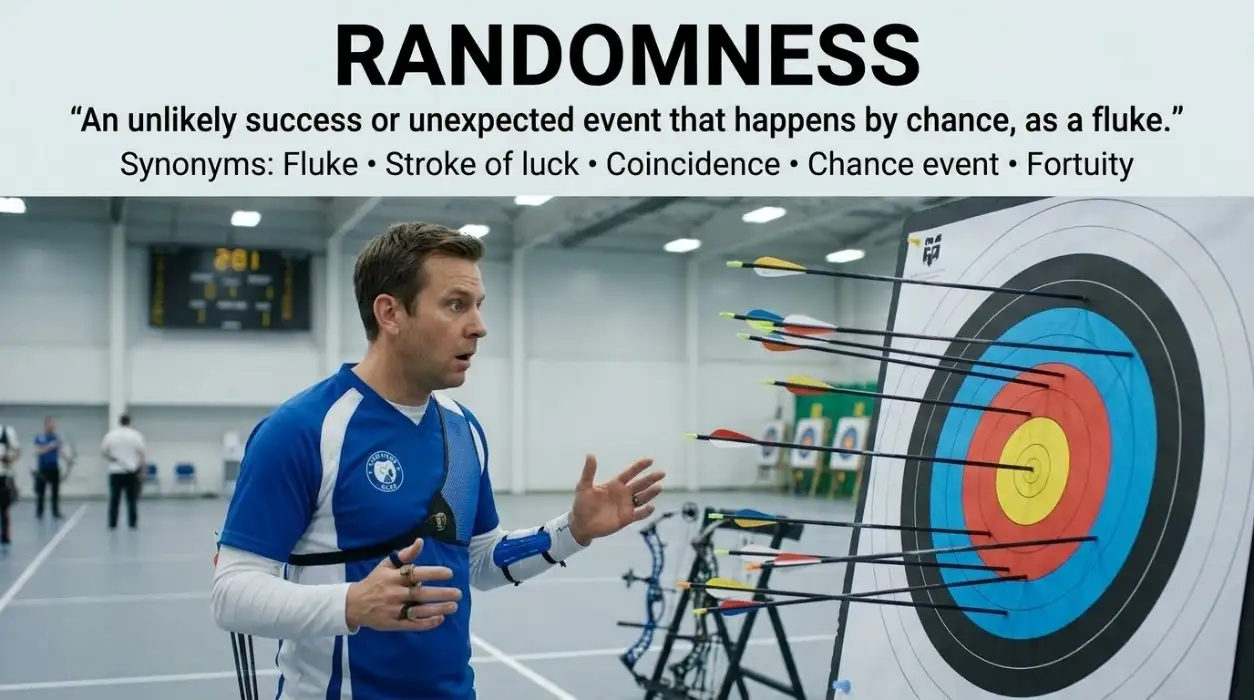
Fluke (Noun) — US /fluːk/ — UK /fluːk/
Meaning: A fluke is an unlikely success or event that happens unexpectedly.
Tone/Register: Informal.
Examples:
Winning the contest was a complete fluke.
That perfect shot was a lucky fluke.
Random Variation (Noun Phrase) — US /ˈrændəm ˌveriˈeɪʃən/ — UK /ˈrændəm ˌveəriˈeɪʃən/
Meaning: Random variation refers to differences that occur without a predictable systematic pattern.
Tone/Register: Academic and scientific.
Examples:
Some differences were caused by random variation.
The researchers separated real trends from random variation.
Random Occurrence (Noun Phrase) — US /ˈrændəm əˈkɝːəns/ — UK /ˈrændəm əˈkʌrəns/
Meaning: A random occurrence is an event that happens without a predictable pattern.
Tone/Register: Neutral and formal.
Examples:
The unusual result may have been a random occurrence.
We cannot assume every random occurrence has a deeper cause.
Random Behavior (Noun Phrase) — US /ˈrændəm bɪˈheɪvjər/ — UK /ˈrændəm bɪˈheɪvjə/
Meaning: Random behavior describes actions or movements that do not follow a predictable pattern.
Tone/Register: Neutral to technical.
Examples:
The software showed random behavior after the update.
The animal’s random behavior was difficult to study.
Chance Variation (Noun Phrase) — US /tʃæns ˌveriˈeɪʃən/ — UK /tʃɑːns ˌveəriˈeɪʃən/
Meaning: Chance variation describes differences produced by chance rather than a consistent underlying pattern.
Tone/Register: Academic and scientific.
Examples:
The small difference may be chance variation.
The effect was separated from chance variation during analysis.
Chance Occurrence (Noun Phrase) — US /tʃæns əˈkɝːəns/ — UK /tʃɑːns əˈkʌrəns/
Meaning: A chance occurrence is an event that happens unexpectedly and without deliberate planning.
Tone/Register: Neutral to formal.
Examples:
Their meeting was a chance occurrence.
The unusual event may have been a chance occurrence.
Chance Event (Noun Phrase) — US /tʃæns ɪˈvent/ — UK /tʃɑːns ɪˈvent/
Meaning: A chance event is an outcome determined partly or entirely by chance.
Tone/Register: Neutral; common in academic contexts.
Examples:
The experiment included several chance events.
A chance event changed the outcome.
Accidentalness (Noun) — US /ˌæksɪˈdentəlnəs/ — UK /ˌæksɪˈdentəlnəs/
Meaning: Accidentalness describes the quality of happening unintentionally rather than deliberately.
Tone/Register: Formal and less common.
Examples:
The accidentalness of the discovery made it memorable.
The process had an element of accidentalness.
Aimlessness (Noun) — US /ˈeɪmləsnəs/ — UK /ˈeɪmləsnəs/
Meaning: Aimlessness describes a lack of clear purpose or direction.
Tone/Register: Neutral to negative.
Examples:
The aimlessness of the discussion frustrated the team.
His wandering had an air of aimlessness.
Purposelessness (Noun) — US /ˈpɝːpəsləsnəs/ — UK /ˈpɜːpəsləsnəs/
Meaning: Purposelessness describes a condition in which actions appear to have no clear purpose.
Tone/Register: Formal or philosophical.
Examples:
The repetition gave the story a feeling of purposelessness.
She questioned the purposelessness of the exercise.
Lack of Pattern (Noun Phrase) — US /ˌlæk əv ˈpætərn/ — UK /ˌlæk əv ˈpætən/
Meaning: Lack of pattern means that no consistent or predictable arrangement can be identified.
Tone/Register: Neutral and highly clear.
Examples:
The lack of pattern made the data difficult to interpret.
We noticed a lack of pattern in the responses.
Lack of Order (Noun Phrase) — US /ˌlæk əv ˈɔːrdər/ — UK /ˌlæk əv ˈɔːdə/
Meaning: Lack of order emphasizes the absence of structure or organized arrangement.
Tone/Register: Neutral.
Examples:
The lack of order slowed the search.
The files showed a clear lack of order.
Lack of Predictability (Noun Phrase) — US /ˌlæk əv prɪˌdɪktəˈbɪləti/ — UK /ˌlæk əv prɪˌdɪktəˈbɪləti/
Meaning: Lack of predictability directly describes a situation where future outcomes are difficult to anticipate.
Tone/Register: Neutral to formal.
Examples:
The lack of predictability made planning difficult.
The system was changed because of its lack of predictability.
Absence of Pattern (Noun Phrase) — US /ˈæbsəns əv ˈpætərn/ — UK /ˈæbsəns əv ˈpætən/
Meaning: Absence of pattern means that no regular relationship or sequence is visible.
Tone/Register: Formal and analytical.
Examples:
The absence of pattern raised new questions.
The absence of pattern was confirmed by further testing.
Absence of Order (Noun Phrase) — US /ˈæbsəns əv ˈɔːrdər/ — UK /ˈæbsəns əv ˈɔːdə/
Meaning: Absence of order describes a condition without a recognizable organizational structure.
Tone/Register: Formal.
Examples:
The absence of order made the collection difficult to study.
The absence of order was obvious from the scattered records.
Non-determinism (Noun) — US /ˌnɑːndɪˈtɝːmɪnɪzəm/ — UK /ˌnɒndɪˈtɜːmɪnɪzəm/
Meaning: Non-determinism describes a system in which the same conditions do not necessarily produce one fixed outcome.
Tone/Register: Technical and academic.
Examples:
The model allows for non-determinism.
Non-determinism is important in some areas of computing and mathematics.
Indeterminacy (Noun) — US /ˌɪndɪˈtɝːmɪnəsi/ — UK /ˌɪndɪˈtɜːmɪnəsi/
Meaning: Indeterminacy describes a condition in which an outcome or meaning cannot be precisely determined.
Tone/Register: Formal, academic, and philosophical.
Examples:
The evidence left some indeterminacy in the final result.
The novel deliberately embraces indeterminacy.
Whimsy (Noun) — US /ˈwɪmzi/ — UK /ˈwɪmzi/
Meaning: Whimsy describes playful or imaginative unpredictability.
Tone/Register: Playful and literary.
Examples:
The designer added a touch of whimsy to the room.
The story moves with charming whimsy.
Whim (Noun) — US /wɪm/ — UK /wɪm/
Meaning: A whim is a sudden desire or decision without a strong practical reason.
Tone/Register: Informal to neutral.
Examples:
We booked the trip on a whim.
She changed the design on a whim.
Caprice (Noun) — US /kəˈpriːs/ — UK /kəˈpriːs/
Meaning: Caprice refers to a sudden, unpredictable change of mind or behavior.
Tone/Register: Literary and formal.
Examples:
The schedule changed according to the manager’s caprice.
The character acts according to sudden caprice.
Vagary (Noun) — US /ˈveɪɡəri/ — UK /ˈveɪɡəri/
Meaning: A vagary is an unexpected or unpredictable event, especially a change in circumstances.
Tone/Register: Literary and formal.
Examples:
We had to adapt to the vagaries of the weather.
The team’s plans were shaped by the vagaries of travel.
Erraticness (Noun) — US /ɪˈrætɪknəs/ — UK /ɪˈrætɪknəs/
Meaning: Erraticness describes behavior that changes unpredictably and lacks consistency.
Tone/Register: Neutral to formal.
Examples:
The erraticness of the machine worried the technician.
His erraticness made the conversation difficult to follow.
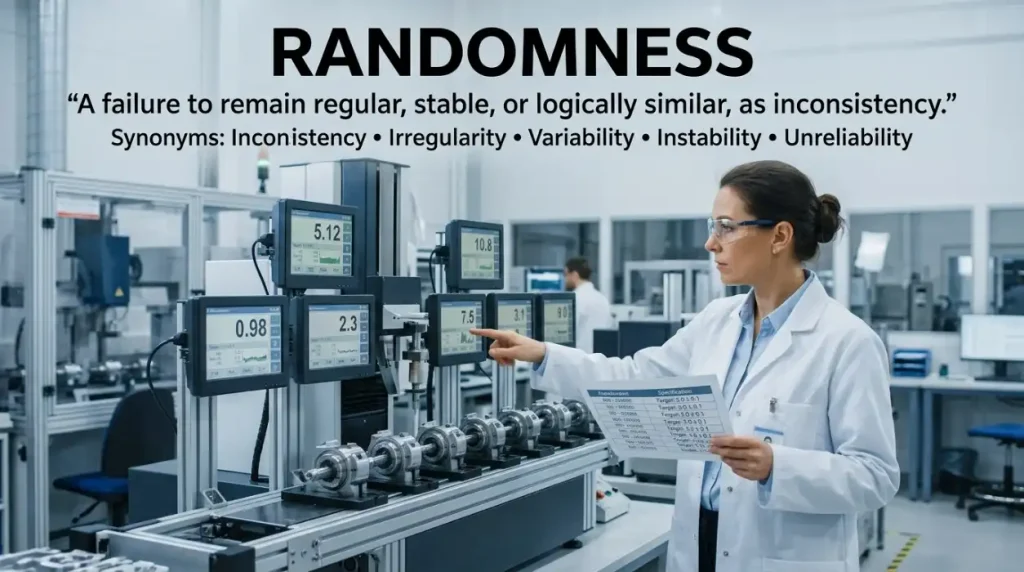
Inconsistency (Noun) — US /ˌɪnkənˈsɪstənsi/ — UK /ˌɪnkənˈsɪstənsi/
Meaning: Inconsistency describes a failure to remain regular, stable, or logically similar.
Tone/Register: Neutral to formal.
Examples:
The inconsistency in the results required another test.
Customers noticed inconsistency in the service.
Disarray (Noun) — US /ˌdɪsəˈreɪ/ — UK /ˌdɪsəˈreɪ/
Meaning: Disarray describes a state of disorder or confusion.
Tone/Register: Formal to neutral.
Examples:
The documents were left in disarray.
The sudden change left the team in disarray.
Confusion (Noun) — US /kənˈfjuːʒən/ — UK /kənˈfjuːʒən/
Meaning: Confusion describes a lack of clarity or understanding that can result from disorder or unpredictable events.
Tone/Register: Neutral; extremely common.
Examples:
The sudden announcement confused.
There was confusion about which route to take.
Turbulence (Noun) — US /ˈtɝːbjələns/ — UK /ˈtɜːbjələns/
Meaning: Turbulence describes unstable, disturbed, or rapidly changing conditions.
Tone/Register: Neutral to formal; literal and figurative.
Examples:
The industry experienced months of turbulence.
The flight was delayed because of severe turbulence.
Instability (Noun) — US /ˌɪnstəˈbɪləti/ — UK /ˌɪnstəˈbɪləti/
Meaning: Instability describes a lack of steadiness or a tendency to change unexpectedly.
Tone/Register: Formal and professional.
Examples:
The instability of the system created technical problems.
Political events were affected by economic instability.
Disorderliness (Noun) — US /dɪsˈɔːrdərlinəs/ — UK /dɪsˈɔːdəlɪnəs/
Meaning: Disorderliness describes a state of being untidy, unorganized, or lacking structure.
Tone/Register: Formal to neutral.
Examples:
The disorderliness of the workspace slowed production.
The report criticized the disorderliness of the process.
Unexpectedness (Noun) — US /ˌʌnɪkˈspɛktɪdnəs/ — UK /ˌʌnɪkˈspektɪdnəs/
Meaning: Unexpectedness emphasizes that an event was not anticipated.
Tone/Register: Neutral.
Examples:
The unexpectedness of the announcement surprised everyone.
The unexpectedness of the ending made the story memorable.
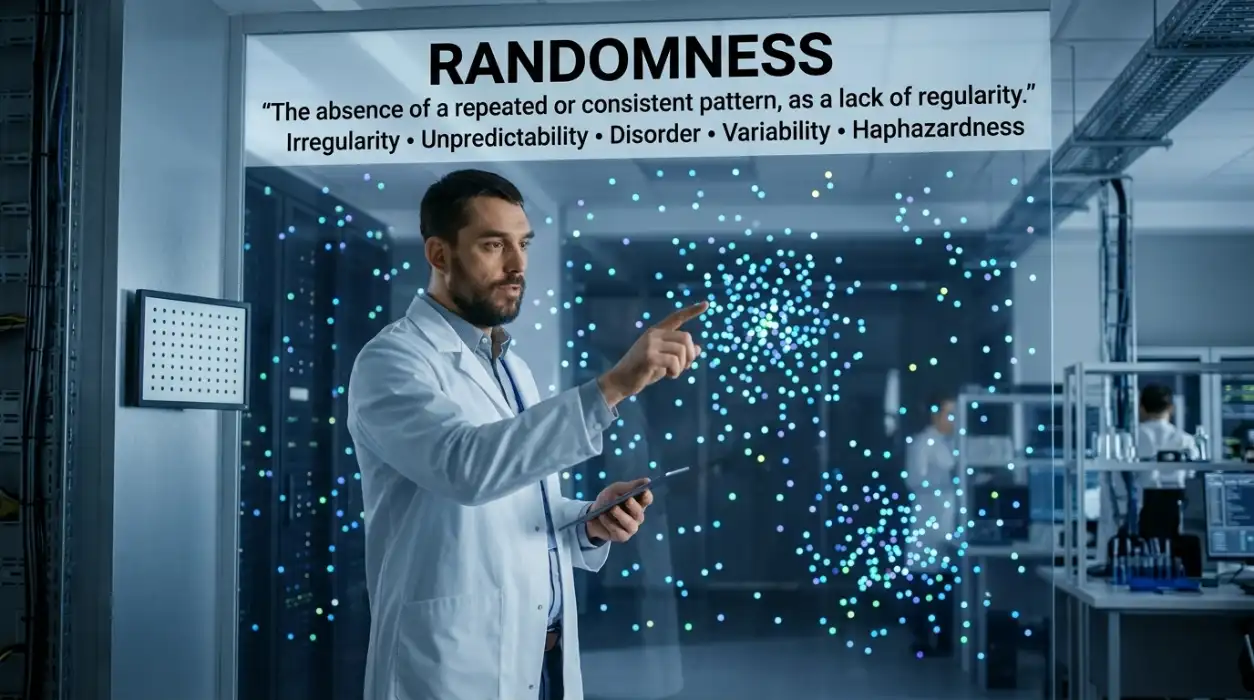
Lack of Regularity (Noun Phrase) — US /ˌlæk əv ˌreɡjəˈlærəti/ — UK /ˌlæk əv ˌreɡjʊˈlærəti/
Meaning: Lack of regularity describes the absence of a repeated or consistent pattern.
Tone/Register: Neutral to formal.
Examples:
The lack of regularity made the schedule difficult to follow.
The study found a lack of regularity in the observations.
Synonyms by Tone
Tone matters because two words can describe similar ideas while creating very different impressions.
Positive
Words such as serendipity, spontaneity, whimsy, and sometimes fortuity can make randomness sound enjoyable or fortunate.
Use these when unexpected events create excitement, creativity, discovery, or opportunity.
Neutral
Chance, unpredictability, uncertainty, variability, irregularity, coincidence, and random variation are generally neutral.
They work well when you want to describe a situation without judging it.
Negative
Haphazardness, chaos, disorder, aimlessness, purposelessness, disarray, inconsistency, and erraticness can carry a critical meaning.
They are useful when randomness causes problems or suggests poor organization.
Playful or Informal
Whim, whimsy, fluke, and spontaneity can sound relaxed or conversational.
They often work better in everyday speech than in highly formal academic writing.
“Randomness” vs Close Alternatives
| Word | Main idea | Typical tone | Best use |
|---|---|---|---|
| Randomness | Lack of predictable pattern | Neutral | General explanation |
| Unpredictability | Difficulty forecasting an outcome | Neutral | Weather, behavior, events |
| Chance | An outcome influenced by possibility rather than certainty | Neutral | Everyday conversation |
| Chaos | Severe lack of order or control | Stronger, often negative | Disorderly situations |
The important distinction is simple.
Randomness focuses on the absence of a predictable pattern.
Unpredictability focuses on your inability to know what will happen.
Chance focuses on possibility or accidental occurrence.
Chaos goes further by suggesting serious disorder or lack of control.
How “Randomness” Changes by Context
Daily Conversation
In everyday speech, randomness, chance, coincidence, and spontaneity are especially useful.
You might say:
“We picked a restaurant at random.”
Or:
“It was such a coincidence that we met there.”
Native speakers often prefer simpler words in conversation. A technical term such as stochasticity would sound unusual in an ordinary chat.
Writing and Blogging
Writers can use unpredictability, irregularity, variability, coincidence, happenstance, and haphazardness to avoid repeating randomness.
For example, instead of writing:
“The randomness of the character’s choices creates randomness in the plot.”
A stronger version is:
“The character’s unpredictability creates uncertainty throughout the plot.”
The second version gives the reader more information.
Professional and Academic Writing
Formal writing benefits from precision.
Stochasticity, variability, indeterminacy, non-determinism, random variation, and chance variation can be appropriate when discussing technical subjects.
The key is accuracy.
Do not choose a sophisticated word simply because it sounds academic. Choose the word that expresses the exact idea.
Creative and Informal Use
Creative writing gives you more freedom.
Whimsy, caprice, vagary, spontaneity, fluke, and happenstance can add personality.
For example:
“By some strange happenstance, the two strangers ended up sharing a table.”
That sounds more expressive than:
“By randomness, the two strangers shared a table.”
Common Mistakes Learners Make
Mistake 1: Treating every synonym as interchangeable
Chaos is not always a replacement for randomness.
A random sequence can be perfectly orderly while still being unpredictable. Chaos usually suggests a stronger absence of order.
Mistake 2: Using “randomness” when “chance” sounds natural
Native speakers commonly say:
“We met by chance.”
They are less likely to say:
“We met by randomness.”
The grammatical difference matters as much as the dictionary meaning.
Mistake 3: Using “serendipity” for every unexpected event
Serendipity normally has a positive sense.
An unexpected accident is not necessarily serendipity.
Mistake 4: Using technical vocabulary in casual situations
Terms such as stochasticity and non-determinism belong mainly to technical or academic contexts.
They may sound unnatural in everyday conversation.
Mistake 5: Assuming randomness always means disorder
Randomness can exist without visible mess.
A mathematically random sequence does not necessarily look physically disorganized.
Register Notes
For formal writing, consider uncertainty, variability, arbitrariness, indeterminacy, or stochasticity when appropriate.
For casual speech, chance, coincidence, fluke, whim, and spontaneity are often more natural.
If you are writing an essay, you can also explore related vocabulary in your broader English vocabulary practice.
Real-Life Mini Scenarios
Workplace
A team notices that customer requests arrive at unpredictable times.
A manager might describe this as unpredictability or variability.
If the filing system has no organization, disorder or haphazardness would be more precise.
Social Situations
Two old friends meet unexpectedly at a café.
You could call it a coincidence or chance occurrence.
If one friend suddenly decides to travel without planning, spontaneity is a better fit.
Media and Pop Culture
A reality show may create suspense through unpredictable outcomes.
Here, unpredictability sounds natural.
A comedian who deliberately mixes surprising ideas may use whimsy or playful randomness.
Writing and Storytelling
A novelist may introduce a surprising event through happenstance.
A character who changes decisions suddenly may be described as capricious.
A plot with severe disorder may be described as chaotic.
The choice of synonym helps readers understand not only what happened, but also how the writer wants them to interpret it.
Practice Quiz
1. Which word best describes an outcome that cannot be predicted?
A. Routine
B. Unpredictability
C. Certainty
D. Regularity
2. You meet an old classmate unexpectedly while traveling. Which word fits best?
A. Coincidence
B. Stability
C. Order
D. Consistency
3. Which word suggests severe disorder?
A. Chance
B. Chaos
C. Variability
D. Uncertainty
4. Which term is most suitable for a scientific discussion of probability-based behavior?
A. Whim
B. Stochasticity
C. Messiness
D. Fluke
5. You decide to take a weekend trip without planning it. Which word fits best?
A. Spontaneity
B. Arbitrariness
C. Disarray
D. Instability
6. Which word can suggest that something was done without proper planning or organization?
A. Haphazardness
B. Serendipity
C. Fortuity
D. Chance
7. Which word usually has a positive association with an unexpected discovery?
A. Disorder
B. Serendipity
C. Confusion
D. Instability
8. Which word describes repeated rises and falls rather than complete disorder?
A. Fluctuation
B. Chaos
C. Whim
D. Aimlessness
9. Which word describes an unexpected success that may have happened by luck?
A. Fluke
B. Regularity
C. Precision
D. Stability
10. Which expression is clearest when no recognizable pattern can be found?
A. Lack of pattern
B. Strong routine
C. Complete certainty
D. Fixed order
Reflection Task
Write one sentence about something unexpected that happened to you recently.
Then rewrite the sentence using a different synonym for randomness. Notice how the tone changes.
Answer key: 1-B | 2-A | 3-B | 4-B | 5-A | 6-A | 7-B | 8-A | 9-A | 10-A
Conclusion
Learning synonyms for randomness gives you more than extra vocabulary. It helps you express chance, uncertainty, disorder, and surprise with greater precision.
For students and content writers, these alternatives make essays and articles less repetitive. For speakers, they make everyday explanations clearer and more natural.
The best synonym for randomness depends on your meaning. Use chance for ordinary situations, unpredictability for uncertain outcomes, and chaos when disorder is central.
Start practicing these words in emails, essays, stories, and daily conversations. Small vocabulary choices can make your English sound more confident and precise.
External reference sources
For pronunciation, definitions, usage, and etymology, these established reference sources are useful:
Merriam Webster
Online Etymology Dictionary
The article is structured for featured-snippet extraction, semantic search, conversational queries, and practical vocabulary learning.
Frequently Asked Questions
What is the best synonym for randomness in academic writing?
There is no single best substitute for every academic sentence. Unpredictability works when the focus is on forecasting, while variability fits changing results. Stochasticity is more specialized and works in technical discussions of random processes. Indeterminacy is useful when an outcome cannot be precisely determined.
What is a simple word for randomness?
Chance is one of the simplest everyday alternatives. It is especially natural when talking about events that happen without planning or certainty. For example, “We met by chance” sounds much more natural than “We met by randomness.” In other contexts, unpredictability may be the clearer simple alternative.
Is “chaos” the same as “randomness”?
Not exactly. Randomness means that a predictable pattern or outcome is absent. Chaos usually suggests a much stronger condition involving disorder, confusion, or lack of control. A process can be random without looking messy. Therefore, replacing randomness with chaos can unintentionally make your sentence stronger and more negative.
What is a positive synonym for randomness?
Serendipity is a strong positive alternative when an unexpected event leads to a fortunate discovery or outcome. Spontaneity can also have a positive tone when unplanned behavior feels exciting or enjoyable. Whimsy works when unexpected behavior has a playful or imaginative quality.
What is the difference between randomness and unpredictability?
Randomness describes a lack of predictable pattern or a process involving chance. Unpredictability focuses more directly on the difficulty of knowing what will happen next. They overlap, but they emphasize different ideas. A weather system may be unpredictable even when scientists understand many of the factors influencing it.

Shahzeena Shazadi is the founder and lead writer at VocablyHub.com, where she creates accurate, reader-focused English language content designed to help people communicate with clarity and confidence. She specializes in synonyms, antonyms, word meanings, idioms, and practical vocabulary guides that simplify complex language concepts for everyday use. Every article is carefully researched, fact-checked, and written in clear, accessible language using reliable references and real-world examples. Her goal is to provide helpful, trustworthy content that supports learners at every stage of their English language journey.
Her editorial approach focuses on accuracy, transparency, and user value while following modern content quality standards. She regularly reviews and updates content to keep information relevant, useful, and easy to understand. Through VocablyHub.com, Shahzeena Shazadi is committed to publishing reliable language resources that help students, writers, educators, professionals, and English learners expand their vocabulary, improve their writing skills, and communicate with confidence in academic, professional, and everyday situations.