
Synonyms for stimulate can rescue a tired sentence when you want to say “encourage,” “spark,” or “energize” without repeating the same word.
Imagine a teacher who wants to stimulate curiosity. A writer may instead choose spark, inspire, or encourage, depending on the exact effect.
Learning synonyms for stimulate gives students, bloggers, content writers, and daily English users more control over tone, precision, and natural word choice.
Because stimulate appears in education, science, business, health, and everyday speech, knowing its alternatives helps you sound clearer and more flexible.
What Does “Synonyms for Stimulate” Really Mean?
Stimulate means to cause something to become more active, energetic, interested, responsive, or developed.
In simple English, to stimulate something is to make it start, grow, react, or become more active.
For example:
- A teacher can stimulate students’ curiosity.
- Exercise can stimulate blood circulation.
- A new policy can stimulate economic activity.
- A good question can stimulate discussion.
- Music can stimulate the senses.
The word is usually neutral and purposeful. It does not automatically express a positive or negative attitude. Its emotional effect depends on the object and context.
Native speakers commonly use stimulate in education, science, medicine, economics, psychology, business, technology, and everyday conversation.
Grammatically, stimulate is a verb.
A simple definition is:
Stimulate: to make something more active, interested, energetic, responsive, or likely to develop.
The important point is that stimulate has several related meanings. Therefore, there is no single synonym that works perfectly in every sentence.
For example, encourage is natural when you mean supporting an action. Activate works better when something is switched into an active state. Pique fits curiosity or interest. Energize focuses on renewed energy.
That distinction matters when choosing among synonyms for stimulate.
Connotative Meaning
Connotation (the feeling, association, or emotional shade a word carries beyond its basic dictionary meaning) can change how a sentence sounds.
Positive Tone
Stimulate can have a positive tone when it refers to encouraging growth, curiosity, creativity, learning, or healthy activity.
For example, “The discussion stimulated new ideas” sounds constructive and productive.
Words such as inspire, encourage, energize, foster, nurture, boost, and galvanize can create a similarly positive impression.
Negative Tone
The word itself is not normally negative. However, some alternatives can sound negative depending on what they cause.
For instance, incite and provoke may suggest conflict, anger, or unwanted reactions.
Similarly, stir up can imply deliberately creating trouble or controversy.
Neutral Tone
In technical or professional writing, stimulate is often neutral.
Words such as activate, trigger, prompt, induce, elicit, generate, and accelerate can also be neutral when the context is factual.
Choosing the right connotation helps you communicate your intended attitude instead of accidentally changing the meaning.
Etymology of “Stimulate”
The word stimulate comes from Latin stimulare, meaning “to goad,” “to prick,” or “to urge on.”
The Latin noun stimulus meant a pointed stick or goad used to drive an animal forward. Over time, the physical idea of pushing or urging developed into the figurative idea of causing action, activity, or response.
Old English: 450–1100
The exact modern word stimulate was not part of ordinary Old English vocabulary. English writers instead used native Germanic words for ideas such as urging, stirring, driving, or encouraging.
The Latin root behind stimulate existed in the wider classical tradition that later influenced English vocabulary.
Middle English: 1100–1500
After the Norman Conquest, English absorbed many Latin and French-derived words. Learned vocabulary increasingly entered English through religious, academic, medical, and scholarly writing.
The idea behind stimulate remained connected to urging or provoking action.
Modern English: 1500–Present
The English verb stimulate became established in the early modern period. Its meaning expanded beyond physical urging.
Today, it can describe stimulating:
- interest
- discussion
- growth
- economic activity
- biological processes
- creativity
- curiosity
- physical responses
- mental activity
So, the modern word keeps the original idea of “causing movement or activity”, but it now applies to many abstract and technical situations.
Pronunciation: US & UK IPA
- US: /ˈstɪmjəleɪt/
- UK: /ˈstɪmjʊleɪt/
Syllables
stim-u-late
There are three syllables.
Affixation Pattern of “Stimulate”
- Root: Latin stimul- / stimulus
- Prefix: none in modern English
- Suffix: -ate, forming the verb
The word should not be confused with stimulation, stimulator, or stimulating, which use related derivational forms.
Synonyms List
Encourage (verb) — US /ɪnˈkɜːrɪdʒ/ | UK /ɪnˈkʌrɪdʒ/
Meaning: To give someone or something support or confidence so that an action or development becomes more likely.
Tone/Register: Neutral, positive, everyday.
Example:
The teacher encouraged students to ask difficult questions.
Her feedback encouraged him to keep writing.
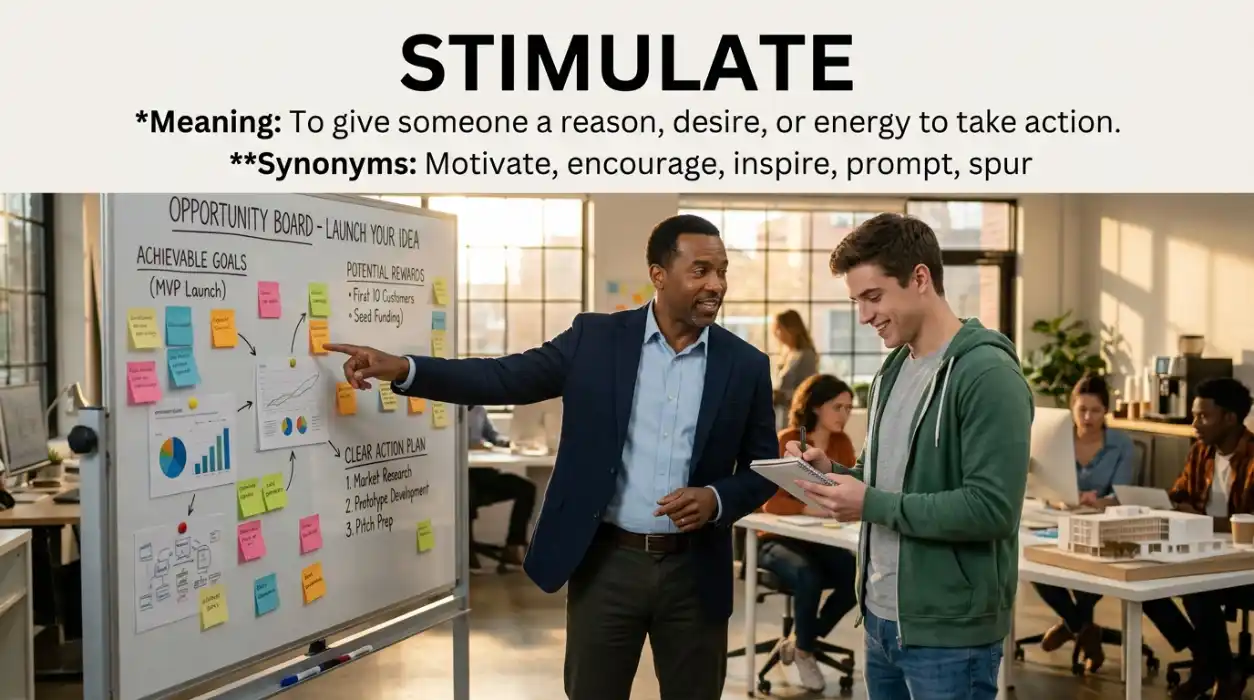
Motivate (verb) — US /ˈmoʊtəveɪt/ | UK /ˈməʊtɪveɪt/
Meaning: To give someone a reason, desire, or energy to take action.
Tone/Register: Neutral, professional, educational.
Example:
The coach motivated the team before the final match.
Clear goals can motivate employees to work consistently.
Inspire (verb) — US /ɪnˈspaɪr/ | UK /ɪnˈspaɪə/
Meaning: To create strong enthusiasm, creativity, or a desire to act.
Tone/Register: Positive, expressive, widely used.
Example:
Her story inspired me to learn another language.
The museum visit inspired several ideas for my project.
Prompt (verb) — US /prɑːmpt/ | UK /prɒmpt/
Meaning: To cause or encourage a particular action or response.
Tone/Register: Neutral, formal, academic.
Example:
The question prompted a lively classroom debate.
The reminder prompted him to check the report again.
Spur (verb) — US /spɜːr/ | UK /spɜː/
Meaning: To encourage someone or something to act more quickly or strongly.
Tone/Register: Neutral, literary, business.
Example:
The competition spurred the team to improve its design.
Higher demand spurred the company to expand production.
Prod (verb) — US /prɑːd/ | UK /prɒd/
Meaning: To push or encourage someone to take action, often because they are slow to act.
Tone/Register: Informal, conversational.
Example:
I had to prod my brother to finish his application.
The deadline prodded everyone into action.
Urge (verb) — US /ɜːrdʒ/ | UK /ɜːdʒ/
Meaning: To strongly encourage someone to do something.
Tone/Register: Neutral, common, sometimes formal.
Example:
The doctor urged him to rest for a few days.
Parents often urge children to read more.
Impel (verb) — US /ɪmˈpel/ | UK /ɪmˈpel/
Meaning: To strongly drive someone toward an action because of an internal or external force.
Tone/Register: Formal, literary, academic.
Example:
Curiosity impelled her to investigate the unusual result.
A sense of duty impelled him to volunteer.
Drive (verb) — US /draɪv/ | UK /draɪv/
Meaning: To strongly motivate or cause someone or something to move toward a result.
Tone/Register: Neutral, business, everyday.
Example:
Customer demand drives many product changes.
Her ambition drove her to practice every evening.
Propel (verb) — US /prəˈpel/ | UK /prəˈpel/
Meaning: To push or move someone or something forward toward greater activity or progress.
Tone/Register: Formal, academic, business.
Example:
The discovery propelled the research forward.
Strong leadership propelled the project into its next stage.
Galvanize (verb) — US /ˈɡælvənaɪz/ | UK /ˈɡælvənaɪz/
Meaning: To suddenly encourage people to take energetic and determined action.
Tone/Register: Formal, journalistic, powerful.
Example:
The announcement galvanized volunteers across the city.
The crisis galvanized the team into finding a solution.
Incite (verb) — US /ɪnˈsaɪt/ | UK /ɪnˈsaɪt/
Meaning: To deliberately encourage a strong reaction or action, often something harmful or aggressive.
Tone/Register: Formal, often negative.
Example:
The speech was criticized for inciting anger.
The article should not incite hostility toward another group.
Provoke (verb) — US /prəˈvoʊk/ | UK /prəˈvəʊk/
Meaning: To cause a reaction, especially a strong emotional, verbal, or physical response.
Tone/Register: Neutral to negative.
Example:
The unusual question provoked a thoughtful response.
His comment provoked an argument.
Trigger (verb) — US /ˈtrɪɡər/ | UK /ˈtrɪɡə/
Meaning: To cause a reaction, event, process, or response to begin.
Tone/Register: Neutral, technical, everyday.
Example:
The announcement triggered a wave of discussion online.
Cold weather can trigger changes in some plants.
Spark (verb) — US /spɑːrk/ | UK /spɑːk/
Meaning: To suddenly cause interest, discussion, creativity, or activity to begin.
Tone/Register: Informal, vivid, journalistic.
Example:
The documentary sparked a conversation about education.
One simple question sparked several new ideas.
Kindle (verb) — US /ˈkɪndəl/ | UK /ˈkɪndəl/
Meaning: To gradually awaken or create a feeling, interest, or enthusiasm.
Tone/Register: Literary, expressive, positive.
Example:
The novel kindled her interest in history.
The trip kindled a lasting passion for photography.
Ignite (verb) — US /ɪɡˈnaɪt/ | UK /ɪɡˈnaɪt/
Meaning: To suddenly create strong enthusiasm, excitement, debate, or activity.
Tone/Register: Vivid, journalistic, expressive.
Example:
The performance ignited the audience’s enthusiasm.
The proposal ignited a national debate.
Awaken (verb) — US /əˈweɪkən/ | UK /əˈweɪkən/
Meaning: To make an interest, feeling, awareness, or desire active.
Tone/Register: Literary, reflective, positive.
Example:
The class awakened his interest in astronomy.
The experience awakened a new sense of confidence.
Arouse (verb) — US /əˈraʊz/ | UK /əˈraʊz/
Meaning: To cause a particular feeling, reaction, interest, or physical response.
Tone/Register: Formal, academic, context-sensitive.
Example:
The photograph aroused strong public interest.
The discovery aroused concern among researchers.
Rouse (verb) — US /raʊz/ | UK /raʊz/
Meaning: To make someone active, alert, or emotionally engaged.
Tone/Register: Literary, formal, sometimes conversational.
Example:
The speech roused the audience to action.
The loud music roused everyone from their quiet mood.
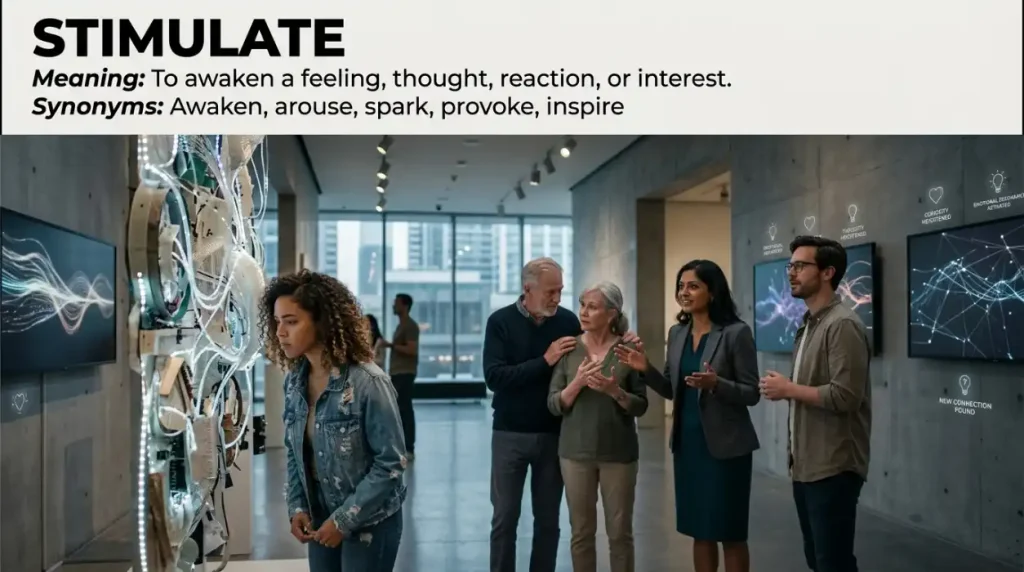
Stir (verb) — US /stɜːr/ | UK /stɜː/
Meaning: To awaken a feeling, thought, reaction, or interest.
Tone/Register: Neutral, literary, expressive.
Example:
The old photograph stirred memories of childhood.
Her question stirred curiosity among the students.
Excite (verb) — US /ɪkˈsaɪt/ | UK /ɪkˈsaɪt/
Meaning: To make someone feel enthusiastic, interested, or emotionally energized.
Tone/Register: Everyday, positive, expressive.
Example:
The new project excited the entire class.
The announcement excited fans around the world.
Enliven (verb) — US /ɪnˈlaɪvən/ | UK /ɪnˈlaɪvən/
Meaning: To make something more lively, interesting, or energetic.
Tone/Register: Formal, literary, positive.
Example:
A few jokes enlivened the long meeting.
The colorful examples enlivened the lesson.
Animate (verb) — US /ˈænəmeɪt/ | UK /ˈænɪmeɪt/
Meaning: To give energy, movement, or liveliness to something.
Tone/Register: Formal, literary, technical.
Example:
Her enthusiasm animated the entire discussion.
Music animated the otherwise quiet room.
Invigorate (verb) — US /ɪnˈvɪɡəreɪt/ | UK /ɪnˈvɪɡəreɪt/
Meaning: To give renewed strength, energy, or freshness.
Tone/Register: Formal, positive, health-related.
Example:
A short walk invigorated me after lunch.
The new strategy invigorated the research team.
Energize (verb) — US /ˈenərdʒaɪz/ | UK /ˈenədʒaɪz/
Meaning: To give someone or something more energy, enthusiasm, or activity.
Tone/Register: Neutral, positive, business.
Example:
The workshop energized the new employees.
Fresh ideas energized the creative team.
Revitalize (verb) — US /ˌriːˈvaɪtəlaɪz/ | UK /ˌriːˈvaɪtəlaɪz/
Meaning: To give new energy, strength, or life to something that has become less active.
Tone/Register: Formal, business, positive.
Example:
The renovation revitalized the old neighborhood.
The campaign revitalized interest in the program.
Rejuvenate (verb) — US /rɪˈdʒuːvəneɪt/ | UK /rɪˈdʒuːvəneɪt/
Meaning: To make someone or something feel fresh, active, or energetic again.
Tone/Register: Formal, positive.
Example:
The weekend break rejuvenated the tired team.
The redesign rejuvenated the website’s visual style.
Perk Up (phrasal verb) — US /pɜːrk ʌp/ | UK /pɜːk ʌp/
Meaning: To become or make something more cheerful, alert, or energetic.
Tone/Register: Informal, conversational.
Example:
A cup of tea helped me perk up during the afternoon.
The bright colors perked up the room.
Fire Up (phrasal verb) — US /faɪər ʌp/ | UK /faɪə ʌp/
Meaning: To make someone enthusiastic, excited, or ready to act.
Tone/Register: Informal, energetic.
Example:
The coach fired up the players before the game.
That song always fires me up before a workout.
Activate (verb) — US /ˈæktəveɪt/ | UK /ˈæktɪveɪt/
Meaning: To cause a system, process, person, or response to become active.
Tone/Register: Technical, professional, neutral.
Example:
The button activates the security system.
The exercise activates several muscle groups.
Actuate (verb) — US /ˈæktʃuˌeɪt/ | UK /ˈæktʃueɪt/
Meaning: To cause a mechanism or person to operate or act.
Tone/Register: Technical, formal.
Example:
The sensor actuates the automatic door.
A strong sense of responsibility actuated his decision.
Elicit (verb) — US /ɪˈlɪsɪt/ | UK /ɪˈlɪsɪt/
Meaning: To draw out a response, reaction, answer, or feeling.
Tone/Register: Academic, professional, formal.
Example:
The teacher’s question elicited several creative answers.
The survey elicited useful feedback from readers.
Evoke (verb) — US /ɪˈvoʊk/ | UK /ɪˈvəʊk/
Meaning: To bring a feeling, memory, image, or response into someone’s mind.
Tone/Register: Formal, literary, expressive.
Example:
The song evoked memories of summer evenings.
The painting evoked a sense of calm.
Induce (verb) — US /ɪnˈduːs/ | UK /ɪnˈdjuːs/
Meaning: To cause a particular condition, effect, or response.
Tone/Register: Formal, scientific, medical.
Example:
The medication may induce sleepiness.
The researchers used heat to induce a chemical reaction.
Generate (verb) — US /ˈdʒenəreɪt/ | UK /ˈdʒenəreɪt/
Meaning: To produce or cause something to exist, especially activity, ideas, energy, or interest.
Tone/Register: Neutral, academic, business.
Example:
The campaign generated considerable public interest.
The workshop generated dozens of practical ideas.
Foster (verb) — US /ˈfɔːstər/ | UK /ˈfɒstə/
Meaning: To encourage the development or growth of something over time.
Tone/Register: Formal, positive, educational.
Example:
The program fosters creativity in young learners.
Good leaders foster trust within their teams.
Cultivate (verb) — US /ˈkʌltəveɪt/ | UK /ˈkʌltɪveɪt/
Meaning: To deliberately develop an ability, relationship, habit, interest, or condition.
Tone/Register: Formal, academic, positive.
Example:
She cultivated an interest in classical music.
The school cultivates independent thinking.
Nurture (verb) — US /ˈnɜːrtʃər/ | UK /ˈnɜːtʃə/
Meaning: To support and encourage something so that it can develop successfully.
Tone/Register: Positive, caring, educational.
Example:
Parents can nurture a child’s curiosity.
The mentor nurtured her confidence as a young writer.
Promote (verb) — US /prəˈmoʊt/ | UK /prəˈməʊt/
Meaning: To encourage or help the growth, development, or acceptance of something.
Tone/Register: Business, formal, neutral.
Example:
The campaign promotes healthy eating habits.
The policy was designed to promote innovation.
Boost (verb) — US /buːst/ | UK /buːst/
Meaning: To increase something such as energy, confidence, activity, demand, or performance.
Tone/Register: Informal to neutral, business.
Example:
The positive feedback boosted her confidence.
The new design boosted customer interest.
Enhance (verb) — US /ɪnˈhæns/ | UK /ɪnˈhɑːns/
Meaning: To improve or increase the quality, value, effect, or attractiveness of something.
Tone/Register: Formal, professional, academic.
Example:
The examples enhanced the students’ understanding.
Better lighting enhanced the presentation.
Accelerate (verb) — US /əkˈseləreɪt/ | UK /əkˈseləreɪt/
Meaning: To make a process happen faster or develop more quickly.
Tone/Register: Formal, scientific, business.
Example:
The new technology accelerated the research process.
Training can accelerate professional development.

Intensify (verb) — US /ɪnˈtensəfaɪ/ | UK /ɪnˈtensɪfaɪ/
Meaning: To make something stronger, more powerful, or more extreme.
Tone/Register: Formal, neutral.
Example:
The debate intensified after the announcement.
The exercise intensified the feeling of fatigue.
Heighten (verb) — US /ˈhaɪtən/ | UK /ˈhaɪtən/
Meaning: To increase the strength, awareness, excitement, or seriousness of something.
Tone/Register: Formal, literary, neutral.
Example:
The music heightened the tension in the scene.
The report heightened public awareness of the issue.
Pique (verb) — US /piːk/ | UK /piːk/
Meaning: To stimulate someone’s curiosity, interest, or attention.
Tone/Register: Formal, journalistic, common in writing.
Example:
The unusual title piqued my curiosity.
The mystery quickly piqued readers’ interest.
Engage (verb) — US /ɪnˈɡeɪdʒ/ | UK /ɪnˈɡeɪdʒ/
Meaning: To attract someone’s attention or involve them actively in something.
Tone/Register: Neutral, professional, educational.
Example:
Interactive lessons engage students more effectively.
The speaker engaged the audience with simple stories.
Rev Up (phrasal verb) — US /rev ʌp/ | UK /rev ʌp/
Meaning: To make something more active, energetic, or intense.
Tone/Register: Informal, conversational.
Example:
The announcement revved up interest in the event.
A short warm-up revved up the players.
Synonyms by Tone
Tone matters because two words can describe a similar effect while creating very different impressions.
Positive
These choices often suggest growth, enthusiasm, creativity, or healthy development:
- Encourage
- Motivate
- Inspire
- Galvanize
- Enliven
- Invigorate
- Energize
- Revitalize
- Foster
- Cultivate
- Nurture
- Boost
- Revive
For example, inspire sounds warmer than prompt, while nurture suggests patient support and development.
Neutral
These words are useful when you want a factual or professional tone:
- Stimulate
- Prompt
- Trigger
- Activate
- Elicit
- Evoke
- Induce
- Generate
- Promote
- Enhance
- Accelerate
- Heighten
- Engage
These alternatives work especially well in reports, essays, academic writing, and explanatory content.
Negative or Potentially Negative
These words can suggest conflict, pressure, unwanted reactions, or controversy:
- Incite
- Provoke
- Prod
- Stir up
- Intensify
The context determines the exact effect. For example, provoke thought can be positive, while provoke an argument is usually negative.
Playful or Informal
For relaxed conversation, these phrases can sound more natural:
- Perk up
- Fire up
- Rev up
- Kick-start
- Jump-start
- Get going
They are useful in speech, casual writing, social posts, and friendly conversation.
Why Tone Matters in Word Choice
Imagine writing:
“The speaker stimulated the audience.”
This is correct, but it is broad.
If you write:
“The speaker inspired the audience.”
The sentence suggests positive emotional influence.
If you write:
“The speaker provoked the audience.”
The meaning changes. It may suggest a strong or challenging reaction.
Therefore, choosing a synonym is not simply about replacing one word with another. It is about choosing the exact shade of meaning you want.
Close Alternatives vs. “Stimulate”
| Word | Main Meaning | Tone | Best Use |
|---|---|---|---|
| Stimulate | Cause activity, interest, or response | Neutral | General and technical contexts |
| Encourage | Support an action or development | Positive | People, learning, behavior |
| Inspire | Create enthusiasm or creative motivation | Positive | Ideas, people, art, achievement |
| Activate | Make something active | Technical | Systems, processes, biological responses |
| Pique | Create curiosity or interest | Neutral/formal | Curiosity, attention, interest |
Encourage vs. Stimulate
Stimulate is broader.
It can describe a physical, mental, economic, or social response.
Encourage usually involves supporting a person, behavior, action, or development.
Compare:
The activity stimulated discussion.
The teacher encouraged students to participate.
The first focuses on the resulting activity. The second focuses on supportive influence.
Stimulate vs Inspire
Inspire has a stronger emotional and creative quality.
You can stimulate interest, activity, or growth. You can inspire confidence, creativity, action, or admiration.
Therefore, inspire is often more personal and positive.
Stimulate vs Activate
Activate is more mechanical or technical.
A switch activates a machine. Exercise activates muscles. A signal can activate a process.
Meanwhile, a teacher may stimulate curiosity rather than “activate” it.
How “Stimulate” Changes by Context
Daily Conversation
In everyday speech, stimulate can sound slightly formal.
People often choose simpler alternatives such as encourage, excite, spark, motivate, or get going.
Instead of:
“That conversation stimulated my interest.”
A casual speaker might say:
“That conversation sparked my interest.”
Both are correct, but the second feels more conversational.
Writing and Blogging
Writers often use stimulate when explaining ideas, trends, reactions, or growth.
However, repeating it can make an article feel mechanical.
You can vary the language with spark, encourage, generate, foster, pique, inspire, or boost.
For example:
“The article stimulated discussion.”
could become:
“The article sparked a lively discussion.”
The second version creates a more vivid image.
Professional and Academic English
Stimulate is especially useful in formal writing.
It frequently appears in subjects such as economics, psychology, education, medicine, biology, and business.
Examples include:
- stimulate economic growth
- stimulate research
- stimulate demand
- stimulate learning
- stimulate a response
- stimulate discussion
In academic writing, alternatives such as induce, elicit, generate, promote, foster, and accelerate can provide greater precision.
Creative and Informal English
Creative writing benefits from stronger imagery.
Instead of repeatedly saying stimulate, a writer might choose:
- kindle
- ignite
- awaken
- stir
- spark
- fire up
- enliven
For example:
“The old photograph awakened memories of childhood.”
This sounds more expressive than simply saying the photograph “stimulated memories.”
Common Mistakes Learners Make
Mistake 1: Treating Every Synonym as Interchangeable
Not every synonym for stimulate fits every sentence.
Pique is strongly associated with curiosity or interest.
Activate focuses on making something operational or active.
Nurture implies gradual development.
Incite can imply harmful or aggressive action.
Always check the specific meaning first.
Mistake 2: Using “Incite” as a Positive Replacement
A learner might write:
“The teacher incited students to learn.”
This sounds unusual and may suggest that the teacher provoked students into action.
Use encouraged, motivated, inspired, or stimulated when the intended meaning is positive.
Mistake 3: Confusing “Elicit” and “Evoke”
These words are close but not identical.
Elicit usually means drawing out a response.
Evoke usually means bringing a feeling, memory, image, or association to mind.
So a question can elicit an answer, while a song can evoke a memory.
Mistake 4: Overusing “Stimulate”
Even a correct word can become repetitive.
If a paragraph contains “stimulate” several times, consider whether encourage, spark, generate, foster, activate, or another precise alternative would improve readability.
Mistake 5: Using Very Formal Words in Casual Speech
Words such as impel, actuate, invigorate, and cultivate are correct, but they can sound formal.
In everyday conversation, motivate, encourage, energize, perk up, or get going may sound more natural.
Mistake 6: Confusing “Stimulate” With “Increase”
Stimulate can lead to an increase, but the words are not identical.
For example:
“The policy stimulated demand.”
means the policy helped cause demand to become stronger.
“The policy increased demand.”
simply states that demand became higher.
The first emphasizes the cause. The second emphasizes the result.
Register Notes
Formal: impel, induce, elicit, cultivate, foster, invigorate, actuate.
Academic: stimulate, induce, elicit, evoke, generate, accelerate, intensify.
Business: motivate, boost, promote, enhance, galvanize, accelerate.
Everyday: encourage, excite, spark, stir, perk up, get going.
Informal: fire up, rev up, kick-start, jump-start.
For related vocabulary study, an internal guide to workplace and academic English can help you build stronger word-choice habits.
Real-Life Mini Scenarios
Workplace
A manager introduces a brainstorming session to stimulate creative thinking.
In a more conversational sentence, you could say the session sparked new ideas.
Social Situation
A friend asks an unusual question that stimulates an interesting conversation.
You might also say the question prompted discussion or set off a debate.
Education
A teacher uses a challenging story to stimulate students’ curiosity.
Here, pique, awaken, inspire, or engage may offer a more precise shade.
Media and Pop Culture
A surprising movie ending can stimulate online discussion.
A writer might instead say the ending ignited, sparked, or stirred up debate.
Writing and Storytelling
A vivid description can stimulate the reader’s imagination.
A creative writer may prefer awaken, kindle, or evoke because these words create stronger imagery.

Practice Quiz
1. The teacher wanted to ___ curiosity about astronomy.
A. stimulate
B. activate
C. actuate
D. intensify
2. The unusual headline ___ my curiosity.
A. induced
B. piqued
C. actuated
D. accelerated
3. The coach’s speech ___ the players before the final.
A. galvanized
B. evoked
C. elicited
D. cultivated
4. The new button will ___ the security system.
A. inspire
B. nurture
C. activate
D. kindle
5. The documentary ___ a debate about climate education.
A. sparked
B. nurtured
C. rejuvenated
D. actuated
6. Her mentor ___ her confidence as a young writer.
A. triggered
B. nurtured
C. provoked
D. intensified
7. The question ___ several thoughtful answers from the class.
A. elicited
B. ignited
C. boosted
D. revved up
8. The medication may ___ sleepiness.
A. inspire
B. induce
C. pique
D. enliven
9. A short break helped the tired workers ___.
A. perk up
B. incite
C. elicit
D. cultivate
10. The announcement ___ a wave of online discussion.
A. generated
B. actuated
C. nurtured
D. rejuvenated
Answer Key: 1-A | 2-B | 3-A | 4-C | 5-A | 6-B | 7-A | 8-B | 9-A | 10-A
Reflection Task
Choose one synonym from this article and write your own sentence about school, work, friendship, media, or daily life. Then replace that synonym with stimulate and notice how the tone changes.
Conclusion
Understanding stimulate can help you describe the act of encouraging activity, interest, growth, thought, or a response. Learning its synonyms, meaning, and examples can improve your English vocabulary and make your communication more precise.
The word stimulate is commonly used in discussions about learning, motivation, growth, physical responses, and intellectual activity. Knowing its related synonyms can help you express ideas about encouraging, inspiring, activating, motivating, or promoting something in different ways.
By practicing stimulate in sentences and exploring related words, you can strengthen your vocabulary and writing skills. A clear understanding of this word will help you use it naturally, accurately, and confidently in different English contexts.
Frequently Asked Questions
1. What is the best synonym for stimulate in academic writing?
There is no single best replacement because the meaning changes by context. Foster works well for development, induce for causing a condition or response, elicit for drawing out a response, and generate for producing activity or ideas. In many academic sentences, however, stimulate itself remains a clear and appropriate choice.
2. What is a simple synonym for stimulate in everyday English?
For everyday English, encourage, motivate, excite, spark, and get going are often easier and more natural than formal alternatives. The best choice depends on the meaning. For example, “encourage” fits a person, while “spark” works naturally with interest, discussion, or an idea.
3. Is “encourage” the same as “stimulate”?
Not exactly. Encourage usually means giving support or confidence so that someone acts or develops. Stimulate is broader and can describe mental, physical, economic, scientific, or social activity. A teacher may encourage a student, while a question may stimulate discussion.
4. What synonym for stimulate means “increase interest”?
Several words can express this idea. Pique means to create curiosity or interest, while spark suggests suddenly starting interest. Generate can describe producing interest, and boost suggests increasing an existing level of interest. Choose according to whether you mean creating, starting, or increasing interest.
5. What is the difference between stimulate and activate?
Stimulate means to cause increased activity, interest, growth, or response. Activate specifically emphasizes making something active or operational. For example, a discussion can stimulate ideas, while a switch can activate a machine. In scientific contexts, however, both words can sometimes describe processes becoming active.

Shahzeena Shazadi is the founder and lead writer at VocablyHub.com, where she creates accurate, reader-focused English language content designed to help people communicate with clarity and confidence. She specializes in synonyms, antonyms, word meanings, idioms, and practical vocabulary guides that simplify complex language concepts for everyday use. Every article is carefully researched, fact-checked, and written in clear, accessible language using reliable references and real-world examples. Her goal is to provide helpful, trustworthy content that supports learners at every stage of their English language journey.
Her editorial approach focuses on accuracy, transparency, and user value while following modern content quality standards. She regularly reviews and updates content to keep information relevant, useful, and easy to understand. Through VocablyHub.com, Shahzeena Shazadi is committed to publishing reliable language resources that help students, writers, educators, professionals, and English learners expand their vocabulary, improve their writing skills, and communicate with confidence in academic, professional, and everyday situations.