
Synonyms for one-off can help when you need a fresh way to describe something that happens, appears, or is made only once.
Imagine your company hosts a special event that will never be repeated. You could call it a one-off event, or choose a more precise alternative.
Because one-off is common in everyday English, learning its alternatives can make your writing more flexible, natural, and expressive.
Moreover, students, bloggers, content writers, and daily English users can use these words to avoid repetition and match the right tone.
What Does “One-Off” Really Mean?
One-off describes something that happens, is made, or is intended to happen only once rather than repeatedly.
In simple English, one-off means “happening or existing only one time.”
For example:
The company organized a one-off training session.
This means the training session was arranged as a single event, not as part of a regular series.
The expression can describe events, products, performances, payments, projects, decisions, opportunities, and situations.
Part of Speech
One-off can function as:
- Adjective: a one-off event
- Noun: This concert was a one-off.
It is especially common in British English. In American English, one-time, single, or standalone may often sound more natural depending on the context.
Emotional Tone
The expression itself is usually neutral. However, context can make it sound positive, unusual, exclusive, temporary, or even disappointing.
For example:
The artist created a one-off painting for the exhibition.
Here, the phrase can suggest rarity or special value.
Connotative Meaning
Connotation (the feeling or association a word carries beyond its basic meaning) can change how a synonym sounds.
Positive tone:
Words such as unique, special, and unrepeatable can suggest rarity or importance.
Negative tone:
Words such as isolated or nonrecurring may emphasize that something lacks continuity.
Neutral tone:
Words such as single, individual, and one-time simply describe something that happens once.
Therefore, choosing the right synonym depends on both meaning and mood.
Etymology of “One-Off”
The expression one-off developed from the idea of producing or making something as a single item rather than as part of a continuing production run.
The phrase is particularly associated with British English and became established in modern usage during the 20th century.
Old English: 450–1100
Old English did not use one-off as the modern expression. However, the individual elements one and off have much older Germanic roots.
One developed from Old English ān, meaning “one” or “a single.”
Off came from Old English forms related to separation, removal, or distance.
Middle English: 1100–1500
During Middle English, one developed toward forms closer to modern English one. The use of off also expanded into many expressions involving separation or removal.
However, the modern compound one-off was not yet established.
Modern English: 1500–Present
Modern English eventually combined the concepts of one and off to describe something produced or occurring only once.
Today, one-off is widely recognized, especially in British English, for unusual single events, products, arrangements, and actions.
Pronunciation
One-off
- US: /ˈwʌn ˌɔːf/
- UK: /ˈwʌn ˌɒf/
Syllables
one-off
Affixation Pattern of “One-Off”
Root: one + off
Prefix: none
Suffix: none
It is a compound expression, rather than a word formed through ordinary prefixation or suffixation.
Synonyms List:
The following alternatives cover slightly different contexts. Some are exact substitutes, while others are context-specific alternatives that express the same central idea of something occurring, existing, or being produced only once.

One-Time (Adjective) — US: /ˌwʌn ˈtaɪm/ | UK: /ˌwʌn ˈtaɪm/
Meaning: Happening or intended to happen only once.
Tone/Register: Neutral, everyday
Example:
The museum hosted a one-time exhibition.
Visitors enjoyed a one-time performance by the singer.
Single (Adjective) — US: /ˈsɪŋɡəl/ | UK: /ˈsɪŋɡəl/
Meaning: Existing or occurring as one rather than as part of a series.
Tone/Register: Neutral
Example:
The project required a single payment.
We held a single meeting to discuss the issue.
Unique (Adjective) — US: /juˈniːk/ | UK: /juˈniːk/
Meaning: Being unlike anything else, often because it is distinctive or rare.
Tone/Register: Neutral to positive
Example:
The designer created a unique piece.
Her performance offered a unique experience.
Individual (Adjective) — US: /ˌɪndəˈvɪdʒuəl/ | UK: /ˌɪndɪˈvɪdʒuəl/
Meaning: Separate from others and considered on its own.
Tone/Register: Neutral, formal
Example:
Each project was reviewed separately.
The artist sold the works as individual pieces.
Standalone (Adjective) — US: /ˈstændəˌloʊn/ | UK: /ˈstændəˌləʊn/
Meaning: Existing independently rather than as part of a larger series or system.
Tone/Register: Professional, technical
Example:
The company released a standalone report.
This is a standalone project rather than a regular program.
Singular (Adjective) — US: /ˈsɪŋɡjələr/ | UK: /ˈsɪŋɡjələr/
Meaning: Existing as one distinct example or occurrence.
Tone/Register: Formal, academic
Example:
The study examined a singular event.
Her decision was a singular occurrence in the department.
Isolated (Adjective) — US: /ˈaɪsəleɪtɪd/ | UK: /ˈaɪsəleɪtɪd/
Meaning: Occurring separately and without a continuing pattern.
Tone/Register: Neutral, formal
Example:
The incident appeared to be isolated.
It was an isolated case rather than a regular problem.
Nonrecurring (Adjective) — US: /ˌnɑːnrɪˈkɜːrɪŋ/ | UK: /ˌnɒnrɪˈkɜːrɪŋ/
Meaning: Not expected to happen again.
Tone/Register: Formal, business
Example:
The company reported a nonrecurring expense.
The payment was a nonrecurring charge.
Nonrepeating (Adjective) — US: /ˌnɑːnrɪˈpiːtɪŋ/ | UK: /ˌnɒnrɪˈpiːtɪŋ/
Meaning: Not repeated after the original occurrence.
Tone/Register: Formal
Example:
The survey recorded a nonrepeating event.
The pattern included a nonrepeating sequence.
Once-Only (Adjective) — US: /ˌwʌns ˈoʊnli/ | UK: /ˌwʌns ˈəʊnli/
Meaning: Intended to happen only once.
Tone/Register: Neutral
Example:
The organization offered a once-only opportunity.
It was a once-only performance.
Once-in-a-Lifetime (Adjective) — US: /ˌwʌns ɪn ə ˈlaɪftaɪm/ | UK: /ˌwʌns ɪn ə ˈlaɪftaɪm/
Meaning: So unusual or special that it is unlikely to happen again during a person’s life.
Tone/Register: Emotional, conversational
Example:
Seeing the rare eclipse was a once-in-a-lifetime experience.
She received a once-in-a-lifetime opportunity.
Unrepeatable (Adjective) — US: /ˌʌnrɪˈpiːtəbəl/ | UK: /ˌʌnrɪˈpiːtəbəl/
Meaning: Impossible or unlikely to reproduce or experience again.
Tone/Register: Formal, expressive
Example:
The concert created an unrepeatable moment.
It was an unrepeatable experience for the audience.
Infrequent (Adjective) — US: /ɪnˈfriːkwənt/ | UK: /ɪnˈfriːkwənt/
Meaning: Happening rarely rather than regularly.
Tone/Register: Neutral, formal
Example:
The organization holds infrequent special events.
Such opportunities are infrequent.
Occasional (Adjective) — US: /əˈkeɪʒənəl/ | UK: /əˈkeɪʒənəl/
Meaning: Happening sometimes but not regularly.
Tone/Register: Neutral
Example:
The café hosts occasional live performances.
We have occasional meetings outside the normal schedule.
Sporadic (Adjective) — US: /spəˈrædɪk/ | UK: /spəˈrædɪk/
Meaning: Happening irregularly and infrequently.
Tone/Register: Formal
Example:
The town experienced sporadic cultural events.
Sporadic appearances kept the performer unexpected.
Exceptional (Adjective) — US: /ɪkˈsepʃənəl/ | UK: /ɪkˈsepʃənəl/
Meaning: Unusual because it falls outside what normally happens.
Tone/Register: Formal, positive
Example:
The school arranged an exceptional event.
It was an exceptional opportunity for young writers.
Special (Adjective) — US: /ˈspeʃəl/ | UK: /ˈspeʃəl/
Meaning: Different from ordinary situations because of particular importance or purpose.
Tone/Register: Neutral, positive
Example:
They planned a special performance.
The gallery prepared a special exhibition.
Rare (Adjective) — US: /rer/ | UK: /reə/
Meaning: Not common or occurring only occasionally.
Tone/Register: Neutral
Example:
The festival was a rare event.
She made a rare public appearance.
Singular Event (Noun Phrase) — US: /ˈsɪŋɡjələr ɪˈvent/ | UK: /ˈsɪŋɡjələr ɪˈvent/
Meaning: An event that stands alone rather than forming part of a series.
Tone/Register: Formal
Example:
The ceremony was treated as a singular event.
The report focused on one singular event.
Isolated Event (Noun Phrase) — US: /ˈaɪsəleɪtɪd ɪˈvent/ | UK: /ˈaɪsəleɪtɪd ɪˈvent/
Meaning: An event that occurs separately without forming a pattern.
Tone/Register: Formal
Example:
The accident was an isolated event.
Officials described it as an isolated event.

Single Instance (Noun Phrase) — US: /ˈsɪŋɡəl ˈɪnstəns/ | UK: /ˈsɪŋɡəl ˈɪnstəns/
Meaning: One particular occurrence of something.
Tone/Register: Academic, formal
Example:
The researchers recorded a single instance.
One single instance was not enough to prove the pattern.
Individual Instance (Noun Phrase) — US: /ˌɪndəˈvɪdʒuəl ˈɪnstəns/ | UK: /ˌɪndɪˈvɪdʒuəl ˈɪnstəns/
Meaning: One separate occurrence considered independently.
Tone/Register: Academic, formal
Example:
Each instance was examined.
The report described the individual instance carefully.
Single Occurrence (Noun Phrase) — US: /ˈsɪŋɡəl əˈkɜːrəns/ | UK: /ˈsɪŋɡəl əˈkʌrəns/
Meaning: Something that happens only once.
Tone/Register: Formal
Example:
The mistake was a single occurrence.
The unusual result appeared as a single occurrence.
Isolated Occurrence (Noun Phrase) — US: /ˈaɪsəleɪtɪd əˈkɜːrəns/ | UK: /ˈaɪsəleɪtɪd əˈkʌrəns/
Meaning: A separate event that does not appear to form a repeated pattern.
Tone/Register: Formal
Example:
The error seemed to be an isolated occurrence.
Researchers treated the result as an isolated occurrence.
One-Time Event (Noun Phrase) — US: /ˌwʌn ˈtaɪm ɪˈvent/ | UK: /ˌwʌn ˈtaɪm ɪˈvent/
Meaning: An event planned to happen only once.
Tone/Register: Neutral
Example:
The school arranged a one-time event.
The concert was a one-time event.
Single Occasion (Noun Phrase) — US: /ˈsɪŋɡəl əˈkeɪʒən/ | UK: /ˈsɪŋɡəl əˈkeɪʒən/
Meaning: One particular time when something happens.
Tone/Register: Neutral, formal
Example:
The service was provided on a single occasion.
She spoke with him on a single occasion.
One-Time Arrangement (Noun Phrase) — US: /ˌwʌn ˈtaɪm əˈreɪndʒmənt/ | UK: /ˌwʌn ˈtaɪm əˈreɪndʒmənt/
Meaning: An arrangement created for one particular situation.
Tone/Register: Business, neutral
Example:
They made a one-time arrangement with the speaker.
The agreement was a one-time arrangement.
Ad Hoc (Adjective) — US: /ˌæd ˈhɑːk/ | UK: /ˌæd ˈhɒk/
Meaning: Created or organized for a specific immediate purpose rather than as a regular arrangement.
Tone/Register: Formal, professional
Example:
The manager formed an ad hoc committee.
They created an ad hoc solution for the unusual problem.
Standalone Event (Noun Phrase) — US: /ˈstændəˌloʊn ɪˈvent/ | UK: /ˈstændəˌləʊn ɪˈvent/
Meaning: An event that exists independently rather than as part of a continuing series.
Tone/Register: Professional
Example:
The workshop was a standalone event.
It was advertised as a standalone event.
Standalone Project (Noun Phrase) — US: /ˈstændəˌloʊn ˈprɑːdʒekt/ | UK: /ˈstændəˌləʊn ˈprɒdʒekt/
Meaning: A project completed independently rather than as part of an ongoing program.
Tone/Register: Business, professional
Example:
The team completed a standalone project.
This assignment is a standalone project.
Single-Instance (Adjective) — US: /ˌsɪŋɡəl ˈɪnstəns/ | UK: /ˌsɪŋɡəl ˈɪnstəns/
Meaning: Designed or occurring in only one instance.
Tone/Register: Technical, formal
Example:
The company used a single-instance process.
The issue involved a single-instance failure.
Limited (Adjective) — US: /ˈlɪmɪtɪd/ | UK: /ˈlɪmɪtɪd/
Meaning: Restricted in scope, duration, or availability.
Tone/Register: Neutral, business
Example:
The group organized a limited special event.
The opportunity was limited to one occasion.
Temporary (Adjective) — US: /ˈtempəreri/ | UK: /ˈtempərəri/
Meaning: Existing for a short period rather than permanently.
Tone/Register: Neutral
Example:
The company introduced a temporary arrangement.
The change was temporary, not permanent.
Short-Term (Adjective) — US: /ˌʃɔːrt ˈtɜːrm/ | UK: /ˌʃɔːt ˈtɜːm/
Meaning: Continuing for a limited period.
Tone/Register: Business, neutral
Example:
They created a short-term project.
The role was part of a short-term arrangement.
Singular Production (Noun Phrase) — US: /ˈsɪŋɡjələr prəˈdʌkʃən/ | UK: /ˈsɪŋɡjələr prəˈdʌkʃən/
Meaning: A production made as one distinct item rather than as a repeated run.
Tone/Register: Creative, formal
Example:
The designer completed a singular production.
The garment was a singular production for the exhibition.
Custom-Made (Adjective) — US: /ˌkʌstəm ˈmeɪd/ | UK: /ˌkʌstəm ˈmeɪd/
Meaning: Made specifically for a particular person or purpose.
Tone/Register: Neutral, professional
Example:
The artist created a custom-made piece.
The costume was custom-made for the performance.
Bespoke (Adjective) — US: /bɪˈspoʊk/ | UK: /bɪˈspəʊk/
Meaning: Specially made for a particular customer or purpose.
Tone/Register: British, formal
Example:
The designer created a bespoke outfit.
The gallery displayed a bespoke sculpture.
Special Edition (Noun Phrase) — US: /ˌspeʃəl ɪˈdɪʃən/ | UK: /ˌspeʃəl ɪˈdɪʃən/
Meaning: A specially produced version that differs from a standard edition.
Tone/Register: Publishing, media, neutral
Example:
The magazine released a special edition.
Fans collected the special edition.
Limited Edition (Noun Phrase) — US: /ˌlɪmɪtɪd ɪˈdɪʃən/ | UK: /ˌlɪmɪtɪd ɪˈdɪʃən/
Meaning: A version produced in a restricted quantity.
Tone/Register: Commercial, creative
Example:
The artist released a limited edition.
The book appeared in a limited edition.
Exclusive (Adjective) — US: /ɪkˈskluːsɪv/ | UK: /ɪkˈskluːsɪv/
Meaning: Restricted to a particular occasion, group, or purpose.
Tone/Register: Neutral to positive
Example:
The newspaper published an exclusive interview.
The event offered an exclusive opportunity.
Exceptional Case (Noun Phrase) — US: /ɪkˈsepʃənəl keɪs/ | UK: /ɪkˈsepʃənəl keɪs/
Meaning: A situation that differs from the normal pattern.
Tone/Register: Formal
Example:
The manager approved an exceptional case.
The rule allows an exceptional case.
Isolated Case (Noun Phrase) — US: /ˈaɪsəleɪtɪd keɪs/ | UK: /ˈaɪsəleɪtɪd keɪs/
Meaning: One situation that occurs separately from similar situations.
Tone/Register: Formal
Example:
The complaint was an isolated case.
Officials said it appeared to be an isolated case.
Special Occasion (Noun Phrase) — US: /ˌspeʃəl əˈkeɪʒən/ | UK: /ˌspeʃəl əˈkeɪʒən/
Meaning: A particular event that is important or unusual.
Tone/Register: Neutral, positive
Example:
They prepared a special meal for the occasion.
The ceremony was planned for a special occasion.
Unique Instance (Noun Phrase) — US: /juˈniːk ˈɪnstəns/ | UK: /juˈniːk ˈɪnstəns/
Meaning: One occurrence that is distinctive and not commonly repeated.
Tone/Register: Academic, formal
Example:
The discovery was a unique instance.
Researchers documented the unique instance carefully.

Singular Example (Noun Phrase) — US: /ˈsɪŋɡjələr ɪɡˈzæmpəl/ | UK: /ˈsɪŋɡjələr ɪɡˈzɑːmpəl/
Meaning: One distinct example considered separately.
Tone/Register: Academic, formal
Example:
The article discusses a singular example.
This remains a singular example of the phenomenon.
Exceptional Instance (Noun Phrase) — US: /ɪkˈsepʃənəl ˈɪnstəns/ | UK: /ɪkˈsepʃənəl ˈɪnstəns/
Meaning: A single occurrence that is notably different from the usual pattern.
Tone/Register: Formal
Example:
The event was an exceptional instance.
The researcher described it as an exceptional instance.
Isolated Incident (Noun Phrase) — US: /ˈaɪsəleɪtɪd ˈɪnsɪdənt/ | UK: /ˈaɪsəleɪtɪd ˈɪnsɪdənt/
Meaning: A single unusual event that does not appear to be part of a wider pattern.
Tone/Register: Formal, news
Example:
Police described the problem as an isolated incident.
The mistake appeared to be an isolated incident.
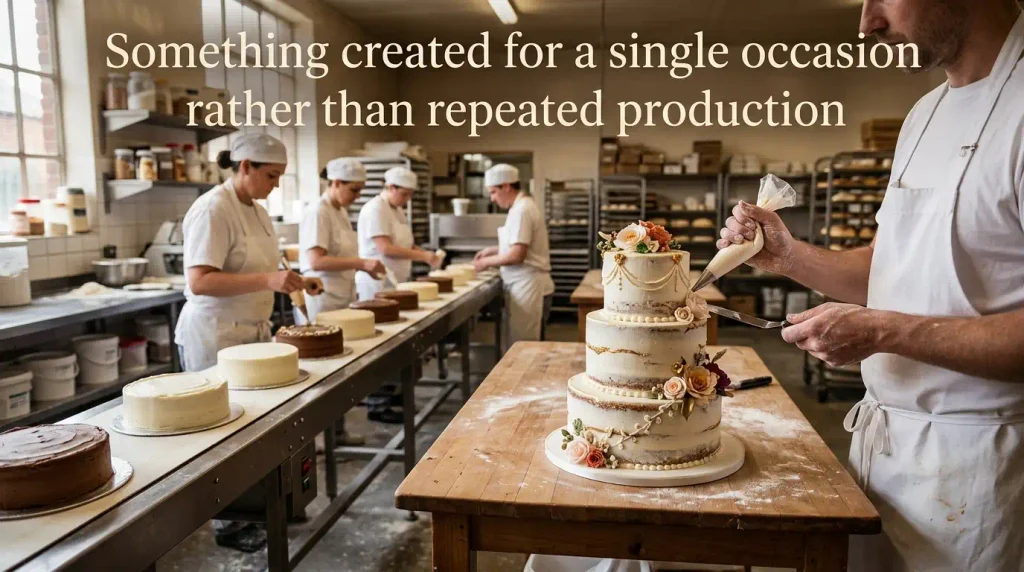
One-Time Creation (Noun Phrase) — US: /ˌwʌn ˈtaɪm kriˈeɪʃən/ | UK: /ˌwʌn ˈtaɪm kriˈeɪʃən/
Meaning: Something created for a single occasion rather than repeated production.
Tone/Register: Creative, neutral
Example:
The artist designed a one-time creation.
The sculpture was a one-time creation for the festival.
Synonyms for One-Off by Tone
Positive Alternatives
When you want to emphasize rarity, value, or excitement, choose:
- Unique
- Special
- Exceptional
- Exclusive
- Unrepeatable
- Once-in-a-lifetime
- Bespoke
- Custom-made
For example, unique sounds appreciative, while unrepeatable emphasizes that the experience cannot easily happen again.
Neutral Alternatives
For straightforward communication, these are useful:
- One-time
- Single
- Individual
- Standalone
- Single instance
- Single occurrence
- Once-only
- One-time event
These choices work especially well in emails, essays, reports, and everyday conversation.
Negative or Detached Alternatives
When the context highlights separation or lack of continuity, consider:
- Isolated
- Isolated incident
- Isolated case
- Nonrecurring
- Sporadic
- Infrequent
However, these words should be selected carefully because they may sound less positive than one-off.
Playful or Informal Alternatives
In relaxed English, you can often use:
- One-time
- Special
- Rare
- One-time event
- Once-only
The best choice depends on the audience and situation.
One-Off vs Close Alternatives
One-time vs One-Off
One-off and one-time are extremely close. Both can describe something that happens only once.
However, one-off is especially common in British English, while one-time is very natural in American English.
It was a one-off event.
It was a one-time event.
Both sentences communicate nearly the same idea.
One-Off vs Unique
Unique focuses on being different from everything else.
One-off focuses on happening or being produced only once.
Therefore, something can be one-off without being unique.
One-Off vs Standalone
Standalone emphasizes independence from a series, system, or larger project.
One-off emphasizes the lack of repetition.
Thus, a standalone article could potentially be published many times, while a one-off article is specifically associated with a single occasion.
How One-Off Changes by Context
Daily Conversation
In everyday speech, one-off often describes unusual plans or events.
“It was just a one-off dinner.”
Here, the speaker means the dinner was not part of a regular arrangement.
However, one-time may sound more natural to many American English speakers.
Writing and Blogging
Bloggers can use one-off when discussing individual events, projects, campaigns, or experiences.
For example:
The company launched a one-off campaign for the anniversary.
Nevertheless, writers can replace it with single, standalone, or special when repetition would make the paragraph dull.
Professional and Academic Writing
Formal writing often benefits from alternatives such as single occurrence, isolated case, nonrecurring, and individual instance.
For example:
The researchers identified a single occurrence of the behavior.
This sounds more precise than casual wording.
Creative and Informal Use
Creative writing can use unique, unrepeatable, special, or once-in-a-lifetime to create stronger emotional impact.
For instance:
That night became an unrepeatable memory.
The alternative adds emotion instead of simply stating that the event happened once.
Common Mistakes Learners Make
Mistake 1: Treating “Unique” as an Exact Replacement
Unique does not always mean “happening once.”
It usually means something is highly distinctive or unlike other things.
Mistake 2: Using “Occasional” for Something That Happened Once
Occasional normally suggests something happens from time to time.
Therefore, it is not an exact synonym for a truly single event.
Mistake 3: Confusing “Temporary” With “One-Off”
A temporary situation lasts for a limited period.
A one-off situation happens only once.
These ideas can overlap, but they are not identical.
Mistake 4: Overusing “One-Off”
Although one-off is natural, repeating it throughout an article can make your writing sound limited.
Instead, use alternatives such as single, standalone, special, or one-time when their meanings fit.
Native Usage Notes
In British English, one-off is very common:
It was a one-off opportunity.
In American English, one-time is often preferred:
It was a one-time opportunity.
Also, remember the spelling. As a noun or adjective, one-off is commonly written with a hyphen.
a one-off event
This was a one-off.
The plural noun is generally one-offs.
The designer created several one-offs.
Real-Life Mini Scenarios
Workplace
A manager organizes a single training session for an unusual software update.
It was a one-off training session.
A formal report might instead say:
It was a nonrecurring training activity.
Social Situation
Friends meet for dinner before one person moves abroad.
It was a one-off dinner before her move.
A warmer alternative would be:
It was a special occasion for all of us.
Media and Pop Culture
A musician performs with another artist for one special concert.
The collaboration was a one-off performance.
A promotional article might call it an exclusive performance.
Writing and Storytelling
A novelist describes a strange event that never happens again.
The incident remained an isolated occurrence.
For a more emotional style:
It became an unrepeatable moment in her life.
Why Synonyms for One-Off Matter
Vocabulary variety is more than replacing words.
Instead, it helps you communicate exact meaning, tone, and intention.
For example, one-time is simple and direct. Unique adds a sense of distinction. Isolated highlights separation, while once-in-a-lifetime creates emotional importance.
Therefore, students can improve essays, bloggers can make articles smoother, and professional writers can make reports more precise.
Moreover, speakers can choose words that sound natural for different audiences.
Practice Quiz
1. Which word best describes something designed to happen only once?
A. Frequent
B. One-time
C. Permanent
D. Regular
2. Which alternative emphasizes that something is unlike anything else?
A. Unique
B. Temporary
C. Occasional
D. Repeated
3. A company reports an expense that will not happen again. Which term fits best?
A. Nonrecurring
B. Frequent
C. Continuous
D. Routine
4. Which word best describes an event separate from a wider pattern?
A. Isolated
B. Daily
C. Regular
D. Repeated
5. Which phrase sounds especially positive and emotional?
A. Isolated case
B. Single instance
C. Once-in-a-lifetime
D. Nonrecurring event
6. Which word means made specifically for a person or purpose?
A. Bespoke
B. Sporadic
C. Single
D. Isolated
7. Which term is especially useful in formal academic writing?
A. Single occurrence
B. One-time thing
C. Cool event
D. Special stuff
8. Which alternative emphasizes independence from a larger series?
A. Standalone
B. Occasional
C. Rare
D. Temporary
9. Which word means happening sometimes but not regularly?
A. Occasional
B. One-off
C. Unique
D. Singular
10. Which phrase describes one unusual situation that does not form a pattern?
A. Isolated case
B. Regular series
C. Repeated event
D. Daily activity
Answer Key: 1-B, 2-A, 3-A, 4-A, 5-C, 6-A, 7-A, 8-A, 9-A, 10-A
Reflection Task
Write one sentence using one-off, then rewrite the same sentence using a more precise alternative such as one-time, unique, standalone, isolated, or unrepeatable.
FAQs
1. What is the best synonym for one-off in American English?
One-time is usually the closest everyday alternative in American English. For example, “a one-time event” naturally describes something planned or expected to happen only once. However, single, standalone, or special may be better depending on the exact context. The best synonym should match whether you are emphasizing rarity, independence, importance, or non-repetition.
2. Is one-off formal or informal English?
One-off is standard English but is generally more conversational than highly formal alternatives such as single occurrence or nonrecurring event. It is especially common in British English. In professional or academic writing, choose a more precise alternative when the context requires technical clarity. Nevertheless, one-off is perfectly natural in many workplace and general-interest texts.
3. Can I use one-off for a person?
Usually, one-off is used for events, products, arrangements, situations, and actions rather than people. Calling a person “a one-off” can mean that the person is highly unusual or unlike anyone else, but this usage is more informal and context-dependent. For a person, unique, exceptional, or one of a kind may communicate the intended meaning more clearly.
4. What is the difference between one-off and once-in-a-lifetime?
One-off simply means something happens or is made once. Once-in-a-lifetime adds strong emotional meaning and suggests an extremely rare opportunity or experience. For example, a company may hold a one-off meeting, while seeing a rare natural phenomenon could be described as a once-in-a-lifetime experience. Therefore, the second expression is much stronger emotionally.
5. Is “one-time” the same as “one-off”?
In many situations, yes. Both can describe something that happens only once. However, one-time is particularly natural in American English, while one-off is especially common in British English. Context can also create small differences. For example, one-time payment is very common, while one-off event is a natural British expression for a single event.
6. What is a formal synonym for one-off?
For formal writing, useful alternatives include single occurrence, single instance, isolated incident, nonrecurring event, and individual instance. The best choice depends on the context. For example, financial writing may prefer nonrecurring, while academic writing may use single occurrence. These expressions provide greater precision than a general phrase such as one-off.
7. Can one-off describe a product?
Yes. One-off can describe a product or object made as a single example rather than as part of a regular production run. For instance, “The designer created a one-off sculpture” means the sculpture was made as an individual piece. Depending on the context, custom-made, bespoke, unique, or limited edition may provide a more specific meaning.
Conclusion
Learning synonyms for one-off gives you more control over your vocabulary. Instead of repeating one phrase, you can select words that express rarity, separation, or importance.
For students and writers, these alternatives make essays, articles, and reports more precise. Meanwhile, speakers can sound more natural by choosing vocabulary suited to each situation.
Whether you prefer one-time, unique, standalone, isolated, or unrepeatable, the key is understanding the small differences in meaning and tone.
Finally, practice these synonyms for one-off in emails, essays, blog posts, and daily conversations. The more you use them, the more naturally they become part of your vocabulary.

Shahzeena Shazadi is the founder and lead writer at VocablyHub.com, where she creates accurate, reader-focused English language content designed to help people communicate with clarity and confidence. She specializes in synonyms, antonyms, word meanings, idioms, and practical vocabulary guides that simplify complex language concepts for everyday use. Every article is carefully researched, fact-checked, and written in clear, accessible language using reliable references and real-world examples. Her goal is to provide helpful, trustworthy content that supports learners at every stage of their English language journey.
Her editorial approach focuses on accuracy, transparency, and user value while following modern content quality standards. She regularly reviews and updates content to keep information relevant, useful, and easy to understand. Through VocablyHub.com, Shahzeena Shazadi is committed to publishing reliable language resources that help students, writers, educators, professionals, and English learners expand their vocabulary, improve their writing skills, and communicate with confidence in academic, professional, and everyday situations.