
Synonyms for taken back depend on the meaning. If someone takes back a statement, you can use retract, withdraw, recant, revoke, or disavow. If something is returned or reclaimed, retrieve, recover, reclaim, or regain may fit.
Imagine saying something in anger and immediately thinking, “I wish I had not said that.” You might say, “I take it back,” meaning you withdraw your words.
The phrase taken back is common because English speakers use it in several everyday situations, from correcting statements to returning items or expressing surprise.
For students, synonyms for taken back make essays more precise. Bloggers and content writers can avoid repetition and choose words that match the exact meaning.
Daily English users also benefit from knowing the difference. Saying retract sounds more formal than take back, while stunned expresses surprise rather than withdrawal.
What Does “Taken Back” Really Mean?
Taken back is the past participle form of the phrasal verb take back, but its meaning changes according to context.
The phrase can mean:
- To withdraw something you said
“I take back what I said.” - To return or accept something again
“The store took the damaged item back.” - To reverse or withdraw an offer, decision, or promise
“The company took back its offer.” - To make someone remember an earlier time
“That song took me back to school.” - To surprise or shock someone when used in the expression taken aback
“I was taken aback by the sudden question.”
This last meaning is important. Taken back and taken aback are not normally interchangeable. Taken aback means surprised, shocked, or momentarily confused.
Part of Speech
Taken is the past participle of the irregular verb take.
Back is an adverb or particle in the phrasal verb take back.
Together, taken back can function within several grammatical structures.
Simple definition:
Taken back means withdrawn, returned, reclaimed, reversed, remembered, or emotionally surprised, depending on the context.
Native speakers normally understand the intended meaning from the surrounding sentence.
Common Contexts
You may hear or read taken back when talking about:
- Statements
- Opinions
- Promises
- Offers
- Decisions
- Purchases
- Property
- Relationships
- Memories
- Emotional reactions
That wide range is why context matters so much.
Connotative Meaning
Connotation (the feeling or association a word carries beyond its basic dictionary meaning) depends strongly on which sense of taken back is being used.
Positive Tone
In a positive context, taken back may suggest reconciliation or restoration.
“She was taken back into the family.”
It can also suggest a pleasant memory when something takes you back to a happy period.
Negative Tone
The phrase can suggest regret, embarrassment, conflict, or correction.
“He took back his accusation.”
It may also appear when someone reverses a promise or decision.
Neutral Tone
The phrase is neutral when describing a returned item, withdrawn statement, or restored possession.
“The shop took the product back.”
“She took back her original comment.”
The emotional meaning comes from the context rather than from the phrase itself.
Etymology
The phrase is built from two very old English elements: take and back.
Old English: 450–1100
The modern verb take did not originally come from Old English niman, the older West Germanic verb meaning “take.” Instead, modern take entered English from a Scandinavian source.
Etymonline traces take to late Old English tacan, meaning “to grip, seize by force, or lay hold of,” from a Scandinavian source related to Old Norse taka.
Back is much older in English. Old English bæc meant “back” and came from Proto-Germanic bakam.
The basic ideas of taking and returning backward therefore have deep Germanic roots.
Middle English: 1100–1500
During Middle English, take expanded into many meanings, including obtaining, receiving, carrying, accepting, and capturing.
The word back also developed wider spatial and figurative uses.
Phrasal verbs built from a main verb plus a particle became an important feature of English. Take back eventually developed the idea of moving something back, returning it, or withdrawing something previously given or said.
Modern English: 1500–Present
The modern meanings of take back became increasingly varied.
Today, English speakers can use it for returning purchases, withdrawing statements, reversing commitments, accepting someone again, or mentally returning to an earlier time.
The related verb retract developed a particularly important formal meaning. Etymonline records its sense of “revoke, recant, take back” from the 1540s.
The verb withdraw is even older in its “take back” sense. Etymonline dates withdraw to the early 13th century and gives its early meaning as “take back, draw away or aside.”
Pronunciation
Taken back
- US IPA: /ˌteɪkən ˈbæk/
- UK IPA: /ˌteɪkən ˈbæk/
Take back
- US IPA: /ˌteɪk ˈbæk/
- UK IPA: /ˌteɪk ˈbæk/
Syllables
tak-en-back
The phrase has three syllables when taken is pronounced naturally.
Affixation Pattern
Root:
- take
- back
Prefix:
- None
Suffix:
- -en in taken is part of the irregular past-participle form
Word formation:
take + back → take back → took back → taken back
The phrase is a phrasal verb construction, not a single derived word.
Synonyms List
The phrase has several meanings. The first group below focuses on withdrawing words or claims. Other groups cover reversing decisions, recovering something, and being surprised.
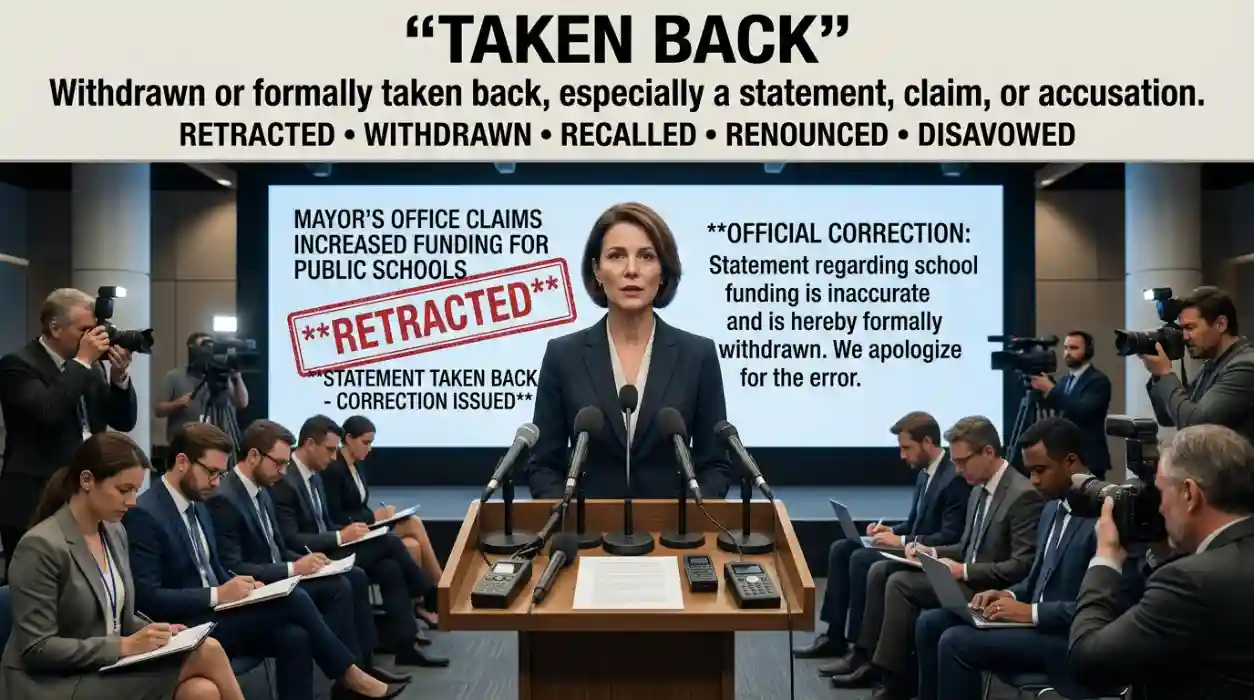
1. Retracted (Verb/Adjective) — US /rɪˈtræktɪd/ | UK /rɪˈtræktɪd/
Meaning: Withdrawn or formally taken back, especially a statement, claim, or accusation.
Tone/Register: Formal, professional, academic.
Examples:
“The newspaper retracted the false claim.”
“He retracted his earlier accusation.”
This is one of the closest formal alternatives to taken back when discussing words or statements. Cambridge defines retract as taking back an offer or statement or admitting that a statement was false.
2. Withdrawn (Verb/Adjective) — US /wɪðˈdrɔːn/ | UK /wɪðˈdrɔːn/
Meaning: Removed, recalled, or taken back from consideration or public use.
Tone/Register: Neutral to formal.
Examples:
“The candidate withdrew the proposal.”
“The complaint was withdrawn later.”
3. Recanted (Verb) — US /rɪˈkæntɪd/ | UK /rɪˈkæntɪd/
Meaning: Publicly stated that a previous belief, statement, or claim was wrong.
Tone/Register: Formal, serious.
Examples:
“The witness recanted his testimony.”
“She later recanted her original claim.”
4. Revoked (Verb) — US /rɪˈvoʊkt/ | UK /rɪˈvəʊkt/
Meaning: Officially canceled or took back something that had previously been granted.
Tone/Register: Formal, legal, administrative.
Examples:
“The authority revoked his license.”
“The organization revoked the invitation.”
5. Retraced (Verb) — US /riːˈtreɪst/ | UK /riːˈtreɪst/
Meaning: Went back over a previous route, path, or sequence.
Tone/Register: Neutral.
Examples:
“We retraced our steps to find the missing phone.”
“She retraced the route from the station.”
This is not a synonym for withdrawing a statement. It belongs to the physical “go back” sense.
6. Reversed (Verb) — US /rɪˈvɜːrst/ | UK /rɪˈvɜːst/
Meaning: Changed a decision, action, or position to its opposite.
Tone/Register: Neutral to formal.
Examples:
“The manager reversed the decision.”
“The court reversed the earlier ruling.”
7. Rescinded (Verb) — US /rɪˈsɪndɪd/ | UK /rɪˈsɪndɪd/
Meaning: Officially canceled an agreement, offer, or decision.
Tone/Register: Formal, legal, business.
Examples:
“The company rescinded the offer.”
“The contract was rescinded after the error was discovered.”
8. Recalled (Verb) — US /rɪˈkɔːld/ | UK /rɪˈkɔːld/
Meaning: Called back, withdrawn, or brought back from circulation or use.
Tone/Register: Neutral to formal.
Examples:
“The manufacturer recalled the product.”
“The ambassador was recalled for consultation.”
9. Revoked and Withdrawn (Verb Phrase) — US /rɪˈvoʊkt ænd wɪðˈdrɔːn/ | UK /rɪˈvəʊkt ænd wɪðˈdrɔːn/
Meaning: Officially removed or canceled something previously offered or authorized.
Tone/Register: Formal.
Examples:
“The permit was revoked and withdrawn.”
“The approval was revoked and withdrawn after review.”
10. Disavowed (Verb) — US /ˌdɪsəˈvaʊd/ | UK /ˌdɪsəˈvaʊd/
Meaning: Publicly rejected responsibility for or association with something previously connected to you.
Tone/Register: Formal, political, professional.
Examples:
“She disavowed the controversial statement.”
“The organization disavowed the remarks.”
11. Renounced (Verb) — US /rɪˈnaʊnst/ | UK /rɪˈnaʊnst/
Meaning: Formally gave up or rejected a belief, claim, right, or position.
Tone/Register: Formal.
Examples:
“He renounced his earlier position.”
“She renounced her claim to the title.”
12. Disowned (Verb) — US /dɪsˈoʊnd/ | UK /dɪsˈəʊnd/
Meaning: Refused to acknowledge or accept responsibility for something previously associated with you.
Tone/Register: Strong, formal, or emotional.
Examples:
“He disowned his earlier remarks.”
“The politician disowned the controversial proposal.”
13. Repudiated (Verb) — US /rɪˈpjuːdieɪtɪd/ | UK /rɪˈpjuːdieɪtɪd/
Meaning: Strongly rejected a statement, agreement, belief, or responsibility.
Tone/Register: Very formal.
Examples:
“The government repudiated the accusation.”
“She repudiated the earlier agreement.”
14. Disclaimed (Verb) — US /dɪˈkleɪmd/ | UK /dɪˈkleɪmd/
Meaning: Denied responsibility for or rejected an association with something.
Tone/Register: Formal, legal.
Examples:
“The company disclaimed responsibility.”
“He disclaimed any knowledge of the incident.”
15. Recanted a Statement (Verb Phrase) — US /rɪˈkæntɪd ə ˈsteɪtmənt/ | UK /rɪˈkæntɪd ə ˈsteɪtmənt/
Meaning: Publicly withdrew a statement after deciding it was incorrect.
Tone/Register: Formal.
Examples:
“The witness recanted his statement.”
“She recanted the statement during the hearing.”
16. Retracted a Claim (Verb Phrase) — US /rɪˈtræktɪd ə kleɪm/ | UK /rɪˈtræktɪd ə kleɪm/
Meaning: Formally withdrew a claim that had previously been made.
Tone/Register: Academic, journalistic, formal.
Examples:
“The researcher retracted the claim.”
“The author retracted the unsupported claim.”
17. Took Back One’s Words (Verb Phrase) — US /tʊk bæk wʌnz wɜːrdz/ | UK /tʊk bæk wʌnz wɜːdz/
Meaning: Admitted that something previously said should not have been said.
Tone/Register: Everyday, conversational.
Examples:
“I wish I could take back my words.”
“He apologized and took back his words.”
18. Swallowed One’s Words (Idiom) — US /ˈswɑːloʊd wʌnz wɜːrdz/ | UK /ˈswɒləʊd wʌnz wɜːdz/
Meaning: Admitted that a previous statement or prediction was wrong.
Tone/Register: Informal, idiomatic.
Examples:
“I had to swallow my words after the team won.”
“She swallowed her words when the results arrived.”
19. Ate One’s Words (Idiom) — US /eɪt wʌnz wɜːrdz/ | UK /eɪt wʌnz wɜːdz/
Meaning: Admitted that something previously said was wrong.
Tone/Register: Informal, conversational.
Examples:
“He ate his words after seeing the evidence.”
“I had to eat my words about the new player.”
20. Unsay (Verb) — US /ʌnˈseɪ/ | UK /ʌnˈseɪ/
Meaning: Take back something that has already been said.
Tone/Register: Informal, conversational.
Examples:
“I wish I could unsay that.”
“You cannot unsay those words.”
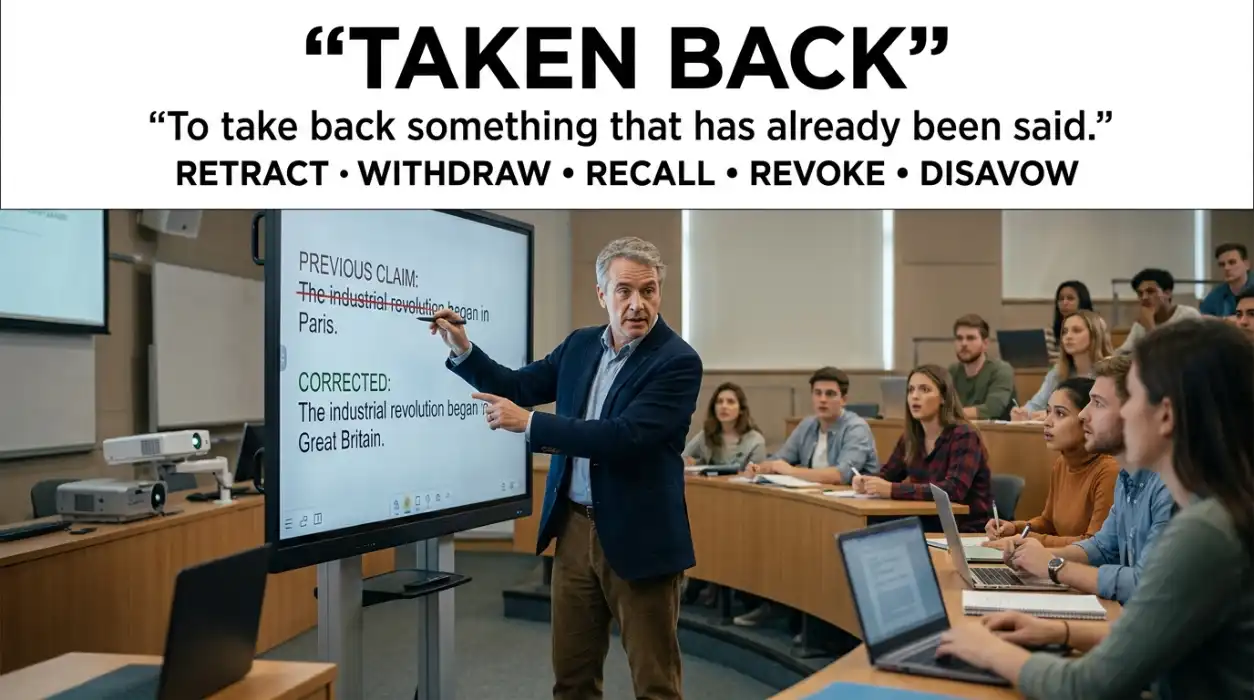
21. Retract One’s Words (Verb Phrase) — US /rɪˈtrækt wʌnz wɜːrdz/ | UK /rɪˈtrækt wʌnz wɜːdz/
Meaning: Formally withdraw something previously spoken or written.
Tone/Register: Formal.
Examples:
“He refused to retract his words.”
“She eventually retracted her words.”
22. Qualify (Verb) — US /ˈkwɑːləfaɪ/ | UK /ˈkwɒlɪfaɪ/
Meaning: Add limits or conditions to an earlier statement rather than completely withdrawing it.
Tone/Register: Formal, academic.
Examples:
“She qualified her earlier statement.”
“The professor qualified his criticism.”
23. Correct (Verb) — US /kəˈrekt/ | UK /kəˈrekt/
Meaning: Replace incorrect information with accurate information.
Tone/Register: Neutral.
Examples:
“He corrected his earlier statement.”
“She corrected the mistake immediately.”
24. Clarify (Verb) — US /ˈklerəfaɪ/ | UK /ˈklærɪfaɪ/
Meaning: Explain or modify an earlier statement so its intended meaning is clearer.
Tone/Register: Neutral to formal.
Examples:
“She clarified what she meant.”
“He clarified his earlier comments.”
Clarify does not always mean “take back.” It is appropriate when the speaker wants to explain rather than fully withdraw.
25. Amend (Verb) — US /əˈmend/ | UK /əˈmend/
Meaning: Change or improve an earlier statement, document, proposal, or decision.
Tone/Register: Formal, professional.
Examples:
“The committee amended its proposal.”
“He amended his original statement.”
26. Cancelled (Verb/Adjective) — US /ˈkænsəld/ | UK /ˈkænsəld/
Meaning: Stopped or called off something that had previously been arranged.
Tone/Register: Neutral.
Examples:
“The meeting was cancelled.”
“They cancelled the offer before signing.”
27. Countermanded (Verb) — US /ˌkaʊntərˈmændɪd/ | UK /ˌkaʊntəˈmɑːndɪd/
Meaning: Officially reversed a previous order or instruction.
Tone/Register: Formal, official.
Examples:
“The commander countermanded the order.”
“The original instruction was countermanded.”
28. Repealed (Verb) — US /rɪˈpiːld/ | UK /rɪˈpiːld/
Meaning: Officially ended a law, rule, or legal provision.
Tone/Register: Legal, formal.
Examples:
“The old law was repealed.”
“Parliament repealed the outdated rule.”
29. Annulled (Verb) — US /əˈnʌld/ | UK /əˈnʌld/
Meaning: Officially declared an agreement, decision, or legal arrangement invalid.
Tone/Register: Formal, legal.
Examples:
“The agreement was annulled.”
“The court annulled the previous decision.”
30. Reversed a Decision (Verb Phrase) — US /rɪˈvɜːrst ə dɪˈsɪʒən/ | UK /rɪˈvɜːst ə dɪˈsɪʒən/
Meaning: Changed an earlier decision to a different or opposite one.
Tone/Register: Neutral to formal.
Examples:
“The board reversed its decision.”
“The judge reversed the earlier ruling.”
31. Reconsidered (Verb) — US /ˌriːkənˈsɪrd/ | UK /ˌriːkənˈsɪəd/
Meaning: Thought about a previous decision again and possibly changed it.
Tone/Register: Neutral, professional.
Examples:
“She reconsidered her decision.”
“The team reconsidered the original plan.”
32. Changed One’s Mind (Verb Phrase) — US /tʃeɪndʒd wʌnz maɪnd/ | UK /tʃeɪndʒd wʌnz maɪnd/
Meaning: Decided to think or act differently from before.
Tone/Register: Everyday.
Examples:
“I changed my mind about the trip.”
“He changed his mind and stayed home.”
33. Backed Out (Phrasal Verb) — US /bækt aʊt/ | UK /bækt aʊt/
Meaning: Withdrew from an agreement, plan, promise, or commitment.
Tone/Register: Informal.
Examples:
“She backed out of the deal.”
“He backed out at the last minute.”
34. Pulled Back (Phrasal Verb) — US /pʊld bæk/ | UK /pʊld bæk/
Meaning: Reduced commitment or withdrew from an action, plan, or position.
Tone/Register: Neutral, conversational.
Examples:
“The company pulled back from the project.”
“He pulled back after hearing the criticism.”
35. Called Off (Phrasal Verb) — US /kɔːld ɔːf/ | UK /kɔːld ɒf/
Meaning: Canceled something that had been planned or arranged.
Tone/Register: Informal to neutral.
Examples:
“They called off the meeting.”
“The couple called off the wedding.”
36. Reversed Course (Verb Phrase) — US /rɪˈvɜːrst kɔːrs/ | UK /rɪˈvɜːst kɔːs/
Meaning: Changed direction or abandoned a previous approach.
Tone/Register: Neutral to formal.
Examples:
“The company reversed course after the complaints.”
“The government reversed course on the proposal.”
37. Retrieved (Verb) — US /rɪˈtriːvd/ | UK /rɪˈtriːvd/
Meaning: Got something back after it had been lost, removed, or left somewhere.
Tone/Register: Neutral, formal.
Examples:
“She retrieved her phone from the car.”
“He retrieved the documents from storage.”
38. Recovered (Verb) — US /rɪˈkʌvərd/ | UK /rɪˈkʌvəd/
Meaning: Got something back after losing it or being separated from it.
Tone/Register: Neutral.
Examples:
“They recovered the missing files.”
“She recovered her bag from the station.”
39. Reclaimed (Verb) — US /rɪˈkleɪmd/ | UK /rɪˈkleɪmd/
Meaning: Took back something that belonged to you or that you believed you had a right to.
Tone/Register: Neutral to formal.
Examples:
“He reclaimed his property.”
“She reclaimed her seat after the break.”
40. Regained (Verb) — US /rɪˈɡeɪnd/ | UK /rɪˈɡeɪnd/
Meaning: Got something back after losing it.
Tone/Register: Neutral, formal.
Examples:
“She regained control of the project.”
“He eventually regained his confidence.”

41. Recaptured (Verb) — US /ˌriːˈkæptʃərd/ | UK /ˌriːˈkæptʃəd/
Meaning: Took control of something again after it had been lost or taken.
Tone/Register: Formal, military, narrative.
Examples:
“The team recaptured the lead.”
“The soldiers recaptured the town.”
42. Retrieved Again (Verb Phrase) — US /rɪˈtriːvd əˈɡen/ | UK /rɪˈtriːvd əˈɡen/
Meaning: Obtained something again after it had been removed or misplaced.
Tone/Register: Neutral.
Examples:
“She retrieved the file again.”
“He retrieved the book from the library.”
43. Restored (Verb) — US /rɪˈstɔːrd/ | UK /rɪˈstɔːd/
Meaning: Returned something to an earlier condition, position, or state.
Tone/Register: Formal, neutral.
Examples:
“The original settings were restored.”
“The team restored access to the account.”
44. Returned (Verb) — US /rɪˈtɜːrnd/ | UK /rɪˈtɜːnd/
Meaning: Gave something back or brought it back to its previous place.
Tone/Register: Neutral.
Examples:
“She returned the borrowed book.”
“He returned the keys after the meeting.”
45. Repossessed (Verb) — US /ˌriːpəˈzest/ | UK /ˌriːpəˈzest/
Meaning: Officially took property back from someone who had failed to meet an obligation.
Tone/Register: Legal, financial.
Examples:
“The lender repossessed the vehicle.”
“The property was repossessed after repeated missed payments.”
46. Shocked (Adjective/Verb) — US /ʃɑːkt/ | UK /ʃɒkt/
Meaning: Strongly surprised or emotionally disturbed by something unexpected.
Tone/Register: Neutral, emotional.
Examples:
“I was shocked by the announcement.”
“She looked shocked when she heard the news.”
47. Stunned (Adjective/Verb) — US /stʌnd/ | UK /stʌnd/
Meaning: Extremely surprised or temporarily unable to react normally.
Tone/Register: Neutral, strong.
Examples:
“We were stunned by the result.”
“He stood stunned after hearing the decision.”
48. Astonished (Adjective) — US /əˈstɑːnɪʃt/ | UK /əˈstɒnɪʃt/
Meaning: Extremely surprised because something was unexpected.
Tone/Register: Neutral to formal.
Examples:
“She was astonished by his answer.”
“I was astonished to see everyone there.”
49. Surprised (Adjective) — US /sərˈpraɪzd/ | UK /səˈpraɪzd/
Meaning: Feeling unexpected interest, confusion, or shock because something happened differently from what you expected.
Tone/Register: Neutral.
Examples:
“I was surprised by her reaction.”
“He looked surprised when I arrived.”
50. Taken Aback (Adjective Phrase) — US /ˌteɪkən əˈbæk/ | UK /ˌteɪkən əˈbæk/
Meaning: Suddenly surprised, shocked, or unsettled by something unexpected.
Tone/Register: Neutral to formal, idiomatic.
Examples:
“She was taken aback by his blunt question.”
“I was taken aback when they changed the plan.”
Important: Taken aback is not the same as ordinary taken back. The expressions have different meanings.
Synonyms by Tone
Positive or Restorative
Some alternatives can suggest recovery, restoration, or returning something to a previous state:
- restored
- regained
- reclaimed
- recovered
- returned
These are useful when the context is about getting something valuable back.
Neutral
These work well in ordinary speech and general writing:
- taken back
- returned
- retrieved
- reconsidered
- changed one’s mind
- corrected
- clarified
- cancelled
- reversed
Negative or Conflict-Related
These often appear when someone admits an error, withdraws an accusation, or rejects an earlier position:
- retracted
- recanted
- repudiated
- disavowed
- renounced
- disowned
- revoked
- rescinded
Formal
These are especially useful in legal, academic, political, or professional writing:
- rescinded
- revoked
- repealed
- annulled
- repudiated
- countermanded
- retracted
- disclaimed
Informal
These sound more natural in everyday conversation:
- take back one’s words
- unsay
- eat one’s words
- swallow one’s words
- back out
- pull back
- call off
- change one’s mind
Tone matters because “I take it back” sounds conversational, while “I retract my statement” sounds formal and deliberate.
“Taken Back” vs Close Alternatives
Retracted vs Taken Back
Taken back is common and conversational.
Retracted is more formal and often implies a public or official withdrawal.
“I take back what I said.”
“The newspaper retracted the statement.”
Use take back in everyday speech. Use retract for formal statements, claims, allegations, or published material.
Taken Back vs Withdrawn
Withdrawn is broader.
You can withdraw a statement, offer, application, complaint, proposal, or commitment.
“She withdrew her complaint.”
“He took back what he said.”
The first sounds more formal. The second is more conversational.
Taken Back vs Reversed
Reversed usually refers to a decision, policy, judgment, direction, or action.
“The company reversed its decision.”
You would not normally say reversed his words when you simply mean he admitted that what he said was wrong.
How “Taken Back” Changes by Context
Daily Conversation
In casual English, take back is extremely useful.
“I take it back.”
This means:
“I admit what I said was wrong.”
Another common example is:
“Can I take that back?”
This may refer to a statement, opinion, or even an emotional reaction.
Writing and Blogging
Writers often need more precise alternatives.
Instead of repeating taken back, choose:
- retracted
- withdrew
- corrected
- clarified
- reversed
- rescinded
For example:
“The author retracted the claim after discovering new evidence.”
That is more precise than:
“The author took the claim back.”
Professional or Academic Tone
Formal contexts favor words such as retract, rescind, revoke, amend, repudiate, repeal, and withdraw.
The choice depends on what has changed.
A researcher may retract a claim.
A government may repeal a law.
A company may rescind an offer.
An authority may revoke a license.
Creative or Informal Use
Creative writing often benefits from idioms.
“He swallowed his words.”
“She had to eat her words.”
These expressions make dialogue feel more natural.
However, they should not replace precise formal vocabulary in academic or professional writing.
Common Mistakes and Native Usage
Mistake 1: Using “Retract” for Every Meaning
Retract mainly works when something is being withdrawn, especially a statement, claim, or offer.
You would not normally say:
“I retracted my lost phone.”
Use retrieved or recovered instead.
Mistake 2: Confusing “Taken Back” With “Taken Aback”
This is one of the most important distinctions.
Taken back: something was withdrawn, returned, reclaimed, or reversed.
Taken aback: someone was shocked.
Compare:
“She took back her accusation.”
“She was taken aback by his accusation.”
The meanings are completely different.
Mistake 3: Using “Revoke” for Casual Speech
Revoke sounds official.
“The authority revoked the permit.”
It would sound strange to say:
“I revoked what I said.”
In everyday English, I take it back is much more natural.
Mistake 4: Confusing “Withdraw” and “Revoke”
A person can withdraw a statement or application.
An authority can revoke a license, permit, privilege, or official authorization.
There is overlap, but the words are not always interchangeable.
Mistake 5: Using “Regain” for Statements
Regain normally means getting something back that you lost.
“She regained her confidence.”
It does not naturally replace take back a statement.
Register Notes
Everyday: take back, change your mind, call off, unsay
Neutral: return, correct, reconsider, reverse
Formal: retract, rescind, revoke, repudiate
Legal: annul, repeal, revoke, rescind
Idiomatic: eat your words, swallow your words
Emotional: shocked, stunned, astonished, taken aback
For another useful vocabulary exercise, you can explore how synonyms for “surprised” differ in emotional strength and formality.
Real-Life Mini Scenarios
Workplace
A manager sends an email announcing a policy change. After receiving new information, the manager reverses the decision.
If the original email contained a false claim, the manager might retract the claim instead.
The two verbs describe different actions.
Social Situation
Two friends argue.
One says something harsh and later says:
“I take it back.”
That is natural conversational English.
If the friend formally apologizes in writing, the same idea might become:
“I retract that statement.”
Media and Public Statements
A journalist publishes incorrect information.
After checking the facts, the publication retracts the claim.
If a politician changes an official policy, the government may reverse the decision or withdraw the proposal.
Writing and Storytelling
A character makes a confident prediction and later discovers it was wrong.
The narrator might say:
“He had to eat his words.”
This is more colorful than simply saying:
“He admitted he was wrong.”
Why the Right Synonym Matters
The biggest lesson is simple: synonyms are not interchangeable just because their dictionary meanings look similar.
Consider these sentences:
“She took back her accusation.”
“She retracted her accusation.”
“She withdrew her accusation.”
All three can work, but they create slightly different impressions.
The first is conversational.
The second sounds formal.
The third emphasizes removal or withdrawal.
Now compare:
“She recovered her phone.”
“She retracted her phone.”
The second sentence is incorrect for the intended meaning.
That is why learning synonyms should always involve context, grammar, tone, and meaning.

Practice Exercise
1. Your friend says something rude and then admits it was wrong. What is the most natural phrase?
A. I revoke it.
B. I take it back.
C. I repeal it.
D. I repossess it.
2. A newspaper removes a false claim from its reporting. Which word fits best?
A. Retract
B. Retrieve
C. Regain
D. Restore
3. A government officially cancels a law. Which verb is most appropriate?
A. Repeal
B. Unsay
C. Retrieve
D. Swallow
4. A company officially cancels an offer it previously made. Which word is strongest?
A. Rescind
B. Surprise
C. Reclaim
D. Retrace
5. Someone gets their lost phone back. Which word fits best?
A. Recant
B. Retrieve
C. Revoke
D. Repudiate
6. A manager changes an earlier decision. Which phrase is natural?
A. Reverse the decision
B. Eat the decision
C. Retract the decision always
D. Unsay the decision
7. Someone admits that their prediction was completely wrong. Which idiom works well?
A. Repeal the prediction
B. Eat their words
C. Repossess their words
D. Annul their words
8. A person publicly rejects responsibility for a controversial comment. Which word fits best?
A. Disavow
B. Retrieve
C. Restore
D. Recover
9. You want to say that someone was extremely surprised. Which phrase is correct?
A. back
B. Taken aback
C. again
D. Take away
10. A court cancels a previous legal arrangement. Which word may fit?
A. Annul
B. Unsay
C. Retrieve
D. Reconsider
Answer key: 1-B, 2-A, 3-A, 4-A, 5-B, 6-A, 7-B, 8-A, 9-B, 10-A,
Reflection Task
Write two sentences using different meanings of taken back.
For example, use one sentence for withdrawing words and another for recovering something. Then replace the phrase with a more precise synonym.
External Sources:
Cambridge Dictionary is especially useful for the meanings and usage of take back and retract, while the Online Etymology Dictionary provides the historical development of take, back, withdraw, retract, and revoke.
Conclusion
Learning synonyms for taken back helps you express regret, correction, reversal, recovery, and surprise with much greater precision and confidence.
For students and bloggers, the right synonym makes writing smoother. For speakers, it makes everyday English sound more natural and less repetitive.
Words such as retract, withdraw, revoke, reclaim, recover, reverse, and stunned are useful because each carries a different shade of meaning.
Start with one or two new expressions today. Use them in an email, essay, story, or conversation, and let context turn vocabulary into lasting skill.
Frequently Asked Questions
1. What is the best synonym for “taken back” when talking about words?
When taken back means withdrawing something you said, retracted is one of the closest formal synonyms. In everyday conversation, take it back, unsay, or withdraw what I said sound more natural. The best choice depends on register. Use retract for formal statements, published claims, allegations, or official comments.
2. What is another word for “taken back” when someone changes their mind?
When someone changes a decision or opinion, useful alternatives include reconsidered, reversed, changed their mind, or backed out, depending on the situation. Changed their mind is the most conversational. Reversed suits decisions and policies. Backed out suggests withdrawing from a plan, agreement, or commitment.
3. Is “retract” the same as “take back”?
They can have the same meaning when someone withdraws a statement, claim, accusation, or offer. However, retract is more formal. “I take back what I said” sounds natural in conversation, while “I retract my statement” sounds appropriate in journalism, academia, law, or professional communication.
4. What is the difference between “taken back” and “taken aback”?
Taken back can mean withdrawn, returned, reclaimed, or reversed. Taken aback means suddenly surprised, shocked, or unsettled. For example, “She took back her comment” means she withdrew it. “She was taken aback by the comment” means the comment surprised her.
5. What synonym for “taken back” works in academic writing?
For academic writing, retracted, withdrawn, reconsidered, amended, or revised may work depending on the context. If a researcher removes a false claim, retracted is especially appropriate. If an argument is changed after further thought, revised or reconsidered may be more accurate.

Shahzeena Shazadi is the founder and lead writer at VocablyHub.com, where she creates accurate, reader-focused English language content designed to help people communicate with clarity and confidence. She specializes in synonyms, antonyms, word meanings, idioms, and practical vocabulary guides that simplify complex language concepts for everyday use. Every article is carefully researched, fact-checked, and written in clear, accessible language using reliable references and real-world examples. Her goal is to provide helpful, trustworthy content that supports learners at every stage of their English language journey.
Her editorial approach focuses on accuracy, transparency, and user value while following modern content quality standards. She regularly reviews and updates content to keep information relevant, useful, and easy to understand. Through VocablyHub.com, Shahzeena Shazadi is committed to publishing reliable language resources that help students, writers, educators, professionals, and English learners expand their vocabulary, improve their writing skills, and communicate with confidence in academic, professional, and everyday situations.