
Synonyms for stomping can make a simple action feel vivid, whether someone walks heavily after an argument or moves with energy across a noisy floor.
A child might stomp across the kitchen after losing a game. Choosing another verb can show anger, tiredness, confidence, speed, or playful energy.
Learning synonyms for stomping helps students, bloggers, content writers, and daily English users avoid repetition and choose words with the right tone.
The word is common because it clearly describes heavy foot movement. Exploring synonyms for stomping gives you more natural choices for speaking and writing.
What Does “Stomping” Really Mean?
Stomping is the present participle and gerund form of stomp. It means walking or stepping heavily and forcefully, often while making a noticeable sound.
The action often carries emotion. Someone may stomp because they feel angry, frustrated, excited, impatient, or determined.
Native speakers usually understand the emotional meaning from context. For instance, “She was stomping around the house” may suggest irritation, while “Everyone was stomping to the music” can suggest energetic enjoyment.
Stomping can also describe physically pressing something with the foot. In some contexts, it can mean crushing or damaging something underfoot.
Part of Speech
Stomping can function as:
- Verb: “He is stomping across the floor.”
- Gerund: “Stomping is not allowed indoors.”
- Present participle: “The stomping child finally calmed down.”
Easy Definition
Stomping means moving or stepping with heavy, forceful foot movements, usually creating a strong physical or emotional impression.
Connotative Meaning of “Stomping”
Connotation (the feeling or association that a word suggests beyond its basic dictionary meaning) helps explain why stomping can sound stronger than walking or stepping.
Positive Tone
Stomping can sound energetic, confident, lively, or celebratory.
For example, people may stomp their feet during a concert or dance performance.
Negative Tone
The word often suggests anger, frustration, impatience, or aggression.
“She was stomping around the office” can make the person sound visibly annoyed.
Neutral Tone
In a straightforward physical description, stomping can simply mean making heavy steps.
For instance, a person wearing heavy boots may stomp through mud without feeling angry.
Etymology of “Stomping”
The verb stomp has Germanic connections and belongs to a group of English words associated with heavy stepping, stamping, and making forceful contact with the ground.
Its exact historical development is less certain than that of many older English verbs. However, its central idea has remained consistent: a strong or heavy movement of the foot.
Old English: 450–1100
The modern form stomp was not a standard Old English word. Old English had several native Germanic words for stepping, walking, striking, and stamping.
These older movement words helped form the broader vocabulary from which later English developed.
Middle English: 1100–1500
During Middle English, vocabulary connected with stamp, tread, and forceful foot movement became more established.
English speakers increasingly developed different verbs for ordinary walking, heavy movement, striking, and stepping on something.
Modern English: 1500–Present
Stomp became established in Modern English as a vivid word for heavy or forceful stepping.
Over time, it gained wider figurative and informal uses. Today, stomping can describe walking angrily, dancing energetically, crushing something, or moving heavily through difficult ground.
Pronunciation of “Stomping”
US: /ˈstɑːmpɪŋ/
UK: /ˈstɒmpɪŋ/
Syllables
stom-ping
The word has two syllables.
Affixation Pattern of “Stomping”
Root: stomp
Prefix: none
Suffix: -ing
The formation is:
stomp + -ing = stomping
The spelling keeps the final p and adds -ing.
Synonyms List
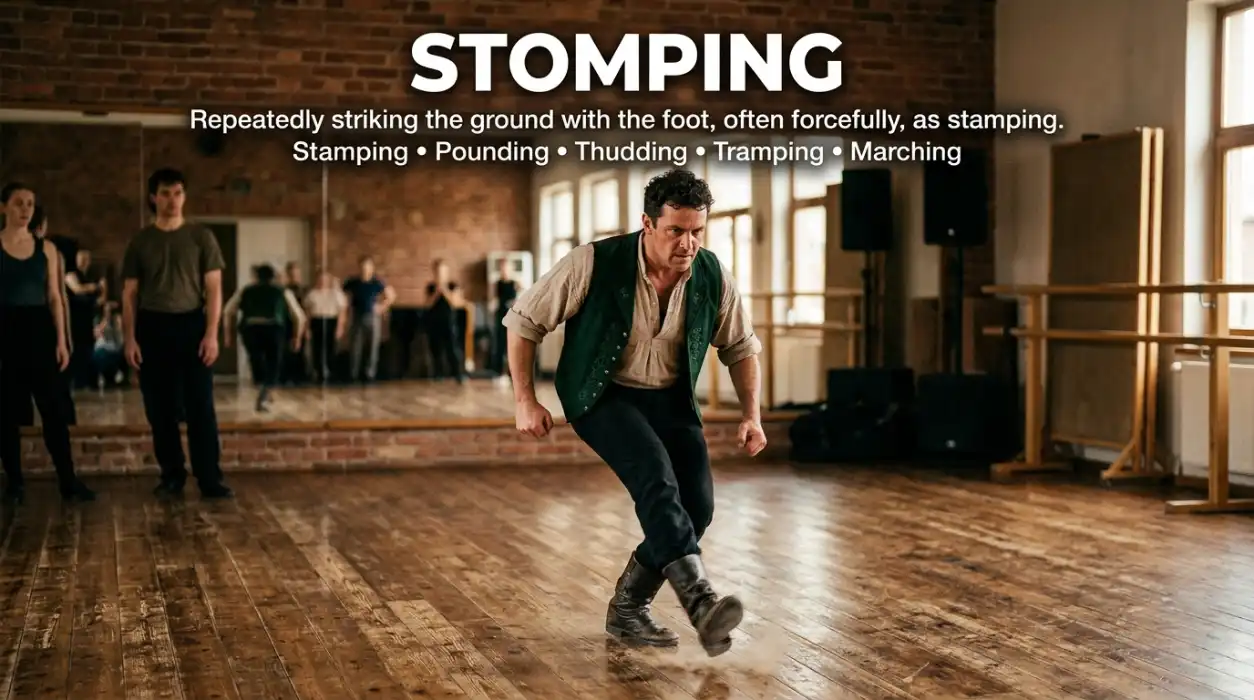
Stamping (verb) — US /ˈstæmpɪŋ/ | UK /ˈstæmpɪŋ/
Meaning: Stamping means repeatedly striking the ground with the foot, often forcefully.
Tone/Register: Neutral, everyday
Examples:
She was stamping her feet to stay warm.
The toddler started stamping during the tantrum.
Treading Heavily (verb phrase) — US /ˈtrɛdɪŋ ˈhɛvəli/ | UK /ˈtrɛdɪŋ ˈhɛvɪli/
Meaning: Treading heavily means walking or stepping with noticeably heavy foot pressure.
Tone/Register: Neutral, descriptive
Examples:
He was treading heavily across the wooden floor.
The hikers came back treading heavily through the wet ground.
Walking Heavily (verb phrase) — US /ˈwɔːkɪŋ ˈhɛvəli/ | UK /ˈwɔːkɪŋ ˈhɛvɪli/
Meaning: Walking heavily means moving on foot with unusually strong or weighty steps.
Tone/Register: Neutral, everyday
Examples:
Someone was walking heavily above my apartment.
She came downstairs walking heavily after the long day.
Stepping Heavily (verb phrase) — US /ˈstɛpɪŋ ˈhɛvəli/ | UK /ˈstɛpɪŋ ˈhɛvɪli/
Meaning: Stepping heavily means putting the feet down with considerable force.
Tone/Register: Neutral
Examples:
He was stepping heavily on the loose boards.
The dancer kept stepping heavily to the drumbeat.
Tramping (verb) — US /ˈtræmpɪŋ/ | UK /ˈtræmpɪŋ/
Meaning: Tramping means walking heavily, often across rough, wet, or muddy ground.
Tone/Register: Neutral, informal
Examples:
We spent the afternoon tramping through the forest.
They came home after tramping across the fields.
Trudging (verb) — US /ˈtrʌdʒɪŋ/ | UK /ˈtrʌdʒɪŋ/
Meaning: Trudging means walking slowly and heavily because of tiredness, difficulty, or unpleasant conditions.
Tone/Register: Neutral, descriptive
Examples:
He was trudging home after a twelve-hour shift.
We kept trudging through the snow.
Clomping (verb) — US /ˈklɑːmpɪŋ/ | UK /ˈklɒmpɪŋ/
Meaning: Clomping means walking with heavy, awkward, and often noisy steps.
Tone/Register: Informal, expressive
Examples:
Dad came clomping down the hallway in boots.
She was clomping around in oversized shoes.
Tromping (verb) — US /ˈtrɑːmpɪŋ/ | UK /ˈtrɒmpɪŋ/
Meaning: Tromping means walking heavily and noisily, especially over difficult ground.
Tone/Register: Informal, conversational
Examples:
The children went tromping through the puddles.
We were tromping back to the cabin in the rain.
Pounding (verb) — US /ˈpaʊndɪŋ/ | UK /ˈpaʊndɪŋ/
Meaning: Pounding describes repeated heavy movement or impact that creates a strong sense of force.
Tone/Register: Neutral, vivid
Examples:
His boots were pounding against the stairs.
The runners kept pounding along the pavement.
Thudding (verb) — US /ˈθʌdɪŋ/ | UK /ˈθʌdɪŋ/
Meaning: Thudding means moving or striking with a deep, dull sound.
Tone/Register: Neutral, descriptive
Examples:
Her shoes were thudding across the gym floor.
Heavy footsteps came thudding from upstairs.
Thumping (verb) — US /ˈθʌmpɪŋ/ | UK /ˈθʌmpɪŋ/
Meaning: Thumping means making repeated heavy impacts that produce a dull sound.
Tone/Register: Neutral, informal
Examples:
He was thumping his feet against the floor.
The boots kept thumping on the wooden steps.
Marching (verb) — US /ˈmɑːrtʃɪŋ/ | UK /ˈmɑːtʃɪŋ/
Meaning: Marching means walking with deliberate, regular, and often firm steps.
Tone/Register: Neutral, formal
Examples:
She was marching toward the manager’s office.
The students marched across the field together.
Striding (verb) — US /ˈstraɪdɪŋ/ | UK /ˈstraɪdɪŋ/
Meaning: Striding means walking with long, confident steps.
Tone/Register: Neutral, polished
Examples:
He was striding across the lobby with confidence.
She came striding into the meeting room.
Strutting (verb) — US /ˈstrʌtɪŋ/ | UK /ˈstrʌtɪŋ/
Meaning: Strutting means walking proudly and confidently, sometimes in a showy way.
Tone/Register: Informal, expressive
Examples:
He was strutting across the stage after his performance.
The bird kept strutting around the garden.
Storming (verb) — US /ˈstɔːrmɪŋ/ | UK /ˈstɔːmɪŋ/
Meaning: Storming means moving suddenly and forcefully because of anger or strong emotion.
Tone/Register: Informal, emotional
Examples:
She was storming out of the office.
He went storming into the kitchen after the argument.
Charging (verb) — US /ˈtʃɑːrdʒɪŋ/ | UK /ˈtʃɑːdʒɪŋ/
Meaning: Charging means moving forward quickly and forcefully.
Tone/Register: Neutral, vivid
Examples:
The players were charging toward the goal.
He came charging through the doorway.
Rushing (verb) — US /ˈrʌʃɪŋ/ | UK /ˈrʌʃɪŋ/
Meaning: Rushing means moving very quickly because of urgency, excitement, or pressure.
Tone/Register: Neutral, everyday
Examples:
She was rushing down the stairs to catch the bus.
He came rushing outside when he heard the noise.
Barreling (verb) — US /ˈbærəlɪŋ/ | UK /ˈbærəlɪŋ/
Meaning: Barreling means moving quickly and forcefully, often with little attention to obstacles.
Tone/Register: Informal, vivid
Examples:
The children came barreling into the room.
He was barreling down the hallway.
Pacing Heavily (verb phrase) — US /ˈpeɪsɪŋ ˈhɛvəli/ | UK /ˈpeɪsɪŋ ˈhɛvɪli/
Meaning: Pacing heavily means repeatedly walking back and forth with noticeable force.
Tone/Register: Neutral, descriptive
Examples:
He was pacing heavily while waiting for the call.
She paced around the room during the tense discussion.
Moving Heavily (verb phrase) — US /ˈmuːvɪŋ ˈhɛvəli/ | UK /ˈmuːvɪŋ ˈhɛvɪli/
Meaning: Moving heavily means traveling with slow, weighty, or forceful body movement.
Tone/Register: Neutral
Examples:
The tired workers were moving heavily after the long shift.
He moved heavily through the deep mud.
Walking Forcefully (verb phrase) — US /ˈwɔːkɪŋ ˈfɔːrsfəli/ | UK /ˈwɔːkɪŋ ˈfɔːsfəli/
Meaning: Walking forcefully means walking with deliberate physical strength or emphasis.
Tone/Register: Neutral, descriptive
Examples:
She was walking forcefully toward the exit.
He walked forcefully across the stage.
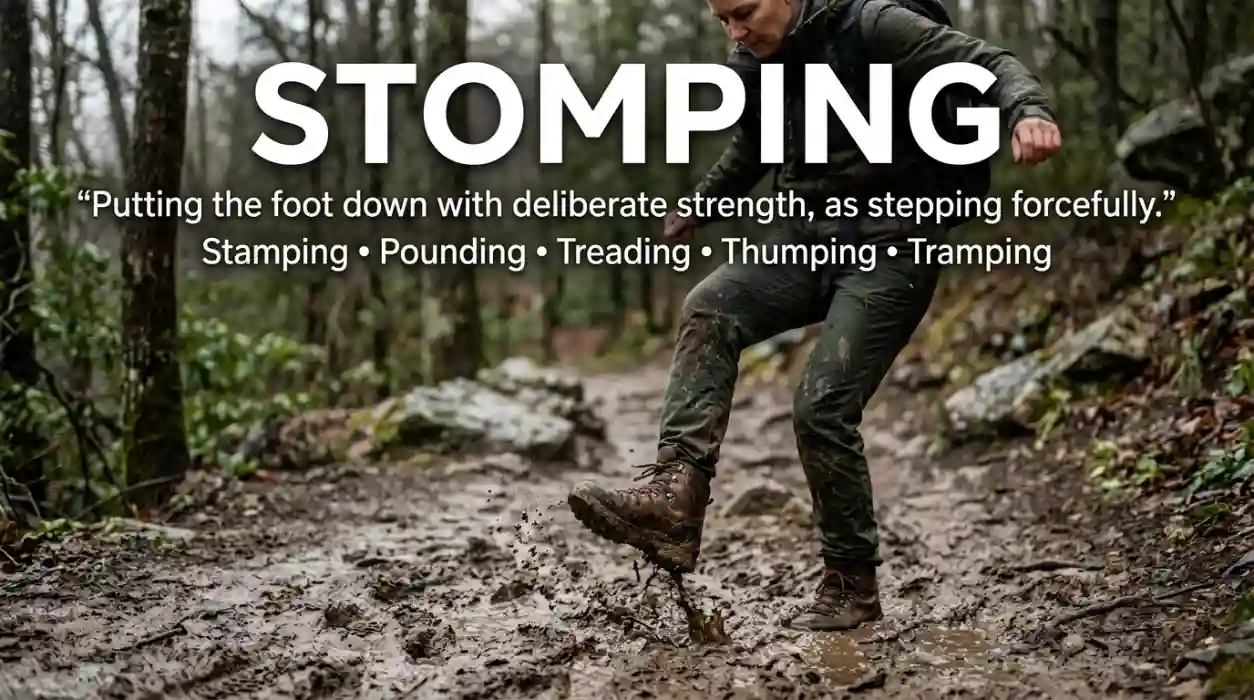
Stepping Forcefully (verb phrase) — US /ˈstɛpɪŋ ˈfɔːrsfəli/ | UK /ˈstɛpɪŋ ˈfɔːsfəli/
Meaning: Stepping forcefully means putting the foot down with deliberate strength.
Tone/Register: Neutral
Examples:
The dancer was stepping forcefully to the beat.
He stepped forcefully onto the pedal.
Pressing Down (verb phrase) — US /ˈprɛsɪŋ daʊn/ | UK /ˈprɛsɪŋ daʊn/
Meaning: Pressing down means applying downward pressure with the foot or another part of the body.
Tone/Register: Neutral, technical
Examples:
She was pressing down on the pedal.
He pressed down firmly on the cardboard.
Crushing (verb) — US /ˈkrʌʃɪŋ/ | UK /ˈkrʌʃɪŋ/
Meaning: Crushing means applying enough force to break, flatten, or damage something.
Tone/Register: Neutral
Examples:
He was crushing the empty can under his shoe.
The machine kept crushing the plastic containers.
Flattening (verb) — US /ˈflætənɪŋ/ | UK /ˈflætənɪŋ/
Meaning: Flattening means pressing something until it becomes flat or thinner.
Tone/Register: Neutral
Examples:
She was flattening the cardboard with her foot.
The heavy equipment flattened the grass.
Squashing (verb) — US /ˈskwɑːʃɪŋ/ | UK /ˈskwɒʃɪŋ/
Meaning: Squashing means pressing something firmly so that it becomes smaller, flatter, or damaged.
Tone/Register: Informal, everyday
Examples:
He was squashing the paper cup with his shoe.
The box was squashed beneath the luggage.
Trampling (verb) — US /ˈtræmpəlɪŋ/ | UK /ˈtræmpəlɪŋ/
Meaning: Trampling means repeatedly stepping on something and often causing damage.
Tone/Register: Neutral, descriptive
Examples:
The crowd was trampling the grass near the entrance.
The animals were trampling the plants.
Grinding Down (phrasal verb) — US /ˈɡraɪndɪŋ daʊn/ | UK /ˈɡraɪndɪŋ daʊn/
Meaning: Grinding down means wearing or crushing something through repeated pressure or friction.
Tone/Register: Neutral, technical
Examples:
The constant movement was grinding down the stone.
His boots were grinding the dirt into the floor.
Striking (verb) — US /ˈstraɪkɪŋ/ | UK /ˈstraɪkɪŋ/
Meaning: Striking means hitting something with force, including with the foot.
Tone/Register: Neutral, formal
Examples:
He was striking the ground with his heel.
The player kept striking the ball with power.
Kicking (verb) — US /ˈkɪkɪŋ/ | UK /ˈkɪkɪŋ/
Meaning: Kicking means hitting or pushing something with the foot.
Tone/Register: Neutral, everyday
Examples:
The child was kicking the leaves across the yard.
He kept kicking the ball against the wall.
Dancing Heavily (verb phrase) — US /ˈdænsɪŋ ˈhɛvəli/ | UK /ˈdɑːnsɪŋ ˈhɛvɪli/
Meaning: Dancing heavily means dancing with strong, emphatic foot movements.
Tone/Register: Informal, descriptive
Examples:
The crowd was dancing heavily to the drums.
She danced heavily during the final song.
Tapping Forcefully (verb phrase) — US /ˈtæpɪŋ ˈfɔːrsfəli/ | UK /ˈtæpɪŋ ˈfɔːsfəli/
Meaning: Tapping forcefully means repeatedly touching a surface with noticeable pressure.
Tone/Register: Neutral
Examples:
He was tapping forcefully on the floor with his heel.
She tapped the ground firmly to keep the rhythm.
Hopping (verb) — US /ˈhɑːpɪŋ/ | UK /ˈhɒpɪŋ/
Meaning: Hopping means moving through small jumps, sometimes creating energetic foot movement.
Tone/Register: Informal, everyday
Examples:
The children were hopping around the living room.
He went hopping across the wet pavement.
Bouncing (verb) — US /ˈbaʊnsɪŋ/ | UK /ˈbaʊnsɪŋ/
Meaning: Bouncing means moving repeatedly up and down with energetic body movement.
Tone/Register: Informal
Examples:
The kids were bouncing around to the music.
She was bouncing with excitement before the show.
Grooving (verb) — US /ˈɡruːvɪŋ/ | UK /ˈɡruːvɪŋ/
Meaning: Grooving means moving rhythmically to music in a relaxed and enjoyable way.
Tone/Register: Informal, playful
Examples:
Everyone was grooving to the live band.
He started grooving when his favorite song played.
Stomping Around (phrasal verb) — US /ˈstɑːmpɪŋ əˈraʊnd/ | UK /ˈstɒmpɪŋ əˈraʊnd/
Meaning: Stomping around means moving around heavily and noisily, often while showing emotion.
Tone/Register: Informal
Examples:
He was stomping around the apartment after the argument.
The puppy was stomping around in the puddles.
Stamping Around (phrasal verb) — US /ˈstæmpɪŋ əˈraʊnd/ | UK /ˈstæmpɪŋ əˈraʊnd/
Meaning: Stamping around means moving repeatedly with firm foot strikes.
Tone/Register: Informal, descriptive
Examples:
She was stamping around the room looking for her keys.
The child stamped around until dinner was ready.
Tramping Along (phrasal verb) — US /ˈtræmpɪŋ əˈlɔːŋ/ | UK /ˈtræmpɪŋ əˈlɒŋ/
Meaning: Tramping along means continuing to walk heavily, usually for some distance.
Tone/Register: Informal
Examples:
We were tramping along the muddy trail.
They kept tramping along despite the cold wind.
Marching Off (phrasal verb) — US /ˈmɑːrtʃɪŋ ɔːf/ | UK /ˈmɑːtʃɪŋ ɒf/
Meaning: Marching off means leaving with firm, deliberate steps.
Tone/Register: Neutral, sometimes emotional
Examples:
She was marching off before anyone could respond.
He marched off to finish the task alone.
Storming Off (phrasal verb) — US /ˈstɔːrmɪŋ ɔːf/ | UK /ˈstɔːmɪŋ ɒf/
Meaning: Storming off means leaving suddenly and angrily.
Tone/Register: Informal, emotional
Examples:
He was storming off after the disagreement.
She stormed off before the conversation ended.
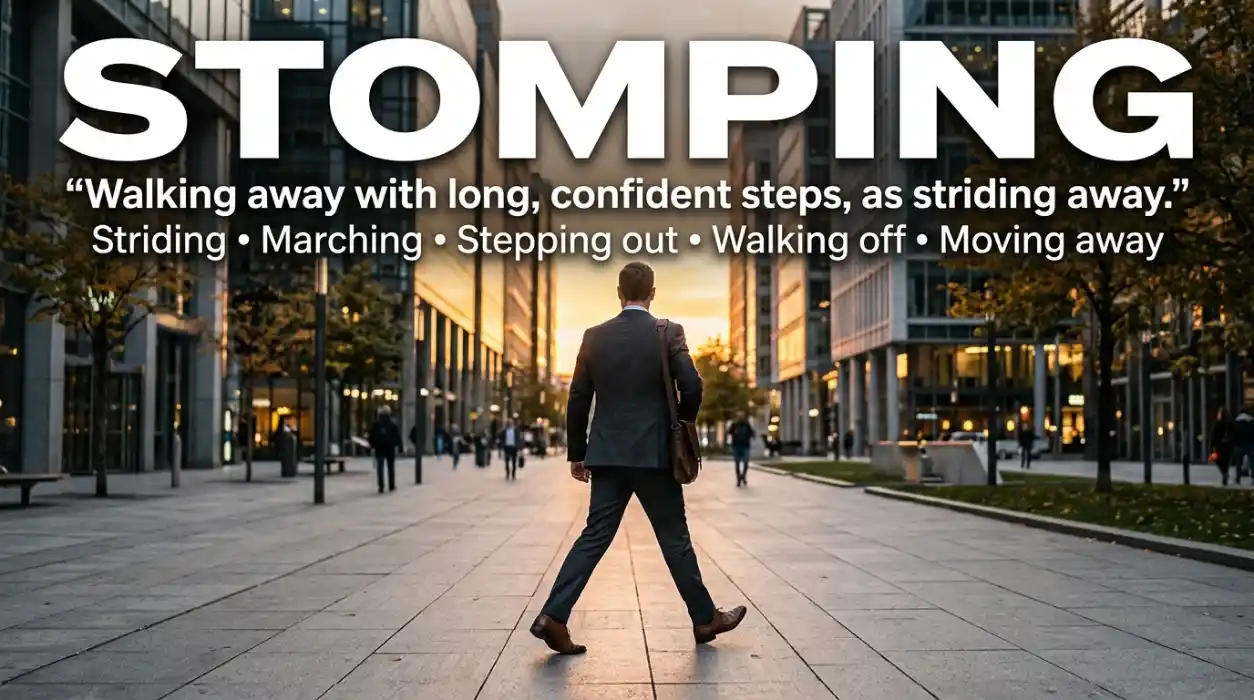
Striding Away (phrasal verb) — US /ˈstraɪdɪŋ əˈweɪ/ | UK /ˈstraɪdɪŋ əˈweɪ/
Meaning: Striding away means walking away with long, confident steps.
Tone/Register: Neutral, polished
Examples:
She was striding away from the building.
He strode away without looking back.
Clattering (verb) — US /ˈklætərɪŋ/ | UK /ˈklætərɪŋ/
Meaning: Clattering means moving while producing a series of loud, hard sounds.
Tone/Register: Descriptive, informal
Examples:
His boots were clattering across the tiled floor.
The workers came clattering down the metal stairs.
Clumping (verb) — US /ˈklʌmpɪŋ/ | UK /ˈklʌmpɪŋ/
Meaning: Clumping means moving with heavy, awkward steps that create noticeable noise.
Tone/Register: Informal, descriptive
Examples:
The child came clumping down the stairs.
Someone was clumping around upstairs in heavy shoes.
Thundering (verb) — US /ˈθʌndərɪŋ/ | UK /ˈθʌndərɪŋ/
Meaning: Thundering means moving with extremely loud, powerful, or dramatic sounds.
Tone/Register: Vivid, literary
Examples:
The horses came thundering down the track.
His footsteps were thundering through the hallway.
Thundering Along (phrasal verb) — US /ˈθʌndərɪŋ əˈlɔːŋ/ | UK /ˈθʌndərɪŋ əˈlɒŋ/
Meaning: Thundering along means moving forward rapidly and noisily.
Tone/Register: Vivid, informal
Examples:
The runners came thundering along the road.
The children went thundering along the corridor.
Plodding (verb) — US /ˈplɑːdɪŋ/ | UK /ˈplɒdɪŋ/
Meaning: Plodding means walking slowly and heavily, usually because of tiredness.
Tone/Register: Neutral, descriptive
Examples:
He was plodding toward the bus stop.
The tired dog came plodding behind us.
Shuffling (verb) — US /ˈʃʌfəlɪŋ/ | UK /ˈʃʌfəlɪŋ/
Meaning: Shuffling means walking without lifting the feet properly, often creating a dragging sound.
Tone/Register: Neutral, descriptive
Examples:
She was shuffling across the room in slippers.
He shuffled toward the kitchen half asleep.
Hustling (verb) — US /ˈhʌsəlɪŋ/ | UK /ˈhʌsəlɪŋ/
Meaning: Hustling means moving quickly and energetically because of urgency or pressure.
Tone/Register: Informal, everyday
Examples:
We were hustling through the airport.
She hustled back to her desk before the meeting.
Plowing Through (phrasal verb) — US /ˈplaʊɪŋ θruː/ | UK /ˈplaʊɪŋ θruː/
Meaning: Plowing through means moving forcefully through something difficult, crowded, or resistant.
Tone/Register: Informal, figurative
Examples:
He was plowing through the deep mud.
She plowed through the crowd to reach the exit.
Pushing Through (phrasal verb) — US /ˈpʊʃɪŋ θruː/ | UK /ˈpʊʃɪŋ θruː/
Meaning: Pushing through means continuing forward despite physical resistance or obstacles.
Tone/Register: Neutral, figurative
Examples:
The hikers kept pushing through the thick brush.
She pushed through the crowd toward the stage.
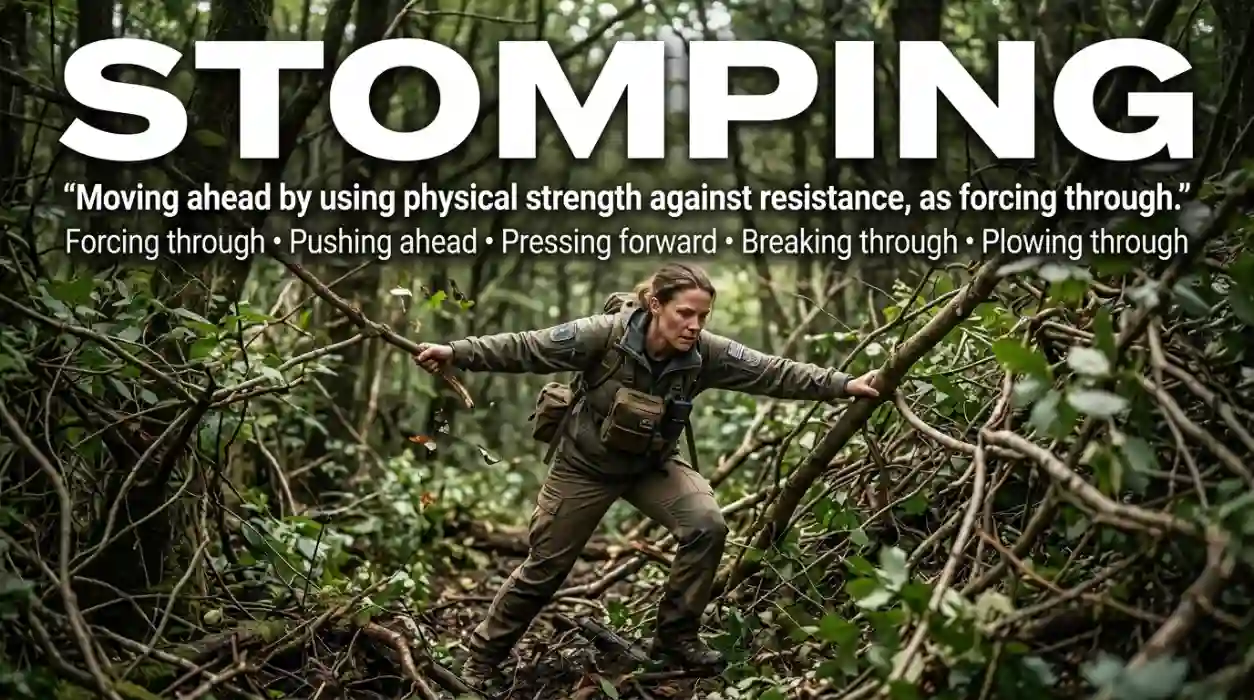
Forcing Through (phrasal verb) — US /ˈfɔːrsɪŋ θruː/ | UK /ˈfɔːsɪŋ θruː/
Meaning: Forcing through means moving ahead by using physical strength against resistance.
Tone/Register: Neutral, strong
Examples:
He was forcing his way through the packed hallway.
The rescue team forced through the blocked entrance.
Synonyms by Tone
Tone matters because synonyms do more than replace a word. They also tell readers how an action feels.
Positive or Energetic
- Striding
- Charging
- Powering forward
- Grooving
- Dancing heavily
- Hopping
- Bouncing
- Hustling
- Driving forward
These words can suggest confidence, excitement, energy, or determination.
Neutral
- Stamping
- Treading heavily
- Walking heavily
- Stepping heavily
- Tramping
- Marching
- Pounding
- Thudding
- Shuffling
- Wading through
These alternatives mainly describe the physical action. The surrounding context determines the emotion.
Negative or Forceful
- Storming
- Trampling
- Crushing
- Flattening
- Squashing
- Grinding down
- Forcing through
- Moving with force
These choices can suggest anger, damage, aggression, or physical pressure.
Playful or Informal
- Clomping
- Tromping
- Strutting
- Grooving
- Bouncing
- Clumping
- Thundering
These words can make a sentence more conversational, humorous, or visually expressive.
Why Tone Matters in Word Choice
Compare these sentences:
She was stomping upstairs.
She was trudging upstairs.
The first can suggest anger. The second suggests tiredness or difficulty. The third suggests confidence.
Therefore, a strong synonym does not simply avoid repetition. It gives your reader a more exact picture.
“Stomping” vs Close Alternatives
Stamping vs Stomping
Stomping often suggests heavy, forceful movement and may carry emotional meaning.
Stamping focuses more directly on repeatedly striking the ground with the feet.
Use stomping for dramatic movement. Use stamping when the repeated foot action matters most.
Stomping vs Trudging
Stomping emphasizes force and weight.
Trudging emphasizes slow, tiring, difficult movement.
Someone can stomp because they are angry. Someone can trudge because they are exhausted.
Stomping vs Marching
Stomping sounds less controlled and more emotional.
Marching suggests deliberate, organized, purposeful steps.
A frustrated employee may stomp out of a room. A group of students may march across a field.
How “Stomping” Changes by Context
Daily Conversation
In everyday English, stomping often describes emotional movement.
“She was stomping around the house” naturally suggests that something is bothering her.
However, context can remove the negative feeling. “The kids were stomping to the music” sounds energetic and playful.
Writing and Blogging
Writers often use stomping to create a strong visual image.
Instead of saying, “He walked into the room angrily,” a writer may say, “He came stomping into the room.”
Still, variety matters. Use clomped, trudged, strode, or marched when those words communicate the scene more precisely.
Professional or Academic Tone
Formal writing usually favors precise and objective descriptions.
Instead of “The worker was stomping around,” a report might say, “The worker walked forcefully across the area.”
Likewise, academic writing may prefer stepped heavily or applied downward pressure when the physical action needs technical precision.
Creative or Informal Use
Creative writing gives stomping plenty of room to express personality.
A character who stomps, storms, or clomps can reveal emotion without the writer directly saying, “The character was angry.”
Similarly, a comic scene may use clomping or tromping to make footsteps feel humorous.
Common Mistakes Learners Make
Mistake 1: Using “stomping” for ordinary walking
Not every person who walks heavily is stomping.
If someone simply walks with long steps, striding may be better.
Mistake 2: Assuming stomping always means anger
Anger is common, but it is not required.
People can stomp while dancing, celebrating, warming their feet, or moving through mud.
Mistake 3: Confusing “stomping” and “trampling”
Stomping focuses on heavy foot movement.
Trampling usually suggests repeated steps that damage something beneath the feet.
Mistake 4: Choosing an overly dramatic synonym
Words such as thundering and charging create strong images.
They may sound unnatural if the movement is quiet or ordinary.
Mistake 5: Using informal alternatives in formal writing
Words such as clobbering, grooving, or tromping suit casual contexts.
For reports and academic work, more neutral descriptions usually work better.
Mistake 6: Replacing the word mechanically
A synonym should match the sentence’s meaning, not simply look different.
For example, trudging cannot replace stomping when the main idea is repeated angry foot strikes.
Register Notes
Formal or technical: pressing down, striking, moving with force, treading heavily
Neutral: stamping, walking heavily, stepping heavily, marching, pounding
Informal: stomping around, clomping, tromping, grooving, hustling
Literary: thundering, striding, storming
Spoken English: stomping, clomping, tramping, rushing, shuffling
Academic writing: use precise descriptive phrases rather than highly emotional alternatives unless the context requires them.
A useful internal vocabulary guide on movement verbs can also help learners compare physical actions by speed, force, and emotion.
Real-Life Mini Scenarios Using
Workplace
After a tense discussion, an employee may walk out stomping. The word shows that the person leaves with visible frustration.
Social Situation
At a concert, people may stomp along with the beat. Here, the movement feels energetic rather than hostile.
Media and Pop Culture
A sports commentator may describe an athlete as stomping through a competition. In this informal use, the phrase emphasizes energy and dominance.
Writing and Storytelling
A novelist might write, “She came stomping through the rain.” The verb immediately creates movement, sound, and emotion.
The same principle applies to the alternatives. Trudging can show exhaustion, striding can show confidence, clomping can suggest awkward noise, and trampling can emphasize damage.
Practice Quiz
1. Someone leaves a meeting while clearly angry and making heavy steps. Which word fits best?
A. Stomping
B. Floating
C. Whispering
D. Resting
2. A tired traveler walks slowly through deep snow. Which alternative is most natural?
A. Striding
B. Trudging
C. Grooving
D. Charging
3. A confident person walks across a stage with long steps. Which word fits?
A. Shuffling
B. Striding
C. Squashing
D. Trampling
4. A crowd repeatedly steps on flowers and damages them. Which word fits?
A. Grooving
B. Trampling
C. Hopping
D. Marching
5. A child walks noisily in oversized boots. Which word creates the clearest image?
A. Clomping
B. Floating
C. Whispering
D. Gliding
6. A group moves rhythmically to loud music. Which word sounds natural?
A. Grooving
B. Routing
C. Flattening
D. Grinding
7. A person moves quickly because they are late for a bus. Which word fits?
A. Rushing
B. Plodding
C. Trudging
D. Shuffling
8. A formal writer wants to describe repeated foot strikes against the ground. Which word fits?
A. Stamping
B. Grooving
C. Hopping
D. Bouncing
9. Someone walks slowly because they are exhausted. Which word works best?
A. Charging
B. Trudging
C. Strutting
D. Barreling
10. Someone walks proudly with long, confident steps. Which alternative fits?
A. Striding
B. Shuffling
C. Squashing
D. Trampling
Answer Key: 1-A | 2-B | 3-B | 4-B | 5-A | 6-A | 7-A | 8-A | 9-B | 10-A
Reflection Task
Write one sentence about a real situation using stomping or one of its alternatives.
Then replace your chosen word with two other synonyms. Notice how each version changes the movement, emotion, or tone.
Conclusion
Learning synonyms for stomping helps you describe movement with more detail, from angry steps to tired walking, confident strides, and playful dancing.
Better word choice makes writing, blogging, speaking, and everyday communication clearer. Each verb can add a different feeling without making your sentence longer.
You do not need to memorize all alternatives today. Start with a few useful words, notice them in real conversations, and practice them in context.
Try one new synonym in an email, essay, story, or daily conversation this week. Small vocabulary choices can make your English sound more natural and expressive.
Frequently Asked Questions
1. What is a good synonym for stomping when someone is angry?
Stamping and storming are useful choices, depending on the sentence. Stamping emphasizes forceful foot movement, while storming emphasizes angry movement into or out of a place. If you want to show both emotion and heavy steps, stomping remains a natural everyday choice.
2. What are the best synonyms for stomping in creative writing?
Creative writing can use clomping, thundering, tramping, stomping, striding, storming, or pounding, depending on the scene. Choose the word based on the image you want. Clomping creates a comic or awkward sound, while thundering creates a much louder and more dramatic effect.
3. What is a formal alternative to stomping?
A formal alternative depends on the intended meaning. Walking forcefully, stepping heavily, and treading heavily work for physical movement. If the action involves pressure on an object, pressing down may be more precise. Formal writing should describe the exact action rather than simply choosing a stronger-sounding word.
4. Is stomping always associated with anger?
No. Although stomping frequently appears in descriptions of anger or frustration, it can also describe energetic movement. People can stomp during a dance, concert, celebration, or exercise. The surrounding words determine whether the action feels aggressive, playful, excited, or simply physical.
5. What is the difference between stomping and marching?
Stomping usually emphasizes heavy, forceful, or emotional steps. Marching suggests deliberate, regular, organized movement. Someone might stomp around after receiving bad news, whereas a group of students might march together during an organized event.

Shahzeena Shazadi is the founder and lead writer at VocablyHub.com, where she creates accurate, reader-focused English language content designed to help people communicate with clarity and confidence. She specializes in synonyms, antonyms, word meanings, idioms, and practical vocabulary guides that simplify complex language concepts for everyday use. Every article is carefully researched, fact-checked, and written in clear, accessible language using reliable references and real-world examples. Her goal is to provide helpful, trustworthy content that supports learners at every stage of their English language journey.
Her editorial approach focuses on accuracy, transparency, and user value while following modern content quality standards. She regularly reviews and updates content to keep information relevant, useful, and easy to understand. Through VocablyHub.com, Shahzeena Shazadi is committed to publishing reliable language resources that help students, writers, educators, professionals, and English learners expand their vocabulary, improve their writing skills, and communicate with confidence in academic, professional, and everyday situations.