
Synonyms for staffing become useful when “staffing” starts appearing too often in a report, email, or job-related article. A few precise alternatives can make your writing sound clearer.
Imagine a manager saying, “We need better staffing for the weekend.” Depending on the meaning, “personnel planning,” “recruitment,” or “workforce allocation” may fit better.
The phrase “synonyms for staffing” is common because staffing covers hiring, assigning, scheduling, and maintaining workers. Students, bloggers, and writers often need a more exact term.
Learning synonyms for staffing also helps daily English users. You can choose a word that sounds natural in an email, academic paper, business report, or ordinary workplace conversation.
What Does “Synonyms for Staffing” Really Mean?
Staffing is a noun or a gerund form of staff. In workplace English, it generally refers to providing an organization, team, department, or project with the people needed to perform its work.
In simple English:
Staffing means making sure the right number of people are available to do the required work.
However, the exact meaning changes with context.
For example:
- Staffing a new office can mean hiring employees for it.
- Staffing a hospital can mean ensuring enough qualified workers are available.
- Staffing a shift can mean assigning people to that particular period.
- Staffing strategy can mean planning future workforce needs.
Native speakers therefore do not treat every synonym as interchangeable. Recruitment focuses mainly on finding and attracting employees. Scheduling focuses on working hours. Workforce planning focuses on longer-term personnel needs.
The most useful alternatives depend on what “staffing” means in your sentence.
Part of Speech
Staffing can function as:
- Noun: “The company is reviewing its staffing.”
- Gerund: “Staffing the clinic requires careful planning.”
- Modifier: “We need a staffing plan.”
Its tone is usually neutral and professional. It appears frequently in business, healthcare, education, hospitality, government, retail, and human-resources contexts.
Connotative Meaning
Connotation (the emotional or cultural feeling associated with a word beyond its basic dictionary meaning) matters when choosing a staffing synonym.
Positive Tone
Words such as talent development, workforce optimization, and team building can suggest growth, efficiency, or investment in people.
Negative Tone
Terms such as understaffing, staff shortages, and labor shortages can highlight a problem or lack of available workers.
Neutral Tone
Words such as personnel allocation, workforce planning, recruitment, and staff deployment usually sound factual and professional.
Therefore, choose the alternative according to the message you want to communicate. A neutral report may need “workforce planning,” while a problem-focused report may need “staff shortage.”
Etymology of “Staffing”
The word staffing comes from staff, with the suffix -ing.
The older English word staff is related to Old English stæf, meaning a stick, rod, or walking staff. The word belongs to the Germanic language family and has related forms in other Germanic languages.
The workplace meaning of staff developed later. The idea shifted from a physical support or group of people who provide support to an organization. By the modern period, staff had become established as a term for employees or personnel.
Old English: 450–1100
Old English stæf referred primarily to a stick, rod, or staff used for support. It did not have the modern human-resources meaning.
Middle English: 1100–1500
During Middle English, staff continued to refer to a physical stick or support. Related figurative uses gradually developed around support, authority, and groups serving an institution.
Modern English: 1500–Present
In Modern English, staff developed its familiar organizational sense. Today, staffing commonly describes the process of supplying an organization or activity with enough suitable workers.
The modern business meaning is therefore historically connected to the broader idea of supporting an organization with people.
Pronunciation
Staffing
- US: /ˈstæfɪŋ/
- UK: /ˈstɑːfɪŋ/
The first syllable receives the main stress.
Syllables
staff-ing
Affixation Pattern of “Staffing”
- Root: staff
- Prefix: none
- Suffix: -ing
The suffix -ing forms the present participle or gerund from the verb staff.
Synonyms List
Recruitment (Noun) — US /ˌriːˈkruːtmənt/ — UK /rɪˈkruːtmənt/
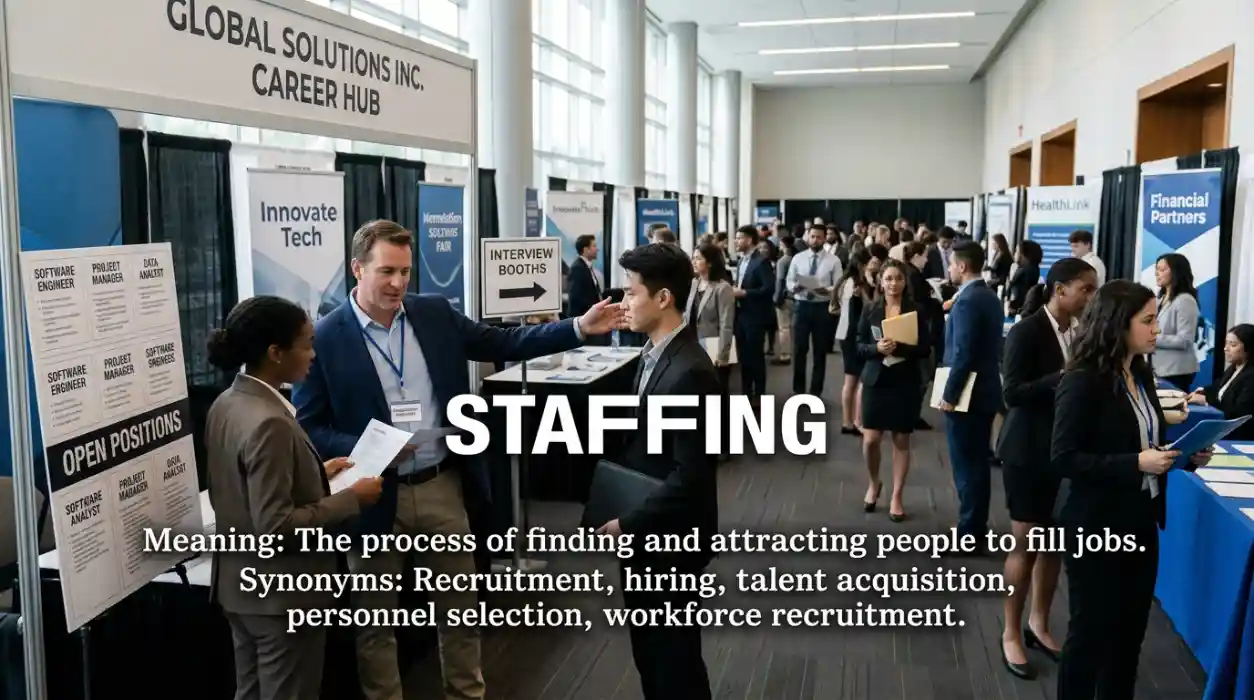
Meaning: Recruitment is the process of finding and attracting people to fill jobs.
Tone/Register: Professional, Business, HR
Example:
The company increased recruitment before the busy season.
Our recruitment team is looking for experienced nurses.
Hiring (Noun) — US /ˈhaɪərɪŋ/ — UK /ˈhaɪərɪŋ/
Meaning: Hiring refers to the act or process of employing people.
Tone/Register: Neutral, Business
Example:
Hiring has slowed since the project ended.
We are hiring two assistants for the new branch.
Employment (Noun) — US /ɪmˈplɔɪmənt/ — UK /ɪmˈplɔɪmənt/
Meaning: Employment refers broadly to the state or process of having people work for an organization.
Tone/Register: Formal, Business, Academic
Example:
The factory provides employment for hundreds of residents.
The report examines local employment trends.
Personnel Provision (Noun Phrase) — US /ˌpɜːrsəˈnel prəˈvɪʒən/ — UK /ˌpɜːsəˈnel prəˈvɪʒən/
Meaning: Personnel provision means supplying an organization with the workers it needs.
Tone/Register: Formal, Administrative
Example:
Personnel provision must match the clinic’s opening hours.
The contract covers personnel provision for the event.
Workforce Planning (Noun Phrase) — US /ˈwɜːrkfɔːrs ˈplænɪŋ/ — UK /ˈwɜːkfɔːs ˈplænɪŋ/
Meaning: Workforce planning involves predicting and preparing for an organization’s future employee needs.
Tone/Register: Professional, Strategic
Example:
Workforce planning helped the company prepare for expansion.
Our annual plan includes long-term workforce planning.
Personnel Planning (Noun Phrase) — US /ˌpɜːrsəˈnel ˈplænɪŋ/ — UK /ˌpɜːsəˈnel ˈplænɪŋ/
Meaning: Personnel planning focuses on determining how many employees and what kinds of employees an organization needs.
Tone/Register: Formal, HR, Business
Example:
Personnel planning begins before the new budget cycle.
The department revised its personnel planning process.
Workforce Management (Noun Phrase) — US /ˈwɜːrkfɔːrs ˈmænɪdʒmənt/ — UK /ˈwɜːkfɔːs ˈmænɪdʒmənt/
Meaning: Workforce management involves organizing and overseeing employees to meet operational needs.
Tone/Register: Professional, Business
Example:
Good workforce management keeps shifts balanced.
The hospital is reviewing its workforce management policy.
Personnel Management (Noun Phrase) — US /ˌpɜːrsəˈnel ˈmænɪdʒmənt/ — UK /ˌpɜːsəˈnel ˈmænɪdʒmənt/
Meaning: Personnel management involves administering and managing an organization’s employees.
Tone/Register: Formal, Business
Example:
Personnel management is part of the director’s role.
The course covers traditional personnel management practices.
Workforce Allocation (Noun Phrase) — US /ˈwɜːrkfɔːrs ˌæləˈkeɪʃən/ — UK /ˈwɜːkfɔːs ˌæləˈkeɪʃən/
Meaning: Workforce allocation means distributing employees across tasks, departments, or locations.
Tone/Register: Professional, Administrative
Example:
Workforce allocation changed after the project was delayed.
The manager reviewed workforce allocation across three sites.
Personnel Allocation (Noun Phrase) — US /ˌpɜːrsəˈnel ˌæləˈkeɪʃən/ — UK /ˌpɜːsəˈnel ˌæləˈkeɪʃən/
Meaning: Personnel allocation refers to assigning employees where their work is needed.
Tone/Register: Formal, Business
Example:
Personnel allocation must reflect each department’s workload.
The director approved the new personnel allocation.
Staff Allocation (Noun Phrase) — US /ˈstæf ˌæləˈkeɪʃən/ — UK /ˈstɑːf ˌæləˈkeɪʃən/
Meaning: Staff allocation means deciding where existing employees should work.
Tone/Register: Neutral, Professional
Example:
Staff allocation changes every Monday.
The supervisor handles staff allocation for each ward.
Staff Deployment (Noun Phrase) — US /ˈstæf dɪˈplɔɪmənt/ — UK /ˈstɑːf dɪˈplɔɪmənt/
Meaning: Staff deployment emphasizes placing employees where they are most needed.
Tone/Register: Formal, Operational
Example:
Staff deployment changed during the emergency.
The manager coordinated staff deployment across the building.
Workforce Deployment (Noun Phrase) — US /ˈwɜːrkfɔːrs dɪˈplɔɪmənt/ — UK /ˈwɜːkfɔːs dɪˈplɔɪmənt/
Meaning: Workforce deployment describes the organized placement of workers across operational needs.
Tone/Register: Formal, Business
Example:
Workforce deployment became a priority during the expansion.
The report examines workforce deployment patterns.
Staff Scheduling (Noun Phrase) — US /ˈstæf ˈskedʒuːlɪŋ/ — UK /ˈstɑːf ˈʃedjuːlɪŋ/
Meaning: Staff scheduling means arranging employees’ working times and shifts.
Tone/Register: Neutral, Workplace
Example:
Staff scheduling takes place every Friday.
She manages staff scheduling for the restaurant.
Employee Scheduling (Noun Phrase) — US /ɪmˈplɔɪiː ˈskedʒuːlɪŋ/ — UK /ɪmˈplɔɪiː ˈʃedjuːlɪŋ/
Meaning: Employee scheduling focuses on assigning workers to specific shifts or periods.
Tone/Register: Neutral, Business
Example:
Employee scheduling is difficult during holidays.
The new supervisor handles employee scheduling.
Shift Planning (Noun Phrase) — US /ˈʃɪft ˈplænɪŋ/ — UK /ˈʃɪft ˈplænɪŋ/
Meaning: Shift planning involves deciding which workers will cover particular working periods.
Tone/Register: Neutral, Operational
Example:
Shift planning starts two weeks ahead.
Careful shift planning reduces last-minute changes.
Staff Scheduling Management (Noun Phrase) — US /ˈstæf ˈskedʒuːlɪŋ ˈmænɪdʒmənt/ — UK /ˈstɑːf ˈʃedjuːlɪŋ ˈmænɪdʒmənt/
Meaning: This phrase refers to overseeing employee schedules and shift coverage.
Tone/Register: Formal, Administrative
Example:
Staff scheduling management takes several hours each week.
The supervisor now oversees scheduling management.
Team Resourcing (Noun Phrase) — US /tiːm ˈriːsɔːrsɪŋ/ — UK /tiːm ˈriːsɔːsɪŋ/
Meaning: Team resourcing means providing a team with enough people and appropriate skills.
Tone/Register: Professional, Business
Example:
The project needs better team resourcing.
Team resourcing became important after the deadline moved forward.
Workforce Resourcing (Noun Phrase) — US /ˈwɜːrkfɔːrs ˈriːsɔːrsɪŋ/ — UK /ˈwɜːkfɔːs ˈriːsɔːsɪŋ/
Meaning: Workforce resourcing focuses on obtaining and organizing people needed for work.
Tone/Register: Professional, Strategic
Example:
Workforce resourcing supports our expansion plans.
The director discussed workforce resourcing at the meeting.
Human Resources Provision (Noun Phrase) — US /ˌhjuːmən rɪˈsɔːrsɪz prəˈvɪʒən/ — UK /ˌhjuːmən rɪˈsɔːsɪz prəˈvɪʒən/
Meaning: Human resources provision refers to supplying an organization with the people and personnel support it requires.
Tone/Register: Formal, Corporate
Example:
Human resources provision was reviewed during the audit.
The agreement includes human resources provision.
Talent Acquisition (Noun Phrase) — US /ˈtælənt ˌækwɪˈzɪʃən/ — UK /ˈtælənt ˌækwɪˈzɪʃən/
Meaning: Talent acquisition focuses on identifying and attracting suitable skilled workers.
Tone/Register: Professional, HR
Example:
Talent acquisition is important in competitive industries.
Her role includes talent acquisition for technical positions.

Talent Sourcing (Noun Phrase) — US /ˈtælənt ˈsɔːrsɪŋ/ — UK /ˈtælənt ˈsɔːsɪŋ/
Meaning: Talent sourcing means actively finding potential candidates for employment.
Tone/Register: Professional, HR
Example:
Talent sourcing helped us reach more qualified candidates.
The recruiter specializes in talent sourcing.
Candidate Sourcing (Noun Phrase) — US /ˈkændɪdeɪt ˈsɔːrsɪŋ/ — UK /ˈkændɪdət ˈsɔːsɪŋ/
Meaning: Candidate sourcing involves locating people who may be suitable for open positions.
Tone/Register: Professional, Recruitment
Example:
Candidate sourcing takes time for specialized roles.
The team improved candidate sourcing through professional networks.
Recruitment Planning (Noun Phrase) — US /rɪˈkruːtmənt ˈplænɪŋ/ — UK /rɪˈkruːtmənt ˈplænɪŋ/
Meaning: Recruitment planning organizes how an organization will find and hire needed employees.
Tone/Register: Professional, HR
Example:
Recruitment planning begins before positions become vacant.
The company updated its recruitment planning process.
Hiring Strategy (Noun Phrase) — US /ˈhaɪərɪŋ ˈstrætədʒi/ — UK /ˈhaɪərɪŋ ˈstrætədʒi/
Meaning: A hiring strategy is a planned approach to attracting and employing workers.
Tone/Register: Professional, Business
Example:
The company changed its hiring strategy this year.
Our hiring strategy focuses on experienced candidates.
Staffing Strategy (Noun Phrase) — US /ˈstæfɪŋ ˈstrætədʒi/ — UK /ˈstɑːfɪŋ ˈstrætədʒi/
Meaning: Staffing strategy refers to a planned approach to meeting an organization’s personnel needs.
Tone/Register: Professional, Strategic
Example:
The hospital needs a stronger staffing strategy.
Their staffing strategy covers seasonal demand.
Personnel Strategy (Noun Phrase) — US /ˌpɜːrsəˈnel ˈstrætədʒi/ — UK /ˌpɜːsəˈnel ˈstrætədʒi/
Meaning: Personnel strategy describes a broad plan for managing an organization’s people.
Tone/Register: Formal, Business
Example:
The board approved a new personnel strategy.
The strategy supports long-term workforce growth.
Workforce Strategy (Noun Phrase) — US /ˈwɜːrkfɔːrs ˈstrætədʒi/ — UK /ˈwɜːkfɔːs ˈstrætədʒi/
Meaning: Workforce strategy is a long-term plan for developing and organizing employees.
Tone/Register: Professional, Strategic
Example:
Our workforce strategy supports future expansion.
The report outlines a five-year workforce strategy.
Employee Resourcing (Noun Phrase) — US /ɪmˈplɔɪiː ˈriːsɔːrsɪŋ/ — UK /ɪmˈplɔɪiː ˈriːsɔːsɪŋ/
Meaning: Employee resourcing concerns obtaining and organizing workers for organizational needs.
Tone/Register: Formal, HR
Example:
Employee resourcing is discussed in the annual plan.
The department needs stronger employee resourcing.
Personnel Resourcing (Noun Phrase) — US /ˌpɜːrsəˈnel ˈriːsɔːrsɪŋ/ — UK /ˌpɜːsəˈnel ˈriːsɔːsɪŋ/
Meaning: Personnel resourcing means arranging suitable people for organizational requirements.
Tone/Register: Formal, Corporate
Example:
Personnel resourcing supports the new department.
The manager oversees personnel resourcing.
Human Capital Planning (Noun Phrase) — US /ˈhjuːmən ˈkæpɪtəl ˈplænɪŋ/ — UK /ˈhjuːmən ˈkæpɪtəl ˈplænɪŋ/
Meaning: Human capital planning considers the skills, numbers, and development needs of an organization’s workforce.
Tone/Register: Academic, Corporate
Example:
Human capital planning supports long-term growth.
The report includes human capital planning recommendations.
Human Capital Management (Noun Phrase) — US /ˈhjuːmən ˈkæpɪtəl ˈmænɪdʒmənt/ — UK /ˈhjuːmən ˈkæpɪtəl ˈmænɪdʒmənt/
Meaning: Human capital management involves managing employees as a key organizational resource.
Tone/Register: Corporate, Academic
Example:
Human capital management is part of the executive program.
The company is reviewing its human capital management approach.
Labor Allocation (Noun Phrase) — US /ˈleɪbər ˌæləˈkeɪʃən/ — UK /ˈleɪbə ˌæləˈkeɪʃən/
Meaning: Labor allocation means distributing workers according to operational needs.
Tone/Register: Formal, Economic, Business
Example:
Labor allocation changed after production increased.
The manager reviewed labor allocation across the factory.
Labor Planning (Noun Phrase) — US /ˈleɪbər ˈplænɪŋ/ — UK /ˈleɪbə ˈplænɪŋ/
Meaning: Labor planning involves determining the workforce needed to meet operational demands.
Tone/Register: Formal, Business
Example:
Labor planning is essential before a large project.
The operations team completed its labor planning.
Manpower Planning (Noun Phrase) — US /ˈmænˌpaʊər ˈplænɪŋ/ — UK /ˈmænpɑːə ˈplænɪŋ/
Meaning: Manpower planning is an older term for planning the number and type of workers required.
Tone/Register: Traditional, Formal
Example:
The textbook uses the term manpower planning.
Modern reports often prefer workforce planning.
Personnel Deployment (Noun Phrase) — US /ˌpɜːrsəˈnel dɪˈplɔɪmənt/ — UK /ˌpɜːsəˈnel dɪˈplɔɪmənt/
Meaning: Personnel deployment means placing employees in specific operational roles or locations.
Tone/Register: Formal, Operational
Example:
Personnel deployment changed during the emergency response.
The director approved temporary personnel deployment.
Employee Deployment (Noun Phrase) — US /ɪmˈplɔɪiː dɪˈplɔɪmənt/ — UK /ɪmˈplɔɪiː dɪˈplɔɪmənt/
Meaning: Employee deployment focuses on placing workers where their skills are required.
Tone/Register: Professional, Operational
Example:
Employee deployment depends on project priorities.
The supervisor coordinated employee deployment.
Staff Placement (Noun Phrase) — US /ˈstæf ˈpleɪsmənt/ — UK /ˈstɑːf ˈpleɪsmənt/
Meaning: Staff placement refers to assigning employees to particular roles, departments, or locations.
Tone/Register: Neutral, Professional
Example:
Staff placement was completed before opening day.
The coordinator handles staff placement.
Employee Placement (Noun Phrase) — US /ɪmˈplɔɪiː ˈpleɪsmənt/ — UK /ɪmˈplɔɪiː ˈpleɪsmənt/
Meaning: Employee placement means assigning or positioning a worker in a suitable job or location.
Tone/Register: Neutral, HR
Example:
Employee placement depends on experience and availability.
The program supports employee placement in local offices.
Workforce Placement (Noun Phrase) — US /ˈwɜːrkfɔːrs ˈpleɪsmənt/ — UK /ˈwɜːkfɔːs ˈpleɪsmənt/
Meaning: Workforce placement concerns positioning workers where their labor is required.
Tone/Register: Formal, Employment
Example:
Workforce placement was discussed at the planning meeting.
The agency supports workforce placement in rural areas.
Staff Assignment (Noun Phrase) — US /ˈstæf əˈsaɪnmənt/ — UK /ˈstɑːf əˈsaɪnmənt/
Meaning: Staff assignment means giving employees particular duties or positions.
Tone/Register: Neutral, Workplace
Example:
Staff assignment changes each semester.
The manager completed the staff assignment list.
Employee Assignment (Noun Phrase) — US /ɪmˈplɔɪiː əˈsaɪnmənt/ — UK /ɪmˈplɔɪiː əˈsaɪnmənt/
Meaning: Employee assignment refers to giving a worker a specific task, project, or role.
Tone/Register: Neutral, Business
Example:
Employee assignment depends on each person’s skills.
The new employee received a project assignment.
Workforce Assignment (Noun Phrase) — US /ˈwɜːrkfɔːrs əˈsaɪnmənt/ — UK /ˈwɜːkfɔːs əˈsaɪnmənt/
Meaning: Workforce assignment refers to distributing workers across jobs or responsibilities.
Tone/Register: Formal, Operational
Example:
Workforce assignment was revised after the deadline changed.
The system supports workforce assignment across teams.

Staff Provision (Noun Phrase) — US /ˈstæf prəˈvɪʒən/ — UK /ˈstɑːf prəˈvɪʒən/
Meaning: Staff provision means ensuring that enough employees are available for a service or activity.
Tone/Register: Formal, Administrative
Example:
Staff provision is essential during school examinations.
The agreement specifies staff provision for the event.
Employee Provision (Noun Phrase) — US /ɪmˈplɔɪiː prəˈvɪʒən/ — UK /ɪmˈplɔɪiː prəˈvɪʒən/
Meaning: Employee provision refers to supplying workers to meet an organization’s needs.
Tone/Register: Formal, Administrative
Example:
Employee provision must increase during peak periods.
The contract includes employee provision for the project.
Staff Coverage (Noun Phrase) — US /ˈstæf ˈkʌvərɪdʒ/ — UK /ˈstɑːf ˈkʌvərɪdʒ/
Meaning: Staff coverage describes whether enough employees are available to cover required duties or hours.
Tone/Register: Neutral, Workplace
Example:
We need better staff coverage on weekends.
The manager checked staff coverage before approving leave.
Workforce Coverage (Noun Phrase) — US /ˈwɜːrkfɔːrs ˈkʌvərɪdʒ/ — UK /ˈwɜːkfɔːs ˈkʌvərɪdʒ/
Meaning: Workforce coverage refers to having enough workers available to meet operational requirements.
Tone/Register: Professional, Operational
Example:
Workforce coverage is limited during holidays.
The team reviewed workforce coverage for the summer.
Staffing Support (Noun Phrase) — US /ˈstæfɪŋ səˈpɔːrt/ — UK /ˈstɑːfɪŋ səˈpɔːt/
Meaning: Staffing support refers to assistance that helps an organization obtain or maintain adequate personnel.
Tone/Register: Neutral, Professional
Example:
The clinic requested additional staffing support.
Temporary staffing support was arranged for the event.
Staff Augmentation (Noun Phrase) — US /ˈstæf ɔːɡmənˈteɪʃən/ — UK /ˈstɑːf ɔːɡmenˈteɪʃən/
Meaning: Staff augmentation means adding external or temporary workers to an existing team.
Tone/Register: Business, Technical
Example:
The project used staff augmentation during the final phase.
Staff augmentation helped the team meet a tight deadline.
Temporary Staffing (Noun Phrase) — US /ˈtɛmpəreri ˈstæfɪŋ/ — UK /ˈtɛmpərəri ˈstɑːfɪŋ/
Meaning: Temporary staffing refers to using workers for a limited period.
Tone/Register: Business, Employment
Example:
Temporary staffing increased during the holiday season.
The hospital arranged temporary staffing for several weeks.
Contract Staffing (Noun Phrase) — US /ˈkɑːntrækt ˈstæfɪŋ/ — UK /ˈkɒntrækt ˈstɑːfɪŋ/
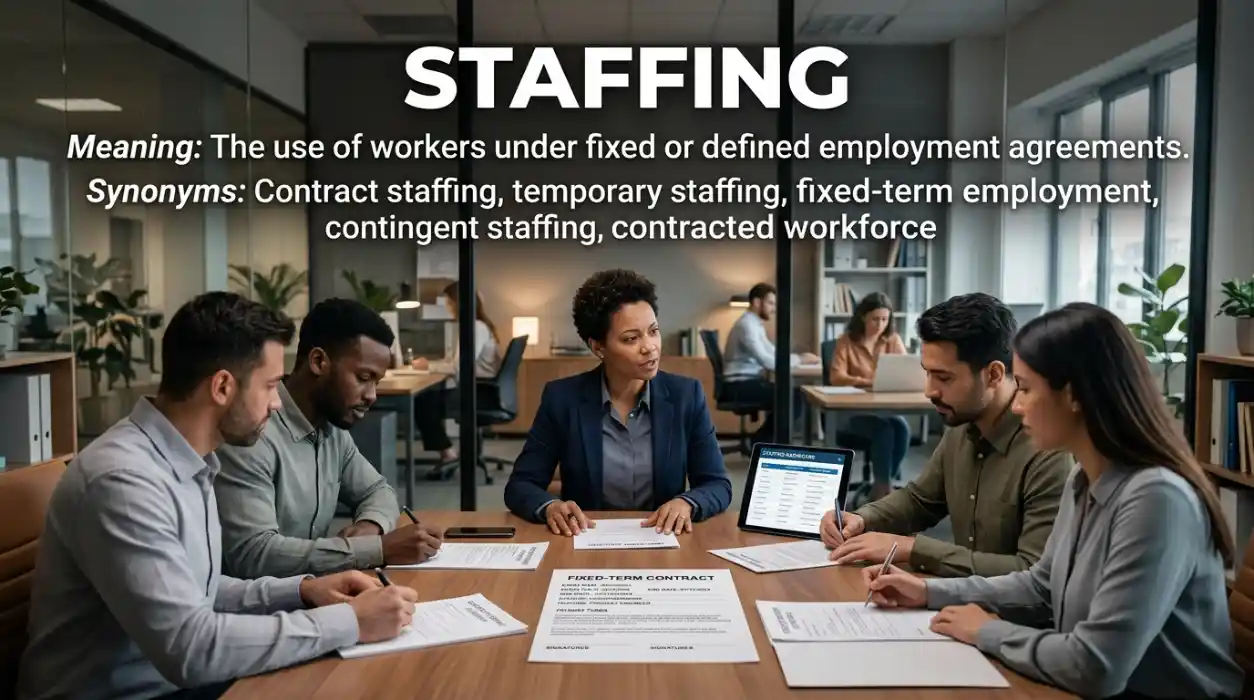
Meaning: Contract staffing involves using workers under fixed or defined employment agreements.
Tone/Register: Business, HR
Example:
Contract staffing can support short-term projects.
The company reviewed its contract staffing arrangements.
Synonyms by Tone
Positive or Growth-Focused
- Talent management
- Talent deployment
- Workforce development
- Team building
- Workforce optimization
- Talent acquisition
- Team resourcing
These expressions can emphasize growth, capability, skills, and organizational development.
Neutral
- Staffing
- Hiring
- Recruitment
- Workforce planning
- Personnel planning
- Staff scheduling
- Employee scheduling
- Staff allocation
- Employee placement
- Staff assignment
- Workforce coordination
- Staff organization
These work well when you simply want to describe an activity without adding strong emotion.
Problem-Focused or Shortage-Related
- Staff coverage
- Workforce coverage
- Personnel provision
- Staff provision
- Labor resourcing
- Workforce capacity planning
These can be useful when the context involves shortages, workload, or operational pressure.
Formal or Technical
- Human capital planning
- Human capital management
- Personnel deployment
- Workforce deployment
- Personnel administration
- Workforce administration
- Personnel resourcing
- Workforce strategy
These choices are more common in reports, organizational documents, research, and professional communication.
Informal or Everyday
- Hiring
- Scheduling
- Getting enough people
- Bringing people in
- Filling positions
These sound more natural in everyday conversation.
Tone matters because two expressions can refer to related activities while creating very different impressions. “Hiring” sounds direct and familiar. “Human capital planning” sounds more strategic and corporate.
“Staffing” vs. Close Alternatives
| Term | Main Meaning | Typical Tone | Best Use |
|---|---|---|---|
| Staffing | Providing enough workers for an organization or activity | Neutral | General workplace writing |
| Recruitment | Finding and attracting applicants | Professional | Hiring processes |
| Workforce planning | Predicting future workforce needs | Strategic | Business plans and reports |
| Staff scheduling | Arranging working hours and shifts | Practical | Daily operations |
The key distinction is simple.
Use staffing when you mean the broader process of having enough people.
Use workforce planning when you are thinking about future personnel needs.
How “Staffing” Changes by Context
Daily Conversation
In ordinary conversation, hiring, scheduling, and getting enough staff usually sound more natural than technical alternatives.
For example:
“The café is hiring more people for summer.”
This is simpler than saying:
“The café is implementing additional personnel provision.”
Native speakers generally prefer the first version in casual speech.
Writing and Blogging
Bloggers can use staffing, recruitment, hiring, workforce planning, and talent acquisition according to the exact topic.
For example, a blog about finding employees might use “recruitment.” A post about managing a growing company might use “workforce planning.”
Using varied vocabulary can improve readability, but synonyms should never be added merely to avoid repeating a word.
Professional and Academic Writing
Formal writing often benefits from precise terms.
For instance, human capital planning may suit a research discussion, while personnel allocation may work in an organizational report.
However, technical vocabulary should clarify the idea. It should not make a simple sentence unnecessarily complicated.
Creative or Informal Use
Creative writing can use expressions such as bringing people in, filling the team, or getting enough hands on deck, depending on the audience.
For example:
“They were scrambling to get enough people on deck before the festival.”
This is more colorful than “They were managing staffing requirements.”
Common Mistakes Learners Make
Mistake 1: Treating Every Alternative as Identical
“Recruitment” does not always mean the same thing as “staffing.”
Recruitment normally concerns attracting candidates. Staffing can include hiring, scheduling, assignment, and workforce planning.
Mistake 2: Using Technical Terms in Casual Speech
Saying “human capital planning” in a simple conversation can sound unnecessarily formal.
Instead, say:
“We need to plan our hiring.”
Mistake 3: Using “Manpower” Without Considering Register
Manpower planning is an established traditional term, but workforce planning is often preferred in contemporary professional English because it is more neutral and inclusive.
Mistake 4: Confusing Staffing With Team Building
Staffing concerns having or arranging workers.
Team building concerns improving relationships, collaboration, and cohesion among people who are already part of a team.
Mistake 5: Overusing Synonyms
Do not replace every occurrence of “staffing” with a different phrase.
Natural repetition is better than awkward variation. Precision should come before keyword variety.
Register Notes
Formal
Use terms such as:
- Personnel planning
- Workforce strategy
- Human capital planning
- Personnel deployment
- Workforce administration
Neutral Professional
Use:
- Staffing
- Hiring
- Recruitment
- Workforce planning
- Staff allocation
- Employee scheduling
Informal
Use:
- Hiring people
- Getting more staff
- Filling the team
- Bringing people in
Spoken vs. Written English
Hiring and getting more staff are common in speech.
Workforce planning and personnel allocation appear more often in reports, proposals, research, and business documents.
If you are building related vocabulary, you can also explore a separate article about synonyms for employees to distinguish terms for people from terms for staffing processes.
Real-Life Mini Scenarios
Workplace
A restaurant expects a busy weekend.
- “We need better staff coverage.”
- “We need to improve staff scheduling.”
- “We need to hire more people.”
All three can work, but each emphasizes something different.
Social Situation
A friend says:
“The event is short on people.”
A natural response might be:
“They probably need more staff.”
In a more formal message, you could write:
“The event requires additional personnel provision.”
Media and Pop Culture
A news article about a television production may discuss talent acquisition, staff deployment, or workforce planning.
A casual entertainment article may simply say that the production team is hiring more people.
Writing and Storytelling
A story might say:
“The hospital was struggling to keep enough people on each shift.”
A business report could express the same general issue as:
“The hospital was experiencing workforce coverage challenges.”
The second version sounds more institutional.
Practice Quiz
1. A company is trying to attract qualified applicants for five open positions. Which term fits best?
A. Staff scheduling
B. Recruitment
C. Staff coverage
D. Team building
2. A manager decides who works Monday’s morning shift. Which term is most precise?
A. Shift planning
B. Talent acquisition
C. Workforce development
D. Human capital management
3. A company is predicting how many employees it will need next year. Which term fits best?
A. Workforce planning
B. Staff placement
C. Hiring and placement
D. Team building
4. A hospital needs enough nurses available for every shift. Which expression fits best?
A. Staff coverage
B. Talent sourcing
C. Recruitment planning
D. Workforce development
5. Which term sounds most natural in casual conversation?
A. Human capital planning
B. Personnel deployment
C. Hiring
D. Workforce administration
6. A business is assigning employees to different departments. Which term is appropriate?
A. Personnel allocation
B. Talent sourcing
C. Recruitment
D. Employment
7. A company adds outside specialists to an existing project team. What is this called?
A. Staff augmentation
B. Staff scheduling
C. Team building
D. Personnel administration
8. Which term focuses specifically on employee working hours?
A. Workforce strategy
B. Staff scheduling
C. Talent management
D. Recruitment
9. A report discusses improving employees’ skills and career abilities. Which term fits best?
A. Workforce development
B. Staff coverage
C. Candidate sourcing
D. Staff assignment
Answer Key: 1-B | 2-A | 3-A | 4-A | 5-C | 6-A | 7-A | 8-B | 9-A
Reflection Task
Write one sentence about your workplace, school, project, or community using one synonym for staffing. Then rewrite the sentence with a second synonym and notice how the tone or meaning changes.
Conclusion
Understanding staffing can help you describe the process of hiring, assigning, and managing employees within an organization. Learning its synonyms, meaning, and examples can improve your English vocabulary and make your communication more precise.
The term staffing is commonly used in business, human resources, management, and workplace discussions. Knowing its related synonyms can help you express ideas about recruitment, hiring, workforce management, personnel planning, and employee placement in different ways.
By practicing staffing in sentences and exploring related terms, you can strengthen your vocabulary and writing skills. A clear understanding of this term will help you use it naturally, accurately, and confidently in different English contexts.
FAQs
1. What is a good synonym for staffing in a business report?
A strong general alternative is workforce planning, especially when the report discusses future employee requirements. If the report focuses on hiring, recruitment or hiring may be more accurate. If it discusses assigning current employees, personnel allocation or staff deployment works better. The best choice depends on the specific activity rather than simply replacing the word “staffing” word for word.
2. What is another word for staffing employees?
If you mean finding and employing people, hiring or recruitment is usually appropriate. If you mean assigning existing employees to particular jobs, staff allocation, employee assignment, or staff deployment may fit better. “Staffing employees” can sound repetitive because staffing already refers to the process of providing people for work.
3. What is a formal synonym for staffing?
Several formal alternatives exist, including personnel planning, workforce planning, personnel provision, personnel allocation, and human capital planning. However, they do not have the same meaning. For a general formal business context, “workforce planning” is often a clear choice when the focus is on determining future staffing needs.
4. What is the difference between staffing and recruitment?
Staffing is broader than recruitment. Staffing can include determining workforce needs, hiring people, assigning employees, scheduling shifts, and maintaining adequate coverage. Recruitment specifically focuses on finding and attracting candidates for jobs. Therefore, recruitment can be part of staffing, but staffing can involve many activities beyond recruitment.
5. What is a synonym for staffing in education?
In education, suitable alternatives depend on the situation. Teacher recruitment works when schools are finding new teachers. Staff allocation fits when teachers or employees are assigned to departments or classes. Workforce planning suits longer-term planning. Staff scheduling is appropriate when the focus is on timetables, shifts, or coverage.

Shahzeena Shazadi is the founder and lead writer at VocablyHub.com, where she creates accurate, reader-focused English language content designed to help people communicate with clarity and confidence. She specializes in synonyms, antonyms, word meanings, idioms, and practical vocabulary guides that simplify complex language concepts for everyday use. Every article is carefully researched, fact-checked, and written in clear, accessible language using reliable references and real-world examples. Her goal is to provide helpful, trustworthy content that supports learners at every stage of their English language journey.
Her editorial approach focuses on accuracy, transparency, and user value while following modern content quality standards. She regularly reviews and updates content to keep information relevant, useful, and easy to understand. Through VocablyHub.com, Shahzeena Shazadi is committed to publishing reliable language resources that help students, writers, educators, professionals, and English learners expand their vocabulary, improve their writing skills, and communicate with confidence in academic, professional, and everyday situations.