
Synonyms for spat can rescue a dull sentence when two people have a small argument. The right word shows whether the moment feels playful, tense, rude, or serious.
Picture two coworkers disagreeing over a deadline. You might call it a spat, a tiff, or a heated exchange, depending on how sharp the disagreement becomes.
Learning synonyms for spat gives students, bloggers, content writers, and daily English users more control. It also helps you avoid repeating the same word.
The word spat is common because it neatly describes a short, minor quarrel. However, the best alternative depends on the people involved, the setting, and the tone.
Quick Answer: What Is a Synonym for “Spat”?
The closest everyday synonyms for spat include quarrel, argument, squabble, tiff, disagreement, dispute, row, clash, altercation, and falling-out.
However, these words are not perfectly interchangeable.
- Tiff usually suggests a small or relatively harmless quarrel.
- Squabble often suggests a petty or silly argument.
- Quarrel is a general word for an angry disagreement.
- Dispute sounds more formal and can involve an important issue.
- Altercation suggests a heated verbal confrontation and sometimes a physical one.
- Row is especially common in British English.
- Feud suggests a longer and deeper conflict.
So, the best synonym depends on how serious, emotional, public, formal, or prolonged the disagreement is.
What Does “Spat” Really Mean?
Spat is a noun meaning a short, usually minor argument or quarrel between people.
For example:
The couple had a spat about where to spend the weekend.
The word usually describes a disagreement that is limited in scope. It does not normally suggest a long-running conflict.
Native speakers often hear spat as relatively informal and slightly mild. A spat can involve irritation, hurt feelings, or angry words, but it usually sounds smaller than a feud, major conflict, or serious dispute.
Part of Speech
Spat is primarily a noun when it means a short quarrel.
It can also appear in the plural:
- a spat
- two spats
- several spats
Do not confuse this meaning with spat as the past tense of spit.
For example:
- They had a spat. → argument
- He spat out the words. → past tense of spit
That distinction is important for English learners.
Connotative Meaning of “Spat”
Connotation (the feeling or association a word carries beyond its basic dictionary meaning) can change how a sentence sounds.
Positive Tone
Spat can sometimes sound mildly humorous or affectionate when used for a small disagreement between people who are otherwise close.
The siblings had a little spat and were laughing again ten minutes later.
Here, the word reduces the seriousness of the disagreement.
Negative Tone
A spat can also describe genuine tension, especially when someone is angry or offended.
The two managers had a public spat over the project.
In this context, the word still suggests a quarrel, but the situation sounds more uncomfortable.
Neutral Tone
In factual writing, spat can simply describe a brief disagreement without strongly judging either person.
The two politicians were involved in a brief spat on social media.
The surrounding words determine whether the sentence sounds critical, humorous, or neutral.
Etymology
The noun spat, meaning a short quarrel, is relatively modern compared with words such as argument and quarrel.
Its exact origin is uncertain. English dictionaries generally place the quarrel sense in the 19th century, when spat developed as an informal word for a brief disagreement.
Old English: 450–1100
The modern noun spat meaning “quarrel” was not a normal Old English word with this meaning.
Old English had other vocabulary for conflict, disagreement, anger, and fighting. The modern sense developed much later.
Middle English: 1100–1500
During the Middle English period, English gained many words and expressions connected with arguing, conflict, and dispute.
However, the modern informal noun spat was still not established in its present sense.
Modern English: 1500–Present
The noun spat, meaning a minor quarrel, emerged in modern English, especially in the 19th century.
Its short, punchy sound suits its meaning. Today, it is widely understood as an informal word for a brief disagreement.
The word’s history is less certain than that of quarrel or argument, so it is best to avoid claiming a precise single origin.

Pronunciation
US: /spæt/
UK: /spæt/
The vowel is the same short a sound heard in cat and hat.
Syllables
spat
It is a one-syllable word.
Affixation Pattern of “Spat”
Root: spat
Prefix: none
Suffix: none
The word is a simple, single-syllable lexical item in its noun use.
Synonyms List
Argument (Noun) — US / UK: /ˈɑːrɡjəmənt/ / /ˈɑːɡjʊmənt/
Meaning: An argument is a disagreement in which people express opposing views or feelings.
Tone/Register: Neutral; extremely common.
Example:
We had an argument about the travel plans.
They talked calmly after the argument ended.
Quarrel (Noun) — US / UK: /ˈkwɔːrəl/ / /ˈkwɒrəl/
Meaning: A quarrel is an angry disagreement between people.
Tone/Register: Neutral; common in both speech and writing.
Example:
The neighbors had a quarrel over the parking space.
Their quarrel lasted only a few minutes.
Disagreement (Noun) — US / UK: /ˌdɪsəˈɡriːmənt/ / /ˌdɪsəˈɡriːmənt/
Meaning: A disagreement occurs when people do not share the same opinion or decision.
Tone/Register: Neutral; polite and widely useful.
Example:
We had a disagreement about the budget.
Despite their disagreement, they remained friendly.
Dispute (Noun) — US / UK: /dɪˈspjuːt/ / /dɪˈspjuːt/
Meaning: A dispute is a disagreement that may involve a specific issue, claim, or conflict.
Tone/Register: Formal to neutral.
Example:
The neighbors are in a dispute over the fence.
Both sides want to settle the dispute quickly.
Altercation (Noun) — US / UK: /ˌɔːltərˈkeɪʃən/ / /ˌɔːltəˈkeɪʃən/
Meaning: An altercation is a heated verbal confrontation that can sometimes become physical.
Tone/Register: Formal; often used in news reports.
Example:
An altercation broke out outside the restaurant.
Security arrived after the verbal altercation.
Squabble (Noun) — US / UK: /ˈskwɑːbəl/ / /ˈskwɒbəl/
Meaning: A squabble is a petty or unimportant argument.
Tone/Register: Informal; mildly dismissive.
Example:
The children had a squabble over the remote.
Their little squabble was over before dinner.
Tiff (Noun) — US / UK: /tɪf/ / /tɪf/
Meaning: A tiff is a small, usually temporary quarrel.
Tone/Register: Informal; mild.
Example:
They had a tiff about whose turn it was to cook.
The couple soon forgot about their tiff.
Row (Noun) — US / UK: /raʊ/ / /raʊ/
Meaning: A row is a noisy or angry argument, especially in British English.
Tone/Register: Informal; especially British.
Example:
We heard a row coming from the apartment upstairs.
The two friends had a row over money.
Clash (Noun) — US / UK: /klæʃ/ / /klæʃ/
Meaning: A clash is a conflict caused by strongly opposing opinions, interests, or personalities.
Tone/Register: Neutral to formal.
Example:
The two managers had a clash over the new policy.
Their personalities often clash at work.
Conflict (Noun) — US / UK: /ˈkɑːnflɪkt/ / /ˈkɒnflɪkt/
Meaning: Conflict is a broader term for serious opposition or disagreement between people or groups.
Tone/Register: Neutral to formal.
Example:
The conflict began with a small misunderstanding.
They are trying to resolve the conflict peacefully.
Bicker (Verb) — US / UK: /ˈbɪkər/ / /ˈbɪkə/
Meaning: To bicker means to argue repeatedly about small or unimportant matters.
Tone/Register: Informal; often mildly negative.
Example:
The siblings always bicker over the television.
They spent the morning bickering about chores.
Wrangle (Noun) — US / UK: /ˈræŋɡəl/ / /ˈræŋɡəl/
Meaning: A wrangle is a prolonged or difficult argument.
Tone/Register: Neutral to formal.
Example:
The committee had a long wrangle over the proposal.
The budget wrangle delayed the meeting.
Feud (Noun) — US / UK: /fjuːd/ / /fjuːd/
Meaning: A feud is a long-running and often bitter conflict between people or groups.
Tone/Register: Neutral; often dramatic.
Example:
The two families have been in a feud for years.
Their public feud attracted media attention.
Falling-out (Noun) — US / UK: /ˌfɔːlɪŋ ˈaʊt/ / /ˌfɔːlɪŋ ˈaʊt/
Meaning: A falling-out is a disagreement that damages a relationship.
Tone/Register: Informal.
Example:
They had a falling-out after the business deal.
The friends have not spoken since their falling-out.
Quarrelling (Noun/Gerund) — US / UK: /ˈkwɔːrəlɪŋ/ / /ˈkwɒrəlɪŋ/
Meaning: Quarrelling refers to the act or habit of arguing with someone.
Tone/Register: Neutral.
Example:
Constant quarrelling made the household stressful.
Their quarrelling stopped when they reached a compromise.
Bickering (Noun/Gerund) — US / UK: /ˈbɪkərɪŋ/ / /ˈbɪkərɪŋ/
Meaning: Bickering is repeated arguing over small issues.
Tone/Register: Informal; mildly negative.
Example:
Their constant bickering annoyed everyone.
A little bickering started during the meeting.
Contention (Noun) — US / UK: /kənˈtenʃən/ / /kənˈtenʃən/
Meaning: Contention refers to disagreement or a point that people strongly argue about.
Tone/Register: Formal; academic.
Example:
The main point of contention was the deadline.
Cost became a major point of contention during negotiations.
Confrontation (Noun) — US / UK: /ˌkɑːnfrənˈteɪʃən/ / /ˌkɒnfrʌnˈteɪʃən/
Meaning: A confrontation is a direct encounter between people with opposing views or feelings.
Tone/Register: Neutral to formal.
Example:
She avoided a confrontation with her supervisor.
The confrontation became uncomfortable quickly.
Dust-up (Noun) — US / UK: /ˈdʌst ʌp/ / /ˈdʌst ʌp/
Meaning: A dust-up is an informal argument or minor fight.
Tone/Register: Informal; conversational.
Example:
The neighbors had a dust-up about the noise.
It was only a small dust-up.
Blowup (Noun) — US / UK: /ˈbloʊʌp/ / /ˈbləʊʌp/
Meaning: A blowup is a sudden and usually angry argument.
Tone/Register: Informal.
Example:
The meeting ended in a major blowup.
Their private disagreement turned into a public blowup.
Run-in (Noun) — US / UK: /ˈrʌn ɪn/ / /ˈrʌn ɪn/
Meaning: A run-in is an unpleasant encounter or disagreement with another person.
Tone/Register: Informal.
Example:
I had a run-in with a rude driver yesterday.
Her run-in with the manager left her frustrated.
Bust-up (Noun) — US / UK: /ˈbʌst ʌp/ / /ˈbʌst ʌp/
Meaning: A bust-up is an informal term for an argument or fight.
Tone/Register: Informal; especially British.
Example:
The teammates had a bust-up after the game.
Their bust-up was discussed by everyone afterward.
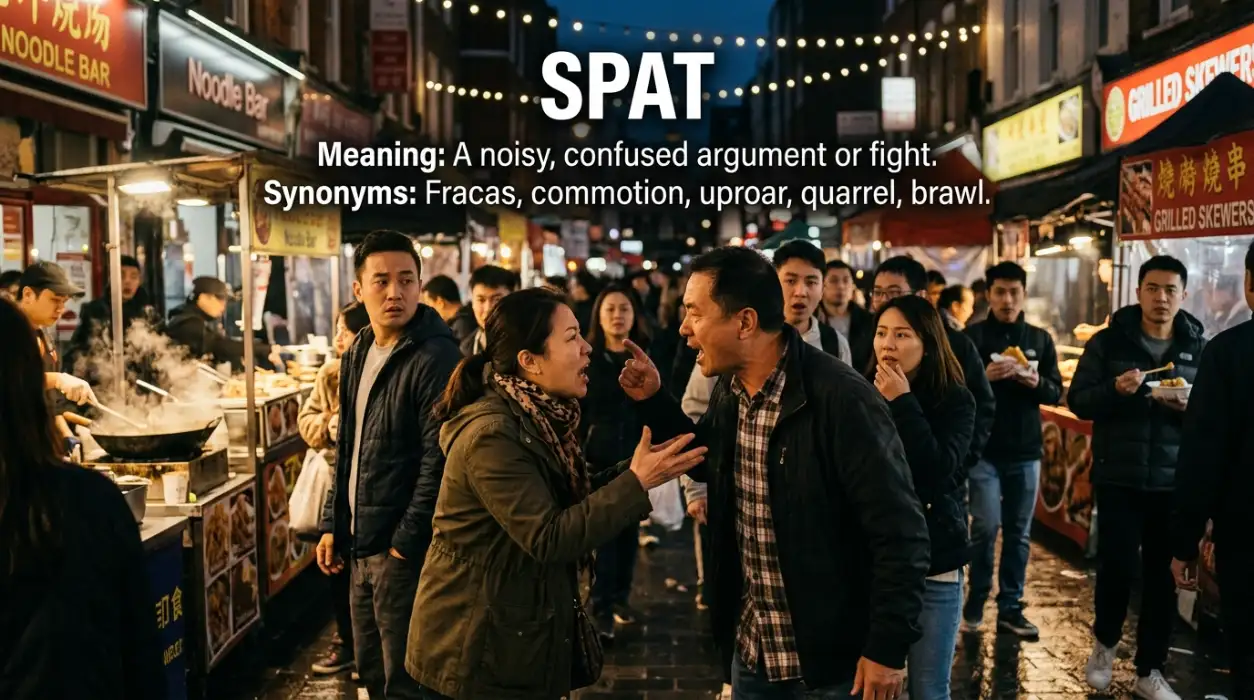
Fracas (Noun) — US / UK: /ˈfrækɑː/ / /ˈfrækɑː/
Meaning: A fracas is a noisy, confused argument or fight.
Tone/Register: Formal or journalistic.
Example:
A fracas broke out near the entrance.
Police arrived after the brief fracas.
Rumpus (Noun) — US / UK: /ˈrʌmpəs/ / /ˈrʌmpəs/
Meaning: A rumpus is a noisy disturbance that may involve arguing or disorder.
Tone/Register: Informal; somewhat old-fashioned.
Example:
The neighbors caused a rumpus late at night.
A small rumpus started in the hallway.
Ruckus (Noun) — US / UK: /ˈrʌkəs/ / /ˈrʌkəs/
Meaning: A ruckus is a noisy disturbance that can accompany an argument or confrontation.
Tone/Register: Informal.
Example:
The argument caused a ruckus in the café.
Everyone turned around when the ruckus began.
Kerfuffle (Noun) — US / UK: /kərˈfʌfəl/ / /kəˈfʌfəl/
Meaning: A kerfuffle is a confused or unnecessary fuss, disagreement, or disturbance.
Tone/Register: Informal; playful.
Example:
There was a kerfuffle over the seating plan.
The whole kerfuffle was forgotten by lunchtime.
Hassle (Noun) — US / UK: /ˈhæsəl/ / /ˈhæsəl/
Meaning: A hassle is a difficult or annoying situation and can describe a minor dispute in informal contexts.
Tone/Register: Informal.
Example:
We had a hassle with the landlord about repairs.
I do not want another hassle over parking.
Beef (Noun) — US / UK: /biːf/ / /biːf/
Meaning: In informal English, a beef is a complaint or grievance that can lead to an argument.
Tone/Register: Very informal; slang.
Example:
He has a beef with the new schedule.
What is your beef with the team leader?
Flare-up (Noun) — US / UK: /ˈfler ʌp/ / /ˈfleər ʌp/
Meaning: A flare-up is a sudden increase in anger, tension, or conflict.
Tone/Register: Neutral to informal.
Example:
A flare-up started during the discussion.
The two sides had another flare-up over the issue.
Exchange (Noun) — US / UK: /ɪksˈtʃeɪndʒ/ / /ɪksˈtʃeɪndʒ/
Meaning: An exchange can describe a short verbal interaction, especially when the words are angry or sharp.
Tone/Register: Neutral; often used in journalism.
Example:
The two officials had a tense exchange.
Their brief exchange ended without an apology.
Cross Words (Noun Phrase) — US / UK: /krɔːs wɜːrdz/ / /krɒs wɜːdz/
Meaning: Cross words are angry or unfriendly remarks exchanged between people.
Tone/Register: Informal; slightly old-fashioned.
Example:
A few cross words were exchanged after the mistake.
They settled down after their exchange of cross words.
War of Words (Noun Phrase) — US / UK: /wɔːr əv wɜːrdz/ / /wɔːr əv wɜːdz/
Meaning: A war of words is a prolonged public exchange of angry or critical statements.
Tone/Register: Journalistic; dramatic.
Example:
The candidates entered a war of words online.
Their war of words continued throughout the week.
Verbal Clash (Noun Phrase) — US / UK: /ˈvɜːrbəl klæʃ/ / /ˈvɜːbəl klæʃ/
Meaning: A verbal clash is a direct disagreement expressed through speech.
Tone/Register: Neutral to formal.
Example:
The interview ended with a verbal clash.
The two guests had a brief verbal clash.
Verbal Dispute (Noun Phrase) — US / UK: /ˈvɜːrbəl dɪˈspjuːt/ / /ˈvɜːbəl dɪˈspjuːt/
Meaning: A verbal dispute is a disagreement expressed through spoken words.
Tone/Register: Formal.
Example:
A verbal dispute began near the entrance.
The staff separated the people involved in the dispute.
Verbal Altercation (Noun Phrase) — US / UK: /ˈvɜːrbəl ˌɔːltərˈkeɪʃən/ / /ˈvɜːbəl ˌɔːltəˈkeɪʃən/
Meaning: A verbal altercation is a heated spoken confrontation.
Tone/Register: Formal; often used in reports.
Example:
The driver was involved in a verbal altercation.
The verbal altercation ended when security arrived.
Heated Exchange (Noun Phrase) — US / UK: /ˈhiːtɪd ɪksˈtʃeɪndʒ/ / /ˈhiːtɪd ɪksˈtʃeɪndʒ/
Meaning: A heated exchange is a short conversation marked by strong anger or disagreement.
Tone/Register: Neutral; widely useful.
Example:
The meeting included a heated exchange about funding.
Their heated exchange surprised the rest of the team.
Hostile Exchange (Noun Phrase) — US / UK: /ˈhɑːstəl ɪksˈtʃeɪndʒ/ / /ˈhɒstaɪl ɪksˈtʃeɪndʒ/
Meaning: A hostile exchange involves openly unfriendly or aggressive remarks.
Tone/Register: Formal to neutral.
Example:
The interview ended after a hostile exchange.
A hostile exchange followed the accusation.
Difference of Opinion (Noun Phrase) — US / UK: /ˈdɪfrəns əv əˈpɪnjən/ / /ˈdɪfrəns əv əˈpɪnjən/
Meaning: A difference of opinion is a polite way to describe opposing views.
Tone/Register: Neutral; polite and professional.
Example:
We had a difference of opinion about the proposal.
A difference of opinion does not have to damage teamwork.
Contretemps (Noun) — US / UK: /ˌkɑːntrəˈtɑːn/ / /ˌkɒntrəˈtɒn/
Meaning: A contretemps is a minor disagreement or awkward conflict, often between people who are expected to remain polite.
Tone/Register: Formal; literary.
Example:
A brief contretemps occurred during the dinner.
The contretemps was soon forgotten.
Tangle (Noun) — US / UK: /ˈtæŋɡəl/ / /ˈtæŋɡəl/
Meaning: A tangle can describe a complicated disagreement or difficult dispute.
Tone/Register: Informal to neutral.
Example:
The company became involved in a legal tangle.
We got into a tangle over the contract terms.
Scrap (Noun) — US / UK: /skræp/ / /skræp/
Meaning: A scrap is an informal argument or minor fight.
Tone/Register: Informal.
Example:
The two boys had a scrap outside the shop.
It started as a verbal scrap.
Fight (Noun) — US / UK: /faɪt/ / /faɪt/
Meaning: A fight can mean an argument, although it may also mean physical violence.
Tone/Register: Common; informal to neutral.
Example:
They had a fight about household chores.
The fight ended when both sides apologized.
Battle (Noun) — US / UK: /ˈbætəl/ / /ˈbætəl/
Meaning: A battle can describe a strong or sustained disagreement, usually in a figurative sense.
Tone/Register: Dramatic; neutral to formal.
Example:
The boardroom battle lasted for hours.
They faced a battle over the proposed changes.
Showdown (Noun) — US / UK: /ˈʃoʊdaʊn/ / /ˈʃəʊdaʊn/
Meaning: A showdown is a decisive confrontation between opposing people or sides.
Tone/Register: Informal to journalistic.
Example:
The meeting became a showdown between the two directors.
Everyone expected a showdown over the proposal.
Standoff (Noun) — US / UK: /ˈstændɔːf/ / /ˈstændɒf/
Meaning: A standoff is a situation in which opposing sides refuse to give way.
Tone/Register: Neutral to formal.
Example:
The disagreement resulted in a standoff.
Neither side wanted to compromise during the standoff.
Strife (Noun) — US / UK: /straɪf/ / /straɪf/
Meaning: Strife refers to serious or prolonged disagreement and conflict.
Tone/Register: Formal; literary.
Example:
The organization suffered years of internal strife.
The dispute created more strife within the group.
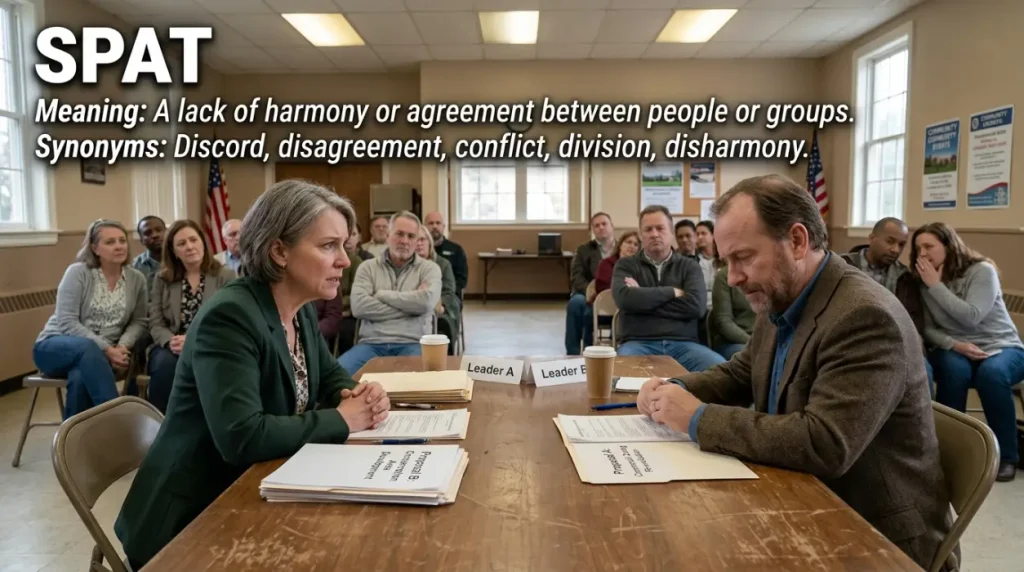
Discord (Noun) — US / UK: /ˈdɪskɔːrd/ / /ˈdɪskɔːd/
Meaning: Discord means a lack of harmony or agreement between people or groups.
Tone/Register: Formal; academic.
Example:
The disagreement created discord within the team.
Years of discord followed the leadership dispute.
Friction (Noun) — US / UK: /ˈfrɪkʃən/ / /ˈfrɪkʃən/
Meaning: Friction is ongoing tension or disagreement between people.
Tone/Register: Neutral to formal.
Example:
There has been friction between the departments.
Small misunderstandings created friction at work.
Recriminations (Noun) — US / UK: /rɪˌkrɪməˈneɪʃənz/ / /rɪˌkrɪməˈneɪʃənz/
Meaning: Recriminations are angry accusations made by people who blame one another.
Tone/Register: Formal.
Example:
The meeting ended with recriminations.
Both sides exchanged recriminations after the failure.
Barney (Noun) — US / UK: /ˈbɑːrni/ / /ˈbɑːni/
Meaning: A barney is British informal slang for an argument or quarrel.
Tone/Register: Very informal; mainly British.
Example:
The roommates had a barney about the dishes.
Their barney was over before dinner.
To-do (Noun) — US / UK: /ˈtuː duː/ / /ˈtuː duː/
Meaning: A to-do is a fuss, disturbance, or argument about something.
Tone/Register: Informal; conversational.
Example:
There was a big to-do over the missing tickets.
The whole to-do seemed unnecessary.
Have Words (Verb Phrase) — US / UK: /hæv wɜːrdz/ / /hæv wɜːdz/
Meaning: To have words means to argue or speak angrily with someone.
Tone/Register: Informal.
Example:
I had words with my neighbor about the noise.
She said she would have words with the supplier.
Words (Noun) — US / UK: /wɜːrdz/ / /wɜːdz/
Meaning: In the expression “have words,” words can refer to an argument or angry conversation.
Tone/Register: Informal.
Example:
They had words after the meeting.
I think he had words with his teammate.
Brouhaha (Noun) — US / UK: /ˈbruːhɑːhɑː/ / /ˈbruːhɑːhɑː/
Meaning: A brouhaha is a noisy or exaggerated fuss surrounding a disagreement or event.
Tone/Register: Informal; humorous.
Example:
The policy change caused a media brouhaha.
The online brouhaha lasted for several days.
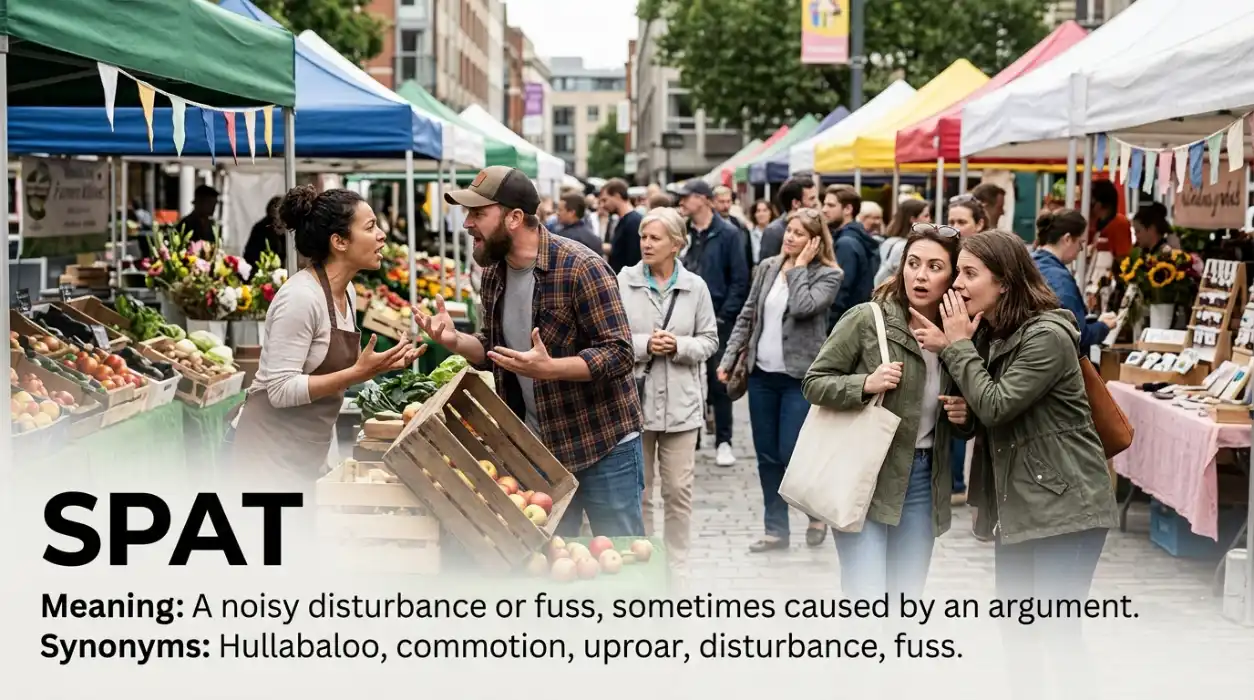
Hullabaloo (Noun) — US / UK: /ˌhʌləbəˈluː/ / /ˌhʌləbəˈluː/
Meaning: A hullabaloo is a noisy disturbance or fuss, sometimes caused by an argument.
Tone/Register: Informal; playful or old-fashioned.
Example:
There was a hullabaloo over the seating mistake.
The whole hullabaloo was louder than the problem deserved.
Synonym by Tone
Not every synonym for spat creates the same impression.
Positive or Lightly Humorous
These can make a disagreement sound smaller or less threatening:
- tiff
- kerfuffle
- to-do
- dust-up
- little squabble
- falling-out
For example, tiff sounds much lighter than altercation.
Neutral
These work well when you simply want to describe disagreement:
- argument
- disagreement
- quarrel
- dispute
- clash
- exchange
- conflict
These are useful for everyday conversation and general writing.
Negative or Serious
These suggest greater hostility, intensity, or duration:
- feud
- confrontation
- hostile exchange
- altercation
- strife
- antagonism
- war of words
A feud, for instance, should not normally replace spat when two people argued for five minutes.
Playful or Informal
These are common in relaxed speech:
- tiff
- squabble
- dust-up
- bust-up
- barney
- kerfuffle
- beef
- rumpus
They can make writing sound lively. However, they may be unsuitable for formal academic work.
“Spat” vs Close Alternatives
Spat vs Tiff
Both usually describe a small disagreement.
Spat is slightly broader and can sound more public or news-oriented.
Tiff often sounds lighter and more personal.
Use tiff for a minor disagreement between friends, partners, or relatives.
Spat vs Squabble
A squabble often suggests that the argument is petty or silly.
A spat does not necessarily imply that either person is being childish.
The executives had a public spat.
This sounds more natural than a public squabble if the disagreement involved serious adults and a visible dispute.
Spat vs Altercation
An altercation is much stronger.
It often suggests a heated confrontation and can imply that physical aggression was possible.
Therefore, calling a mild disagreement an altercation may exaggerate the situation.
How “Spat” Changes by Context
Daily Conversation
In everyday English, spat, argument, tiff, and squabble are useful choices.
We had a little spat last night.
The phrase sounds natural and conversational.
Writing and Blogging
Bloggers can use spat when discussing celebrities, public disagreements, relationships, or social media disputes.
However, repetition can make the writing flat. Switching between spat, clash, dispute, and heated exchange can add precision.
Professional or Academic Writing
Formal writing usually favors disagreement, dispute, conflict, contention, or confrontation.
For example:
The researchers disagreed about the interpretation of the results.
That is usually more suitable than:
The researchers had a spat about the results.
Creative and Informal Writing
Creative writing gives you more freedom.
A character might have a tiff, dust-up, barney, or war of words, depending on personality and setting.
The word itself can help establish the voice of the scene.
Common Mistakes Learners Make
Mistake 1: Using “Spat” for Every Conflict
A spat normally suggests a brief or relatively minor disagreement.
For a long-running family conflict, feud may be more accurate.
For an official disagreement over a contract, dispute may fit better.
Mistake 2: Confusing “Spat” With “Fight”
A fight can be verbal or physical.
A spat is normally verbal and relatively minor.
So, the words are related, but they are not always interchangeable.
Mistake 3: Using “Tiff” for a Serious Confrontation
Tiff has a soft, almost playful quality.
If someone threatens another person during an argument, tiff would sound inappropriate.
Mistake 4: Using “Altercation” Too Casually
Altercation is stronger and more formal.
It is often found in reports about heated confrontations.
Mistake 5: Repeating “Spat” Too Often
Repeatedly using the same noun can make writing sound mechanical.
Instead, choose alternatives based on the exact situation.
For a related vocabulary resource, you could also explore a guide to synonyms for argument and compare the shades of meaning.
Register Notes
Informal
Use these mainly in conversation:
- tiff
- squabble
- dust-up
- bust-up
- barney
- beef
- have words
Neutral
These are safe in many situations:
- argument
- disagreement
- quarrel
- dispute
- clash
- conflict
- exchange
Formal
These suit reports, academic writing, or serious descriptions:
- altercation
- contention
- confrontation
- antagonism
- discord
- strife
- recriminations
- umbrage
Real-Life Mini Scenarios
Workplace
Two managers disagree during a meeting.
You could write:
The managers had a heated exchange.
If the disagreement continues over several weeks, dispute or conflict may be better.
Social Situation
Two friends argue about a missed invitation.
They had a little tiff over the invitation.
This sounds natural because the disagreement is personal and relatively minor.
Media and Pop Culture
Two public figures criticize each other online.
The celebrities became involved in a public war of words.
If the disagreement is short, a public spat is also a natural phrase.
Writing and Storytelling
A novelist wants to show a brief disagreement between siblings.
The siblings had a squabble over the last piece of cake.
The word squabble adds a playful quality that conflict would not.
Practice Quiz
1. Two children argue over who gets the last cookie.
A. feud
B. squabble
C. strife
D. confrontation
2. Two government officials exchange angry comments publicly.
A. tiff
B. kerfuffle
C. war of words
D. barney
3. Two partners have a small disagreement and quickly make up.
A. tiff
B. feud
C. antagonism
D. strife
4. A formal contract disagreement continues between two companies.
A. dispute
B. tiff
C. squabble
D. kerfuffle
5. Two neighbors have a loud argument in British English.
A. row
B. pique
C. contention
D. umbrage
6. A news report describes a heated confrontation outside a restaurant.
A. tiff
B. altercation
C. falling-out
D. difference of opinion
7. Two friends stop speaking after a serious disagreement.
A. falling-out
B. exchange
C. tiff
D. kerfuffle
8. A writer wants a polite phrase for opposing views.
A. dust-up
B. difference of opinion
C. blowup
D. bust-up
9. A team has ongoing tension caused by different personalities.
A. friction
B. tiff
C. to-do
D. spat
10. A British speaker describes an informal argument using slang.
A. barney
B. contention
C. discord
D. recriminations
Answer key: 1-B, 2-C, 3-A, 4-A, 5-A, 6-B, 7-A, 8-B, 9-A, 10-A,
Reflection Task
Write one sentence about a disagreement you have seen in real life. Describe it using tiff, squabble, dispute, heated exchange, or another synonym from this guide. Then ask yourself: Does the word match the seriousness and tone of the situation?
Conclusion
Understanding spat can help you describe a short, usually minor argument or disagreement between people. It can also be the past tense of “spit,” depending on the context. Learning its synonyms, meaning, and examples can improve your English vocabulary and communication skills.
The word spat is commonly used when discussing disagreements, conflicts, or brief arguments in everyday conversations and writing. Knowing its related synonyms can help you express ideas about quarrels, disputes, disagreements, and arguments in different ways.
By practicing spat in sentences and exploring related words, you can strengthen your vocabulary and writing skills. A clear understanding of this word will help you use it naturally, accurately, and confidently in different English contexts.
FAQs
1. What is the best synonym for spat in everyday English?
Argument is usually the safest everyday synonym for spat. It is widely understood and works in both casual and neutral contexts. However, tiff is better when the disagreement is small and temporary, while squabble works well when the argument seems petty. For a more serious disagreement, dispute, conflict, or altercation may be more accurate.
2. Is “spat” a formal or informal word?
Spat is generally informal to neutral. It is common in conversations, news writing, entertainment coverage, and general online writing. It can describe a disagreement without sounding extremely serious. In academic or highly formal writing, alternatives such as disagreement, dispute, conflict, or contention may sound more appropriate.
3. What is the difference between a spat and a quarrel?
A spat usually suggests a short or minor disagreement, while a quarrel is a broader term for an angry disagreement. A quarrel can be brief, but it does not necessarily carry the mild feeling associated with a spat. Therefore, calling something a spat can make the conflict sound smaller or less serious.
4. Can “spat” describe an argument between friends?
Yes. Spat is especially natural when describing a brief disagreement between friends, partners, relatives, or coworkers. For example, you can say, “My sister and I had a spat about the trip.” The word suggests that the disagreement was limited rather than a deep or permanent break in the relationship.
5. Is “spat” the same as “fight”?
Not always. Fight is broader and can describe either a verbal argument or physical violence. Spat normally describes a short verbal disagreement and usually sounds milder. If physical aggression occurred, fight or altercation may communicate the situation more accurately. Context is important when choosing between these words.

Shahzeena Shazadi is the founder and lead writer at VocablyHub.com, where she creates accurate, reader-focused English language content designed to help people communicate with clarity and confidence. She specializes in synonyms, antonyms, word meanings, idioms, and practical vocabulary guides that simplify complex language concepts for everyday use. Every article is carefully researched, fact-checked, and written in clear, accessible language using reliable references and real-world examples. Her goal is to provide helpful, trustworthy content that supports learners at every stage of their English language journey.
Her editorial approach focuses on accuracy, transparency, and user value while following modern content quality standards. She regularly reviews and updates content to keep information relevant, useful, and easy to understand. Through VocablyHub.com, Shahzeena Shazadi is committed to publishing reliable language resources that help students, writers, educators, professionals, and English learners expand their vocabulary, improve their writing skills, and communicate with confidence in academic, professional, and everyday situations.