
The phrase smelling good is commonly used to describe a pleasant, fresh, or attractive scent. It can refer to people, perfumes, flowers, food, rooms, or other things that have an enjoyable aroma.
Understanding smelling good can help you describe pleasant scents more clearly in everyday conversations and writing. Learning its synonyms and related expressions can also expand your English vocabulary and help you choose more descriptive words.
The meaning of smelling good can vary depending on the context. It may describe a person who has a pleasant fragrance, a delicious-smelling meal, or an environment filled with a fresh and appealing scent.
By learning smelling good, its synonyms, meaning, and examples, you can improve your vocabulary and communication skills. This guide will help you understand the phrase clearly and use it naturally and confidently in different English contexts.
Core Meaning of Smelling Good
The phrase “smelling good” describes anything that emits an appealing, pleasant, or fragrant aroma to the human nose.
Native speakers use it in casual daily conversations when complimenting perfume, fresh cooking, clean laundry, or blooming flowers.
In English grammar, “smelling good” acts as a participial phrase or descriptive predicate using a sensory linking verb.
Definition: Emitting a pleasant, agreeable, or inviting scent that pleases the olfactory senses.
Connotative Meaning
Connotation refers to the emotional feeling or cultural association that a word carries beyond its literal dictionary definition.
- Positive tone: Evokes warmth, cleanliness, appetite, luxury, comfort, and immediate sensory delight.
- Negative tone: Rare, but can occasionally imply an overwhelming, heavy, or synthetic artificial fragrance.
- Neutral tone: Simply stating that an object or space releases an agreeable or noticeable scent.
Etymology and History
The verb “smell” comes from Middle English smellen, while “good” stems from Proto-Germanic *gōdaz, meaning fitting or suitable.
- Old English (450–1100): Early speakers used terms like stenc (which meant any smell) along with positive modifiers.
- Middle English (1100–1500): The verb smellen emerged alongside French terms like fragrant and aromatic in literature.
- Modern English (1500–Present): Descriptive sensory phrases expanded significantly to cover luxury perfumes and culinary delights.

Pronunciation and Syllables
- US Pronunciation: /ˈsmɛl.ɪŋ ɡʊd/
- UK Pronunciation: /ˈsmɛl.ɪŋ ɡʊd/
- Syllables: smell-ing good
Affixation Pattern:
- Root: smell (Germanic root for olfactory perception)
- Suffix: -ing (Present participle suffix)
- Modifier: good (Adjective modifying the sensory experience)
Synonyms List
Fragrant (Adjective) — US: /ˈfreɪ.ɡrənt/ | UK: /ˈfreɪ.ɡrənt/
Meaning: Having a pleasant, sweet, or agreeable smell.
Tone/Register: Formal / Literary
Examples:
- Fresh jasmine blossoms make the garden incredibly fragrant at night.
- She filled the room with fragrant herbal candles.
Aromatic (Adjective) — US: /ˌær.əˈmæt.ɪk/ | UK: /ˌær.əˈmæt.ɪk/
Meaning: Having a strong, distinctive, and pleasant smell, often of spices or herbs.
Tone/Register: Neutral / Culinary
Examples:
- The chef added aromatic basil to the simmering tomato sauce.
- Hot chai delivers an aromatic blend of cardamom and clove.
Sweet-smelling (Adjective) — US: /ˈswiːtˌsmɛl.ɪŋ/ | UK: /ˈswiːtˌsmɛl.ɪŋ/
Meaning: Emitting a sugary, gentle, or pleasant aroma.
Tone/Register: General / Daily
Examples:
- The lotion left a sweet-smelling trace of honey on her skin.
- Sweet-smelling flowers lined the garden path.
Scented (Adjective) — US: /ˈsɛn.tɪd/ | UK: /ˈsɛn.tɪd/
Meaning: Imbued with a specific pleasant fragrance or perfume.
Tone/Register: Neutral / Commercial
Examples:
- He bought scented soaps for the guest bathroom.
- Lavender-scented oil helps ease evening stress.
Perfumed (Adjective) — US: /ˈpɝː.fjuːmd/ | UK: /ˈpɜː.fjuːmd/
Meaning: Treated or imbued with a sweet, luxurious, or rich fragrance.
Tone/Register: Formal / Descriptive
Examples:
- The letter arrived in a perfumed paper envelope.
- She walked past in a wave of perfumed elegance.
Redolent (Adjective) — US: /ˈrɛd.əl.ənt/ | UK: /ˈrɛd.əl.ənt/
Meaning: Strongly reminiscent or suggestive of a particular pleasant odor.
Tone/Register: Literary / Academic
Examples:
- The old library was redolent of pine polished wood and aged paper.
- Summer breezes were redolent of salty ocean air.
Odorous (Adjective) — US: /ˈoʊ.dɚ.əs/ | UK: /ˈəʊ.dər.əs/
Meaning: Yielding a distinct odor, often pleasant in specific literary contexts.
Tone/Register: Formal / Academic
Examples:
- Pine forests emit odorous resins during hot afternoon hours.
- The odorous incense drifted slowly through the temple hall.
Odoriferous (Adjective) — US: /ˌoʊ.dəˈrɪf.ɚ.əs/ | UK: /ˌəʊ.dəˈrɪf.ər.əs/
Meaning: Bearing or producing a sweet or potent scent.
Tone/Register: Formal / Elevated
Examples:
- The greenhouse hosted many odoriferous tropical plants.
- Odoriferous spices filled the vibrant open-air market stalls.
Balmy (Adjective) — US: /ˈbɑː.mi/ | UK: /ˈbɑː.mi/
Meaning: Soft, fragrant, and soothingly pleasant to the senses.
Tone/Register: Literary / Descriptive
Examples:
- A balmy breeze carried the scent of orange blossoms across the patio.
- We enjoyed the warm, balmy air during our evening stroll.
Ambrosial (Adjective) — US: /æmˈbroʊ.ʒəl/ | UK: /æmˈbrəʊ.zi.əl/
Meaning: Exceptionally pleasing to smell or taste, worthy of the gods.
Tone/Register: Elevated / Literary
Examples:
- The bakery produced an ambrosial aroma of melting chocolate and butter.
- That ripe peach released an ambrosial fragrance.
Delicious (Adjective) — US: /dɪˈlɪʃ.əs/ | UK: /dɪˈlɪʃ.əs/
Meaning: Highly pleasing to the sense of smell or taste.
Tone/Register: Casual / Daily
Examples:
- Something delicious is cooking in the kitchen right now.
- The candle gives off a delicious vanilla scent.
Savory (Adjective) — US: /ˈseɪ.vɚ.i/ | UK: /ˈseɪ.vər.i/
Meaning: Appetizing or salty and spicy in smell and taste.
Tone/Register: Culinary / Neutral
Examples:
- Savory scents of roasted garlic filled the entire home.
- The soup released a rich savory aroma as it boiled.
Fresh (Adjective) — US: /frɛʃ/ | UK: /frɛʃ/
Meaning: Clean, crisp, and pure in scent, like clean air or laundry.
Tone/Register: Daily / Universal
Examples:
- Clean sheets always have a fresh,h crisp scent.
- Morning rain leaves the pine forest smelling fresh.
Clean-smelling (Adjective) — US: /ˈkliːnˌsmɛl.ɪŋ/ | UK: /ˈkliːnˌsmɛl.ɪŋ/
Meaning: Free from dirt or foul odors, giving an impression of purity.
Tone/Register: Daily / General
Examples:
- The soap leaves a clean-smelling layer on your hands.
- Soap and water kept the hospital room clean-smelling.
Crisp (Adjective) — US: /krɪsp/ | UK: /krɪsp/
Meaning: Refreshingly sharp, cool, and clear to the olfactory sense.
Tone/Register: Expressive / Descriptive
Examples:
- The mountain air was crisp and invigorating.
- Crisp autumn leaves carry a wonderful earthy smell.
Invigorating (Adjective) — US: /ɪnˈvɪɡ.ɚ.eɪ.t̬ɪŋ/ | UK: /ɪnˈvɪɡ.ər.eɪ.tɪŋ/
Meaning: Giving strength, energy, and freshness through its scent.
Tone/Register: Professional / Expressive
Examples:
- Eucalyptus oil delivers an invigorating aroma in steam rooms.
- Citrus sprays provide an invigorating scent for quiet mornings.
Refreshing (Adjective) — US: /rɪˈfrɛʃ.ɪŋ/ | UK: /rɪˈfrɛʃ.ɪŋ/
Meaning: Welcome and stimulating because of freshness or coolness.
Tone/Register: General / Daily
Examples:
- A refreshing scent of peppermint filled the studio.
- Mint tea yields a refreshing fragrance on hot days.
Sweet-scented (Adjective) — US: /ˈswiːtˌsɛn.tɪd/ | UK: /ˈswiːtˌsɛn.tɪd/
Meaning: Possessing a sweet and pleasant fragrance.
Tone/Register: General / Descriptive
Examples:
- Sweet-scented lilies adorned the wedding venue table.
- She loves sweet-scented hand creams in winter.
Floral (Adjective) — US: /ˈflɔːr.əl/ | UK: /ˈflɔː.rəl/
Meaning: Resembling or characteristic of flowers in fragrance.
Tone/Register: Commercial / Descriptive
Examples:
- This perfume features strong floral notes of rose and jasmine.
- The laundry soap left a mild floral scent on towels.
Citrusy (Adjective) — US: /ˈsɪt.rə.si/ | UK: /ˈsɪt.rə.si/
Meaning: Reminiscent of lemons, oranges, or limes in freshness.
Tone/Register: Casual / Descriptive
Examples:
- A citrusy aroma brightened up the dark kitchen.
- Cleaners often use citrusy scents for a natural feel.
Fruity (Adjective) — US: /ˈfruː.ti/ | UK: /ˈfruː.ti/
Meaning: Carrying a sweet, rich smell like fresh ripe fruit.
Tone/Register: Casual / Daily
Examples:
- The body wash has a fruity berry fragrance.
- Summer drinks emit a lively fruity aroma.
Earthy (Adjective) — US: /ˈɝː.θi/ | UK: /ˈɜː.θi/
Meaning: Resembling fresh soil, rain, or natural woods pleasantly.
Tone/Register: Descriptive / Literary
Examples:
- Rain on dry dirt creates a rich, earthy smell called petrichor.
- The tea possesses an earthy,y grounded scent.
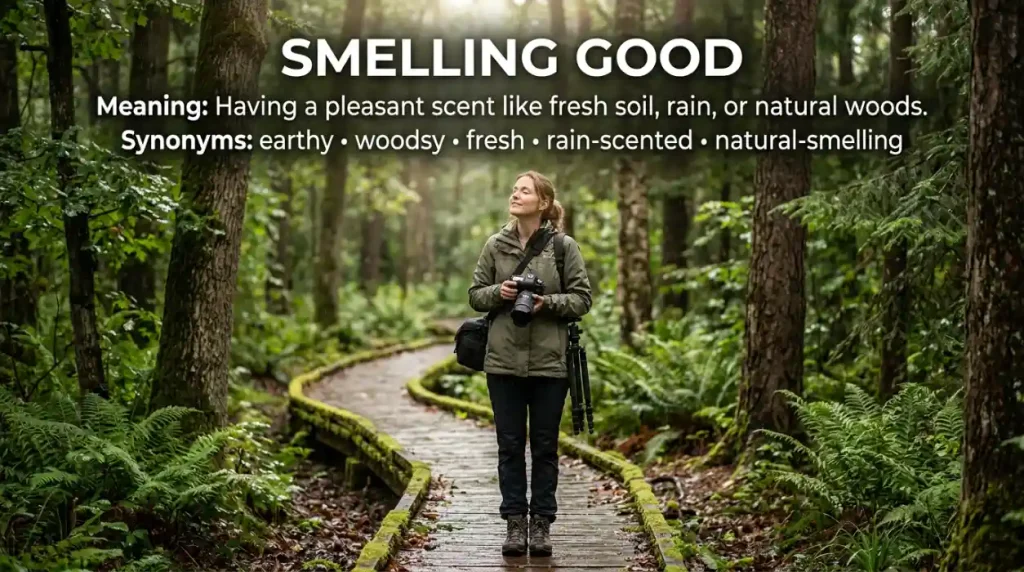
Woody (Adjective) — US: /ˈwʊd.i/ | UK: /ˈwʊd.i/
Meaning: Reminiscent of trees, timber, or forest bark.
Tone/Register: Descriptive / Commercial
Examples:
- Sandalwood provides a warm woody aroma to colognes.
- The cabin smelled of cozy woody cedar planks.
Musky (Adjective) — US: /ˈmʌs.ki/ | UK: /ˈmʌs.ki/
Meaning: Having a heavy, warm, and natural earthy scent.
Tone/Register: Commercial / Expressive
Examples:
- The cologne leaves a dark musky trail after hours.
- Musky notes give perfumes depth and warmth.
Honeyed (Adjective) — US: /ˈhʌn.id/ | UK: /ˈhʌn.id/
Meaning: Sweet, rich, and warm, like natural bee honey.
Tone/Register: Literary / Descriptive
Examples:
- Honeyed scents from wildflower fields drifted into the car window.
- The candle gave off a soft honeyed fragrance.
Spicy (Adjective) — US: /ˈspaɪ.si/ | UK: /ˈspaɪ.si/
Meaning: Carrying the warm, sharp aroma of fascinating spices.
Tone/Register: Daily / Culinary
Examples:
- The bakery filled the alley with spicy cinnamon notes.
- Clove tea gives off a deep, spicy smell.
Sugary (Adjective) — US: /ˈʃʊɡ.ɚ.i/ | UK: /ˈʃʊɡ.ər.i/
Meaning: Sweet and rich, like spun sugar or candy.
Tone/Register: Informal / Daily
Examples:
- Fairgrounds always smell of sugary cotton candy.
- The room mist has a sugary vanilla trail.
Heavenly (Adjective) — US: /ˈhɛv.ən.li/ | UK: /ˈhɛv.n̩.li/
Meaning: Delightful and wonderful to the sense of smell.
Tone/Register: Conversational / Informal
Examples:
- That fresh bread smells absolutely heavenly right now.
- Her new perfume has a heavenly floral scent.
Mouthwatering (Adjective) — US: /ˈmaʊθˌwɑː.t̬ɚ.ɪŋ/ | UK: /ˈmaʊθˌwɔː.tər.ɪŋ/
Meaning: So appetizing in scent that it stimulates saliva.
Tone/Register: Daily / Culinary
Examples:
- Mouthwatering smells of grilled steak drifted over the fence.
- The apple pie released a mouthwatering aroma.
Appetizing (Adjective) — US: /ˈæp.ə.taɪ.zɪŋ/ | UK: /ˈæp.ɪ.taɪ.zɪŋ/
Meaning: Appealing strongly to one’s appetite through scent.
Tone/Register: Neutral / General
Examples:
- The soup smelled appetizing on a cold winter afternoon.
- Warm spices created an appetizing kitchen environment.
Nectarous (Adjective) — US: /ˈnɛk.tɚ.əs/ | UK: /ˈnɛk.tər.əs/
Meaning: Sweet and delicious, like plant nectar.
Tone/Register: Literary / Elevated
Examples:
- Nectarous scents attracted bees to the blooming fruit orchard.
- The ripe melon gave off a nectarous fragrance.
Pleasant-smelling (Adjective) — US: /ˈplɛz.əntˌsmɛl.ɪŋ/ | UK: /ˈplɛz.əntˌsmɛl.ɪŋ/
Meaning: Agreeable and nice to the sense of smell.
Tone/Register: Neutral / General
Examples:
- They planted pleasant-smelling bushes near the porch.
- Soap makers use pleasant-smelling herbal bases.
Agreeable (Adjective) — US: /əˈɡriː.ə.bəl/ | UK: /əˈɡriː.ə.bəl/
Meaning: Pleasing and satisfying to smell without being harsh.
Tone/Register: Formal / Academic
Examples:
- The room offered an agreeable scent of dried lavender.
- Natural oils provide an agreeable scent for indoor spaces.
Delectable (Adjective) — US: /dɪˈlɛk.tə.bəl/ | UK: /dɪˈlɛk.tə.bəl/
Meaning: Extremely pleasing and delightful to senses.
Tone/Register: Elevated / Expressive
Examples:
- Delectable smells of roasting coffee greeted early morning guests.
- The stew produced a delectable aroma.
Intoxicating (Adjective) — US: /ɪnˈtɑːk.sə.keɪ.t̬ɪŋ/ | UK: /ɪnˈtɒk.sɪ.keɪ.tɪŋ/
Meaning: Captivating and overwhelming in a pleasant scent way.
Tone/Register: Expressive / Literary
Examples:
- Jasmine night air creates an intoxicating atmosphere.
- The perfumer created an intoxicating blend of rose and musk.
Essential (Adjective) — US: /ɪˈsɛn.ʃəl/ | UK: /ɪˈsɛn.ʃəl/
Meaning: Containing pure natural plant extracts giving strong natural scents.
Tone/Register: Technical / Commercial
Examples:
- Essential rosemary oil keeps the studio smelling natural.
- Diffusers spread essential plant fragrances smoothly.
Pure (Adjective) — US: /pjʊr/ | UK: /pjʊə/
Meaning: Clean, unpolluted, and natural in scent.
Tone/Register: Universal / General
Examples:
- High mountain snow offers pure, untainted air.
- She loves the pure scent of clean water and soap.
Clean (Adjective) — US: /kliːn/ | UK: /kliːn/
Meaning: Free from stink, heavy perfume, or staleness.
Tone/Register: Daily / Universal
Examples:
- The laundry room smells clean and washed.
- Sun-dried cotton has a clean,n simple smell.
Zesty (Adjective) — US: /ˈzɛs.ti/ | UK: /ˈzɛs.ti/
Meaning: Lively, bright, and citrus-like in aroma.
Tone/Register: Casual / Expressive
Examples:
- Lime peel provides a zesty punch to the room spray.
- A zesty orange scent woke everyone up quickly.
Tangy (Adjective) — US: /ˈtæŋ.i/ | UK: /ˈtæŋ.i/
Meaning: Sharp, fresh, and slightly sour in scent.
Tone/Register: Daily / Culinary
Examples:
- Tangy lemon scents filled the sunlit kitchen.
- Green apples give off a tangy, refreshing smell.
Rich (Adjective) — US: /rɪtʃ/ | UK: /rɪtʃ/
Meaning: Deep, full, and luxurious in aroma profile.
Tone/Register: Descriptive / Commercial
Examples:
- Dark chocolate yields a rich,h comforting scent.
- The leather jacket has a rich, ch warm smell.
Warm (Adjective) — US: /wɔːrm/ | UK: /wɔːm/
Meaning: Comforting and deep, often with vanilla, amber, or spice notes.
Tone/Register: General / Daily
Examples:
- A warm scent of baking cookies drifted downstairs.
- Amber oils give colognes a warm, comforting base.
Mellow (Adjective) — US: /ˈmɛl.oʊ/ | UK: /ˈmɛl.əʊ/
Meaning: Soft, smooth, and gentle to smell.
Tone/Register: Conversational / Descriptive
Examples:
- Aged wood releases a mellow oak aroma.
- The tea offers a mellow floral bouquet.
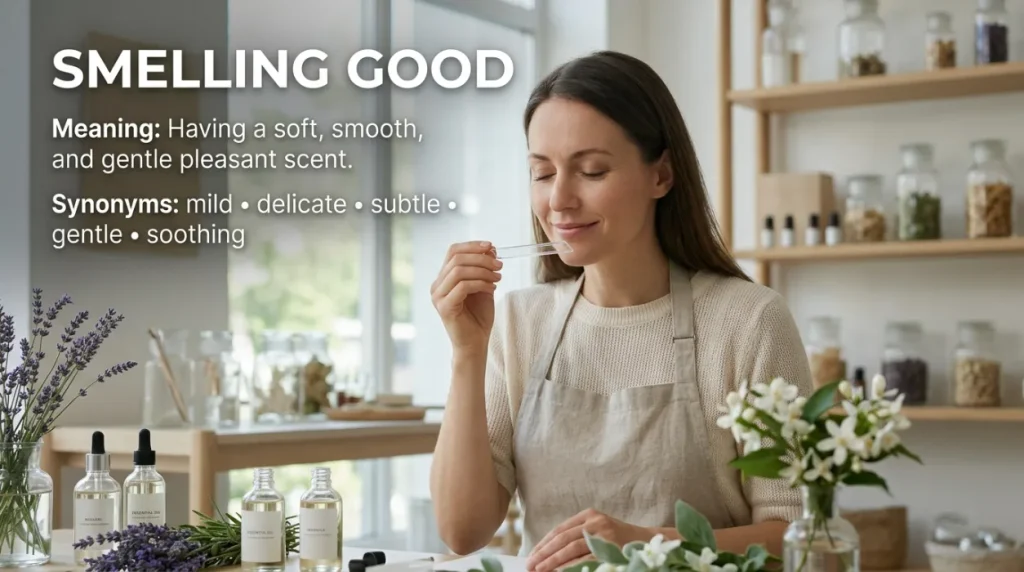
Soothing (Adjective) — US: /ˈsuː.ðɪŋ/ | UK: /ˈsuː.ðɪŋ/
Meaning: Calming and relaxing through sensory scent quality.
Tone/Register: General / Health
Examples:
- Chamomile tea provides a soothing scent before bed.
- Soothing lavender diffusers help children rest well.
Pine-scented (Adjective) — US: /ˈpaɪnˌsɛn.tɪd/ | UK: /ˈpaɪnˌsɛn.tɪd/
Meaning: Carrying the fresh smell of evergreen pine trees.
Tone/Register: Daily / Commercial
Examples:
- The living room felt festive with a pine-scented candle.
- Pine-scented cleaners refresh bathroom tiles quickly.
Herbal (Adjective) — US: /ˈɝː.bəl/ | UK: /ˈhɜː.bəl/
Meaning: Reminiscent of fresh or dried plant leaves and herbs.
Tone/Register: Neutral / General
Examples:
- Thyme and sage give the roast an herbal smell.
- The spa uses herbal mists for guest relaxation.
Honey-scented (Adjective) — US: /ˈhʌn.iˌsɛn.tɪd/ | UK: /ˈhʌn.iˌsɛn.tɪd/
Meaning: Carrying the sweet natural aroma of honey.
Tone/Register: Descriptive / General
Examples:
- Bees circled honey-scented yellow flowers.
- Beeswax candles create a soft honey-scented glow.
Balsamic (Adjective) — US: /bɑːlˈsæm.ɪk/ | UK: /bɒlˈsæm.ɪk/
Meaning: Rich, sweet, and resinous like natural plant balms.
Tone/Register: Technical / Formal
Examples:
- Pine tree resin yields a balsamic forest scent.
- The perfume features balsamic notes of myrrh.
Perfume-like (Adjective) — US: /ˈpɝː.fjuːmˌlaɪk/ | UK: /ˈpɜː.fjuːmˌlaɪk/
Meaning: Resembling crafted luxury perfume in fragrance.
Tone/Register: General / Daily
Examples:
- Rare night orchids release a perfume-like scent.
- The body lotion has a delicate perfume-like quality.
Ambrosian (Adjective) — US: /æmˈbroʊ.ʒən/ | UK: /æmˈbroʊ.zi.ən/
Meaning: Heavenly and divine in scent profile.
Tone/Register: Literary / Academic
Examples:
- Sweet pastries filled the room with ambrosian delights.
- The garden released ambrosian fragrances after dawn.
Spicy-sweet (Adjective) — US: /ˈspaɪ.siˌswiːt/ | UK: /ˈspaɪ.siˌswiːt/
Meaning: Combining sharp spice notes with sugary sweetness.
Tone/Register: Daily / Culinary
Examples:
- Gingerbread houses smell spicy-sweet during holidays.
- Chai tea offers a spicy-sweet morning aroma.
Clean-cut (Adjective) — US: /ˈkliːn.kʌt/ | UK: /ˈkliːn.kʌt/
Meaning: Sharp, clear, and fresh without heavy complexity.
Tone/Register: Informal / General
Examples:
- The soap leaves a clean-cut, soapy scent.
- His cologne has a clean-cut,t refreshing vibe.
Odor-free (Adjective) — US: /ˈoʊ.dɚ.friː/ | UK: /ˈəʊ.dər.friː/
Meaning: Free from unpleasant smells, leaving pure, fresh air.
Tone/Register: Business / Technical
Examples:
- The new paint keeps rooms odor-free within hours.
- Air purifiers keep apartments clean and odor-free.
Petrichor-rich (Adjective) — US: /ˈpɛt.rɪ.kɔːr.rɪtʃ/ | UK: /ˈpɛt.rɪ.kɔː.rɪtʃ/
Meaning: Filled with the pleasant earthy smell of rain on dry ground.
Tone/Register: Literary / Scientific
Examples:
- Summer storms leave a petrichor-rich atmosphere behind.
- The desert air turned petrichor-rich as rain fell.
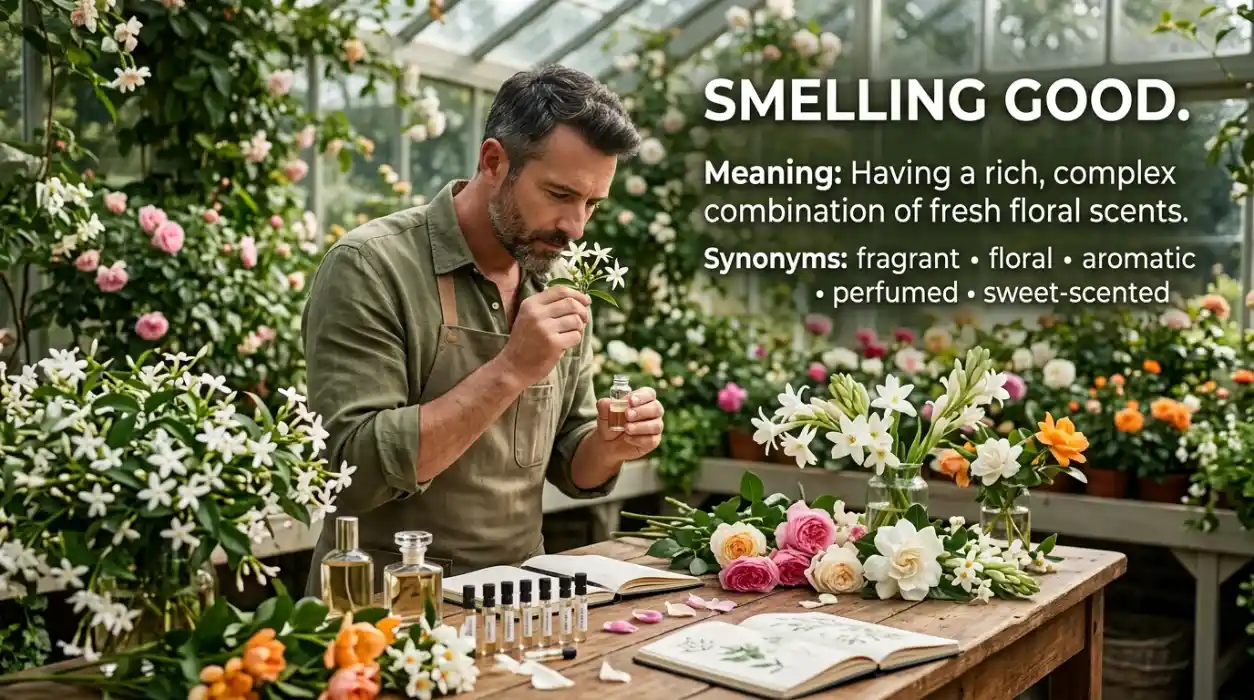
Bouquet-like (Adjective) — US: /boʊˈkeɪˌlaɪk/ | UK: /buːˈkeɪˌlaɪk/
Meaning: Rich with a complex combination of fresh floral scents.
Tone/Register: Expressive / Commercial
Examples:
- Fine green tea exhibits a bouquet-like scent profile.
- The wine releases a bouquet-like fruity scent when swirled.
Synonyms by Tone
Tone Breakdown
Understanding tone helps you select the proper synonym for smelling good based on audience and context.
- Positive / Delightful: Fragrant, Aromatic, Ambrosial, Delectable, Heavenly.
- Neutral / Objective: Scented, Herbal, Floral, Essential, Pleasant-smelling.
- Negative / Overwhelming: Heavy, Perfumed (when overapplied), Musky (in hot weather).
- Playful / Casual: Mouthwatering, Sugary, Zesty, Citrusy, Delicious.
Tone matters because using a heavy term like “perfumed” for fresh soup sounds confusing, whereas “aromatic” fits perfectly.
Mini Comparison: Fragrant vs. Aromatic vs. Redolent
| Feature | Fragrant | Aromatic | Redolent |
| Primary Focus | Sweet, floral, or general pleasant smell | Strong spice, herb, or food aroma | Evoking memories or deep atmospheric scents |
| Emotional Tone | Soft, elegant, and pleasant | Warm, rich, and appetizing | Nostalgic, deep, and literary |
| Best Context | Perfumes, flowers, air mists | Cooking, herbs, coffees, teas | Historic places, old rooms, natural settings |
Use fragrant when describing flowers or light perfumes. Switch to aromatic for herbs, spices, or coffee, and pick redolent when evoking memory or deep atmosphere.
Context-Based Usage
Daily Conversation
In casual chats, native speakers prefer brief terms like “fresh,” “delicious,” or “heavenly.” For instance: “That coffee smells delicious.”
Writing and Blogging
Content creators use evocative words like “fragrant,” “invigorating,” or “mouthwatering” to keep readers sensory-engaged without repeating basic phrases.
Professional and Academic Tone
In business or scientific settings, accurate terms matter. Words like “aromatic,” “essential,” or “agreeable” fit formal reports and product descriptions.
Common Mistakes and Native Usage
Learners often confuse “aromatic” with general sweet smells. Calling a sweet strawberry perfume “aromatic” sounds slightly off because native speakers reserve “aromatic” for herbs, spices, and foods.
Another mistake is using “odorous” when intending a compliment. While “odorous” can mean fragrant in literary English, it frequently carries negative connotations in modern daily speech.
Native Usage Tip: Match scent words to the source object. Use “floral” for flowers, “savory” for meats, and “crisp” for fresh outdoor air. For deeper vocabulary studies, check out ourEnglish learning guides.
Real-Life Mini Scenarios
- Workplace: When a coworker brings hot espresso, describe the office as aromatic rather than heavily perfumed.
- Social Situations: Compliment a friend’s new soap by calling it crisp and refreshing.
- Media & Pop Culture: Food shows often describe gourmet dishes as mouthwatering.
- Writing & Storytelling: Novelists describe old cottages as redolent of woodsmoke and dried lavender.
Conclusion
Understanding smelling good can help you describe a pleasant, fresh, or attractive scent in people, places, food, flowers, and other things. Learning its synonyms, meaning, and examples can improve your English vocabulary and make your descriptions more expressive.
The phrase smelling good is commonly used in everyday conversations and writing when talking about pleasant fragrances or aromas. Knowing its related synonyms can help you describe something as fragrant, fresh, aromatic, sweet-smelling, or pleasant in different ways.
By practicing smelling good in sentences and exploring related expressions, you can strengthen your vocabulary and communication skills. A clear understanding of this phrase will help you describe pleasant scents naturally, accurately, and confidently in different English contexts.
Practice Quiz
Which synonym best describes fresh lavender and blooming roses?
A) Savory
B) Fragrant
C) Earthy
D) Spicy
Choose the culinary word for simmering curry or spiced chai:
A) Floral
B) Aromatic
C) Musky
D) Crisp
If rain falls on dry soil, the scent created is described as:
A) Citrusy
B) Petrichor-rich
C) Sugary
D) Perfumed
Which word carries a literary tone meaning evocative of memories or past settings?
A) Redolent
B) Fresh
C) Clean
D) Zesty
What term best fits fresh bedsheets dried under the sun?
A) Savory
B) Crisp
C) Spicy
D) Ambrosial
Which synonym is ideal for describing a sweet lemon air spray?
A) Musky
B) Citrusy
C) Earthy
D) Redolent
What word implies an appetizing scent that makes you hungry?
A) Mouthwatering
B) Balmy
C) Essential
D) Odorous
Which term best suits cedar wood or sandalwood scents?
A) Fruity
B) Woody
C) Sugary
D) Tangy
A heavenly scent fit for divine gods is called:
A) Ambrosial
B) Clean-cut
C) Odor-free
D) Herbal
What term best describes soft, soothing warm evening air?
A) Balmy
B) Tangy
C) Zesty
D) Spicy
Reflection Task:
Write one original sentence using the synonym “aromatic” to describe your favorite hot beverage.
Answer Key: 1-B, 2-B, 3-B, 4-A, 5-B, 6-B, 7-A, 8-B, 9-A, 10-A
Frequently Asked Questions
What is the most common synonym for smelling good in daily speech?
In daily English, people most frequently use simple words like “delicious,” “fresh,” or “nice.” When complimenting perfumes or flowers, “fragrant” and “lovely” serve as the most natural daily choices.
How does “fragrant” differ from “aromatic”?
“Fragrant” generally refers to sweet, floral, or perfume-like scents found in flowers, lotions, and soaps. “Aromatic” specifically describes strong, warm, and distinctive scents coming from herbs, spices, coffee, or hot cooked foods.
Is “odorous” a positive synonym for smelling good?
While “odorous” historically meant having a strong scent in classic literature, modern native speakers often associate it with unpleasant smells. Therefore, “fragrant” or “aromatic” are safer choices for positive compliments.
What is the word for the good smell after rain?
The specific word for the pleasant, earthy smell produced when rain falls on dry soil is “petrichor.” You can also describe the air as “earthy” or “fresh-rain scented” in casual conversations.
What is an elegant literary word for smelling good?
In formal or creative writing, words like “redolent,” “ambrosial,” or “odoriferous” serve as elegant alternatives. They add depth, sophistication, and vivid imagery to descriptive paragraphs.

Shahzeena Shazadi is the founder and lead writer at VocablyHub.com, where she creates accurate, reader-focused English language content designed to help people communicate with clarity and confidence. She specializes in synonyms, antonyms, word meanings, idioms, and practical vocabulary guides that simplify complex language concepts for everyday use. Every article is carefully researched, fact-checked, and written in clear, accessible language using reliable references and real-world examples. Her goal is to provide helpful, trustworthy content that supports learners at every stage of their English language journey.
Her editorial approach focuses on accuracy, transparency, and user value while following modern content quality standards. She regularly reviews and updates content to keep information relevant, useful, and easy to understand. Through VocablyHub.com, Shahzeena Shazadi is committed to publishing reliable language resources that help students, writers, educators, professionals, and English learners expand their vocabulary, improve their writing skills, and communicate with confidence in academic, professional, and everyday situations.