
A synonym for sparing is a word such as limited, economical, restrained, frugal, or scant, depending on the context. Sparing describes using something carefully, using only a small amount, or giving something in limited quantities. The best alternative depends on the meaning you want to express.
Imagine a student who uses only a little ink to complete an assignment. You might describe the student as sparing with ink. In another situation, a writer may use sparse to describe a paragraph with very few details.
Learning the right synonym for sparing helps you communicate with greater accuracy. It also makes everyday conversations, essays, emails, and blog posts more natural and engaging.
The word sparing appears in many situations because people often discuss limited resources, careful spending, brief explanations, and restrained behavior. Its meaning changes slightly with the noun or phrase around it.
Students, bloggers, content writers, and everyday English users can all benefit from learning these alternatives. Each word adds a different shade of meaning and helps you avoid repeating the same expression.
What Does “Sparing” Really Mean?
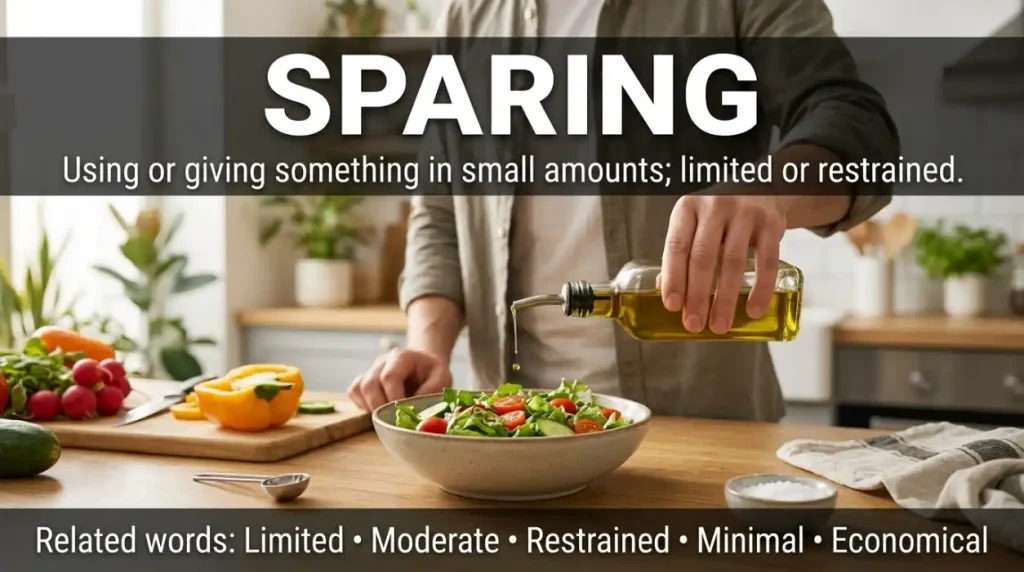
Sparing is an adjective that usually describes using, giving, or providing something in small amounts. It can also mean careful, restrained, or unwilling to use more than necessary.
For example, a sparing use of salt means using only a little salt. Sparing praise means giving praise infrequently or in limited amounts.
The word can also appear in the phrase spare no effort, which means to make every possible effort. This expression uses spare differently, so context matters.
Part of Speech
- Adjective: A sparing use of resources; sparing comments.
- Verb form: Sparing can be the present participle of spare, as in “She is sparing no effort to succeed.”
Simple Definition
In everyday English, sparing means using or giving only a little of something, or exercising restraint when deciding how much to use or provide.
How Native Speakers Understand It
Native speakers generally understand sparing as a word associated with moderation, limited quantity, or careful use. It often appears in expressions such as sparing use, sparing praise, and sparing details.
Its tone is usually neutral or slightly formal. It can sound positive when describing wise resource use, but it may suggest coldness or insufficiency when describing praise, affection, or support.
Connotative Meaning
(Connotation is the emotional association or implied feeling that a word carries beyond its basic dictionary definition.)
- Positive tone: Sparing use of resources suggests thoughtfulness, efficiency, and responsibility.
- Negative tone: Sparing praise may suggest that someone rarely appreciates others.
- Neutral tone: Sparing details simply indicates that an explanation contains little information.
The surrounding words and situation determine which interpretation readers are likely to make.
Etymology
The word sparing comes from the verb spare, which developed from Old English sparian, meaning to refrain from harming, preserve, or allow something to remain available.
Historical Development
Old English (450–1100): The related verb sparian expressed ideas such as refraining from using, saving, or preserving something. These meanings laid the foundation for modern uses of spare.
Middle English (1100–1500): Forms related to spare continued to develop. The word increasingly conveyed the ideas of saving, withholding, or refraining from using something unnecessarily.
Modern English (1500–present): Sparing developed into a common adjective describing limited use, small quantities, or restrained behavior. Today, speakers use it in personal, professional, literary, and everyday contexts.
Pronunciation
- US IPA: /ˈsper.ɪŋ/
- UK IPA: /ˈspeə.rɪŋ/
Syllables: spar-ing
Affixation pattern: spare + -ing
- Root: spare
- Prefix: None
- Suffix: -ing
The suffix -ing forms the present participle of spare and can also appear in the adjective sparing.
Synonyms List
The following alternatives cover the main meanings of sparing: careful use, limited quantity, restraint, and infrequent provision. Not every word fits every sentence, so pay attention to the specific definition and example.
1. Frugal (Adjective) — US / UK: /ˈfruː.ɡəl/
Meaning: Careful about spending money or using resources without unnecessary waste.
Tone/Register: Positive; everyday, financial, and professional.
Examples:
My grandparents are frugal and rarely waste food.
A frugal lifestyle helped Nina save for university.
2. Economical (Adjective) — US / UK: /ˌiː.kəˈnɑː.mɪ.kəl/; /ˌiː.kəˈnɒm.ɪ.kəl/
Meaning: Using money, time, or materials efficiently.
Tone/Register: Neutral to positive; business and everyday English.
Examples:
This economical recipe uses just five ingredients.
We chose an economical way to heat the house.
3. Thrifty (Adjective) — US / UK: /ˈθrɪf.ti/
Meaning: Managing money or supplies carefully to avoid waste.
Tone/Register: Positive; informal and everyday.
Examples:
Sam is thrifty and buys secondhand furniture.
Her thrifty habits helped her build an emergency fund.
4. Moderate (Adjective) — US / UK: /ˈmɑː.dɚ.ət/; /ˈmɒd.ər.ət/
Meaning: Staying within reasonable limits rather than using too much.
Tone/Register: Neutral; general, academic, and professional.
Examples:
Use a moderate amount of chili in the sauce.
He maintains a moderate pace during long runs.
5. Restrained (Adjective) — US / UK: /rɪˈstreɪnd/
Meaning: Controlled and deliberately limited in expression or behavior.
Tone/Register: Formal to neutral; professional and literary.
Examples:
Her restrained response kept the discussion calm.
The designer chose a restrained color palette.
6. Limited (Adjective) — US / UK: /ˈlɪm.ɪ.tɪd/
Meaning: Restricted in amount, extent, or availability.
Tone/Register: Neutral; suitable for almost any context.
Examples:
We have limited time to finish the project.
The library has a limited supply of reference books.
7. Minimal (Adjective) — US / UK: /ˈmɪn.ə.məl/
Meaning: As small or as little as possible or necessary.
Tone/Register: Neutral to positive; academic, design, and professional writing.
Examples:
The repair caused minimal disruption to our work.
She packed minimal luggage for the weekend.
8. Scant (Adjective) — US / UK: /skænt/
Meaning: Barely enough in quantity or amount.
Tone/Register: Formal; often carries a negative implication.
Examples:
The report offers scant evidence for its conclusion.
We had scant time to prepare for the interview.
9. Sparse (Adjective) — US / UK: /spɑːrs/; /spɑːs/
Meaning: Present in small numbers or spread thinly over an area or text.
Tone/Register: Neutral to negative; descriptive and academic.
Examples:
Trees are sparse in this dry region.
The article contains sparse details about the incident.
10. Meager (Adjective) — US / UK: /ˈmiː.ɡɚ/; /ˈmiː.ɡə/
Meaning: Smaller or poorer in quantity than what is needed or expected.
Tone/Register: Negative; general and formal writing.
Examples:
The workers received meager compensation for their efforts.
We made dinner from our meager supplies.
11. Minimalist (Adjective) — US / UK: /ˈmɪn.ə.mə.lɪst/
Meaning: Favoring simplicity and the removal of unnecessary elements.
Tone/Register: Positive or neutral; design, lifestyle, and art.
Examples:
Her minimalist desk holds only a laptop and notebook.
They decorated the apartment in a minimalist style.
12. Modest (Adjective) — US / UK: /ˈmɑː.dɪst/; /ˈmɒd.ɪst/
Meaning: Relatively small in size, amount, or ambition.
Tone/Register: Neutral to positive; professional and everyday.
Examples:
The project requires a modest amount of funding.
We achieved modest growth during the first quarter.
13. Temperate (Adjective) — US / UK: /ˈtem.pɚ.ət/; /ˈtem.pər.ət/
Meaning: Moderate or self-controlled, especially in habits or behavior.
Tone/Register: Formal; literary and sometimes old-fashioned.
Examples:
He follows a temperate approach to eating.
The speaker offered a temperate response to criticism.
14. Abstemious (Adjective) — US / UK: /əbˈstiː.mi.əs/
Meaning: Practicing restraint, especially with food, drink, or indulgence.
Tone/Register: Formal; literary and uncommon in conversation.
Examples:
Her abstemious habits helped her maintain a simple routine.
He remained abstemious during the holiday celebrations.
15. Self-restrained (Adjective) — US / UK: /ˌself.rɪˈstreɪnd/
Meaning: Able to control personal impulses, reactions, or desires.
Tone/Register: Neutral to formal; personal development and psychology.
Examples:
She gave a self-restrained reply instead of arguing.
His self-restrained behavior impressed the interview panel.
16. Disciplined (Adjective) — US / UK: /ˈdɪs.ə.plɪnd/
Meaning: Following consistent rules or habits to control behavior and use resources wisely.
Tone/Register: Positive; educational, personal, and professional.
Examples:
A disciplined budget helped him reduce unnecessary spending.
She takes a disciplined approach to studying.
17. Controlled (Adjective) — US / UK: /kənˈtroʊld/; /kənˈtrəʊld/
Meaning: Kept within deliberate limits rather than allowed to become excessive.
Tone/Register: Neutral; business, technical, and everyday English.
Examples:
The editor used controlled language in the official statement.
Keep the temperature controlled throughout the process.
18. Cautious (Adjective) — US / UK: /ˈkɔː.ʃəs/
Meaning: Careful to avoid unnecessary risk, waste, or mistakes.
Tone/Register: Neutral to positive; everyday and professional.
Examples:
The team took a cautious approach to spending.
I’m cautious about using unfamiliar ingredients.
19. Conservative (Adjective) — US / UK: /kənˈsɝː.və.tɪv/; /kənˈsɜː.və.tɪv/
Meaning: Avoiding excess or taking a careful approach to resources, estimates, or decisions.
Tone/Register: Neutral; finance, business, and formal writing.
Examples:
We made a conservative estimate of next year’s expenses.
The company adopted a conservative spending plan.
20. Selective (Adjective) — US / UK: /sɪˈlek.tɪv/
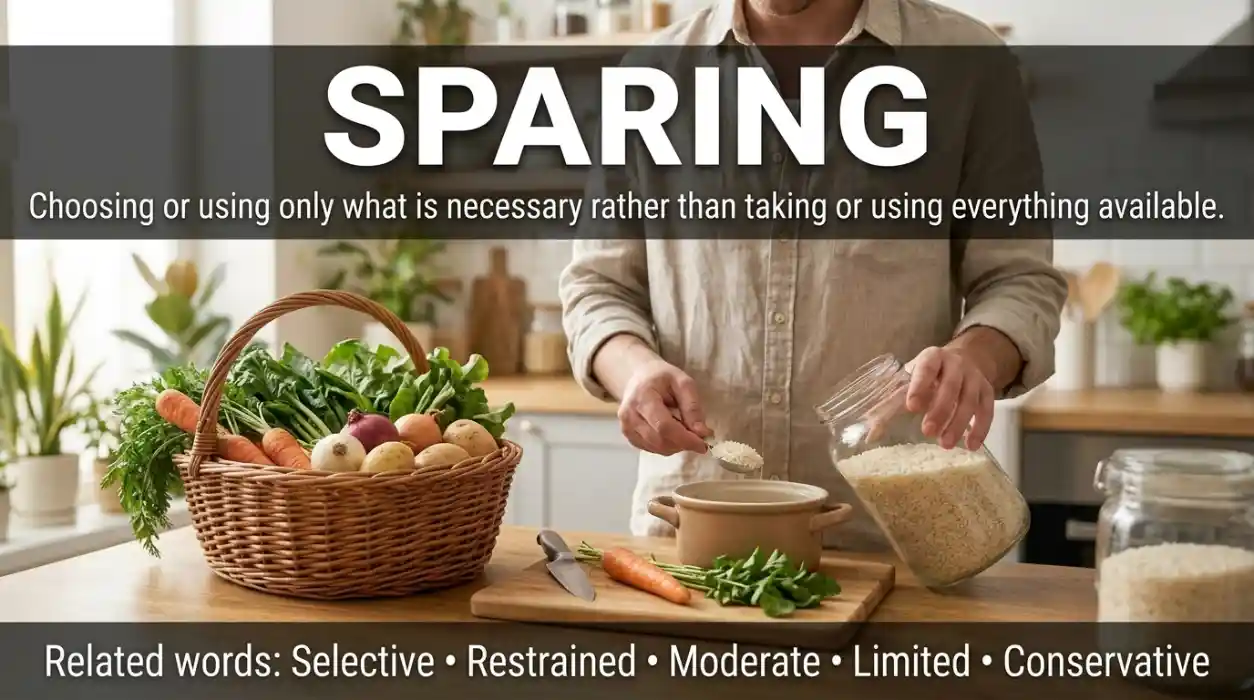
Meaning: Choosing carefully rather than accepting or using everything available.
Tone/Register: Neutral to positive; education, media, and professional settings.
Examples:
Be selective about the sources you cite.
She is selective about the projects she accepts.
21. Judicious (Adjective) — US / UK: /dʒuːˈdɪʃ.əs/
Meaning: Showing good judgment about how much to use or when to act.
Tone/Register: Formal; academic and professional.
Examples:
Judicious use of evidence strengthens the essay.
The manager made judicious cuts to unnecessary expenses.
22. Prudent (Adjective) — US / UK: /ˈpruː.dənt/
Meaning: Careful and sensible when managing resources or making decisions.
Tone/Register: Positive; formal, financial, and professional.
Examples:
It is prudent to keep some money for emergencies.
A prudent editor checks every claim before publication.
23. Sparing in Use (Adjective Phrase) — US / UK: /ˈsper.ɪŋ ɪn juːs/
Meaning: Using something only in small quantities or on limited occasions.
Tone/Register: Neutral to formal; instructions and explanatory writing.
Examples:
Be sparing in your use of bold text.
The chef was sparing in her use of butter.
24. Economizing (Verb, Present Participle) — US / UK: /ɪˈkɑː.nə.maɪ.zɪŋ/; /ɪˈkɒn.ə.maɪ.zɪŋ/
Meaning: Reducing spending or consumption to make resources last longer.
Tone/Register: Neutral; household, financial, and business contexts.
Examples:
We’re economizing by cooking at home this month.
The department is economizing on paper and electricity.
25. Saving (Adjective) — US / UK: /ˈseɪ.vɪŋ/
Meaning: Helping conserve money, time, energy, or other resources.
Tone/Register: Neutral to positive; everyday and business English.
Examples:
Taking the train is a time-saving option.
The new system introduced energy-saving features.
26. Unwasteful (Adjective) — US / UK: /ʌnˈweɪst.fəl/
Meaning: Avoiding waste in the use of materials, money, or effort.
Tone/Register: Neutral; understandable but less idiomatic than efficient or frugal.
Examples:
They developed an unwasteful approach to meal preparation.
Her unwasteful habits kept the household running smoothly.
27. Efficient (Adjective) — US / UK: /ɪˈfɪʃ.ənt/
Meaning: Achieving a result with little unnecessary waste of time, energy, or materials.
Tone/Register: Positive; business, academic, and everyday contexts.
Examples:
The efficient process reduced paper consumption.
She found an efficient way to organize her notes.
28. Lean (Adjective) — US / UK: /liːn/
Meaning: Using few resources or containing little excess.
Tone/Register: Neutral to positive; business, fitness, and technical writing.
Examples:
The startup operates with a lean team.
We designed a lean process with fewer unnecessary steps.
29. Bare (Adjective) — US / UK: /ber/; /beə/
Meaning: Reduced to the minimum, with little extra or decoration.
Tone/Register: Neutral to negative; descriptive and literary.
Examples:
The room contained only the bare essentials.
He gave a bare outline of the proposal.
30. Measurable (Adjective) — US / UK: /ˈmeʒ.ɚ.ə.bəl/; /ˈmeʒ.ər.ə.bəl/
Meaning: Able to be assessed or quantified; in resource discussions, it may describe a limited amount that can be measured.
Tone/Register: Neutral; academic and technical.
Examples:
The change produced a measurable waste reduction.
We saw a measurable improvement in energy use.
31. Infrequent (Adjective) — US / UK: /ɪnˈfriː.kwənt/
Meaning: Happening or occurring only occasionally.
Tone/Register: Neutral; formal and everyday.
Examples:
His infrequent comments made the meeting feel quiet.
The region experiences infrequent rainfall.
32. Occasional (Adjective) — US / UK: /əˈkeɪ.ʒən.əl/
Meaning: Happening from time to time rather than regularly.
Tone/Register: Neutral; conversational and written English.
Examples:
She offers occasional feedback on my drafts.
We make occasional use of the conference room.
33. Rare (Adjective) — US / UK: /rer/; /reə/
Meaning: Uncommon or happening very seldom.
Tone/Register: Neutral; everyday and formal.
Examples:
He makes rare appearances at team meetings.
Such generous gestures are rare in competitive workplaces.
34. Infrequently Given (Adjective Phrase) — US / UK: /ɪnˈfriː.kwənt.li ˈɡɪv.ən/
Meaning: Provided or offered only on a few occasions.
Tone/Register: Formal; descriptive writing.
Examples:
Praise was infrequently given in the old classroom.
Bonuses were infrequently given during the downturn.
35. Measured (Adjective) — US / UK: /ˈmeʒ.ɚd/; /ˈmeʒ.əd/
Meaning: Carefully controlled in amount, pace, or expression.
Tone/Register: Neutral to positive; professional and literary.
Examples:
She spoke in a measured tone during the debate.
The company took measured steps toward expansion.
36. Reserved (Adjective) — US / UK: /rɪˈzɝːvd/; /rɪˈzɜːvd/
Meaning: Restrained in expressing feelings, opinions, or enthusiasm.
Tone/Register: Neutral; personal and professional.
Examples:
He remained reserved when discussing his achievements.
Her reserved manner made the first conversation formal.
37. Unassuming (Adjective) — US / UK: /ˌʌn.əˈsuː.mɪŋ/
Meaning: Modest and not intended to attract attention.
Tone/Register: Positive; social and descriptive writing.
Examples:
The unassuming café serves excellent homemade bread.
She gave an unassuming introduction before the lecture.
38. Understated (Adjective) — US / UK: /ˌʌn.dɚˈsteɪ.tɪd/; /ˌʌn.dəˈsteɪ.tɪd/
Meaning: Expressed subtly rather than dramatically or excessively.
Tone/Register: Positive or neutral; design, communication, and criticism.
Examples:
His understated humor made the interview enjoyable.
The room has an understated elegance.
39. Subdued (Adjective) — US / UK: /səbˈduːd/
Meaning: Muted or restrained in intensity, brightness, or emotional expression.
Tone/Register: Neutral; descriptive and literary.
Examples:
The restaurant uses subdued lighting in the evening.
Her subdued reaction surprised everyone.
40. Reserved in Praise (Adjective Phrase) — US / UK: /rɪˈzɝːvd ɪn preɪz/; /rɪˈzɜːvd ɪn preɪz/
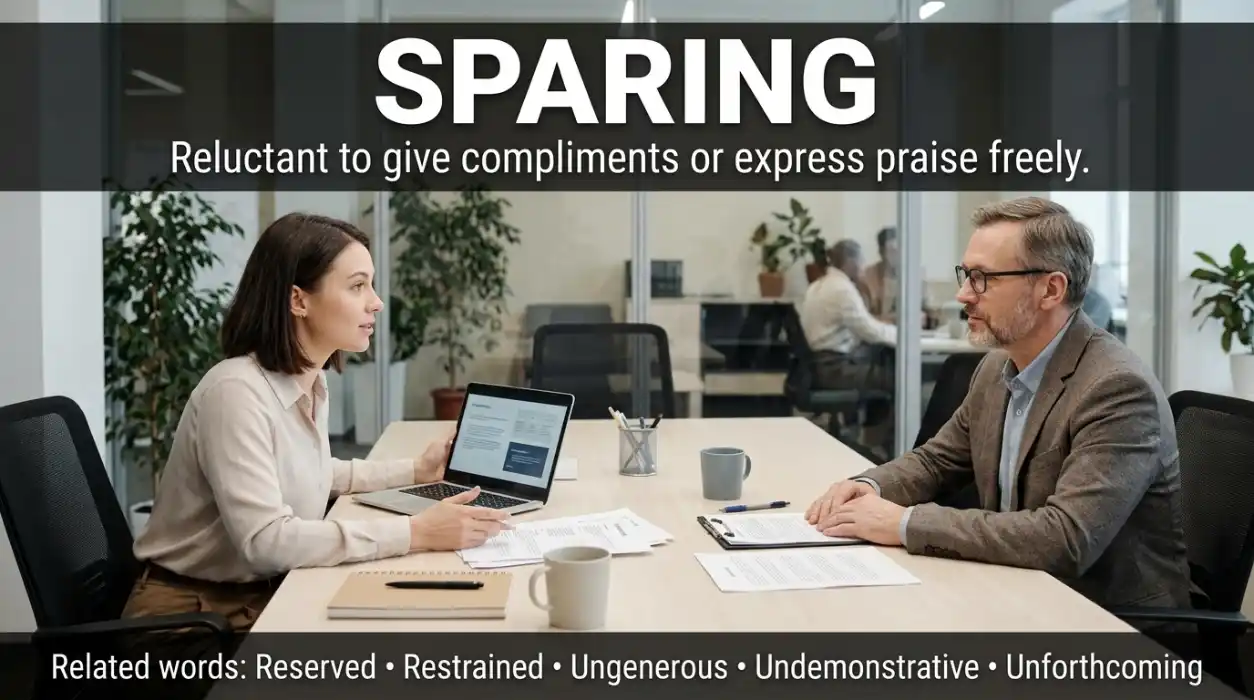
Meaning: Reluctant to give compliments or positive judgments freely.
Tone/Register: Neutral to negative; personal and professional.
Examples:
The coach is reserved in praise but generous with advice.
My supervisor is reserved in praise, so her compliment meant a lot.
41. Parsimonious (Adjective) — US / UK: /ˌpɑːr.səˈmoʊ.ni.əs/; /ˌpɑː.sɪˈməʊ.ni.əs/
Meaning: Extremely unwilling to spend or give resources, often to an unreasonable degree.
Tone/Register: Formal; usually negative.
Examples:
The parsimonious owner refused to replace broken equipment.
His parsimonious approach frustrated the entire team.
42. Stingy (Adjective) — US / UK: /ˈstɪn.dʒi/
Meaning: Unwilling to spend money or give something that others reasonably expect.
Tone/Register: Informal; negative.
Examples:
Don’t be stingy with the birthday cake.
Everyone noticed his stingy tipping habits.
43. Miserly (Adjective) — US / UK: /ˈmaɪ.zɚ.li/; /ˈmaɪ.zə.li/
Meaning: Extremely reluctant to spend or share money or possessions.
Tone/Register: Negative; literary and everyday.
Examples:
The miserly landlord ignored basic repairs.
She described the miserly allowance as unfair.
44. Cheap (Adjective) — US / UK: /tʃiːp/
Meaning: Unwilling to spend enough money, often implying poor generosity or quality.
Tone/Register: Informal; negative when describing a person.
Examples:
He seemed cheap when he refused to split the small bill.
Don’t choose a cheap repair if it won’t last.
45. Tightfisted (Adjective) — US / UK: /ˌtaɪtˈfɪs.tɪd/
Meaning: Very unwilling to spend money or give financial help.
Tone/Register: Informal; strongly negative.
Examples:
The tightfisted manager wouldn’t approve new office chairs.
Her tightfisted uncle never bought gifts.
46. Closefisted (Adjective) — US / UK: /ˌkloʊsˈfɪs.tɪd/; /ˌkləʊsˈfɪs.tɪd/
Meaning: Reluctant to spend or share money.
Tone/Register: Informal to literary; negative.
Examples:
The closefisted investor rejected every reasonable expense.
His closefisted habits made group outings difficult.
47. Ungenerous (Adjective) — US / UK: /ʌnˈdʒen.ɚ.əs/; /ʌnˈdʒen.ər.əs/
Meaning: Unwilling to give money, praise, help, or consideration freely.
Tone/Register: Neutral to negative; formal and everyday.
Examples:
That was an ungenerous response to a sincere apology.
Her ungenerous comments hurt the new employee.
48. Miserly in Spending (Adjective Phrase) — US / UK: /ˈmaɪ.zɚ.li ɪn ˈspen.dɪŋ/; /ˈmaɪ.zə.li ɪn ˈspen.dɪŋ/
Meaning: Spending far less than is reasonable or appropriate.
Tone/Register: Negative; explanatory and formal.
Examples:
The committee was miserly in spending on safety.
A miserly approach to maintenance caused bigger problems later.
49. Underprovided (Adjective) — US / UK: /ˌʌn.dɚ.prəˈvaɪ.dɪd/; /ˌʌn.də.prəˈvaɪ.dɪd/
Meaning: Supplied with less than the amount or support needed.
Tone/Register: Neutral to negative; academic and institutional.
Examples:
The underprovided clinic struggled to serve the community.
Students felt underprovided with learning materials.
50. Insufficient (Adjective) — US / UK: /ˌɪn.səˈfɪʃ.ənt/
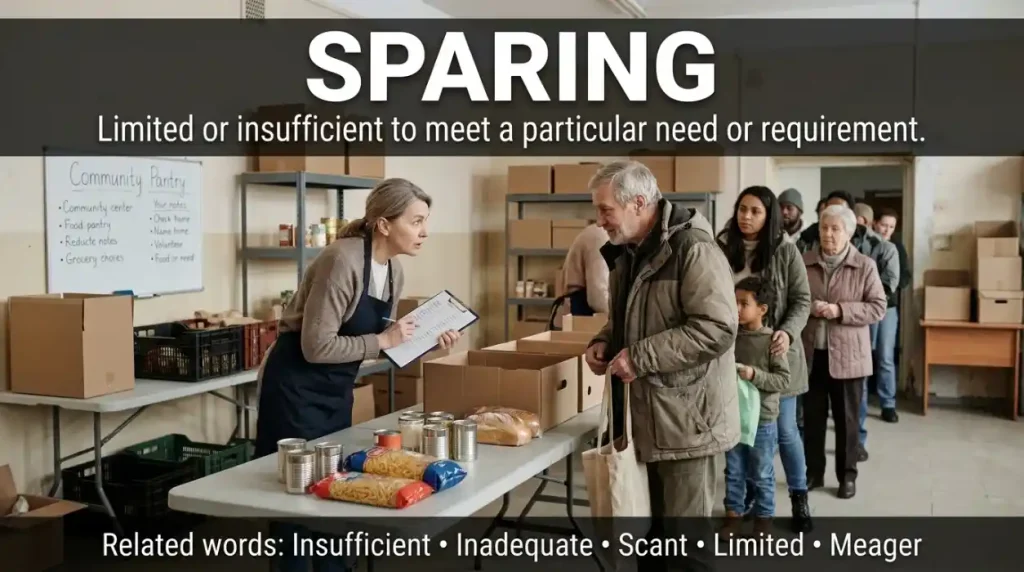
Meaning: Not enough to meet a particular need or requirement.
Tone/Register: Neutral to negative; formal, academic, and professional.
Examples:
The evidence was insufficient to support the claim.
We received insufficient information to make a decision.
Important usage note: Some words in this list are close alternatives rather than exact replacements. Efficient emphasizes results with little waste, while insufficient means not enough. Choose a word that preserves your intended meaning rather than replacing sparing mechanically.
Synonyms by Tone
The tone of a synonym can change how your message sounds. A word that praises careful spending may sound insulting when applied to a person’s generosity.
Positive synonyms
Use these words when you want to praise sensible decisions or careful resource management.
- Frugal
- Economical
- Thrifty
- Prudent
- Judicious
- Efficient
- Disciplined
- Moderate
Example: “Her frugal habits helped her save for a family holiday.”
Neutral synonyms
These words describe quantity, frequency, or restraint without necessarily expressing approval or criticism.
- Limited
- Minimal
- Sparse
- Modest
- Measured
- Controlled
- Occasional
- Infrequent
- Rare
- Restrained
Example: “The report provides limited information about the new policy.”
Negative synonyms
These alternatives suggest a lack of generosity, an inadequate amount, or excessive unwillingness to share.
- Stingy
- Miserly
- Parsimonious
- Tightfisted
- Closefisted
- Ungenerous
- Meager
- Insufficient
Example: “The manager’s stingy budget left the team without essential supplies.”
Playful or informal alternatives
These words work well in casual conversation, although they may sound critical when used to describe people.
- Cheap
- Tightfisted
- Stingy
- Thrifty
Example: “I’m being thrifty this month, so homemade coffee it is!”
Choose your words according to the situation. Thrifty often compliments someone, while stingy criticizes them. This distinction matters in emails, essays, workplace conversations, and creative writing.
“Sparing” vs. Close Alternatives
| Word | Main meaning | Best use |
|---|---|---|
| Sparing | Using or giving something in small amounts | General descriptions of limited use |
| Frugal | Avoiding unnecessary spending or waste | Money, household budgets, and lifestyles |
| Sparse | Present in small numbers or quantities | Information, vegetation, crowds, and decoration |
| Scant | Barely enough or less than expected | Evidence, time, supplies, and information |
| Restrained | Deliberately controlled in expression or behavior | Emotions, language, reactions, and design |
| Stingy | Unwilling to give or spend reasonably | Critical descriptions of people or behavior |
Consider these examples:
- Sparing: “The chef was sparing with the salt.”
- Frugal: “The chef followed a frugal household budget.”
- Sparse: “The menu offered sparse descriptions of each dish.”
- Scant: “The kitchen had scant supplies.”
- Restrained: “The chef gave a restrained response to the complaint.”
- Stingy: “The owner was stingy with staff bonuses.”
The words describe different aspects of a situation. Sparing focuses on limited use, frugal on avoiding waste, and sparse on what is present. Scant often suggests insufficiency, while restrained emphasizes control. Stingy usually carries a negative judgment.
Common Mistakes English Learners Make
Mistake 1: Using “stingy” as a positive synonym
Incorrect: “My friend is stingy with money because she saves for emergencies.”
Better: “My friend is frugal with money because she saves for emergencies.”
Stingy suggests an unreasonable reluctance to spend or share. Frugal usually describes sensible resource management.
Mistake 2: Confusing “sparing” with “sparse”
Incorrect: “She was sparse with the salt.”
Better: “She was sparing with the salt.”
Use sparing with when describing someone’s limited use of something. Use sparse when describing something that exists in small quantities or numbers.
Mistake 3: Using “scant” when you mean “economical”
An economical method saves resources while achieving a useful result. A scant supply may be too small to meet a need.
Mistake 4: Assuming every synonym works with every noun
You can say sparing with praise, frugal with money, and sparse in detail. However, these expressions are not interchangeable in every context.
Mistake 5: Overusing synonyms to avoid repetition
Natural English does not require a different word in every sentence. Repeating a precise term is better than choosing an inaccurate replacement.
Register Notes: Formal vs. Informal English
In formal writing, judicious, prudent, restrained, limited, and insufficient often suit academic or professional contexts.
In everyday conversation, careful, thrifty, stingy, and cheap may sound more natural, depending on the meaning.
For related vocabulary practice, you could also explore an internal article about synonyms for careful and how they differ in tone.
Real-Life Scenarios Using “Sparing”
Workplace: A manager makes sparing use of overtime to protect the team’s work-life balance. The word suggests that overtime happens only when necessary.
Social situations: Someone offers sparing praise during a conversation. This may sound reserved or slightly critical, depending on the relationship.
Media and pop culture: A film uses sparse dialogue and restrained music. These choices can create suspense without overwhelming the audience.
Writing and storytelling: A novelist provides scant details about a mysterious character. Readers may become curious and continue reading to discover more.
These examples show why context matters more than memorizing a long list. The best alternative communicates the intended meaning, tone, and level of formality.
How “Sparing” Changes by Context
Daily conversation
People use sparing when discussing food, money, time, praise, and other limited resources. In casual conversation, using very little or being careful with may sound more natural.
Example: “I’m sparing with sugar because I prefer less sweetness.”
Writing and blogging
Writers can use sparing to explain a deliberate choice. For example, “Use emojis sparingly in a professional article” advises moderation without suggesting that emojis are always inappropriate.
Bloggers can improve readability by choosing specific alternatives instead of repeating broad words such as small or less.
Professional and academic writing
Words such as limited, insufficient, judicious, and restrained offer different levels of precision.
Example: “The study provides limited evidence, so further research is necessary.”
Here, limited describes the evidence available. Insufficient would make the stronger claim that the evidence does not meet the required standard.
Creative and informal writing
Authors can use sparse, scant, muted, and understated to create a particular atmosphere.
Example: “Sparse dialogue gave the scene a quiet, unsettling mood.”
In casual speech, thrifty and stingy can add humor or criticism. Choose carefully because the wrong word may sound harsher than intended.
External Reference
For further vocabulary study, consult the Merriam-Webster Dictionary or the Oxford English Dictionary. These established references can help you check definitions, pronunciation, word history, and example usage.
Use dictionary entries alongside real sentences. A definition tells you what a word means, while examples help you understand where it sounds natural.
Practice Exercise:
1. Maya carefully manages her household budget and avoids unnecessary purchases. She is:
A. Stingy
B. Frugal
C. Sparse
D. Insufficient
2. The report contains very little evidence to support its main claim. The evidence is:
A. Thrifty
B. Restrained
C. Scant
D. Economical
3. The garden has only a few trees spread across a large area. The trees are:
A. Sparse
B. Stingy
C. Prudent
D. Moderate
4. The speaker controlled her emotions and avoided an angry response. Her reaction was:
A. Meager
B. Restrained
C. Frugal
D. Infrequent
5. The manager refuses to provide reasonable supplies even when the team needs them. The manager is:
A. Judicious
B. Efficient
C. Stingy
D. Modest
6. A student uses only a little perfume before attending class. The student is ______ with perfume.
A. Sparse
B. Sparing
C. Insufficient
D. Rare
7. A company reduces unnecessary steps to save time and energy. Its new process is:
A. Efficient
B. Ungenerous
C. Scant
D. Reserved
8. A person receives too little food to meet their basic needs. The food supply is:
A. Economical
B. Meager
C. Disciplined
D. Understated
9. A researcher carefully chooses only the most reliable sources for an essay. The researcher is:
A. Selective
B. Miserly
C. Subdued
D. Tightfisted
10. A film uses very little dialogue, creating a quiet atmosphere. Its dialogue is:
A. Thrifty
B. Sparse
C. Frugal
D. Cautious
Answer key: 1-B, 2-C, 3-A, 4-B, 5-C, 6-B, 7-A, 8-B, 9-A, 10-B
Reflection task:
Write one sentence using sparing, frugal, sparse, or restrained. Explain why your chosen word fits the situation better than another synonym.
Conclusion:
Learning a synonym for sparing helps you express limited use, careful spending, and restraint with greater confidence in everyday English and professional writing.
Each alternative adds a unique shade of meaning. Words such as frugal, sparse, and restrained help you communicate your ideas more clearly.
Build your vocabulary by practicing these words in emails, essays, blog posts, and daily conversations. Small changes can make your English more natural.
Start today by choosing three synonyms and writing one original sentence for each. Review your examples regularly, and notice how your vocabulary grows with practice.
Frequently Asked Questions
1. What is the best synonym for sparing in academic writing?
The best choice depends on your sentence. Use limited when describing a restricted amount of evidence or information. Choose scant when the amount is barely adequate. Use restrained for controlled language or behavior, and judicious when you want to emphasize sound judgment. Check whether the replacement preserves your original meaning before using it in an essay or research paper.
2. What is a synonym for sparing when describing food?
Use light, moderate, or limited when describing a small amount of food or an ingredient. For example, “Use a light coating of oil” sounds natural in a recipe. You can also say “Use salt sparingly.” The best expression depends on whether you are describing a small quantity, a careful action, or a deliberate effort to avoid excess.
3. What does sparing mean in the phrase “sparing use”?
Sparing use means using something in small amounts or only when necessary. The expression often appears in advice, instructions, and professional writing. For example, “The editor recommends sparing use of technical terms” means the writer should avoid unnecessary jargon. The phrase emphasizes moderation rather than complete avoidance, so it does not mean that the item should never be used.
4. Is sparing a synonym for careful?
Sometimes, but the words emphasize different ideas. Careful describes attention to possible mistakes, risks, or consequences. Sparing usually focuses on limiting how much of something you use or give. For example, a careful driver pays attention to the road, while a driver who makes sparing use of the horn sounds it only when necessary.
5. What is a formal synonym for sparing with praise?
Reserved in praise is a natural expression for someone who rarely gives compliments. Restrained can describe a controlled expression of approval, while measured suggests deliberate, balanced judgment. Choose the phrase that fits the intended meaning. Avoid stingy in formal professional feedback unless you deliberately want to criticize someone’s unwillingness to acknowledge other people’s achievements.

Shahzeena Shazadi is the founder and lead writer at VocablyHub.com, where she creates accurate, reader-focused English language content designed to help people communicate with clarity and confidence. She specializes in synonyms, antonyms, word meanings, idioms, and practical vocabulary guides that simplify complex language concepts for everyday use. Every article is carefully researched, fact-checked, and written in clear, accessible language using reliable references and real-world examples. Her goal is to provide helpful, trustworthy content that supports learners at every stage of their English language journey.
Her editorial approach focuses on accuracy, transparency, and user value while following modern content quality standards. She regularly reviews and updates content to keep information relevant, useful, and easy to understand. Through VocablyHub.com, Shahzeena Shazadi is committed to publishing reliable language resources that help students, writers, educators, professionals, and English learners expand their vocabulary, improve their writing skills, and communicate with confidence in academic, professional, and everyday situations.