
Synonyms for surround include encircle, encompass, enclose, envelop, ring, hem in, and border. The best alternative depends on whether you mean being physically around something, enclosing it, or being closely connected to it.
Synonyms for surround can make a simple sentence more vivid. Picture a small house with tall trees around it. You might say the trees surround, encircle, or envelop the house.
The word surround is common because we use it for places, people, objects, situations, and ideas. Learning synonyms gives students and writers more precise choices.
For bloggers and content writers, synonyms for surround reduce repetition and improve descriptions. Daily English users can also choose words that sound more natural in context.
A strong vocabulary is not about using the biggest word. It is about choosing the word that expresses exactly what you mean. That is where these alternatives help.
What Does “Surround” Really Mean?
Surround is mainly a verb. It means to be or move around something or someone on all sides. It can also describe something that closely relates to or exists around a subject.
Cambridge Dictionary gives the central meaning as being “everywhere around” something. It also records a broader use for circumstances, issues, or subjects connected with something.
Simple Definition
Surround means to be all around something or someone, often on every side.
For example:
Tall trees surround the house.
This means the trees are positioned around the house.
It can also be used figuratively:
Mystery surrounds the case.
Here, surround does not describe a physical circle. It means the case is closely associated with mystery or uncertainty.
Part of Speech
Surround is primarily a transitive verb.
It can also appear in related forms:
- surround — base verb
- surrounded — past tense and past participle
- surrounding — present participle or adjective
- surroundings — plural noun
For example:
The mountains surround the village.
The village is surrounded by mountains.
The surrounding hills are green.
The village has beautiful surroundings.
Cambridge lists surrounded as the past simple and past participle of surround.
How Native Speakers Understand “Surround”
Native speakers usually imagine something positioned around another thing.
The word works well for:
- buildings
- cities
- people
- landscapes
- crowds
- objects
- sounds
- emotions
- problems
- circumstances
- uncertainty
- controversy
It can therefore be literal or figurative.
Connotative Meaning
Connotation (the emotional association or implied feeling connected with a word beyond its basic dictionary meaning) can change how Surround feels.
Positive Tone
Surround can suggest comfort, beauty, protection, or companionship.
She was surrounded by supportive friends.
Here, the word creates a warm feeling.
Negative Tone
It can suggest pressure, danger, confinement, or threat.
The building was surrounded by armed guards.
The physical position is similar, but the emotional effect is very different.
Neutral Tone
It can simply describe location.
The garden is surrounded by a stone wall.
There is no strong emotional judgment.
Etymology
The history of surround is especially interesting because its modern meaning developed from an older idea connected with overflowing or spreading around something.
Etymological sources trace the verb to Anglo-French surounder, related to Old French soronder or suronder, meaning “to overflow” or “abound.” Its deeper source is Late Latin superundare, built from super (“over”) and undare (“to flow in waves”).
The modern sense of encompassing or enclosing something on all sides appeared later. Etymonline dates that sense to the early 17th century.
Old English: 450–1100
The modern word surround was not part of Old English vocabulary in its current form.
Old English used native expressions for ideas such as going around, enclosing, encircling, and being around something.
Middle English: 1100–1500
The word entered English during the Middle English period through French influence. Its earliest recorded English sense was associated with flooding or overflowing.
Modern English: 1500–Present
By the early 1600s, surround developed its familiar meaning of enclosing or being around something on all sides. The word later expanded naturally into figurative uses involving circumstances, emotions, uncertainty, and issues.

Pronunciation
US: /səˈraʊnd/
UK: /səˈraʊnd/
Cambridge gives the same IPA pronunciation for both wide varieties of English.
Syllables
sur-round
Affixation Pattern of “Surround”
Historical prefix: sur-
Root: related historically to the idea of flowing or spreading around
Suffix: none in the modern base form
The modern spelling was also influenced by association with round, although the historical origin of surround is not simply sur- + round.
Synonyms List
The following alternatives cover the major meanings of surround. They are not all interchangeable. Some describe physical enclosure, some describe movement around something, and others work mainly in figurative contexts.
1. Encircle (verb) — US /ɪnˈsɝː.kəl/ | UK /ɪnˈsɜː.kəl/
Meaning: To form a circle or ring around something.
Tone/Register: Neutral, descriptive, literary.
Examples:
A stone wall encircles the old garden.
The runners encircled the coach after the race.
2. Encompass (verb) — US /ɪnˈkʌm.pəs/ | UK /ɪnˈkʌm.pəs/
Meaning: To surround something or include it within a larger whole.
Tone/Register: Formal, academic, professional.
Examples:
The park encompasses several walking trails.
The course encompasses both theory and practice.
3. Enclose (verb) — US /ɪnˈkloʊz/ | UK /ɪnˈkləʊz/
Meaning: To surround something with a boundary, covering, wall, or container.
Tone/Register: Neutral, formal.
Examples:
A wooden fence encloses the yard.
Please enclose the documents in the envelope.
4. Envelop (verb) — US /ɪnˈveləp/ | UK /ɪnˈveləp/
Meaning: To surround something, often like a covering or layer.
Tone/Register: Literary, descriptive.
Examples:
Morning fog enveloped the valley.
Warm darkness enveloped the room.
5. Ring (verb) — US /rɪŋ/ | UK /rɪŋ/
Meaning: To form a circle around something.
Tone/Register: Neutral, everyday.
Examples:
Tall trees ring the lake.
A crowd ringed the stage.
6. Hem in (phrasal verb) — US /hem ɪn/ | UK /hem ɪn/
Meaning: To surround someone or something so that movement becomes difficult.
Tone/Register: Informal, descriptive.
Examples:
The narrow streets hemmed us in.
High walls hemmed the garden in.
7. Fence in (phrasal verb) — US /fens ɪn/ | UK /fens ɪn/
Meaning: To surround an area with a fence.
Tone/Register: Everyday, practical.
Examples:
They fenced in the backyard for the dog.
The farmer fenced in the vegetable garden.
8. Wall in (phrasal verb) — US /wɔːl ɪn/ | UK /wɔːl ɪn/
Meaning: To surround something with walls.
Tone/Register: Everyday, physical.
Examples:
The builders walled in the courtyard.
A high barrier walled in the property.
9. Box in (phrasal verb) — US /bɑːks ɪn/ | UK /bɒks ɪn/
Meaning: To surround someone or something so that there is little room to move.
Tone/Register: Informal.
Examples:
Two cars boxed in my vehicle.
The furniture boxed him in near the doorway.
10. Beset (verb) — US /bɪˈset/ | UK /bɪˈset/
Meaning: To surround or trouble someone or something with difficulties or problems.
Tone/Register: Formal, literary.
Examples:
The company was beset by financial problems.
The project was beset with delays.
11. Beleaguer (verb) — US /bɪˈliːɡɚ/ | UK /bɪˈliːɡə/
Meaning: To surround or trouble someone persistently, especially with difficulties.
Tone/Register: Formal, literary.
Examples:
The beleaguered team faced another setback.
The town was beleaguered by repeated storms.
12. Besiege (verb) — US /bɪˈsiːdʒ/ | UK /bɪˈsiːdʒ/
Meaning: To surround a place with forces or, figuratively, to overwhelm someone with demands.
Tone/Register: Formal, military, figurative.
Examples:
The army besieged the fortress.
Reporters besieged the actor with questions.
13. Invest (verb) — US /ɪnˈvest/ | UK /ɪnˈvest/
Meaning: In military language, to surround a place as part of an attack or siege.
Tone/Register: Formal, military, historical.
Examples:
The troops invested the fortified city.
The castle was invested for several weeks.
14. Gird (verb) — US /ɡɝːd/ | UK /ɡɜːd/
Meaning: To surround or encircle something with a belt-like structure.
Tone/Register: Formal, literary.
Examples:
A stone path girds the central garden.
A narrow road girds the hillside.
15. Girdle (verb) — US /ˈɡɝːdəl/ | UK /ˈɡɜːdəl/
Meaning: To encircle something completely, especially in a formal or literary description.
Tone/Register: Literary, formal.
Examples:
A river girdles the eastern edge of the town.
Green hills girdled the ancient settlement.
16. Border (verb) — US /ˈbɔːrdɚ/ | UK /ˈbɔːdə/
Meaning: To lie along the edge of something rather than necessarily surround it.
Tone/Register: Neutral, geographic.
Examples:
Trees border the narrow road.
A flower bed borders the walkway.
17. Flank (verb) — US /flæŋk/ | UK /flæŋk/
Meaning: To be positioned on the sides of someone or something.
Tone/Register: Formal, military, descriptive.
Examples:
Two trees flank the entrance.
Guards flanked the visiting official.
18. Cluster around (phrase) — US /ˈklʌstɚ əˈraʊnd/ | UK /ˈklʌstə əˈraʊnd/
Meaning: To gather closely around a person, object, or place.
Tone/Register: Neutral, descriptive.
Examples:
Fans clustered around the singer.
Children clustered around the storyteller.
19. Gather around (phrase) — US /ˈɡæðɚ əˈraʊnd/ | UK /ˈɡæðə əˈraʊnd/
Meaning: To come together around something or someone.
Tone/Register: Everyday, neutral.
Examples:
Everyone gathered around the table.
The students gathered around the science model.
20. Crowd around (phrase) — US /kraʊd əˈraʊnd/ | UK /kraʊd əˈraʊnd/
Meaning: To gather tightly around something or someone.
Tone/Register: Informal, visual.
Examples:
Fans crowded around the entrance.
People crowded around the street performer.

21. Gather round (phrase) — US /ˈɡæðɚ raʊnd/ | UK /ˈɡæðə raʊnd/
Meaning: To come closer and form a group around a person or activity.
Tone/Register: Informal, conversational.
Examples:
“Gather round,” the teacher said.
The children gathered round to hear the story.
22. Hover around (phrase) — US /ˈhʌvɚ əˈraʊnd/ | UK /ˈhʌvə əˈraʊnd/
Meaning: To remain close to someone or something without moving far away.
Tone/Register: Informal, descriptive.
Examples:
Several reporters hovered around the entrance.
A curious cat hovered around the kitchen.
23. Linger around (phrase) — US /ˈlɪŋɚ əˈraʊnd/ | UK /ˈlɪŋə əˈraʊnd/
Meaning: To remain nearby for a period of time.
Tone/Register: Informal, neutral.
Examples:
Tourists lingered around the square.
A few guests lingered around after dinner.
24. Close around (phrase) — US /kloʊz əˈraʊnd/ | UK /kləʊz əˈraʊnd/
Meaning: To move into a position around something or someone.
Tone/Register: Literary, descriptive.
Examples:
The crowd closed around the performer.
The darkness closed around the cabin.
25. Gather about (phrase) — US /ˈɡæðɚ əˈbaʊt/ | UK /ˈɡæðə əˈbaʊt/
Meaning: To gather around something or someone.
Tone/Register: Literary, somewhat old-fashioned.
Examples:
Villagers gathered about the fire.
The children gathered about their teacher.
26. Enfold (verb) — US /ɪnˈfoʊld/ | UK /ɪnˈfəʊld/
Meaning: To surround or wrap something within a covering or embrace.
Tone/Register: Literary, emotional.
Examples:
The blanket enfolded the sleeping child.
Soft mist enfolded the hills.
27. Embrace (verb) — US /ɪmˈbreɪs/ | UK /ɪmˈbreɪs/
Meaning: To surround something closely, especially in a figurative or affectionate sense.
Tone/Register: Literary, positive, figurative.
Examples:
The valley is embraced by green hills.
The community embraced the new tradition.
28. Wrap around (phrasal verb) — US /ræp əˈraʊnd/ | UK /ræp əˈraʊnd/
Meaning: To extend around the outside of something.
Tone/Register: Everyday, descriptive.
Examples:
A balcony wraps around the building.
She wrapped a scarf around her neck.
29. Wind around (phrase) — US /waɪnd əˈraʊnd/ | UK /waɪnd əˈraʊnd/
Meaning: To curve or extend around something.
Tone/Register: Descriptive, neutral.
Examples:
A narrow road winds around the mountain.
The river winds around the village.
30. Coil around (phrase) — US /kɔɪl əˈraʊnd/ | UK /kɔɪl əˈraʊnd/
Meaning: To form loops around something.
Tone/Register: Descriptive, physical.
Examples:
The vine coiled around the tree trunk.
The rope coiled around the post.
31. Cover (verb) — US /ˈkʌvɚ/ | UK /ˈkʌvə/
Meaning: To extend over or across an area, sometimes surrounding it visually or physically.
Tone/Register: Neutral, broad.
Examples:
Dense fog covered the valley.
Wildflowers covered the hillside.
32. Cloak (verb) — US /kloʊk/ | UK /kləʊk/
Meaning: To cover or surround something with a layer that hides or softens it.
Tone/Register: Literary, figurative.
Examples:
Darkness cloaked the empty street.
Silence cloaked the abandoned house.
33. Shroud (verb) — US /ʃraʊd/ | UK /ʃraʊd/
Meaning: To cover or surround something so that it becomes hidden or unclear.
Tone/Register: Literary, dramatic.
Examples:
Mist shrouded the distant mountains.
Secrecy shrouded the negotiations.
34. Encase (verb) — US /ɪnˈkeɪs/ | UK /ɪnˈkeɪs/
Meaning: To completely enclose something inside a protective or surrounding layer.
Tone/Register: Technical, formal.
Examples:
The device was encased in plastic.
The fossil was encased in rock.
35. Contain (verb) — US /kənˈteɪn/ | UK /kənˈteɪn/
Meaning: To hold something within boundaries or limits.
Tone/Register: Neutral, formal.
Examples:
The walls contain the garden area.
The box contains several smaller compartments.
36. Enfold around (phrase) — US /ɪnˈfoʊld əˈraʊnd/ | UK /ɪnˈfəʊld əˈraʊnd/
Meaning: To close or wrap around something from several directions.
Tone/Register: Literary.
Examples:
The hills enfold the quiet village.
The curtains enfolded the stage.
37. Be around (phrase) — US /bi əˈraʊnd/ | UK /bi əˈraʊnd/
Meaning: To exist or remain in the area surrounding something.
Tone/Register: Informal, everyday.
Examples:
There are several cafés around the station.
Friends were around her when she received the news.
38. Lie around (phrase) — US /laɪ əˈraʊnd/ | UK /laɪ əˈraʊnd/
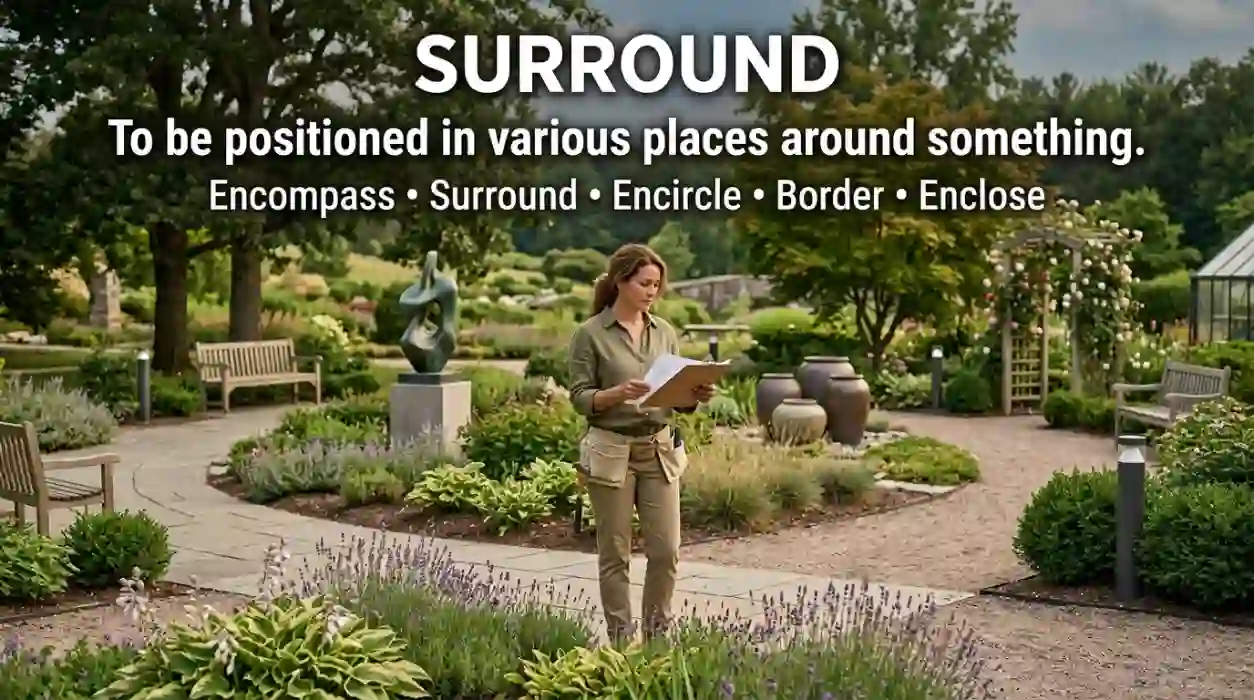
Meaning: To be positioned in various places around something.
Tone/Register: Everyday, descriptive.
Examples:
Books lay around the desk.
Small rocks lay around the campsite.
39. Be encircling (phrase) — US /bi ɪnˈsɝːklɪŋ/ | UK /bi ɪnˈsɜːklɪŋ/
Meaning: To form a surrounding ring around something.
Tone/Register: Formal, descriptive.
Examples:
A row of trees was encircling the field.
Clouds were encircling the peak.
40. Be enclosing (phrase) — US /bi ɪnˈkloʊzɪŋ/ | UK /bi ɪnˈkləʊzɪŋ/
Meaning: To form a boundary around something.
Tone/Register: Formal, descriptive.
Examples:
A wall was enclosing the courtyard.
The glass panels were enclosing the display.
41. Beset with (phrase) — US /bɪˈset wɪð/ | UK /bɪˈset wɪð/
Meaning: To be surrounded by difficulties, problems, or unwanted conditions.
Tone/Register: Formal, literary.
Examples:
The proposal was beset with technical problems.
The project was beset with unexpected obstacles.
42. Shrouded in (phrase) — US /ˈʃraʊdɪd ɪn/ | UK /ˈʃraʊdɪd ɪn/
Meanings: Surrounded by something that makes a subject unclear, hidden, or mysterious.
Tone/Register: Literary, journalistic.
Example:
The disappearance remains shrouded in mystery.
The decision was shrouded in secrecy.
43. Wrapped in (phrase) — US /ræpt ɪn/ | UK /ræpt ɪn/
Meaning: Surrounded or covered by something.
Tone/Register: Neutral, descriptive.
Examples:
The baby was wrapped in a soft blanket.
The hills were wrapped in morning fog.
44. Immersed in (phrase) — US /ɪˈmɝːst ɪn/ | UK /ɪˈmɜːst ɪn/
Meaning: Surrounded by or deeply involved in an environment, activity, or experience.
Tone/Register: Neutral, academic, figurative.
Examples:
She was immersed in the local culture.
He became immersed in the music.
45. Drenched in (phrase) — US /drentʃt ɪn/ | UK /drentʃt ɪn/
Meaning: Completely covered or filled with something, especially light, color, or emotion.
Tone/Register: Descriptive, literary.
Examples:
The room was drenched in golden light.
The hills were drenched in autumn color.
46. Steeped in (phrase) — US /stiːpt ɪn/ | UK /stiːpt ɪn/
Meaning: Deeply surrounded or filled with a particular tradition, culture, history, or quality.
Tone/Register: Formal, literary.
Examples:
The town is steeped in history.
The ceremony is steeped in tradition.
47. Permeate (verb) — US /ˈpɝː.mi.eɪt/ | UK /ˈpɜː.mi.eɪt/
Meaning: To spread throughout something so that it becomes present everywhere within it.
Tone/Register: Formal, academic.
Examples:
The smell of coffee permeated the room.
A sense of calm permeated the building.
48. Pervade (verb) — US /pɚˈveɪd/ | UK /pəˈveɪd/
Meaning: To spread through every part of a place, situation, or experience.
Tone/Register: Formal, academic, literary.
Examples:
A feeling of excitement pervaded the stadium.
Silence pervaded the empty house.
49. Attend (verb) — US /əˈtend/ | UK /əˈtend/
Meaning: In formal or literary usage, to accompany or be present around someone or something.
Tone/Register: Formal, literary.
Examples:
A sense of ceremony attended the occasion.
Several traditions attended the annual celebration.
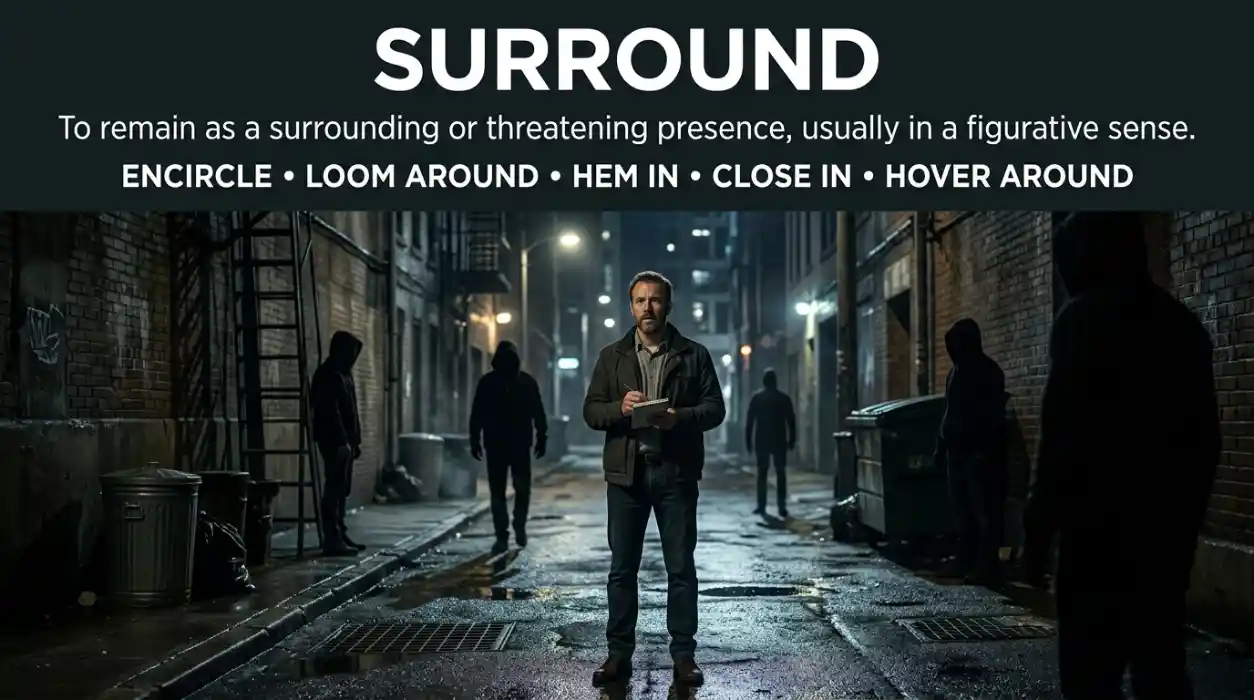
50. Hang over (phrasal verb) — US /hæŋ ˈoʊvɚ/ | UK /hæŋ ˈəʊvə/
Meaning: To remain as a surrounding or threatening presence, usually in a figurative sense.
Tone/Register: Informal, figurative.
Examples:
Uncertainty hangs over the future of the project.
A feeling of tension hung over the meeting.
Synonyms for “Surround” by Tone
Positive
Use embrace, enfold, immerse, gather around, wrap around, and surround when the situation feels warm, supportive, beautiful, or comforting.
She was surrounded by people who cared about her.
The word surrounded becomes positive because of the context.
Neutral
Use encircle, enclose, encompass, ring, border, contain, flank, gather around, and cluster around for straightforward descriptions.
These words focus mainly on position, structure, or movement.
Negative
Use hem in, box in, besiege, beleaguer, beset, shroud, cloak, and hang over when the surrounding situation creates pressure, danger, uncertainty, or restriction.
Playful or Informal
Use crowd around, gather round, hover around, keep around, and box in when speaking casually.
Why Tone Matters
Compare these sentences:
The hills embraced the village.
The hills encircled the village.
The walls hemmed in the village.
All three describe something around a place, but the emotional effect changes.
Embraced sounds warm.
Encircled sounds neutral.
Hemmed in suggests restriction.
That is why choosing a synonym requires more than matching dictionary definitions.
“Surround” vs. Close Alternatives
Encircle vs. Surround
Surround is broad and extremely common.
Encircle emphasizes a circular or ring-like arrangement.
Use surround for general descriptions:
Trees surround the house.
Use encircle when the circular arrangement matters:
A stone wall encircles the garden.
Surround vs. Enclose
Surround means to be around something.
Enclose usually emphasizes a boundary that keeps something inside.
Mountains surround the town.
A fence encloses the yard.
The first describes location. The second emphasizes containment.
Surround vs. Envelop
Envelop suggests complete coverage or immersion.
Clouds surrounded the mountain.
This is neutral.
Clouds enveloped the mountain.
This sounds more vivid and atmospheric.
How “Surround” Changes by Context
Daily Conversation
In casual speech, surround is simple and natural.
“The house is surrounded by trees.”
You can also use phrases such as around, ringed by, or wrapped around when the context allows.
For people, surrounded by is particularly common:
“She was surrounded by friends.”
Writing and Blogging
Writers often use encircle, encompass, envelop, border, and surround to avoid repetition.
A travel article might say:
“The village is surrounded by mountains.”
A more descriptive version could say:
“The village is nestled among mountains.”
However, nestled among is a related descriptive expression rather than a perfect synonym. Accuracy should always come before forced variety.
Professional or Academic English
Academic writing often uses encompass, contain, encircle, and permeate, depending on the meaning.
For example:
“The study encompasses three major areas.”
Here, surround would not be the right replacement.
This illustrates an important vocabulary principle: a synonym must preserve both the meaning and the grammatical function of the original sentence.
Creative or Informal Use
Creative writing gives you more freedom.
Words such as envelop, enfold, cloak, shroud, embrace, and girdle can create stronger imagery.
Compare:
Darkness surrounded the house.
with:
Darkness enveloped the house.
The second sentence creates a more atmospheric picture.
Common Mistakes Learners Make
Mistake 1: Using “surround” for every kind of inclusion
Surround and include are not always interchangeable.
The course encompasses grammar and writing.
This means the course contains those areas.
It does not mean grammar and writing physically surround the course.
Mistake 2: Confusing “enclose” and “surround”
A fence may enclose a garden because it creates a boundary.
Trees may surround a garden because they stand around it.
The difference can be subtle but important.
Mistake 3: Using “encircle” without a circular idea
Encircle strongly suggests a ring or circle.
If the surrounding objects are only on several sides, surround may be more natural.
Mistake 4: Choosing “besiege” in ordinary situations
Besiege has a strong military or figurative meaning.
Reporters besieged the celebrity.
This is possible because the word is being used figuratively.
But:
My friends besieged me at dinner.
sounds unusually dramatic unless that effect is intended.
Mistake 5: Confusing “surroundings” with “surround”
Surround is usually a verb.
Surroundings is a plural noun referring to the place and things around someone or something. Cambridge defines surroundings as the place where someone or something is and the things in it.
The trees surround the house.
The house has beautiful surroundings.
Native Usage Note
Native speakers usually choose the simplest accurate word.
They do not replace surround with a complicated synonym merely to sound intelligent.
In everyday English, surround, around, ring, enclose, and border are often enough.
In academic or creative writing, more specialized alternatives can add precision.
For related vocabulary study, an internal article about synonyms for encompass would pair naturally with this topic.
Real-Life Mini Scenarios
Workplace
A manager might surround a difficult project with a skilled team.
More precisely, the manager could assemble or gather experts around the project. If the experts form a protective or supportive environment, surround can remain natural.
Social Situations
At a celebration, friends may gather around the birthday cake.
A child may be surrounded by family members.
A crowd may cluster around a street performer.
Each expression creates a slightly different picture.
Media and Pop Culture
A celebrity may be besieged by reporters after an important event.
A film scene may show a character surrounded by mysterious figures.
A dramatic landscape may be enveloped in fog.
Writing and Storytelling
A novelist might write:
“The cabin was surrounded by silent pines.”
A more atmospheric version could be:
“The cabin was enveloped by mist and shadow.”
Both communicate a surrounding idea, but the second creates a stronger mood.
Interactive Practice Quiz
Choose the most natural answer for each situation.
1. Tall mountains ______ the small village.
A. surround
B. coach
C. instruct
D. contain
2. A stone wall ______ the garden.
A. encloses
B. hovers
C. besets
D. permeates
3. A group of fans ______ the actor after the show.
A. crowded around
B. bordered
C. encased
D. girdled
4. Morning fog ______ the valley.
A. enveloped
B. fenced in
C. flanked
D. contained
5. The course ______ several areas of environmental science.
A. encompasses
B. encircles
C. hems in
D. coils around
6. The army ______ the fortress.
A. besieged
B. gathered around
C. bordered
D. wrapped around
7. Two large trees ______ the entrance.
A. flank
B. shroud
C. beset
D. immerse
8. The dog was ______ by a wooden fence.
A. fenced in
B. permeated
C. besieged
D. encompassed
9. The project was ______ with unexpected problems.
A. beset
B. encircled
C. embraced
D. bordered
10. The smell of fresh bread ______ the kitchen.
A. permeated
B. flanked
C. fenced in
D. encircled
Answer key: 1-A | 2-A | 3-A | 4-A | 5-A | 6-A | 7-A | 8-A | 9-A | 10-A
Reflection Task
Write one sentence about a place, person, object, or situation using surround. Then rewrite it with a different synonym and notice how the tone or mental image changes.
External Reference Sources
For reliable definitions and pronunciation, consult the Cambridge Dictionary entry for surround. It confirms the core meaning, grammatical information, examples, and US/UK pronunciation.
For word history, Etymonline provides the historical development of surround, including its Anglo-French and Late Latin roots and the development of its modern enclosing sense.
Conclusion
Learning synonyms for surround helps you describe places, people, emotions, and ideas with greater precision. The right word can make simple writing clearer and more vivid.
Students gain flexibility in essays, while bloggers and content writers avoid dull repetition. Strong synonym choices also make everyday speech more natural.
Remember the key differences: encircle suggests a ring, enclose suggests a boundary, and envelop suggests complete covering. Context always matters.
Try one new synonym today. Use it in an email, essay, story, or daily conversation, then compare its tone with surround. Practice turns vocabulary into confidence.
Frequently Asked Questions
1. What is the best synonym for surround in academic writing?
Encompass is often useful when the intended meaning is “include or cover a broad range.” Encompass is especially natural when discussing subjects, categories, research areas, or concepts. If the sentence describes physical location, encircle or enclose may be more precise. Always choose according to the intended meaning rather than formality alone.
2. What is a stronger word for surround in descriptive writing?
Envelop, enfold, shroud, cloak, and embrace can create stronger imagery. Envelop suggests complete coverage, while shroud often adds mystery or darkness. Embrace can create a warmer image. These choices are particularly useful in storytelling, travel writing, poetry, and atmospheric descriptions.
3. What is the difference between surround and encircle?
Surround is the broader word and simply means being around something or someone. Encircle specifically suggests forming a circle or ring around it. For example, “Mountains surround the town” is general, while “A wall encircles the garden” emphasizes the circular boundary.
4. What is the difference between surround and encompass?
Surround usually describes something positioned around another thing. Encompass can describe physical coverage, but it frequently means “include” or “cover a range.” For example, a forest can surround a village, while a course can encompass several subjects. The second use is conceptual rather than spatial.
5. Which synonym for surround means “trap or restrict”?
Hem in and box in are strong choices for physical restriction. Hem in means to surround someone or something so movement becomes difficult. Box in is more conversational. In military or dramatic contexts, besiege can describe surrounding a place or overwhelming someone with pressure.

Shahzeena Shazadi is the founder and lead writer at VocablyHub.com, where she creates accurate, reader-focused English language content designed to help people communicate with clarity and confidence. She specializes in synonyms, antonyms, word meanings, idioms, and practical vocabulary guides that simplify complex language concepts for everyday use. Every article is carefully researched, fact-checked, and written in clear, accessible language using reliable references and real-world examples. Her goal is to provide helpful, trustworthy content that supports learners at every stage of their English language journey.
Her editorial approach focuses on accuracy, transparency, and user value while following modern content quality standards. She regularly reviews and updates content to keep information relevant, useful, and easy to understand. Through VocablyHub.com, Shahzeena Shazadi is committed to publishing reliable language resources that help students, writers, educators, professionals, and English learners expand their vocabulary, improve their writing skills, and communicate with confidence in academic, professional, and everyday situations.