
Synonyms for supervised include monitored, overseen, managed, watched, guided, and controlled. The best choice depends on whether you mean safety, observation, leadership, instruction, or formal authority.
Synonyms for supervised become useful when “supervised” appears too often. A student, writer, or blogger can choose a more precise word.
Imagine a teacher watching students during a science experiment. The students are supervised, but “monitored” or “overseen” may fit too.
For students and content writers, synonyms for supervised add variety and precision. They also help daily English sound more natural.
The word is common because people supervise workers, children, projects, research, exams, and activities. Learning alternatives makes communication clearer.
What Does “Supervised” Really Mean?
Supervised is the past tense and past participle of the verb supervise. It means that a person, activity, task, or group was watched, directed, or managed to make sure things were done properly, safely, or according to rules.
Cambridge defines supervise as watching a person or activity to make sure everything is done correctly or safely. In workplace English, it can also mean managing a department, project, or group while ensuring that work follows requirements.
Part of speech: Verb form; it can also function as a past participle adjective.
Simple definition:
Supervised means watched, guided, or managed by someone responsible for making sure something is done correctly or safely.
How Native Speakers Understand “Supervised”
Native speakers usually understand supervised as implying some level of responsibility or oversight.
For example:
- “The children were supervised by two teachers.”
- “The research was supervised by a professor.”
- “The workers were supervised by a site manager.”
The exact meaning changes with context. A teacher may supervise students closely, while a manager may supervise employees without watching every action.
Emotional Tone
The word supervised is generally neutral.
It can sound positive when supervision provides safety or support.
“The children completed the activity under supervised conditions.”
It can sound restrictive when it suggests that someone cannot act independently.
“The visit was supervised by a staff member.”
So, the surrounding context determines the emotional effect.
Connotative Meaning
Connotation (the feeling, association, or implied meaning a word carries beyond its basic dictionary meaning) matters when choosing a synonym.
Positive tone: guided, supported, mentored, coached
These words can suggest help, development, and encouragement.
Negative tone: controlled, policed, scrutinized
These can suggest strict authority or limited freedom.
Neutral tone: monitored, observed, overseen, supervised
These usually describe oversight without strongly suggesting approval or disapproval.
Etymology
The word comes from supervise.
Supervise entered English in the late 15th century, originally meaning “look over.” It came through Medieval Latin supervisus, the past participle of supervidere, meaning “oversee” or “inspect.” The Latin elements are super, meaning “over,” and videre, meaning “to see.”
Old English: 450–1100
The modern word supervise was not an ordinary Old English word. Its Latin-based form entered English much later.
Old English already had native expressions for watching and overseeing. One related historical word is oversee, from Old English oferseon, meaning “to look over” or “keep watch over.”
Middle English: 1100–1500
During the late Middle English period, forms related to supervise appeared. Supervide, taken directly from Medieval Latin, is recorded from the late 15th century.
Modern English: 1500–Present
The modern sense developed gradually. The meaning involving responsibility for other people’s work or performance is recorded from the 1640s.
Pronunciation
US: /ˈsuː.pɚ.vaɪzd/
UK: /ˈsuː.pə.vaɪzd/
The pronunciation of the base verb supervise is /ˈsuː.pɚ.vaɪz/ in US English and /ˈsuː.pə.vaɪz/ in UK English.
Syllables
su-per-vised
Affixation Pattern of “Supervised”
Root/base: vis/vid — related to seeing
Prefix: super- — above, over
Suffix: -ed — marks the past tense or past participle
The deeper Latin origin is supervidere, combining the ideas of “over” and “see.”
Synonyms List
The alternatives below are not perfectly interchangeable in every sentence. Supervised covers several related ideas, including watching, managing, directing, checking, guiding, and maintaining control. The synonym you choose should match the exact context.
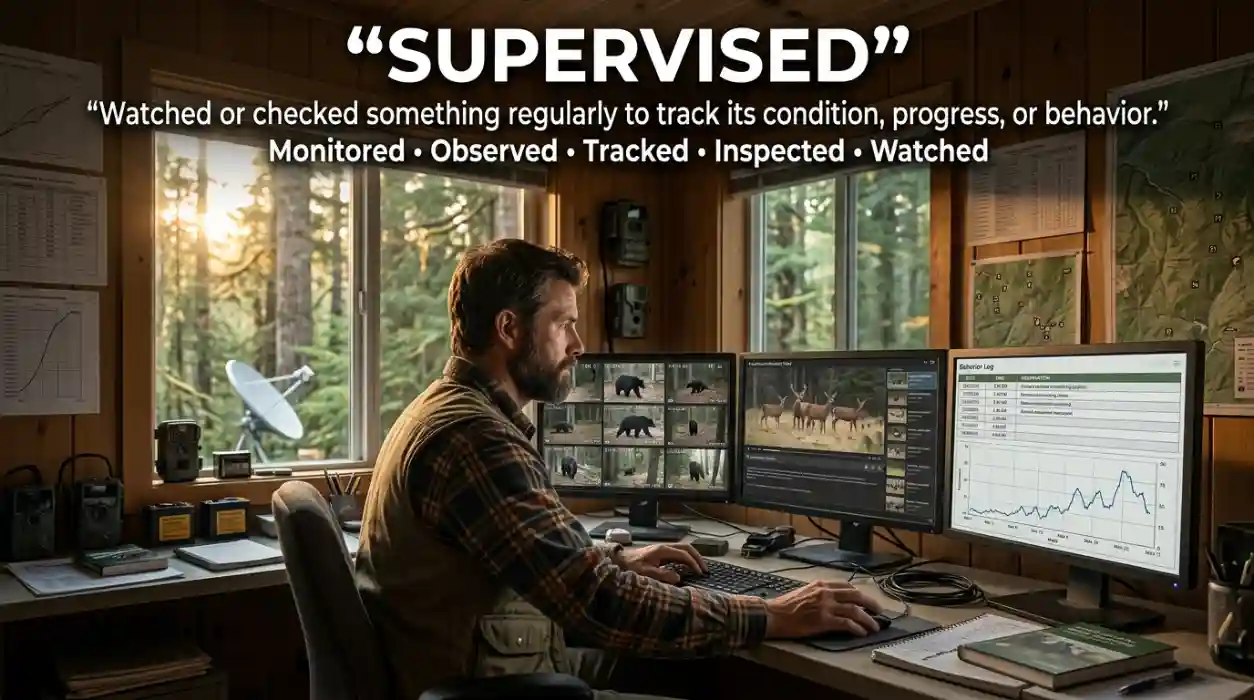
1. Monitored (verb) — US /ˈmɑː.nə.tɚd/ | UK /ˈmɒn.ɪ.təd/
Meaning: Watched or checked something regularly to track its condition, progress, or behavior.
Tone/Register: Neutral, professional, academic.
Examples:
The patient’s condition was monitored throughout the night.
The manager monitored the team’s progress each week.
2. Overseen (verb) — US /ˌoʊ.vɚˈsiːn/ | UK /ˌəʊ.vəˈsiːn/
Meaning: Had responsibility for making sure work or an activity was completed properly.
Tone/Register: Formal, professional.
Examples
The project was overseen by an experienced engineer.
She oversaw the final stage of production.
3. Managed (verb) — US /ˈmæn.ɪdʒd/ | UK /ˈmæn.ɪdʒd/
Meaning: Directed people, work, or resources while taking responsibility for results.
Tone/Register: Business, professional, neutral.
Examples:
He managed a team of twelve designers.
The campaign was managed by a small communications group.
4. Directed (verb) — US /dəˈrektɪd/ | UK /daɪˈrektɪd/
Meaning: Gave instructions and guided an activity toward a particular goal.
Tone/Register: Formal, professional.
Examples
The operation was directed by a senior officer.
She directed the team during the emergency drill.
5. Guided (verb) — US /ˈɡaɪ.dɪd/ | UK /ˈɡaɪ.dɪd/
Meaning: Helped someone complete a task by giving advice, instruction, or direction.
Tone/Register: Positive, educational.
Examples:
The professor guided the students through the research process.
A mentor guided her during the first month.
6. Watched (verb) — US /wɑːtʃt/ | UK /wɒtʃt/
Meaning: Kept an eye on a person or activity to ensure safety or proper behavior.
Tone/Register: Informal, everyday.
Examples:
The lifeguard watched the children in the pool.
Dad watched the kids while they played outside.
7. Observed (verb) — US /əbˈzɝːvd/ | UK /əbˈzɜːvd/
Meaning: Carefully watched something to notice behavior, progress, or changes.
Tone/Register: Academic, formal, neutral.
Examples:
The researchers observed the participants closely.
The teacher observed how each student solved the problem.
8. Controlled (verb) — US /kənˈtroʊld/ | UK /kənˈtrəʊld/
Meaning: Kept an activity or situation within set limits through authority or regulation.
Tone/Register: Formal, sometimes negative.
Examples:
Access to the laboratory was carefully controlled.
The process was controlled by a central team.
9. Regulated (verb) — US /ˈreɡ.jə.leɪ.tɪd/ | UK /ˈreɡ.jʊ.leɪ.tɪd/
Meaning: Supervised an activity by applying rules, standards, or legal requirements.
Tone/Register: Formal, legal, professional.
Examples:
The industry is regulated by national authorities.
The activity was strictly regulated for safety.
10. Administered (verb) — US /ədˈmɪn.ə.stɚd/ | UK /ədˈmɪn.ɪ.stəd/
Meaning: Managed or organized an activity, system, or process.
Tone/Register: Formal, academic, institutional.
Examples:
The program was administered by the university.
The examination was administered under strict conditions.
11. Superintended (verb) — US /ˌsuː.pɚ.ɪnˈten.dɪd/ | UK /ˌsuː.pər.ɪnˈten.dɪd/
Meaning: Had formal responsibility for directing and overseeing work.
Tone/Register: Very formal, traditional.
Examples:
The construction was superintended by a senior architect.
He superintended the work for several months.
12. Coordinated (verb) — US /koʊˈɔːr.də.neɪ.tɪd/ | UK /kəʊˈɔː.dɪ.neɪ.tɪd/
Meaning: Organized people or activities so they work effectively together.
Tone/Register: Professional, neutral.
Examples:
She coordinated the volunteer team.
He coordinated the research activities across three departments.
13. Directed by (phrase) — US /dəˈrekt baɪ/ | UK /daɪˈrekt baɪ/
Meaning: Placed under the authority or guidance of a particular person.
Tone/Register: Formal, professional.
Examples:
The study was directed by a senior researcher.
The project was directed by the department head.
14. Guided by (phrase) — US /ˈɡaɪ.dɪd baɪ/ | UK /ˈɡaɪ.dɪd baɪ/
Meaning: Completed with advice or direction from another person.
Tone/Register: Positive, academic.
Examples:
The students worked under a guided research program.
The team was guided by an experienced consultant.
15. Attended (verb) — US /əˈten.dɪd/ | UK /əˈten.dɪd/
Meaning: Stayed with or looked after someone, especially in a care or support context.
Tone/Register: Formal, context-dependent.
Examples:
The patient was attended by trained staff.
The guests were attended by several assistants.
16. Guarded (verb) — US /ˈɡɑːr.dɪd/ | UK /ˈɡɑː.dɪd/
Meaning: Watched someone or something to protect it from danger or unauthorized action.
Tone/Register: Neutral, security-related.
Examples:
The entrance was guarded by security staff.
The children were closely guarded near the road.
17. Superintended by (phrase) — US /ˌsuː.pɚ.ɪnˈten.dɪd baɪ/ | UK /ˌsuː.pər.ɪnˈten.dɪd baɪ/
Meaning: Formally placed under the responsibility of someone in charge.
Tone/Register: Formal, traditional.
Examples:
The works were superintended by the chief engineer.
The school was supervised by a senior administrator.
18. Regulated by (phrase) — US /ˈreɡ.jə.leɪ.tɪd baɪ/ | UK /ˈreɡ.jʊ.leɪ.tɪd baɪ/
Meaning: Controlled or supervised according to established rules.
Tone/Register: Legal, technical, formal.
Examples:
The service is regulated by national standards.
The process is regulated by strict safety rules.
19. Scrutinized (verb) — US /ˈskruː.tə.naɪzd/ | UK /ˈskruː.tɪ.naɪzd/
Meaning: Examined something very carefully, often looking for errors or problems.
Tone/Register: Formal, analytical.
Examples:
The report was scrutinized before publication.
Every application was scrutinized by the review panel.
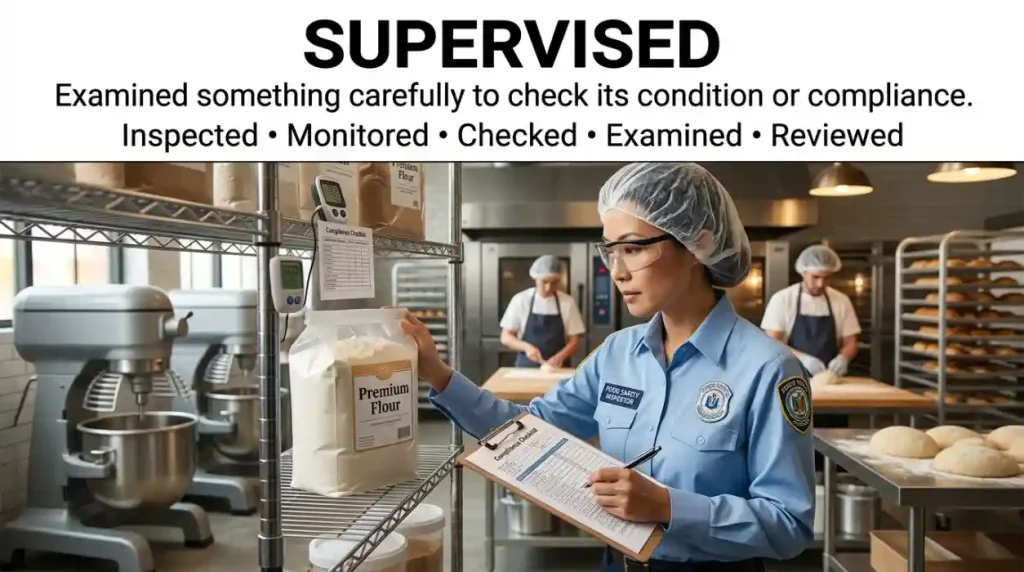
20. Inspected (verb) — US /ɪnˈspek.tɪd/ | UK /ɪnˈspek.tɪd/
Meaning: Examined something carefully to check its condition or compliance.
Tone/Register: Professional, technical.
Examples:
The equipment was inspected before use.
The building was inspected by a safety officer.
21. Checked (verb) — US /tʃekt/ | UK /tʃekt/
Meaning: Examined something to make sure it was correct, safe, or acceptable.
Tone/Register: Everyday, neutral.
Examples:
The teacher checked the students’ work.
The supervisor checked every form before submission.
22. Reviewed (verb) — US /rɪˈvjuːd/ | UK /rɪˈvjuːd/
Meaning: Examined work, information, or progress carefully.
Tone/Register: Academic, professional.
Examples:
The supervisor reviewed the final report.
The proposal was reviewed by two editors.
23. Assessed (verb) — US /əˈsest/ | UK /əˈsest/
Meaning: Judged the quality, progress, condition, or performance of something.
Tone/Register: Academic, professional.
Examples:
The students were assessed throughout the course.
Their progress was assessed by the instructor.
24. Evaluated (verb) — US /ɪˈvælju.eɪ.tɪd/ | UK /ɪˈvælju.eɪ.tɪd/
Meaning: Carefully judged performance, quality, effectiveness, or value.
Tone/Register: Academic, professional.
Examples:
The project was evaluated by an independent panel.
Each trainee was evaluated at the end of the program.
25. Tracked (verb) — US /trækt/ | UK /trækt/
Meaning: Followed progress, movement, or development over time.
Tone/Register: Neutral, technical, informal.
Examples:
The teacher tracked each student’s progress.
The team tracked the project’s milestones.
26. Followed (verb) — US /ˈfɑː.loʊd/ | UK /ˈfɒl.əʊd/
Meaning: Kept up with the development or progress of a person, task, or situation.
Tone/Register: Everyday, neutral.
Examples:
The manager followed the project closely.
The teacher followed her students’ progress.
27. Kept watch over (phrase) — US /kept wɑːtʃ ˈoʊ.vɚ/ | UK /kept wɒtʃ ˈəʊ.və/
Meaning: Stayed alert while watching someone or something for safety or protection.
Tone/Register: Everyday, warm.
Examples:
The nurse kept watch over the patient.
Her brother kept watch over the children.
28. Kept an eye on (phrase) — US /kept ən aɪ ɑːn/ | UK /kept ən aɪ ɒn/
Meaning: Watched something casually or regularly to make sure it remained safe or correct.
Tone/Register: Informal.
Examples:
Can you keep an eye on the children?
She kept an eye on the oven while cooking.
29. Looked after (phrase) — US /lʊkt ˈæf.tɚ/ | UK /lʊkt ˈɑːf.tə/
Meaning: Took care of a person or thing while being responsible for its well-being.
Tone/Register: Informal, everyday.
Examples:
She looked after the children during lunch.
A nurse looked after the patient overnight.
30. Cared for (phrase) — US /kerd fɔːr/ | UK /keəd fɔː/
Meaning: Provided attention, protection, or support to someone who needed care.
Tone/Register: Warm, personal, healthcare.
Examples:
The children were cared for by trained staff.
The patient was carefully cared for during recovery.
31. Mentored (verb) — US /ˈmen.tɚd/ | UK /ˈmen.təd/
Meaning: Supported someone’s development through advice, experience, and guidance.
Tone/Register: Positive, professional, educational.
Examples:
She mentored new teachers during their first year.
He was mentored by an experienced researcher.
32. Coached (verb) — US /koʊtʃt/ | UK /kəʊtʃt/
Meaning: Trained or guided someone to improve a skill or performance.
Tone/Register: Positive, educational, sports, professional.
Examples:
The athletes were coached by a former champion.
She coached the students for the debate competition.
33. Instructed (verb) — US /ɪnˈstrʌk.tɪd/ | UK /ɪnˈstrʌk.tɪd/
Meaning: Taught someone how to perform a task or follow a procedure.
Tone/Register: Formal, educational.
Examples:
The trainees were instructed by a safety expert.
The students were instructed to wear protective equipment.
34. Trained (verb) — US /treɪnd/ | UK /treɪnd/
Meaning: Taught or prepared someone to perform a task correctly.
Tone/Register: Neutral, professional.
Examples:
The new employees were trained by senior staff.
Volunteers were trained before working with children.
35. Supported (verb) — US /səˈpɔːr.tɪd/ | UK /səˈpɔː.tɪd/
Meaning: Helped someone succeed by providing assistance, encouragement, or resources.
Tone/Register: Positive, broad.
Examples:
The students were supported by experienced tutors.
The team was supported throughout the project.
36. Assisted (verb) — US /əˈsɪs.tɪd/ | UK /əˈsɪs.tɪd/
Meaning: Helped someone complete an activity or task.
Tone/Register: Formal, professional.
Examples:
The researcher assisted the students during the experiment.
New employees were assisted by senior colleagues.
37. Guided and monitored (phrase) — US /ˈɡaɪ.dɪd ænd ˈmɑː.nə.tɚd/ | UK /ˈɡaɪ.dɪd ənd ˈmɒn.ɪ.təd/
Meaning: Provided direction while also checking progress and performance.
Tone/Register: Professional, educational.
Examples:
The instructor guided and monitored the interns during training.
The supervisor guided and monitored the students throughout the project.
::
38. Managed closely (phrase) — US /ˈmæn.ɪdʒd ˈkloʊs.li/ | UK /ˈmæn.ɪdʒd ˈkləʊs.li/
Meaning: Directed with frequent attention and detailed oversight.
Tone/Register: Professional, sometimes restrictive.
Examples:
The manager managed the new team closely at first.
The project manager managed the project closely because of the deadline.
39. Watched over (phrase) — US /wɑːtʃt ˈoʊ.vɚ/ | UK /wɒtʃt ˈəʊ.və/
Meaning: Carefully watched someone or something to provide protection or guidance.
Tone/Register: Neutral, caring.
Examples:
The teacher watched over the younger students.
A lifeguard watched over the swimmers.
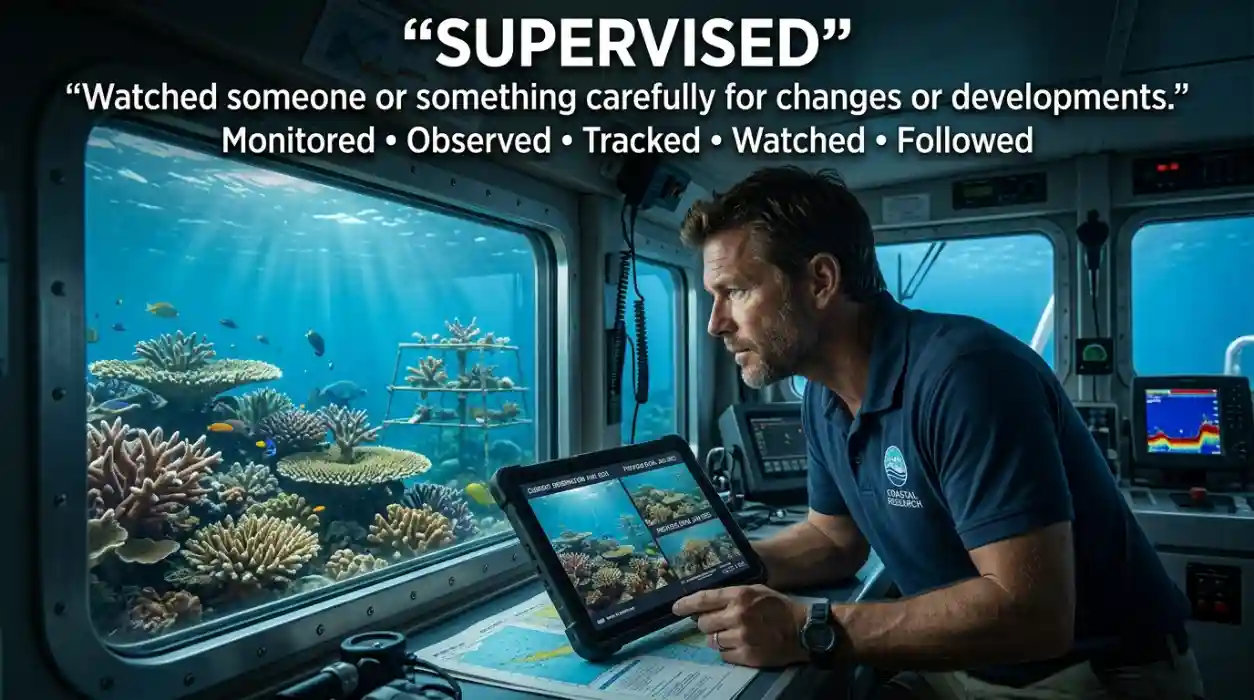
40. Kept under observation (phrase) — US /kept ˈʌn.dɚ ˌɑːb.zɚˈveɪ.ʃən/ | UK /kept ˈʌn.də ˌɒb.zəˈveɪ.ʃən/
Meaning: Watched someone or something carefully for changes or developments.
Tone/Register: Formal, medical, technical.
Examples:
The nurse kept the patient under observation overnight.
The technician kept the machine under observation during testing.
::
41. Supervised directly (phrase) — US /ˈsuː.pɚ.vaɪzd dəˈrekt.li/ | UK /ˈsuː.pə.vaɪzd daɪˈrekt.li/
Meaning: Watched or directed personally rather than through another person.
Tone/Register: Professional, formal.
Examples:
The surgeon supervised the procedure directly.
The instructor supervised the training directly.
42. Supervised closely (phrase) — US /ˈsuː.pɚ.vaɪzd ˈkloʊs.li/ | UK /ˈsuː.pə.vaɪzd ˈkləʊs.li/
Meaning: Watched with frequent attention and detailed oversight.
Tone/Register: Neutral, professional.
Examples:
The lifeguards supervised the children closely near the water.
The trainers supervised the new employees closely during training.
43. Regarded and monitored (phrase) — US /rɪˈɡɑːr.dɪd ænd ˈmɑː.nə.tɚd/ | UK /rɪˈɡɑː.dɪd ənd ˈmɒn.ɪ.təd/
Meaning: Treated as a responsibility while being followed carefully for progress or change.
Tone/Register: Formal.
Examples:
The project manager monitored the project throughout its development.
The research team reviewed its results at every stage.
44. Policed (verb) — US /pəˈliːst/ | UK /pəˈliːst/
Meaning: Enforced rules by watching behavior and taking action when rules were broken.
Tone/Register: Formal, sometimes negative.
Examples:
The rules were strictly policed during the event.
The organization policed access to restricted areas.
45. Regarded under oversight (phrase) — US /ˈoʊ.vɚ.saɪt/ | UK /ˈəʊ.və.saɪt/
Meaning: Managed while being subject to formal review or accountability.
Tone/Register: Formal, institutional.
Examples:
The program operated under board oversight.
The research remained under institutional oversight.
46. Accounted for (phrase) — US /əˈkaʊn.tɪd fɔːr/ | UK /əˈkaʊn.tɪd fɔː/
Meaning: Kept track of people or items so their location or status remained known.
Tone/Register: Neutral, practical.
Examples:
The supervisor accounted for all students after the drill.
The supervisor checked that every worker was accounted for.
47. Kept under control (phrase) — US /kept ˈʌn.dɚ kənˈtroʊl/ | UK /kept ˈʌn.də kənˈtrəʊl/
Meaning: Managed so that behavior or activity stayed within acceptable limits.
Tone/Register: Neutral to negative.
Examples:
Security staff kept the crowd under control.
Security staff kept the situation under control throughout the event.t.
48. Directed and monitored (phrase) — US /dəˈrek.tɪd ænd ˈmɑː.nə.tɚd/ | UK /daɪˈrek.tɪd ənd ˈmɒn.ɪ.təd/
Meaning: Given instructions while being checked for progress and compliance.
Tone/Register: Formal, professional.
Examples:
The project manager directed and monitored the work.
The project manager directed and monitored the process throughout the trial.
49. Observed under supervision (phrase) — US /əbˈzɝːvd ˈʌn.dɚ ˌsuː.pɚˈvɪʒ.ən/ | UK /əbˈzɜːvd ˈʌn.də ˌsuː.pəˈvɪʒ.ən/
Meaning: Watched while operating within a formal supervisory arrangement.
Tone/Register: Academic, professional.
Examples:
The trainee performed the procedure under supervision.
The students were observed under supervision during the practical session.
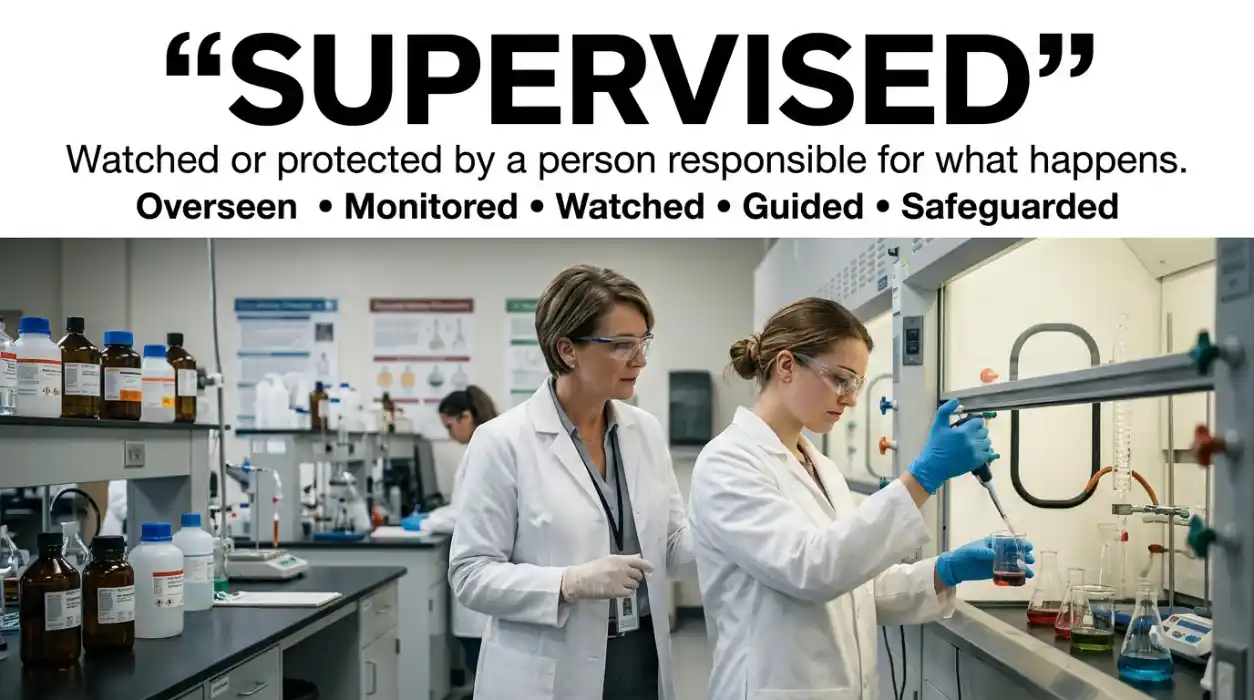
50. Under the watch of (phrase) — US /ˈʌn.dɚ ðə wɑːtʃ əv/ | UK /ˈʌn.də ðə wɒtʃ əv/
Meaning: Watched or protected by a person responsible for what happens.
Tone/Register: Literary, conversational, context-dependent.
Examples:
The children played under the watch of their teacher.
The new staff worked under the watch of an experienced manager.
Usage note: Several entries above are context-based equivalents rather than perfect dictionary synonyms. For example, mentored, coached, and supported emphasize development, while monitored, inspected, and scrutinized emphasize observation or checking. This distinction is important for accurate English.
Synonyms by Tone
Positive
Use guided, mentored, coached, supported, assisted, cared for, and looked after when you want to emphasize help or protection.
These choices work especially well in education, training, childcare, and personal development.
Neutral
Use monitored, observed, overseen, checked, reviewed, tracked, watched, and coordinated when you simply need to describe oversight.
These are useful in reports, articles, workplace communication, and everyday conversation.
Negative or Strict
Use controlled, policed, scrutinized, kept under control, or managed closely when the context involves strong authority, strict checking, or limited independence.
These words can change the emotional feel of a sentence.
Formal
Use superintended, administered, regulated, assessed, evaluated, inspected, and under oversight in academic, institutional, legal, or professional writing.
Informal
Use watched, kept an eye on, watched over, and looked after in ordinary conversation.
Why Tone Matters
Consider these sentences:
“The students were guided by a teacher.”
This sounds supportive.
“The students were controlled by a teacher.”
This sounds restrictive.
Both describe authority, but their connotations are very different.
“Supervised” vs. Close Alternatives
Monitored vs. Supervised
Supervised usually includes responsibility and authority.
Monitored focuses more on observation and tracking.
Use supervised for people, teams, tasks, and activities when someone is responsible for proper performance. Use monitored when the emphasis is on watching progress or changes.
Supervised vs. Overseen
These are very close.
Overseen often sounds more formal and emphasizes responsibility for a project, operation, or process.
Supervised is broader and is very common for people, employees, students, and activities.
Supervised vs. Managed
Managed suggests active responsibility for people, resources, or operations.
Supervised can involve less direct control.
A manager may supervise employees, but someone can supervise a task without managing an entire department.
How “Supervised” Changes by Context
Daily Conversation
In everyday English, watched, looked after, and kept an eye on often sound more natural.
“Can you keep an eye on my son?”
This is more conversational than:
“Can you supervise my son?”
The second sentence sounds more formal or institutional.
Writing and Blogging
Bloggers often use monitored, guided, overseen, reviewed, or checked to avoid repeating supervised.
For example:
“The campaign was supervised by the editor.”
can become:
“The campaign was overseen by the editor.”
The second version may sound more polished in an article.
Professional or Academic English
Professional writing often favors overseen, monitored, regulated, assessed, evaluated, and administered.
These words allow writers to describe exactly what kind of oversight took place.
Creative or Informal English
Creative writing may use watched over, kept an eye on, or under the watch of.
These phrases can create a more personal or visual feeling.
Common Mistakes Learners Make
Mistake 1: Treating every synonym as interchangeable
Not every alternative works in every sentence.
For example, a teacher can supervise students, but “the teacher administered the students” is incorrect. Administer normally applies to a process, system, program, test, or treatment.
Mistake 2: Using “controlled” when you mean “helped”
“Controlled” can imply restriction.
If your meaning is supportive, guided, coached, or mentored may be better.
Mistake 3: Using “monitored” when responsibility matters
Someone may monitor a situation without being responsible for directing it.
If responsibility is central, supervised or oversaw may be more precise.
Mistake 4: Confusing “observed” with “supervised”
An observer watches.
A supervisor watches and may have responsibility for the activity.
Mistake 5: Overusing “supervised”
Repeating the same word can make an essay sound mechanical.
Instead, first identify the intended meaning: observation, authority, guidance, safety, evaluation, or management.
Native Usage Tip
Native speakers commonly choose the synonym that describes the specific action, not simply the nearest dictionary match.
If someone leads a project, say oversaw.
If someone teaches and supports a learner, say guided or mentored.
For one useful internal resource, consider creating a related article about synonyms for monitored and linking it naturally from this topic.
Real-Life Mini Scenarios
Workplace
A department head supervises employees by checking performance, answering questions, and ensuring standards are followed.
In a more specific sentence, the manager oversees the project while team leaders monitor daily progress.
Social Situations
A parent may look after children at home.
A teacher may supervise them during a school activity.
A lifeguard may watch over swimmers at a pool.
Media and Pop Culture
A film director may oversee production.
A coach may train or coach performers preparing for a demanding role.
A producer may coordinate several departments.
Writing and Storytelling
A novelist might write:
“Under the watch of her mentor, Maya completed the difficult experiment.”
This sounds more vivid than repeatedly writing “Maya was supervised.”
Quick Guide: Which Word Should You Choose?
- Monitored → watched progress
- Overseen → held responsibility for a project
- Managed → directed people or resources
- Guided → provided helpful direction
- Observed → watched carefully
- Controlled → restricted or regulated
- Regulated → enforced rules or standards
- Inspected → examined condition or compliance
- Reviewed → examined work or information
- Assessed → judged performance or progress
- Mentored → developed someone’s skills
- Coached → trained someone toward better performance
- Supported → provided help or encouragement
- Looked after → cared for someone
- Kept an eye on → casually watched something
Practice Quiz
1. The teacher ______ the children during the laboratory experiment.
A. supervised
B. decorated
C. published
D. translated
2. The manager ______ the entire construction project.
A. oversaw
B. painted
C. borrowed
D. memorized
3. The doctor ______ the patient’s condition throughout the night.
A. monitored
B. coached
C. directed
D. administered
4. The mentor ______ the new employee during her first month.
A. guided
B. regulated
C. policed
D. inspected
5. The safety officer ______ the equipment before workers used it.
A. inspected
B. mentored
C. supported
D. coached
6. The university ______ the examination to hundreds of students.
A. administered
B. watched over
C. followed
D. guarded
7. The trainer ______ the athletes before the competition.
A. coached
B. regulated
C. reviewed
D. observed
8. Which word sounds most restrictive?
A. guided
B. supported
C. controlled
D. mentored
9. Which phrase is most natural in casual conversation?
A. kept an eye on
B. superintended
C. administered
D. regulated
10. A researcher carefully watches participants and records changes. Which word fits best?
A. monitored
B. looked after
C. managed
D. coached
Answer key: 1-A | 2-A | 3-A | 4-A | 5-A | 6-A | 7-A | 8-C | 9-A | 10-A
Reflection Task
Write one sentence about school, work, family, or daily life using a synonym for supervised. Then replace that synonym with a second alternative and notice how the tone changes.
External Reference Sources
For dictionary-based verification of meaning and pronunciation, Cambridge Dictionary is a useful reference. Its entry identifies manage, oversee, and superintend among related terms and provides US and UK pronunciation information.
For word history, Etymonline traces supervise to Medieval Latin supervidere, from super “over” and videre “to see.”
Cambridge Dictionary — supervise
Etymonline — supervise etymology
Conclusion
Learning synonyms for supervised helps you describe observation, leadership, guidance, safety, and authority with greater precision. The right word makes your meaning clearer.
Students can use these alternatives in essays, while bloggers and writers can avoid repetitive wording. Daily English users can also sound more natural.
Remember that synonyms carry different tones. “Guided” feels supportive, “monitored” feels neutral, and “controlled” can feel restrictive.
Start practicing today. Use one new synonym in an email, essay, or conversation, then try another. Small vocabulary choices can build stronger English.
Frequently Asked Questions
1. What is the best synonym for supervised in academic writing?
Overseen, monitored, assessed, evaluated, and guided can work well in academic writing, but they express different ideas. Monitored emphasizes observation, assessed emphasizes judgment, and guided emphasizes support or instruction. Use overseen when someone has formal responsibility for a research project or academic activity.
2. What is a professional synonym for supervised?
Overseen is one of the strongest professional alternatives when someone has responsibility for a project, operation, or department. Monitored, managed, administered, and regulated can also work depending on the situation. The best choice depends on whether the original sentence focuses on responsibility, observation, management, or rule enforcement.
3. What is the difference between supervised and monitored?
Supervised usually suggests responsibility for making sure people or activities are handled correctly. Monitored focuses more on watching, tracking, or checking progress. A supervisor may monitor employees, but someone can monitor a process without having authority over the people involved.
4. What is a positive synonym for supervised?
Guided, mentored, coached, supported, and assisted often have more positive connotations. They emphasize help, learning, development, or encouragement. For example, “The trainee was mentored by an experienced employee” sounds more supportive than “The trainee was controlled by an employee.”
5. What is a synonym for supervised when talking about children?
The best choice depends on the situation. Watched, looked after, cared for, watched over, and supervised are common. Looked after emphasizes care, while supervised emphasizes responsibility and safety. In casual conversation, “Can you keep an eye on the children?” sounds especially natural.

Shahzeena Shazadi is the founder and lead writer at VocablyHub.com, where she creates accurate, reader-focused English language content designed to help people communicate with clarity and confidence. She specializes in synonyms, antonyms, word meanings, idioms, and practical vocabulary guides that simplify complex language concepts for everyday use. Every article is carefully researched, fact-checked, and written in clear, accessible language using reliable references and real-world examples. Her goal is to provide helpful, trustworthy content that supports learners at every stage of their English language journey.
Her editorial approach focuses on accuracy, transparency, and user value while following modern content quality standards. She regularly reviews and updates content to keep information relevant, useful, and easy to understand. Through VocablyHub.com, Shahzeena Shazadi is committed to publishing reliable language resources that help students, writers, educators, professionals, and English learners expand their vocabulary, improve their writing skills, and communicate with confidence in academic, professional, and everyday situations.