
Synonyms for supernatural include paranormal, mystical, magical, occult, otherworldly, preternatural, and unnatural. The best alternative depends on whether you mean mysterious forces, magic, spirits, religion, or something beyond ordinary experience.
Synonyms for supernatural can make a story more vivid. Imagine a dark hallway where a strange light appears with no clear source. A writer might call it paranormal, mystical, or otherworldly.
The word supernatural is common in fiction, religion, folklore, film, literature, and everyday discussions of unexplained events. Its exact meaning changes with context.
Learning synonyms for supernatural helps students, bloggers, content writers, and daily English users describe mysterious ideas with greater accuracy instead of repeating one word.
What Does “Supernatural” Really Mean?
Supernatural describes something believed to exist or happen beyond the ordinary laws of nature or beyond what science can explain.
Cambridge defines supernatural as something caused by forces that cannot be explained by science. It can also function as a noun in the supernatural, meaning unexplained forces or events.
Oxford similarly connects the word with things that cannot be explained by scientific laws and that appear to involve gods or magic.
Simple definition
Supernatural: beyond the ordinary natural world, especially involving forces, beings, or events that are not explained by known natural laws.
Part of speech
Supernatural is primarily an adjective.
It can describe:
- supernatural powers
- supernatural beings
- supernatural events
- supernatural forces
- supernatural abilities
- supernatural experiences
- supernatural stories
It can also function as a noun when used as the supernatural.
The film contains several supernatural elements.
She enjoys stories about the supernatural.
How native speakers understand “supernatural”
Native speakers generally associate supernatural with things such as ghosts, spirits, miracles, magic, psychic abilities, mysterious forces, and beings beyond ordinary human experience.
However, the word does not necessarily state that such things are objectively real.
It can simply describe a belief, story, claim, or fictional element.
The novel has a supernatural setting.
This sentence describes the type of story. It does not establish that supernatural forces actually exist.
Common contexts
You will commonly see supernatural in:
- Horror
- Fantasy
- Science fiction
- Folklore
- Religion
- Mythology
- Literature
- Film and television
- Paranormal discussions
- Cultural studies
- Everyday conversations
Connotative Meaning of “Supernatural”
Connotation (the emotional or cultural feeling associated with a word beyond its basic dictionary meaning) is especially important here.
Positive tone
In some contexts, supernatural can sound fascinating, powerful, mysterious, or awe-inspiring.
The story describes a supernatural gift that protects the village.
Here, the word has a sense of wonder.
Negative tone
In horror or frightening contexts, it can suggest danger, fear, evil, or something threatening.
The family believed a supernatural presence had entered the house.
The surrounding context creates the negative feeling.
Neutral tone
The word can also be completely descriptive.
The documentary examines supernatural beliefs across cultures.
There is no clear positive or negative judgment in that sentence.
Etymology
The history of supernatural reaches back to Latin.
Etymonline traces the adjective to the early 15th century, from Medieval Latin supernaturalis, meaning “above or beyond nature” and “divine.” It combines Latin super, meaning “above,” with natura, meaning “nature.”
The term also appears in Middle English in forms such as supernatural and supernaturel, ultimately coming through Middle French from Latin.
Old English: 450–1100
The modern English word supernatural was not an ordinary Old English word.
However, its components have much older roots.
The Latin natura developed from a root connected with birth and natural condition. English already had native vocabulary for ideas of nature and the natural world, but the later compound supernatural entered English much later.
Middle English: 1100–1500
This is the key period for the English history of the supernatural.
Forms derived from French and Latin entered Middle English. The early meaning was strongly associated with the divine or with something beyond ordinary nature.
Modern English: 1500–Present
The meaning broadened over time.
The word continued to be used for divine or religious phenomena. From the 19th century onward, its association with ghosts and related phenomena became especially prominent.
Today, supernatural can describe religious miracles, ghost stories, magical fiction, paranormal claims, and other phenomena presented as beyond ordinary natural explanation.
Pronunciation
US: /ˌsuːpɚˈnætʃɚəl/
UK: /ˌsuːpəˈnætʃərəl/
Cambridge lists these British and American pronunciations separately.
Syllables
su-per-nat-u-ral
The word is commonly pronounced with four or five syllabic divisions depending on the pronunciation system used.
Affixation Pattern of “Supernatural”
Root: natural
Prefix: super-
Suffix: -al
The structure is approximately:
super + nature + -al
The prefix super- means above, beyond, or more than ordinary in this formation.
Synonyms List
Not every word below is a perfect interchangeable synonym.
Some describe a very specific kind of supernatural phenomenon. Others are near-synonyms that work naturally in particular contexts.
That distinction matters because paranormal, magical, divine, and uncanny do not carry the same meaning.
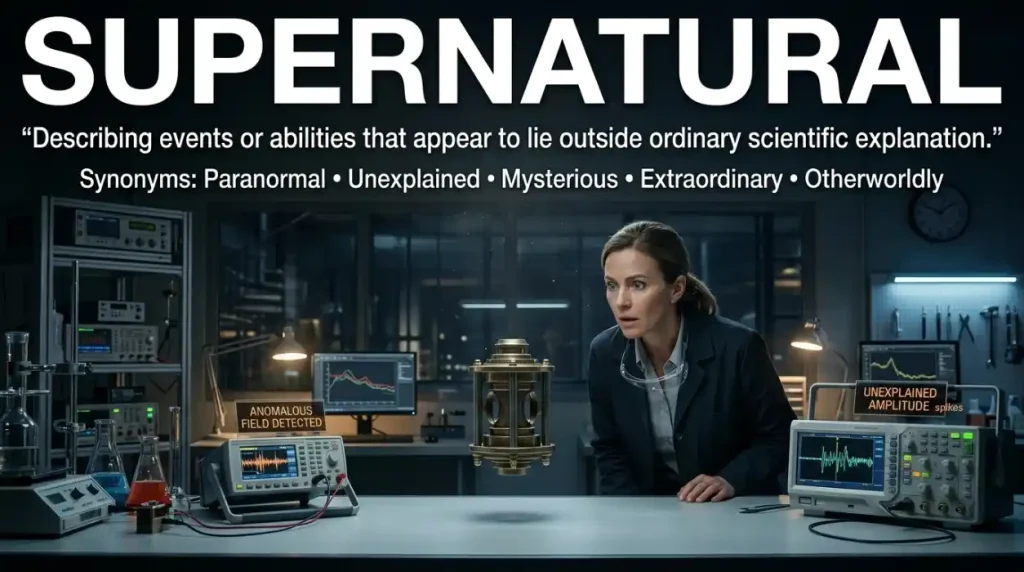
1. Paranormal (Adjective) — US / UK: /ˌpærəˈnɔːrməl/
Meaning: Relating to events or abilities that appear to lie outside ordinary scientific explanation.
Tone/Register: Neutral, popular, academic.
Examples:
The podcast investigates alleged paranormal activity.
She became interested in paranormal experiences after the incident.
2. Mystical (Adjective) — US / UK: /ˈmɪstɪkəl/
Meaning: Connected with mystery, spiritual experience, or realities believed to lie beyond ordinary understanding.
Tone/Register: Literary, spiritual.
Examples:
The mountain has a mystical atmosphere.
The poem uses mystical imagery throughout.
3. Magical (Adjective) — US / UK: /ˈmædʒɪkəl/
Meaning: Relating to magic or producing an extraordinary effect that resembles magic.
Tone/Register: Neutral, literary, informal.
Examples:
The children discovered a magical forest.
The performance created a magical feeling in the theater.
4. Occult (Adjective) — US / UK: /əˈkʌlt/
Meaning: Relating to hidden supernatural forces, magic, or practices associated with mysterious powers.
Tone/Register: Formal, esoteric.
Examples:
The book explores occult traditions.
The story contains several occult symbols.
5. Otherworldly (Adjective) — US / UK: /ˌʌðərˈwɜːrldli/
Meaning: Seeming to belong to another world rather than ordinary human reality.
Tone/Register: Literary, descriptive.
Examples:
The singer’s voice had an otherworldly quality.
The landscape looked strangely otherworldly at night.
6. Preternatural (Adjective) — US / UK: /ˌpriːtərˈnætʃərəl/
Meaning: Beyond what is normally expected in nature without necessarily implying a religious or magical cause.
Tone/Register: Formal, literary.
Examples:
She displayed preternatural calm during the crisis.
His preternatural speed amazed the audience.
7. Unnatural (Adjective) — US / UK: /ʌnˈnætʃərəl/
Meaning: Contrary to what is considered natural or normal.
Tone/Register: Neutral, literary.
Examples:
The forest was silent in an unnatural way.
Something about the creature’s movement seemed unnatural.
8. Unexplained (Adjective) — US / UK: /ˌʌnɪkˈspleɪnd/
Meaning: Not currently explained or understood.
Tone/Register: Neutral, scientific.
Examples:
The investigators recorded several unexplained sounds.
An unexplained light appeared over the valley.
9. Mysterious (Adjective) — US / UK: /mɪˈstɪəriəs/
Meaning: Difficult to understand, explain, or identify.
Tone/Register: Neutral, literary.
Examples:
A mysterious figure appeared at the door.
The case remains mysterious.
10. Enigmatic (Adjective) — US / UK: /ˌenɪɡˈmætɪk/
Meaning: Difficult to interpret or understand because its meaning or nature is unclear.
Tone/Register: Formal, literary.
Examples:
The painting has an enigmatic quality.
An enigmatic stranger arrives in the opening scene.
11. Uncanny (Adjective) — US / UK: /ʌnˈkæni/
Meaning: Strange in a way that feels unsettling or eerily familiar.
Tone/Register: Literary, sophisticated.
Examples:
The empty house had an uncanny atmosphere.
Her uncanny ability to predict events surprised everyone.
12. Eerie (Adjective) — US / UK: /ˈɪəri/
Meaning: Strange and frightening in a quiet or unsettling way.
Tone/Register: Informal, literary.
Examples:
An eerie sound came from upstairs.
The abandoned hotel looked eerie after dark.
13. Haunting (Adjective) — US / UK: /ˈhɔːntɪŋ/
Meaning: Creating a powerful feeling of mystery, sadness, fear, or lingering presence.
Tone/Register: Literary, emotional.
Examples:
The film has a haunting atmosphere.
A haunting melody played in the background.
14. Spectral (Adjective) — US / UK: /ˈspektrəl/
Meaning: Relating to or resembling a ghost or apparition.
Tone/Register: Literary, formal.
Examples:
A spectral figure appeared in the painting.
The castle was surrounded by spectral mist.
15. Ghostly (Adjective) — US / UK: /ˈɡoʊstli/
Meaning: Resembling or associated with ghosts.
Tone/Register: Neutral, informal.
Examples:
A ghostly shape moved across the window.
The room had a ghostly blue glow.
16. Phantasmal (Adjective) — US / UK: /fænˈtæzməl/
Meaning: Resembling an apparition or something existing only as an illusion or vision.
Tone/Register: Literary.
Examples:
A phantasmal figure appeared in the fog.
The painting creates a phantasmal effect.
17. Apparitional (Adjective) — US / UK: /ˌæpəˈrɪʃənəl/
Meaning: Relating to an apparition or ghostly appearance.
Tone/Register: Formal, literary.
Examples:
The story includes an apparitional visitor.
The witness described an apparitional figure.
18. Spiritual (Adjective) — US / UK: /ˈspɪrɪtʃuəl/
Meaning: Relating to the spirit, religious belief, or non-material aspects of human experience.
Tone/Register: Neutral, religious.
Examples:
The ceremony had deep spiritual meaning.
She described the experience as spiritual rather than frightening.
19. Divine (Adjective) — US / UK: /dɪˈvaɪn/
Meaning: Associated with God or a deity.
Tone/Register: Religious, formal.
Examples:
The tradition describes a divine intervention.
The character believes the message came from a divine source.
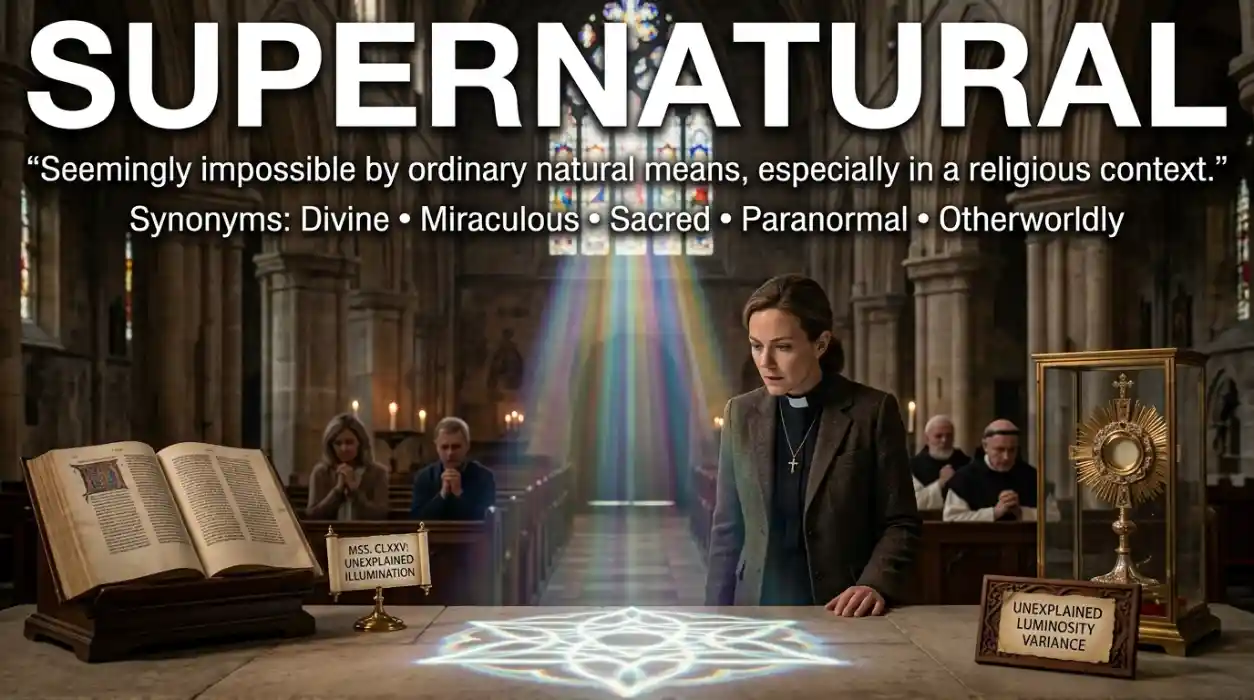
20. Miraculous (Adjective) — US / UK: /mɪˈrækjələs/
Meaning: Seemingly impossible by ordinary natural means, especially in a religious context.
Tone/Register: Religious, literary.
Examples:
The story describes a miraculous recovery.
The villagers regarded the event as miraculous.
21. Mythical (Adjective) — US / UK: /ˈmɪθɪkəl/
Meaning: Related to traditional myths or legendary beings and events.
Tone/Register: Literary, cultural.
Examples:
The story features mythical creatures.
A mythical kingdom appears in the final chapter.
22. Mythological (Adjective) — US / UK: /ˌmɪθəˈlɑːdʒɪkəl/
Meaning: Connected with myths, legendary traditions, or mythic figures.
Tone/Register: Academic, literary.
Examples:
The painting contains mythological figures.
The film borrows from Greek mythological traditions.
23. Legendary (Adjective) — US / UK: /ˈledʒənderi/
Meaning: Connected with stories or figures that have become famous through tradition or storytelling.
Tone/Register: Neutral, literary.
Examples:
The hero became a legendary figure.
The village is associated with a legendary creature.
24. Fantastic (Adjective) — US / UK: /fænˈtæstɪk/
Meaning: Imaginative or seemingly impossible rather than realistic.
Tone/Register: Literary, everyday.
Examples:
The novel contains fantastic creatures.
The story takes place in a fantastic world.
25. Fantastical (Adjective) — US / UK: /fænˈtæstɪkəl/
Meaning: Characterized by imaginative, extraordinary, or impossible elements.
Tone/Register: Literary.
Examples:
The film creates a fantastical world.
Her illustrations are wonderfully fantastical.
26. Enchanted (Adjective) — US / UK: /ɪnˈtʃæntɪd/
Meaning: Affected by magic or presented as possessing magical qualities.
Tone/Register: Literary, fairy-tale.
Examples:
They entered an enchanted forest.
The castle looked enchanted beneath the moonlight.
27. Bewitched (Adjective) — US / UK: /bɪˈwɪtʃt/
Meaning: Affected by a spell or magic.
Tone/Register: Literary, traditional.
Examples:
The villagers believed the house was bewitched.
The princess appeared to be under a bewitched spell.
28. Spellbound (Adjective) — US / UK: /ˈspelbaʊnd/
Meaning: Completely fascinated, as if controlled by magic.
Tone/Register: Literary, figurative.
Examples:
The audience sat spellbound.
The child watched the magician spellbound.
29. Sorcerous (Adjective) — US / UK: /ˈsɔːrsərəs/
Meaning: Relating to sorcery or the use of magical powers.
Tone/Register: Literary, fantasy.
Examples:
The novel features a sorcerous villain.
A sorcerous force protects the ancient temple.
30. Occultic (Adjective) — US / UK: /əˈkʌltɪk/
Meaning: Relating to occult beliefs, practices, or hidden supernatural forces.
Tone/Register: Specialized, formal.
Examples:
The museum displayed books on occultic traditions.
The character studies occultic symbols.
31. Esoteric (Adjective) — US / UK: /ˌesəˈterɪk/
Meaning: Intended for or understood by a small group with specialized knowledge.
Tone/Register: Formal, academic.
Examples:
The manuscript contains esoteric symbols.
The discussion became highly esoteric.
32. Arcane (Adjective) — US / UK: /ɑːrˈkeɪn/
Meaning: Mysterious or understood by only a small number of people.
Tone/Register: Formal, literary.
Examples:
The story describes an arcane ritual.
He discovered an arcane tradition in the old text.
33. Unworldly (Adjective) — US / UK: /ʌnˈwɜːrldli/
Meaning: Seeming detached from ordinary earthly experience.
Tone/Register: Literary.
Examples:
Her voice had an unworldly quality.
The scene felt strangely unworldly.
34. Transcendent (Adjective) — US / UK: /trænˈsendənt/
Meaning: Going beyond ordinary physical or human experience.
Tone/Register: Formal, philosophical, spiritual.
Examples:
The poem searches for a transcendent experience.
He described the music as transcendent.
35. Transnatural (Adjective) — US / UK: /trænzˈnætʃərəl/
Meaning: Existing beyond or outside ordinary natural processes.
Tone/Register: Rare, academic.
Examples:
The author describes a transnatural realm.
The concept belongs to a transnatural mythology.
36. Supernormal (Adjective) — US / UK: /ˌsuːpərˈnɔːrməl/
Meaning: Beyond what is normally expected or observed.
Tone/Register: Technical, specialized.
Examples:
The researchers investigated claims of supernormal abilities.
The character possesses supernormal strength.
37. Preternatural-like (Adjective Phrase) — US / UK: /ˌpriːtərˈnætʃərəl/
Meaning: Describing something unusually extraordinary in a way that appears beyond normal human ability.
Tone/Register: Literary.
Examples:
She displayed preternatural-like focus during the competition.
His preternatural-like memory became part of the story.
38. Occurrence-beyond-nature (Noun Phrase) — US / UK: /əˈkɜːrəns/
Meaning: An event presented as occurring outside ordinary natural explanation.
Tone/Register: Explanatory, academic.
Examples:
The documentary examines occurrences beyond nature.
Witnesses described the event as an occurrence beyond nature.
39. Otherworldly (Noun/Adjective Use) — US / UK: /ˌʌðərˈwɜːrldli/
Meaning: Something associated with a realm or experience outside ordinary earthly life.
Tone/Register: Literary.
Examples:
The author creates an otherworldly realm.
The character hears an otherworldly voice.
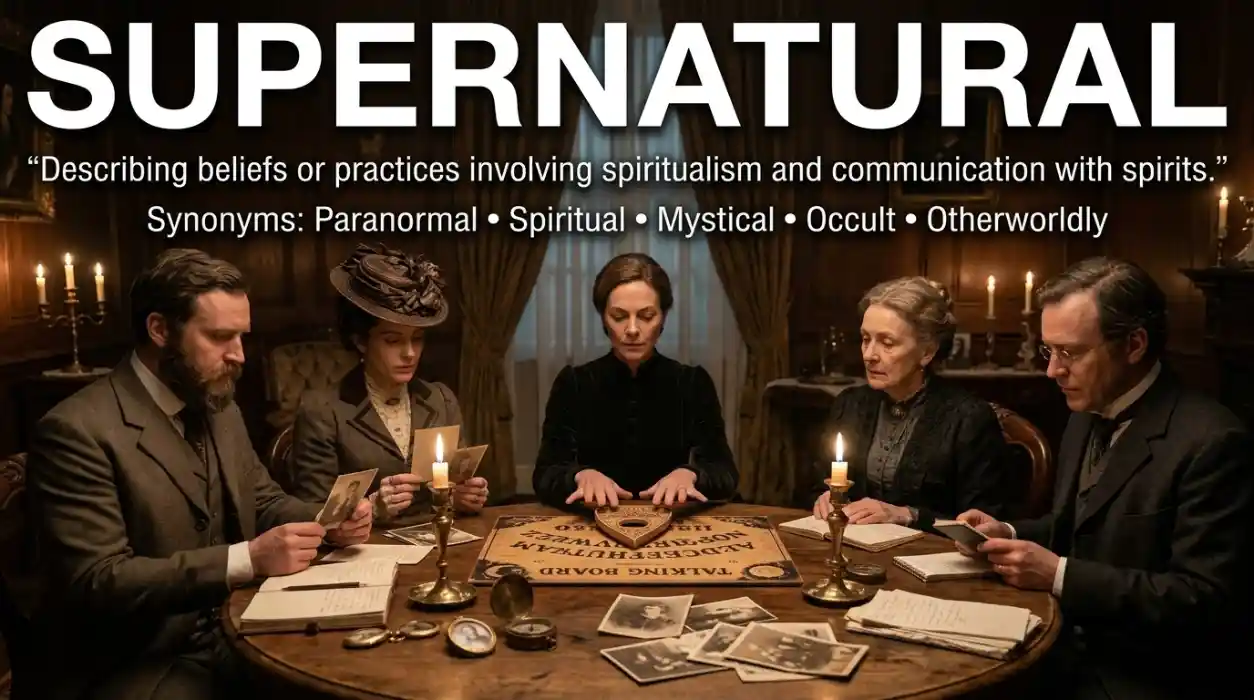
40. Spiritualistic (Adjective) — US / UK: /ˌspɪrɪtʃuəˈlɪstɪk/
Meaning: Relating to spiritualism or beliefs involving communication with spirits.
Tone/Register: Religious, specialized.
Examples:
The novel explores spiritualistic practices.
The séance scene has a spiritualistic tone.
41. Ghostlike (Adjective) — US / UK: /ˈɡoʊstlaɪk/
Meaning: Resembling a ghost in appearance, movement, or atmosphere.
Tone/Register: Informal, descriptive.
Examples:
A ghostlike figure crossed the garden.
The mist gave the trees a ghostlike appearance.
42. Spectral (Adjective) — US / UK: /ˈspektrəl/
Meaning: Suggesting a ghost or an apparition.
Tone/Register: Literary.
Examples:
A spectral glow filled the room.
The author describes a spectral visitor.
43. Mystical (Adjective) — US / UK: /ˈmɪstɪkəl/
Meaning: Associated with spiritual mystery or a reality beyond ordinary understanding.
Tone/Register: Spiritual, literary.
Examples:
The temple has a mystical atmosphere.
The poem presents nature as a mystical force.
44. Magical (Adjective) — US / UK: /ˈmædʒɪkəl/
Meaning: Involving magic or producing an extraordinary, enchanting effect.
Tone/Register: Everyday, literary.
Examples:
The story follows a magical creature.
The children imagined the garden as magical.
45. Mythic (Adjective) — US / UK: /ˈmɪθɪk/
Meaning: Having the qualities of myth, legend, or an archetypal story.
Tone/Register: Literary, academic.
Examples:
The hero has a mythic quality.
The film uses a mythic structure.
46. Fabled (Adjective) — US / UK: /ˈfeɪbəld/
Meaning: Famous through traditional stories, legends, or imaginative accounts.
Tone/Register: Literary.
Examples:
They searched for the fabled creature.
The book describes a fabled kingdom.
47. Superhuman (Adjective) — US / UK: /ˌsuːpərˈhjuːmən/
Meaning: Possessing abilities beyond normal human limits.
Tone/Register: Neutral, popular culture.
Examples:
The superhero has superhuman strength.
She showed almost superhuman endurance.
48. Extraordinary (Adjective) — US / UK: /ɪkˈstrɔːrdəneri/
Meaning: Far beyond what is ordinary or expected.
Tone/Register: Neutral, everyday.
Examples:
The athlete displayed extraordinary strength.
The story describes an extraordinary event.
49. Marvelous (Adjective) — US / UK: /ˈmɑːrvələs/
Meaning: Extremely remarkable, wonderful, or astonishing.
Tone/Register: Literary, positive.
Examples:
The tale describes marvelous creatures.
The audience watched a marvelous transformation.
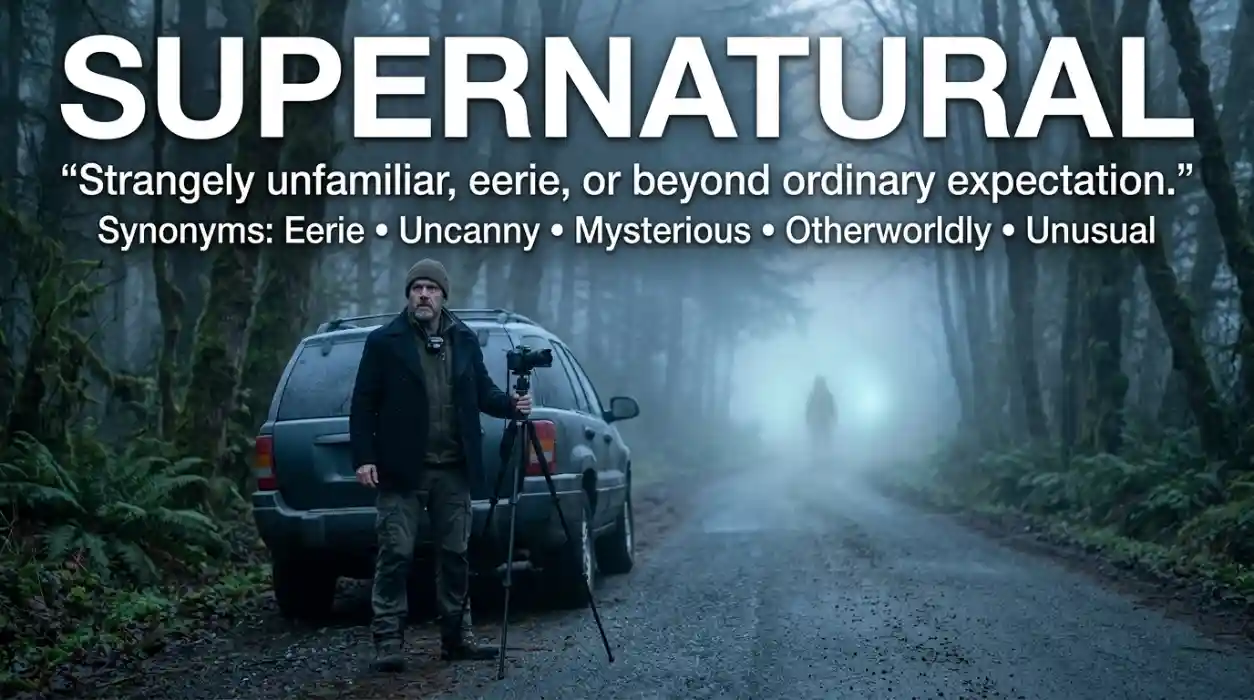
50. Uncanny-like (Adjective Phrase) — US / UK: /ʌnˈkæni/
Meaning: Describing something that feels strangely unfamiliar, eerie, or beyond ordinary expectation.
Tone/Register: Literary, descriptive.
Examples:
The painting has an uncanny atmosphere.
His imitation was uncanny in its accuracy.
Important usage note: A few entries above, such as transnatural, supernormal, and the descriptive phrases, are specialized or context-dependent rather than perfect dictionary replacements for supernatural. They should not be treated as interchangeable in every sentence.
Synonyms by Tone
Tone matters because two words can describe similar ideas while creating very different impressions.
Positive or Wonder-Focused
These choices can create fascination, beauty, or awe:
- Magical
- Mystical
- Enchanted
- Marvelous
- Transcendent
- Otherworldly
- Extraordinary
The garden had an almost magical quality.
This sounds inviting rather than frightening.
Neutral or Descriptive
These are useful when you want to describe unexplained phenomena without strongly judging them:
- Paranormal
- Supernatural
- Unexplained
- Mysterious
- Mythical
- Mythological
- Legendary
- Unnatural
These words work especially well in informational writing.
Negative or Unsettling
These words can create fear, discomfort, or uncertainty:
- Eerie
- Uncanny
- Haunting
- Ghostly
- Spectral
- Phantasmal
- Thwarting or threatening supernatural imagery
The emotional effect usually comes from context.
Formal or Specialized
Consider:
- Occult
- Preternatural
- Esoteric
- Arcane
- Transcendent
- Spiritualistic
- Supernormal
These words should be used when their specific meaning fits.
“Supernatural” vs Close Alternatives
Paranormal vs Supernatural
Supernatural is broader.
It can cover religious miracles, gods, spirits, magical beings, and phenomena considered beyond natural laws.
Paranormal often focuses on unusual events or abilities that appear to fall outside established scientific understanding.
The story contains supernatural creatures.
The investigators study paranormal activity.
The second sentence sounds more like an investigation into unexplained claims.
Supernatural vs Preternatural
These words are close but historically distinct.
Supernatural traditionally suggests something beyond or above nature.
Preternatural can describe something extraordinary or outside the ordinary course of nature without necessarily implying a divine or magical source.
The character possesses supernatural powers.
The athlete showed preternatural calm.
The second can simply mean extraordinarily unusual.
Supernatural vs Unnatural
Supernatural suggests something beyond ordinary natural explanation.
Unnatural usually means contrary to what is considered natural, normal, or expected.
The story features supernatural beings.
The creature moved in an unnatural way.
The second sentence does not necessarily imply ghosts or magic.
How “Supernatural” Changes by Context
Daily Conversation
In casual conversation, supernatural often appears when people discuss films, shows, strange experiences, ghosts, or unexplained events.
“That movie has a lot of supernatural elements.”
In everyday speech, weird, mysterious, strange, or paranormal may sound more conversational depending on the meaning.
Writing and Blogging
Bloggers often use supernatural in articles about:
- Horror stories
- Mythology
- Folklore
- Fantasy
- Paranormal claims
- Fictional characters
- Cultural beliefs
A good writer should distinguish between supernatural, paranormal, and mythological rather than treating them as identical.
Professional or Academic Tone
Academic writing often requires more precise terminology.
A researcher discussing cultural beliefs might use supernatural beliefs.
A researcher studying unexplained experiences might use paranormal experiences.
A scholar discussing ancient stories might choose mythological.
Precision makes the writing more credible.
Creative or Informal Use
Creative writing benefits from more vivid alternatives.
Instead of:
A supernatural forest appeared.
You could write:
An enchanted forest appeared.
Or:
An eerie forest emerged from the mist.
Each version creates a different atmosphere.
Common Mistakes Learners Make
Mistake 1: Treating “magical” as a perfect synonym
Magical often suggests literal magic, but it can also mean wonderfully impressive.
The wedding was magical.
This does not necessarily mean supernatural forces were present.
Mistake 2: Using “paranormal” for every religious miracle
A miracle may be described as supernatural or divine.
Calling every miracle “paranormal” can change the context because paranormal often carries an investigative or unexplained-phenomenon sense.
Mistake 3: Confusing “mysterious” with “supernatural”
Something can be mysterious without being supernatural.
A locked room with no obvious explanation is mysterious.
A ghost moving through the room is generally presented as supernatural.
Mistake 4: Assuming “mythical” means “supernatural”
A mythical creature may have supernatural qualities, but mythical primarily refers to its place in myth or legend.
Mistake 5: Using “unnatural” when you mean “supernatural”
These words have different implications.
Unnatural can mean abnormal, artificial, or contrary to ordinary expectations.
Supernatural points toward something beyond ordinary natural explanation.
Mistake 6: Overusing dramatic vocabulary
Words such as occult, arcane, spectral, and phantasmal can make ordinary writing sound theatrical.
Use them when the context genuinely calls for that tone.
Native Usage Notes
Native speakers commonly use supernatural with words such as:
- supernatural being
- supernatural force
- supernatural power
- supernatural event
- supernatural ability
- supernatural world
- supernatural element
- supernatural phenomenon
- supernatural experience
The noun phrase the supernatural is also common.
The story explores the supernatural.
This means the broader category of supernatural forces, events, beings, or experiences.
Register Notes
Everyday
- Strange
- Mysterious
- Magical
- Extraordinary
- Unexplained
Neutral
- Supernatural
- Paranormal
- Unnatural
- Mythical
- Otherworldly
Formal
- Preternatural
- Occult
- Transcendent
- Esoteric
- Arcane
Literary
- Eerie
- Haunting
- Spectral
- Phantasmal
- Enchanted
- Fabled
The most natural synonym depends on your audience.
Real-Life Mini Scenarios
Workplace
A writer preparing a film review might say:
“The series uses supernatural elements to create tension.”
For a neutral professional review, paranormal may be better if the story focuses specifically on unexplained phenomena.
Social Situation
A friend might say:
“That experience felt supernatural.”
Another person might describe the same experience as:
“That was really strange.”
The second version is more cautious and does not make a claim about its cause.
Media and Pop Culture
Entertainment writing frequently uses supernatural, paranormal, magical, and otherworldly terms.
A fantasy series may feature magical creatures.
A horror series may focus on supernatural entities.
A documentary may investigate alleged paranormal activity.
Writing and Storytelling
A novelist can use specific vocabulary to build atmosphere.
A supernatural figure entered the room.
This is direct.
A spectral figure entered the room.
This emphasizes a ghost-like appearance.
An otherworldly figure entered the room.
This emphasizes unfamiliarity and a sense of another realm.
Practice Quiz
1. The documentary investigates reports of ______ activity in the old building.
A. paranormal
B. ordinary
C. academic
D. practical
2. The children entered an ______ forest filled with talking animals.
A. enchanted
B. unfinished
C. technical
D. ordinary
3. The character can lift a car with ______ strength.
A. superhuman
B. mythical
C. academic
D. unfinished
4. The scientist described the observation as ______ because no explanation was available.
A. unexplained
B. divine
C. enchanted
D. legendary
5. The story contains ______ creatures from ancient Greek traditions.
A. mythological
B. professional
C. ordinary
D. technical
6. The abandoned house had an ______ atmosphere that made everyone uncomfortable.
A. eerie
B. magical
C. cheerful
D. ordinary
7. The religious text describes a ______ intervention.
A. divine
B. paranormal
C. ghostly
D. uncanny
8. The singer’s voice sounded almost ______, as if it came from another world.
A. otherworldly
B. unfinished
C. practical
D. routine
9. The author describes a secret ______ ritual involving ancient symbols.
A. occult
B. ordinary
C. academic
D. social
10. The athlete showed ______ calm during the dangerous situation.
A. preternatural
B. unfinished
C. mythical
D. haunted
Reflection Task
Write one sentence using supernatural, then rewrite it with a more precise alternative such as paranormal, mystical, magical, eerie, otherworldly, divine, or mythical. Notice how the tone changes.
Answer key: 1-A | 2-A | 3-A | 4-A | 5-A | 6-A | 7-A | 8-A | 9-A | 10-A
External references:
For authoritative definitions and pronunciation, consult Cambridge Dictionary — supernatural and Oxford Learner’s Dictionaries — supernatural. For word history, see Online Etymology Dictionary — supernatural.
Conclusion
Learning synonyms for supernatural helps you describe mystery with greater precision. A ghostly scene, magical world, and religious miracle do not necessarily need the same adjective.
The right word also changes atmosphere. “Magical” can feel warm, “eerie” can feel frightening, “mystical” can feel spiritual, and “paranormal” can sound investigative.
Students can use these distinctions in essays, while bloggers and content writers can create richer descriptions without repeating the same word. Daily speakers gain more precise ways to explain unusual experiences.
Practice these alternatives in short sentences, stories, emails, and conversations. Choose one new synonym today and notice how it changes the mood of your writing.
FAQs
1. What is the best synonym for supernatural in a horror story?
Paranormal, eerie, ghostly, spectral, and otherworldly can work well, depending on the scene. “Paranormal” emphasizes unexplained phenomena, while “ghostly” points specifically toward ghosts. “Eerie” describes the unsettling atmosphere rather than proving that a supernatural force exists.
2. What is a synonym for supernatural that sounds more academic?
Preternatural, paranormal, transcendent, mythological, and occult can sound more specialized, but they have different meanings. In academic writing, paranormal is useful for unexplained phenomena, while mythological is better for myths and traditional stories. Precision matters more than using a sophisticated word.
3. Is paranormal the same as supernatural?
The terms overlap, but they are not identical. Supernatural is a broad term for things presented as beyond ordinary natural explanation. Paranormal commonly refers to unusual phenomena that appear outside established scientific explanation, especially alleged psychic or unexplained experiences.
4. What is a positive synonym for supernatural?
If you want a positive or beautiful tone, try magical, mystical, enchanted, marvelous, transcendent, or otherworldly. For example, “The garden had a magical atmosphere” sounds warm and inviting. “The garden had a supernatural atmosphere” sounds more mysterious and potentially unsettling.
5. What is the difference between supernatural and magical?
Supernatural is broader and can include ghosts, divine beings, miracles, spirits, and unexplained forces. Magical specifically suggests magic or a spell-like quality. A story can contain supernatural elements without involving traditional magic, such as ghosts or divine intervention.

Shahzeena Shazadi is the founder and lead writer at VocablyHub.com, where she creates accurate, reader-focused English language content designed to help people communicate with clarity and confidence. She specializes in synonyms, antonyms, word meanings, idioms, and practical vocabulary guides that simplify complex language concepts for everyday use. Every article is carefully researched, fact-checked, and written in clear, accessible language using reliable references and real-world examples. Her goal is to provide helpful, trustworthy content that supports learners at every stage of their English language journey.
Her editorial approach focuses on accuracy, transparency, and user value while following modern content quality standards. She regularly reviews and updates content to keep information relevant, useful, and easy to understand. Through VocablyHub.com, Shahzeena Shazadi is committed to publishing reliable language resources that help students, writers, educators, professionals, and English learners expand their vocabulary, improve their writing skills, and communicate with confidence in academic, professional, and everyday situations.