
Synonyms for storming depend on its meaning. For severe weather, use raging, thundering, pouring, or raining heavily. For angry movement, use marching angrily, rushing, charging, or bursting in. In military contexts, assaulting, attacking, or invading may fit.
Imagine someone saying, “She stormed out of the room.” They mean she left suddenly and angrily.
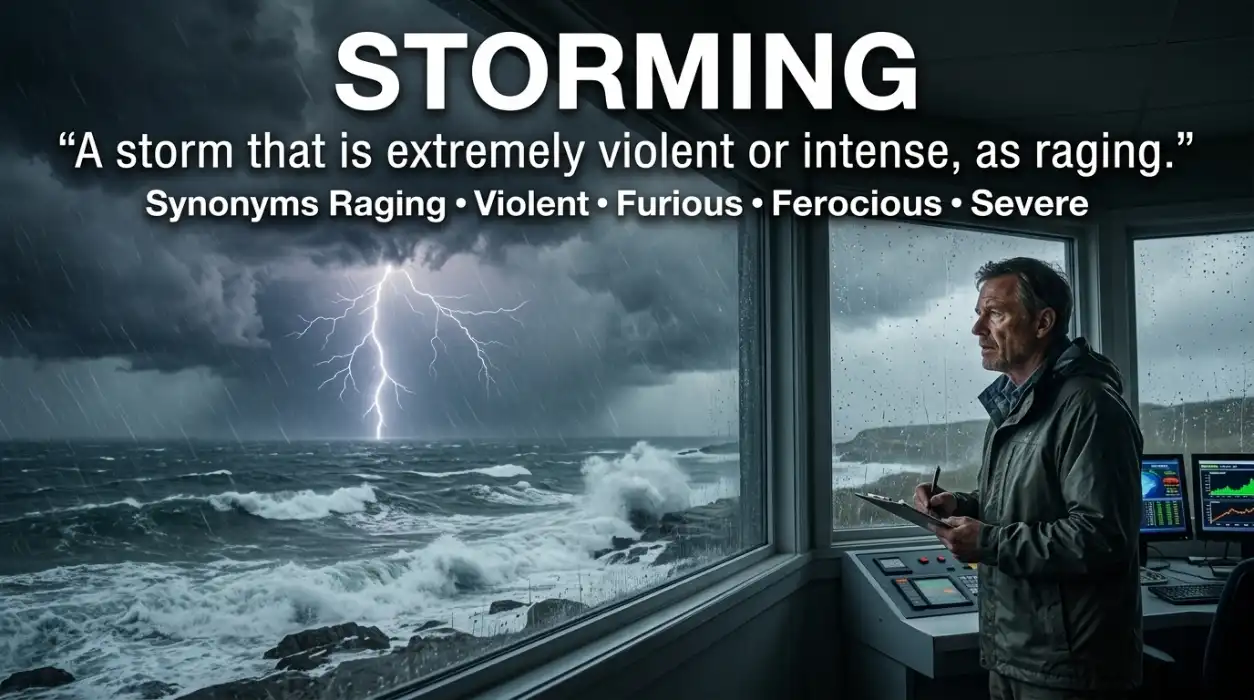
Now imagine, “It was storming all night.” Here, storming refers to severe weather.
This makes synonyms for storming especially interesting. The same form can describe weather, anger, forceful movement, or military action.
Learning the right alternative helps students write more accurately. Bloggers and content writers can also avoid repetition without changing the intended meaning.
For daily English users, knowing a synonym for storming makes it easier to describe a scene, emotion, argument, or weather event naturally.
What Does “Storming” Really Mean?
Storming is the -ing form of the verb “storm.” Its meaning changes according to context.
The most common meanings are:
- Experiencing a storm or severe weather.
- Moving somewhere suddenly and angrily.
- Entering or attacking a place with force.
- Speaking or behaving with intense anger.
For example:
“It was storming when we left.”
Here, storming describes severe weather.
Compare that with:
“He was storming down the hallway.”
This means he was moving quickly and angrily.
Another example is:
“The soldiers were storming the building.”
Here, the word refers to a forceful attack or entry.
Part of Speech
Storming is usually a present participle or gerund formed from the verb storm.
As a present participle:
“She is storming out of the office.”
As a gerund:
“Storming the building was considered too risky.”
The correct synonym depends heavily on which sense is intended.
Simple Definition
Storming means experiencing severe weather, moving or speaking with great anger, or entering and attacking a place forcefully, depending on context.
Emotional Tone of “Storming”
The word often carries strong energy.
When describing a person’s behavior, storming commonly suggests anger, frustration, impatience, or emotional intensity.
“She stormed out after the argument.”
The phrase creates a vivid image. The person is not simply leaving. They are leaving dramatically and angrily.
In weather descriptions, however, the word is emotionally neutral.
“It was storming outside.”
The speaker is simply describing the weather.
In military language, storming can suggest force, urgency, danger, and aggression.
Connotative Meaning of “Storming”
Connotation (the emotional feeling or association connected with a word beyond its basic literal meaning) is important when selecting an alternative.
Positive Tone
In ordinary English, storming is rarely strongly positive when it describes behavior.
However, in some informal expressions, forceful energy can be presented positively.
For example, someone may describe an athlete as charging forward to suggest confidence and determination.
Negative Tone
The anger-related sense often has a negative or dramatic tone.
Words such as raging, fuming, lashing out, and charging can suggest conflict or aggression.
Neutral Tone
Weather-related uses are usually neutral.
Storming, raining heavily, thundering, and pouring can describe weather without expressing an attitude toward it.
The military sense is factual in historical or analytical writing, although the action itself may involve violence.
Etymology of “Storming”
The word storming comes from the verb storm, plus the English suffix -ing.
The noun storm is very old. It comes from Old English storm, meaning a violent disturbance of the atmosphere, such as strong wind or rain.
The word is related to other Germanic forms, including Old Norse stormr and related words in Germanic languages.
Over time, English speakers extended the physical idea of a violent storm to human behavior.
A person who storms out behaves as though their movement is sudden, forceful, and turbulent.
Old English: 450–1100
Old English already had storm, referring to violent weather.
The physical meaning came first. The metaphorical uses associated with angry movement developed later.
Middle English: 1100–1500
During Middle English, storm continued to describe violent weather.
The word also gained broader figurative associations with disturbance, conflict, and force.
Modern English: 1500–Present
Modern English developed many figurative expressions based on storm.
We now say people storm out, storm into a room, or storm off when they move dramatically because they are angry.
The military meaning also became established in phrases such as storm a fortress or storm the gates.
The form storming is simply the present participle or gerund form of storm.
Pronunciation
US: /ˈstɔːrmɪŋ/
UK: /ˈstɔːmɪŋ/
Syllables
storm-ing
Affixation Pattern of “Storming”
Root: storm
Prefix: none
Suffix: -ing
The suffix -ing creates the present participle or gerund form.
Synonyms List
Raging (Verb/Present Participle) — US /ˈreɪdʒɪŋ/ — UK /ˈreɪdʒɪŋ/
Meaning: Raging can describe a storm that is extremely violent or intense.
Tone/Register: Neutral to dramatic.
Examples:
A raging storm moved across the coast.
The sea became dangerous during the raging weather.
Thundering (Verb/Present Participle) — US /ˈθʌndərɪŋ/ — UK /ˈθʌndərɪŋ/
Meaning: Thundering describes weather marked by thunder.
Tone/Register: Descriptive and literary.
Examples:
It was thundering throughout the night.
The children woke when the sky started thundering.
Pouring (Verb/Present Participle) — US /ˈpɔːrɪŋ/ — UK /ˈpɔːrɪŋ/
Meaning: Pouring describes rain falling very heavily.
Tone/Register: Informal and extremely common.
Examples:
It was pouring when I left work.
Take an umbrella because it’s pouring outside.
Raining Heavily (Verb Phrase) — US /ˈreɪnɪŋ ˈhevɪli/ — UK /ˈreɪnɪŋ ˈhevɪli/
Meaning: Raining heavily means that a large amount of rain is falling.
Tone/Register: Neutral and descriptive.
Examples:
It was raining heavily during the match.
We stayed indoors because it was raining heavily.
Bucketing Down (Verb Phrase) — US /ˈbʌkɪtɪŋ daʊn/ — UK /ˈbʌkɪtɪŋ daʊn/
Meaning: Bucketing down is an informal expression for very heavy rain.
Tone/Register: Informal, especially British English.
Examples:
It’s bucketing down outside.
We waited because the rain was bucketing down.
Lashing Down (Verb Phrase) — US /ˈlæʃɪŋ daʊn/ — UK /ˈlæʃɪŋ daʊn/
Meaning: Lashing down means raining extremely heavily.
Tone/Register: Informal, especially British and Irish English.
Examples:
It was lashing down all morning.
The streets flooded because it was lashing down.
Raining Hard (Verb Phrase) — US /ˈreɪnɪŋ hɑːrd/ — UK /ˈreɪnɪŋ hɑːd/
Meaning: Raining hard means rain is falling with considerable force or intensity.
Tone/Register: Informal and conversational.
Examples:
It’s raining hard now.
We canceled the picnic because it was raining hard.
Pouring With Rain (Verb Phrase) — US /ˈpɔːrɪŋ wɪð reɪn/ — UK /ˈpɔːrɪŋ wɪð reɪn/
Meaning: Pouring with rain emphasizes extremely heavy rainfall.
Tone/Register: Conversational.
Examples:
The road was empty because it was pouring with rain.
It was pouring with rain by midnight.
Booming (Verb/Present Participle) — US /ˈbuːmɪŋ/ — UK /ˈbuːmɪŋ/
Meaning: Booming can describe thunder producing deep, powerful sounds.
Tone/Register: Descriptive.
Examples:
Thunder was booming over the hills.
We heard booming thunder from inside the house.
Raging On (Phrasal Verb) — US /ˈreɪdʒɪŋ ɑːn/ — UK /ˈreɪdʒɪŋ ɒn/
Meaning: Raging on describes a storm continuing with great force.
Tone/Register: Neutral to dramatic.
Examples:
The storm was raging on after midnight.
Heavy winds kept raging on through the morning.
Fuming (Verb/Present Participle) — US /ˈfjuːmɪŋ/ — UK /ˈfjuːmɪŋ/
Meaning: Fuming means being extremely angry.
Tone/Register: Informal and expressive.
Examples:
She was fuming after the meeting.
He left the room fuming.
Raging (Verb/Present Participle) — US /ˈreɪdʒɪŋ/ — UK /ˈreɪdʒɪŋ/
Meaning: When used about a person, raging means behaving with intense anger.
Tone/Register: Informal to dramatic.
Examples:
He was raging about the decision.
She came home raging after the argument.
Seething (Verb/Present Participle) — US /ˈsiːðɪŋ/ — UK /ˈsiːðɪŋ/
Meaning: Seething describes intense anger that may be controlled rather than openly expressed.
Tone/Register: Neutral to literary.
Examples:
She was seething with frustration.
He sat quietly, clearly seething.
Boiling (Verb/Present Participle) — US /ˈbɔɪlɪŋ/ — UK /ˈbɔɪlɪŋ/
Meaning: Boiling is an informal way to say someone is extremely angry.
Tone/Register: Informal.
Examples:
Dad was boiling when he saw the damage.
She was absolutely boiling after the call.
Flaring Up (Phrasal Verb) — US /ˈflerɪŋ ʌp/ — UK /ˈfleərɪŋ ʌp/
Meaning: Flaring up means suddenly becoming angry or emotionally intense.
Tone/Register: Informal and common.
Examples:
The argument flared up again.
His temper was flaring up during the discussion.
Lashing Out (Phrasal Verb) — US /ˈlæʃɪŋ aʊt/ — UK /ˈlæʃɪŋ aʊt/
Meaning: Lashing out means reacting to anger by attacking someone verbally or physically.
Tone/Register: Neutral to negative.
Examples:
He was lashing out because he felt ignored.
She apologized for lashing out at her friend.
Exploding (Verb/Present Participle) — US /ɪkˈsploʊdɪŋ/ — UK /ɪkˈspləʊdɪŋ/
Meaning: Exploding can describe suddenly expressing extreme anger.
Tone/Register: Informal and dramatic.
Examples:
He was exploding with anger.
She nearly exploded when she heard the accusation.
Losing One’s Temper (Verb Phrase) — US /ˈluːzɪŋ wʌnz ˈtempər/ — UK /ˈluːzɪŋ wʌnz ˈtempə/
Meaning: Losing one’s temper means becoming openly angry and unable to remain calm.
Tone/Register: Neutral and common.
Examples:
He was losing his temper during the argument.
Try not to lose your temper over a small mistake.
Blowing Up (Phrasal Verb) — US /ˈbloʊɪŋ ʌp/ — UK /ˈbləʊɪŋ ʌp/
Meaning: Blowing up informally means suddenly becoming very angry.
Tone/Register: Informal.
Examples:
She blew up when she saw the message.
He started blowing up over a minor problem.
Flipping Out (Phrasal Verb) — US /ˈflɪpɪŋ aʊt/ — UK /ˈflɪpɪŋ aʊt/
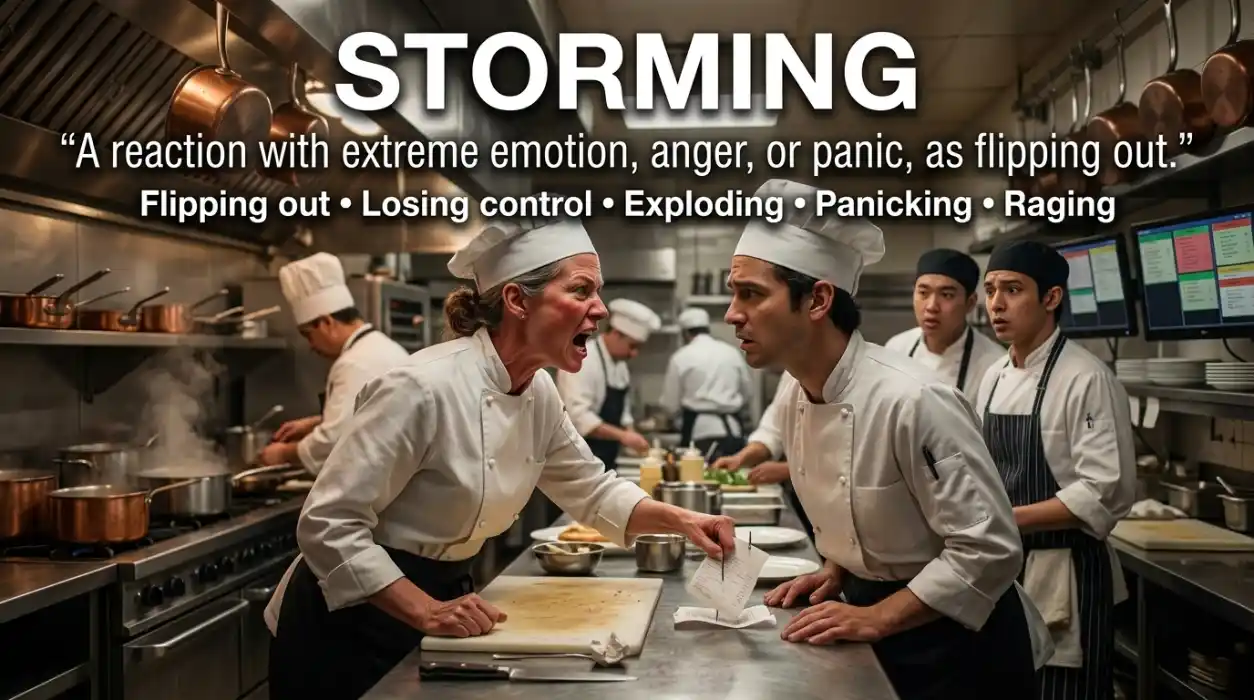
Meaning: Flipping out means reacting with extreme emotion, anger, or panic.
Tone/Register: Very informal.
Examples:
He was flipping out about the missed flight.
She started flipping out when her phone disappeared.
Marching Out (Verb Phrase) — US /ˈmɑːrtʃɪŋ aʊt/ — UK /ˈmɑːtʃɪŋ aʊt/
Meaning: Marching out can describe leaving firmly and angrily.
Tone/Register: Informal and expressive.
Examples:
She marched out of the office.
He marched out after refusing to continue the discussion.
Walking Out (Phrasal Verb) — US /ˈwɔːkɪŋ aʊt/ — UK /ˈwɔːkɪŋ aʊt/
Meaning: Walking out means leaving a place, sometimes because of anger or disagreement.
Tone/Register: Neutral to informal.
Examples:
He walked out after the argument.
She threatened to walk out of the meeting.
Rushing Out (Phrasal Verb) — US /ˈrʌʃɪŋ aʊt/ — UK /ˈrʌʃɪŋ aʊt/
Meaning: Rushing out means leaving quickly, often because of urgency.
Tone/Register: Neutral.
Examples:
She rushed out after receiving the call.
He rushed out of the house without his coat.
Charging Out (Phrasal Verb) — US /ˈtʃɑːrdʒɪŋ aʊt/ — UK /ˈtʃɑːdʒɪŋ aʊt/
Meaning: Charging out means moving out quickly and forcefully.
Tone/Register: Dramatic and informal.
Examples
He charged out of the room.
She charged out before anyone could stop her.
Bursting Out (Phrasal Verb) — US /ˈbɝːstɪŋ aʊt/ — UK /ˈbɜːstɪŋ aʊt/
Meaning: Bursting out can describe leaving suddenly and forcefully.
Tone/Register: Expressive.
Examples:
She burst out of the room in tears.
He burst out after hearing the accusation.
Dashing Off (Phrasal Verb) — US /ˈdæʃɪŋ ɔːf/ — UK /ˈdæʃɪŋ ɒf/
Meaning: Dashing off means leaving quickly, without necessarily expressing anger.
Tone/Register: Informal.
Examples:
He dashed off before the rain started.
She dashed off to catch the last train.
Storming Off (Phrasal Verb) — US /ˈstɔːrmɪŋ ɔːf/ — UK /ˈstɔːmɪŋ ɒf/
Meaning: Storming off means leaving suddenly because of anger or frustration.
Tone/Register: Informal and expressive.
Examples:
She stormed off after the disagreement.
He stormed off without saying goodbye.
Storming Out (Phrasal Verb) — US /ˈstɔːrmɪŋ aʊt/ — UK /ˈstɔːmɪŋ aʊt/
Meaning: Storming out means leaving a place dramatically and angrily.
Tone/Register: Informal.
Examples:
He stormed out of the restaurant.
She stormed out after the accusation.
Bursting In (Phrasal Verb) — US /ˈbɝːstɪŋ ɪn/ — UK /ˈbɜːstɪŋ ɪn/
Meaning: Bursting in means entering suddenly and energetically, often without permission.
Tone/Register: Informal and expressive.
Examples:
He burst into the office without knocking.
She came bursting in with urgent news.
Rushing In (Phrasal Verb) — US /ˈrʌʃɪŋ ɪn/ — UK /ˈrʌʃɪŋ ɪn/
Meaning: Rushing in means entering a place very quickly.
Tone/Register: Neutral and conversational.
Examples:
The children came rushing in from outside.
She rushed in when she heard the alarm.
Charging In (Phrasal Verb) — US /ˈtʃɑːrdʒɪŋ ɪn/ — UK /ˈtʃɑːdʒɪŋ ɪn/
Meaning: Charging in means entering rapidly and forcefully.
Tone/Register: Dramatic and informal.
Examples:
He charged into the room without warning.
The dog came charging in from the garden.
Barging In (Phrasal Verb) — US /ˈbɑːrdʒɪŋ ɪn/ — UK /ˈbɑːdʒɪŋ ɪn/
Meaning: Barging in means entering abruptly without considering whether the interruption is appropriate.
Tone/Register: Informal and mildly negative.
Examples:
He barged into my office during lunch.
She apologized for barging in.
Bursting Through (Phrasal Verb) — US /ˈbɝːstɪŋ θruː/ — UK /ˈbɜːstɪŋ θruː/
Meaning: Bursting through means entering or passing through something suddenly and forcefully.
Tone/Register: Dramatic and descriptive.
Examples:
The players came bursting through the doors.
He burst through the gate when he heard the news.
Forcing Entry (Verb Phrase) — US /ˈfɔːrsɪŋ ˈentri/ — UK /ˈfɔːsɪŋ ˈentri/
Meaning: Forcing entry means entering a place by overcoming a physical barrier or resistance.
Tone/Register: Formal, legal, and security-related.
Examples:
Police reported that someone had forced entry.
The report described the method used to gain entry.
Assaulting (Verb/Present Participle) — US /əˈsɔːltɪŋ/ — UK /əˈsɔːltɪŋ/
Meaning: Assaulting can describe attacking a place or position with force in a military context.
Tone/Register: Military and formal.
Examples:
The troops were assaulting the defensive position.
The unit began assaulting the outer wall.
Attacking (Verb/Present Participle) — US /əˈtækɪŋ/ — UK /əˈtækɪŋ/
Meaning: Attacking means using force against a person, group, place, or position.
Tone/Register: Neutral to formal.
Examples:
The forces were attacking the stronghold.
The team was attacking from the eastern side.
Invading (Verb/Present Participle) — US /ɪnˈveɪdɪŋ/ — UK /ɪnˈveɪdɪŋ/
Meaning: Invading means entering a country or territory with hostile military force.
Tone/Register: Formal and military.
Examples:
The army was invading the neighboring territory.
The documentary explains how the forces began invading the region.
Assaulting the Position (Verb Phrase) — US /əˈsɔːltɪŋ ðə pəˈzɪʃən/ — UK /əˈsɔːltɪŋ ðə pəˈzɪʃən/
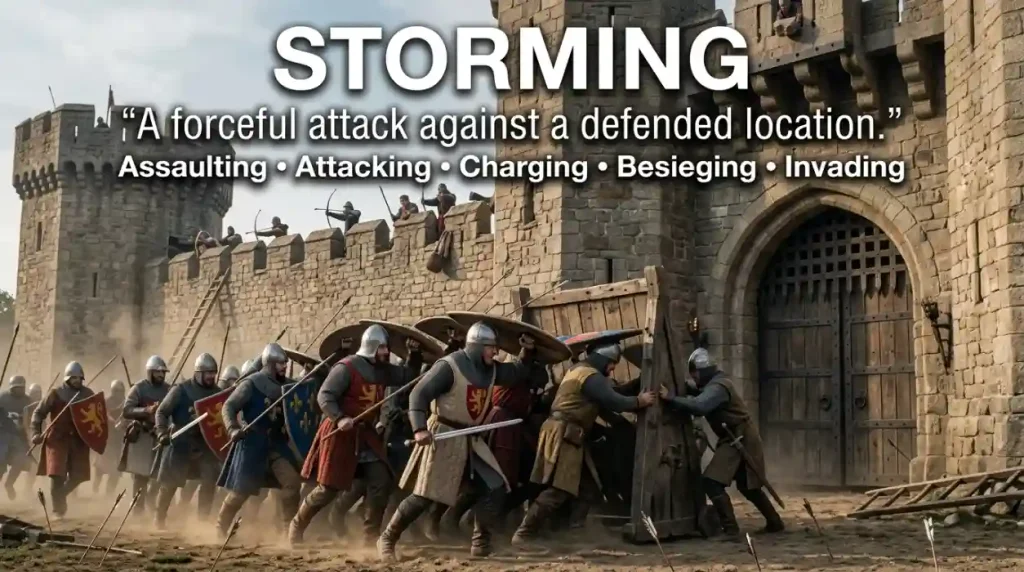
Meaning: This phrase describes a forceful attack against a defended location.
Tone/Register: Military and formal.
Examples:
The soldiers began assaulting the position at dawn.
The report describes the risks of assaulting the position.
Attacking the Stronghold (Verb Phrase) — US /əˈtækɪŋ ðə ˈstrɔːŋhoʊld/ — UK /əˈtækɪŋ ðə ˈstrɒŋhəʊld/
Meaning: This phrase means launching an attack against a strongly defended place.
Tone/Register: Historical, military, and dramatic.
Examples:
The army was attacking the stronghold.
The film depicts soldiers attacking the stronghold at night.
Taking by Force (Verb Phrase) — US /ˈteɪkɪŋ baɪ fɔːrs/ — UK /ˈteɪkɪŋ baɪ fɔːs/
Meaning: Taking by force means gaining control through physical or military power.
Tone/Register: Formal and historical.
Examples:
The fortress was taken by force.
The account describes attempts to take the city by force.
Breaching (Verb/Present Participle) — US /ˈbriːtʃɪŋ/ — UK /ˈbriːtʃɪŋ/
Meaning: Breaching means breaking through a wall, barrier, defense, or boundary.
Tone/Register: Technical, military, and formal.
Examples:
The team was breaching the outer barrier.
The operation focused on breaching the defensive line.
Overrunning (Verb/Present Participle) — US /ˌoʊvərˈrʌnɪŋ/ — UK /ˌəʊvəˈrʌnɪŋ/
Meaning: Overrunning means advancing over an area or position and overwhelming its defenders.
Tone/Register: Military and formal.
Examples:
The troops were overrunning the defensive line.
The position was quickly overrun.
Invading Force (Noun Phrase) — US /ɪnˈveɪdɪŋ fɔːrs/ — UK /ɪnˈveɪdɪŋ fɔːs/
Meaning: An invading force is a group entering territory through hostile military action.
Tone/Register: Formal and historical.
Examples:
The invading force approached the city.
Residents fled as the invading force advanced.
Rushing Forward (Phrasal Verb) — US /ˈrʌʃɪŋ ˈfɔːrwərd/ — UK /ˈrʌʃɪŋ ˈfɔːwəd/
Meaning: Rushing forward means moving rapidly toward something.
Tone/Register: Neutral to dramatic.
Examples:
The players were rushing forward.
The crowd began rushing forward after the gates opened.
Charging Forward (Phrasal Verb) — US /ˈtʃɑːrdʒɪŋ ˈfɔːrwərd/ — UK /ˈtʃɑːdʒɪŋ ˈfɔːwəd/
Meaning: Charging forward means moving rapidly and forcefully toward a person, place, or goal.
Tone/Register: Dramatic and energetic.
Examples:
The runners came charging forward.
The horse was charging forward at full speed.
Surging Forward (Phrasal Verb) — US /ˈsɝːdʒɪŋ ˈfɔːrwərd/ — UK /ˈsɜːdʒɪŋ ˈfɔːwəd/
Meaning: Surging forward describes a powerful, sudden movement ahead.
Tone/Register: Descriptive and dramatic.
Examples:
The crowd was surging forward.
The team kept surging forward despite the pressure.
Pushing Forward (Phrasal Verb) — US /ˈpʊʃɪŋ ˈfɔːrwərd/ — UK /ˈpʊʃɪŋ ˈfɔːwəd/
Meaning: Pushing forward means continuing to move ahead despite resistance or difficulty.
Tone/Register: Neutral and figurative.
Examples:
The hikers kept pushing forward.
The project is pushing forward despite delays.
Synonyms by Tone
Positive or Energetic
When storming describes powerful movement without anger, alternatives such as charging forward, surging forward, rushing forward, and pushing forward can sound energetic or determined.
These are useful in sports, storytelling, and motivational writing.
Neutral
For weather, raining heavily, pouring, thundering, raining hard, and raging can be neutral descriptions when the context is factual.
For movement, rushing out, rushing in, and walking out can also be relatively neutral.
Negative
Anger-related words such as fuming, seething, raging, lashing out, blowing up, and losing one’s temper have negative emotional associations.
Military alternatives such as attacking, invading, assaulting, and overrunning describe forceful action and can carry serious or violent associations.
Playful or Informal
Bucketing down, lashing down, boiling, flipping out, and blowing up are more conversational.
They can sound vivid and natural in everyday speech but may be unsuitable for formal academic writing.
Tone matters because changing one word can change the entire impression.
“She walked out.”
Sounds fairly neutral.
“She stormed out.”
Strongly suggests anger.
“She marched out.”
Suggests firmness and determination.
“Storming” vs Close Alternatives
| Word | Main emphasis | Typical context |
|---|---|---|
| Storming | Anger, severe weather, or forceful action | Everyday, weather, military |
| Raging | Extreme intensity or anger | Weather and emotions |
| Fuming | Strong private or visible anger | People |
| Rushing | Speed | Movement |
| Attacking | Force against a target | Military or conflict |
Raging vs Storming
Storming can describe weather, angry movement, or forceful action.
Raging emphasizes intensity.
“The storm was raging.”
Focuses on the storm’s violence.
“She was storming out.”
Focuses on the person’s angry movement.
Storming vs Fuming
Fuming is specifically about anger.
It does not normally describe leaving a room.
“She was fuming.”
Means she was extremely angry.
“She stormed out.”
Means she left angrily.
Storming vs Rushing
Rushing focuses on speed.
Storming often adds anger or force.
Someone can rush out because they are late. Someone who storms out usually leaves because they are upset.
How “Storming” Changes by Context
Daily Conversation
In everyday speech, context makes the meaning clear.
“It’s storming outside.”
refers to weather.
“He stormed out.”
refers to angry behavior.
For casual conversation, pouring, rushing, fuming, walking out, and blowing up are often more natural than formal alternatives.
Writing and Blogging
Writers can use storming when they want vivid imagery.
A sentence such as:
“She stormed into the room.”
immediately creates a picture of energetic, angry movement.
For weather writing, alternatives such as raging, pouring, and thundering can add variety without changing the basic scene.
Professional and Academic Writing
Formal writing usually requires greater precision.
Instead of saying:
“The troops were storming the area.”
a historical or academic writer may need a more exact term such as attacking, invading, breaching, or overrunning.
For weather reports, heavy rainfall, severe weather, or thunderstorms may be more precise than storming.
Creative and Informal Use
Creative writing benefits from vivid verbs.
“He stormed down the stairs.”
Creates more emotional energy than:
“He walked down the stairs.”
Similarly, charged, burst, marched, and rushed can change the speed and emotional atmosphere of a scene.
Common Mistakes and Native Usage
Mistake 1: Using “storming” when you only mean heavy rain
Not every rainy day is a storm.
If there is simply a lot of rain, pouring or raining heavily may be more accurate.
Mistake 2: Treating “fuming” as a movement verb
You can say:
“She was fuming.”
But fuming does not mean that she left the room.
For angry movement, use storming out, marching out, or walking out angrily.
Mistake 3: Assuming “raging” always means anger
Raging can describe people, but it can also describe natural forces.
“A raging storm crossed the region.”
Here, there is no human anger involved.
Mistake 4: Using military synonyms in ordinary situations
Words such as assaulting, invading, overrunning, and breaching are strong.
Do not use them casually for someone simply entering a room.
Mistake 5: Confusing “storming in” with “rushing in”
Rushing in describes speed.
Storming in usually suggests anger or forceful behavior.
That emotional difference is important.
Register Notes
Everyday speech: storming out, rushing out, blowing up, fuming, pouring.
Formal writing: attacking, invading, breaching, overrunning, severe weather.
Weather descriptions: raining heavily, pouring, thundering, raging.
Creative writing: storming, charging, bursting, surging, marching.
Military or historical writing: assaulting, attacking, breaching, overrunning, taking by force.
For related vocabulary practice, an internal article on synonyms for angry can help distinguish emotional intensity from physical movement.
Real-Life Mini Scenarios
Workplace
A colleague receives unexpected criticism.
“She stormed out of the meeting.”
If you want a softer description, say:
“She walked out of the meeting.”
The second sentence does not automatically imply anger.
Social Situation
Two friends argue.
“He was fuming after the conversation.”
Here, fuming describes his emotional state.
If he leaves angrily, you can say:
“He stormed off.”
Media and Pop Culture
A movie scene may show a character bursting into a room after hearing surprising news.
A sports commentator might say a player is charging forward toward the goal.
The choice depends on whether the scene emphasizes anger, speed, or energy.
Writing and Storytelling
A novelist can create different moods with small verb changes.
“She walked into the room.”
sounds neutral.
“She marched into the room.”
sounds firm.
“She stormed into the room.”
strongly suggests anger.
“She burst into the room.”
suggests sudden, energetic movement.
These distinctions make descriptive writing more vivid.

Practice Quiz
Choose the most natural answer for each situation.
1. Heavy rain is falling outside your house. Which word sounds most natural?
A. Pouring
B. Fuming
C. Invading
D. Marching
2. A person leaves a meeting angrily. Which phrase fits best?
A. Storming out
B. Pouring out
C. Thundering out
D. Raining out
3. Someone is extremely angry but remains relatively quiet. Which word fits best?
A. Seething
B. Rushing
C. Pouring
D. Bursting
4. A military force attacks a defended location. Which word is appropriate?
A. Assaulting
B. Pouring
C. Walking
D. Dashing
5. Someone enters an office without knocking and interrupts a conversation. Which phrase fits?
A. Barging in
B. Raining in
C. Fuming in
D. Pouring in
6. A person leaves quickly because they received an urgent phone call. Which phrase fits best?
A. Rushing out
B. Storming out
C. Fuming out
D. Invading out
7. A storm produces loud, repeated thunder. Which word is most descriptive?
A. Thundering
B. Marching
C. Fuming
D. Charging
8. Someone suddenly becomes extremely angry during an argument. Which informal phrase fits?
A. Blowing up
B. Walking around
C. Pouring down
D. Marching forward
9. A character enters a room suddenly with great energy. Which phrase works well?
A. Bursting in
B. Raining in
C. Seething in
D. Fuming down
10. A person leaves firmly after disagreeing with someone. Which word emphasizes determination?
A. Marching out
B. Pouring out
C. Thundering out
D. Raining out
11. An army enters another country’s territory with hostile intent. Which word is most precise?
A. Invading
B. Rushing
C. Walking
D. Dashing
12. A crowd moves suddenly and powerfully toward an exit. Which phrase fits?
A. Surging forward
B. Fuming forward
C. Pouring forward
D. Seething forward
Reflection Task
Write two sentences about the same person leaving a room. Use storming out in one sentence and walking out in the other. Ask yourself: how does the emotional meaning change?
Answer key: 1-A | 2-A | 3-A | 4-A | 5-A | 6-A | 7-A | 8-A | 9-A | 10-A | 11-A | 12-A
Frequently Asked Questions
What is a good synonym for storming out of a room?
Good alternatives include marching out, walking out angrily, rushing out, charging out, and leaving abruptly. The best choice depends on the intended emotion. Marching out suggests firmness, rushing out emphasizes speed, and charging out suggests force. If anger is central, storming out remains one of the clearest choices.
What is the difference between storming and pouring when describing weather?
Storming refers broadly to experiencing storm conditions, while pouring specifically emphasizes very heavy rain. It can be pouring without there being thunder or strong winds. Therefore, “It was pouring” focuses on rainfall, while “It was storming” can suggest a broader and more severe weather event.
What does storming mean when someone is angry?
When a person is storming, they are usually behaving or moving in a visibly angry way. Expressions such as storming out, storming off, and storming into a room suggest sudden, forceful movement caused by anger or frustration. The word often creates a stronger emotional image than simply saying someone left or entered.
What is the difference between storming, fuming, and seething?
Storming often describes angry movement or behavior. Fuming means being extremely angry and is common in everyday speech. Seething describes intense anger that may remain partly controlled or hidden. For example, someone can be seething silently, while someone who storms out usually makes their anger visible through their actions.
What is a formal synonym for storming in a military context?
Depending on the situation, formal alternatives include attacking, assaulting, breaching, invading, and overrunning. These terms are not perfectly interchangeable. Breaching emphasizes breaking through a defense, invading emphasizes entering territory, and overrunning suggests overwhelming a position or area.
External Learning Sources
For pronunciation, definitions, usage examples, and etymology, these established reference sources are useful:
Merriam-Webster
Oxford Learner’s Dictionaries
Etymonline
Conclusion
Learning synonyms for storming helps you describe weather, anger, movement, and conflict with greater accuracy. The right word can make a sentence much clearer.
Words like pouring and thundering suit weather, while fuming and seething describe anger. Movement needs choices such as rushing or marching.
In formal writing, precision matters even more. Attacking, invading, and breaching each describe different forms of forceful action and should not be treated as identical.
Practice these distinctions in emails, essays, stories, and daily conversations. Choose one new synonym today and create your own sentence with it.

Shahzeena Shazadi is the founder and lead writer at VocablyHub.com, where she creates accurate, reader-focused English language content designed to help people communicate with clarity and confidence. She specializes in synonyms, antonyms, word meanings, idioms, and practical vocabulary guides that simplify complex language concepts for everyday use. Every article is carefully researched, fact-checked, and written in clear, accessible language using reliable references and real-world examples. Her goal is to provide helpful, trustworthy content that supports learners at every stage of their English language journey.
Her editorial approach focuses on accuracy, transparency, and user value while following modern content quality standards. She regularly reviews and updates content to keep information relevant, useful, and easy to understand. Through VocablyHub.com, Shahzeena Shazadi is committed to publishing reliable language resources that help students, writers, educators, professionals, and English learners expand their vocabulary, improve their writing skills, and communicate with confidence in academic, professional, and everyday situations.