
Synonyms for stomped can make your English more vivid when someone walks heavily, crushes something, or reacts with strong emotion.
Imagine a child stomping across the room after losing a game. The action feels louder, stronger, and more emotional than simply saying they walked away.
Learning synonyms for stomped helps students, bloggers, writers, and daily English users choose words that match the exact action, mood, and situation.
The word is common because it describes strong physical movement clearly. However, synonyms for stomped let you sound more precise, natural, and expressive.
What Does “Stomped” Really Mean?
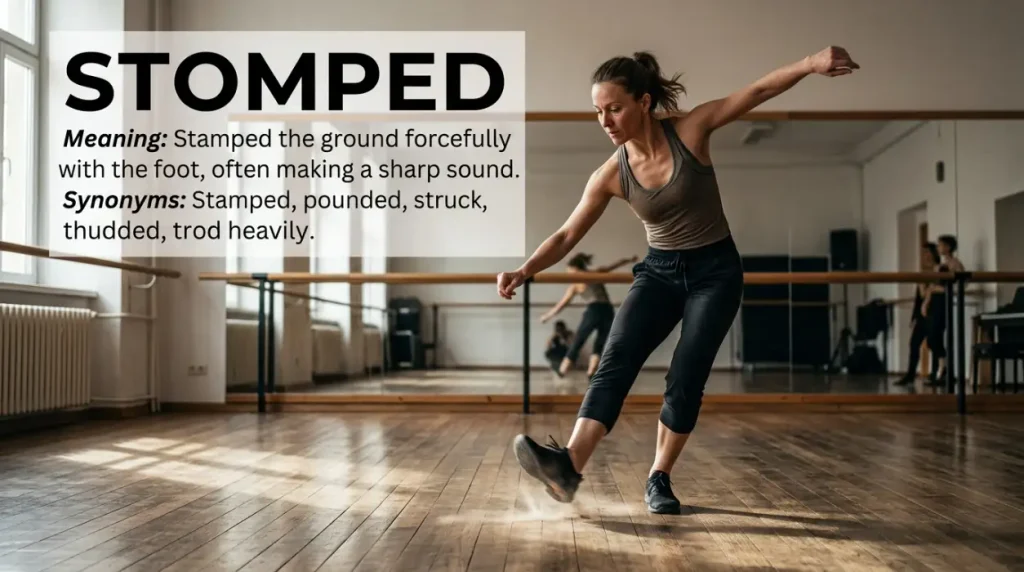
Stomped is the past tense and past participle of stomp. It usually means walked or stepped heavily and noisily, often because of anger, excitement, frustration, or determination.
It can also mean pressed, crushed, or struck something with the foot. In informal English, especially in sports, stomped can mean defeated someone very easily or by a large margin.
Native speakers understand the word from context. For instance, “She stomped out of the office” suggests an angry departure, while “He stomped on the cardboard” describes forceful physical action.
Part of Speech: Verb, past tense and past participle
Easy definition:
Stomped means walked, stepped, or struck something with heavy force, usually making a strong physical or emotional impression.
Connotative Meaning
Connotation (the feeling or association a word creates beyond its basic dictionary meaning) can make stomped feel stronger than words such as walked or stepped.
Positive tone: It can suggest confidence, excitement, energy, or determination.
Negative tone: It often suggests anger, frustration, aggression, impatience, or hostility.
Neutral tone: In a physical description, it can simply describe heavy or forceful movement without judging the person.
Etymology
The verb stomp has a less certain history than many older English verbs. English dictionaries generally connect it with Germanic forms related to making a heavy step or stamping movement.
The basic idea has remained remarkably stable: a heavy step that creates force or noise.
Old English: 450–1100
The exact modern form stomp was not a standard Old English verb. Old English used related Germanic vocabulary for stepping, stamping, and striking with the feet.
These older forms helped establish the broader English vocabulary of physical movement.
Middle English: 1100–1500
During Middle English, English developed several words describing walking, stepping, stamping, and striking. Forms related to stamp became especially important.
The distinction between ordinary walking and forceful foot movement gradually became clearer in everyday English.
Modern English: 1500–Present
Stomp became established in Modern English as a vivid verb for heavy stepping or stamping. Its figurative uses later expanded.
Today, stomped can describe angry movement, dancing, crushing something, extinguishing a small fire, and even overwhelming an opponent in informal sports language.
Pronunciation of “Stomped”
US: /stɑːmpt/
UK: /stɒmpt/
Syllables
stomped
It is a one-syllable word.
Affixation Pattern of “Stomped”
Root: stomp
Prefix: none
Suffix: -ed, marking the past tense and past participle
The pattern is simple:
stomp + -ed = stomped
The spelling does not add an extra syllable because the base word already ends in the consonant sound /p/.
Synonyms List
Stamped (verb) — US /stæmpt/ | UK /stæmpt/
Meaning: Stamped means struck the ground forcefully with the foot, often producing a sharp sound.
Tone/Register: Neutral, common
Examples:
She stamped her feet to warm them up.
The angry child stamped across the hallway.
Trampled (verb) — US /ˈtræmpəld/ | UK /ˈtræmpəld/
Meaning: Trampled means stepped heavily on something repeatedly, often damaging or crushing it.
Tone/Register: Neutral, descriptive
Examples:
The crowd trampled the flowers near the entrance.
Several leaves were trampled under our shoes.
Tramped (verb) — US /træmpt/ | UK /træmpt/
Meaning: Tramped means walked heavily, often for a long distance or across rough ground.
Tone/Register: Neutral, informal
Examples:
We tramped through the muddy field after the rain.
He tramped home with wet shoes.
Trod (verb) — US /trɑːd/ | UK /trɒd/
Meaning: Trod is the past tense of tread, and means stepped or walked on something.
Tone/Register: Literary, neutral
Examples:
She trod carefully across the old wooden floor.
He trod on a loose piece of gravel.
Trudged (verb) — US /trʌdʒd/ | UK /trʌdʒd/
Meaning: Trudged means walked slowly and heavily, usually because of tiredness, difficulty, or bad conditions.
Tone/Register: Neutral, descriptive
Examples:
We trudged through the snow after sunset.
He trudged back to the car after the long hike.
Clomped (verb) — US /klɑːmpt/ | UK /klɒmpt/
Meaning: Clomped means walked with heavy, noisy steps.
Tone/Register: Informal, descriptive
Examples:
Dad clomped upstairs in his work boots.
She clomped into the kitchen before breakfast.
Clumped (verb) — US /klʌmpt/ | UK /klʌmpt/
Meaning: Clumped means moved with heavy, awkward steps that make noticeable sounds.
Tone/Register: Informal, descriptive
Examples:
The child clumped across the floor in oversized shoes.
He clumped down the stairs without turning on the light.
Tromped (verb) — US /trɑːmpt/ | UK /trɒmpt/
Meaning: Tromped means walked heavily or noisily, especially across difficult ground.
Tone/Register: Informal, conversational
Examples:
We tromped through the wet grass.
They tromped back to the cabin before dark.
Pounded (verb) — US /ˈpaʊndɪd/ | UK /ˈpaʊndɪd/
Meaning: Pounded means moved or struck with repeated heavy force.
Tone/Register: Neutral, vivid
Examples:
He pounded down the stairs when he heard the alarm.
Rain pounded against the roof all night.
Thudded (verb) — US /θʌdɪd/ | UK /θʌdɪd/
Meaning: Thudded means moved or landed with a dull, heavy sound.
Tone/Register: Neutral, descriptive
Examples:
His boots thudded across the wooden floor.
The box thudded onto the table.
Thumped (verb) — US /θʌmpt/ | UK /θʌmpt/
Meaning: Thumped means struck or moved with a heavy, dull impact.
Tone/Register: Neutral
Examples:
He thumped his feet against the floor.
The heavy bag thumped against the wall.
Marched (verb) — US /mɑːrtʃt/ | UK /mɑːtʃt/
Meaning: Marched means walked with firm, deliberate steps, often showing purpose or determination.
Tone/Register: Neutral, formal
Examples:
She marched into the meeting with a clear plan.
He marched straight to the manager’s desk.
Strutted (verb) — US /ˈstrʌtɪd/ | UK /ˈstrʌtɪd/
Meaning: Strutted means walked proudly or confidently, sometimes in a way that seems showy.
Tone/Register: Informal, expressive
Examples:
He strutted across the stage after his performance.
The peacock strutted around the garden.
Stormed (verb) — US /stɔːrmd/ | UK /stɔːmd/
Meaning: Stormed means left or entered a place with force and anger.
Tone/Register: Informal, emotional
Examples:
She stormed out after the argument.
He stormed into the room without knocking.
Stampeded (verb) — US /stæmˈpiːdɪd/ | UK /stæmˈpiːdɪd/
Meaning: Stampeded means moved suddenly and uncontrollably as a group.
Tone/Register: Neutral, descriptive
Examples:
The horses stampeded after the loud noise.
Fans stampeded toward the open gate.
Tramped Along (phrasal verb) — US /træmpt əˈlɔːŋ/ | UK /træmpt əˈlɒŋ/
Meaning: Tramped along means continued walking with heavy or tiring steps.
Tone/Register: Informal
Examples:
We tramped along the muddy trail for hours.
She tramped along without saying a word.
Stamped About (phrasal verb) — US /stæmpt əˈbaʊt/ | UK /stæmpt əˈbaʊt/
Meaning: Stamped about means moved around noisily with forceful steps.
Tone/Register: Informal, expressive
Examples:
The toddler stamped about the room in frustration.
He stamped about looking for his missing phone.
Stepped Hard (verb phrase) — US /stept hɑːrd/ | UK /stept hɑːd/
Meaning: Stepped hard means placed the foot down with noticeable force.
Tone/Register: Neutral
Examples:
She stepped hard on the pedal.
He stepped hard on the cardboard box.
Crushed (verb) — US /krʌʃt/ | UK /krʌʃt/
Meaning: Crushed means pressed something with enough force to break, flatten, or damage it.
Tone/Register: Neutral
Examples:
He crushed the empty can under his boot.
The fallen chair crushed several small boxes.
Flattened (verb) — US /ˈflætənd/ | UK /ˈflætənd/
Meaning: Flattened means pressed something until it became flat or much thinner.
Tone/Register: Neutral
Examples:
She flattened the cardboard with her shoe.
The heavy object flattened the grass.
Squashed (verb) — US /skwɑːʃt/ | UK /skwɒʃt/
Meaning: Squashed means pressed something firmly so that it becomes damaged, smaller, or flatter.
Tone/Register: Informal, everyday
Examples:
He squashed the paper cup with his foot.
The box was squashed under the heavy luggage.
Pulverized (verb) — US /ˈpʌlvəraɪzd/ | UK /ˈpʌlvəraɪzd/
Meaning: Pulverized means crushed something into very small pieces or powder.
Tone/Register: Formal, technical
Examples:
The machine pulverized the dry material.
The stones were pulverized during processing.

Smashed (verb) — US /smæʃt/ | UK /smæʃt/
Meaning: Smashed means broke or damaged something violently or with great force.
Tone/Register: Informal, vivid
Examples:
He smashed the old box with his boot.
The ball smashed through the paper target.
Mangled (verb) — US /ˈmæŋɡəld/ | UK /ˈmæŋɡəld/
Meaning: Mangled means badly damaged, crushed, or twisted.
Tone/Register: Strong, descriptive
Examples:
The machine mangled the cardboard.
The old chair was mangled beyond repair.
Ground Down (phrasal verb) — US /ɡraʊnd daʊn/ | UK /ɡraʊnd daʊn/
Meaning: Ground down means gradually crushed or worn away through pressure or friction.
Tone/Register: Neutral, technical
Examples:
The stones were ground down by constant movement.
Her shoes had ground down the soft surface.
Pressed Down (verb phrase) — US /prest daʊn/ | UK /prest daʊn/
Meaning: Pressed down means pushed something toward a lower surface with force.
Tone/Register: Neutral
Examples:
He pressed down on the lid with his shoe.
She pressed down firmly to flatten the paper.
Trashed (verb) — US /træʃt/ | UK /træʃt/
Meaning: Trashed means badly damaged or ruined something.
Tone/Register: Informal
Examples:
The kids trashed the old cardboard display.
The storm trashed several garden decorations.
Demolished (verb) — US /dɪˈmɑːlɪʃt/ | UK /dɪˈmɒlɪʃt/
Meaning: Demolished means destroyed something completely or defeated someone decisively in informal language.
Tone/Register: Neutral, figurative
Examples:
The crew demolished the damaged shed.
Our team demolished the competition in yesterday’s match.
Thrashed (verb) — US /θræʃt/ | UK /θræʃt/
Meaning: Thrashed means defeated someone very clearly or by a large margin.
Tone/Register: Informal, sports
Examples:
Our school team thrashed its rival by five goals.
They were thrashed in the final quarter.
Trounced (verb) — US /traʊnst/ | UK /traʊnst/
Meaning: Trounced means defeated someone decisively and often unexpectedly.
Tone/Register: Informal, sports
Examples:
The home team trounced its opponent.
She trounced everyone in the office chess game.
Routed (verb) — US /ˈraʊtɪd/ | UK /ˈraʊtɪd/
Meaning: Routed means defeated an opponent so completely that they had to retreat or lost control.
Tone/Register: Formal, historical, sports
Examples:
The army routed the opposing force.
The visiting team routed its hosts in the second half.
Dominated (verb) — US /ˈdɑːməneɪtɪd/ | UK /ˈdɒmɪneɪtɪd/
Meaning: Dominated means controlled a contest or situation so strongly that others struggled to compete.
Tone/Register: Neutral, sports, business
Examples:
The champion dominated the entire match.
She dominated the discussion with strong evidence.
Overwhelmed (verb) — US /ˌoʊvərˈwɛlmd/ | UK /ˌəʊvəˈwɛlmd/
Meaning: Overwhelmed means defeated or overpowered because the opposing force was much stronger.
Tone/Register: Neutral, formal
Examples:
The defense was overwhelmed by the constant pressure.
Our small team felt overwhelmed by the workload.
Steamrolled (verb) — US /ˈstiːmroʊld/ | UK /ˈstiːmrəʊld/
Meaning: Steamrolled means defeated or pushed aside with overwhelming force.
Tone/Register: Informal, figurative
Examples:
The favorites steamrolled their opponents.
The larger company steamrolled the smaller competitor.
Clobbered (verb) — US /ˈklɑːbərd/ | UK /ˈklɒbəd/
Meaning: Clobbered means hit or defeated someone very heavily.
Tone/Register: Informal
Examples:
Our team got clobbered in the second game.
The boxer clobbered his opponent with a powerful punch.
Walloped (verb) — US /ˈwɑːləpt/ | UK /ˈwɒləpt/
Meaning: Walloped means hit or defeated someone with great force.
Tone/Register: Informal, playful
Examples:
The champion walloped his rival in the final round.
Our team got walloped by ten points.
Battered (verb) — US /ˈbætərd/ | UK /ˈbætəd/
Meaning: Battered means repeatedly hit or severely damaged.
Tone/Register: Neutral, vivid
Examples:
The waves battered the small boat.
The defense was battered by repeated attacks.
Outclassed (verb) — US /ˌaʊtˈklæst/ | UK /ˌaʊtˈklɑːst/
Meaning: Outclassed means defeated because someone demonstrated clearly greater skill or ability.
Tone/Register: Neutral, sports
Examples:
The younger player was outclassed by the veteran.
Our team was outclassed from the opening minute.
Blew Away (phrasal verb) — US /bluː əˈweɪ/ | UK /bluː əˈweɪ/
Meaning: Blew away means defeated someone easily in informal speech or impressed someone greatly, depending on context.
Tone/Register: Informal
Examples:
The new team blew away its opponent.
Her performance blew away the judges.
Beat Soundly (verb phrase) — US /biːt ˈsaʊndli/ | UK /biːt ˈsaʊndli/
Meaning: Beat soundly means defeat someone clearly and by a substantial margin.
Tone/Register: Neutral, sports
Examples:
The visitors beat us soundly in the final match.
Their defense beat the attackers soundly.
Crushed the Competition (verb phrase) — US /krʌʃt ðə ˌkɑːmpəˈtɪʃən/ | UK /krʌʃt ðə ˌkɒmpəˈtɪʃən/
Meaning: Crushed the competition means defeated competitors by a very large margin.
Tone/Register: Informal, business, sports
Examples:
The runner crushed the competition at the event.
Their product launch crushed the competition in media attention.
Vanquished (verb) — US /ˈvæŋkwɪʃt/ | UK /ˈvæŋkwɪʃt/
Meaning: Vanquished means defeated an opponent completely.
Tone/Register: Formal, literary
Examples:
The hero finally vanquished the enemy.
The champion vanquished every challenger.
Conquered (verb) — US /ˈkɑːŋkərd/ | UK /ˈkɒŋkəd/
Meaning: Conquered means defeated and gained control over an opponent or challenge.
Tone/Register: Formal, historical, figurative
Examples:
The army conquered the neighboring territory.
She conquered her fear of public speaking.

Overpowered (verb) — US /ˌoʊvərˈpaʊərd/ | UK /ˌəʊvəˈpaʊəd/
Meaning: Overpowered means defeated by using greater physical strength, force, or influence.
Tone/Register: Neutral
Examples:
The larger player overpowered his opponent.
The strong wind overpowered the small shelter.
Subdued (verb) — US /səbˈduːd/ | UK /səbˈdjuːd/
Meaning: Subdued means brought someone or something under control by force.
Tone/Register: Formal
Examples:
Security quickly subdued the attacker.
The firefighters subdued the small blaze.
Synonyms by Tone
Tone matters because two words can describe similar movement while creating very different feelings.
Positive or energetic
Strutted, charged, powered forward, grooved, danced, strode, hustled
These choices can suggest confidence, energy, excitement, or determination. They work well when the speaker does not want the movement to sound angry.
Neutral
Stamped, tramped, trod, trudged, clomped, pounded, marched, stepped hard, rushed, shuffled
These words focus mainly on the physical action. The surrounding sentence usually determines the emotional meaning.
Negative or forceful
Trampled, crushed, smashed, mangled, thrashed, routed, dominated, steamrolled, clobbered, battered
These choices create a stronger sense of damage, aggression, or decisive defeat.
Playful or informal
Tromped, clumped, walloped, blew away, grooved, bounced, clobbered
These words work especially well in conversations, sports commentary, storytelling, and casual writing.
Choosing the right tone helps your reader understand not only what happened, but also how it felt.
“Stomped” vs Close Alternatives
Stamped vs Stomped
Stomped often suggests heavy movement, anger, or dramatic emotion. Stamped focuses more directly on striking the ground with the foot.
Use stomped when the person’s emotional state matters.
Use stamped when the physical action itself matters.
Stomped vs Trudged
Stomped suggests force and often noise. Trudged suggests slow, tiring, difficult movement.
For instance, an angry employee may stomp out of a room. A tired employee may trudge home after work.
Stomped vs Trampled
Stomped can describe one strong step or repeated heavy steps. Trampled usually means repeatedly stepping on something and damaging it.
Therefore, “She stomped across the room” and “The crowd trampled the grass” create different images.
How “Stomped” Changes by Context
Daily Conversation
In everyday speech, stomped often describes emotional movement.
“She stomped upstairs” can suggest that she was annoyed. However, the word can also describe a simple physical action when someone needs to take a heavy step.
Writing or Blogging
In blogging and general writing, stomped adds visual energy. It can make a scene feel more immediate.
Still, writers should vary vocabulary. Words such as trudged, marched, clomped, and strode can show different types of movement.
Professional or Academic Tone
Formal writing usually needs more precise vocabulary. Stomped can sound conversational or emotional.
Depending on the intended meaning, professional writers may prefer walked forcefully, moved rapidly, pressed down, defeated decisively, or another specific phrase.
Creative or Informal Use
Creative writing gives stomped more freedom. It can reveal anger, excitement, comedy, frustration, or dramatic tension.
For instance, “He stomped through the rain” creates a stronger scene than “He walked through the rain.”
Common Mistakes Learners Make
Mistake 1: Using “stomped” for every kind of walking
Not every strong step is a stomp. If someone walks confidently but calmly, a stride may fit better.
Mistake 2: Ignoring emotional meaning
“Stomped out of the room” often suggests anger. Therefore, avoid it when you want completely calm movement.
Mistake 3: Confusing “stomped” and “trampled”
Use trampled when repeated steps damage something underfoot. Use stomped when the main idea involves heavy stepping.
Mistake 4: Using sports slang in formal writing
“Stomped the other team” sounds informal. In an academic report, defeated decisively is usually clearer.
Mistake 5: Treating every synonym as interchangeable
Synonyms rarely have identical meanings. Trudged emphasizes tiredness, strode emphasizes confidence, and stomped emphasizes force.
Register Notes
Formal: vanquished, subdued, extinguished, pulverized, routed
Neutral: stamped, trampled, marched, dominated, crushed, overwhelmed
Informal: stomped, clomped, tromped, clobbered, walloped, blew away
Spoken English: stomped, clobbered, thrashed, trudged, rushed
Written English: trampled, pulverized, vanquished, subdued, routed
For deeper vocabulary learning, an internal guide on strong verbs and descriptive movement words can help you compare these choices by context.
Real-Life Mini Scenarios
Workplace
After receiving an unfair criticism, Maya stomped out of the meeting. Her heavy steps showed frustration without directly stating that she was angry.
Social Situation
At a birthday party, everyone stomped and danced when the favorite song started. Here, the word suggests energetic movement rather than anger.
Media and Pop Culture
A sports commentator might say that one team stomped its rival. In this setting, the phrase is informal and means the team won very easily.
Writing and Storytelling
A novelist might write, “He stomped through the muddy street.” The verb creates a stronger visual image than the simpler verb walked.
The same principle applies to the synonyms above. Trudged can show exhaustion, strode can show confidence, clomped can create a comic sound, and trampled can show physical damage.

Practice Exercise
1. An angry student leaves the classroom with heavy steps. Which word fits best?
A. Stomped
B. Whispered
C. Smiled
D. Rested
2. A tired hiker walks slowly through deep snow. Which word is most natural?
A. Strutted
B. Trudged
C. Grooved
D. Rushed
3. A confident speaker walks across a stage with long steps. Which word fits?
A. Shuffled
B. Strode
C. Trampled
D. Squashed
4. A crowd repeatedly walks over flowers and damages them. Which word fits?
A. Trampled
B. Danced
C. Hopped
D. Rushed
5. A sports team wins by a huge margin in casual conversation. Which word works well?
A. Clobbered
B. Whispered
C. Wandered
D. Rested
6. A child walks noisily upstairs wearing large boots. Which word is most descriptive?
A. Clomped
B. Floated
C. Slept
D. Glanced
7. A formal article describes a complete military defeat. Which word fits best?
A. Grooved
B. Vanquished
C. Hopped
D. Bounced
8. Someone puts out a small flame with a boot. Which verb can describe the action?
A. Extinguished
B. Strutted
C. Rushed
D. Marched
9. Someone walks slowly because they feel exhausted. Which word is strongest?
A. Trudged
B. Charged
C. Strutted
D. Grooved
10. A person moves forward quickly and forcefully toward a target. Which phrase fits?
A. Charged ahead
B. Shuffled back
C. Stood still
D. Whispered away
Answer Key: 1-A | 2-B | 3-B | 4-A | 5-A | 6-A | 7-B | 8-A | 9-A | 10-A
Reflection Task
Write one sentence about a real event in your life using stomped, trudged, strode, clomped, trampled, or another synonym from this article.
Conclusion
Understanding the Synonyms for stomped can help you describe actions and emotions more clearly in your writing. Words such as trampled, stamped, crushed, marched, and trodden can be used depending on the context and the exact meaning you want to convey.
The Synonyms for stomped can vary when describing someone walking heavily, striking something with force, or crushing something underfoot. Choosing the right alternative allows you to make your sentences more precise and helps readers better understand the action being described.
Learning different Synonyms for stomped is a simple way to expand your vocabulary and improve your communication skills. By selecting a synonym that fits the situation, you can make your writing more natural, expressive, and engaging.
FAQs
1. What is a good synonym for stomped when someone is angry?
Stamped, stormed, and stomped out can work when anger drives the movement. However, each creates a slightly different image. Stamped focuses on forceful foot movement, while stormed out emphasizes an angry departure. Choose the alternative based on whether you want to highlight the feet, the movement, or the person’s emotional reaction.
2. What is the difference between stomped and trudged?
Stomped usually suggests heavy, forceful steps and may communicate anger or frustration. Trudged suggests slow, difficult walking caused by tiredness, bad weather, or an unpleasant journey. Someone can stomp because they are angry, but they usually trudge because moving forward feels difficult or exhausting.
3. Can stomped mean defeated in sports?
Yes. In informal sports English, stomped can mean defeated an opponent very easily or by a large margin. For example, “The team stomped its rival” means the team won decisively. More formal alternatives include defeated decisively, dominated, or outclassed, depending on the exact situation.
4. What is a formal word for stomped?
The best formal alternative depends on the meaning. For heavy walking, marched or strode may work. For crushing something, pulverized or flattened may fit.
5. Is stomped a negative word?
Not always. Stomped often carries a negative emotional association when someone moves angrily, but context can change the feeling. At a concert, people might stomp their feet with excitement. In a sports sentence, stomped can simply describe a decisive victory in informal language.

Shahzeena Shazadi is the founder and lead writer at VocablyHub.com, where she creates accurate, reader-focused English language content designed to help people communicate with clarity and confidence. She specializes in synonyms, antonyms, word meanings, idioms, and practical vocabulary guides that simplify complex language concepts for everyday use. Every article is carefully researched, fact-checked, and written in clear, accessible language using reliable references and real-world examples. Her goal is to provide helpful, trustworthy content that supports learners at every stage of their English language journey.
Her editorial approach focuses on accuracy, transparency, and user value while following modern content quality standards. She regularly reviews and updates content to keep information relevant, useful, and easy to understand. Through VocablyHub.com, Shahzeena Shazadi is committed to publishing reliable language resources that help students, writers, educators, professionals, and English learners expand their vocabulary, improve their writing skills, and communicate with confidence in academic, professional, and everyday situations.