
Synonyms for social skills empower your everyday vocabulary by helping you describe human interactions with precision.
Imagine walking into a networking room full of strangers where someone effortlessly connects people and guides the conversation.
You notice how smooth their interactions feel, so you tell a colleague that they have strong interpersonal abilities.
Learning synonyms for social skills allows students, bloggers, writers, and speakers to express subtle communication details clearly.
Furthermore, mastering synonyms for social skills enriches your writing so you do not repeat basic terms constantly.
What Does “Social Skills” Really Mean?
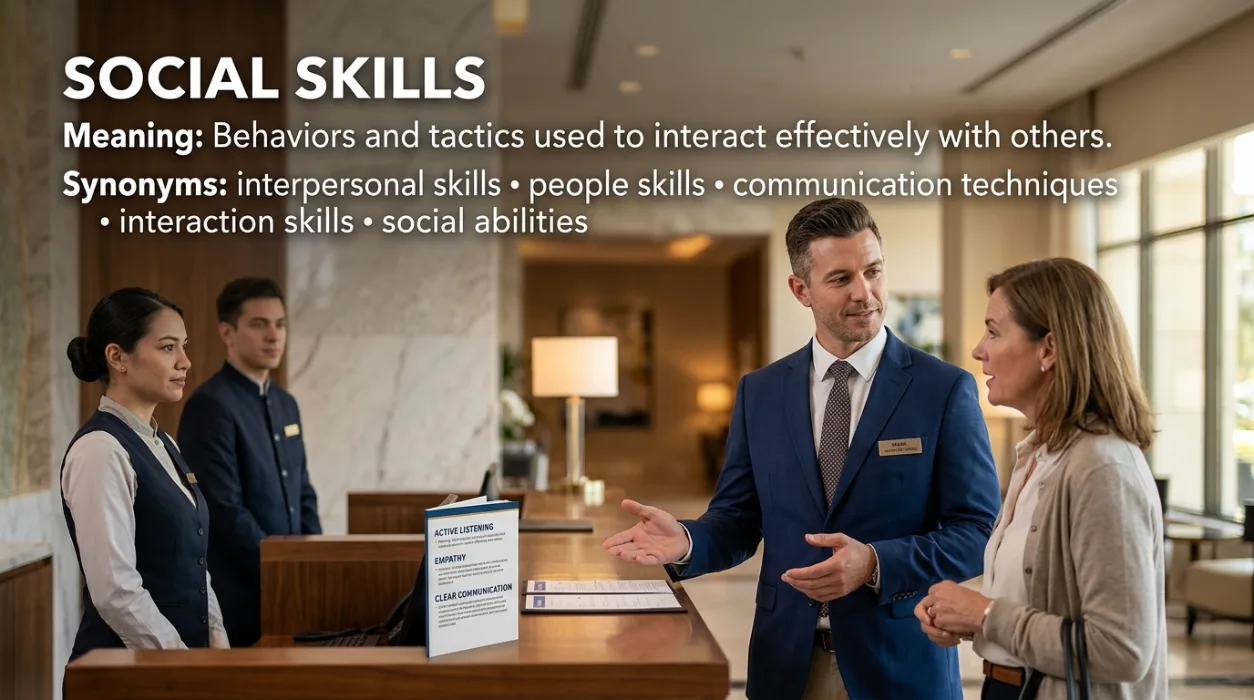
The phrase “social skills” refers to the learned abilities we use to communicate and interact effectively with others.
Native speakers use this term frequently when discussing career growth, personal relationships, classroom behavior, and emotional health.
In English grammar, “social skills” functions as a plural noun phrase combining an adjective with a common noun.
Definition: The specific skills, behaviors, and strategies needed to interact, communicate, and build healthy relationships with other people.
Connotative Meaning
Connotation means the emotional association or cultural feeling that a word carries beyond its dictionary definition.
- Positive tone: Reflects empathy, active listening, charm, warmth, leadership, and emotional maturity.
- Negative tone: Excessive focus on social manipulation or superficial politeness can sometimes feel calculated.
- Neutral tone: Describing human interaction techniques, behavioral patterns, or communication capabilities objectively.
Etymology and History
The adjective “social” comes from Latin socialis (meaning companionable), while “skill” stems from Old Norse skil (meaning distinction or knowledge).
- Old English (450–1100): Early speakers relied on Germanic roots like cræft (craft or skill) to describe practical abilities.
- Middle English (1100–1500): Anglo-Norman vocabulary introduced terms related to courtly manners, grace, and public conduct.
- Modern English (1500–Present): Psychology and modern sociology combined “social” and “skills” to describe interpersonal competence.
Pronunciation and Syllables
- US Pronunciation: /ˈsoʊ.ʃəl skɪlz/
- UK Pronunciation: /ˈsəʊ.ʃəl skɪlz/
- Syllables: so-cial skills
Affixation Pattern:
- Root: soci (Latin root for companion or ally)
- Suffix: -al (Adjective-forming suffix meaning relating to)
- Base Word: skill (Noun representing ability) + -s (Plural suffix)
Synonyms List
Interpersonal Skills (Plural Noun) — US: /ˌɪn.t̬ɚˈpɝː.sən.əl skɪlz/ | UK: /ˌɪn.təˈpɜː.sən.əl skɪlz/
Meaning: The behaviors and tactics a person uses to interact with others effectively.
Tone/Register: Business / Professional
Examples:
- Strong interpersonal skills help managers lead diverse remote teams successfully.
- She highlights her interpersonal skills on her professional summary page.
Communication Skills (Plural Noun) — US: /kəˌmjuː.nəˈkeɪ.ʃən skɪlz/ | UK: /kəˌmjuː.nɪˈkeɪ.ʃən skɪlz/
Meaning: The abilities needed to convey information clearly and listen attentively to others.
Tone/Register: General / Professional
Examples:
- Excellent communication skills are essential for effective customer service representatives.
- He improved his communication skills by joining a public speaking club.
Soft Skills (Plural Noun) — US: /ˈsɑːft skɪlz/ | UK: /ˈsɒft skɪlz/
Meaning: Personal attributes that enable someone to interact harmoniously with other people.
Tone/Register: Corporate / Business
Examples:
- Tech companies value soft skills just as much as coding expertise.
- Modern hiring managers test candidates’ soft skills during team interviews.
People Skills (Plural Noun) — US: /ˈpiː.pəl skɪlz/ | UK: /ˈpiː.pəl skɪlz/
Meaning: The practical ability to communicate well and relate easily to people.
Tone/Register: Daily / Conversational
Examples:
- Her natural people skills made her an outstanding event host.
- Working in retail quickly sharpens your daily people skills.
Interpersonal Competence (Noun) — US: /ˌɪn.t̬ɚˈpɝː.sən.əl ˈkɑːm.pə.t̬əns/ | UK: /ˌɪn.təˈpɜː.sən.əl ˈkɒm.pɪ.təns/
Meaning: The demonstrated capacity to handle social relationships and conversations skillfully.
Tone/Register: Formal / Academic
Examples:
- High interpersonal competence reduces workplace friction during complex projects.
- Researchers measure interpersonal competence through structured behavioral observations.
Social Intelligence (Noun) — US: /ˈsoʊ.ʃəl ɪnˈtɛl.ə.dʒəns/ | UK: /ˈsəʊ.ʃəl ɪnˈtel.ɪ.dʒəns/
Meaning: The capacity to know oneself and understand others in varied social environments.
Tone/Register: Academic / Professional
Examples:
- Strong social intelligence allows leaders to navigate delicate team conflicts.
- Developing social intelligence helps students adapt to new environments.
Emotional Intelligence (Noun) — US: /ɪˈmoʊ.ʃən.əl ɪnˈtɛl.ə.dʒəns/ | UK: /ɪˈməʊ.ʃən.əl ɪnˈtel.ɪ.dʒəns/
Meaning: The ability to understand, use, and manage your own emotions constructively.
Tone/Register: Professional / Educational
Examples:
- Emotional intelligence enables individuals to remain calm during arguments.
- Executive coaching focuses heavily on developing emotional intelligence.
Tact (Noun) — US: /tækt/ | UK: /tækt/
Meaning: Skill and sensitivity in dealing with others or handling difficult situations.
Tone/Register: Formal / General
Examples:
- She handled the sensitive client complaint with exceptional tact.
- Delivering constructive criticism requires genuine tact and empathy.
Diplomacy (Noun) — US: /dɪˈploʊ.mə.si/ | UK: /dɪˈpləʊ.mə.si/
Meaning: The art of managing relationships without causing offense or conflict.
Tone/Register: Formal / Professional
Examples:
- Workplace diplomacy keeps cross-departmental projects running without friction.
- He used quiet diplomacy to resolve the contract dispute.
Relational Skills (Plural Noun) — US: /rɪˈleɪ.ʃən.əl skɪlz/ | UK: /rɪˈleɪ.ʃən.əl skɪlz/
Meaning: Abilities that allow someone to build and maintain healthy social connections.
Tone/Register: Academic / Business
Examples:
- Strong relational skills help counselors connect with clients deeply.
- Community leaders rely on relational skills to foster unity.
Sociability (Noun) — US: /ˌsoʊ.ʃəˈbɪl.ə.t̬i/ | UK: /ˌsəʊ.ʃəˈbɪl.ə.ti/
Meaning: The quality of being fond of company and easy to engage with.
Tone/Register: Neutral / General
Examples:
- His natural sociability makes him popular at corporate gatherings.
- Outdoor events encourage natural sociability among neighborhood residents.
Charm (Noun) — US: /tʃɑːrm/ | UK: /tʃɑːm/
Meaning: The power or quality of pleasing, attracting, or fascinating others.
Tone/Register: Informal / General
Examples:
- Her personal charm instantly put the interviewers at ease.
- He used his natural charm to win over audience members.
Charisma (Noun) — US: /kəˈrɪz.mə/ | UK: /kəˈrɪz.mə/
Meaning: Compelling attractiveness or charm that inspires devotion in others.
Tone/Register: Expressive / General
Examples:
- The speaker possessed enough charisma to captivate a crowded room.
- True charisma combines deep active listening with authentic confidence.
Empathy (Noun) — US: /ˈɛm.pə.θi/ | UK: /ˈem.pə.θi/
Meaning: The ability to understand and share the feelings of another person.
Tone/Register: General / Universal
Examples:
- Showing empathy helps customer support agents defuse tense situations.
- Empathy forms the foundation of all meaningful human connections.
Conversational Skills (Plural Noun) — US: /ˌkɑːn.vɚˈseɪ.ʃən.əl skɪlz/ | UK: /ˌkɒn.vəˈseɪ.ʃən.əl skɪlz/
Meaning: The techniques needed to start, maintain, and conclude engaging dialogues.
Tone/Register: Daily / Educational
Examples:
- Good conversational skills help introverts feel comfortable at social events.
- Practice improves your conversational skills over time.
Social Savvy (Noun) — US: /ˈsoʊ.ʃəl ˈsæv.i/ | UK: /ˈsəʊ.ʃəl ˈsæv.i/
Meaning: Practical knowledge and shrewd understanding of social situations.
Tone/Register: Informal / Modern
Examples:
- Her social savvy helped her navigate complex political events easily.
- Young entrepreneurs need social savvy to secure investment deals.
Social Aptitude (Noun) — US: /ˈsoʊ.ʃəl ˈæp.tə.tuːd/ | UK: /ˈsəʊ.ʃəl ˈæp.tɪ.tjuːd/
Meaning: A natural tendency or ability to succeed in social interactions.
Tone/Register: Formal / Academic
Examples:
- Tests revealed his high social aptitude for team leadership roles.
- Early childhood activities encourage healthy social aptitude growth.
Rapport-building (Noun) — US: /ræˈpɔːrˌbɪl.dɪŋ/ | UK: /ræˈpɔːˌbɪl.dɪŋ/
Meaning: The capacity to establish harmonious and trusting relationships quickly.
Tone/Register: Business / Professional
Examples:
- Effective rapport-building makes sales calls feel like friendly chats.
- Teachers use rapport-building tactics during the first week of class.
Social Grace (Noun) — US: /ˈsoʊ.ʃəl ɡreɪs/ | UK: /ˈsəʊ.ʃəl ɡreɪs/
Meaning: Polite and refined behavior shown in public or social situations.
Tone/Register: Formal / Literary
Examples:
- She moved through the formal dinner with effortless social grace.
- Learning social grace helps young professionals make good first impressions.
Mannerliness (Noun) — US: /ˈmæn.ɚ.li.nəs/ | UK: /ˈmæn.ə.li.nəs/
Meaning: The quality of polite behavior and good manners toward others.
Tone/Register: Formal / General
Examples:
- His consistent mannerliness impressed both clients and colleagues alike.
- Traditional mannerliness never goes out of style in formal settings.
Poise (Noun) — US: /pɔɪz/ | UK: /pɔɪz/
Meaning: Graceful and elegant bearing along with composure under pressure.
Tone/Register: Elevated / General
Examples:
- She maintained her poise while answering tricky media questions.
- Stage training helps performers carry themselves with absolute poise.

Presence (Noun) — US: /ˈprɛz.əns/ | UK: /ˈprez.əns/
Meaning: An impressive or noticeable quality of poise and confidence.
Tone/Register: Professional / Expressive
Examples:
- The executive had a commanding presence that attracted attention.
- Developing executive presence requires confidence and clarity.
Persuasiveness (Noun) — US: /pɚˈsweɪ.sɪv.nəs/ | UK: /pəˈsweɪ.sɪv.nəs/
Meaning: The ability to convince others to adopt a belief or action.
Tone/Register: Business / Academic
Examples:
- His persuasiveness helped secure full funding for the community park.
- Good lawyers combine logical arguments with natural persuasiveness.
Active Listening (Noun) — US: /ˈæk.tɪv ˈlɪs.ən.ɪŋ/ | UK: /ˈæk.tɪv ˈlɪs.ən.ɪŋ/
Meaning: Fully concentrating on, understanding, and responding thoughtfully to speakers.
Tone/Register: Educational / Professional
Examples:
- Active listening prevents misunderstandings during team brainstorms.
- Practice active listening to make friends feel truly heard.
Expressiveness (Noun) — US: /ɪkˈsprɛs.ɪv.nəs/ | UK: /ɪkˈspres.ɪv.nəs/
Meaning: The quality of effectively communicating thoughts and feelings.
Tone/Register: General / Expressive
Examples:
- Her emotional expressiveness made her storytelling captivating.
- Facial expressiveness helps actors communicate without speaking.
Likeability (Noun) — US: /ˌlaɪ.kəˈbɪl.ə.t̬i/ | UK: /ˌlaɪ.kəˈbɪl.ə.ti/
Meaning: The quality of being easy to like and pleasant to be around.
Tone/Register: Informal / Business
Examples:
- High likeability can help job candidates stand out during interviews.
- Genuine warmth increases your overall likeability naturally.
Approachability (Noun) — US: /əˌproʊ.tʃəˈbɪl.ə.t̬i/ | UK: /əˌprəʊ.tʃəˈbɪl.ə.ti/
Meaning: The quality of being easy to talk to and welcoming.
Tone/Register: Business / General
Examples:
- A manager’s approachability encourages staff to share new ideas.
- Her smiling posture increased her approachability at networking sessions.
Social Competence (Noun) — US: /ˈsoʊ.ʃəl ˈkɑːm.pə.t̬əns/ | UK: /ˈsəʊ.ʃəl ˈkɒm.pɪ.təns/
Meaning: The ability to achieve personal goals in social interactions while maintaining positive relationships.
Tone/Register: Academic / Psychological
Examples:
- Schools design programs to enhance children’s social competence.
- High social competence correlates with better academic teamwork.
Politeness (Noun) — US: /pəˈlaɪt.nəs/ | UK: /pəˈlaɪt.nəs/
Meaning: Behavior that is respectful and considerate toward other people.
Tone/Register: General / Daily
Examples:
- Basic politeness goes a long way when requesting help from strangers.
- She treated every guest with consistent politeness.
Courtesy (Noun) — US: /ˈkɝː.t̬ə.si/ | UK: /ˈkɜː.tə.si/
Meaning: Polite, respectful, or considerate behavior shown through actions.
Tone/Register: Formal / General
Examples:
- The driver showed courtesy by letting pedestrians cross first.
- Professional courtesy requires replying to work emails promptly.
Affability (Noun) — US: /ˌæf.əˈbɪl.ə.t̬i/ | UK: /ˌæf.əˈbɪl.ə.ti/
Meaning: The quality of being friendly, good-natured, or easy to talk to.
Tone/Register: Formal / Literary
Examples:
- The host welcomed everyone with characteristic affability.
- His affability made international visitors feel instantly welcome.
Geniality (Noun) — US: /ˌdʒiː.niˈæl.ə.t̬i/ | UK: /ˌdʒiː.niˈæl.ə.ti/
Meaning: A cheerful, warm, and friendly disposition in social settings.
Tone/Register: Elevated / Formal
Examples:
- The doctor’s geniality helped ease nervous patients.
- We enjoyed the warm geniality of our holiday dinner hosts.
Congeniality (Noun) — US: /kənˌdʒiː.niˈæl.ə.t̬i/ | UK: /kənˌdʒiː.niˈæl.ə.ti/
Meaning: Pleasantness that stems from shared interests or agreeable character.
Tone/Register: Formal / Academic
Examples:
- The team was chosen for both technical expertise and congeniality.
- A sense of congeniality filled the book club meeting room.
Extroversion (Noun) — US: /ˌɛk.strəˈvɝː.ʒən/ | UK: /ˌek.strəˈvɜː.ʃən/
Meaning: Social behavior characterized by outgoingness and high social engagement.
Tone/Register: Academic / Psychological
Examples:
- His natural extroversion suited him well for outdoor sales roles.
- Extroversion helps people feel energized in large crowds.
Outgoingness (Noun) — US: /ˌaʊtˈɡoʊ.ɪŋ.nəs/ | UK: /ˌaʊtˈɡəʊ.ɪŋ.nəs/
Meaning: A friendly, open, and socially active character quality.
Tone/Register: Conversational / General
Examples:
- Her outgoingness made it easy to gather new team members.
- Outgoingness can be developed through consistent small talk practice.
Friendly Demeanor (Noun) — US: /ˈfrɛnd.li dɪˈmiː.nɚ/ | UK: /ˈfrend.li dɪˈmiː.nər/
Meaning: An outward behavior or appearance that shows warmth and open kindness.
Tone/Register: General / Business
Examples:
- The receptionist’s friendly demeanor brightened every visitor’s morning.
- A friendly demeanor helps defuse awkward social pauses.
Social Dexterity (Noun) — US: /ˈsoʊ.ʃəl dɛkˈstrɛr.ə.t̬i/ | UK: /ˈsəʊ.ʃəl dekˈster.ə.ti/
Meaning: Ease and skill in handling complicated or delicate social scenarios.
Tone/Register: Elevated / Business
Examples:
- She handled the public debate with admirable social dexterity.
- Social dexterity enables diplomats to balance opposing viewpoints.
Social Agility (Noun) — US: /ˈsoʊ.ʃəl əˈdʒɪl.ə.t̬i/ | UK: /ˈsəʊ.ʃəl əˈdʒɪl.ə.ti/
Meaning: The ability to adapt social communication quickly to different audiences.
Tone/Register: Business / Professional
Examples:
- Modern managers need social agility to converse with diverse audiences.
- Social agility allows writers to shift tone seamlessly between groups.
Networking Skills (Plural Noun) — US: /ˈnɛt.wɝː.kɪŋ skɪlz/ | UK: /ˈnet.wɜː.kɪŋ skɪlz/
Meaning: The abilities needed to build and maintain helpful professional connections.
Tone/Register: Business / Corporate
Examples:
- Strong networking skills opened doors for her startup funding.
- Attending conferences helps job seekers sharpen networking skills.

Collaboration Skills (Plural Noun) — US: /kəˌlæb.əˈreɪ.ʃən skɪlz/ | UK: /kəˌlæb.əˈreɪ.ʃən skɪlz/
Meaning: The abilities required to work productively with others toward common goals.
Tone/Register: Business / Professional
Examples:
- Remote teams depend heavily on digital collaboration skills.
- Group projects help students build essential collaboration skills.
Teamwork Skills (Plural Noun) — US: /ˈtiːm.wɝːk skɪlz/ | UK: /ˈtiːm.wɜːk skɪlz/
Meaning: The capacity to cooperate with teammates and share work responsibilities effectively.
Tone/Register: General / Professional
Examples:
- Athletes display teamwork skills both on and off the field.
- Hiring managers look for solid teamwork skills in new applicants.
Conflict Resolution Skills (Plural Noun) — US: /ˈkɑːn.flɪkt ˌrɛz.əˈluː.ʃən skɪlz/ | UK: /ˈkɒn.flɪkt ˌrez.əˈluː.ʃən skɪlz/
Meaning: The abilities used to resolve disagreements peacefully and constructively.
Tone/Register: Business / Academic
Examples:
- Leaders use conflict resolution skills to settle team disputes fairly.
- Mediation training improves personal conflict resolution skills.
Assertiveness (Noun) — US: /əˈsɝː.t̬ɪv.nəs/ | UK: /əˈsɜː.tɪv.nəs/
Meaning: Confident and forceful social behavior used to express opinions respectfully.
Tone/Register: Professional / Psychological
Examples:
- Healthy assertiveness ensures your workplace boundaries are respected.
- Assertiveness training helps quiet employees share valuable ideas.
Social Tactfulness (Noun) — US: /ˈsoʊ.ʃəl ˈtækt.fəl.nəs/ | UK: /ˈsəʊ.ʃəl ˈtækt.fəl.nəs/
Meaning: The habit of speaking and acting with careful regard for others’ feelings.
Tone/Register: Formal / General
Examples:
- Her social tactfulness prevented an argument during the family dinner.
- Delivering feedback requires a balance of honesty and social tactfulness.
Social Awareness (Noun) — US: /ˈsoʊ.ʃəl əˈwɛr.nəs/ | UK: /ˈsəʊ.ʃəl əˈweə.nəs/
Meaning: The ability to understand the feelings and perspectives of surrounding groups.
Tone/Register: Academic / General
Examples:
- Social awareness helps individuals read room dynamics before speaking.
- Volunteers show strong social awareness of local community needs.
Interpersonal Acumen (Noun) — US: /ˌɪn.t̬ɚˈpɝː.sən.əl əˈkjuː.mən/ | UK: /ˌɪn.təˈpɜː.sən.əl əˈkjuː.mən/
Meaning: Keen insight and quick judgment when dealing with people.
Tone/Register: Elevated / Corporate
Examples:
- Executive hiring committees seek leaders with high interpersonal acumen.
- Interpersonal acumen allows negotiators to spot hidden motivations.
Social Sensitivity (Noun) — US: /ˈsoʊ.ʃəl ˌsɛn.səˈtɪv.ə.t̬i/ | UK: /ˈsəʊ.ʃəl ˌsen.sɪˈtɪv.ə.ti/
Meaning: An awareness of social cues, feelings, and behavioral shifts in others.
Tone/Register: Psychological / Educational
Examples:
- Teachers with high social sensitivity notice when students need extra support.
- Social sensitivity helps friends comfort one another effectively.
Relationship Management (Noun) — US: /rɪˈleɪ.ʃən.ʃɪp ˈmæn.ədʒ.mənt/ | UK: /rɪˈleɪ.ʃən.ʃɪp ˈmæn.ɪdʒ.mənt/
Meaning: The process of maintaining positive, long-term personal or professional bonds.
Tone/Register: Business / Corporate
Examples:
- Relationship management is vital for maintaining long-term corporate clients.
- Account executives dedicate time to active relationship management.
Social Fitness (Noun) — US: /ˈsoʊ.ʃəl ˈfɪt.nəs/ | UK: /ˈsəʊ.ʃəl ˈfɪt.nəs/
Meaning: The health and strength of one’s social connections and interaction habits.
Tone/Register: Modern / Wellness
Examples:
- Regular catch-ups with old friends boost your overall social fitness.
- Daily conversations keep your social fitness strong during retirement.
Conversational Ease (Noun) — US: /ˌkɑːn.vɚˈseɪ.ʃən.əl iːz/ | UK: /ˌkɒn.vəˈseɪ.ʃən.əl iːz/
Meaning: Natural, comfortable, and unforced flow in spoken dialogue.
Tone/Register: Literary / General
Examples:
- Her conversational ease put nervous new neighbors at rest immediately.
- Podcast hosts rely on conversational ease to entertain audience members.
Social Fluency (Noun) — US: /ˈsoʊ.ʃəl ˈfluː.ən.si/ | UK: /ˈsəʊ.ʃəl ˈfluː.ən.si/
Meaning: The ability to move smoothly through diverse social environments and cultures.
Tone/Register: Professional / Elevated
Examples:
- Global executives require social fluency to lead cross-border initiatives.
- Travel enhances cultural understanding and social fluency over time.
Persuasive Ability (Noun) — US: /pɚˈsweɪ.sɪv əˈbɪl.ə.t̬i/ | UK: /pəˈsweɪ.sɪv əˈbɪl.ə.ti/
Meaning: The power to influence the opinions or behaviors of others through reason.
Tone/Register: Formal / Academic
Examples:
- Her persuasive ability convinced the board to adopt renewable power.
- Debate coaches train students to refine their persuasive ability.
Influence Skills (Plural Noun) — US: /ˈɪn.flu.əns skɪlz/ | UK: /ˈɪn.flu.əns skɪlz/
Meaning: Techniques used to guide opinions and actions without using direct authority.
Tone/Register: Corporate / Business
Examples:
- Managers rely on influence skills when directing cross-functional teams.
- Developing influence skills helps professionals lead projects smoothly.
Negotiation Skills (Plural Noun) — US: /nəˌɡoʊ.ʃiˈeɪ.ʃən skɪlz/ | UK: /nəˌɡəʊ.ʃiˈeɪ.ʃən skɪlz/
Meaning: Abilities used to reach mutually acceptable agreements between parties.
Tone/Register: Business / Professional
Examples:
- Solid negotiation skills help buyers secure fair contract prices.
- She used her negotiation skills to adjust project delivery dates.
Listening Ability (Noun) — US: /ˈlɪs.ən.ɪŋ əˈbɪl.ə.t̬i/ | UK: /ˈlɪs.ən.ɪŋ əˈbɪl.ə.ti/
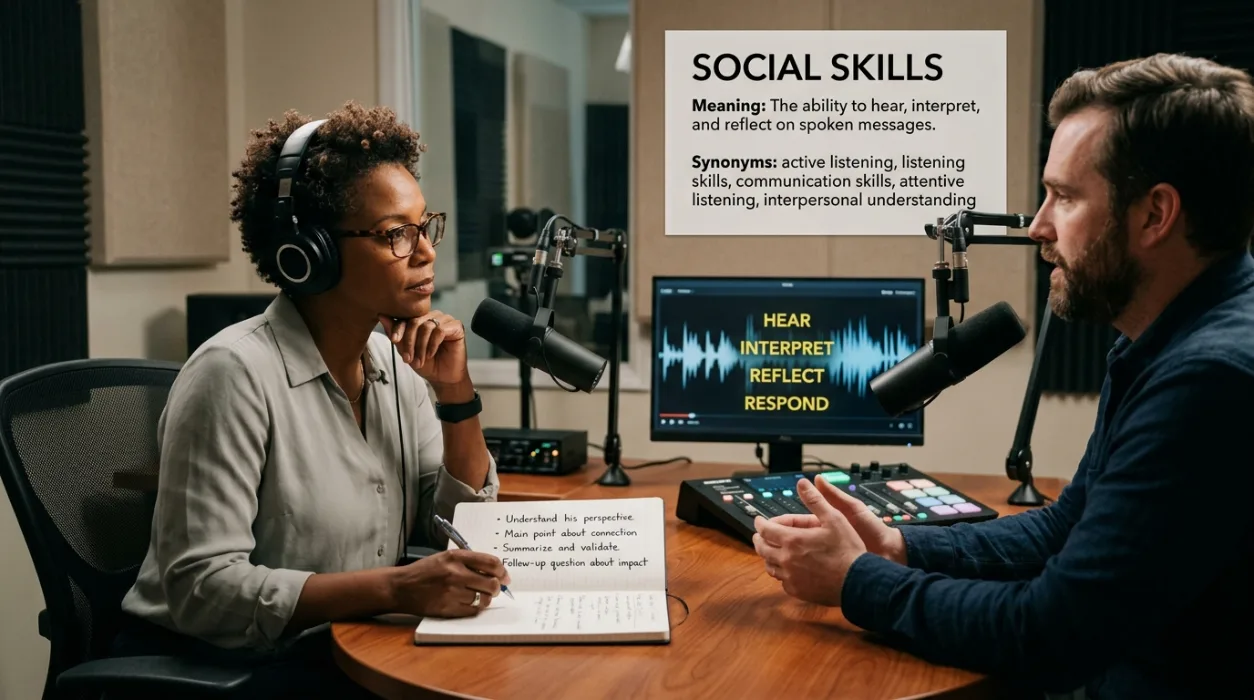
Meaning: The capacity to hear, interpret, and reflect on spoken messages.
Tone/Register: General / Educational
Examples:
- Strong listening ability is vital for accurate healthcare diagnoses.
- Improving your listening ability makes family conversations far more satisfying.
Synonyms by Tone
Tone Breakdown
Consequently, tone selection determines how your audience perceives your vocabulary choice.
- Positive / Empowering: Charisma, Empathy, Social Grace, Poise, Affability.
- Neutral / Professional: Interpersonal Skills, Soft Skills, Communication Skills, Social Competence.
- Negative / Over-Calculated: Social Manipulation, Calculated Charm (when applied insincerely).
- Playful / Informal: People Skills, Social Savvy, Likeability, Outgoingness.
Selecting the right tone matters because calling workplace communication “social savvy” feels casual, while “interpersonal competence” fits a formal performance review.
“Social Skills” vs Close Alternatives
| Feature | Social Skills | Interpersonal Skills | Emotional Intelligence |
| Primary Focus | General behaviors used to interact with others | Direct communication and relationship management | Understanding and managing internal/external emotions |
| Tone & Register | Everyday / General / Educational | Corporate / Business / Resume | Psychological / Academic / Professional |
| Best Usage | Daily chats, parenting guides, school topics | Professional resumes, job descriptions, interviews | Leadership discussions, mental wellness, coaching |
Therefore, use social skills when discussing general interaction habits. Switch to interpersonal skills on professional resumes, and pick emotional intelligence when discussing self-awareness and empathy.
How “Social Skills” Changes by Context
Daily Conversation
In casual everyday conversations, native speakers favor simple, friendly phrases like “people skills” or “being good with people.” For instance: “He has great people skills.”
Writing or Blogging
Bloggers and content creators use expressive terms like “social savvy,” “approachability,” or “conversational ease” to keep readers engaged without repeating basic words.
Professional or Academic Tone
In business reports, performance reviews, or academic papers, formal language works best. Words like “interpersonal competence,” “social agility,” or “rapport-building” add authority.
Creative or Informal Use
Novelists and creative writers choose evocative words like “poise,” “charm,” or “social grace” to bring characters and social scenes to life with vividness.
Common Mistakes Learners Make
Learners frequently confuse “social skills” with simple “extroversion.” Extroversion describes an outgoing personality type, whereas social skills represent learned abilities that anyone can practice.
Another mistake involves using “soft skills” when strictly referring to conversational ability. Remember that soft skills also include time management and adaptability.
Native Usage Tip: Pair social skills synonyms with strong action verbs. Use phrases like “demonstrate interpersonal skills,” “build rapport,” or “cultivate emotional intelligence.” For deeper vocabulary studies, check out our guide oncommunication terms.
Real-Life Examples Using “Social Skills”
- Workplace: When applying for leadership roles, emphasize your interpersonal competence and conflict resolution skills.
- Social Situations: Host a welcoming dinner party by demonstrating affability and conversational ease.
- Media & Pop Culture: Talk show hosts succeed because they combine high social savvy with active listening.
- Writing & Storytelling: Authors describe an elegant diplomat using terms like poise and social dexterity.
Conclusion
Understanding social skills can help you communicate effectively, build relationships, and interact comfortably with others. Learning their synonyms, meanings, and examples can improve your English vocabulary and help you express ideas about communication and interpersonal abilities more clearly.
The term social skills is commonly used when discussing communication, teamwork, cooperation, listening, empathy, and relationship-building. Knowing its related synonyms can help you describe interpersonal abilities and positive interactions in different ways.
By practicing social skills in sentences and exploring related terms, you can strengthen your vocabulary and communication skills. A clear understanding of this phrase will help you use it naturally, accurately, and confidently in different English contexts.
Practice Quiz
Which synonym is best suited for a professional corporate resume?
A) People skills
B) Interpersonal skills
C) Outgoingness
D) Social savvy
Choose the term that specifically means managing personal and others’ emotions:
A) Emotional intelligence
B) Social grace
C) Mannerliness
D) Extroversion
If someone navigates tricky office politics skillfully, they demonstrate:
A) Mannerliness
B) Social dexterity
C) Politeness
D) Extroversion
Which word carries a formal, literary tone for polite social behavior?
A) Likeability
B) Social grace
C) Soft skills
D) People skills
What term refers to fully focusing on and understanding a speaker?
A) Active listening
B) Extroversion
C) Charm
D) Outgoingness
Which phrase fits a casual blog post about making friends easily?
A) Interpersonal acumen
B) People skills
C) Social competence
D) Interpersonal competence
What term describes a leader’s ability to settle disputes peacefully?
A) Conflict resolution skills
B) Outgoingness
C) Affability
D) Geniality
Which word represents a warm, cheerful, and friendly disposition?
A) Geniality
B) Extroversion
C) Tact
D) Poise
What phrase describes adapting communication seamlessly across cultures?
A) Social fluency
B) Politeness
C) Courtesy
D) Mannerliness
Which term is used in psychological research to describe social success?
A) Social competence
B) People skills
C) Social savvy
D) Likeability
Reflection Task:
Write one original sentence using the synonym “emotional intelligence” to describe a positive leadership moment.
Answer Key:
1-B, 2-A, 3-B, 4-B, 5-A, 6-B, 7-A, 8-A, 9-A, 10-A
Frequently Asked Questions
What is the best resume synonym for social skills?
On a resume, “interpersonal skills” is the most widely recognized and professional synonym. Alternatively, using specific terms like “collaboration skills,” “conflict resolution,” or “relationship management” provides concrete evidence of your professional capabilities.
How does emotional intelligence differ from social skills?
Emotional intelligence is the broader capacity to recognize, understand, and manage internal emotions and external interpersonal relationships. Social skills represent the specific, outward behavioral techniques used to communicate and interact effectively with others.
Can introverts possess strong social skills?
Yes, introversion is a personality trait reflecting how someone recharges energy, whereas social skills are learned behaviors. Introverts often excel in specific social skills like active listening, empathy, and deep one-on-one rapport-building.
What are soft skills, and are they identical to social skills?
Soft skills represent non-technical personal attributes, including time management, work ethic, and adaptability. While social skills form a large subcategory of soft skills focused on communication, the terms are not entirely identical.
How can I practice using new social skills synonyms in daily writing?
Start by replacing overused words in your daily emails, essays, and journal entries. Additionally, try grouping synonyms by tone and practicing them through targeted writing exercises or speech routines.

Shahzeena Shazadi is the founder and lead writer at VocablyHub.com, where she creates accurate, reader-focused English language content designed to help people communicate with clarity and confidence. She specializes in synonyms, antonyms, word meanings, idioms, and practical vocabulary guides that simplify complex language concepts for everyday use. Every article is carefully researched, fact-checked, and written in clear, accessible language using reliable references and real-world examples. Her goal is to provide helpful, trustworthy content that supports learners at every stage of their English language journey.
Her editorial approach focuses on accuracy, transparency, and user value while following modern content quality standards. She regularly reviews and updates content to keep information relevant, useful, and easy to understand. Through VocablyHub.com, Shahzeena Shazadi is committed to publishing reliable language resources that help students, writers, educators, professionals, and English learners expand their vocabulary, improve their writing skills, and communicate with confidence in academic, professional, and everyday situations.