
Synonyms for nervously can make your English more expressive when someone feels worried, tense, uncertain, or uncomfortable in a situation.
Imagine a student waiting outside an interview room. They keep checking the clock and tapping their fingers. They are waiting nervously.
In everyday English, synonyms for nervously help you describe different shades of anxiety and tension without repeating the same adverb again and again.
For students, bloggers, content writers, and daily English users, these alternatives make conversations, essays, stories, and descriptions more natural and precise.
What Does “Nervously” Really Mean?
Nervously is an adverb that describes doing something while feeling worried, anxious, tense, frightened, uncertain, or uncomfortable.
In simple English, nervously means in a worried or uneasy way.
For example, someone may speak nervously before an interview. A person may also smile nervously when they feel awkward.
Native speakers commonly use the word in conversations, stories, workplace situations, interviews, presentations, social encounters, and emotional descriptions.
The exact meaning depends on context. Sometimes nervous behavior shows fear. In other cases, it simply shows uncertainty or embarrassment.
Connotative Meaning
Connotation (the feeling or association that a word suggests beyond its basic meaning) can change how a sentence feels.
Positive tone: Nervous behavior can sometimes suggest excitement, anticipation, or genuine concern.
Negative tone: It may suggest fear, insecurity, stress, or anxiety.
Neutral tone: In many situations, it simply describes visible tension without judging the person.
Etymology of “Nervously”
The adverb nervously comes from nervous, which developed through French from Latin nervosus, meaning “sinewy” or “full of nerves.” English later connected the word with sensitivity, agitation, and emotional tension.
Old English: 450–1100
The modern word nervously did not exist in Old English. However, Old English had words related to fear, anxiety, trembling, and emotional disturbance.
Middle English: 1100–1500
After the Norman influence on English, many French and Latin-derived terms entered the language. Forms related to nerve and nervous gradually became established.
Modern English: 1500–Present
The adjective nervous developed its modern emotional sense over time. The adverb nervously then formed by adding -ly, meaning “in a particular manner.”
Pronunciation
US: /ˈnɝː.vəs.li/
UK: /ˈnɜː.vəs.li/
Syllables
ner-vous-ly
Affixation Pattern
Root: nerv
Prefix: none
Suffix: -ous + -ly
The suffix -ous helps form the adjective nervous, while -ly changes the adjective into the adverb nervously.
Synonyms List:
Anxiously (Adverb) — US /ˈæŋkʃəsli/ | UK /ˈæŋkʃəsli/
Meaning: In a worried or uneasy way, especially while expecting something uncertain.
Tone/Register: Neutral, common.
Example:
She waited anxiously for the results.
He looked anxiously at the clock.

Uneasily (Adverb) — US /ʌnˈiːzəli/ | UK /ʌnˈiːzɪli/
Meaning: In a way that shows discomfort, uncertainty, or a lack of confidence.
Tone/Register: Neutral, descriptive.
Example:
He shifted uneasily in his chair.
She glanced uneasily toward the door.
Apprehensively (Adverb) — US /ˌæprɪˈhensɪvli/ | UK /ˌæprɪˈhensɪvli/
Meaning: In a worried way because you expect something unpleasant or difficult.
Tone/Register: Formal, descriptive.
Example:
She approached the office apprehensively.
He read the message apprehensively.
Tightly (Adverb) — US /ˈtaɪtli/ | UK /ˈtaɪtli/
Meaning: In a tense or controlled manner that can reveal nervousness through physical behavior.
Tone/Register: Neutral.
Example:
He held the microphone tightly.
Her fingers curled tightly around the paper.
Tersely (Adverb) — US /ˈtɝːsli/ | UK /ˈtɜːsli/
Meaning: In a brief, clipped way that may reflect tension or discomfort.
Tone/Register: Formal, written.
Example:
“I don’t know,” she replied tersely.
He answered tersely during the interview.
Restlessly (Adverb) — US /ˈrestləsli/ | UK /ˈrestləsli/
Meaning: In a way that shows an inability to relax or remain still.
Tone/Register: Neutral.
Example:
He waited restlessly for the announcement.
She moved restlessly around the room.
Fretfully (Adverb) — US /ˈfretfəli/ | UK /ˈfretfəli/
Meaning: In a worried and troubled way, often because of continued concern.
Tone/Register: Literary, descriptive.
Example:
She looked fretfully at the dark clouds.
He spoke fretfully about the delay.
Fearfully (Adverb) — US /ˈfɪrfəli/ | UK /ˈfɪəfəli/
Meaning: In a way that clearly shows fear or strong concern.
Tone/Register: Neutral, literary.
Example:
The child looked fearfully at the stranger.
She stepped forward fearfully.
Jitterily (Adverb) — US /ˈdʒɪtərɪli/ | UK /ˈdʒɪtərɪli/
Meaning: In a visibly nervous and shaky way.
Tone/Register: Informal, descriptive.
Example:
He laughed jitterily before speaking.
She moved jitterily toward the stage.
Skittishly (Adverb) — US /ˈskɪtɪʃli/ | UK /ˈskɪtɪʃli/
Meaning: In a nervous way that involves quickly reacting to possible danger or uncertainty.
Tone/Register: Literary, descriptive.
Example:
The horse moved skittishly near the crowd.
He glanced skittishly around the unfamiliar room.
Worriedly (Adverb) — US /ˈwɝːidli/ | UK /ˈwʌrɪdli/
Meaning: In a way that clearly expresses worry or concern.
Tone/Register: Everyday.
Example:
She looked worriedly at her phone.
He spoke worriedly about his brother.
Tensely (Adverb) — US /ˈtensli/ | UK /ˈtensli/
Meaning: In a physically or emotionally tight manner caused by stress or anticipation.
Tone/Register: Neutral.
Example:
He waited tensely for the verdict.
She sat tensely during the meeting.
Timidly (Adverb) — US /ˈtɪmɪdli/ | UK /ˈtɪmɪdli/
Meaning: In a shy or lacking-confidence manner.
Tone/Register: Neutral, descriptive.
Example:
She timidly raised her hand.
He timidly introduced himself.
Hesitantly (Adverb) — US /ˈhezɪtəntli/ | UK /ˈhezɪtəntli/
Meaning: In an uncertain way because you are not sure what to do or say.
Tone/Register: Neutral.
Example:
He hesitantly opened the envelope.
She hesitantly accepted the invitation.
Tentatively (Adverb) — US /ˈtentətɪvli/ | UK /ˈtentətɪvli/
Meaning: Cautiously and uncertainly.
Tone/Register: Professional, academic.
Example:
She tentatively suggested a new idea.
He tentatively stepped into the room.
Self-Consciously (Adverb) — US /ˌselfˈkɑːnʃəsli/ | UK /ˌselfˈkɒnʃəsli/
Meaning: In a way that shows awareness or embarrassment about how others may perceive you.
Tone/Register: Neutral.
Example:
He smiled self-consciously after making the mistake.
She adjusted her jacket self-consciously.
Awkwardly (Adverb) — US /ˈɔːkwərdli/ | UK /ˈɔːkwədli/
Meaning: In an uncomfortable or socially uncertain manner.
Tone/Register: Everyday.
Example:
He laughed awkwardly after the question.
She stood awkwardly near the doorway.
Shakily (Adverb) — US /ˈʃeɪkɪli/ | UK /ˈʃeɪkɪli/
Meaning: In a trembling or unsteady way that may reveal fear or nervousness.
Tone/Register: Neutral.
Example:
She spoke shakily during the presentation.
He held the cup shakily.
Tremulously (Adverb) — US /ˈtremjələsli/ | UK /ˈtremjələsli/
Meaning: In a trembling way caused by emotion, fear, or nervousness.
Tone/Register: Literary, formal.
Example:
“I’m ready,” she said tremulously.
His voice sounded tremulously soft.
Warily (Adverb) — US /ˈwerəli/ | UK /ˈweərəli/
Meaning: In a cautious way because you do not completely trust a situation or person.
Tone/Register: Neutral.
Example:
He watched the stranger warily.
She approached the unfamiliar dog warily.
Cautiously (Adverb) — US /ˈkɔːʃəsli/ | UK /ˈkɔːʃəsli/
Meaning: In a careful manner that avoids possible danger or mistakes.
Tone/Register: Neutral, professional.
Example:
She cautiously entered the empty building.
He cautiously answered the difficult question.

Uncertainly (Adverb) — US /ʌnˈsɝːtənli/ | UK /ʌnˈsɜːtənli/
Meaning: In a way that shows doubt or a lack of confidence.
Tone/Register: Neutral.
Example: He looked uncertainly at his notes.
She answered uncertainly when asked for details.
Doubtfully (Adverb) — US /ˈdaʊtfəli/ | UK /ˈdaʊtfəli/
Meaning: In a way that shows doubt or a lack of belief.
Tone/Register: Neutral.
Example:
She looked doubtfully at the proposal.
He nodded doubtfully.
Nervily (Adverb) — US /ˈnɝːvɪli/ | UK /ˈnɜːvɪli/
Meaning: In a nervous or tense manner.
Tone/Register: Informal, uncommon.
Example:
He laughed nervously during the interview.
She waited nervously for her turn.
Agitatedly (Adverb) — US /ˈædʒɪteɪtɪdli/ | UK /ˈædʒɪteɪtɪdli/
Meaning: In a visibly upset, restless, or emotionally disturbed way.
Tone/Register: Formal, descriptive.
Example:
He paced agitatedly across the room.
She spoke agitatedly about the situation.
Frantically (Adverb) — US /ˈfræntɪkli/ | UK /ˈfræntɪkli/
Meaning: In an extremely anxious and hurried way.
Tone/Register: Neutral, strong.
Example:
She searched for her keys.
He called frantically for help.
Restively (Adverb) — US /ˈrestɪvli/ | UK /ˈrestɪvli/
Meaning: In a way that shows impatience, discomfort, or inability to stay calm.
Tone/Register: Formal, literary.
Example:
The audience waited restively for the speaker.
He sat restlessly through the long meeting.
Edgily (Adverb) — US /ˈedʒɪli/ | UK /ˈedʒɪli/
Meaning: In a tense, nervous, or slightly uneasy manner.
Tone/Register: Informal, modern.
Example:
She laughed edgily at the comment.
He answered edgily during the discussion.
Fearfully Nervous (Adverbial Phrase) — US /ˈfɪrfəli ˈnɝːvəs/ | UK /ˈfɪəfəli ˈnɜːvəs/
Meaning: In a manner strongly influenced by fear and nervous anticipation.
Tone/Register: Descriptive.
Example:
He waited fearfully nervous outside the room.
She watched the result fearfully nervous.
With Anxiety (Adverbial Phrase) — US /wɪð æŋˈzaɪəti/ | UK /wɪð æŋˈzaɪəti/
Meaning: In a way that shows significant worry or concern.
Tone/Register: Neutral, formal.
Example:
She checked the results with anxiety.
He waited with anxiety for the phone call.
With Apprehension (Adverbial Phrase) — US /wɪð ˌæprɪˈhenʃən/ | UK /wɪð ˌæprɪˈhenʃən/
Meaning: In a worried manner caused by anticipation of something difficult or unpleasant.
Tone/Register: Formal.
Example:
He entered the office with apprehension.
She opened the letter with apprehension.
In Tension (Adverbial Phrase) — US /ɪn ˈtenʃən/ | UK /ɪn ˈtenʃən/
Meaning: In a state of emotional or physical strain.
Tone/Register: Neutral.
Example:
The players waited in tension.
She watched the announcement in tension.
With Unease (Adverbial Phrase) — US /wɪð ʌnˈiːz/ | UK /wɪð ʌnˈiːz/
Meaning: In a way that reflects discomfort, uncertainty, or mild worry.
Tone/Register: Neutral.
Example:
He listened to the explanation with unease.
She looked at the dark hallway with unease.
With Hesitation (Adverbial Phrase) — US /wɪð ˌhezɪˈteɪʃən/ | UK /wɪð ˌhezɪˈteɪʃən/
Meaning: In an uncertain manner that shows reluctance or lack of confidence.
Tone/Register: Neutral.
Example:
She answered with hesitation.
He accepted the offer with hesitation.
In Fear (Adverbial Phrase) — US /ɪn fɪr/ | UK /ɪn fɪə/
Meaning: In a manner strongly affected by fear.
Tone/Register: Neutral, emotional.
Example:
The child looked around in fear.
He waited in fear for the door to open.
Insecurity (Adverbial Use) — US /ˌɪnsɪˈkjʊrəti/ | UK /ˌɪnsɪˈkjʊərəti/
Meaning: A manner influenced by self-doubt or a lack of confidence.
Tone/Register: Psychological, formal.
Example:
She spoke with visible insecurity.
He approached the group with insecurity.
With Trepidation (Adverbial Phrase) — US /wɪð ˌtrepɪˈdeɪʃən/ | UK /wɪð ˌtrepɪˈdeɪʃən/
Meaning: Fearfully and hesitantly because something uncertain is approaching.
Tone/Register: Formal, literary.
Example:
He opened the examination paper with trepidation.
She entered the unfamiliar building with trepidation.
Under Pressure (Adverbial Phrase) — US /ˈʌndər ˈpreʃər/ | UK /ˈʌndə ˈpreʃə/
Meaning: In a stressed or tense state caused by demanding circumstances.
Tone/Register: Everyday, professional.
Example:
He spoke quickly under pressure.
She decided under pressure.
On Edge (Adverbial Phrase) — US /ɑːn edʒ/ | UK /ɒn edʒ/
Meaning: In a tense and nervous state because you expect something to happen.
Tone/Register: Informal, common.
Example:
Everyone was on edge before the announcement.
She felt on edge during the long wait.
Uneasily (Adverb) — US: /ˈʌn.i.li/ | UK: /ˈʌn.i.li/
Meaning: In a worried, uncomfortable, or uncertain way.
Tone/Register: Neutral; common in both speech and writing.
Examples:
She shifted uneasily while waiting for the interview to begin.
He smiled uneasily when everyone looked at him.
Anxiously (Adverb) — US: /ˈæŋk.ʃəs.li/ | UK: /ˈæŋk.ʃəs.li/
Meaning: In a way that shows worry, concern, or nervous anticipation.
Tone/Register: Neutral to formal; common in everyday and professional English.
Examples:
She anxiously checked her phone before the results arrived.
He waited anxiously outside the doctor’s office.
Apprehensively (Adverb) — US: /ˌæp.rɪˈhen.sɪv.li/ | UK: /ˌæp.rɪˈhen.sɪv.li/
Meaning: In a worried way because you expect something difficult or unpleasant.
Tone/Register: Formal; more common in writing than casual speech.
Examples:
She apprehensively opened the message from her manager.
The child looked apprehensively at the unfamiliar dog.
Fidgetily (Adverb) — US: /ˈfɪdʒ.ə.təl.i/ | UK: /ˈfɪdʒ.ɪ.təl.i/
Meaning: In a restless way that involves small, nervous movements.
Tone/Register: Informal to neutral; useful for descriptive writing.
Examples:
He fidgetily played with his pen during the interview.
She sat fidgetily in her chair while waiting for her turn.
Tentatively (Adverb) — US: /ˈten.tə.tɪv.li/ | UK: /ˈten.tə.tɪv.li/
Meaning: Uncertainly or cautiously because you lack confidence.
Tone/Register: Neutral to formal; common in speech and writing.
Examples:
She tentatively asked if she could join the discussion.
He tentatively stepped into the unfamiliar room.
Restlessly (Adverb) — US: /ˈrest.ləs.li/ | UK: /ˈrest.ləs.li/
Meaning: In a way that shows you cannot relax or remain still.
Tone/Register: Neutral; common in storytelling and everyday English.
Examples:
He restlessly paced around the room before his presentation.
She restlessly checked the door while waiting for her friend.

Trepidatiously (Adverb) — US: /trɪˌped.əˈteɪ.ʃəs.li/ | UK: /trɪˌped.ɪˈteɪ.ʃəs.li/
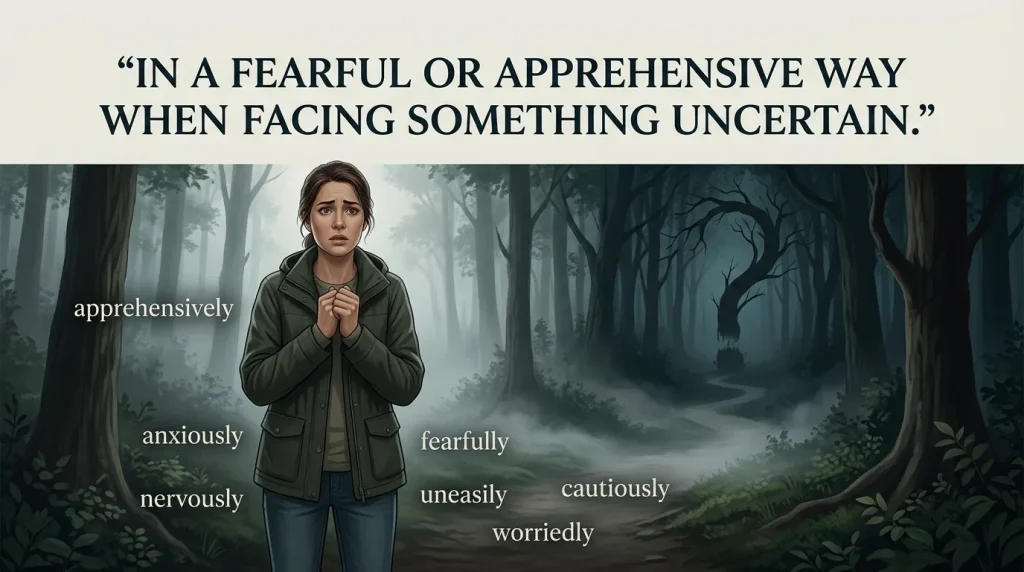
Meaning: In a fearful or apprehensive way when facing something uncertain.
Tone/Register: Formal and literary; relatively uncommon in everyday conversation.
Examples:
The new employee trepidatiously entered the manager’s office.
She trepidatiously approached the stage for her first speech.
Synonyms for “Nervously” by Tone
Positive or Mild
Some alternatives can describe nervousness without making it sound negative. Tentatively, cautiously, and uncertainly may simply show that someone wants to proceed carefully.
In addition, nervousness can sometimes suggest excitement. For example, a person may feel nervous before performing on stage because the event matters deeply to them.
Neutral
For everyday situations, anxiously, uneasily, hesitantly, restlessly, tensely, and uncertainly are useful choices.
These words describe the behavior without strongly judging the person.
Negative or Strong
When the emotion is intense, words such as frantically, fearfully, agitatedly, and with trepidation create a stronger effect.
Therefore, choose these alternatives when the situation involves serious fear, stress, or emotional pressure.
Informal or Conversational
For casual writing, edgily, jitterily, and on edge can sound more natural.
However, avoid informal choices in formal academic writing unless the context specifically requires them.
“Nervously” vs Close Alternatives
Anxiously vs Nervously
Nervously often describes visible behavior caused by tension or uncertainty.
Anxiously focuses more strongly on worry or concern.
For example, someone may smile nervously before an interview. A parent may wait anxiously for exam results.
Nervously vs Hesitantly
Nervously emphasizes emotional tension.
Hesitantly emphasizes uncertainty about an action or decision.
Someone can therefore speak nervously without hesitating. Likewise, a person can hesitate simply because they need more time to think.
Nervously vs Uneasily
Nervously is broader and very common.
Uneasily highlights discomfort or a feeling that something is not quite right.
For natural everyday English, nervously works well. For descriptive writing, uneasily can create a more subtle mood.
How “Nervously” Changes by Context
Daily Conversation
In casual speech, nervously, anxiously, awkwardly, and hesitantly are common.
For example, you might say, “He laughed nervously when everyone looked at him.”
This sounds natural because the sentence focuses on a visible reaction.
Writing and Blogging
Bloggers can use more specific alternatives to avoid repetition.
Instead of writing “she smiled nervously” several times, you might write “she smiled uneasily,” “she answered hesitantly,” or “she glanced anxiously at the screen.”
As a result, your writing feels more varied and precise.
Professional and Academic Writing
Formal writing often benefits from words such as apprehensively, tentatively, cautiously, and with trepidation.
However, context matters. Academic writing should describe observable behavior clearly rather than exaggerating emotional states.
Creative Writing
Creative writers have more freedom to use expressive alternatives.
Words such as tremulously, skittishly, jitterily, and edgily can create stronger emotional imagery.
For instance, “Her voice trembled as she answered” may communicate nervousness more vividly than simply saying she spoke nervously.
Common Mistakes and Native Usage
Mistake 1: Using Every Synonym Interchangeably
Not every alternative has the same meaning.
For example, frantically suggests extreme urgency, while hesitantly mainly suggests uncertainty. Choosing the wrong word can change the meaning.
Mistake 2: Confusing Nervousness With Fear
A nervous person is not always afraid.
Someone can feel nervous before a wedding, presentation, exam, interview, or exciting performance. Therefore, fearfully may sound too strong in some contexts.
Mistake 3: Overusing “Anxiously”
Anxiously is useful, but it should not replace every occurrence of nervously.
Try uneasily, tentatively, hesitantly, or restlessly when those words better describe the specific behavior.
Register Notes
Nervously works in both spoken and written English.
Words such as jitterily and edgily sound more informal. Meanwhile, apprehensively, tremulously, and with trepidation suit formal or literary contexts better.
For academic work, choose precise words that describe the exact emotional state.
Real-Life Mini Scenarios
Workplace
An employee may speak hesitantly when presenting an unfamiliar idea.
During a difficult meeting, another person may respond tensely because the discussion feels uncomfortable.
Social Situations
Someone meeting new people might smile awkwardly or speak timidly.
After making an unexpected mistake, they may laugh self-consciously.
Media and Pop Culture
Actors often portray nervous characters by speaking shakily, moving restlessly, or looking uneasily toward another character.
These details help audiences understand emotions without direct explanation.
Writing and Storytelling
A novelist can create suspense by showing a character opening a door with trepidation.
Similarly, a character can glance warily around a room when they suspect danger.
How to Choose the Right Synonym
Start by identifying the exact emotion.
If the person feels general worry, anxiously works well.
If they lack confidence, timidly or hesitantly may fit better.
For physical tension, choose tensely or shakily.
When the person expects danger, warily or fearfully can be stronger.
If the situation involves extreme stress and urgency, frantically is more appropriate.
Therefore, the best synonym depends on the emotion, intensity, and context.
Quick Reference Guide
General nervousness: nervously, anxiously, uneasily
Worry: anxiously, worriedly, fretfully
Fear: fearfully, with trepidation, in fear
Uncertainty: hesitantly, tentatively, uncertainly
Physical tension: tensely, shakily, restlessly
Shyness: timidly, self-consciously
Caution: cautiously, warily
Strong anxiety: frantically, agitatedly, edgily
Interactive Practice Quiz
1. Which word best fits someone who is worried while waiting for exam results?
A. Anxiously
B. Playfully
C. Calmly
D. Cheerfully
2. Which alternative emphasizes uncertainty before taking action?
A. Hesitantly
B. Frantically
C. Fearfully
D. Restlessly
3. Which word best describes someone who cannot sit still because of nervous tension?
A. Restlessly
B. Timidly
C. Cautiously
D. Doubtfully
4. Which alternative suggests strong fear?
A. Fearfully
B. Tentatively
C. Awkwardly
D. Uncertainly
5. Which word is suitable for careful action when danger may exist?
A. Warily
B. Jitterily
C. Fretfully
D. Timidly
6. Which word best describes a shy student answering quietly?
A. Timidly
B. Frantically
C. Agitatedly
D. Restlessly
7. Which alternative works well in formal writing for fearful anticipation?
A. With trepidation
B. Edgily
C. Jitterily
D. Nervily
8. Which word suggests extreme anxiety and hurried action?
A. Frantically
B. Tentatively
C. Uneasily
D. Cautiously
9. Which word focuses on embarrassment about how others see you?
A. Self-consciously
B. Fearfully
C. Restlessly
D. Fretfully
10. Which alternative best describes a cautious suggestion?
A. Tentatively
B. Frantically
C. Fearfully
D. Shakily
11. Which word describes an uncomfortable feeling that something is wrong?
A. Uneasily
B. Cheerfully
C. Confidently
D. Playfully
12. Which word best fits a trembling voice?
A. Shakily
B. Cautiously
C. Warily
D. Tersely
Reflection Task: Write one sentence using any synonym for nervously. Then explain why your chosen synonym expresses the situation better than the original word.
Answer Key: 1-A, 2-A, 3-A, 4-A, 5-A, 6-A, 7-A, 8-A, 9-A, 10-A, 11-A, 12-A
FAQs
1. What is the best synonym for nervously in everyday English?
Anxiously is one of the closest everyday alternatives when someone feels worried or uneasy. However, the best choice depends on the context. Hesitantly focuses on uncertainty, uneasily highlights discomfort, and tensely emphasizes emotional or physical tension. For general conversation, nervously and anxiously are both natural and widely understood.
2. What is a formal synonym for nervously?
For formal or literary writing, apprehensively, tremulously, with trepidation, and uneasily can work well. Each word adds a slightly different meaning. Apprehensively suggests concern about what may happen, while with trepidation emphasizes fearful anticipation. Always choose the word that matches the exact emotional situation.
3. What is a synonym for nervously that means shy?
Timidly is often the best choice when nervous behavior comes from shyness or low confidence. Self-consciously can also fit when someone feels very aware of how other people see them. For example, “She answered timidly” emphasizes shyness, while “She smiled self-consciously” suggests embarrassment or social discomfort.
4. What is a stronger word than nervously?
For stronger nervousness, consider frantically, fearfully, agitatedly, or with trepidation. These alternatives increase the emotional intensity. Frantically suggests extreme anxiety and hurried action, while fearfully focuses on fear. With trepidation sounds more formal and emphasizes fearful anticipation of something uncertain.
5. Can nervously describe excitement?
Yes. Nervousness does not always mean fear or negativity. People can feel nervous before an exciting event, such as a performance, wedding, competition, or important presentation. In these situations, the word may describe a mixture of excitement and anticipation. Context tells the reader whether the nervous feeling is positive, negative, or neutral.
6. What is the difference between nervously and anxiously?
Nervously usually describes behavior influenced by tension, uncertainty, or discomfort. Anxiously places more emphasis on worry or concern. For example, someone may smile nervously before meeting a new person, while a parent may wait anxiously for important news. Both words overlap, but their emotional focus differs.
7. Which synonym for nervously is best for creative writing?
Creative writing can use uneasily, tremulously, skittishly, jitterily, or with trepidation, depending on the mood. These choices can make a scene more vivid. Rather than simply telling readers that a character feels nervous, a precise adverb can show fear, hesitation, tension, embarrassment, or anticipation.
Conclusion
Learning synonyms for nervously helps you describe emotions with greater precision. Instead of repeating one word, you can show worry, hesitation, fear, tension, or shyness clearly.
Words such as anxiously, uneasily, hesitantly, and tentatively work well in everyday communication. Stronger choices can add emotion to stories and descriptive writing.
For students and writers, these alternatives can make essays, blogs, emails, and conversations more natural. More importantly, they help you understand subtle differences in English vocabulary.
Keep practicing these words in short sentences. Try using one new synonym in an email, essay, story, or daily conversation, and notice how much clearer your English becomes.

Shahzeena Shazadi is the founder and lead writer at VocablyHub.com, where she creates accurate, reader-focused English language content designed to help people communicate with clarity and confidence. She specializes in synonyms, antonyms, word meanings, idioms, and practical vocabulary guides that simplify complex language concepts for everyday use. Every article is carefully researched, fact-checked, and written in clear, accessible language using reliable references and real-world examples. Her goal is to provide helpful, trustworthy content that supports learners at every stage of their English language journey.
Her editorial approach focuses on accuracy, transparency, and user value while following modern content quality standards. She regularly reviews and updates content to keep information relevant, useful, and easy to understand. Through VocablyHub.com, Shahzeena Shazadi is committed to publishing reliable language resources that help students, writers, educators, professionals, and English learners expand their vocabulary, improve their writing skills, and communicate with confidence in academic, professional, and everyday situations.