
Synonyms for my can help you avoid repetition when you talk about ownership, personal ideas, or things connected to you. Better choices make English smoother.
Imagine saying, “My friend liked my idea, and my teacher praised my work.” The grammar works, but repeated words can make your writing feel less varied.
Fortunately, learning synonyms for my gives you more ways to express ownership, connection, authorship, and responsibility. Therefore, you can choose language that fits each situation.
Students, bloggers, content writers, and daily English users can all benefit from these alternatives. They can make essays, emails, blogs, stories, and conversations more natural.
What Does “My” Really Mean?
My shows that something belongs to you or connects with you. It can describe ownership, relationships, opinions, responsibilities, or personal experiences.
Simple definition: My means belonging to me, relating to me, or connected with me.
For example, “my phone” shows possession, while “my sister” shows a family relationship. Similarly, “my opinion” shows a personal viewpoint.
“My” works as a possessive determiner. It normally comes directly before a noun, such as “my book,” “my house,” “my teacher,” or “my idea.”
Modern grammar usually calls “my” a possessive determiner. Some traditional grammar books call it a possessive adjective.
Connotative Meaning
Connotation (the feeling or association that a word suggests beyond its basic meaning) depends on the surrounding context.
Positive tone: “My achievement” may suggest pride, satisfaction, or happiness.
Negative tone: Repeating “my” too often may make a speaker sound overly self-focused.
Neutral tone: “My appointment starts at ten” simply provides information.
Overall, my usually carries a neutral tone. The surrounding words create most of its emotional effect.
Etymology of “My”
The word my comes from an ancient Germanic possessive form. Related forms appear in several Germanic languages.
Old English (450–1100)
Old English used mīn to express possession. Speakers used it to show that something belonged to the first person.
Middle English (1100–1500)
Middle English developed forms such as mi and min. Pronunciation and spelling changed as English evolved.
Modern English (1500–Present)
Over time, my became the standard form before singular nouns. English also developed mine as the independent possessive form.
Pronunciation of “My”
US: /maɪ/
UK: /maɪ/
Syllables
my — one syllable
Affixation Pattern of “My”
Root: Historical Germanic possessive form
Prefix: None
Suffix: None
Synonyms List:
Because my performs a grammatical function, English does not have 45 exact one-word synonyms. Instead, the following alternatives express related meanings such as ownership, connection, authorship, contribution, and responsibility.
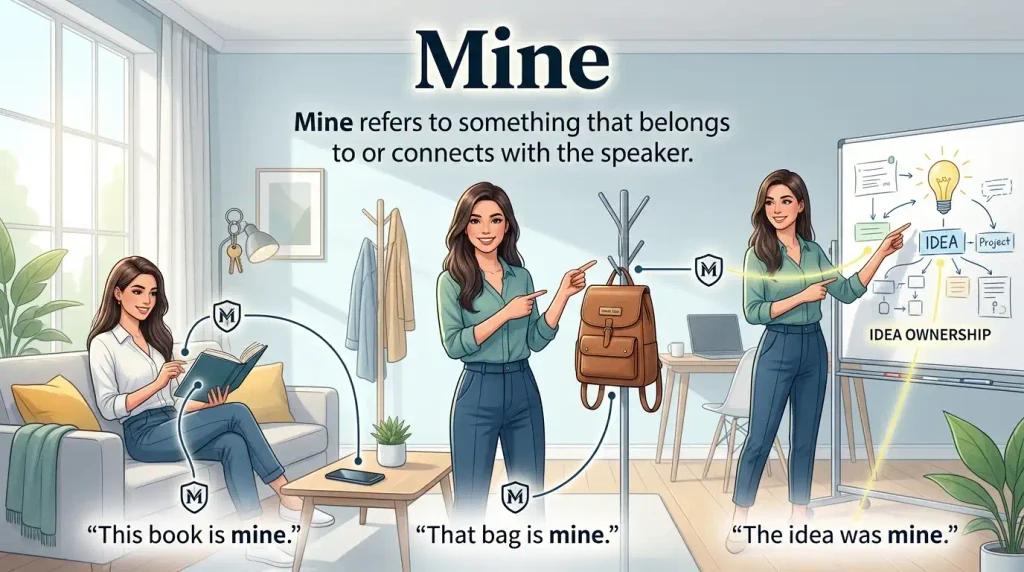
Mine (Pronoun) — US: /maɪn/ | UK: /maɪn/
Meaning: Mine refers to something that belongs to or connects with the speaker.
Tone/Register: Neutral, everyday
Example: This notebook is mine.
That seat is mine, so please leave it free.
My Own (Possessive Phrase) — US: /maɪ oʊn/ | UK: /maɪ əʊn/
Meaning: My own emphasizes that something belongs specifically to the speaker.
Tone/Register: Neutral, emphatic
Example: I finally have my own office.
She wants to create her own website.
Of Mine (Possessive Phrase) — US: /əv maɪn/ | UK: /əv maɪn/
Meaning: Of mine shows a personal connection with the speaker.
Tone/Register: Conversational
Example: A friend of mine lives nearby.
A former teacher of mine recommended this book.
Belonging to Me (Phrase) — US: /bɪˈlɔːŋɪŋ tə miː/ | UK: /bɪˈlɒŋɪŋ tə miː/
Meaning: This phrase clearly identifies something as belonging to the speaker.
Tone/Register: Neutral, explanatory
Example: The suitcase belonging to me is missing.
Please return the documents belonging to me.
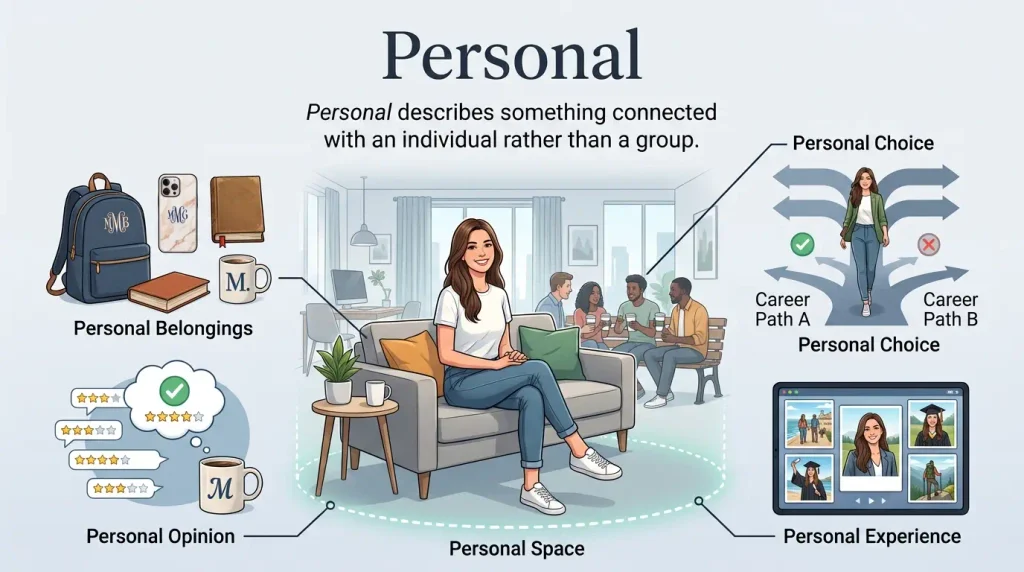
Personal (Adjective) — US: /ˈpɝːsənəl/ | UK: /ˈpɜːsənəl/
Meaning: Personal describes something connected with an individual rather than a group.
Tone/Register: Neutral, formal
Example: That is my personal opinion.
Please keep your personal details private.
Individual (Adjective) — US: /ˌɪndəˈvɪdʒuəl/ | UK: /ˌɪndɪˈvɪdʒuəl/
Meaning: Individual describes something connected with one particular person.
Tone/Register: Formal, academic
Example: Each student has an individual learning style.
The study examined individual experiences.
Private (Adjective) — US: /ˈpraɪvət/ | UK: /ˈpraɪvət/
Meaning: Private describes personal matters that someone does not want to share publicly.
Tone/Register: Neutral, formal
Example: I keep my private life separate from work.
She shared a private message with me.
Personal Belonging (Noun Phrase) — US: /ˈpɝːsənəl bɪˈlɔːŋɪŋ/ | UK: /ˈpɜːsənəl bɪˈlɒŋɪŋ/
Meaning: A personal belonging refers to an item that belongs to an individual.
Tone/Register: Neutral
Example: Please collect your personal belongings.
He packed his personal belongings carefully.
Possessed by Me (Phrase) — US: /pəˈzest baɪ miː/ | UK: /pəˈzest baɪ miː/
Meaning: This phrase indicates that the speaker owns or holds something.
Tone/Register: Formal, legal
Example: I possess the original certificate.
I currently possess the required documents.
Under My Ownership (Phrase) — US: /ˈʌndər maɪ ˈoʊnərʃɪp/ | UK: /ˈʌndə maɪ ˈəʊnəʃɪp/
Meaning: This phrase formally identifies the speaker as the owner.
Tone/Register: Formal, legal
Example: I retain ownership of the property.
The vehicle remains under my ownership.
In My Possession (Phrase) — US: /ɪn maɪ pəˈzeʃən/ | UK: /ɪn maɪ pəˈzeʃən/
Meaning: This expression means that the speaker currently holds or controls something.
Tone/Register: Formal
Example: I have the original certificate in my possession.
The keys remain in my possession.
Associated With Me (Phrase) — US: /əˈsoʊsieɪtɪd wɪð miː/ | UK: /əˈsəʊsieɪtɪd wɪð miː/
Meaning: This phrase shows a connection between something and the speaker.
Tone/Register: Formal, professional
Example: The account is associated with me.
The project has a strong connection with me.
Connected With Me (Phrase) — US: /kəˈnektɪd wɪð miː/ | UK: /kəˈnektɪd wɪð miː/
Meaning: It indicates a direct relationship between something and the speaker.
Tone/Register: Neutral
Example: That issue connects directly with me.
The case has a personal connection with me.
Relating to Me (Phrase) — US: /rɪˈleɪtɪŋ tə miː/ | UK: /rɪˈleɪtɪŋ tə miː/
Meaning: This expression identifies something that concerns the speaker.
Tone/Register: Formal
Example: Please review the records relating to me.
The information relates directly to me.
Concerning Me (Phrase) — US: /kənˈsɝːnɪŋ miː/ | UK: /kənˈsɜːnɪŋ miː/
Meaning: Concerning me refers to something involving or affecting the speaker.
Tone/Register: Formal
Example: I received information concerning me.
The discussion included a matter concerning me.
Pertaining to Me (Phrase) — US: /pərˈteɪnɪŋ tə miː/ | UK: /pəˈteɪnɪŋ tə miː/
Meaning: About me; identifies something directly relevant to the speaker.
Tone/Register: Formal, academic
Example: Please send information about me.
The file contains records about me.
Attributed to Me (Phrase) — US: /əˈtrɪbjətɪd tə miː/ | UK: /əˈtrɪbjʊtɪd tə miː/
Meaning: This phrase indicates that someone credits a statement or idea to the speaker.
Tone/Register: Formal, academic
Example: Someone incorrectly attributed the quotation to me.
The article attributes the comment to me.
Created by Me (Phrase) — US: /kriˈeɪtɪd baɪ miː/ | UK: /kriˈeɪtɪd baɪ miː/
Meaning: This phrase shows that the speaker made or produced something.
Tone/Register: Neutral, creative
Example: I created this design myself.
I created the artwork last year.
Written by Me (Phrase) — US: /ˈrɪtən baɪ miː/ | UK: /ˈrɪtən baɪ miː/
Meaning: This expression identifies the speaker as the writer.
Tone/Register: Neutral, academic
Example: I wrote the essay myself.
I wrote the original story last year.
Chosen by Me (Phrase) — US: /ˈtʃoʊzən baɪ miː/ | UK: /ˈtʃəʊzən baɪ miː/
Meaning: This phrase shows that the speaker personally selected something.
Tone/Register: Neutral
Example: I chose the final option.
I selected that color for the room.
Owned by Me (Phrase) — US: /oʊnd baɪ miː/ | UK: /əʊnd baɪ miː/
Meaning: This phrase directly states that the speaker owns something.
Tone/Register: Neutral, formal
Example: I own the house.
I own the vehicle parked outside.
Held by Me (Phrase) — US: /held baɪ miː/ | UK: /held baɪ miː/
Meaning: Held by me indicates that the speaker currently keeps or controls something.
Tone/Register: Formal
Example: I hold the original copy.
I currently hold responsibility for the records.
Controlled by Me (Phrase) — US: /kənˈtroʊld baɪ miː/ | UK: /kənˈtrəʊld baɪ miː/
Meaning: This expression indicates that the speaker has authority over something.
Tone/Register: Formal, professional
Example: I control the account.
I control the process from start to finish.
Managed by Me (Phrase) — US: /ˈmænɪdʒd baɪ miː/ | UK: /ˈmænɪdʒd baɪ miː/
Meaning: Managed by me means that the speaker handles or directs something.
Tone/Register: Professional
Example: I manage the project.
I manage the department each day.
Prepared by Me (Phrase) — US: /prɪˈperd baɪ miː/ | UK: /prɪˈpeəd baɪ miː/
Meaning: This phrase indicates that the speaker prepared something.
Tone/Register: Professional
Example: I prepared the presentation this morning.
I prepared the report before the meeting.
Designed by Me (Phrase) — US: /dɪˈzaɪnd baɪ miː/ | UK: /dɪˈzaɪnd baɪ miː/
Meaning: It shows that the speaker created a particular design.
Tone/Register: Professional, creative
Example: I designed the logo myself.
I designed the room around a simple theme.
Developed by Me (Phrase) — US: /dɪˈveləpt baɪ miː/ | UK: /dɪˈveləpt baɪ miː/
Meaning: This phrase indicates that the speaker created or improved something.
Tone/Register: Professional, academic
Example: I developed the research model.
I developed a new approach for the project.
Selected by Me (Phrase) — US: /səˈlektɪd baɪ miː/ | UK: /sɪˈlektɪd baɪ miː/
Meaning: Selected by me indicates that the speaker made the final choice.
Tone/Register: Formal
Example: I selected the final candidates.
I selected these books for the course.
Produced by Me (Phrase) — US: /prəˈduːst baɪ miː/ | UK: /prəˈdjuːst baɪ miː/
Meaning: This expression shows that the speaker produced something.
Tone/Register: Professional, creative
Example: I produced the video myself.
I produced the content for the campaign.
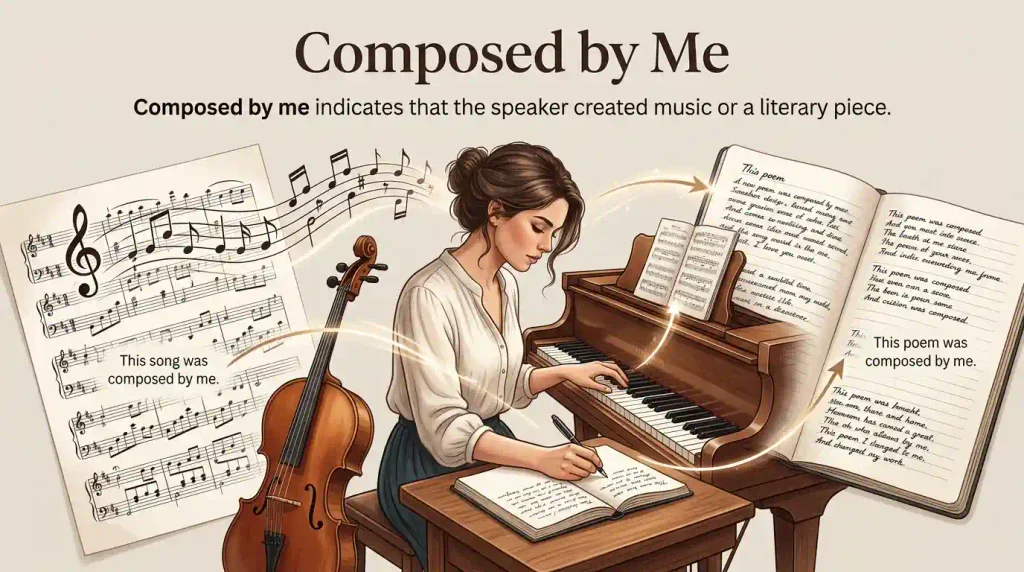
Composed by Me (Phrase) — US: /kəmˈpoʊzd baɪ miː/ | UK: /kəmˈpəʊzd baɪ miː/
Meaning: Composed by me indicates that the speaker created music or a literary piece.
Tone/Register: Formal, creative
Example: I composed the song last summer.
I composed an original piano piece.
Authored by Me (Phrase) — US: /ˈɔːθərd baɪ miː/ | UK: /ˈɔːθəd baɪ miː/
Meaning: Authored by me identifies the speaker as the writer of a work.
Tone/Register: Formal, academic
Example: I authored the research article.
I authored the paper with my colleague.
Drafted by Me (Phrase) — US: /dræftɪd baɪ miː/ | UK: /drɑːftɪd baɪ miː/
Meaning: Drafted by me indicates that the speaker prepared an initial version.
Tone/Register: Professional
Example: I drafted the proposal yesterday.
I drafted the first version before lunch.
Recommended by Me (Phrase) — US: /ˌrekəˈmendɪd baɪ miː/ | UK: /ˌrekəˈmendɪd baɪ miː/
Meaning: Recommended by me indicates that the speaker suggested something.
Tone/Register: Neutral
Example: I recommended that book to my friend.
I recommended the documentary last week.
Approved by Me (Phrase) — US: /əˈpruːvd baɪ miː/ | UK: /əˈpruːvd baɪ miː/
Meaning: This phrase shows that the speaker approved.
Tone/Register: Professional, formal
Example: I approved the final plan.
I approved the document after reviewing it.
Assigned to Me (Phrase) — US: /əˈsaɪnd tə miː/ | UK: /əˈsaɪnd tə miː/
Meaning: Assigned to me indicates that someone gave a task or responsibility to the speaker.
Tone/Register: Professional
Example: My manager assigned the project to me.
The teacher assigned this essay to me.
Directed by Me (Phrase) — US: /dəˈrektɪd baɪ miː/ | UK: /dɪˈrektɪd baɪ miː/
Meaning: Directed by me indicates that the speaker guided an activity or production.
Tone/Register: Professional, creative
Example: I directed the performance.
I directed the project from its first stage.
Led by Me (Phrase) — US: /led baɪ miː/ | UK: /led baɪ miː/
Meaning: Led by me indicates that the speaker guided a group or activity.
Tone/Register: Professional
Example: I led the meeting yesterday.
I led the research team during the project.
Supervised by Me (Phrase) — US: /ˈsuːpərvaɪzd baɪ miː/ | UK: /ˈsuːpəvaɪzd baɪ miː/
Meaning: This phrase shows that the speaker monitored an activity or group.
Tone/Register: Formal, professional
Example: I supervised the students during the activity.
I supervised the work throughout the afternoon.
Conducted by Me (Phrase) — US: /kənˈdʌktɪd baɪ miː/ | UK: /kənˈdʌktɪd baɪ miː/
Meaning: Conducted by me indicates that the speaker carried out an activity or study.
Tone/Register: Academic, formal
Example: I conducted the interview yesterday.
I conducted the study during the summer.
Completed by Me (Phrase) — US: /kəmˈpliːtɪd baɪ miː/ | UK: /kəmˈpliːtɪd baɪ miː/
Meaning: Completed by me indicates that the speaker finished a task.
Tone/Register: Neutral, professional
Example: I completed the assignment early.
I completed the form before the deadline.
Submitted by Me (Phrase) — US: /səbˈmɪtɪd baɪ miː/ | UK: /səbˈmɪtɪd baɪ miː/
Meaning: Submitted by me indicates that the speaker officially sent something.
Tone/Register: Formal, academic
Example: I submitted the application yesterday.
I submitted the final paper on Monday.
Presented by Me (Phrase) — US: /prɪˈzentɪd baɪ miː/ | UK: /prɪˈzentɪd baɪ miː/
Meaning: Presented by me indicates that the speaker delivered or displayed information.
Tone/Register: Professional, academic
Example: I presented the findings at the meeting.
I presented the report to the team.
Delivered by Me (Phrase) — US: /dɪˈlɪvərd baɪ miː/ | UK: /dɪˈlɪvəd baɪ miː/
Meaning: Delivered by me indicates that the speaker gave a speech, message, or presentation.
Tone/Register: Professional
Example: I delivered the speech yesterday.
I delivered the presentation confidently.
Initiated by Me (Phrase) — US: /ɪˈnɪʃieɪtɪd baɪ miː/ | UK: /ɪˈnɪʃieɪtɪd baɪ miː/
Meaning: Initiated by me indicates that the speaker started an activity or process.
Tone/Register: Formal, professional
Example: I initiated the discussion.
I initiated the project after the meeting.
Requested by Me (Phrase) — US: /rɪˈkwestɪd baɪ miː/ | UK: /rɪˈkwestɪd baɪ miː/
Meaning: Requested by me indicates that the speaker asked for something.
Tone/Register: Neutral, formal
Example: I requested the information yesterday.
I requested a copy of the report.
Suggested by Me (Phrase) — US: /səˈdʒestɪd baɪ miː/ | UK: /səˈdʒestɪd baɪ miː/
Meaning: Suggested by me indicates that the speaker offered an idea or recommendation.
Tone/Register: Neutral
Example: I suggested a simpler solution.
I suggested that we meet earlier.
Proposed by Me (Phrase) — US: /prəˈpoʊzd baɪ miː/ | UK: /prəˈpəʊzd baɪ miː/
Meaning: Proposed by me indicates that the speaker formally presented an idea or plan.
Tone/Register: Formal, professional
Example: I proposed a new policy.
I proposed the plan during the meeting.
Started by Me (Phrase) — US: /ˈstɑːrtɪd baɪ miː/ | UK: /ˈstɑːtɪd baɪ miː/
Meaning: Started by me indicates that the speaker began something.
Tone/Register: Neutral
Example: I started the conversation.
I started the project last year.
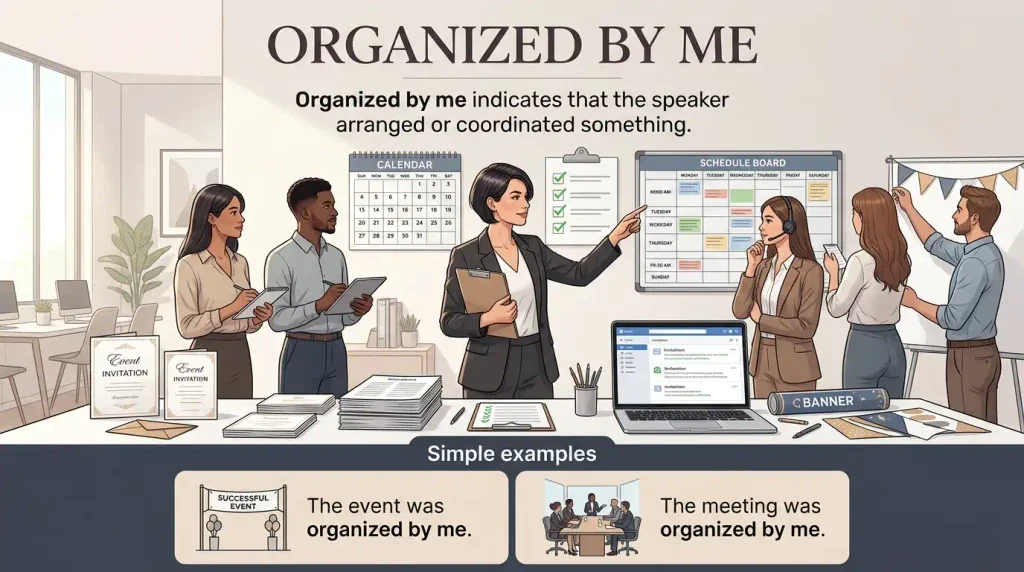
Organized by Me (Phrase) — US: /ˈɔːrɡənaɪzd baɪ miː/ | UK: /ˈɔːɡənaɪzd baɪ miː/
Meaning: Organized by me indicates that the speaker arranged or coordinated something.
Tone/Register: Neutral, professional
Example: I organized the event.
I organized the meeting for Friday.
Synonyms by Tone
Positive
My own, personal, and of mine can add warmth, individuality, pride, or emotional connection. For example, “my own business” can suggest independence.
Neutral
My, mine, belonging to me, and connected with me usually provide information without creating a strong emotional effect.
Formal
About me, concerning me, associated with me, and in my possession suit formal documents and professional communication.
Professional
Managed by me, prepared by me, developed by me, and supervised by me highlight responsibility, contribution, or leadership.
Creative
Created by me, designed by me, composed by me, and authored by me highlight creative contribution.
Tone matters because the same basic idea can sound friendly, formal, personal, or professional. Therefore, choose the expression that matches your audience.
“My” vs Close Alternatives
My vs Mine
Use my before a noun. Use mine when the possessive can stand alone.
Example: This is my notebook.
Example: This notebook is mine.
My vs My Own
“My” identifies possession or connection. However, my own adds emphasis.
Example: I have my own room.
My vs Of Mine
“My friend” sounds direct and common. Meanwhile, a friend of mine sounds natural and conversational.
Example: My friend called me.
Example: A friend of mine called me.
How “My” Changes by Context
Daily Conversation
In everyday speech, my remains the easiest choice. People naturally say “my phone,” “my sister,” “my job,” and “my opinion.”
However, speakers can use mine, my own, and of mine when the grammar allows them.
Writing and Blogging
Bloggers should watch for unnecessary repetition. Instead of replacing every “my,” writers can restructure sentences.
For example, “My experience changed my thinking” can become “The experience changed my thinking.” This approach creates variety without forcing unusual synonyms.
Professional Writing
Professional writers often need to explain responsibility. Active sentences usually work best.
For example, “I prepared the report” sounds clearer than “The report was prepared by me.” Likewise, “I managed the project” directly identifies responsibility.
Academic Writing
Academic writers can use expressions such as authored by me, developed by me, and conducted by me when they need to explain personal contributions.
However, active forms often provide better readability. “I conducted the study” sounds direct and professional.
Creative Writing
Creative writers can use “ mine and my own to create personality or emotional emphasis.
For example, “A childhood memory of mine returned unexpectedly” creates a reflective feeling. Likewise, “my own story” highlights personal experience.
Common Mistakes and Native Usage
Using “Mine” Before a Noun
Incorrect: “This is mine book.”
Correct: “This is my book.”
Correct: “This book is mine.”
Treating Every Alternative as an Exact Synonym
Not every phrase can replace my. For example, managed by me focuses on responsibility, while created by me focuses on authorship.
Therefore, choose an expression according to the meaning you want.
Using “Personal” Everywhere
“Personal” does not replace “my” in every sentence. For example, “my mother” cannot become “personal mother.”
Instead, use personal when you mean something connected with an individual’s private life, thoughts, or affairs.
Making Casual English Too Formal
“The matter about me requires attention” sounds unnatural in normal conversation.
Instead, say, “I need to deal with this matter.”
Replacing Simple English Unnecessarily
Sometimes my remains the best choice. “My passport is missing” sounds short, clear, and natural.
By comparison, “The passport belonging to me is missing” sounds unnecessarily complicated.
Register Notes
Everyday spoken English: my, mine, my own, of mine
General writing: my, mine, personal, my own
Academic writing: individual, personal, authored by me, conducted by me
Professional writing: associated with me, prepared by me, managed by me
Legal or administrative writing: under my ownership, in my possession, attributed to me
Overall, simple language usually works best. Native speakers do not replace common words merely to sound sophisticated.
Real-Life Mini Scenarios
Workplace
A manager might say, “My project is almost finished.” Alternatively, the manager could say, “I have almost finished the project.”
Social Situations
Someone might say, “A friend of mine lives here.” This expression sounds relaxed and natural in everyday conversation.
Media and Pop Culture
A public figure might say, “That is my personal opinion.” Here, personal emphasizes an individual viewpoint.
Academic Setting
A researcher may write, “I conducted the study during the summer.” This active structure clearly identifies responsibility.
Creative Work
An artist could say, “I created this painting myself.” The sentence directly highlights the artist’s contribution.
How to Choose the Right Alternative
For ownership, choose mine, owned by me, or in my possession, depending on the sentence. For example, “This laptop is mine” sounds natural in everyday English.
When you want to show a personal connection, consider personal, associated with me, or connected with me. However, check the exact meaning before choosing one.
For authorship, use written by me, authored by me, or created by me when you need to identify the creator. In many cases, an active sentence sounds even better: “I wrote the article.”
Similarly, managed by me, supervised by me, and conducted by me can describe responsibility. Therefore, active forms such as “I managed,” “I supervised,” and “I conducted” often create stronger sentences.
Finally, my own works well when you want to add emphasis. For instance, “I have my own office” highlights personal possession and independence.
Overall, choose an alternative according to meaning, context, grammar, and tone. As a result, your English will sound more natural without unnecessary vocabulary.
Interactive Practice Quiz
1. Which sentence is grammatically correct?
A. This is mine book.
B. This is my book.
C. This is me book.
D. This is own book.
2. Which option emphasizes personal ownership?
A. own mine
B. mine own
C. my own
D. personal mine
3. Which phrase sounds natural in casual conversation?
A. a friend of mine
B. a friend of me
C. a friend by mine
D. a friend belonging to me
4. Which word can stand independently as a possessive pronoun?
A. my
B. mine
C. personal
D. own
5. Which phrase sounds most formal?
A. my records
B. my own records
C. records about me
D. records about me
6. Which sentence correctly uses “mine”?
A. This phone is mine.
B. This is mine phone.
C. My phone is new.
D. I bought my phone.
7. Which phrase focuses on authorship?
A. connected with me
B. personal
C. mine own
D. written by me
8. Which phrase emphasizes legal ownership?
A. under my ownership
B. of mine
C. my own
D. personal
9. Which phrase shows professional responsibility?
A. of mine
B. mine
C. managed by me
D. personal
10. Which phrase describes a creative contribution?
A. in my possession
B. about me
C. concerning me
D. designed by me
Reflection Task
Write one sentence using mine, my own, of mine, or another contextual alternative. Then rewrite it using my, if the grammar allows it.
Answer Key: 1-B, 2-C, 3-A, 4-B, 5-D, 6-A, 7-D, 8-A, 9-C, 10-D
FAQs
1. What are the closest alternatives to “my” in English?
The closest grammatical alternative is mine, although it cannot replace “my” in every sentence. Other useful expressions include my own, of mine, and belonging to me. Each option has a different grammatical function. For example, “my book” works before a noun, while “this book is mine” uses the independent possessive form.
2. Can “mine” replace “my” before a noun?
No. My normally comes before a noun, whereas mine usually stands alone. Therefore, say “my car” but “the car is mine.” The phrase “mine car” is incorrect in standard English. Learning this difference helps English learners avoid a common possessive mistake and build more accurate sentences.
3. What is a good alternative to “my” in formal writing?
The best choice depends on the intended meaning. Expressions such as about me, associated with me, in my possession, and attributed to me can work in formal contexts. Nevertheless, writers should not replace “my” simply to sound sophisticated. If “my” provides the clearest meaning, keeping it usually remains the better choice.
4. How can I avoid repeating “my” in an essay?
Sentence restructuring offers one of the easiest solutions. Instead of replacing every occurrence, remove unnecessary repetition or change the sentence structure. Active verbs can also highlight your contribution. For example, “I conducted the study” sounds clearer than “The study was conducted by me.” This method improves variety while keeping academic writing direct.
5. Is “personal” a true synonym for “my”?
Not exactly. Personal can describe something connected with an individual, but it does not perform the same grammatical role as my. For example, “my opinion” can become “my personal opinion,” but “personal” cannot replace “my” before every noun. Consequently, use this word only when its meaning fits the context.
Conclusion
Understanding synonyms for my can help you express ownership, connection, authorship, and responsibility in more varied ways. The right choice always depends on context.
Words such as mine, my own, and of mine work especially well in everyday English. Meanwhile, other expressions fit professional, academic, legal, or creative situations.
The goal is not to replace “my” everywhere. Instead, learn how different structures change meaning, tone, and sentence flow. This approach makes your English clearer and more natural.
For students, bloggers, writers, and English learners, regular practice can strengthen vocabulary and communication. Try these expressions in emails, essays, articles, stories, and daily conversations.

Shahzeena Shazadi is the founder and lead writer at VocablyHub.com, where she creates accurate, reader-focused English language content designed to help people communicate with clarity and confidence. She specializes in synonyms, antonyms, word meanings, idioms, and practical vocabulary guides that simplify complex language concepts for everyday use. Every article is carefully researched, fact-checked, and written in clear, accessible language using reliable references and real-world examples. Her goal is to provide helpful, trustworthy content that supports learners at every stage of their English language journey.
Her editorial approach focuses on accuracy, transparency, and user value while following modern content quality standards. She regularly reviews and updates content to keep information relevant, useful, and easy to understand. Through VocablyHub.com, Shahzeena Shazadi is committed to publishing reliable language resources that help students, writers, educators, professionals, and English learners expand their vocabulary, improve their writing skills, and communicate with confidence in academic, professional, and everyday situations.